DENTURE MARKING SYSTEMS
*,1
Ahmed Hilal Sheriff,
1
II Year BDS, Saveetha Dental College
2Head of Department of Prosthodontics
3
Senior Lecturer, Department of Prosthodontics
ARTICLE INFO ABSTRACT
Aim: To determine the various denture
personal identification in post mortem scenarios in the literature. Sources used:
English listed with pubmed,
data bases, till January 5th 2017 reporting various ways of denture marking and their uses. Results:
was extracted in terms of study design, type of denture marker, method of denture marking, advantages and disadvantages of the denture marking.
Conclusion:
The superiority of one technique over the other could not be established with the available data, hence more standardized trials needs to be initiated to throw more light on this
Copyright©2017, Ahmed Hilal Sheriff et al. This is an open access article distributed under the Creative Commons Att unrestricted use, distribution, and reproduction in any medium, provided the original work is properly cited.
INTRODUCTION
Labeling of all dentures is recommended by most international dental associations and forensic odontologists. In fact, in some countries and certain states of the USA, the labeling of dentures is regulated by legislation. (Alexander et al., 1998
the obligation of the profession, a dental practitioner needs to maintain meticulous dental records of his patients. This would include documenting the identity of dentures.
identification systems are important for hospitalized patients, patients in long-term care facilities, for forensic identification purposes, and other social reasons. (Ling, 1998
Mahoorkar and Jain, 2013) At times the only identifiable remains are a victim’s partial or complete dentures.
and Pretty, 2006) The identification of the victims during natural calamities and accidental deaths is a very difficult task and the early identification is of prime importance. There many ways of identifying the bodies by the forensic experts in which the dentists in general and prosthodontists in particular plays a major role by identifying the victims with their natural teeth, caries teeth, restorations on the teeth like filling dental prostheses including crowns, partial, or complete dentures. Bridges and implants (Thomas et al
al., 2010). The experts also utilize palatal Rugoscopy
*Correspondingauthor: Ahmed Hilal Sheriff, K.
II Year BDS, Saveetha Dental College, Chennai, Tamilnadu, India
ISSN: 0975-833X
Article History:
Received xxxxxxxxxx, 2017 Received in revised form xxxxxxxx, 2017
Accepted xxxxxxxxx, 2017 Published online xxxxxxxxx,2017
Citation: Ahmed Hilal Sheriff, K., Dr. Dhanraj, M. and Dr. Preetham Prasad Nittla
International Journal of Current Research, 9, (04),49237
Article History:
Received 19th January, 2017 Received in revised form 20th February, 2017
Accepted 06th March, 2017
Published online 30th April,2017
Key words:
Dental practitioners, Complete denture, Denture marker.
RESEARCH ARTICLE
DENTURE MARKING SYSTEMS – A SYSTEMATIC REVIEW
, K.,
2Dr. Dhanraj, M. and
3Dr. Preetham Prasad Nittla
Saveetha Dental College, Chennai, Tamilnadu, India
Head of Department of Prosthodontics, Saveetha Dental College, Chennai, Tamilnadu, India
Department of Prosthodontics, Saveetha Dental College, Chennai
ABSTRACT
To determine the various denture marking systems used for identification of the Subjects for personal identification in post mortem scenarios in the literature.
Sources used: An electronic search was conducted for articles written in English or translated into English listed with pubmed, Cochranelibrary, Science Direct, Wiley online library, Google scholar data bases, till January 5th 2017 reporting various ways of denture marking and their uses.
Results: The database yielded 20 articles in total out of which 11 articles were selected and the data was extracted in terms of study design, type of denture marker, method of denture marking, advantages and disadvantages of the denture marking.
Conclusion: The literature has listed 9 Engraving and 18 embedding methods of denture marking. The superiority of one technique over the other could not be established with the available data, hence more standardized trials needs to be initiated to throw more light on this
is an open access article distributed under the Creative Commons Att use, distribution, and reproduction in any medium, provided the original work is properly cited.
Labeling of all dentures is recommended by most international dental associations and forensic odontologists. In fact, in some certain states of the USA, the labeling of dentures ., 1998) As part of the obligation of the profession, a dental practitioner needs to maintain meticulous dental records of his patients. This would include documenting the identity of dentures. Denture identification systems are important for hospitalized patients, term care facilities, for forensic identification 1998; Lamb, 1992; At times the only identifiable remains are a victim’s partial or complete dentures. (Richmond
The identification of the victims during natural calamities and accidental deaths is a very difficult task and the early identification is of prime importance. There are many ways of identifying the bodies by the forensic experts in which the dentists in general and prosthodontists in particular plays a major role by identifying the victims with their natural teeth, caries teeth, restorations on the teeth like fillings or dental prostheses including crowns, partial, or complete
et al., 2014; Berketa et
The experts also utilize palatal Rugoscopy and DNA
Ahmed Hilal Sheriff, K.
II Year BDS, Saveetha Dental College, Chennai, Tamilnadu, India.
analysis as an aid for the identification purpose.
2008; Inoue et al., 2000) All these will become easy when the antemortem records are available, i.e., documentation of the patient details or the prosthodontic work
marked. There are many incidents in the history where the victims are identified with their prostheses, like a young dentist, Paul Revere, with the help of bridge work identified the US revolutionary war victims. With the help of missing lo teeth identified the body of Charles the Bold 1933) and the Countess of
identified with the help of his gold denture.
1966) Adolf Hitler and Eva Braun, World Trade Centre bombing, in the Waco Branch Davidien siege, and in numerous airplane crashes and in post tsunami period.
Identification of dentures helps in recognizing the denture wearer and it has a great significance especially in a forensic scenario which makes it useful for the case. Positive identification of the denture is usually done with a tiny, discreet identification code which is embedded in the denture base. American Board of Forensic Odontology guidelines indicate that most dental identifications are based on restorations, caries, missing teeth and/or prosthetic devices.
denture marking not only assists in the return of a lost denture, but also it facilitates the identification of edentulous persons who are either living or deceased.
for denture markers are that they should be biologically inert when incorporated into the denture, inexpensive, easy and International Journal of Current Research
Vol. 9, Issue, 04, pp.49237-49241, April, 2017
INTERNATIONAL
OF CURRENT RESEARCH
Ahmed Hilal Sheriff, K., Dr. Dhanraj, M. and Dr. Preetham Prasad Nittla, 2017. “Denture marking systems 49237-49241.
A SYSTEMATIC REVIEW
Preetham Prasad Nittla
, Tamilnadu, India
, Tamilnadu, India
Chennai, Tamilnadu, India
marking systems used for identification of the Subjects for
An electronic search was conducted for articles written in English or translated into Cochranelibrary, Science Direct, Wiley online library, Google scholar data bases, till January 5th 2017 reporting various ways of denture marking and their uses.
The database yielded 20 articles in total out of which 11 articles were selected and the data was extracted in terms of study design, type of denture marker, method of denture marking,
terature has listed 9 Engraving and 18 embedding methods of denture marking. The superiority of one technique over the other could not be established with the available data, hence more standardized trials needs to be initiated to throw more light on this domain.
is an open access article distributed under the Creative Commons Attribution License, which permits
the identification purpose. (Ohtani et al., All these will become easy when the antemortem records are available, i.e., documentation of the patient details or the prosthodontic work must be labeled marked. There are many incidents in the history where the victims are identified with their prostheses, like a young dentist, Paul Revere, with the help of bridge work identified the US revolutionary war victims. With the help of missing lower teeth identified the body of Charles the Bold (Humble, and the Countess of Salisbury's burned body was identified with the help of his gold denture. (Harvey, Adolf Hitler and Eva Braun, World Trade Centre bombing, in the Waco Branch Davidien siege, and in numerous airplane crashes and in post tsunami period. (Pretty, 2007) Identification of dentures helps in recognizing the denture-wearer and it has a great significance especially in a forensic scenario which makes it useful for the case. Positive identification of the denture is usually done with a tiny, discreet tion code which is embedded in the denture base. The American Board of Forensic Odontology guidelines indicate that most dental identifications are based on restorations, caries, missing teeth and/or prosthetic devices. The purpose of nly assists in the return of a lost denture, but also it facilitates the identification of edentulous persons who are either living or deceased. The standard requirements for denture markers are that they should be biologically inert the denture, inexpensive, easy and INTERNATIONAL JOURNAL
OF CURRENT RESEARCH
quick to apply, possible to retrieve after an accident, acid resistant and survive elevated temperatures. The marking must also be aesthetically acceptable, visible (readable) and durable without jeopardizing the strength of the prosthesis. In addition, the marking should be permanent and resistant to everyday cleansing and disinfecting agents. The recommended areas for marking therefore are the posterior regions of the lingual flange and the palate. In countries where unique identification numbers are given to each individual, dentures may be marked with that number to enable positive identification. Over the years, various methods of denture marking have been reported in the literature. A number of labelling systems are available and can be broadly separated into either surface marking methods or inclusion systems. Each of the commonly described techniques is assessed with respect to their strengths and weaknesses.
Aim
To determine the various denture marking systems used for identification of the Subjects for personal identification in post mortem scenarios in the literature.
PICO Analysis
P-Population
Patients using Denture with Denture Markers.
I-Intervention
Denture marking techniques
o Engraving
o Embedding
o Embossing
O-Outcome
Personal Identification through retrieval of Denture markers.
MATERIALS AND METHODS
Sources used
An electronic search was conducted for articles written in English or translated into English listed with pubmed, Cochranelibrary, ScienceDirect, Wiley online library, Google scholar data bases, till January 5th 2017 reporting various ways of denture marking and their uses.
Pico analysis
The search methodology applied was a combination of MESH terms and suitable keywords.
P – Population
Complete Denture with denture marking, Partial denture with denture marking, fixed partial denture with denture marking, Cast metal denture with denture marking.
I – Intervention
Engraving method, Embossing method, Invisible ink method, Fibre tip pen method, Heaths method, Stevensons method,
Weckers electro pen method, Laser etching method, Onion skin paper method, Denture bar coding method, Lose inclusion method, Youngs method, Dippenars method, Reesons method, Clear acrylic T bar method, Olivers method, Lenticular card method, Bar coding method, Radio frequency identification tag, Lead foil method, Metallic band according to Swedish guidelines, Photograph inclusion method, Min I Dent method, Data matrix code, Microlabelling, Cast embossed identification plate, Ceramic crown engraving method, Memory card method.
O – Outcome
Personal identification, Post-mortem identification
Selection of studies
The review process consist of two phases. In the first phase titles and abstract of the search were initially screened for relevance and the full text of relevant abstract were obtained and accessed. The hand search of selected journals as well as search of references in the selected studies were also done. The articles that were obtained after first step of review processusing the following inclusion criteriawas screened in second phase and relevant and suitable articles were isolated for further processing and data extraction.
Inclusion criteria
The articles discussing the following parameters were included for the systematic review.
Randomized controlled trials reporting denture markers in complete dentures.
Experimental research reporting heat processed techniques for dentures with denture markers.
Articles discussing the importance of denture markers in forensics and personal identification.
Data extraction
The data from the finally included studied were tabulated and the following information were extracted.
Study design.
Intervention.
Type of denture marker.
Disadvantage.
Advantage.
RESULTS
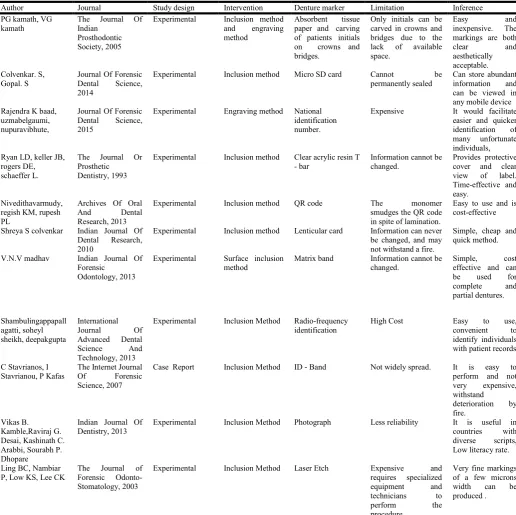
The following information were extracted and tabulated. Name of the author, Name of the journal, Study design, Method of marking the denture, Type of denture marker, Limitation and Inference were extracted and tabulated.
DISCUSSION
Denture marking or labelling is a recent concept in either prosthetic or forensic dentistry and the forensic experts have urged its routine practice. The need for labelling is to confirm personal identification in victims of fire, mass disasters, etc. Various techniques like inserting a laminated label, usually containing the name of the individual or the hospital number, etc., or surface marking on the dentures can be used. Persons who have been deceased for some time before
discovery, and those found in water also present unpleasant and difficult visual identifications. Dental identifications have always played a key role in natural and manmade disaster situations and, in particular, the mass casualties normally associated with aviation disasters. (Clark, 1994; Brannon and Kessler, 1999) Because of the lack of a comprehensive
fingerprint database, dental identification continues to be crucial. The frequency of edentulousness has not changed in the present. The oral status of populations varies in different countries, and the wearing of complete dentures will be a fact for the foreseeable future. Hence, there is a need to address the
issue of denture marking for social and legal reasons. (Borrman, 1995) Practicing dentists can become valuable
[image:3.595.38.555.155.670.2]members of the dental identification process by using these techniques to mark dental restorations, which would be valuable in restoring their patients' identity. But the fact is Table 1. Extracted data of existing articles regarding various types and methods of denture marking system
Author Journal Study design Intervention Denture marker Limitation Inference PG kamath, VG
kamath
The Journal Of Indian
Prosthodontic Society, 2005
Experimental Inclusion method and engraving method
Absorbent tissue paper and carving of patients initials on crowns and bridges.
Only initials can be carved in crowns and bridges due to the lack of available space.
Easy and
inexpensive. The markings are both clear and aesthetically acceptable. Colvenkar. S,
Gopal. S
Journal Of Forensic Dental Science, 2014
Experimental Inclusion method Micro SD card Cannot be permanently sealed
Can store abundant information and can be viewed in any mobile device Rajendra K baad,
uzmabelgaumi, nupuravibhute,
Journal Of Forensic Dental Science, 2015
Experimental Engraving method National identification number.
Expensive It would facilitate easier and quicker identification of many unfortunate individuals, Ryan LD, keller JB,
rogers DE, schaeffer L.
The Journal Or Prosthetic Dentistry, 1993
Experimental Inclusion method Clear acrylic resin T - bar
Information cannot be changed.
Provides protective cover and clear view of label. Time-effective and easy.
Nivedithavarmudy, regish KM, rupesh PL
Archives Of Oral And Dental Research, 2013
Experimental Inclusion method QR code The monomer smudges the QR code in spite of lamination.
Easy to use and is cost-effective
Shreya S colvenkar Indian Journal Of Dental Research, 2010
Experimental Inclusion method Lenticular card Information can never be changed, and may not withstand a fire.
Simple, cheap and quick method.
V.N.V madhav Indian Journal Of Forensic
Odontology, 2013
Experimental Surface inclusion method
Matrix band Information cannot be changed.
Simple, cost effective and can be used for complete and partial dentures.
Shambulingappapall agatti, soheyl sheikh, deepakgupta
International Journal Of Advanced Dental Science And Technology, 2013
Experimental Inclusion Method Radio-frequency identification
High Cost Easy to use, convenient to identify individuals with patient records
C Stavrianos, I Stavrianou, P Kafas
The Internet Journal Of Forensic Science, 2007
Case Report Inclusion Method ID - Band Not widely spread. It is easy to perform and not very expensive, withstand deterioration by fire.
Vikas B. Kamble,Raviraj G. Desai, Kashinath C. Arabbi, Sourabh P. Dhopare
Indian Journal Of Dentistry, 2013
Experimental Inclusion Method Photograph Less reliability It is useful in countries with diverse scripts, Low literacy rate.
Ling BC, Nambiar P, Low KS, Lee CK
The Journal of Forensic Odonto-Stomatology, 2003
Experimental Inclusion Method Laser Etch Expensive and requires specialized equipment and technicians to perform the procedure.
contrary to the need. No practitioner labels his dentures regularly. Requirements for denture markers have been that they should be biologically inert, not expensive, and easy to inscribe and retrieve after an accident. (Borrman et al., 1999) There have been a number of requests from individuals and dental organizations over the years to insist that dental prostheses are labelled with the patient's name or a unique number. (Borrman et al., 1999) Dentures can be labelled either on the surface by engraving, embossing and marking or a label can be inserted in a recess created on the posterior palatal slope of the maxillary denture and posterior lingual flanges of the mandibular dentures of the size of the label to be inserted and covered by clear self – cure acrylic resin. Due to clear acrylic, the label information could easily be read. Each of the commonly described techniques is assessed with respect to their strengths and weaknesses. According to a survey in Australia, no practitioner labelled the dentures routinely, for cost, lack of awareness of standards and recommendations and a belief that it was of little importance. (Alexander et al., 1998) The Swedish ID band has become the international standard and FDI accepted denture marking system. It is a SS metallic band incorporated into acrylic containing a personal number
i.e. a combination of birth date, birth number and sex. (Stavrianos et al., 2008) The information to be incorporated in
a label varies from basic necessity i.e. patient’s initials and date of birth to patient’s preference.
The MicroSD card is a useful tool for denture marking. With the MicroSD card, data can be stored in the form of treatment photographs, treatment videos, family photos, and videos. The MicroSD holds large amounts of information that can be easily modified. In addition, the stored data does not need sophisticated equipment for viewing, and can even be viewed using mobile phones. With an adapter, data can be moved from mobile phone to computer or files from your computer to other devices, regardless of the type of memory card. The data is very easily accessible to people across the world with the increasing mobile penetration in developed as well as developing markets. At this time, the cost of MicroSD card is 150 rupees. The cost of this MicroSD card is significantly less than the costs of using a microchip or barcode system for denture identification. This method of denture marking can be used both for new and existing denture prosthesis that have not been labeled. A dentist could easily perform this procedure without special training or the use of a dental technician. The disadvantage of this technique is that the marker cannot be permanently sealed in the denture because the MicroSD card needs to be removed and inserted into an electronic device to view the data. In addition it would be restricted to use in dentures with a long enough or large enough flange. The recent advances in denture marking is the use of bar codes and QR codes. In a developing country like India, an insufficient database of the citizens, antemortem medical and dental records have challenged the forensic science. The 2D barcode can hold voluminous information like case sheets and images. This technique is very simple, cost effective, and the incorporation of the marker does not need any special laboratory techniques. They can be very useful in dental hospitals with large patient volumes and where students have multiple complete denture patients at any given time ensuring rapid recognition and minimal risk of denture exchange and cross-infection. Furthermore, the equipment is necessary to produce the markers are universal, and the marker itself is easy to generate and cost effective, which is in contrast to other markers. From the forensic point of view, dentures with
barcode markers recovered from the deceased may be easily recognized by the help of a mobile camera. Since the 2D barcode can hold photographic details. (Anehosur et al., 2010) The denture can also be connected with antemortem photographic records to facilitate identification. Nevertheless, thermal tests revealed that the photographic marker and barcode were only resistant to around 200–300°C, which is considerably lower than for the metal matrix band (1050°C), this being similar to that of other metal marker. That's why the metal markers are considered as most ideal for postmortem identification. (Anehosur et al., 2010) A similar method like using bar cose as a denture marker is the QR code. It has many advantageous characteristics, such as simpler and handy technique, cost-effectiveness, and large data storage capacity. QR Code like any other marker is accurate as such, but its effectiveness in unfavorable conditions determines the clinical application. In a recent study the size of the QR Code was carefully selected for ease of inclusion in dentures. Instead of clear auto polymerizing acrylic resin, clear acrylic sheets were used to cover the label as the probability of QR Code getting distorted by the monomer content is high and the porosity of auto polymerizing acrylic resin would affect the scanning result. Acrylic sheets of varying thickness are available, and these were cut according to the groove and placed. (Poovannan
et al., 2016) Barcodes and QR Codes, which are usually
associated with commercial products on the market, were applied in denture identification systems, which contributes greatly to forensic science.
Conclusion
The advantages of denture labelling are wide, from prosthesis identification to patient identification to maintenance of record and its retrieval when necessary. The awareness for such a system which is helpful not only in medico-legal cases but also in home care institutes to prevent misplaces needs to be developed. Patient education and awareness in this direction can only be achieved if there is an appropriate framework for this in dental education to educate students and technicians first. Patients receiving partial and complete dentures should be informed and given the choice of opting for labelling their dentures. At the same time Dentists treating them could contribute greatly by using such simple means to help maintain a person’s identity. The major reason for not marking dentures is a lack of awareness of the various methods and a belief that it has very little importance. The value of labeling dentures is immense when a positive identity of an individual is required. This has been emphasized frequently by the forensic odontologists. Therefore, an appropriate framework within dental education is required to ensure that both dentists and dental students are exposed to denture marking methodologies. The superiority of one technique over the other could not be established with the available data, hence more standardized trials needs to be initiated to throw more light on this domain.
REFERENCES
Alexander, P., et al. 1998. An assessment of attitudes to, and extent of, the practice of denture marking in South Australia. Australian Dental Journal, 43(5): p. 337-341. Anehosur, G.V., A.B. Acharya, and R.K. Nadiger, 2010.
Berketa, J.W., et al. 2010. Radiographic recognition of dental implants as an aid to identifying the deceased. Journal of
Forensic Sciences, 55(1): p. 66-70.
Borrman, H., C. Thomas, and E. Engstrom, 1995. Denture marking. Clinical and technical aspects. The Journal of
forensic odonto-stomatology, 13(1): p. 14-17.
Borrman, H., et al. 1999. On denture marking. The Journal of
forensic odonto-stomatology, 17(1): p. 20-26.
Brannon, R.B. and H.P. Kessler, 1999. Problems in mass-disaster dental identification: a retrospective review.
Journal of Forensic Science, 44(1): p. 123-127.
Clark, D. 1994. An analysis of the value of forensic odontology in ten mass disasters. International Dental
Journal, 44(3): p. 241-250.
Harvey, W. 1966. Identity by teeth and the marking of dentures. British Dental Journal, 121(7): p. 334.
Humble, B. 1933. Identification by means of teeth. Br Dent J., 54: p. 528.
Inoue, M., Y. Hanaoka, and K. Minaguchi, 2000. Personal identification by DNA analysis of samples from dental prostheses made of acrylic resin. The Bulletin of Tokyo
Dental College, 41(4): p. 175-185.
Lamb, D.J. 1992. A simple method for permanent identification of dentures. The Journal of Prosthetic
Dentistry, 67(6): p. 894.
Ling, B.C. 1998. Computer-printer denture microlabeling system. The Journal of Prosthetic Dentistry, 79(3): p. 363-364.
Mahoorkar, S. and A. Jain, 2013. Denture identification using unique identification authority of India barcode. Journal of
Forensic Dental Sciences, 5(1): p. 60.
Ohtani, M., et al. 2008. Indication and limitations of using palatal rugae for personal identification in edentulous cases. Forensic Science International, 176(2): p. 178-182. Poovannan, S., et al. 2016. An In vitro evaluation of the
reliability of QR code denture labeling technique. Journal
of Forensic Dental Sciences, 8(3): p. 179.
Pretty, I. 2007. Forensic dentistry: 1. Identification of human remains. Dental update, 34(10): p. 621-2, 624-6, 629-30 passim.
Richmond, R. and I.A. Pretty, 2006. Contemporary methods of labeling dental prostheses—A review of the literature.
Journal of Forensic Sciences, 51(5): p. 1120-1126.
Stavrianos, C., I. Stavrianou, and P. Kafas, 2008. Denture identification system based on Swedish guidelines: a forensic aspect. Internet J Forensic Sci., 3(1): p. 1-4. Thomas, J., et al. 2014. Dentures in Forensic Identification-A
Review of Methods & Benefits. J Adv Med Dent Sci., 2: p. 85-94.