THE MODIFIEDTRIZ PROGRAM (MTRIZ)
*Attalah Mohamed
University Science Malaysia,
ARTICLE INFO ABSTRACT
This article discuss the use of TRIZ theory and its adaptation to MTRIZ, which focuses on developing critical thinking abilities and problem solving . In addition, this article discuss the motives for designing MTRIZ designing, principles, tools, goals
expected outcomes of MTRIZ.
Copyright © 2016, Attalah Mohamed et al. This is an open access article distributed under the Creative Commons Att use, distribution, and reproduction in any medium, provided the original work is properly cited.
INTRODUCTION
The aim of TRIZ theory since its development was to provide the individuals with systematic strategies that can promote creative thinking (Tannant, 2005). Saveansky describes TRIZ theory as a systematic, scientific approach, which aims at finding innovative solution to problems (Saveansky, 2002). TRIZ theory is composed of three main parts:
Logical analysis of the system, its components, and its challenges. The logical analysis can help understand the origin of the problem and removes the ambiguities surrounding it.
Employment of the appropriate scientific principals and inclusion of examples that illustrates the methodologies for each step of the scientific principle. This scientific approach is widely known for its ability for effective problem solving problems.
The usage of suitable tools to bypass the psychological inhibition that can limit pursuing of effective problem solving.
TRIZ theory basic assumptions
Contradictions: Contradictions is one of the most important
principles in TRIZ theory. The contradiction occurs when one finds a positive solution to a problem in the system, or one
*Corresponding author: Attalah Mohamed,
University Science Malaysia, Penang, Malaysia.
ISSN: 0975-833X
Article History:
Received 23rd January, 2016
Received in revised form 14th February, 2016
Accepted 16th March, 2016 Published online 26th April,2016
Key words:
TRIZ theory,
MTRIZ, Critical thinking.
Citation: Attalah Mohamed, Alatawi, Mohd Zuri Ghani and Aswati Hamzah Current Research, 8, (05), 29938-29943.
RESEARCH ARTICLE
MODIFIEDTRIZ PROGRAM (MTRIZ)
Attalah Mohamed, Alatawi, Mohd Zuri Ghani and Aswati
University Science Malaysia, Penang, Malaysia
ABSTRACT
This article discuss the use of TRIZ theory and its adaptation to MTRIZ, which focuses on developing critical thinking abilities and problem solving . In addition, this article discuss the motives for designing MTRIZ designing, principles, tools, goals, target group, and the activities, and expected outcomes of MTRIZ.
is an open access article distributed under the Creative Commons Attribution License, which use, distribution, and reproduction in any medium, provided the original work is properly cited.
The aim of TRIZ theory since its development was to provide with systematic strategies that can promote creative thinking (Tannant, 2005). Saveansky describes TRIZ theory as a systematic, scientific approach, which aims at finding innovative solution to problems (Saveansky, 2002).
main parts:
Logical analysis of the system, its components, and its challenges. The logical analysis can help understand the origin of the problem and removes the ambiguities
Employment of the appropriate scientific principals and ion of examples that illustrates the methodologies for each step of the scientific principle. This scientific approach is widely known for its ability for effective
The usage of suitable tools to bypass the psychological on that can limit pursuing of effective problem
Contradictions is one of the most important principles in TRIZ theory. The contradiction occurs when one finds a positive solution to a problem in the system, or one
component of the system, but such solution creates a negative impact on the system as a whole or on one of its components (Hallburton and Roze 2006). This means that by attempting to solve a problem, another problem is created, thus an innovative solution is required to enhance the system without creating a negative impact on the system’s whole or part (Pahi, 2002). Contradictions is expected to occur in any system, and it assumes that there is no compatibility between the solution and the problem, thus it is required to pinpoint the incompatibility and resolve it or minimize its negative effect(s) on the system.
The final, ideal solution
The final, ideal solution theory is based on the vison that the system seeks to be working supremely, such that all component of the system should be working at its best performance level without any negative impact on the system. Accordingly, having a vision of the final desired state of the system before attempting the use of TRIZ theory is crucial. Such vision can ease and clarify the process of finding a creative solution to the problem (Kowalick, 1997).
Resources
Resources is another important aspect of TRIZ theory. Many resources can be available in institutions or corporations, for example, but such resources are not well used, or not well known to their anticipated users. Publicizing the available resources can help to resolve many of the contradictions (Kowalick, 1997).
International Journal of Current Research
Vol. 8, Issue, 04, pp.29938-29943, April, 2016
INTERNATIONAL
Attalah Mohamed, Alatawi, Mohd Zuri Ghani and Aswati Hamzah, V. 2016. “The Modifiedtriz program (
Aswati Hamzah
This article discuss the use of TRIZ theory and its adaptation to MTRIZ, which focuses on developing critical thinking abilities and problem solving . In addition, this article discuss the , target group, and the activities, and
ribution License, which permits unrestricted
component of the system, but such solution creates a negative impact on the system as a whole or on one of its components Roze 2006). This means that by attempting to solve a problem, another problem is created, thus an innovative on is required to enhance the system without creating a negative impact on the system’s whole or part (Pahi, 2002). Contradictions is expected to occur in any system, and it assumes that there is no compatibility between the solution and it is required to pinpoint the incompatibility and resolve it or minimize its negative effect(s) on the system.
The final, ideal solution theory is based on the vison that the system seeks to be working supremely, such that all the component of the system should be working at its best performance level without any negative impact on the system. Accordingly, having a vision of the final desired state of the system before attempting the use of TRIZ theory is crucial.
can ease and clarify the process of finding a creative solution to the problem (Kowalick, 1997).
Resources is another important aspect of TRIZ theory. Many resources can be available in institutions or corporations, for urces are not well used, or not well known to their anticipated users. Publicizing the available resources can help to resolve many of the contradictions
INTERNATIONAL JOURNAL OF CURRENT RESEARCH
TRIZ principles
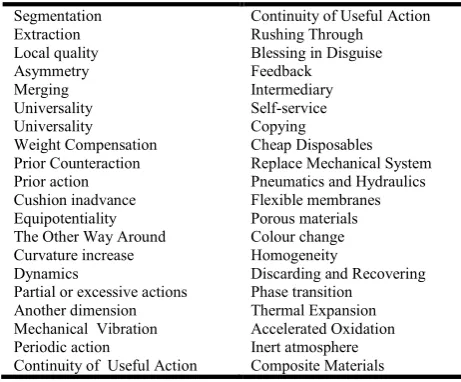
[image:2.595.45.276.177.368.2]TRIZ (Gadd, 2011) consists of forty (40) Inventive Principles – the Contradiction Matrix and Extraction Principles. The technical and physical contradictions can be solved by implementing the 40 principles. The set of the forty principles is a major tool for problem solving in TRIZ and its usage is quite easy and effective (Gadd, 2011).
Table 1. The forty principles of TRIZ theory (faqeeh, A2005)
Segmentation Continuity of Useful Action
Extraction Rushing Through
Local quality Blessing in Disguise
Asymmetry Feedback
Merging Intermediary
Universality Self-service
Universality Copying
Weight Compensation Cheap Disposables Prior Counteraction Replace Mechanical System
Prior action Pneumatics and Hydraulics
Cushion inadvance Flexible membranes Equipotentiality Porous materials The Other Way Around Colour change Curvature increase Homogeneity
Dynamics Discarding and Recovering
Partial or excessive actions Phase transition Another dimension Thermal Expansion Mechanical Vibration Accelerated Oxidation Periodic action Inert atmosphere Continuity of Useful Action Composite Materials
TRIZ theory has 40 principles that were compiled by Altshuller from the analysis and inferences of patents. Souchcoy (1993) believes that TRIZ theory has special characteristics, which include:
Engineering foundations that focus on the development of techniques of the systems.
Creative methods for solving technical, administrative, and pedagogical problems.
Ability to solve contradictions for technological and non-technological problems.
The principle of TRIZ theory in solving problems
Initially, the problem in the system should be considered within specific constraints (specific situation). Then the specific constrains of the problem is removed to generalize the problem. Once the problem is generalized, the strategies of TRIZ theory can be screened to find the most suitable principle for the problem, which is then used to solve the problem. Finally, the generalized solution of the problem is extrapolated to the original specific problem (Al-Amer, 2009).
Previous studies in TRIZ theory
In 2003, Abo Jado conducted a study that aimed to investigate the effect of a training program on tenth graders. Abo Jado’s program was based on 15 strategies of TRIZ theory, and he implemented the program on 100 tenth graders from both genders. Abo Jado formed study and control groups based on the gender. The result of Abo Jado’s study showed that students who received the training program excelled. In 2004, Marsh et al. investigated the possibility of applying TRIZ theory in teaching. The results showed that all of the 40
strategies of TRIZ theory were effective in resolving educational problems for both teachers and students in elementary to post-secondary stages. Al-Faqeeh (2004) reported to the Center for Talent Care in Jeddah, the findings of a study that investigated TRIZ theory and its importance and effect as an enrichment program for the gifted and talented students. Al-Faqeeh program was based on 15 creative strategies of TRIZ theory, which were applied twice a week. Al-Faqeeh also noted the possibility of integrating TRIZ theory in the curriculum specifically in the disciplines of mathematics and science. Al-Amer (2008) conducted a study that aimed to develop a training program based on 16 strategies of TRIZ theory. Al-Amer investigated the effectiveness of his program on the enhancement of creative thinking -such as fluency, flexibility, and originality- in solving mathematical problems. Al-Amer study sample was comprised of 60 female, high-achieving students in the ninth grade in Ha’el region, KSA. Al-Amer study consisted of a study group and a control group. The result of Al-Amerprogram showed that the students who received the training program performed higher than those who did not. In a study to investigate the effectiveness of a program that was based on TRIZ theory, Bin Khamees (2010) conducted a study that aimed at enhancing the creative thinking and achievement in the subject of biology for the tenth grade female students in Jeddah, KSA. Al-Khamees study and control group were comprised of 30 and 25 students, respectively. The results of the study indicated the effectiveness of the program on enhancing the creative thinking and achievement.
Motives for the program design
The relative modernity of TRIZ theory as it became known in the last few years in United States, Europe, and other countries of the world.
The small number of studies that was conducted on TRIZ theory despite its importance and its application in many disciplines; including the educational field.
The importance of creating a systematic procedures, which are based on specialized theory, for teaching critical thinking and problem solving.
The low level of students’ critical thinking and problem solving within the different stages of schooling, and the necessity in developing such skills.
TRIZ theory was originally applied to the technical and design disciplines, but the limited application of TRIZ theory to education was very promising, which encouraged the researcher of this study to use TRIZ theory for further insight on its effectiveness on teaching.
The design of the program
The program follows the following pillars:
The basics of TRIZ theory, and following the basic structure of the first training program founded on TRIZ theory in the Arabic world, which was developed by Abu-Jado.
comprehending the principles and the method of application of TRIZ theory in solving problems.
Fulfilling the goals of the training program require versatility in the use of strategies and methodologies during the training.
The trainer is the center player in the educational training, thus, the role of the trainer should be emphasized in all aspects including logistics and implementation of the program.
The precise outline of trainer and trainee roles in the program during all the implementation stages of the program.
The design of the MTRIZ program diligently chose dynamic elements that can be easily applied. The MTRIZ design attempt to create a suitable program that enable the talented students to easily acquire and build on. The core of the MTRIZ program is to advance the critical thinking and problem solving skills, thus the MTRIZ will encourage the talented students to inquire and embark addressing novel solutions to current and emerging problems. The MTRIZ program was designed to fit the environment and issues facing the Arabic talented students. The design of the MTRIZ program concentrated on ten elements. The inclusion of these ten elements took into account 1) suitability to the time frame of MTRIZ administration such that the talented students can have adequate training to become competent in all ten elements; 2) the holistic excitement and pleasure of the program content and delivery, which are crucial aspects to advance the enthusiasm of the talented students toward acquiring competency in critical thinking and problem solving. The TRIZ program was chosen to be the basis for this study due its following characteristics:
The TRIZ Program consists of multiple methods for solving technical problems in such a way that the technical application is dependent on the cognitive framework.
The TRIZ Program is designed to bypass and/or overthrow the psychological learning barriers.
The TRIZ Program utilizes methodologies that were used in addressing advanced problems, which require resourceful, creative application.
The TRIZ Program is very efficient in analyzing the expected outcomes and in selection of the suitable means/processes to achieve the desired outcomes. The TRIZ Program is effective in screening the available resources, and in choosing the appropriate resources and/or their adaptation to the process need.
(MTRIZP) Development of the Modified TRIZ Program 8
Development of a training M. program that involves creating a package of material about a specific subject or activity from which people can be trained and learn new knowledge.
In this study, the training program includes activities that will enhance critical thinking skills and solving problem will of talented students in order to enable them to use the learned skills to solve daily life problems. The activities in this training program are developed based-on the TRIZ program regarding age, individual and cultural background among the talented students. Learning thinking skills is a significant contributor to students' well-being (Fisher, 2005; Qatami., 2005) that enables them to develop their thinking abilities and become independent learners. Additionally, enjoyable and non-threatening environment is required for the program to be successful.
In the conceptual framework in chapter one, ten principles were chosen namely:
Segmentation
Extraction
Merging
Inversion
Self-service
Changing color
Nesting
Universality
Blessing in disguise
Copying
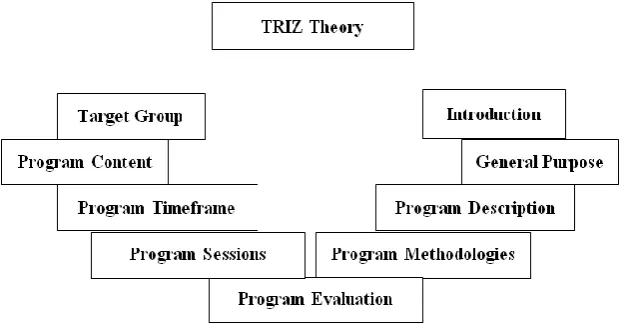
[image:3.595.146.459.212.376.2]In order to ensure that these skills are learned by talented students, the MTRIZP is developed with graded activities to help talented students enhance critical thinking and improve solving problem. Furthermore, aspects that are included are
modifications and adaptations made to the original m program, goals, lessons, learning outcomes, objectives, and activity procedures.
The program expected outcome
After the implementation of the program, the trainee (students), who were exposed to the activities and training of the program should be able to achieve the following training and pedagogical goals:
Increase the awareness of the students on the most important problems facing their societies, and the development of their abilities to solve such problems using specific strategies.
Provide systematic and organized opportunities for the students to get exposed to other people’s experiences, and gaining the abilities to accept and comprehend the views of others.
Gain of necessary skills that enable the problem solving abilities of the trainee(Abdeen,2014). The trainee here employs TRIZ theory and evaluate the solutions the solutions that he arrived at.
Enabling students to form a vision regarding the ideal approach to problem solving of personal and social problems.
Acquiring of critical thinking and problem solving and their subjective utilization in the trainees’ different life situations.
Enhance the skills of the trainees in working within a collaborative team, and develop their abilities ability in employing metrics to assess the suggestion of the trainees.
The innovative principles of the training program
The program in this study used the principles of TRIZ theory as the core for its training modules, which aimed at enhancing the critical thinking and problems solving. The current training program in this study only used ten TRIZ principles rather than employing all of the 40 TRIZ principles, which is due to the following:
The difficulty in employing all of the 40 TRIZ principles in one study and by one author. Moreover, using all of TRIZ principles can require elongated training sessions and demanding financial support.
Some of the unused TRIZ principles are not fit for the sample of this study, as such principles targets technical, technological, and non-pedagogical applications.
The selected TRIZ principles are closely linked to pedagogy.
The selected TRIZ principles were chosen after consultation with experts in the field.
Execution of the program
The program is administered to the experimental group collectively (as a group) in the frequency of one 45-minute session per day week. The training for each of the selected
TRIZ theory principles spans two days. The following is an outline for the sessions:
Introduction of the TRIZ theory principle, which is the focus of the activity for the session. In introducing the TRIZ principle, care is taken to simplify the TRIZ principle, and a myriad of scientific, practical examples are provided by the trainer. The trainees are then asked to provide other examples on the TRIZ strategy at focus.
A problem that faces the students or the society in which they live in is introduced. The problems is analyzed from different aspects. Here the trainees are introduced to the meaning of a problem, its causes, and its positive and negative implications.
Training of trainees on finding ideal, final solutions for the problems discussed during the sessions.
Using of the TRIZ theory principle, which are being emphasized during the sessions to find as many solutions to the problems discussed during the training sessions.
After presenting the solutions by the trainees, the trainees evaluate the solutions.
Assigning a problem to the trainees to solve using the TRIZ theory principle at focus in the training session.
Utilization of educational methodologies in the training program such as collaborative learning, discussion, dialogue, brain storming, research, and homework.
The principles used in the program
The strategies, as defined by Souchcoy (1999) are:
The Segmentation Principle
This Principle refers to the possibility of solving problems by splitting the system into several parts, each is independent from the other .But if the system is already divided, splitting it to more parts can make problem solving become possible. The recommendations for the dividing principle are:
Divide the main system/problem to several parts to ease Extractions and combinations.
Divide the main system to several parts to enable the removal and retrieval of some of the parts as needed.
Divide each part of the system to sub-parts such as: Liquid; gas; solid powder particles.
Increase the degree of the system’s Segmentation.
The Extraction Principle
The possibility of solving problems by selecting ingredients that work well and work to keep them alive, and to identify the harmful components or parts or those that do not work well for separation and disposal.
The Extraction principle recommendations are:
If part of the system prohibited completing the desired outcome, it should be isolated and eliminated.
Identification of the most important part in the system, and the development of a new system that includes only this particular part of the system.
The Merging Principle
Indicates the spatial and temporal link between systems that result in similar or contiguous operations and the collection of things or similar or identical components that perform functions and balanced operations so that they are close or contiguous in terms of time and place.
The Merging principle recommends:
Combine the analogous parts spatially
Combine the analogous parts temporally.
Combine the implementation of connected parts simultaneously.
The Nesting Principle
This strategy usually includes measures contrary to those used in solving problems. If things are fixes, we make them move, and if they are moving ,we make them become fixed.
The inclusion principle recommends:
Include one part within another, or put one part in the interior of another.
Insert one part in another part of the system
Increase the number of overlapped parts in the system
Show the activities of the operation when needed, and do not show the activities when not needed.
The Inversion Principe
Making the system able to serve itself through fulfilling supportive functions (maintenance, difference treatment and the use of wasted resources).
The inversion principle recommends:
Invert the stable and dynamic parts of the system
Replace parts of the system with other parts that have opposite characteristics -for example, white with black; full with empty.
Invert a part of the system top to bottom.
Invert the desired outcome of the system.
Blessing in Disguise Principle
Points at changing the color of the thing or its external environment.
The Blessing in Disguise principle recommends:
Employ the parts of the system that responds negatively to achieve positive outcomes.
[image:5.595.113.482.371.690.2] Maximize the negative effect in such a way that makes it unable to portray the negative effect on the system or its surrounding.
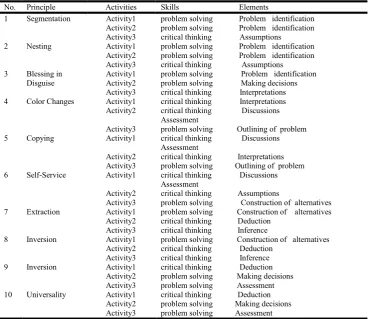
Table 2. Activities’ design of MTRIZ
No. Principle Activities Skills Elements 1 Segmentation Activity1
Activity2 Activity3
problem solving Problem identification problem solving Problem identification critical thinking Assumptions
2 Nesting Activity1
Activity2 Activity3
problem solving Problem identification problem solving Problem identification critical thinking Assumptions 3 Blessing in
Disguise
Activity1 Activity2 Activity3
problem solving Problem identification problem solving Making decisions critical thinking Interpretations 4 Color Changes Activity1
Activity2
Activity3
critical thinking Interpretations critical thinking Discussions Assessment
problem solving Outlining of problem
5 Copying Activity1
Activity2 Activity3
critical thinking Discussions Assessment
critical thinking Interpretations problem solving Outlining of problem 6 Self-Service Activity1
Activity2 Activity3
critical thinking Discussions Assessment
critical thinking Assumptions
problem solving Construction of alternatives
7 Extraction Activity1
Activity2 Activity3
problem solving Construction of alternatives critical thinking Deduction
critical thinking Inference
8 Inversion Activity1
Activity2 Activity3
problem solving Construction of alternatives critical thinking Deduction
critical thinking Inference
9 Inversion Activity1
Activity2 Activity3
critical thinking Deduction problem solving Making decisions problem solving Assessment 10 Universality Activity1
Activity2 Activity3
Eliminate a negative part by merging it with another part that cancels its negative effect.
Changing Color and Transparency Principle
Containment something in something else which in turn can be contained in something third, and so on, or by passing a certain something in the cavity of something else.
The changing color and transparency principle recommends:
Change the color of the outcome or the color of its surrounding.
Change the transparency of the system or the transparency of its surroundings.
Use glowing colors
Universality Principle
Making the system capable of several functions or tasks or make every part of the system able to carry out the largest number of job performance and thus less need for other platforms.
The Universality principle recommends:
Enabling each part of the system to do more than its own task, thus requiring less systems.
The Copying Principle
Using items or harmful effects on the environment to get the positive effects.
The copying principle recommends:
Use a simple, economy copy of the system instead of the original complicated, pricy system.
Using a photo to replace the system, by which it can be magnified or shrunk according to the arising needs.
The Self -Service Principal
This strategy refers to the possibility of solving problems using a simple copy instead of using complicated things and replacing a thing by its copy.
The principal of self-service recommends
Enabling the system to serve itself by doing additional support tasks.
Enabling the system to serve itself by adapting and self-correction.
Employ the available and consumed resources within the system to achieve the desired self-service.
Teaching materials
The training program was based on the user indicated that they are extracted from the theoretical literature Theories.
Reliability of the MTRIZ
The researcher presented the training program prepared to (11) arbitrator of doctoral and master's campaign is experienced in
special education, talent and guidance and science education and child psychology, in the universities and the Ministry of Education and talent centers to judge the appropriateness of the program, the clarity of language, and recommendations on how to achieve the objectives of the activities. The arbitrators were also asked to provide recommendations, to express their views, and modify the MTRIZ to what they see fit. The researcher adopted the recommendations that the arbitrators agreed on up to (70%). The adopted recommendations included change, addition, or deletion of some paragraphs, or activities or meetings. In addition, an amendments was made to MTRIZ as advised by the arbitrators.
Conclusion
This research discusses the process development of the MTRIZ Program that relates to the scope of the purpose of the study, which includes goals the pillars, characteristics, sentimental processes, cognition processes, content and application.
REFERENCES
Abdeen, S. 2014. Theory Concurrent thinking. Life science Journals, 11(12) , USA.
Abdeen, S. 2015. Think out the box with Concurrent thinking theory. IPCiRE2015, USM.
Al-Amer S. 2008. The origin of pedagogy philosophy in Islam. Um-Alqura publications, Mecca, KSA.
Al-Amer, H. 2009. The theory of the creative solutions to problem; TRIZ. Deebinoprublications, Amman, Jordan. Ben Khamees, M. 2010. The effectiveness of a suggested
program in the light of TRIZ theory for the enhancement of creative thinking and achievement in the biology subject for the tenth grade female students. College of education, King AbdAlasis University, Mecca, KSA.
Bruner, J. S. 1962. The conditions of creativity. In H. E. Gruber, G. Terrell, and M. Wertheimer (Eds.), Contemporary approaches to creative thinking (pp. 1-30). New York, NY: Atherton Press.
Carwie, L. 2009. The effect of computer-supported argument mapping on the critical thinking skills of undergraduate nursing students. University of South Alabama
Dewey, J. 1991. How we think. Buffalo, NY: Prometheus Books. (Original workpublished 1910)
Duplass, J. A., and Ziedler, D. L. 2002. Critical thinking and logical argument. Social Education, 66(5), 10–14.
Guilford, J. 1992. The Nature of Human Intelligence. New York, McGraw-Hill.
Habib, M. 2000. The development of creativity in the various stages of childhood. Cairo: Anglo- Egyptian library. Israel, Glenn D. 1992. Sampling the Evidence of Extension
Program Impact. Program Evaluation and Organizational Development, IFAS, University of Florida. PEOD-5. October.
Jaber, J. 1999. The Psychology of Learning and Teaching Theories. Print 9, Cairo, Dar Al-Nahdah Al-Arabiah