Natural Language Inference by Tree-Based Convolution
and Heuristic Matching
Lili Mou∗,1Rui Men,∗1 Ge Li,†1 Yan Xu,1 Lu Zhang,1 Rui Yan,2 Zhi Jin†1 1Key Laboratory of High Confidence Software Technologies (Peking University),
Ministry of Education, China; Software Institute, Peking University, China
{doublepower.mou,menruimr}@gmail.com {lige,xuyan14,zhanglu,zhijin}@sei.pku.edu.cn
2Baidu Inc., China [email protected]
Abstract
In this paper, we propose the TBCNN-pair model to recognize entailment and contradiction between two sentences. In our model, a tree-based convolutional neu-ral network (TBCNN) captures sentence-level semantics; then heuristic matching layers like concatenation, element-wise product/difference combine the informa-tion in individual sentences. Experimen-tal results show that our model outper-forms existing sentence encoding-based approaches by a large margin.
1 Introduction
Recognizing entailment and contradiction be-tween two sentences (called a premise and a hy-pothesis) is known asnatural language inference (NLI) in MacCartney (2009). Provided with a premise sentence, the task is to judge whether the hypothesis can be inferred (entailment), or the hypothesis cannot be true (contradiction). Several examples are illustrated in Table 1.
NLI is in the core of natural language under-standing and has wide applications in NLP, e.g., question answering (Harabagiu and Hickl, 2006) and automatic summarization (Lacatusu et al., 2006; Yan et al., 2011a; Yan et al., 2011b). More-over, NLI is also related to other tasks of sen-tence pair modeling, including paraphrase detec-tion (Hu et al., 2014), reladetec-tion recognidetec-tion of dis-course units (Liu et al., 2016), etc.
Traditional approaches to NLI mainly fall into two groups: feature-rich models and formal rea-soning methods. Feature-based approaches typ-ically leverage machine learning models, but re-quire intensive human engineering to represent lexical and syntactic information in two sentences
∗Equal contribution. †Corresponding authors.
Premise Two men on bicycles competing in a race. People are riding bikes. E
Hypothesis Men are riding bicycles on the streets. C
A few people are catching fish. N Table 1: Examples of relations between a premise and a hypothesis: Entailment, Contradiction, and
Neutral (irrelevant).
(MacCartney et al., 2006; Harabagiu et al., 2006). Formal reasoning, on the other hand, converts a sentence into a formal logical representation and uses interpreters to search for a proof. However, such approaches are limited in terms of scope and accuracy (Bos and Markert, 2005).
The renewed prosperity of neural networks has made significant achievements in various NLP ap-plications, including individual sentence modeling (Kalchbrenner et al., 2014; Mou et al., 2015) as well as sentence matching (Hu et al., 2014; Yin and Sch¨utze, 2015). A typical neural architecture to model sentence pairs is the “Siamese” structure (Bromley et al., 1993), which involves an underly-ing sentence model and a matchunderly-ing layer to de-termine the relationship between two sentences. Prevailing sentence models include convolutional networks (Kalchbrenner et al., 2014) and recur-rent/recursive networks (Socher et al., 2011b). Al-though they have achieved high performance, they may either fail to fully make use of the syntacti-cal information in sentences or be difficult to train due to the long propagation path. Recently, we propose a novel tree-based convolutional neural network (TBCNN) to alleviate the aforementioned problems and have achieved higher performance in two sentence classification tasks (Mou et al., 2015). However, it is less clear whether TBCNN can be harnessed to model sentence pairs for im-plicit logical inference, as is in the NLI task.
In this paper, we propose the TBCNN-pair neural model to recognize entailment and con-tradiction between two sentences. We
age our newly proposed TBCNN model to cap-ture structural information in sentences, which is important to NLI. For example, the phrase “riding bicycles on the streets” in Table 1 can be well recognized by TBCNN via the
depen-dency relations dobj(riding,bicycles)
andprep on(riding,street). As we can see, TBCNN is more robust than sequential con-volution in terms of word order distortion, which may be introduced by determinators, modifiers, etc. A pooling layer then aggregates information along the tree, serving as a way of semantic com-positonality. Finally, two sentences’ information is combined by several heuristic matching lay-ers, including concatenation, element-wise prod-uct and difference; they are effective in capturing relationships between two sentences, but remain low complexity.
To sum up, the main contributions of this pa-per are two-fold: (1) We are the first to introduce tree-based convolution to sentence pair modeling tasks like NLI; (2) Leveraging additional heuris-tics further improves the accuracy while remaining low complexity, outperforming existing sentence encoding-based approaches to a large extent, in-cluding feature-rich methods and long short term memory (LSTM)-based recurrent networks.1 2 Related Work
Entailment recognition can be viewed as a task of sentence pair modeling. Most neural networks in this field involve a sentence-level model, followed by one or a few matching layers. They are some-times called “Siamese” architectures (Bromley et al., 1993).
Hu et al. (2014) and Yin and Sch¨utze (2015) ap-ply convolutional neural networks (CNNs) as the individual sentence model, where a set of feature detectors over successive words are designed to extract local features. Wan et al. (2015) build sen-tence pair models upon recurrent neural networks (RNNs) to iteratively integrate information along a sentence. Socher et al. (2011a) dynamically con-struct tree con-structures (analogous to parse trees) by recursive autoencoders to detect paraphrase be-tween two sentences. As shown, inherent struc-tural information in sentences is oftentimes impor-tant to natural language understanding.
The simplest approach to match two sentences,
1Code is released on:
https://sites.google.com/site/tbcnninference/
perhaps, is to concatenate their vector representa-tions (Zhang et al., 2015; Hu et al., 2014, Arc-I). Concatenation is also applied in our previous work of matching the subject and object in relation clas-sification (Xu et al., 2015; Xu et al., 2016). He et al. (2015) apply additional heuristics, namely Euclidean distance, cosine measure, and element-wise absolute difference. The above methods op-erate on a fixed-size vector representation of a sen-tence, categorized assentence encoding-based ap-proaches. Thus the matching complexity isO(1), i.e., independent of the sentence length. Word-by-word similarity matrices are introduced to enhance interaction. To obtain the similarity matrix, Hu et al. (2014) (Arc-II) concatenate two words’ vectors (after convolution), Socher et al. (2011a) compute Euclidean distance, and Wan et al. (2015) apply tensor product. In this way, the complexity is of
O(n2), wherenis the length of a sentence; hence
similarity matrices are difficult to scale and less efficient for large datasets.
Recently, Rockt¨aschel et al. (2016) intro-duce several context-aware methods for sentence matching. They report that RNNs over a single chain of two sentences are more informative than separate RNNs; a static attention over the first sen-tence is also useful when modeling the second one. Such context-awareness interweaves the sentence modeling and matching steps. In some scenarios like sentence pair re-ranking (Yan et al., 2016), it is not feasible to pre-calculate the vector represen-tations of sentences, so the matching complexity is ofO(n). Rockt¨aschel et al. (2016) further develop a word-by-word attention mechanism and obtain a higher accuracy with a complexity order ofO(n2). 3 Our Approach
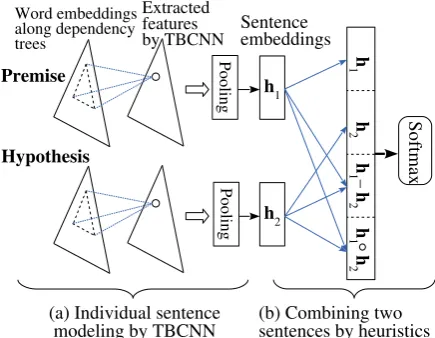
We follow the “Siamese” architecture (like most work in Section 2) and adopt a two-step strategy to classify the relation between two sentences. Con-cretely, our model comprises two parts:
• A tree-based convolutional neural network models each individual sentence (Figure 1a). Notice that, the two sentences, premise and hy-pothesis, share a same TBCNN model (with same parameters), because this part aims to capture general semantics of sentences.
concate-Po
oli
ng h1
h
1
h
2
h
1 –
h
2
h
1
h
2
(b) Combining two sentences by heuristics (a) Individual sentence
modeling by TBCNN Premise
Hypothesis
h2 Extracted
features by TBCNN Word embeddings
along dependency
trees Sentenceembeddings
S
oft
m
ax
Po
oli
ng
Figure 1: TBCNN-pair model. (a)
Individ-ual sentence modeling via tree-based convolution. (b) Sentence pair modeling with heuristics, after which a softmax layer is applied for output.
nation, element-wise product and difference, which are effective and efficient.
Finally, we add a softmax layer for output. The training objective is cross-entropy loss, and we adopt mini-batch stochastic gradient descent, computed by back-propagation.
3.1 Tree-Based Convolution
The tree-based convolutoinal neural network (TBCNN) is first proposed in our previous work (Mou et al., 2016)2 to classify program source
code; later, we further propose TBCNN variants to model sentences (Mou et al., 2015). This sub-section details the tree-based convolution process. The basic idea of TBCNN is to design a set of subtree feature detectors sliding over the parse tree of a sentence; either a constituency tree or a depen-dency tree applies. In this paper, we prefer the de-pendency tree-based convolution for its efficiency and compact expressiveness.
Concretely, a sentence is first converted to a dependency parse tree.3 Each node in the
de-pendency tree corresponds to a word in the sen-tence; an edgea→bindicatesais governed byb. Edges are labeled with grammatical relations (e.g.,
nsubj) between the parent node and its children (de Marneffe et al., 2006). Words are represented by pretrained vector representations, also known asword embeddings(Mikolov et al., 2013a).
2Preprinted on arXiv on September 2014 (http://arxiv.org/abs/1409.5718v1) 3Parsed by the Stanford parser
(http://nlp.stanford.edu/software/lex-parser.shtml)
Now, we consider a set of two-layer subtree fea-ture detectors sliding over the dependency tree. At a position where the parent node is p with child nodesc1,· · ·, cn, the output of the feature detec-tor,y, is
y=f Wpp+
n
X
i=1
Wr[ci]ci+b
!
Let us assume word embeddings (pandci) are ofnedimensions; that the convolutional layeryis
nc-dimensional. W ∈ Rnc×ne is the weight ma-trix; b∈ Rnc is the bias vector. r[c
i]denotes the dependency relation between p and ci. f is the non-linear activation function, and we applyReLU
in our experiments.
After tree-based convolution, we obtain a set of feature maps, which are one-one corresponding to original words in the sentence. Therefore, they may vary in size and length. A dynamic pooling layer is applied to aggregate information along dif-ferent parts of the tree, serving as a way of seman-tic compositionality(Hu et al., 2014). We use the maxpooling operation, which takes the maximum value in each dimension.
Then we add a fully-connected hidden layer to further mix the information in a sentence. The ob-tained vector representation of a sentence is de-noted as h (also called a sentence embedding). Notice that the same tree-based convolution ap-plies to both the premise and hypothesis.
Tree-based convolution along with pooling en-ables structural features to reach the output layer with short propagation paths, as opposed to the recursive network (Socher et al., 2011b), which is also structure-sensitive but may suffer from the problem of long propagation path. By contrast, TBCNN is effective and efficient in learning such structural information (Mou et al., 2015).
3.2 Matching Heuristics
In this part, we introduce how vector represen-tations of individual sentences are combined to capture the relation between the premise and hy-pothesis. As the dataset is large, we preferO(1) matching operations because of efficiency con-cerns. Concretely, we have three matching heuris-tics:
• Concatenation of the two sentence vectors,
• Element-wise product, and
• Element-wise difference.
[image:3.595.73.291.64.233.2]“closeness.” These matching layers are further concatenated (Figure 1b), given by
m= [h1;h2;h1−h2;h1◦h2]
whereh1 ∈ Rnc andh2 ∈ Rnc are the sentence
vectors of the premise and hypothesis, respec-tively; “◦” denotes element-wise product; semi-colons refer to column vector concatenation.m∈ R4ncis the output of the matching layer.
We would like to point out that, with subse-quent linear transformation, element-wise differ-ence is a special case of concatenation. If we assume the subsequent transformation takes the form of W[h1 h2]>, where W = [W1 W2] is
the weights for concatenated sentence representa-tions, then element-wise difference can be viewed as such thatW0(h1−h2) = [W0 −W0][h1h2]>.
(W0is the weights corresponding to element-wise
difference.) Thus, our third heuristic can be ab-sorbed into the first one in terms of model ca-pacity. However, as will be shown in the exper-iment, explicitly specifying this heuristic signifi-cantly improves the performance, indicating that optimization differs, despite the same model ca-pacity. Moreover, word embedding studies show that linear offset of vectors can capture relation-ships between two words (Mikolov et al., 2013b), but it has not been exploited in sentence-pair rela-tion recognirela-tion. Although element-wise distance is used to detect paraphrase in He et al. (2015), it mainly reflects “similarity” information. Our study verifies that vector offset is useful in cap-turing generic sentence relationships, akin to the word analogy task.
4 Evaluation
4.1 Dataset
To evaluate our TBCNN-pair model, we used the newly published Stanford Natural Language In-ference (SNLI) dataset (Bowman et al., 2015).4
The dataset is constructed by crowdsourced ef-forts, each sentence written by humans. More-over, the SNLI dataset is magnitudes of larger than previous resources, and hence is particularly suitable for comparing neural models. The tar-get labels comprise three classes: Entailment,
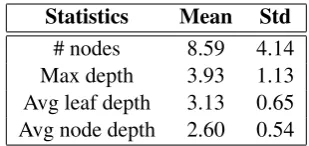
Contradiction, and Neutral (two irrel-evant sentences). We applied the standard train/validation/test split, contraining 550k, 10k, and 10k samples, respectively. Figure 2 presents
4http://nlp.stanford.edu/projects/snli/
Statistics Mean Std
# nodes 8.59 4.14
Max depth 3.93 1.13
Avg leaf depth 3.13 0.65
[image:4.595.338.493.61.134.2]Avg node depth 2.60 0.54
Table 2: Statistics of the Stanford Natural Lan-guage Inference dataset where each sentence is parsed into a dependency parse tree.
0 0.1 0.2 0.3
Dropout rate 76
78 80 82 84
Validation acc. (%)
Figure 2: Validation accuracy versus dropout rate (full TBCNN-pair model).
additional dataset statistics, especially those rele-vant to dependency parse trees.5
4.2 Hyperparameter Settings
All our neural layers, including embeddings, were set to 300 dimensions. The model is mostly robust when the dimension is large, e.g., several hundred (Collobert and Weston, 2008). Word embeddings were pretrained ourselves by word2vec on the English Wikipedia corpus and fined tuned during training as a part of model parameters. We applied
`2penalty of3×10−4; dropout was chosen by
val-idation with a granularity of 0.1 (Figure 2). We see that a large dropout rate (≥0.3) hurts the perfor-mance (and also makes training slow) for such a large dataset as opposed to small datasets in other tasks (Peng et al., 2015). Initial learning rate was set to 1, and a power decay was applied. We used stochastic gradient descent with a batch size of 50.
4.3 Performance
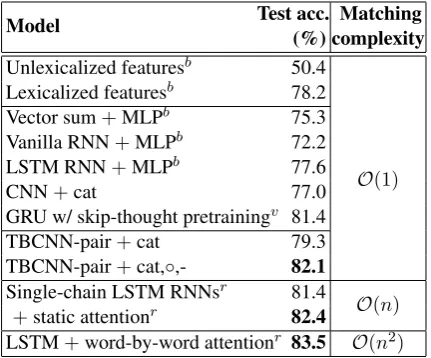
Table 3 compares our model with previous
re-sults. As seen, the TBCNN sentence pair
model, followed by simple concatenation alone, outperforms existing sentence encoding-based approaches (without pretraining), including a feature-rich method using 6 groups of human-engineered features, long short term memory
[image:4.595.334.494.194.293.2]Model Test acc. Matching(%) complexity Unlexicalized featuresb 50.4
O(1) Lexicalized featuresb 78.2
Vector sum+MLPb 75.3
Vanilla RNN+MLPb 72.2
LSTM RNN+MLPb 77.6
CNN+cat 77.0 GRU w/ skip-thought pretrainingv 81.4
TBCNN-pair+cat 79.3 TBCNN-pair+cat,◦,- 82.1 Single-chain LSTM RNNsr 81.4
O(n) +static attentionr 82.4
[image:5.595.74.290.62.241.2]LSTM+word-by-word attentionr 83.5 O(n2)
Table 3: Accuracy of the TBCNN-pair model in comparison with previous results (bBowman et al., 2015; vVendrov et al., 2015; rRockt¨aschel et al., 2015). “cat” refers to concatenation; “-” and “◦” denote element-wise difference and product, resp.
Model Variant Valid Acc. Test Acc.
TBCNN+◦ 73.8 72.5
TBCNN+- 79.9 79.3
TBCNN+cat 80.8 79.3
TBCNN+cat,◦ 81.6 80.7
TBCNN+cat,- 81.7 81.6
[image:5.595.81.282.326.427.2]TBCNN+cat,◦,- 82.4 82.1
Table 4: Validation and test accuracies of TBCNN-pair variants (in percentage).
(LSTM)-based RNNs, and traditional CNNs. This verifies the rationale for using tree-based convolu-tion as the sentence-level neural model for NLI.
Table 4 compares different heuristics of match-ing. We first analyze each heuristic separately: using element-wise product alone is significantly worse than concatenation or element-wise differ-ence; the latter two are comparable to each other.
Combining different matching heuristics im-proves the result: the TBCNN-pair model with concatenation, element-wise product and differ-ence yields the highest performance of 82.1%. As analyzed in Section 3.2, the element-wise differ-ence matching layer does not add to model com-plexity and can be absorbed as a special case into simple concatenation. However, explicitly using such heuristic yields an accuracy boost of 1–2%. Further applying element-wise product improves the accuracy by another 0.5%.
The full TBCNN-pair model outperforms all existing sentence encoding-based approaches,
in-cluding a 1024d gated recurrent unit (GRU)-based RNN with “skip-thought” pretraining (Vendrov et al., 2015). The results obtained by our model are also comparable to several attention-based LSTMs, which are more computationally inten-sive than ours in terms of complexity order. 4.4 Complexity Concerns
For most sentence models including TBCNN, the overall complexity is at leastO(n). However, an efficient matching approach is still important, es-pecially to retrieval-and-reranking systems (Yan et al., 2016; Li et al., 2016). For example, in a retrieval-based question-answering or conversa-tion system, we can largely reduce response time by performing sentence matching based on pre-computed candidates’ embeddings. By contrast, context-aware matching approaches as described in Section 2 involve processing each candidate given a new user-issued query, which is time-consuming in terms of most industrial products.
In our experiments, the matching part (Fig-ure 1b) counts 1.71% of the total time during pre-diction (single-CPU,C++implementation), show-ing the potential applications of our approach in efficient retrieval of semantically related sen-tences.
5 Conclusion
In this paper, we proposed the TBCNN-pair model for natural language inference. Our model re-lies on the tree-based convolutional neural net-work (TBCNN) to capture sentence-level seman-tics; then two sentences’ information is com-bined by several heuristics including concatena-tion, element-wise product and difference. Ex-perimental results on a large dataset show a high performance of our TBCNN-pair model while re-maining a low complexity order.
Acknowledgments
References
Johan Bos and Katja Markert. 2005. Combining shal-low and deep NLP methods for recognizing textual
entailment. In Proceedings of the First PASCAL
Challenges Workshop on Recognising Textual En-tailment, pages 65–68.
Samuel R. Bowman, Gabor Angeli, Christopher Potts, and Christopher D. Manning. 2015. A large anno-tated corpus for learning natural language inference. In Proceedings of the 2015 Conference on Empiri-cal Methods in Natural Language Processing, pages 632–642.
Jane Bromley, James W Bentz, L´eon Bottou, Is-abelle Guyon, Yann LeCun, Cliff Moore, Eduard S¨ackinger, and Roopak Shah. 1993. Signature ver-ification using a “Siamese” time delay neural
net-work. International Journal of Pattern Recognition
and Artificial Intelligence, 7(04):669–688.
Ronan Collobert and Jason Weston. 2008. A unified architecture for natural language processing: Deep
neural networks with multitask learning. In
Pro-ceedings of the 25th International Conference on Machine learning, pages 160–167.
Marie-Catherine de Marneffe, Bill MacCartney, and Christopher D Manning. 2006. Generating typed dependency parses from phrase structure parses. In Proceedings of the Language Resource and Evalua-tion Conference, pages 449–454.
Sanda Harabagiu and Andrew Hickl. 2006. Methods for using textual entailment in open-domain
ques-tion answering. In Proceedings of the 21st
Inter-national Conference on Computational Linguistics and the 44th Annual Meeting of the Association for Computational Linguistics, pages 905–912.
Sanda Harabagiu, Andrew Hickl, and Finley Lacatusu. 2006. Negation, contrast and contradiction in text
processing. InProceedings of AAAI Conference on
Artificial Intelligence, pages 755–762.
Hua He, Kevin Gimpel, and Jimmy Lin. 2015. Multi-perspective sentence similarity modeling with
con-volutional neural networks. InProceedings of the
2015 Conference on Empirical Methods in Natural Language Processing, pages 17–21.
Baotian Hu, Zhengdong Lu, Hang Li, and Qingcai Chen. 2014. Convolutional neural network archi-tectures for matching natural language sentences. InAdvances in Neural Information Processing
Sys-tems, pages 2042–2050.
Nal Kalchbrenner, Edward Grefenstette, and Phil Blun-som. 2014. A convolutional neural network for
modelling sentences. In Proceedings of the 52nd
Annual Meeting of the Association for Computa-tional Linguistics, pages 655–665.
Finley Lacatusu, Andrew Hickl, Kirk Roberts, Ying Shi, Jeremy Bensley, Bryan Rink, Patrick Wang, and
Lara Taylor. 2006. LCCs GISTexter at DUC 2006: Multi-strategy multi-document summarization. In Proceedings of DUC 2006.
Xiang Li, Lili Mou, Rui Yan, and Ming Zhang. 2016. StalemateBreaker: A proactive content-introducing approach to automatic human-computer
conversa-tion. InProceedings of the 25th International Joint
Conference on Artificial Intelligence.
Yang Liu, Sujian Li, Xiaodong Zhang, and Zhifang Sui. 2016. Implicit discourse relation classification via
multi-task neural networks. InProceedings of the
Thirtieth AAAI Conference on Artificial Intelligence. Bill MacCartney, Trond Grenager, Marie-Catherine de Marneffe, Daniel Cer, and Christopher D. Man-ning. 2006. Learning to recognize features of valid
textual entailments. InProceedings of the Human
Language Technology Conference of the NAACL, pages 41–48.
Bill MacCartney. 2009. Natural Language Inference.
Ph.D. thesis, Stanford University.
Tomas Mikolov, Ilya Sutskever, Kai Chen, Greg S Cor-rado, and Jeff Dean. 2013a. Distributed representa-tions of words and phrases and their
compositional-ity. InAdvances in Neural Information Processing
Systems, pages 3111–3119.
Tomas Mikolov, Wen-tau Yih, and Geoffrey Zweig. 2013b. Linguistic regularities in continuous space
word representations. InNAACL-HLT, pages 746–
751.
Lili Mou, Hao Peng, Ge Li, Yan Xu, Lu Zhang, and Zhi Jin. 2015. Discriminative neural sentence
mod-eling by tree-based convolution. InProceedings of
the 2015 Conference on Empirical Methods in Nat-ural Language Processing, pages 2315–2325. Lili Mou, Ge Li, Lu Zhang, Tao Wang, and Zhi Jin.
2016. Convolutional neural networks over tree
structures for programming language processing. In Proceedings of the Thirtieth AAAI Conference on Artificial Intelligence.
Hao Peng, Lili Mou, Ge Li, Yunchuan Chen, Yangyang Lu, and Zhi Jin. 2015. A comparative study on regularization strategies for embedding-based neural
networks. InProceedings of the 2015 Conference on
Empirical Methods in Natural Language
Process-ing, pages 2106–2111.
Tim Rockt¨aschel, Edward Grefenstette, Karl Moritz Hermann, Tom´aˇs Koˇcisk`y, and Phil Blunsom. 2016. Reasoning about entailment with neural attention. In Proceedings of the International Conference on Learning Representations.
Richard Socher, Eric H Huang, Jeffrey Pennin, Christo-pher D Manning, and Andrew Y Ng. 2011a. Dy-namic pooling and unfolding recursive autoencoders
for paraphrase detection. InAdvances in Neural
Richard Socher, Jeffrey Pennington, Eric H Huang, Andrew Y Ng, and Christopher D Manning. 2011b. Semi-supervised recursive autoencoders for
predict-ing sentiment distributions. In Proceedings of the
Conference on Empirical Methods in Natural Lan-guage Processing, pages 151–161.
Ivan Vendrov, Ryan Kiros, Sanja Fidler, and Raquel Urtasun. 2015. Order-embeddings of images and
language.arXiv preprint arXiv:1511.06361.
Shengxian Wan, Yanyan Lan, Jiafeng Guo, Jun Xu, Liang Pang, and Xueqi Cheng. 2015. A deep ar-chitecture for semantic matching with multiple
po-sitional sentence representations. arXiv preprint
arXiv:1511.08277.
Yan Xu, Lili Mou, Ge Li, Yunchuan Chen, Hao Peng, and Zhi Jin. 2015. Classifying relations via long short term memory networks along shortest
depen-dency paths. InProceedings of Conference on
Em-pirical Methods in Natural Language Processing, pages 1785–1794.
Yan Xu, Ran Jia, Lili Mou, Ge Li, Yunchuan Chen, Yangyang Lu, and Zhi Jin. 2016. Improved re-lation classification by deep recurrent neural
net-works with data augmentation. arXiv preprint
arXiv:1601.03651.
Rui Yan, Liang Kong, Congrui Huang, Xiaojun Wan, Xiaoming Li, and Yan Zhang. 2011a. Timeline gen-eration through evolutionary trans-temporal
summa-rization. In Proceedings of the Conference on
Em-pirical Methods in Natural Language Processing, pages 433–443.
Rui Yan, Xiaojun Wan, Jahna Otterbacher, Liang Kong, Xiaoming Li, and Yan Zhang. 2011b. Evolutionary timeline summarization: A balanced optimization
framework via iterative substitution. InProceedings
of the 34th international ACM SIGIR conference on Research and development in Information Retrieval, pages 745–754.
Rui Yan, Yiping Song, and Hua Wu. 2016. Learn-ing to respond with deep neural networks for re-trieval based human-computer conversation system. InProceedings of the 39th International ACM SIGIR Conference on Research and Development in Infor-mation Retrieval.
Wenpeng Yin and Hinrich Sch¨utze. 2015. Convolu-tional neural network for paraphrase identification. InProceedings of the 2015 Conference of the North American Chapter of the Association for Computa-tional Linguistics: Human Language Technologies, pages 901–911.
Biao Zhang, Jinsong Su, Deyi Xiong, Yaojie Lu, Hong Duan, and Junfeng Yao. 2015. Shallow convo-lutional neural network for implicit discourse
rela-tion recognirela-tion. In Proceedings of the 2015