Proceedings of the Fourth Conference on Machine Translation (WMT), Volume 3: Shared Task Papers (Day 2) pages 95–100 95
NJU Submissions for the WMT19 Quality Estimation Shared Task
Qi Hou, Shujian Huang∗, Tianhao Ning, Xinyu Dai and Jiajun Chen
National Key Laboratory for Novel Software Technology, Nanjing, China Nanjing University, Nanjing, China
{houq, huangsj, ningth, daixy, chenjj}@nlp.nju.edu.cn
Abstract
In this paper, we describe the submissions of the team from Nanjing University for the WMT19 sentence-level Quality Estima-tion (QE) shared task on English-German lan-guage pair. We develop two approaches based on a two-stage neural QE model consisting of a feature extractor and a quality estima-tor. More specifically, one of the proposed approaches employs the translation knowledge between the two languages from two differ-ent translation directions; while the other one employs extra monolingual knowledge from both source and target sides, obtained by pre-training deep self-attention networks. To ef-ficiently train these two-stage models, a joint learning training method is applied. Experi-ments show that the ensemble model of the above two models achieves the best results on the benchmark dataset of the WMT17 sentence-level QE shared task and obtains competitive results in WMT19, ranking 3rd out of 10 submissions.
1 Introduction
Sentence-level Quality Estimation (QE) of Ma-chine Translation (MT) is a task to predict the quality scores for unseen machine translation out-puts at run-time, without relying on reference translations. There are some interesting appli-cations of sentence-level QE, such as deciding whether a given translation is good enough for publishing, informing readers of the target lan-guage only whether or not they can rely on a trans-lation, filtering out sentences that are not good enough for post-editing by professional transla-tors, selecting the best translation among multiple MT systems and so on.
The common methods formalize the sentence-level QE as a supervised regression task. Tradi-tional QE models (Specia et al.,2013,2015) have
∗
Corresponding author.
two independent modules: feature extractor mod-ule and machine learning modmod-ule. The feature ex-tractor module is used to extract human-crafted features, which describe the translation quality, such as source fluency indicators, translation com-plexity indicators, and adequacy indicators. And the machine learning module serves for predicting how much effort is needed to post-edit translations to acceptable results as measured by the Human-targeted Translation Edit Rate (HTER) (Snover et al.,2006) based on extracted features above.
With the great success of deep neural networks in a number of tasks in natural language process-ing (NLP), some researches have begun to apply neural networks to QE task and these neural ap-proaches have shown promising results.Shah et al.
(2015, 2016) combine neural features, such as word embedding features and neural network lan-guage model (NNLM) features with other features produced by QuEst++ (Specia et al.,2015).Kim and Lee(2016);Kim et al.(2017a,b) apply mod-ified recurrent neural network (RNN) based neu-ral machine translation (NMT) model (Bahdanau et al.,2014) to the sentence-level QE task, which does not require manual effort for finding the best relevant features. Wang et al.(2018) replace the above NMT model with modified self-attention mechanism based transformer model (Vaswani et al.,2017). This approach achieves the best re-sult we know so far in the WMT17 sentence-level QE task on English-German language pair.
the two proposed QE models above. In Section4, we report experimental results and conclude our paper in Section5.
2 Employing Bi-directional Translation Knowledge
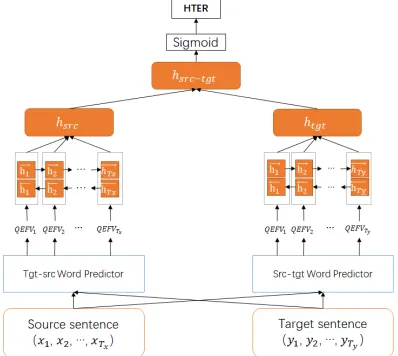
Sennrich et al. (2015) apply the idea of back-translation to improve the performance of NMT model by extending the parallel corpus with monolingual data. Kozlova et al. (2016) propose two types of features including pseudo-references features for source sentence and back-translations features for machine translation to enrich the base-line features in sentence-level QE task. Inspired by these successful practices, we present a Bi-directional QE model, as depicted in Figure1. 2.1 Model Architecture
The Bi-directional QE model contains a neural feature extractor and a neural quality estimator. The feature extractor relies on two symmetric word predictors to extract quality estimation fea-ture vectors (QEFVs) of the source sentence and target sentence (i.e., machine translation output). The quality estimator is based on two identical Bi-directional RNN (BiRNN) (Schuster and Paliwal,
[image:2.595.82.281.471.649.2]1997) for predicting quality scores using QEFVs as inputs.
Figure 1: An illustration of the architecture of the pro-posed Bi-directional QE model.
The source-to-target word predictor modi-fies self-attention mechanism based transformer model (Vaswani et al.,2017) to i) apply additional backward decoder for the target sentence with the right to left masked self-attention and ii) generate
QEFVs for target words as outputs, which is sim-ilar with QEBrain model as described in Wang et al.(2018). It is a conditional probabilistic model that generates a target wordyatj-th position via the source context x = (x1, ..., xTx) and target
contexty−j = (y1, ..., yj−1, yj+1, ..., yTy) as
fol-lows:
P(yj |y−j,x;θ) =softmax([−→sj;←s−j])
= exp(w
T
j W sj)
PKy
k=1exp(wkTW sj) (1)
whereTx andTy are the length of the source and target sentences. sj = [−→sj;←s−j]is the concatena-tion of−→sj and←s−j,−→sj is the hidden state at the last layer of forward decoder and←s−jis the hidden state of backward decoder. wj ∈ RKy is the one-hot representation of the target word, andKyis the vo-cabulary size of the target language.W ∈RKy×2d is the weight matrix, anddis the size of a unidi-rectional hidden layer.
To describe how well a target wordyjin a target sentence is translated from a source sentence, the QEFVjis defined as follows:
QEFVj = [(wTjW)sTj]T (2) whereis an element-wise multiplication.
Similarly, the target-to-source word predictor encodes a target sentence as input and decodes ev-ery word for source sentence step by step. We use the identical modified transformer model to gener-ate QEFVifor every source wordxias output.
The quality estimator firstly uses the Bi-directional Long Short-term Memory (BiL-STM) (Hochreiter and Schmidhuber,1997) model to encode given QEFVs of the source and target sentences such that
−−→
h1:Tx,
←−−
h1:Tx =BiLSTM({QEFVi}ii==1Tx) (3)
−−→
h1:Ty,
←−−
h1:Ty =BiLSTM(
QEFVj jj==1Ty) (4) Secondly, the quality estimator compresses the concatenation of two sequential hidden states along the depth direction to a single one by av-eraging them respectively as follows:
hsrc =
1 Tx
i=Tx
X
i=1
([−→hi; ←−
hi]) (5)
htgt=
1 Ty
j=Ty
X
j=1
([−→hj; ←−
Finally, sentence-level quality score of a trans-lation sentence is calculated as follows:
QEsentence(y, x) =σ(vT[hsrc;htgt]) (7) wherevis a vector,σdenotes the logistic sigmoid function.
In general, the word predictors in both direc-tions can supervise each other and jointly com-plete the goal of feature extractor, which enhances the representation ability of the whole QE model. At the same time, bi-directional translation knowl-edge is transferred from feature extractor to qual-ity estimator, which can be deemed to data aug-mentation of the original parallel corpus. There-fore, this approach can increase the diversity of training samples and improve the robustness of QE model.
2.2 Model Training
The training objective of Bi-directional QE model is to minimize the Mean Average Error (MAE) be-tween the gold standard labels and predicted qual-ity scores over the QE training samples. Because the training set for QE task is not sufficient for training the entire QE model, we need to use large-scale parallel corpus in source-to-target direction and reverse (target-to-source) direction to pre-train two word predictors respectively. Then, the pa-rameters of the whole Bi-directional QE model are trained jointly with the training samples of sentence-level QE task.
3 Employing Monolingual Knowledge
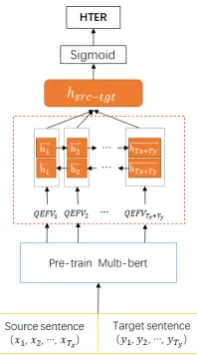
In fact, most language pairs do not have a large amount of parallel corpus to train the modified NMT model. But finding monolingual data for any language is relatively easy. Therefore, we propose a QE model to integrate monolingual knowledge, as depicted in Figure2.
3.1 Model Architecture
[image:3.595.367.466.60.238.2]The BERT-based QE model also consists of a neural feature extractor and a neural quality es-timator. The feature extractor is implemented by a pre-training representation learning model for language understanding called Multilingual-BERT (Devlin et al.,2018), which extracts hidden states corresponding to the last attention block as QEFVs for the sentence pair of source sentence and target sentence. Further, we can use a self-attention based transformer model (Vaswani et al.,
Figure 2: An illustration of the architecture of the pro-posed BERT-based QE model.
2017) to translate the source sentence to pseudo-reference, which is the same language as the target sentence. Then, the input of feature extractor is re-placed with the sentence pair of pseudo-reference and target sentence.
The quality estimator applies BiLSTM based model to predict quality scores using QEFVs as inputs such that
−−−−−→
h1:Tx+Ty,
←−−−−−
h1:Tx+Ty =BiLSTM({QEFVi}
i=Tx+Ty
i=1 )
(8)
hsrc−tgt=
1 Tx+Ty
i=Tx+Ty
X
i=1
([−→hi; ←−
hi]) (9)
QEsentence(x, y) =σ(vT1hsrc−tgt) (10)
wherev1is a vector.
3.2 Model Training
Consistently, the pre-trained feature extractor and initialized quality estimator of BERT-based QE model are trained jointly over the training samples of sentence-level QE task by minimizing the MAE loss function.
4 Experiments
4.1 Dataset and Metrics
The bilingual parallel corpus that we used for training word predictors is officially released by the WMT17 Shared Task: Machine Translation of News1, including Europarl v7, Common Crawl corpus, News Commentary v12, and Rapid corpus of EU press releases. The newstest2016 was used
Train Dev Test 2017 Sentences 23,000 1,000 2,000
Table 1: Statistics of the en-de dataset of the WMT17 sentence-level QE task.
Train Dev Test 2019 Sentences 13,442 1,000 1,023
Table 2: Statistics of the en-de dataset of the WMT19 sentence-level QE task.
as development dataset. Pre-processing script can be found at github2.
To test the performance of the proposed QE models, we conducted experiments on the WMT17 and WMT19 sentence-level QE task for English-to-German (en-de) direction. Because the gold standard labels of testing data on the WMT18 sentence-level QE task are unobtainable. The statistics of the dataset are shown in Tables1and
2.
Pearson’s correlation coefficient (Pearson) (as primary metric), Mean Average Error (MAE) and Root Mean Squared Error (RMSE) are used to evaluate the correlation between the predicted quality scores and the true HTER scores.
4.2 Experimental Setting
Both of the word predictors of Bi-directional QE Model hold the same parameters. The number of layers for the self-attention encoder and for-ward/backward self-attention decoder are all set as 6, where we use 8-head self-attention in practice. The dimensionality of word embedding and self-attention layers are all 512 except the feed-forward sub-layer is 2048. The dropout rate is set as 0.1. Worth mentioning, the normal transformer model introduced in BERT-based QE model is trained us-ing the same parallel corpus and parameter set-tings as word predictors.
For quality estimator module, the number of hidden units for forward and backward LSTM is 512. And we uniformly use a minibatch stochastic gradient descent (SGD) algorithm together with Adam (Kingma and Ba,2014) to train all models described.
These proposed models were compared with the traditional QE framework QuEst++ (Specia et al., 2015), the neural network features based
2https://github.com/zhaocq-nlp/MT-data-processing
QE model SHEF/QUEST-EMB (Shah et al.,2016) and the QE model combined with NMT model, including POSTECH (Kim et al., 2017b), QE-Brain (Wang et al., 2018), and UNQE (Li et al.,
2018).
4.3 Experimental Results
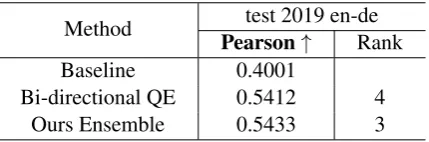
In this section, we will report the experimental re-sults of our approaches for WMT17 and WMT19 sentence-level QE task in English-German direc-tion. For WMT17 QE task, we tried to verify our proposed models and chose the best two models to participate in WMT19 QE task. In Table3and Table4, results of WMT17 and WMT19 QE tasks are listed respectively.
Method test 2017 en-de Pearson↑MAE↓RMSE↓ Baseline 0.397 0.136 0.175 SHEF/QUEST-EMB 0.496 0.126 0.166 POSTECH Single 0.6599 0.1057 0.1450
QEBrain Single 0.6837 0.1001 0.1441
UNQE Single 0.700 -
-Bi-directional QE 0.7097 0.1028 0.1352 BERT-based QE 0.6827 0.1081 0.1456 +NMT 0.703 0.1007 0.1377 POSTECH Ensemble 0.6954 0.1019 0.1371 QEBrain Ensemble 0.7159 0.0965 0.1384
UNQE Ensemble 0.710 -
[image:4.595.309.524.594.665.2]-Ours Ensemble 0.7337 0.0964 0.1294
Table 3: Results of the models on the WMT17 sentence-level QE. “BERT-based QE model” repre-sents the original model with the sentence pair of source sentence and target sentence as inputs. “+NMT” represents that we use the sentence pair of pseudo-reference and target sentence as inputs of BERT-based QE model. And the rest of these two models remain the same.
Method test 2019 en-de Pearson↑ Rank
Baseline 0.4001
Bi-directional QE 0.5412 4
Ours Ensemble 0.5433 3
Table 4: Results of submitted models on the WMT19 sentence-level QE.
we ensemble the two best single models above, where corresponding weights are tuned according to Pearson’s correlation coefficient on the devel-opment dataset. The ensemble model can be com-parable or better than the state-of-the-art (SOTA) ensemble models of WMT17 sentence-level QE task.
Considering the experimental results obtained from WMT17 QE task, we submitted the en-semble model and Bi-directional QE model to WMT19 sentence-level QE task, and ranked 3rd and 4th respectively according to WMT19 QE website.
5 Conclusion
This paper introduces two proposed QE mod-els, Bi-directional QE model and BERT-based QE model, for the WMT19 sentence-level Quality Estimation shared task on English-German lan-guage pair. They can be used selectively in sit-uations where parallel corpus and/or monolin-gual corpus are available. Experimental results showed that our ensemble model outperformed the SOTA results on WMT17 sentence-level QE task in English-German direction and ranked 3rd in WMT19 QE task. In future work, we would like to explore how to apply our approaches for finer-grained QE task, such as phrase-level and word-level.
References
Dzmitry Bahdanau, Kyunghyun Cho, and Yoshua Ben-gio. 2014. Neural machine translation by jointly learning to align and translate. arXiv preprint arXiv:1409.0473.
Jacob Devlin, Ming-Wei Chang, Kenton Lee, and Kristina Toutanova. 2018. Bert: Pre-training of deep bidirectional transformers for language understand-ing. arXiv preprint arXiv:1810.04805.
Sepp Hochreiter and J¨urgen Schmidhuber. 1997. Long short-term memory. Neural Computation, 9(8):1735–1780.
Hyun Kim, Hun-Young Jung, Hongseok Kwon, Jong-Hyeok Lee, and Seung-Hoon Na. 2017a. Predictor-estimator: Neural quality estimation based on tar-get word prediction for machine translation. ACM Transactions on Asian and Low-resource Language Information Processing, 17(1):3.
Hyun Kim and Jong-Hyeok Lee. 2016. Recurrent neural network based translation quality estimation. In Proceedings of the 1st Conference on Machine Translation, pages 787–792.
Hyun Kim, Jong-Hyeok Lee, and Seung-Hoon Na. 2017b. Predictor-estimator using multilevel task learning with stack propagation for neural quality estimation. In Proceedings of the 2nd Conference on Machine Translation, pages 562–568.
Diederik P Kingma and Jimmy Ba. 2014. Adam: A method for stochastic optimization. arXiv preprint arXiv:1412.6980.
Anna Kozlova, Mariya Shmatova, and Anton Frolov. 2016. Ysda participation in the wmt16 quality esti-mation shared task. InProceedings of the 1st Con-ference on Machine Translation, pages 793–799.
Maoxi Li, Qingyu Xiang, Zhiming Chen, and Mingwen Wang. 2018. A unified neural network for quality estimation of machine translation. IEICE Transac-tions on Information and Systems, E101.D(9):2417– 2421.
Mike Schuster and Kuldip K Paliwal. 1997. Bidirec-tional recurrent neural networks. IEEE Transactions on Signal Processing, 45(11):2673–2681.
Rico Sennrich, Barry Haddow, and Alexandra Birch. 2015. Improving neural machine translation models with monolingual data. arXiv preprint arXiv:1511.06709.
Kashif Shah, Fethi Bougares, Lo¨ıc Barrault, and Lucia Specia. 2016. Shef-lium-nn: Sentence level qual-ity estimation with neural network features. In Pro-ceedings of the 1st Conference on Machine Transla-tion, volume 2, pages 838–842.
Kashif Shah, Raymond WM Ng, Fethi Bougares, and Lucia Specia. 2015. Investigating continuous space language models for machine translation quality es-timation. InProceedings of the 2015 Conference on Empirical Methods in Natural Language Process-ing, pages 1073–1078.
Matthew Snover, Bonnie Dorr, Richard Schwartz, Lin-nea Micciulla, and John Makhoul. 2006. A study of translation edit rate with targeted human annotation. InProceedings of Association for Machine Transla-tion in the Americas, pages 223–231.
Lucia Specia, Gustavo Paetzold, and Carolina Scarton. 2015. Multi-level translation quality prediction with quest++. Proceedings of the 53rd Annual Meeting of the Association for Computational Linguistics: Sys-tem Demonstrations, pages 115–120.
Lucia Specia, Kashif Shah, Jos´e GC De Souza, and Trevor Cohn. 2013. Quest-a translation quality es-timation framework. InProceedings of the 51st An-nual Meeting of the Association for Computational Linguistics: System Demonstrations, pages 79–84.