Proceedings of the 55th Annual Meeting of the Association for Computational Linguistics (Short Papers), pages 433–440 Vancouver, Canada, July 30 - August 4, 2017. c2017 Association for Computational Linguistics
Proceedings of the 55th Annual Meeting of the Association for Computational Linguistics (Short Papers), pages 433–440 Vancouver, Canada, July 30 - August 4, 2017. c2017 Association for Computational Linguistics
Improving Semantic Composition with Offset Inference
Thomas Kober, Julie Weeds, Jeremy Reffin and David Weir
TAG laboratory, Department of Informatics, University of Sussex Brighton, BN1 9RH, UK
{t.kober, j.e.weeds, j.p.reffin, d.j.weir}@sussex.ac.uk
Abstract
Count-based distributional semantic mod-els suffer from sparsity due to unobserved but plausible co-occurrences in any text
collection. This problem is amplified
for models like Anchored Packed Trees (APTs), that take the grammatical type of a
co-occurrence into account. We therefore introduce a novel form of distributional in-ference that exploits the rich type struc-ture in APTs and infers missing data by the
same mechanism that is used for semantic composition.
1 Introduction
Anchored Packed Trees (APTs) is a recently
pro-posed approach to distributional semantics that takes distributional composition to be a process of lexeme contextualisation (Weir et al., 2016). A lexeme’s meaning, characterised as knowledge concerning co-occurrences involving that lexeme, is represented with a higher-order dependency-typed structure (the APT) where paths associated
with higher-order dependencies connect vertices associated with weighted lexeme multisets. The central innovation in the compositional theory is that the APT’s type structure enables the precise
alignment of the semantic representation of each of the lexemes being composed. Like other count-based distributional spaces, however, it is prone to considerable data sparsity, caused by not observ-ing all plausible co-occurrences in the given data. Recently, Kober et al. (2016) introduced a sim-ple unsupervised algorithm to infer missing co-occurrence information by leveraging the distribu-tional neighbourhood and ease the sparsity effect in count-based models.
In this paper, we generalise distributional in-ference (DI) in APTs and show how precisely
the same mechanism that was introduced to sup-port distributional composition, namely “offset-ting” APT representations, gives rise to a novel
form of distributional inference, allowing us to in-fer co-occurrences from neighbours of these resentations. For example, by transforming a rep-resentation ofwhiteto a representation of “things that can be white”, inference of unobserved, but plausible, co-occurrences can be based on find-ing near neighbours (which will be nouns) of the “things that can be white” structure. This further-more exposes an interesting connection between distributional inference and distributional compo-sition. Our method is unsupervised and maintains the intrinsic interpretability of APTs1.
2 Offset Representations
The basis of how composition is modelled in the APTframework is the way that the co-occurrences
are structured. In characterising the distribu-tional semantics of some lexeme w, rather than just recording a co-occurrence betweenwandw0
within some context window, we followPad´o and Lapata (2007) and record the dependency path fromwtow0. This syntagmatic structure makes it
possible to appropriately offset the semantic repre-sentations of each of the lexemes being composed in some phrase. For example many nouns will have distributional features starting with the type
amod, which cannot be observed for adjectives or verbs. Thus, when composing the adjectivewhite
with the noun clothes, the feature spaces of the two lexemes need to be aligned first. This can be achieved by offsetting one of the constituents, which we will explain in more detail in this sec-tion.
We will make use of the following
nota-1We release our code and data athttps://github. com/tttthomasssss/acl2017
tion throughout this work. A typed distribu-tional feature consists of a path and a lexeme such as in amod:white. Inverse paths are de-noted by a horizontal bar above the dependency
relation such as in dobj:prefer and
higher-order paths are separated by a dot such as in
amod.compound:dress.
Offset representations are the central compo-nent in the composition process in the APT
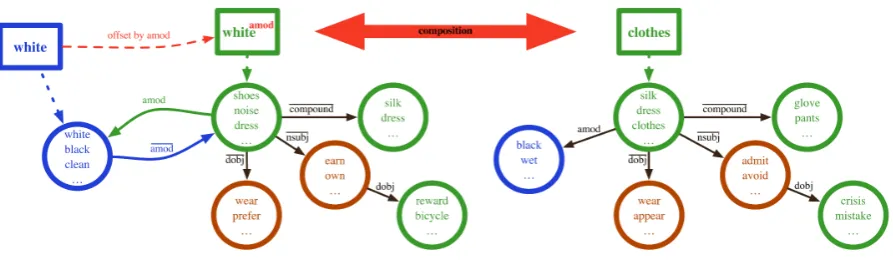
frame-work. Figure1shows the APTrepresentations for
the adjectivewhite(left) and the APTfor the noun
clothes (right), as might have been observed in a text collection. Each node holds a multiset of lex-emes and the anchor of an APTreflects the current
perspective of a lexeme at the given node. An off-set representation can be created by shifting the anchor along a given path. For example the lex-emewhite is at the same node as other adjectives such as black and clean, whereas nouns such as
shoesornoiseare typically reached via theamod
edge.
Offsetting in APTs only involves a change in
the anchor, the underlying structure remains un-changed. By offsetting the lexemewhitebyamod
the anchor is shifted along theamodedge, which results in creating a noun view for the adjective
white. We denote the offset view of a lexeme for a given path by superscripting the offset path, for example theamodoffset of the adjectivewhiteis denoted as whiteamod. The offsetting procedure
changes the starting points of the paths as visi-ble in Figure1between the anchors forwhiteand
whiteamod, since paths always begin at the anchor.
The red dashed line in Figure1reflects that anchor shift. The lexeme whiteamod represents a
proto-typical “white thing”, that is, a noun that has been modified by the adjective white. We note that all edges in the APT space are bi-directional as
ex-emplified in the colouredamod andamodedges in the APTforwhite, however for brevity we only
show uni-directional edges in Figure1.
By considering the APTrepresentations for the
lexemes white and clothes in Figure 1, it be-comes apparent that lexemes with different parts of speech are located in different areas of the
semantic space. If we want to compose the
adjective-noun phrase white clothes, we need to offset one of the two constituents to align the fea-ture spaces in order to leverage their distributional commonalities. This can be achieved by either creating a noun offset view of white, by
shift-ing the anchor along the amod edge, or by cre-ating an adjective offset representation ofclothes
by shifting its anchor along amod. In this work we follow Weir et al. (2016) and always offset the dependent in a given relation. Table1 shows
a subset of the features of Figure 1 as would
be represented in a vectorised APT. Vectorising
the whole APT lexicon results in a very
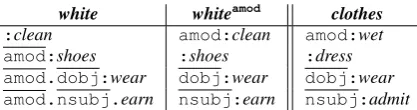
high-dimensional and sparse typed distributional space. The features forwhiteamod(middle column)
high-light the change in feature space caused by offset-ting the adjective white. The features of the off-set viewwhiteamod, are now aligned with the noun
clothessuch that the two can be composed. Com-position can be performed by either selecting the
unionorintersectionof the aligned features.
white whiteamod clothes
:clean amod:clean amod:wet
amod:shoes :shoes :dress
amod.dobj:wear dobj:wear dobj:wear
[image:2.595.314.523.290.345.2]amod.nsubj.earn nsubj:earn nsubj:admit Table 1: Sample of vectorised features for the APTs shown in Figure1. Offsettingwhitebyamodcreates an offset view, whiteamod, representing a noun, and has the consequence of
aligning the feature space withclothes.
2.1 Qualitative Analysis of Offset Representations
Any offset view of a lexeme is behaviourally iden-tical to a “normal” lexeme. It has an associ-ated part of speech, a distributional representation which locates it in semantic space, and we can find neighbours for it in the same way that we find neighbours for any other lexeme. In this way, a single APTdata structure is able to provide many
different views of any given lexeme. These views reflect the different ways in which the lexeme is used. For example lawnsubj is the nsubj
off-set representation of the noun law. This lexeme is a verb and represents an action carried out by thelaw. This contrasts withlawdobj, which is the
dobjoffset representation of the noun law. It is also a verb, however represents actions done to the
law. Table 2 lists the10 nearest neighbours for
a number of lexemes, offset byamod,dobj and
nsubjrespectively.
For example, the neighbourhood of the lexeme
ancient in Table 2shows that the offset view for
ancientamod is a prototypical representation of an
Figure 1: Structured distributional APTspace. Different colours reflect different parts of speech. Boxes denote the current anchor of the APT, circles represent nodes in the APTspace, holding lexemes, and edges represent their relationship within the space.
illustrates that nearest neighbours of offset views are often other offset representations. This means that for example actions carried out by a mother
tend to be similar to actions carried out by afather
or aparent.
2.2 Offset Inference
Our approach generalises the unsupervised algo-rithm proposed byKober et al.(2016), henceforth “standard DI”, as a method for inferring missing
knowledge into an APT representation. Rather
than simply inferring potentially plausible, but un-observed co-occurrences from near distributional neighbours, inferences can be made involving off-set APTs. For example, the adjective white can
be offset so that it represents a noun — a proto-typical “white thing”. This allows inferring plau-sible co-occurrences from other “things that can be white”, such asshoesorshirts. Our algorithm therefore reflects the contextualised use of a word. This has the advantage of being able to make flex-ible and fine grained distinctions in the inference process. For example if the noun lawis used as a subject, our algorithm allows inferring plausi-ble co-occurrences from “other actions carried out by the law”. This contrasts the use oflaw as an object, where offset inference is able to find co-occurrences on the basis of “other actions done to the law”. This is a crucial advantage over the method ofKober et al.(2016) which only supports inference on uncontextualised lexemes.
A sketch of how offset inference for a lexeme
wworks is shown in Algorithm1. Our algorithm
requires a distributional modelM, an APT
repre-sentation for the lexeme w for which to perform
offset inference, a dependency pathp, describing
the offset forw, and the number of neighboursk.
The offset representation of w0 is then enriched with the information from its distributional neigh-bours by some merge function. We note that if the offset pathpis the empty path, we would recover
the algorithm presented by Kober et al. (2016). Our algorithm is unsupervised, and agnostic to the input distributional model and the neighbour re-trieval function.
Algorithm 1Offset Inference
1: procedureOFFSET INFERENCE(M,w,p,k)
2: w0 ←offset(w, p)
3: for allnin neighbours(M, w0, k)do
4: w00←merge(w00, n)
5: end for 6: returnw00 7: end procedure
Connection to Distributional Composition
An interesting observation is the similarity be-tween distributional inference and distributional composition, as both operations are realised by the same mechanism — an offset followed by infer-ring plausible co-occurrence counts for a single lexeme in the case of distributional inference, or for a phrase in the case of composition. The merg-ing of co-occurrence dimensions for distributional inference can also be any of the operations com-monly used for distributional composition such as pointwise minimum, maximum, addition or multi-plication.
miss-Offset Representation Nearest Neighbours
ancientamod civilzation, mythology, tradition, ruin, monument, trackway, tomb, antiquity, folklore, deity
redamod blueamod, blackamod, greenamod, darkamod, onion, pepper, red, tomato, carrot, garlic
economicamod politicalamod, societalamod, cohabiting, economy, growth, cohabitant, globalisation, competitiveness,
globalization, prosperity
governmentdobj overthrow, partydobj, authoritydobj, leaderdobj, capitaldobj, forcedobj, statedobj, officialdobj, ministerdobj, oust
problemdobj difficultydobj, solve, coded, issuedobj, injurydobj, overcome, questiondobj, think, lossdobj, relieve
lawdobj violate, ruledobj, enact, repeal, principledobj, unmake, enforce, policydobj, obey, flout
researchernsubj physiciannsubj, writernsubj, theorize, thwart, theorise, hypothesize, surmise, studentnsubj, workernsubj, apprehend
mothernsubj wifensubj, fathernsubj, parentnsubj, womannsubj, re-married, remarry, girlnsubj,breastfeed, familynsubj, disown
lawnsubj rulensubj, principlensubj, policynsubj, criminalize, casensubj, contractnsubj, prohibit, proscribe, enjoin, chargensubj
Table 2: List of the10nearest neighbours ofamod,dobjandnsubjoffset representations.
ing information, however with the risk of introduc-ing some noise. The latter on the other hand can be used as a process ofco-occurrence filtering, that is leveraging the enriched representations, while also sieving out the previously introduced noise.
3 Experiments
For our experiments we re-implemented the stan-dard DI method ofKober et al.(2016) for a direct comparison. We built an order 2 APTspace on the
basis of the concatenation of ukWaC, Wackype-dia and the BNC (Baroni et al.,2009), pre-parsed with the Malt parser (Nivre et al., 2006). We PPMI transformed the raw co-occurrence counts prior to composition, using a negative SPPMI shift of log 5 (Levy and Goldberg, 2014b). We also
experimented with composing normalised counts and applying the PPMI transformation after com-position as done byWeeds et al.(2017), however found composing PPMI scores to work better for this task.
We evaluate our offset inference algorithm on two popular short phrase composition benchmarks by Mitchell and Lapata (2008) andMitchell and Lapata (2010), henceforth ML08 and ML10 re-spectively. The ML08 dataset consists of 120 dis-tinct verb-object (VO) pairs and the ML10 dataset contains 108 adjective-noun (AN), 108 noun-noun (NN) and 108 verb-object pairs. The goal is to compare a model’s similarity estimates to human provided judgements. For both tasks, each phrase pair has been rated by multiple human annotators on a scale between 1 and 7, where 7 indicates max-imum similarity. Comparison with human judge-ments is achieved by calculating Spearman’s ρ
between the model’s similarity estimates and the scores of each human annotator individually. We performed composition byintersectionand tuned the number of neighbours by a grid search over{0, 10, 30, 50, 100, 500, 1000}on the ML10
develop-ment set, selecting 10 neighbours for NNs, 100 for ANs and 50 for VOs for both DI algorithms. We calculate statistical significance using the method ofSteiger(1980).
Effect of the number of neighbours
Figure2shows the effect of the number of neigh-bours for AN, NN and VO phrases, using offset inference, on the ML10 development set. Interest-ingly, NN compounds exhibit an early saturation effect, while VOs and ANs require more neigh-bours for optimal performance. One explanation for the observed behaviour is that up to some threshold, the neighbours being added contribute actually missing co-occurrence events, whereas past that threshold distributional inference de-grades to just generic smoothing that is simply compensating for sparsity, but overwhelming the representations with non-plausible co-occurrence information. A similar effect has also been ob-served by Erk and Pado (2010) in an exemplar-based model.
Figure 2: Effect of the number of neighbours on the ML10 development set.
Results
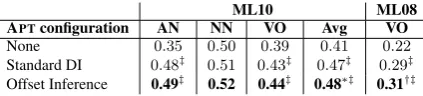
[image:4.595.309.524.518.665.2]the method ofKober et al.(2016) by a statistically significant margin on both datasets.
ML10 ML08
APTconfiguration AN NN VO Avg VO
None 0.35 0.50 0.39 0.41 0.22
Standard DI 0.48‡ 0.51 0.43‡ 0.47‡ 0.29‡
Offset Inference 0.49‡ 0.52 0.44‡ 0.48∗‡ 0.31†‡
Table 3: Comparison of DI algorithms. ‡denotes statistical significance atp <0.01in comparison to the method without DI, * denotes statistical significance atp <0.01in compar-ison to standard DI and†denotes statistical significance at p <0.05in comparison to standard DI.
Table4shows that offset inference substantially
outperforms comparable sparse models by Dinu
et al.(2013) on ML08, achieving a new of-the-art, and matches the performance of the
state-of-the-art neural network model of Hashimoto
et al. (2014) on ML10, while being fully inter-pretable.
Model ML10 - Average ML08
Our work 0.48 0.31
Blacoe and Lapata(2012) 0.44
-Hashimoto et al.(2014) 0.48
-Weir et al.(2016) 0.43 0.26
Dinu et al.(2013) - 0.23−0.26
[image:5.595.76.288.100.148.2]Erk and Pad´o(2008) - 0.27
Table 4: Comparison with existing methods.
4 Related Work
Distributional inference has its roots in the work of Dagan et al. (1993, 1994), who aim to find probability estimates for unseen words in bi-grams, and Sch¨utze (1992, 1998) who leverages the distributional neighbourhood through cluster-ing of contexts for word-sense discrimination. Re-centlyKober et al. (2016) revitalised the idea for compositional distributional semantic models.
Composition with distributional semantic mod-els has become a popular research area in re-cent years. Simple, yet competitive methods, are based on pointwise vector addition or multiplica-tion (Mitchell and Lapata,2008,2010). However, these approaches neglect the structure of the text defining composition as a commutative operation. A number of approaches proposed in the lit-erature attempt to overcome this shortcoming by introducing weighted additive variants (Guevara,
2010,2011;Zanzotto et al.,2010). Another popu-lar strand of work models semantic composition on the basis of ideas arising in formal seman-tics. Composition in such models is usually imple-mented as operations on higher-order tensors (
Ba-roni and Zamparelli,2010;Baroni et al.,2014; Co-ecke et al.,2011;Grefenstette et al.,2011; Grefen-stette and Sadrzadeh, 2011; Grefenstette et al.,
2013; Kartsaklis and Sadrzadeh, 2014; Paperno et al.,2014;Tian et al.,2016;Van de Cruys et al.,
2013). Another widespread approach to
seman-tic composition is to use neural networks ( Bow-man et al., 2016; Hashimoto et al., 2014; Hill et al.,2016;Mou et al.,2015;Socher et al.,2012,
2014;Wieting et al.,2015;Yu and Dredze,2015), or convolutional tree kernels (Croce et al., 2011;
Zanzotto and Dell’Arciprete, 2012;Annesi et al.,
2014) as composition functions.
The above approaches are applied to untyped distributional vector space models where untyped models contrast with typed models (Baroni and Lenci, 2010) in terms of whether structural in-formation is encoded in the representation as in the models of Erk and Pad´o (2008); Gamallo and Pereira-Fari˜na (2017); Levy and Goldberg
(2014a); Pad´o and Lapata (2007); Thater et al.
(2010,2011);Weeds et al.(2014).
The perhaps most popular approach in the lit-erature to evaluating compositional distributional semantic models is to compare human word and phrase similarity judgements with similarity esti-mates of composed meaning representations, un-der the assumption that better distributional repre-sentations will perform better at these tasks ( Bla-coe and Lapata,2012;Dinu et al., 2013;Erk and Pad´o,2008;Hashimoto et al.,2014;Hermann and Blunsom,2013;Kiela et al.,2014;Turney,2012).
5 Conclusion
In this paper we have introduced a novel form of distributional inference that generalises the method introduced by Kober et al. (2016). We have shown its effectiveness for semantic compo-sition on two benchmark phrase similarity tasks where we achieved state-of-the-art performance while retaining the interpretability of our model. We have furthermore highlighted an interesting connection between distributional inference and distributional composition.
[image:5.595.74.289.325.392.2]References
Paolo Annesi, Danilo Croce, and Roberto Basili. 2014. Semantic compositionality in tree ker-nels. In Proceedings of the 23rd ACM Inter-national Conference on Conference on Informa-tion and Knowledge Management. ACM, New York, NY, USA, CIKM ’14, pages 1029–1038. https://doi.org/10.1145/2661829.2661955.
Marco Baroni, Raffaella Bernardi, and Roberto Zam-parelli. 2014. Frege in space: A program for compo-sitional distributional semantics. Linguistic Issues in Language Technology9(6):5–110.
Marco Baroni, Silvia Bernardini, Adriano Fer-raresi, and Eros Zanchetta. 2009. The wacky wide web: a collection of very large linguis-tically processed web-crawled corpora. Lan-guage Resources and Evaluation 43(3):209–226. https://doi.org/10.1007/s10579-009-9081-4. Marco Baroni and Alessandro Lenci. 2010.
Dis-tributional memory: A general framework for corpus-based semantics. Computational Linguistics 36(4):673–721.
Marco Baroni and Roberto Zamparelli. 2010. Nouns are vectors, adjectives are matrices: Repre-senting adjective-noun constructions in seman-tic space. In Proceedings of the 2010 Con-ference on Empirical Methods in Natural Lan-guage Processing. Association for Computational Linguistics, Cambridge, MA, pages 1183–1193. http://www.aclweb.org/anthology/D10-1115. William Blacoe and Mirella Lapata. 2012. A
com-parison of vector-based representations for seman-tic composition. In Proceedings of the 2012 Joint Conference on Empirical Methods in ral Language Processing and Computational Natu-ral Language Learning. Association for Computa-tional Linguistics, Jeju Island, Korea, pages 546– 556. http://www.aclweb.org/anthology/D12-1050. Samuel R. Bowman, Jon Gauthier, Abhinav
Ras-togi, Raghav Gupta, Christopher D. Manning, and Christopher Potts. 2016. A fast unified model for parsing and sentence understanding. In Pro-ceedings of the 54th Annual Meeting of the As-sociation for Computational Linguistics (Volume 1: Long Papers). Association for Computational Linguistics, Berlin, Germany, pages 1466–1477. http://www.aclweb.org/anthology/P16-1139.
Bob Coecke, Mehrnoosh Sadrzadeh, and Stephen Clark. 2011. Mathematical foundations for a com-positional distributed model of meaning. Linguistic Analysis36(1-4):345–384.
Danilo Croce, Alessandro Moschitti, and Roberto Basili. 2011. Structured lexical similarity via convolution kernels on dependency trees. In Proceedings of the 2011 Conference on Em-pirical Methods in Natural Language Process-ing. Association for Computational Linguistics,
Edinburgh, Scotland, UK., pages 1034–1046. http://www.aclweb.org/anthology/D11-1096. Ido Dagan, Shaul Marcus, and Shaul Markovitch.
1993. Contextual word similarity and estimation from sparse data. In Proceedings of the 31st An-nual Meeting on Association for Computational Lin-guistics. Association for Computational Linguistics, Stroudsburg, PA, USA, ACL ’93, pages 164–171. https://doi.org/10.3115/981574.981596.
Ido Dagan, Fernando Pereira, and Lillian Lee. 1994. Similarity-based estimation of word cooccurrence probabilities. In Proceedings of the 32nd Annual Meeting of the Association for Computational Lin-guistics. Association for Computational Linguistics, Las Cruces, New Mexico, USA, pages 272–278. https://doi.org/10.3115/981732.981770.
Georgiana Dinu, Nghia The Pham, and Marco Baroni. 2013. General estimation and evaluation of compo-sitional distributional semantic models. In Proceed-ings of the Workshop on Continuous Vector Space Models and their Compositionality. Association for Computational Linguistics, Sofia, Bulgaria, pages 50–58. http://www.aclweb.org/anthology/W13-3206.
Katrin Erk and Sebastian Pad´o. 2008. A struc-tured vector space model for word meaning in context. In Proceedings of the 2008 Con-ference on Empirical Methods in Natural Lan-guage Processing. Association for Computational Linguistics, Honolulu, Hawaii, pages 897–906. http://www.aclweb.org/anthology/D08-1094. Katrin Erk and Sebastian Pado. 2010.
Exemplar-based models for word meaning in context. In Proceedings of the ACL 2010 Conference Short Papers. Association for Computational Linguistics, Uppsala, Sweden, pages 92–97. http://www.aclweb.org/anthology/P10-2017. Pablo Gamallo and Mart´ın Pereira-Fari˜na. 2017.
Com-positional semantics using feature-based models from wordnet. In Proceedings of the 1st Work-shop on Sense, Concept and Entity Representa-tions and their ApplicaRepresenta-tions. Association for Com-putational Linguistics, Valencia, Spain, pages 1–11. http://www.aclweb.org/anthology/W17-1901. E. Grefenstette, G. Dinu, Y. Zhang, M. Sadrzadeh,
and M. Baroni. 2013. Multi-step regression learning for compositional distributional seman-tics. In Proceedings of the 10th International Conference on Computational Semantics (IWCS 2013) – Long Papers. Association for Computa-tional Linguistics, Potsdam, Germany, pages 131– 142. http://www.aclweb.org/anthology/W13-0112. Edward Grefenstette and Mehrnoosh Sadrzadeh. 2011.
Edinburgh, Scotland, UK., pages 1394–1404. http://www.aclweb.org/anthology/D11-1129.
Edward Grefenstette, Mehrnoosh Sadrzadeh, Stephen Clark, Bob Coecke, and Stephen Pulman. 2011. Concrete sentence spaces for compositional distri-butional models of meaning. Proceedings of the 9th International Conference on Computational Seman-tics (IWCS 2011)pages 125–134.
Emiliano Guevara. 2010. A regression model of adjective-noun compositionality in distribu-tional semantics. In Proceedings of the 2010 Workshop on GEometrical Models of Natural Language Semantics. Association for Computa-tional Linguistics, Uppsala, Sweden, pages 33–37. http://www.aclweb.org/anthology/W10-2805.
Emiliano Guevara. 2011. Computing semantic com-positionality in distributional semantics. In Pro-ceedings of the Ninth International Conference on Computational Semantics. Association for Compu-tational Linguistics, Stroudsburg, PA, USA, IWCS ’11, pages 135–144.
Kazuma Hashimoto, Pontus Stenetorp, Makoto Miwa, and Yoshimasa Tsuruoka. 2014. Jointly learning word representations and composition functions using predicate-argument structures. In Proceedings of the 2014 Conference on Empirical Methods in Natural Language Pro-cessing (EMNLP). Association for Computational Linguistics, Doha, Qatar, pages 1544–1555. http://www.aclweb.org/anthology/D14-1163.
Karl Moritz Hermann and Phil Blunsom. 2013. The role of syntax in vector space models of composi-tional semantics. InProceedings of the 51st Annual Meeting of the Association for Computational Lin-guistics (Volume 1: Long Papers). Association for Computational Linguistics, Sofia, Bulgaria, pages 894–904. http://www.aclweb.org/anthology/P13-1088.
Felix Hill, KyungHyun Cho, Anna Korho-nen, and Yoshua Bengio. 2016. Learning to understand phrases by embedding the dictionary. Transactions of the Associa-tion for ComputaAssocia-tional Linguistics 4:17–30. http://www.aclweb.org/anthology/Q/Q16/Q16-1002.pdf.
Dimitri Kartsaklis and Mehrnoosh Sadrzadeh. 2014. A study of entanglement in a categorical framework of natural language. InProceedings of the 11th Work-shop on Quantum Physics and Logic (QPL).
Douwe Kiela, Felix Hill, Anna Korhonen, and Stephen Clark. 2014. Improving multi-modal representa-tions using image dispersion: Why less is sometimes more. In Proceedings of the 52nd Annual Meet-ing of the Association for Computational LMeet-inguistics (Volume 2: Short Papers). Association for Computa-tional Linguistics, Baltimore, Maryland, pages 835– 841. http://www.aclweb.org/anthology/P14-2135.
Thomas Kober, Julie Weeds, Jeremy Reffin, and David Weir. 2016. Improving sparse word rep-resentations with distributional inference for se-mantic composition. In Proceedings of the 2016 Conference on Empirical Methods in Natu-ral Language Processing. Association for Computa-tional Linguistics, Austin, Texas, pages 1691–1702. https://aclweb.org/anthology/D16-1175.
Omer Levy and Yoav Goldberg. 2014a. Dependency-based word embeddings. In Proceedings of the 52nd Annual Meeting of the Association for Computational Linguistics (Volume 2: Short Papers). Association for Computational Lin-guistics, Baltimore, Maryland, pages 302–308. http://www.aclweb.org/anthology/P14-2050. Omer Levy and Yoav Goldberg. 2014b. Neural
word embedding as implicit matrix factorization. In Z. Ghahramani, M. Welling, C. Cortes, N.D. Lawrence, and K.Q. Weinberger, editors,Advances in Neural Information Processing Systems 27, Cur-ran Associates, Inc., pages 2177–2185.
Jeff Mitchell and Mirella Lapata. 2008. Vector-based models of semantic composition. In Proceed-ings of ACL-08: HLT. Association for Computa-tional Linguistics, Columbus, Ohio, pages 236–244. http://www.aclweb.org/anthology/P/P08/P08-1028. Jeff Mitchell and Mirella Lapata. 2010.
Com-position in distributional models of seman-tics. Cognitive Science 34(8):1388–1429. https://doi.org/10.1111/j.1551-6709.2010.01106.x. Lili Mou, Hao Peng, Ge Li, Yan Xu, Lu Zhang, and
Zhi Jin. 2015. Discriminative neural sentence mod-eling by tree-based convolution. InProceedings of the 2015 Conference on Empirical Methods in Nat-ural Language Processing. Association for Compu-tational Linguistics, Lisbon, Portugal, pages 2315– 2325.http://aclweb.org/anthology/D15-1279. Joakim Nivre, Johan Hall, and Jens Nilsson. 2006.
Maltparser: A data-driven parser-generator for de-pendency parsing. Technical report, V¨axj¨o Univer-sity.
Sebastian Pad´o and Mirella Lapata. 2007. Dependency-based construction of semantic space models. Computational Linguistics33(2):161–199. https://doi.org/10.1162/coli.2007.33.2.161.
Denis Paperno, Nghia The Pham, and Marco Baroni. 2014. A practical and linguistically-motivated ap-proach to compositional distributional semantics. In Proceedings of the 52nd Annual Meeting of the Association for Computational Linguistics (Vol-ume 1: Long Papers). Association for Computa-tional Linguistics, Baltimore, Maryland, pages 90– 99.http://www.aclweb.org/anthology/P14-1009. Hinrich Sch¨utze. 1992. Dimensions of
Hinrich Sch¨utze. 1998. Automatic word sense discrim-ination. Computational Linguistics24(1):97–123.
Richard Socher, Brody Huval, Christopher D. Man-ning, and Andrew Y. Ng. 2012. Semantic compositionality through recursive matrix-vector spaces. In Proceedings of the 2012 Joint Con-ference on Empirical Methods in Natural guage Processing and Computational Natural Lan-guage Learning. Association for Computational Linguistics, Jeju Island, Korea, pages 1201–1211. http://www.aclweb.org/anthology/D12-1110.
Richard Socher, Andrej Karpathy, Quoc Le, Christo-pher Manning, and Andrew Ng. 2014. Grounded compositional semantics for finding and describing images with sentences. Transactions of the Associa-tion for ComputaAssocia-tional Linguistics2:207–218.
James H Steiger. 1980. Tests for comparing ele-ments of a correlation matrix. Psychological Bul-letin87(2):245.
Stefan Thater, Hagen F¨urstenau, and Manfred Pinkal. 2010. Contextualizing semantic representations us-ing syntactically enriched vector models. In Pro-ceedings of the 48th Annual Meeting of the Associa-tion for ComputaAssocia-tional Linguistics. Association for Computational Linguistics, Uppsala, Sweden, pages 948–957. http://www.aclweb.org/anthology/P10-1097.
Stefan Thater, Hagen F¨urstenau, and Manfred Pinkal. 2011. Word meaning in context: A simple and ef-fective vector model. InProceedings of 5th Interna-tional Joint Conference on Natural Language Pro-cessing. Asian Federation of Natural Language Pro-cessing, Chiang Mai, Thailand, pages 1134–1143. http://www.aclweb.org/anthology/I11-1127.
Ran Tian, Naoaki Okazaki, and Kentaro Inui. 2016. Learning semantically and additively composi-tional distribucomposi-tional representations. In Proceed-ings of the 54th Annual Meeting of the As-sociation for Computational Linguistics (Volume 1: Long Papers). Association for Computational Linguistics, Berlin, Germany, pages 1277–1287. http://www.aclweb.org/anthology/P16-1121.
Peter D. Turney. 2012. Domain and function: A dual-space model of semantic relations and compo-sitions. Journal of Artificial Intelligence Research 44(1):533–585.
Tim Van de Cruys, Thierry Poibeau, and Anna Korho-nen. 2013. A tensor-based factorization model of se-mantic compositionality. InProceedings of the 2013 Conference of the North American Chapter of the Association for Computational Linguistics: Human Language Technologies. Association for Computa-tional Linguistics, Atlanta, Georgia, pages 1142– 1151.http://www.aclweb.org/anthology/N13-1134.
Julie Weeds, Thomas Kober, Jeremy Reffin, and David Weir. 2017. When a red herring in not a red
herring: Using compositional methods to detect non-compositional phrases. InProceedings of the 15th Conference of the European Chapter of the Association for Computational Linguistics: Vol-ume 2, Short Papers. Association for Computa-tional Linguistics, Valencia, Spain, pages 529–534. http://www.aclweb.org/anthology/E17-2085.
Julie Weeds, David Weir, and Jeremy Reffin. 2014. Distributional composition using higher-order de-pendency vectors. InProceedings of the 2nd Work-shop on Continuous Vector Space Models and their Compositionality (CVSC). Association for Compu-tational Linguistics, Gothenburg, Sweden, pages 11–20. http://www.aclweb.org/anthology/W14-1502.
David Weir, Julie Weeds, Jeremy Reffin, and Thomas Kober. 2016. Aligning packed dependency trees: a theory of composition for distributional semantics. Computational Linguistics, special issue on Formal Distributional Semantics42(4):727–761.
John Wieting, Mohit Bansal, Kevin Gimpel, and Karen Livescu. 2015. From paraphrase database to compositional paraphrase model and back. Transactions of the Association for Computational Linguistics 3:345–358. http://www.aclweb.org/anthology/Q/Q15/Q15-1025.pdf.
Mo Yu and Mark Dredze. 2015. Learning composition models for phrase embeddings. Transactions of the Association for Computational Linguistics 3:227– 242. http://aclweb.org/anthology/Q/Q15/Q15-1017.pdf.
Fabio Massimo Zanzotto and Lorenzo Dell’Arciprete. 2012. Distributed tree kernels. In John Lang-ford and Joelle Pineau, editors, Proceedings of the 29th International Conference on Machine Learning (ICML-12). Omnipress, New York, NY, USA, ICML ’12, pages 193–200.