2005;
V
ol. 9: No. 50
P
arent training/education programmes for the treatment of conduct disorder
The effectiveness and cost-effectiveness
of parent training/education
programmes for the treatment of
conduct disorder, including oppositional
defiant disorder, in children
J Dretzke, E Frew, C Davenport, J Barlow,
S Stewart-Brown, J Sandercock, S Bayliss,
J Raftery, C Hyde and R Taylor
HTA
Health Technology Assessment
NHS R&D HTA Programme
The National Coordinating Centre for Health Technology Assessment,Mailpoint 728, Boldrewood, University of Southampton, Southampton, SO16 7PX, UK.
Fax: +44 (0) 23 8059 5639 Email: [email protected]
http://www.ncchta.org ISSN 1366-5278
Feedback
The HTA Programme and the authors would like to know your views about this report.
The Correspondence Page on the HTA website (http://www.ncchta.org) is a convenient way to publish your comments. If you prefer, you can send your comments
to the address below, telling us whether you would like us to transfer them to the website.
We look forward to hearing from you.
How to obtain copies of this and other HTA Programme reports.
An electronic version of this publication, in Adobe Acrobat format, is available for downloading free of charge for personal use from the HTA website (http://www.hta.ac.uk). A fully searchable CD-ROM is also available (see below).
Printed copies of HTA monographs cost £20 each (post and packing free in the UK) to both public and
private sector purchasers from our Despatch Agents.
Non-UK purchasers will have to pay a small fee for post and packing. For European countries the cost is £2 per monograph and for the rest of the world £3 per monograph.
You can order HTA monographs from our Despatch Agents: – fax (with credit card or official purchase order)
– post (with credit card or official purchase order or cheque) – phone during office hours (credit cardonly).
Additionally the HTA website allows you either to pay securely by credit card or to print out your order and then post or fax it.
Contact details are as follows:
HTA Despatch Email: [email protected]
c/o Direct Mail Works Ltd Tel: 02392 492 000 4 Oakwood Business Centre Fax: 02392 478 555
Downley, HAVANT PO9 2NP, UK Fax from outside the UK: +44 2392 478 555 NHS libraries can subscribe free of charge. Public libraries can subscribe at a very reduced cost of £100 for each volume (normally comprising 30–40 titles). The commercial subscription rate is £300 per volume. Please see our website for details. Subscriptions can only be purchased for the current or forthcoming volume.
Payment methods
Paying by cheque
If you pay by cheque, the cheque must be in pounds sterling, made payable to Direct Mail Works Ltd and drawn on a bank with a UK address.
Paying by credit card
The following cards are accepted by phone, fax, post or via the website ordering pages: Delta, Eurocard, Mastercard, Solo, Switch and Visa. We advise against sending credit card details in a plain email.
Paying by official purchase order
You can post or fax these, but they must be from public bodies (i.e. NHS or universities) within the UK. We cannot at present accept purchase orders from commercial companies or from outside the UK.
How do I get a copy of HTA on CD?
Please use the form on the HTA website (www.hta.ac.uk/htacd.htm). Or contact Direct Mail Works (see contact details above) by email, post, fax or phone. HTA on CDis currently free of charge worldwide.
conduct disorder, including oppositional
defiant disorder, in children
J Dretzke,
1*
E Frew,
2
C Davenport,
1
J Barlow,
3
S Stewart-Brown,
4
J Sandercock,
1
S Bayliss,
1
J Raftery,
2
C Hyde
1
and R Taylor
1
1
West Midlands Health Technology Assessment Collaboration, Department
of Public Health and Epidemiology, University of Birmingham, UK
2Health Economics Facility, Health Services Management Centre,
University of Birmingham, UK
3
Health Service Research Unit, Department of Public Health, University of
Oxford, Institute of Health Sciences, UK
4
Division of Health in the Community, Warwick Medical School, LWMS,
University of Warwick, Coventry, UK
* Corresponding author
Declared competing interests of authors:S Stewart-Brown’s partner works for a charity providing school-based parent training; there is no financial interest. C Hyde is a member of the editorial board for Health Technology Assessment, although he was not involved in the editorial process for this report.
Published December 2005
This report should be referenced as follows:
Dretzke J, Frew E, Davenport C, Barlow J, Stewart-Brown S, Sandercock J, et al. The effectiveness and cost-effectiveness of parent training/education programmes for the treatment of conduct disorder, including oppositional defiant disorder, in children. Health Technol Assess2005;9(50).
Excellence (NICE) and the National Screening Committee (NSC) who rely on HTA outputs to help raise standards of care. HTA findings also help to improve the quality of the service in the NHS indirectly in that they form a key component of the ‘National Knowledge Service’ that is being developed to improve the evidence of clinical practice throughout the NHS.
The HTA Programme was set up in 1993. Its role is to ensure that high-quality research information on the costs, effectiveness and broader impact of health technologies is produced in the most efficient way for those who use, manage and provide care in the NHS. ‘Health technologies’ are broadly defined to include all interventions used to promote health, prevent and treat disease, and improve rehabilitation and long-term care, rather than settings of care.
The HTA Programme commissions research only on topics where it has identified key gaps in the evidence needed by the NHS. Suggestions for topics are actively sought from people working in the NHS, the public, service-users groups and professional bodies such as Royal Colleges and NHS Trusts. Research suggestions are carefully considered by panels of independent experts (including service users) whose advice results in a ranked list of recommended research priorities. The HTA Programme then commissions the research team best suited to undertake the work, in the manner most appropriate to find the relevant answers. Some projects may take only months, others need several years to answer the research questions adequately. They may involve synthesising existing evidence or conducting a trial to produce new evidence where none currently exists.
Additionally, through its Technology Assessment Report (TAR) call-off contract, the HTA Programme is able to commission bespoke reports, principally for NICE, but also for other policy customers, such as a National Clinical Director. TARs bring together evidence on key aspects of the use of specific
technologies and usually have to be completed within a short time period.
Criteria for inclusion in the HTA monograph series
Reports are published in the HTA monograph series if (1) they have resulted from work commissioned for the HTA Programme, and (2) they are of a sufficiently high scientific quality as assessed by the referees and editors.
Reviews in Health Technology Assessment are termed ‘systematic’ when the account of the search,
appraisal and synthesis methods (to minimise biases and random errors) would, in theory, permit the replication of the review by others.
The research reported in this monograph was commissioned and funded by the HTA Programme on behalf of NICE as project number 03/21/01.The protocol was agreed in October 2003. The assessment report began editorial review in July 2004 and was accepted for publication in December 2004. The authors have been wholly responsible for all data collection, analysis and interpretation, and for writing up their work. The HTA editors and publisher have tried to ensure the accuracy of the authors’ report and would like to thank the referees for their constructive comments on the draft document. However, they do not accept liability for damages or losses arising from material published in this report. The views expressed in this publication are those of the authors and not necessarily those of the HTA Programme, NICE or the Department of Health.
Editor-in-Chief: Professor Tom Walley
Series Editors: Dr Peter Davidson, Dr Chris Hyde, Dr Ruairidh Milne, Dr Rob Riemsma and Dr Ken Stein
Managing Editors: Sally Bailey and Sarah Llewellyn Lloyd
ISSN 1366-5278
© Queen’s Printer and Controller of HMSO 2005
This monograph may be freely reproduced for the purposes of private research and study and may be included in professional journals provided that suitable acknowledgement is made and the reproduction is not associated with any form of advertising.
Applications for commercial reproduction should be addressed to NCCHTA, Mailpoint 728, Boldrewood, University of Southampton, Southampton, SO16 7PX, UK.
Published by Gray Publishing, Tunbridge Wells, Kent, on behalf of NCCHTA.
Objectives: To assess the clinical and cost-effectiveness of parent training programmes for the treatment of children with conduct disorder (CD) up to the age of 18 years.
Data sources: Electronic databases.
Review methods: For the effectiveness review, relevant studies were identified and evaluated. A quantitative synthesis of behavioural outcomes across trials was also undertaken using two approaches: vote counting and meta-analysis. The economic analysis consisted of reviewing previous economic/cost evaluations of parent training/education programmes and the economic information within sponsor’s
submissions; carrying out a detailed exploration of costs of parent training/education programmes; and a de novo modelling assessment of the cost-effectiveness of parent training/education programmes. The potential budget impact to the health service of implementing such programmes was also considered.
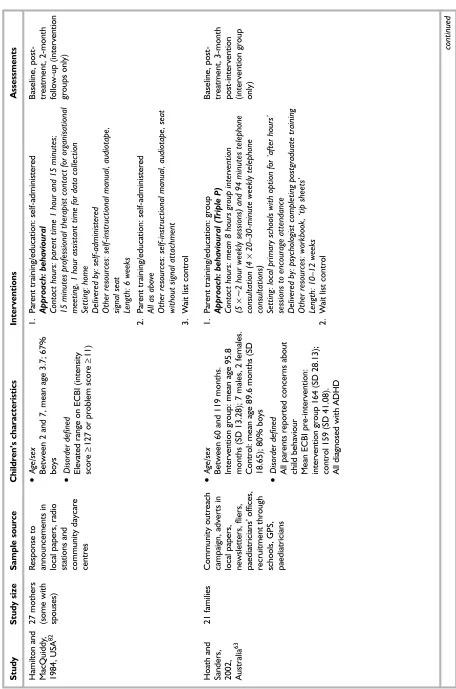
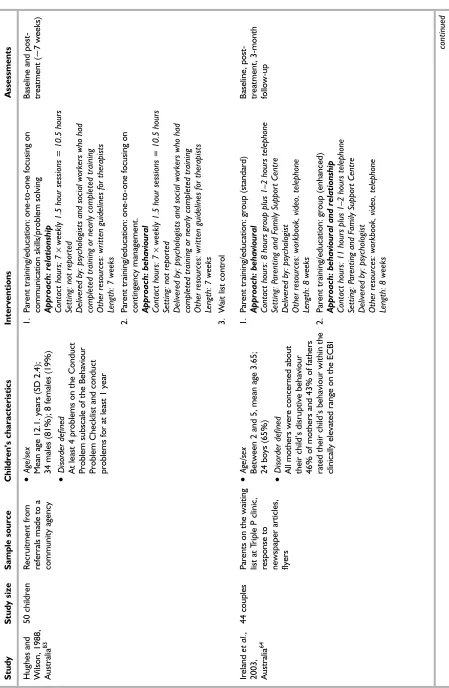
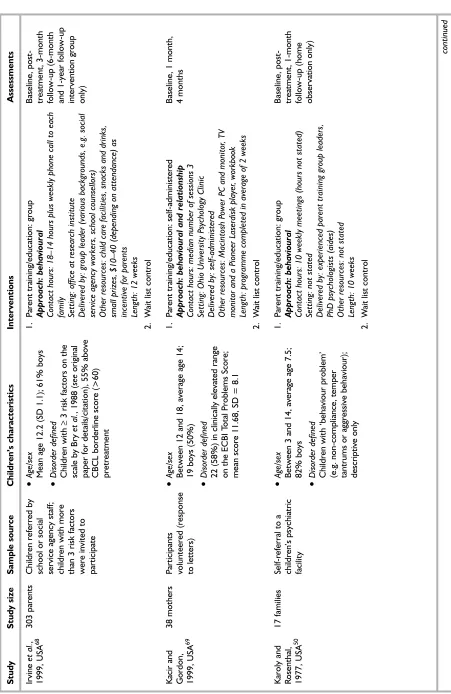
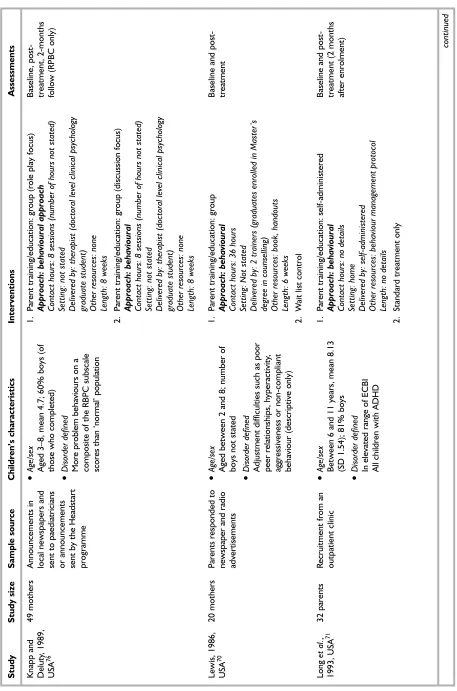
Results: Many of the 37 randomised controlled trials that met the review inclusion and exclusion criteria were assessed as being of poor methodological quality. Studies were clinically heterogeneous in terms of the population, type of parent training/education programme and content, setting, delivery, length and child behaviour outcomes used. Both vote counting and meta-analysis revealed a consistent trend across all studies towards short-term effectiveness (up to 4 months) of parent training/education programmes (compared with control) as measured by a change in child behaviour. Pooled estimates showed a statistically significant improvement on the Eyberg Child Behaviour Inventory frequency and intensity scales, the Dyadic Parent–Child Interaction
Coding System and the Child Behaviour Checklist. No studies reported a statistically significant result favouring control over parent training/education programmes. There were few statistically significant differences between different parent training/education programmes, although there was a trend towards more intensive interventions (e.g. longer contact hours, additional child involvement) being more effective. The cost of treating CD is high, with costs incurred by many agencies. A recent study suggested that by age 28, costs for
individuals with CD were around 10 times higher than for those with no problems, with a mean cost of £70,019. Criminality incurs the greatest cost, followed by
educational provision, foster and residential care and state benefits. Only a small proportion of these costs fall on health services. Using a ‘bottom-up’ costing approach, the costs per family of providing parent training/education programmes range from £629 to £3839 depending on the type and style of delivery. Using the conservative assumption that there are no cost savings from
treatment, a total lifetime quality of life gain of 0.1 would give a cost per quality-adjusted life-year of between £38,393 and £6288 depending on the type of programme delivery and setting.
Conclusions: Parent training/education programmes appear to be an effective and potentially cost-effective therapy for children with CD. However, the relative effectiveness and cost-effectiveness of different models (such as therapy intensity and setting) require further investigation. Further research is required on the impact of parent training/education programmes on the quality of life of children with CD and their parents/carers, as
well as on longer term child outcomes. iii
Abstract
The effectiveness and cost-effectiveness of parent
training/education programmes for the treatment of conduct
disorder, including oppositional defiant disorder, in children
J Dretzke,
1*E Frew,
2C Davenport,
1J Barlow,
3S Stewart-Brown,
4J Sandercock,
1S Bayliss,
1J Raftery,
2C Hyde
1and R Taylor
11West Midlands Health Technology Assessment Collaboration, Department of Public Health and Epidemiology,
University of Birmingham, UK
2Health Economics Facility, Health Services Management Centre, University of Birmingham, UK
3Health Service Research Unit, Department of Public Health, University of Oxford, Institute of Health Sciences, UK
4Division of Health in the Community, Warwick Medical School, LWMS, University of Warwick, Coventry, UK
Glossary and list of abbreviations ... vii
Executive summary... ix
1 Aim of the review ... 1
2 Background ... 3
Description of underlying health problem ... 3
Current service provision ... 6
Description of intervention ... 7
3 Review of existing reviews ... 9
Search strategy ... 9
Inclusion criteria ... 9
Results ... 9
Summary ... 13
4 Effectiveness ... 15
Methods for reviewing effectiveness ... 15
Results ... 18
Summary of effectiveness ... 54
5 Economic analysis ... 57
Review of previous economic/cost evaluations of parent training/education programmes ... 57
Review of sponsor submissions ... 60
Analysis of costs of parent training/education programmes ... 61
Estimating an incremental cost per ‘success’ and per quality-adjusted life-year (QALY) ... 65
Estimate of budget impact (from NHS/PSS perspective) ... 68
6 Implications for other parties... 71
7 Factors relevant to the NHS ... 73
8 Discussion ... 75
Main results: effectiveness ... 75
Main results: cost-effectiveness ... 76
Suggested further research ... 76
9 Conclusions ... 77
Acknowledgements... 79
References... 81
Appendix 1 DSM IV definition of conduct disorder and oppositional defiant disorder ... 87
Appendix 2 Methodological adequacy and results of the meta-analyses of the effectiveness of parent training programmes ... 89
Appendix 3 Inclusion and exclusion form ... 97
Appendix 4 Search strategies ... 99
Appendix 5 Excluded studies ... 105
Appendix 6 Main study characteristics ... 121
Appendix 7 Child behaviour-related outcome measures ... 161
Appendix 8 Quality assessment ... 169
Appendix 9 Direction of effect ... 207
Appendix 10 Vote counting approach ... 229
Appendix 11 Summary of economic evaluations ... 231
Health Technology Assessment reports published to date ... 235
Health Technology Assessment Programme ... 247
Glossary
Conduct disorder (CD) Defined in the 4th edition of the Diagnostic and Statistical Manual of
Mental Disorders(DSM IV) as a repetitive and
persistent pattern of aggressive, defiant or antisocial behaviour, as manifested by the presence of at least three or more of the specific criteria in the past 12 months with a least one criterion present in the past 6 months.
Oppositional defiant disorder (ODD) ODD is defined by a pattern of negativistic, defiant, disobedient and hostile behaviour toward authority figures as evident in such behaviour as temper tantrums, argumentativeness, refusing to comply with requests and deliberately annoying others. ODD shares many of the typical behaviours included in the diagnosis of conduct disorder.
Parent training/education programme
A programme which aims to help parents develop a range of skills, in order to identify, define, observe and respond to problem
behaviour in new ways. ‘Programme’ indicates that the intervention is structured with key components documented, so that it can be reliably applied by different workers with appropriate training. The programmes are generally focused and short-term (often 8–22 weeks). Typically parents attend the sessions without children.
Parent training/education: group based
Programme conducted with groups of parents and one or two therapists in different settings (clinic, community).
Parent training/education: individual A one-to-one programme where parents are seen individually by a therapist; conducted in a clinic or similar or at the parents’ home.
Parent training/education: self-administered
Parents self-administer the programme, e.g. by reading a manual or watching a set of videos; conducted at home or in a group setting in a clinic or similar; no therapist is present.
vii
Glossary and list of abbreviations
Technical terms and abbreviations are used throughout this report. The meaning is usually clear from the context, but a glossary is provided for the non-specialist reader. In some cases, usage differs in the
literature, but the term has a constant meaning throughout this review.
List of abbreviations
A&E accident and emergency
ADHD attention deficit/hyperactivity disorder
ANCOVA analysis of covariance
BAC Becker/Bipolar Adjective Checklist
BPQ Behar Preschool Behaviour Questionnaire
CAMHS Child and Adolescent Mental Health Services
CBCL Child Behaviour Checklist
CD conduct disorder
CI confidence interval
CT child training
viii
List of abbreviations
continued
DPICS Dyadic Parent–Child Interaction Coding System
DSM Diagnostic and Statistical Manual of
Mental Disorders
ECBI Eyberg Child Behaviour Inventory
ES effect size
HSQ Home Situations Questionnaire
ICD International Classification of
Diseases
ICER incremental cost-effectiveness ratio
ITT intention-to-treat
MANOVA multiple analysis of variance
NSF National Service Framework
ODD oppositional defiant disorder
ONS Office of National Statistics
OR odds ratio
PCT Primary Care Trust
PDR Parent Daily Report
PET Parent Effectiveness Training
PSS Personal Social Services
PT parent training
QALY quality-adjusted life-year
QoL quality of life
RBPC Revised Behaviour Problem Checklist
RCT randomised controlled trial
STEP Systematic Training for Effective Parenting
TT teacher training
ix
Aim
The aim of this review was to assess the clinical and cost-effectiveness of parent training
programmes for the treatment of children up to the age of 18 years, with conduct disorder (CD).
Description of proposed service
Parent training/education programmes are short-term, structured interventions, which aim to help parents develop their parenting skills in order to manage children’s problem behaviour more successfully. The programmes run on average for 10–12 weeks (with 1–2-hour weekly sessions) and their key components are documented and
repeatable. Most programmes are behavioural and their primary focus is to address the causes of problem behaviour, although many programmes will also incorporate components that focus on relationship issues. The programmes can be group or individual based, with a therapist or counsellor facilitating the training, and can take place in a variety of settings (e.g. clinics or community centres). The programmes can also be self-administered using workbooks or videos. In a majority of programmes the focus of the
intervention is on the parents only, although a few programmes exist that include children and/or teachers in the intervention.
Epidemiology and background
CD is a severe externalising disorder among children and adolescents (up to the age of 18) characterised by a constellation of persistent antisocial behaviours. Symptoms of CD overlap with those of oppositional defiant disorder (ODD) and attention deficit/hyperactivity disorder (ADHD), although these conditions also have characteristics that are distinct from either clinical condition independently. CD is the commonest psychiatric disorder of childhood (prevalence of around 5%) and the most common reason for referral for psychological and psychiatric treatment in children. Boys are more commonly affected than girls. CD is stable across time within both families and individuals and prognosis is
poor, with behaviour problems in childhood predicting a range of deleterious outcomes in adulthood, including delinquency and criminal behaviour. Although a diverse range of treatments has been used to treat CD, there has to date been an absence of clearly effective interventions.
Method
For the effectiveness review, relevant studies were identified and evaluated. A quantitative synthesis of behavioural outcomes across trials was also undertaken using two approaches: vote counting and meta-analysis. The economic analysis consisted of reviewing previous economic/cost evaluations of parent training/education
programmes and the economic information within sponsor’s submissions; carrying out a detailed exploration of costs of parent training/education programmes; and a de novomodelling assessment
of the cost-effectiveness of parent training/education programmes. The potential budget impact to the NHS/Personal Social Services (PSS) in England and Wales was also considered if parent training/education programmes were to be implemented.
Number and quality of studies
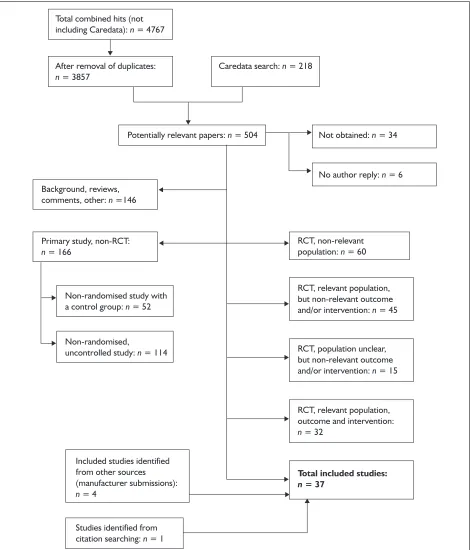
Evidence was available from 37 randomised controlled trials (RCTs) that met the review
inclusion and exclusion criteria. Overall, there was a lack of methodological detail, particularly
concerning randomisation and allocation
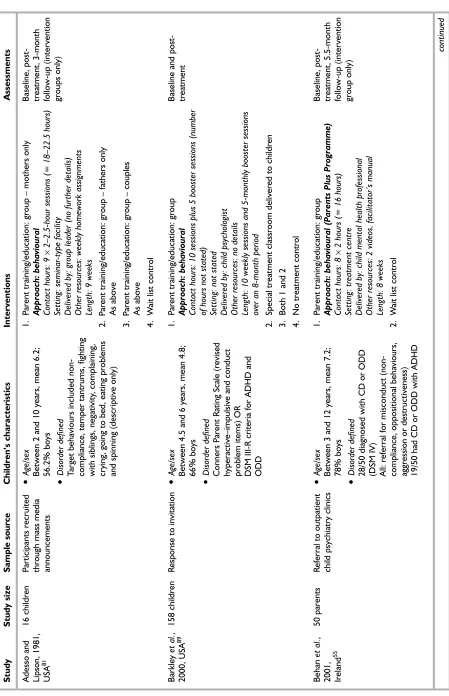
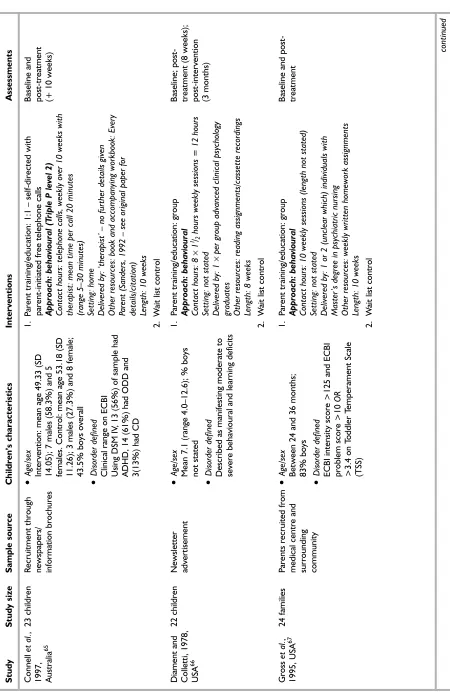
concealment, and as a result a majority of studies were assessed as being of poor methodological quality. Studies were clinically heterogeneous in terms of the population, type of parent
training/education programme and content, setting, delivery, length and child behaviour outcomes used.
Direction of evidence
Both vote counting and meta-analysis revealed a consistent trend across all studies towards short-term effectiveness (up to 4 months) of parent
x
training/education programmes (compared with control) as measured by a change in child behaviour (based on parent reports and independent observations of child behaviour). Pooled estimates showed a statistically significant improvement on the Eyberg Child Behaviour Inventory frequency and intensity scales, the Dyadic Parent–Child Interaction Coding System and the Child Behaviour Checklist. No studies reported a statistically significant result favouring control over parent training/education
programmes. There were few statistically significant differences between different parent training/education programmes, although there was a trend for more intensive interventions (e.g. longer contact hours, additional child
involvement) to be more effective.
Costs of CD
The cost of treating CD is high, with costs incurred by many agencies. A recent study
suggested that by age 28, costs for individuals with conduct disorder were around 10 times higher than for those with no problems, with a mean cost of £70,019. Criminality incurs the greatest cost, followed by educational provision, foster and residential care and state benefits. Only a small proportion of these costs fall on the NHS.
Costs of parent training/education
programmes
Using a ‘bottom-up’ costing approach, the costs per family of providing parent training/education programmes range from £629 to £3839
depending on the type and style of delivery. These costs assume that a health visitor is employed to implement the parent training/education programmes on a salary of £25,015 per year, a high level of supervision is provided and, for group delivery, two health visitors will deliver the programme with an average attendance of eight families per group. It was not possible to translate results from RCTs into direct estimates of utility gain, and there were no long-term comparative data to permit the estimation of plausible lifetime gains. Utility gains from successful treatment are likely to affect utility for parents, siblings and others in addition to the affected child. Using the
conservative assumption that there are no cost savings from treatment, a total lifetime quality of life gain of 0.1 would give a cost per quality-adjusted life-year of between £38,393 and £6288 depending on the type of programme delivery and setting.
Limitations of model
The modelling involves a number of strong assumptions, hence the results should be viewed with caution.
Notes on the generalisability of
the findings
The majority of studies were undertaken in either North America or Australia, and the results may not therefore be generalisable to the UK. A number of studies that undertook longer term follow-up, albeit uncontrolled, suggest that the benefit in child behaviour following parent training/education programmes appears to be maintained over time.
Conclusion
On the balance of evidence, parent training/ education programmes appear to be an effective and potentially cost-effective therapy for children with CD. However, the relative effectiveness and cost-effectiveness of different models of parent training/education programmes (such as therapy intensity and setting) require further investigation.
Need for further research
This review suggests that parent training/education programmes have not, to date, been widely evaluated in the UK. Further research is required on the impact of parent training/education programmes on the quality of life of children with conduct disorder and their parents/carers, the impact of parent training/education programmes on longer term child outcomes (such as
T
he aim of this review was to assess the clinical and cost-effectiveness of parent training programmes in the treatment of children up to the age of 18 years, with conduct disorder (CD). More specifically the aims of the review were to:• examine the clinical effectiveness of
parent/training education programmes in terms
of their impact on children’s behaviour or proxy measures of children’s behaviour
• summarise the available data concerning the cost-effectiveness of parent/training education programmes.
1
Chapter 1
Description of underlying health
problem
CD is a severe externalising disorder among children and adolescents characterised by a constellation of antisocial behaviours. Although instances of antisocial behaviour are seen in varying degrees in most children, those with CD show a persistent pattern of antisocial behaviour and a significant impairment in everyday functioning at home or in school or behaviours that are regarded as unmanageable by others.1
Definitions
CD is defined as a constellation of antisocial behaviours and the two most common definitions are described in the American Diagnostic and
Statistical Manual of Mental Disorders(DSM)2and
the WHOInternational Classification of Diseases
(ICD).3The DSM definition is the one most
commonly used. It has undergone major revision over the past few decades to reflect changes in thinking concerning what should be defined as mental illness.1In the 4th edition of DSM
(DSM IV), the diagnostic category conduct disorder is defined as a repetitive and persistent pattern of aggressive, defiant or antisocial behaviour, as manifested by the presence of at least three or more specific criteria in the past 12 months with at least one criterion present in the past 6 months. These criteria include aggression towards people or animals, destruction of property, deceitfulness or theft and serious violations of rules. The disturbance of behaviour causes clinically significant impairment in social, academic or occupational functioning. In DSM IV, CD is subdivided into childhood onset (before 10 years of age) and adolescent-type onset (onset at 10 years of age or later). Criteria are not met if the individual is aged 18 years or older.
Some of the behaviours characteristic of CD can be found in other diagnostic categories of DSM IV, including oppositional defiant disorder (ODD), adjustment disorder with disturbance of conduct and antisocial personality disorder. ODD is the common pattern of antisocial behaviour in younger children. It is defined by a pattern of negativistic, defiant, disobedient and hostile behaviour toward authority figures as evident in such behaviour as
temper tantrums, argumentativeness, refusing to comply with requests and deliberately annoying others. The more severe behaviours of CD such as aggression towards others and destruction of property are usually not evident. Onset is usually before the age of 8.1,2
In ICD-10, the diagnostic category of CD is based on excessive levels of fighting or bullying, cruelty to animals or other people, severe destructiveness to property, fire setting, stealing, repeated lying, truancy from school and running away from home, unusually frequent and severe temper tantrums, defiant provocative behaviour and persistent severe disobedience. Any one of these categories, if marked, is sufficient for the diagnosis, but isolated dissocial acts are not. Exclusion criteria include uncommon but serious underlying conditions such as schizophrenia, mania, pervasive developmental disorder hyperkinetic disorder and depression. This diagnosis is not recommended unless the duration of the behaviour described above has been
6 months or longer. The ICD-10 criteria specify that judgements concerning the presence of conduct disorder should take into account the child’s developmental level. Temper tantrums, for example, are a normal part of a 3-year-old’s development and their mere presence would not be grounds for diagnosis.
The ICD-10 classification system distinguishes several different categories of CD: CD that is confined to the family (involving dissocial or aggressive behaviour confined to the home and/or to interactions with members of the nuclear family or immediate household); socialised CD
(persistent dissocial or aggressive behaviour occurring in individuals who are generally well integrated into their peer group) and unsocialised CD (persistent dissocial or aggressive behaviour with a significant pervasive abnormality in the individual's relationships with other children).
Risk factors
Predictive risk factors for CD include prior antisocial behaviour, peer rejection, male sex, antisocial parents, early aggression, low family socio-economic status, psychological characteristics
(e.g. high activity level or short attention span), 3
Chapter 2
parental discipline practices (e.g. inconsistent or punitive), low interest in education, large family size, non-traditional family structure or abusive parents.4,5Parental discipline practices (e.g.
inconsistent and/or punitive), poor supervision and rejection or hostility towards the child are key risk factors, accounting for 30–40% of the variance in CD in some epidemiological studies.6
The remedial nature of these latter risk factors has driven the development of parent
training/education programmes for the treatment of CD. Protective factors include female sex, a resilient temperament (e.g. good coping skills), anxiety, supportive relationships with adults, family commitment to social values and stable community institutions.4In practice, there are
often various combinations of risk and protective factors present.
Diagnosis
The diagnosis of CD and related conditions is made on the basis of observed and reported behaviours as defined in either the DSM or the ICD classification system (see ‘Definitions’ above). The use of such criteria is, however, not entirely unproblematic because the behaviours are distributed unimodally in the population (note: the distribution is skewed rather than normal). This means that the diagnosis is based on the presence of a constellation of behaviours that cross a threshold, which may vary from time-to-time as thinking about mental disorders changes. Such an approach raises many questions, such as why three symptoms are the minimum required rather than four or five and why a duration of 6 (ICD-10) or 12 (DSM) months as opposed to more or less time is specified.1The threshold also
excludes from treatment large numbers of children who do not receive a clinical diagnosis, but who may nevertheless have a range of problems that interfere with their own development and that of other children. A diagnosis of CD using clinical diagnostic criteria, however, does not guarantee a homogeneous group of children because diagnosis may involve only a small number of symptoms from a much larger number of possible symptoms.1Therefore,
although in theory the conditions that need to be met for CD to be diagnosed are clearly defined, these issues make the diagnosis less clear-cut in practice.
In addition, the symptoms of CD overlap with those of ODD and attention deficit/hyperactivity disorder (ADHD). This is problematic because the co-morbid conditions have characteristics that are distinct from either clinical condition
independently.1Further, the use of the same
symptoms across all age groups, irrespective of the fact that younger children do not engage in the type of activities that pose problems for older children, is also problematic.1
Much of the research that has been carried out to date has been undertaken on children with varying levels of antisocial behaviour who have been identified via a variety of methods including clinical interviews, standardised measures [e.g. Child Behaviour Checklist (CBCL)] and parent or teacher reports of problem behaviour.1Although
these studies will include many children with CD, some of the children involved would not meet diagnostic criteria (e.g. DSM IV),1and it has been
suggested that they may therefore overestimate the prevalence of CD.
Prevalence
CD is the commonest psychiatric disorder of childhood5and the most common reason for
referral for psychological and psychiatric treatment.1Based on a survey by the Office of
National Statistics (ONS) from 1999,75.3% of all
children and adolescents between the ages of 5 and 15 had clinically significant CDs [ODD, CD (family context), unsocialised CD, socialised CD or another CD]. The overall rate of mental disorders was 9.5% (CD 5.3%, anxiety disorder 4.3%, hyperkinetic disorder 1.4% and other less common disorders 0.5%; overall rate includes some children with more than one type of
disorder). Thus, roughly 50% of all children with a mental disorder have a CD.
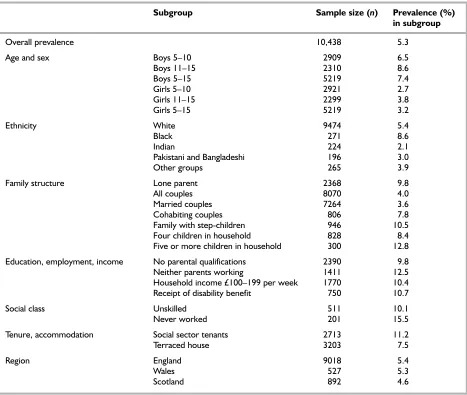
The rates for England and Wales are similar (5.4% for England and 5.3% for Wales). For an average Primary Care Trust (PCT) with a population of 170,000, this results in a figure of 9180 children aged 5–15 with a CD in England and 9010 in Wales. Higher rates of CD compared with the average were found in boys compared with girls and in 11–15-year-old boys compared with 5–10-year-old boys. Higher rates were also found in black children; in families with lone parents, stepchildren or ≥5 children; or where parents had few qualifications, a low income, were unemployed or were social sector tenants. Table 1
lists percentages of prevalence for different subgroups compared with the average prevalence of CD. Some caution must be exercised when interpreting these figures as differences are not always attributable to one factor alone but are due to an interaction of multiple factors. Some groups also have small sample sizes (particularly for ethnicity and social class).
CDs were significantly co-morbid with hyperactivity disorders [odds ratio (OR) = 38.43] [95%
confidence interval (CI) 26.87 to 54.96] and with other conditions such as ODD. This finding has been confirmed by other studies which show, for example, that among clinically referred youths who meet criteria for CD, 84–96% also meet criteria for ODD.8Children with CD were also more likely to have a physical complaint than children with no disorder (64% compared to 54%).
The ONS survey was based on a clinical evaluation of parent, teacher and child data collected by lay interviewers from questionnaires designed by the Department of Child and Adolescent Psychiatry, Institute of Psychiatry, London. Rates are based on the diagnostic criteria for research using the ICD-10 Classification of Mental and Behavioural Disorders3with strict impairment criteria. Figures are weighted to take into account differential sampling, non-response by age, sex and region
and are adjusted to take into account missing teacher data. The total sample size was 10,438.
The prevalence of behaviour problems is also high amongst preschool children, but at this age the diagnosis of CD is uncommon. One study showed that the prevalence of behaviour problems in a primary care paediatric sample was 8.3%. A further study showed the rate of behaviour problems in 3-year-old children to be similar in both rural and urban populations at around 13% of the sample.10One study of preschool children in New Zealand showed a prevalence rate of 22.5%,11although a lower diagnostic threshold was used in this study than is usual.
Rates of psychiatric disorder among preschool children from low-income families are higher than those in community (population-based) samples, but comparable to rates for low-income school-age
[image:17.595.61.528.115.510.2]children and adolescents.12 5
TABLE 1 UK prevalence of conduct disorder in different subgroups7
Subgroup Sample size (n) Prevalence (%)
in subgroup
Overall prevalence 10,438 5.3
Age and sex Boys 5–10 2909 6.5
Boys 11–15 2310 8.6
Boys 5–15 5219 7.4
Girls 5–10 2921 2.7
Girls 11–15 2299 3.8
Girls 5–15 5219 3.2
Ethnicity White 9474 5.4
Black 271 8.6
Indian 224 2.1
Pakistani and Bangladeshi 196 3.0
Other groups 265 3.9
Family structure Lone parent 2368 9.8
All couples 8070 4.0
Married couples 7264 3.6
Cohabiting couples 806 7.8
Family with step-children 946 10.5
Four children in household 828 8.4
Five or more children in household 300 12.8
Education, employment, income No parental qualifications 2390 9.8
Neither parents working 1411 12.5
Household income £100–199 per week 1770 10.4 Receipt of disability benefit 750 10.7
Social class Unskilled 511 10.1
Never worked 201 15.5
Tenure, accommodation Social sector tenants 2713 11.2
Terraced house 3203 7.5
Region England 9018 5.4
Wales 527 5.3
Stability
In addition to having a high prevalence, behaviour problems tend to be stable over
time13–19and the stability is greater the earlier the
problems begin.14In one study, for example,
antisocial behaviour at age 13 was predicted by externalising behaviour at age 3 and behaviour problems at age 5.14There are, however,
important sex differences in the stability of behaviour problems, boys being much more likely than girls to continue to exhibit problem
behaviours.20
Conduct disorder is fairly stable across time within families in addition to within individualsand the continuity is evident across multiple generations. Both parental and grandparental factors predict the level of aggression shown in the next generation of children.6
Prognosis
The prognosis for children with CD is poor, and behaviour problems in childhood predict a range of deleterious outcomes in adulthood. These include delinquency and criminal behaviour, school drop-out and poor educational
achievement, alcoholism, drug abuse, poor work and marital outcomes, domestic violence and child abuse and a range of psychiatric disorders.17,18,21,22
About 40% of 7- and 8-year-olds with CD become recidivist delinquents as teenagers, and over 90% of recidivist juvenile delinquents had had CD as children.5As the condition is relatively intractable
when diagnosed in adolescence and stable over time, many antisocial youths require treatment well into adulthood.1
Costs to society
Antisocial behaviour is the most costly of all mental health problems of childhood.13The costs
to society include the costs of the trauma, disruption and psychological problems caused to others who are victims of crime or aggression in homes, schools and communities, together with the financial costs of services to treat the individuals with CD. These include community
youth justice services, courts, prison services, social services, foster homes, psychiatric services,
accident and emergency (A&E) services, alcohol and drug misuse services, in addition to
unemployment and other benefits.
Current service provision
Current range of treatments for
conduct disorder
A diverse range of treatments have been used to treat CD, including individual and group therapy, behaviour therapy, residential treatment,
pharmacotherapy and psychosurgery, in addition to a range of ‘innovative community-based treatments’.1Despite the range of treatments
available, there has to date been an absence of clearly effective interventions for the treatment of CD.
Current service utilisation
A survey from the Great Britain National Study showed that children with CD had significantly higher lifetimes rate of service utilisation in particular as regards social and education services compared with children with other psychiatric disorders.23The ONS survey showed that
compared with children with no disorder, children with CD are more likely to use NHS services (see
Table 2).
Children and adolescents with a diagnosis of CD are likely to come into contact with a range of services. These include special educational provision such as classes and individual tutoring for children with early behaviour problems in addition to specialist residential schools for
children with more severe problems, mental health services for treatment such as psychotherapy or medication in addition to family-based treatments, or inpatient psychiatric treatment where necessary. These children are also likely to be in contact with the judicial system if their antisocial behaviour involves delinquency, crime or drug use, the more severe cases receiving a prison sentence.
6
TABLE 2 Use of services for any reason over a 12-month period
Services Children with CD Children with no mental health
(%) disorder (%)
Any GP contact 45 35
Any A&E visit 27 17
Any inpatient stay 9 5
Current service cost
The cost of services for children with CD is high.24 The most recent study showed that by age 28, costs for individuals with a diagnosis of CD meeting diagnostic criteria were 10.0 times higher than for those with no problems (95% CI 3.6 to 20.9) and 3.5 times higher than for those with conduct problems not meeting diagnostic criteria (95% CI 1.7 to 6.2). Mean individual total costs of service use up to age 28 were £70,019 for the CD group (mean difference from no problem group £62,898; £22,692 to £117,896) and £24,324 (£16,707; £6594 to £28,149) for the conduct problem group, compared with £7423 for the no-problem group. In all groups crime incurred the greatest cost, followed by extra educational provision, foster and residential care and state benefits. This study allowed for only a limited range of healthcare costs and made no attempt to estimate the costs to society borne by the victims of antisocial behaviour. Parental social class had a relatively small effect, and although substantial independent contributions came from being male, having a low reading age and attending more than two primary schools, CD still predicted the
greatest cost.24
Description of intervention
Parent training/education programmes
The identification of risk factors for CD that showed links with parenting stimulated the development of interventions to help parents change. Parent training/education programmes, and the behavioural programmes in particular, are based on the assumption that child behaviour is a function of the contingencies occurring in the family between the parent and the child, and that the basic process contributing to child behaviour problems is a parenting skills deficit. Hence the main goal of many parent training/education programmes is the development of a range of skills, and parents are helped to identify, define, observe and respond to problem behaviour in new and more adaptive ways. The use of groups to train parents began in the 1970s, and a rapid expansion of group-based parent
training/education programmes has taken place in a number of countries over the past 10 years25
with the growing involvement of voluntary organisations in the provision of such
programmes. Smith26suggests that this growth in
parent training/education programmes owes much to earlier research and practice in the USA, in particular the Systematic Training for Effective Parenting (STEP) developed by Dinkmeyer and
McKay27and Parent Effectiveness Training (PET) developed by Gordon.28Although the structure of parent training/education programmes has continued to evolve over the past two decades, the majority of parent training/education programmes continue to intervene solely with the parent. A minority of programmes involve children in some of the sessions, and some home–school-linked parent training/education programmes provide sessions for both parents and children
independently.
There are two main approaches to parent
training/education programmes – behavioural and relationship. Behavioural programmes focus on teaching parenting skills to remedy the causes of problem behaviour, for example ignoring the latter and praising cooperative behaviour, building a relationship with the child through child-led play and establishing consistent boundaries with ‘time out’ for infringement. Relationship
programmes aim to help parents understand their own emotional world and behaviour in addition to that of their child and to improve communication with their child. These categories are not exclusive and many contemporary programmes combine elements of both. ‘Programme’ indicates that the intervention is structured and its key components documented, so that it can be reliably applied by different workers with appropriate training. The programmes are focused and short-term (often 8–22 weeks), may be conducted in a variety of settings (hospital, community, office or home) and may be conducted in groups or individually. They involve an element of experiential learning and require parents to put what they have learnt in the session into practice as homework. However, programmes targeted at individual
parents/families should be distinguished from general one-to-one counselling, of which some advice on parenting may be a part, such as might be provided by health visitors. This is not to deny the potential importance of such activity or that health visitors may be appropriate personnel to deliver parent training/education programmes. Smith’s26survey of parent training/education programmes in the UK showed that there is a diverse group of providers offering both behavioural and relationship parent training/education programmes.
Identification of participants/criteria for
treatment
Programmes are offered to parents whose children have been identified as having early signs or clinical level behaviour problems. These parents
or psychologist, for example, following parental and/or teacher concerns about the child’s
behaviour. Parents may be invited to take part in a programme on the basis of a parent report alone or following screening using one of the many available screening instruments or clinical diagnosis.
Length of treatment
The average frequency and duration of most parent/training education/education programmes are 2-hourly weekly sessions provided over the course of 10–12 weeks. This may vary but the upper limit seldom exceeds 20 weeks.
Although the majority of
parent-training/education programmes are provided on a group basis (with an average of 6–10 participants per group), psychologists in particular may provide this type of intervention on a one-to-one basis in a clinical setting. Parent training/education programmes may also be delivered on a self-administered basis, in which parents are encouraged to view videotapes or read training materials (books and leaflets) in the home setting.
Personnel involved
The main providers of group-based parent training/education programmes currently include psychologists, therapists/counsellors, social workers and community workers. Groups are facilitated by one or two trained group leaders, some of whom may be parents who have been through
programmes themselves and gone on to undertake group leadership training. In most programmes the group leaders require supervision at regular intervals.
Setting
Parent/training education programmes are currently provided in a variety of settings,
including Child and Adolescent Mental Health Services (CAMHS) premises, health centres, clinics, community centres and schools. There is some evidence to suggest that community-based programmes are more effective than clinic-based programmes.29The basic requirements are that
the programme is provided in a congenial setting which is accessible for parents. The
accommodation should also provide the necessary provision for crèche facilities.
Anticipated costs
The cost of parent training/education programmes depends primarily on the method by which the programme is delivered (e.g. group, individual or self-administered basis), the opportunity costs of the staff involved (e.g. health visitor, social worker, psychologist) including whether the programme is provided by statutory or non-statutory sectors, and the accommodation costs.
A recent review of the five main ways in which parent training/education programmes are provided showed hourly costs ranging from £7.70 to £11.54 for eight clients (these costs are based on 1998–99 figures for a non-London district and include training and subsequent support of group facilitators, paper and accommodation resource costs, travel costs for facilitators and the
accommodation and staffing of a crèche for the clients children). Data are given in Table 3.
A further study of the costs of parent support provided at family centres (managed by both statutory and non-statutory organisations) showed a cost of £6.37–13.95 per hour. The cost to
participating parents is thought to be minimal, but maximally includes the cost of travelling to the programme, loss of earnings and the cost of childcare.
8
TABLE 3 Costs of providing parent training/education programmes
Programme Start up costs Programme costs per client
(training and initial per course (based on
follow-up) (£) eight clients) (£)
Statutory centre based 245 154
Statutory private centre based 245 230
Non-statutory centre based 225 166
Statutory home based 245 1121
Non-statutory home based 225 261
Range (average) 225–245 154–1121 (353)
Search strategy
A scoping search was undertaken in accordance with a predefined protocol based on that used by ARIF (Aggressive Research Intelligence Facility, University of Birmingham). This involved searching the following electronic databases: Cochrane Library Issue 3, 2003, MEDLINE (Ovid) 1966–August week 1, 2003, and the National Research Register Issue 3, 2003. Terms relating to parent training/education programmes and conduct disorders were combined with a filter to capture systematic reviews where appropriate. Websites and databases of the main international health technology assessment organisations were also searched. A preliminary search of Caredata via the NeLSC was also undertaken. The aim of the scoping search was to identify existing reviews and other background material and estimate their volume and nature. This search also served to provide a core of background literature for the review of reviews, which was supplemented by a search for systematic reviews on EMBASE (Ovid) 1980–week 40, 2003. The results of the clinical effectiveness search performed for the main part of this report were also scanned for relevant reviews.
Inclusion criteria
Only reviews meeting the following criteria were included:
1. A systematic search of the literature had been undertaken to identify intervention studies. 2. The review focused on the following:
(a) Intervention: group- or individual-based parent training/education programmes that utilised a structured format.
(b) Population: children <18 years of age. (c) Outcomes: any aspect of children’s
behaviour with the exception of reviews focusing explicitly on treatment for ADHD.
Results
Fifty-one reviews were identified, but only 16 met the above criteria for inclusion.
The remainder of this chapter comprises a critical appraisal of these reviews, to assess the reliability of the data,31and a discussion of the findings. The following criteria were used to appraise the included studies: (i) whether the review addressed a focused clinical question; (ii) whether the criteria for article inclusion were specified; (iii) whether relevant studies were missed; (iv) whether the validity of the included studies was appraised (i.e. account was taken of different study designs); (v) whether the assessment of studies was
reproducible (i.e. sufficient detail provided); (vi) whether the results were similar from study to study; (vii) whether the data from the included studies were presented (i.e. as opposed to the results simply being described); (viii) the precision of the results (i.e. the use of significance levels, and confidence intervals that include the
possibility of no difference); (ix) whether the study addressed which groups of parents and children the results can be applied to; (x) whether all clinically important outcomes were assessed (i.e. the inclusion of outcomes other than just behaviour); and (xi) whether any assessment was undertaken as to whether the benefits of the intervention are worth the harms and costs.
Are the results valid?
Did the review address a focused clinical question?
All 16 reviews addressed a focused clinical question, assessing the effectiveness of one or more parent training programmes, using a number of child and parent outcome measures. Whereas the majority of reviews (n= 13) focused specifically on the effectiveness of parent
training/education programmes, two included parent training/education programmes as part of a review of a broader range of programmes such as psychosocial treatments for conduct disordered children (Brestan and Eyberg, 1998),32and family-based crime prevention programmes (Farrington and Welsh, 2003).33Of the 13 reviews specifically evaluating parent training/education programmes, some focused on specific age groups, such as <5 years (Barlow, 1999,34Bryant et al.,1999;35 Tucker, 199736), 3–10 years (Barlow and Stewart-Brown, 2000;37Richardson and Joughin, 200238) and 6–12 years (Farmer et al., 200239). One review
focused specifically on the effectiveness of parent 9
Chapter 3
training/education programmes for parents with intellectual disabilities (Feldman, 199440) and a
further review focused on parents of ‘mentally retarded’ children (Hornby and Singh, 198341).
Three reviews compared the effectiveness of different types of parenting programme, such as behavioural; Adlerian and PET (Cedar and Levant, 1990;42Mooney, 1995;43Todres and
Bunston, 199344), and three further reviews
focused explicitly on behavioural programmes (Hornby and Singh, 1983;41Serketich and Dumas,
1996;45Tucker, 199736). Only one review
addressed the medium and long-term effectiveness of parent training programmes (Dimond and Hyde, 199930).
Were the criteria for article inclusion appropriate?
All apart from one review (Breiner and Beck, 198446) specified the criteria for article inclusion.
Some reviews utilised broad criteria (e.g. Cedar and Levant, 199042) such as any study measuring
the efficacy of PET, whereas others (e.g. Dimond and Hyde, 199930) specified criteria concerning
the methodology (e.g. design; size of sample; published/unpublished), the intervention (e.g. nature/theoretical basis of intervention – primary/secondary; behavioural/relationship; group or individual; focus on parents/children), the study population (e.g. age, disorder,
intellectual disabilities) and the outcomes used to assess effectiveness (e.g. children’s behaviour; self-esteem; delinquency). All of the criteria specified in the included reviews were consistent with the inclusion criteria for this review of reviews.
Were relevant studies missed?
Five of the included reviews do not provide any details concerning the searches that were undertaken to identify primary studies (Breiner and Beck, 1984;46Brestan and Eyberg, 1998;32
Cedar and Levant, 1990;42Feldman, 1994;40
Tucker, 199736). It is not therefore possible to
assess the likelihood that relevant studies were missed in these reviews.
The remaining reviews provide explicit
descriptions of the searches that were undertaken. These range from extensive searches of up to 14 databases (e.g. Dimond and Hyde, 199930) to
more limited searches of important databases such as PsycINFO and Dissertation Abstracts(e.g.
Serketich and Dumas, 199645). The less
comprehensive the search in terms of the number of databases searched, the more likely it is that relevant studies were missed. In addition, older reviews will not have included more recent studies.
The most inclusive reviews are likely to be those that were (a) conducted recently and (b) have an inclusive search strategy in terms of the number of databases and years searched (Barlow and Stewart-Brown, 2000;37Barlow and Parsons, 2002;47
Bryant et al., 1999;35Dimond and Hyde, 1999;30
Farmer et al., 2002;39Farrington and Welsh,
2003;33Mooney, 1995;43Richardson and Joughin,
2002;38Todres and Bunston, 1993;44Serketich
and Dumas, 199645).
The results of three reviews were based
predominantly on the findings of earlier reviews in the field in addition to searches for recent studies (Brestan and Eyberg, 1998;32Farrington and
Welsh, 2003;33Richardson and Joughin, 200238).
In all of the reviews, sources of unpublished and ongoing primary studies other than Dissertation
Abstractswere not consulted. The exclusion of
unpublished studies would be likely to
overestimate the effectiveness of the intervention.
Was the validity of the included studies appraised?
One of the included reviews failed to provide any assessment of the validity of the primary studies (Tucker, 199736), and appears to have included
uncontrolled studies.
The results of seven of the included reviews were based solely on data obtained from randomised controlled trials (RCTs) or controlled studies (Barlow, 1999;34Barlow and Stewart-Brown,
2000;37Brestan and Eyberg, 1998;32Farmer et al.,
2002;39Farrington and Welsh, 2003;33Mooney,
1995;43Serketich and Dumas, 199645). One review
that used Levant’s (1983)48five criteria of
methodological adequacy showed that the better-designed studies produced a higher effect size for PET programmes (Cedar and Levant, 199042).
Seven of the 26 studies included in that review were classified as being methodologically
adequate, but the seven studies were not specified.
In many of the reviews, the criteria by which the methodological adequacy of the studies was appraised were clearly specified (e.g. sample size, treatment length, random assignment, accuracy and validity), but the findings for each primary study were not presented (e.g. Richardson and Joughin, 2002;38Todres and Bunston, 1993;44
Serketich and Dumas, 199645), thereby making it
difficult to assess the reliability of the findings. The appropriateness of the quality appraisal methods used in the individual reviews was not assessed by this review team.
Was the assessment of studies reproducible?
The assessment method was clearly stated and thereby reproducible in all but one review (Tucker, 199736).
Further details concerning the steps taken to eliminate mistakes (random errors) and bias (systematic errors) were provided in four reviews (Barlow and Stewart-Brown, 2000;37Barlow and Parsons, 2002;47Cedar and Levant, 1990;42 Serketich and Dumas, 199645). For example, in one review the primary studies were reviewed separately by the first author and a research assistant, and inter-rater agreement was assessed using a kappa coefficient. Further disagreement was resolved by consultation (Serketich and Dumas, 199645). In a second review, inter-rater
reliability for the coding of the descriptive variables was assessed by the first author and an assistant, separately coding five randomly selected studies (Cedar and Levant, 199042).
The remaining reviews did not include details about the way in which the primary studies were selected for inclusion or the appraisal process, and none of the overviews indicated whether blinding was undertaken for the purpose of assessment.
Were the results similar from study to study?
Tests of heterogeneity were undertaken only in one review (Barlow, 199934) prior to the data being combined in a meta-analysis; in one further review, statistical tests of heterogeneity precluded the possibility of undertaking a meta-analysis (Dimond and Hyde, 199930). Failure to test for heterogeneity is a significant omission where an average or ‘typical’ effect has been calculated. For example, in one case, an overall effect size of 0.328 was given, but no evidence was provided about either the clinical or statistical heterogeneity of the primary studies reviewed (Cedar and Levant, 199042).
In two cases, correlation coefficients between effect sizes and a number of methodological and
contextual variables were provided (Cedar and Levant, 1990;42Serketich and Dumas, 199645) including sample size, number of groups/sessions and random assignment. However, once again, no analysis of the clinical heterogeneity of the
populations in the primary studies was undertaken and no assessment of the impact of this on the summative data was produced.
Although many of the included reviews demonstrate considerable clinical heterogeneity in terms of the included populations and interventions in the primary studies, most reviews indicate similarity in the results obtained for each study.
What are the results?
What are the overall results of the review?
The results of all included reviews are presented in Appendix 2. Four reviews provide summary measures of effectiveness following meta-analysis (Barlow and Parsons, 2002;47Cedar and Levant, 1990;42Farrington and Welsh, 2003;33Serketich and Dumas, 199645).
Barlow and Parsons (2002)47report a
non-significant trend based on parent reports favouring the intervention group [effect size (ES) –0.5, 95% CI –1.06 to 0.08), with independent observations of children’s behaviour showing a significant result favouring the intervention group (ES –0.54, 95% CI –0.84 to –0.23) (Barlow and Parsons, 200247). A meta-analysis of the limited follow-up data available shows a small non-significant trend favouring the intervention group (ES –0.24, 95% CI –0.56 to 0.09) (Barlow and Parsons, 200247).
The second review shows no evidence of effectiveness (Cedar and Levant, 199042). This review evaluates the effectiveness of one particular type of parenting programme known as PET, which focuses on relationships rather than
children’s behaviour, and does not recommend the use of either praise or ‘time-out’, which are two central tenets of behavioural programmes. This review does, however, show a significant impact on other outcomes including child self-esteem and parent attitudes.
Two further reviews show the effectiveness of parent training/education programmes in improving children’s behaviour, 0.395 (95% CI 0.274 to 0.517) (Farrington and Welsh, 200333) and 0.86 (Serketich and Dumas, 199645), although the latter does not provide any CIs or other indication of uncertainty such as a standard error.
A ‘vote-counting’ technique was used to assess effectiveness in four further reviews that do not provide summary ESs, but do provide data from the included primary studies (Barlow, 1999;34 Dimond and Hyde, 1999;30Richardson and Joughin, 2002;38Todres and Bunston, 199344), with Dimond and Hyde30explicitly using this approach instead of meta-analysis due to
heterogeneity. One review shows that group-based parent training/education programmes are effective in producing significant change in both parental perceptions and objective measures of children’s behaviour (Barlow, 1999;34Barlow and Stewart-Brown, 200037). A second review, that updated the Barlow review, confirmed these
A further review that examined whether these effects were maintained over time showed that parent training/education programmes are effective in producing medium- to long-term changes in children’s behaviour (11 out of 15 studies statistically significant) and in parent well-being (six out of 8 studies statistically significant). It should be noted, however, that these findings were based on studies that utilised a wait list control in which the long-term changes were assessed only in the intervention group. These findings may therefore be due to regression to the mean. One further review that compared behaviour modification, PET and Adlerian programmes (the last two being relationship programmes) showed that the behaviour
modification and Adlerian programmes produced the best results, and that the PET programmes have a much lower success rate (Todres and Bunston, 199344). A key limitation of vote
counting is that it fails to take into account the size of individual studies.
Eight reviews provide descriptive results only (Breiner and Beck, 1984;46Brestan and Eyberg,
1998;32Bryant et al., 1999;35Farmer et al., 2002;39
Feldman, 1994;40Hornby and Singh, 1983;41
Mooney, 1995;43Tucker, 199736). Five of these
reviews include results from studies utilising uncontrolled methodologies (Breiner and Beck, 1984;46Bryant et al., 1999;35Feldman, 1994;40
Hornby and Singh, 1983;41Tucker, 199736), and
are not discussed further here – see Appendix 2. Three reviews provide descriptive results from rigorous studies (Brestan and Eyberg, 1998;32
Farmer et al., 2002;39Mooney, 199543). The first
review shows that two types of parent
training/education programme meet the stringent criteria for well-established effective programmes (i.e. videotape modelling and programmes based on Patterson and Gullion’s ‘Living with Children’) (Brestan and Eyberg, 199832). The second review,
which is based on data from three primary studies only, produced ESs ranging from medium to large, with medium ESs being found for programmes that were implemented under usual practice conditions (Farmer et al., 200239). The third review
compares three types of programme (i.e. behavioural, PET and STEP – the last two being relationship programmes) and shows that as regards child behaviour only the behavioural programmes show evidence of effectiveness, although Adlerian and PET programmes had an impact on self-esteem and STEP programmes impacted positively on children’s grades and child’s locus of control (Mooney, 199543). The
Adlerian, STEP and PET programmes show
considerably more evidence of effectiveness, however, as regards parent attitudes (i.e. democratic and less restrictive/authoritarian attitudes) (Mooney, 199543).
How precise are the results?
Eight reviews did not provide any summary effect estimate (Breiner and Beck, 1984;46Brestan and
Eyberg, 1998;32Bryant et al., 1999;35Farmer et al.,
2002;39Feldman, 1994;40Hornby and Singh,
1983;41Mooney, 1995;43Tucker, 199736), and it is
therefore not possible to assess the precision of the results.
Two reviews that provide a summary estimate of effectiveness following meta-analysis do not provide CIs (Cedar and Levant, 1990;42Serketich
and Dumas, 199645). The two further reviews that
utilised a summative measure and that also provided CIs (Barlow and Parsons, 2002;47
Farrington and Welsh, 200333) are all significant,
although in the first of these reviews, one out of two measures also includes the possibility of their being no difference (Barlow and Parsons, 200247).
Two reviews were based on a ‘vote-counting’ technique in which the number of positive or negative findings for each outcome measure in each primary study were combined (Dimond and Hyde, 1999;30Todres and Bunston, 199344). ‘Vote
counting’, however, is a less reliable method of summarising data because no weighting is used to compensate for the differences between large and small studies, no evidence is available to assess the way in which either clinical or statistical significance is attributed to each outcome measure in each primary study and it is not possible to assess the magnitude of the effects. Furthermore, in one of these reviews (Todres and Bunston, 199344), data
from uncontrolled primary studies were included.
None of the reviews provided any clear evidence of the clinical significance of the ESs produced. This would have involved translating the numeric data provided into clinical descriptions of
children’s behaviour. However, the standardised instruments used in these studies have all been validated as clinical measures of children’s behaviour, and an ES of 1.0 represents a highly significant clinical improvement.
Will the results help in the future care
of parents and children?
Can the results be applied to other parents and children?
Most of the included reviews were directed at parents of children with behaviour problems, and