http://wrap.warwick.ac.uk/
Original citation:
Kermode, James R., Cereda, S., Tangney, P. and De Vita, Alessandro. (2010) A first
principles based polarizable O(N) interatomic force field for bulk silica. Journal of
Chemical Physics, Volume 133 (Number 9). Article number 094102.
Permanent WRAP url:
http://wrap.warwick.ac.uk/64448
Copyright and reuse:
The Warwick Research Archive Portal (WRAP) makes this work of researchers of the
University of Warwick available open access under the following conditions. Copyright ©
and all moral rights to the version of the paper presented here belong to the individual
author(s) and/or other copyright owners. To the extent reasonable and practicable the
material made available in WRAP has been checked for eligibility before being made
available.
Copies of full items can be used for personal research or study, educational, or
not-for-profit purposes without prior permission or charge. Provided that the authors, title and
full bibliographic details are credited, a hyperlink and/or URL is given for the original
metadata page and the content is not changed in any way.
Publisher’s statement:
© AIP. http://dx.doi.org/10.1063/1.3475565
A note on versions:
The version presented in WRAP is the published version or, version of record, and may
be cited as it appears here.
A first principles based polarizable O
„
N
…
interatomic force field
for bulk silica
J. R. Kermode,1,a兲S. Cereda,1P. Tangney,2and A. De Vita1
1
Department of Physics, King’s College London, Strand, London WC2R 2LS, United Kingdom 2
Department of Physics and Department of Materials, Imperial College London, London SW7 2AZ, United Kingdom
共Received 30 March 2010; accepted 14 July 2010; published online 2 September 2010兲
We present a reformulation of the Tangney–Scandolo interatomic force field for silica关J. Chem.
Phys. 117, 8898共2002兲兴, which removes the requirement to perform an Ewald summation. We use
a Yukawa factor to screen electrostatic interactions and a cutoff distance to limit the interatomic potential range to around 10 Å. A reparametrization of the potential is carried out, fitting to data from density functional theory calculations. These calculations were performed within the local density approximation since we find that this choice of functional leads to a better match to the experimental structural and elastic properties of quartz and amorphous silica than the generalized gradient approximation approach used to parametrize the original Tangney–Scandolo force field.
The resulting O共N兲scheme makes it possible to model hundreds of thousands of atoms with modest
computational resources, without compromising the force field accuracy. The new potential is validated by calculating structural, elastic, vibrational, and thermodynamic properties of␣-quartz and amorphous silica. ©2010 American Institute of Physics.关doi:10.1063/1.3475565兴
I. INTRODUCTION
Silica is a material of vast technological importance which has an extremely rich chemical morphology, and a large research effort has been devoted to its experimental investigation1–8 and to theoretical work based on both em-pirical interatomic potentials9–12and highly accurateab initio
calculations.13–19 The phase diagram of silica is very com-plex, with a large number of high pressure crystalline
polymorphs.20 In this work, our motivation is to develop a
new potential suitable for simulations of crystalline and amorphous silica at low temperatures and pressures. This new potential could be used, for example, within the “learn
on the fly” quantum mechanics/molecular mechanics 共QM/
MM兲scheme in studies of fracture,21 where a quantum
me-chanical package would be used to describe the bond-breaking processes taking place near the crack tip, leaving the classical potential to describe the elastic response of the surrounding silica matrix.22 Although first principles quan-tum mechanical calculations have provided considerable in-sight into the properties of silica, limitations in the accessible length-scale and time-scale, particularly considering the huge structural complexity of the higher pressure phases, imply that there will always remain a need for accurate interatomic potentials.
Pair potentials of various complexities, often based on
the Born–Mayer functional form,23have been used to model
silica since the early 1980s. Notably, the potential of van
Beest, Kramer, and van Santen10 共referred to as the BKS
potential兲 is a fixed-charge pair potential which remains
widely used. However, ab initio simulations have revealed
that careful inclusion of many-body electrostatic effects is
essential to reproduce experimental observables such as the
phonon spectrum.24 While specialized two-body or
three-body functional forms have been proposed to describe spe-cific crystal structures,9 no such recipe is available to deal with the general case of disordered phases such as amor-phous silica.
In 2002, Tangney and Scandolo25 proposed a potential
for silica in which the oxygen atoms are polarizable, with dipole moments determined self-consistently in response to the local electrostatic field. The potential was parametrized fromab initioforces, energies, and stresses evaluated for an extended database of configurations to achieve enhanced transferability,26 and has been shown to provide an accurate description of a wide variety of bulk silica properties.27
Fitting the parameters of interatomic potentialsab initio
allows us to test many of the assumptions on which the po-tential forms are built in a completely unbiased fashion. For example, a common factor linking many silica interatomic potentials is the assumption that a full Ewald sum28 must be carried out to include long-range electrostatic effects. This summation is computationally very expensive: for three-dimensional systems with periodic boundary conditions, O共N3/2兲scaling with respect to the number of atoms can be achieved by a careful choice of the separation into real-space and reciprocal-space contributions.29 However, for the two-dimensional geometries widely used in the fracture simula-tions which motivate this work, it is not possible to improve on O共N2兲 scaling.11 The computational cost of long-range electrostatics is particularly important for the Tangney-Scandolo 共TS兲 potential since several electric field evalua-tions are required to self-consistently determine the dipole moments at each time step. It has long been assumed that the slow 共1/r兲 decay of electrostatic interactions makes them a兲Electronic mail: [email protected].
impossible to truncate. However, real materials are not sim-ply composed of rigid ions: electrons screen interactions be-tween nuclei and, as a result of this screening, it is possible to truncate electrostatic interactions for certain systems and for certain physical properties. While there have been very significant developments in the treatment of long-range forces, for example, the O共NlnN兲 particle mesh and O共N兲
fast multipole approaches, such methods typically start to outperform Ewald summation only in systems containing more than 100 000 atoms,30so it is appropriate to investigate whether an accurate short-range potential can be developed. Previous short-ranged potentials for silica have been
devel-oped by applying both Wolf31and Yukawa screenings to the
BKS functional form.11 However, these approaches do not
include any explicit representation of electronic screening effects. Thus, a polarizable model such as the TS potential should provide a better starting point for developing a short-range potential. We note that transferability problems may be associated with using a potential in a region of phase space far away from where it has been parametrized. It is possible that the screened potential may be less transferable than the one involving a full Ewald summation. We shall therefore restrict ourselves to modeling the dominant low temperature
and low-pressure forms of bulk silica, ␣-quartz and
amor-phous silica, which are the most relevant to fracture calcula-tions. While various attempts have been made to represent surface chemistry processes,32,33 this is not our intention in this work. Where bond-breaking processes are important, we propose to use this potential within a QM/MM embedding
scheme, relying on ab initio techniques to describe a small
region with high accuracy, with the force field providing the correct elastic environment. In this paper, we present a short-ranged reformulation of the TS potential, together with a
reparametrization based on new ab initio calculations,
fol-lowed by various validations of the resulting screened force field. At the time of writing, we became aware of a very
recent work34 based on similar ideas, which does not yet
include a reparametrization.
II. FORCE FIELD
A. Overview
The potential consists of two parts: a pair potential and dipole polarization of oxygen ions. The pair potential is of Morse–Stretch form, and is unmodified from that used in the original TS form25
Uij
sr
=Dij关e␥ij关1−共rij/rij 0
兲兴− 2e共␥ij/2兲关1−共rij/rij0兲兴兴
, 共1兲
whereUijsris the short-ranged contribution to the interaction energy between ions iand j, separated by a distancerijand
Dij, and␥ijandrij0 are parameters specific to the species pair identified by ions i and j. The cutoff for this part of the potential is fixed at 18.0 a.u.
The electrostatic contribution to the potential is made up of a sum over pairs of ions, plus a final term to represent the energy required to polarize the ion’s electron density
Uel共兵qi,pi,ri,␣i其兲=
兺
i=1
N
兺
j⫽i
Uijel+
兺
ipi
2
2␣i
. 共2兲
In the original TS potential, the electrostatic pair term is given by
Uijel=
1
2共Eqq+Eqd+Edd兲 共3兲 and is made up of charge-charge, charge-dipole, and dipole-dipole interactions, denoted by Eqq, Eqd, and Edd, respec-tively, and given by
Eqq=
qiqj
rij
, 共4兲
Eqd= 1
rij3关qi共pj·rij兲−qj共pi·rij兲兴, 共5兲
Edd= 1
rij3
冋
pi·pj−3
rij2
共pi·rij兲共pj·rij兲
册
. 共6兲The species chargesqiand polarizabilities␣iare parameters to be determined in the fitting process. The dipole moments
piof each polarizable ion are the sum of an induced dipole moment due to the local electrostatic field and a contribution due to the short-range repulsive forces between ions. Follow-ing Maddenet al.,24 this short-range correction is given by
pisr=␣i
兺
j⫽i
qjrij
rij
3 gij共rij兲, 共7兲
where
gij共rij兲=cij
兺
k=0
4
bijrij k
k e
−bijrij, 共8兲
andbij andcij are additional model parameters. The dipole moments are determined at every time step by iterating
pi m
=␣iE共ri;兵pj
m−1其
j⫽i;rjj⫽i兲+pisr 共9兲
to self-consistency, wherepi m
is the dipole moment on ion i
at iteration m of the self-consistent cycle and E共ri兲 is the total electric field at positionriinduced by other charges and dipoles. For more information about the self-consistent solu-tion of this equasolu-tion, see Ref.25. We note that the derivative of the potential with respect to the self-consistent dipole mo-ments is zero, so there is no need to evaluate the derivative of the dipole moments with respect to ionic positions.
B. Screened electrostatic interactions
In order to make the potential short-ranged, we apply a Yukawa screening function to Eq. 共3兲, replacingUijelwith
Uij
el,s
= 12共Eqq+Eqd+Edd兲e−rijfc共rij兲, 共10兲
where fc共rij兲 is a cutoff function which takes the potential
smoothly to zero at some distance rcut. We found that the
choice of fc共rij兲 is not particularly important; we used a simple switching function
fc共r兲=
冦
1, r⬍rcut−dcut,
1 −r−rcut+dcut 2dcut
+ 1
2sin
dcut
共r−rcut+dcut兲, rcut−dcutⱕrⱕrcut+dcut,
0, r⬎rcut+dcut.
冧
共11兲
wheredcutis a smoothing length.
This definition of the screened electrostatic pair interac-tion energy Uij
el,s
is equivalent to transforming the electro-static Coulomb potential, dipole potential, and dipole field
originating from the charge and dipole on each atom i. For
instance, the transformed short-range potentials are obtained as
⌽s共ri兲=⌽共ri兲e−rifc共ri兲. 共12兲 The appropriate forces corresponding to the transformation are then coded to ensure we have a conservative force field. In particular, the charge-charge, charge-dipole, and dipole-dipole forces have additional contributions which arise from the derivative of the screening functions
Fs共
ij兲
= −ⵜE共ij兲e−rijf
c共rij兲,
+E共ij兲
冉
fc共rij兲−
冏
dfc dr
冏
rij冊
e−rij
rij
rij, 共13兲
where E共ij兲 is the corresponding, unscreened, energy term from Eqs.共4兲–共6兲. The Yukawa factore−rijimplies a
screen-ing length inversely proportional to. Together with the cut-off distancercut, this parameter will be ultimately determined
by the length-scale of physical screening processes which take place in the material.
III. PARAMETRIZATION
The modified, short-range potential requires a full re-parametrization. We have used density functional theory
共DFT兲 to evaluate quantum mechanical forces, energies and
stresses on a representative database of atomic configura-tions. All DFT calculations reported in this work were
car-ried out with the CASTEP planewave code,35 using ultrasoft
pseudopotentials. The TS potential was parametrized using a database generated using a generalized gradient approxima-tion 共PBE-GGA兲 to the exchange-correlation functional.36,37 Gradient corrections are known to be important for correctly resolving the energy ordering of higher pressure crystalline silica phases.13,38 However, for modeling fracture processes which take place at relatively low pressures and tempera-tures, an accurate description of the elastic properties of quartz and low-pressure amorphous silica is our primary mo-tivation. As will be demonstrated below, the local density
approximation 共LDA兲 provides a better description of the
elastic properties of silica. We therefore decided to carry out the potential reparametrization using the LDA, as discussed in more detail in Sec. IV.
To generate the database, we took a series of around a hundred snapshots from microcanonical molecular dynamics
simulations conducted with the original TS potential on a 72-atom quartz unit cell at a temperature of 500 K. To ensure statistical independence, the configurations selected for fit-ting were separated by several picoseconds. Accurate DFT LDA single-point calculations of forces, energy, and stress were then carried out on each of these snapshots. A relatively high plane-wave cutoff energy of 800 eV was required to
fully converge the stress components. ⌫-point sampling of
the Brillouin zone was found to be sufficient. The potential parameters were then obtained by minimizing the cost func-tion
⌫关兵i其兴=wf⌬F+ws⌬S+we⌬E 共14兲
with respect to the parameters兵i其, where
⌬F=
冑
兺k=1nc 兺
i=1
N 兺
␣共Fcl␣,i共兵i其兲−Fai␣,i兲2
冑
兺k=1nc 兺
i=1
N 兺
␣共Fai␣,i兲2
, 共15兲
⌬S=
冑
兺k=1nc 兺
␣,共cl␣,共兵i其兲−ai␣,兲2 3B
冑
nc, 共16兲
⌬E=
冑
兺k,lnc共共
Uk cl
−Ul
cl兲
−共Uk ai
−Ul
ai兲兲2
冑
兺k,lnc共
Uk ai
−Ul
ai兲2 . 共17兲
The outermost sum is over the nc distinct configurations,
labeled by k. Fcl␣,i is the␣-component of the force on ioni calculated with the classical potential using parameters兵i其;
Fai␣,i is the␣-component of the force on ion icalculatedab
initio;cl␣
,
are the components of the stress tensor calculated with the classical potential;B is the bulk modulus;ai␣, are the components of theab initio stress tensor; Ukclis the
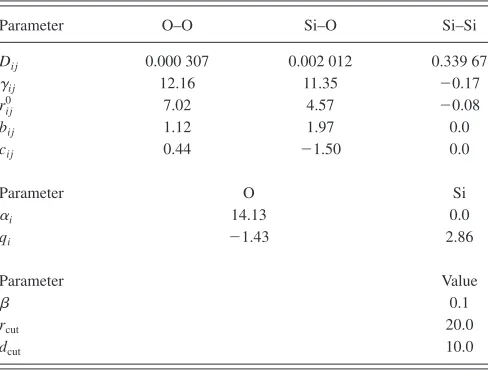
en-TABLE I. Potential parameters共atomic units兲.
Parameter O–O Si–O Si–Si
Dij 0.000 307 0.002 012 0.339 67
␥ij 12.16 11.35 ⫺0.17
rij0 7.02 4.57 ⫺0.08
bij 1.12 1.97 0.0
cij 0.44 ⫺1.50 0.0
Parameter O Si
␣i 14.13 0.0
qi ⫺1.43 2.86
Parameter Value
 0.1
rcut 20.0
[image:4.612.314.558.572.757.2]ergy of configurationkcomputed with the classical potential; andUk
ai
is itsab initioenergy. The weightswf,ws, andweare chosen to reflect the amount of information available, e.g., always implying that wf⬎ws⬎we 共a typical choice is wf = 1.0,ws= 0.5, andwe= 0.1兲. The minimization process is de-scribed in more detail in Ref.39.
After identifying the set of parameters that minimizes
⌫关兵i其兴, we used it to carry out a molecular dynamics simu-lation to generate a new set of reference configurations. The fitting process is then iterated until no systematic parameter change is detectable. This procedure is designed to ensure that the configurations used are representative samples with-out incurring the computational expense of carrying with-out long
ab initio molecular dynamics simulations.26 For this poten-tial, the fitting process was expedited by the existence of a good set of starting configurations generated with the origi-nal TS potential.
The Yukawa screening parameters  andrcut were not
directly included in the fitting process. Instead, a range of
values were tried, from which the inverse length 
= 0.1 a.u.−1and the cutoff radius r
cut= 20 a.u. were selected
as the best compromise between computational efficiency and fit accuracy. In a similar manner, the distance over which the smoothing function fc共r兲 goes to zero was chosen to be
dcut= 10 a.u. The final set of parameters 共Table I兲 selected
yields the values⌬F= 0.10,⌬S= 0.001, and⌬E= 0.25 for the three positive definite error components of our cost function.
This compares well with the original TS potential which has
⌬F= 0.16, ⌬S= 0.014, and ⌬E= 0.18, albeit for a QM data-base sampled from higher temperature dynamical simula-tions of the liquid, where forces tend to be larger. To sum-marize, by introducing the screening and specializing the fit for lower temperature configurations, we have obtained a low force and stress error and a slightly increased error in the energies. This is suitable for use within a force-mixing based
QM/MM framework40such as the learn on the fly method21
where force accuracy is paramount.
IV. RESULTS
A. Implementation
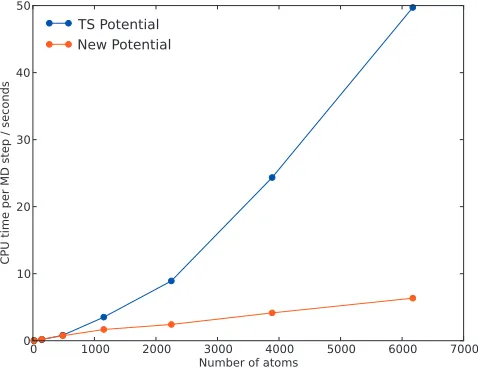
The screened version of the TS potential is significantly faster than the original and, crucially, the finite range leads to linear scaling with respect to the number of atoms. As shown in Fig.1, a speed up of more than one order of magnitude is achieved for a 6000 atom system. For systems containing
fewer than ⬃500 atoms, the early TS potential, which does
not involve additional screening terms and their derivatives, is actually faster than our novel formulation. The new poten-tial has been implemented within theQUIP共Ref.41兲 molecu-lar dynamics framework and has been parallelized, resulting in a code which exhibits linear scaling with respect to both number of atoms and number of CPUs. The implementation has been verified by tightening the convergence tolerance of the self-consistent determination of the dipole moments and checking that the drift in total energy can be made arbitrarily small. Force evaluation carried out with new potential has a computational cost of the order of 10−4 s/atom on four cores
of a 3 GHz Intel “Woodcrest” machine, making simulations with hundreds of thousands of atoms easily affordable.
B. Structural and elastic properties of quartz
The structural and elastic properties of ␣-quartz have
been calculated using our new potential and are reported in
TablesIIandIII, together with the DFT LDA and PBE-GGA
values. A 5⫻5⫻4 Monkhorst–Packk-point mesh was used
for the DFT structural optimizations. Quartz has trigonal symmetry; the most stable form at temperatures below around 500 ° C is␣-quartz which is a member of the P3221
space group. Its primitive cell is illustrated in Fig. 2. The quartz lattice parametersaandcand the internal parameters
u, x, y, and z were determined by geometry optimization,
where共u, 0 , 2/3兲and共x,y, 2/3 +z兲are the fractional
[image:5.612.53.292.49.234.2]coordi-FIG. 1. Time taken for a single MD step as a function of number of atoms, with the original TS potential 共blue兲 and with the new Yukawa-screened implementation共red兲.
TABLE II. Structural properties of␣-quartz.
Experimenta DFT共LDA兲 DFT共PBE-GGA兲 TS potential New potential
a/Å 4.9160 4.8701 5.0284 4.9034 4.8409 c/Å 5.4054 5.3626 5.5120 5.3810 5.3285 V/SiO2/Å3 37.71 36.71 40.23 37.35 36.05
Siu 0.4697 0.4667 0.4813 0.4706 0.4641
Ox 0.4135 0.4129 0.4165 0.4140 0.4118
Oy 0.2669 0.2720 0.2466 0.2681 0.2788
Oz 0.1191 0.1159 0.1360 0.1182 0.1097
aReference7.
[image:5.612.126.486.642.748.2]nates of the first silicon and oxygen atoms, respectively, and the other positions are constrained by symmetry require-ments. The minimum in the potential energy surface of our new potential obeys the required symmetry operations for the P3221 space group to a precision of better than 10−5 Å.
The crystallographic symmetry group to which quartz be-longs has five independent elastic constants: C11, C12, C14,
C33, and C44 关C66 is then given by 共C11−C12兲/2兴. The Cij were computed using a series of finite strains and the virial stress. The internal coordinates of each strained configuration were each time fully relaxed.
The DFT values reported in TablesIIandIIIagree well
with experiment and with previously published ab initio
results.13–18 The LDA consistently underestimates the equi-librium volume of quartz compared with experiment, whereas the PBE-GGA overestimates by a slightly larger fac-tor, leading to increased errors in the elastic properties with respect to experiment.13 This point is further illustrated by considering a third-order fit to the Murnaghan equation of state. We found that both approximations to the exchange-correlation energy lead to accurate predictions of the bulk modulus: 31.7 GPa with the LDA and 29.3 GPa with the PBE-GGA, compared to an experimental range of 34–37 GPa.13 However, the variation in the derivative of the bulk modulus with respect to pressure between LDA and PBE-GGA is more significant. Our results are 5.56 within the LDA and 4.43 with the PBE-GGA, to be compared with the experimental value ofB
⬘
= 5.99.13 In general, the PBE-GGA functional is less accurate at predicting quartz elasticproperties,13,15 which supports our decision to use the LDA to reparametrize our potential. The elastic constants pre-dicted by the new potential are in excellent agreement with both DFT LDA and experiment. It is worth noting that the accuracy of the force fit共⌬F= 0.10兲in the parametrization of our potential is comparable to or larger than the likely dif-ferences between the forces predicted by different approxi-mations to the exchange-correlation energy, whereas the rela-tive error in the stress 共⌬S= 0.001兲 is much lower and is likely to be smaller than the differences between different functionals. Since the elastic constants predicted by the LDA are in good agreement with experiment, we chose to param-etrize our potential using this functional. To summarize our results so far, improvement over the TS potential with re-spect to experiment can be attributed to the use of LDA for the fit and to the choice of a more specialized fit database: the new potential has been fit to crystal configurations at 500 K, whereas the original TS was fit to liquid silica at 3000 K. We have checked this by refitting the original TS functional form, including long-range electrostatics, to the same LDA database. This leads to a potential which provides an almost identical description of quartz to our screened po-tential, indicating that the variations between the TS and Yukawa-screened potentials are primarily due to the choice of QM database and that truncation of the long-range elec-trostatic interactions does not significantly affect the accu-racy of the potential, in agreement with a very recent similar work.34
C. Vibrational properties
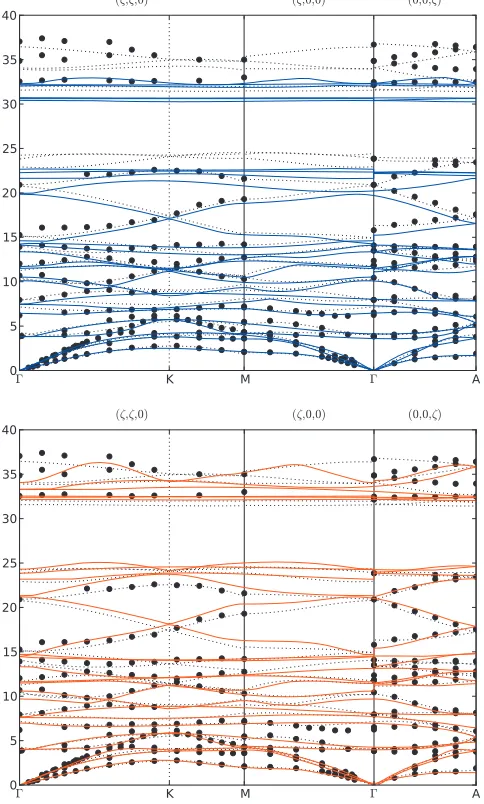
We calculated the phonon dispersion spectrum of
␣-quartz predicted by the new potential using PHONOPY,42
which uses the supercell method with finite atomic displacements,43and the Parlinski–Li–Kawasoe interpolation
scheme.44The results shown in Fig. 3were obtained with a
4⫻4⫻4 supercell of the nine-atom primitive unit cell. This is sufficient to converge the components of the force constant matrix, confirming that the screened potential’s cutoff dis-tance ofrcut= 20 a.u. is reasonable.
[image:6.612.124.485.63.168.2]Overall, the agreement with experiment and with density functional perturbation theory 共DFPT兲 is good, particularly for the low-frequency transverse modes. Even for the longi-tudinal optical modes where long-range electrostatic effects are more important, the screened potential does not perform significantly worse than the TS potential. In fact, the optical
TABLE III. Elastic constants of␣-quartz in GPa.
Experimenta Experimentb DFT共LDA兲 DFT共PBE-GGA兲 TS potential New potential
C11 85.9 86.8 76.6 87.1 98.5 83.5
C12 7.16 7.04 5.88 ⫺7.82 15.2 12.7
C13 10.94 11.91 6.58 6.30 26.1 14.6
C14 ⫺17.66 ⫺18.04 ⫺17.8 ⫺17.0 ⫺10.5 ⫺16.9
C33 89.59 105.75 95.9 87.1 111.1 118.1
C44 57.77 58.2 54.1 49.1 59.8 59.06
C66 39.4 39.9 35.3 47.5 41.6 35.41
aReference4. bReference5.
[image:6.612.92.256.571.719.2]modes are described slightly better with the new potential than with the original. This is not unexpected: the original potential was fitted to PBE-GGA data, and a recent study
computed the GGA phonon spectrum of␣-quartz and found
the agreement with the same experimental data to be slightly
worse than that of LDA calculations.45We note that phonon
modes with wavelengths longer than the range of the poten-tial cannot be correctly described by a screened model, but we do not expect long wavelength optical modes to play an important role in typical molecular dynamics simulations us-ing this potential. The longitudinal frequencies near the
⌫-point have been corrected by adding the nonanalytic
con-tribution due to long-range electric fields to the dynamical matrix.46This requires calculating the high-frequency dielec-tric tensor ⑀⬁and the Born effective charge tensor Zⴱ. Fol-lowing the approach taken by Hanet al.,47this has been done by direct evaluation of the polarization response to small external electric fields共for⑀⬁兲and to small atomic displace-ments共forZⴱ兲; the results are presented in TablesIVandV.
The DFT values were computed with theCASTEPcode using
DFPT.45
The agreement between the dielectric relative permittivi-ties calculated with the new potential and DFT LDA is good. Note that once more the TS potential agrees better with the PBE-GGA results. However, for both potentials, the Born effective charge tensors do not agree particularly well with theab initiovalues. This suggests that the functional form of our potential does not describe the full range of possible electron response phenomena. Since the Born effective charges predicted by the model are too small, the
longitudi-nal optical/transverse optical 共LO/TO兲 splittings at the
⌫-point are also significantly lower than those calculatedab initioor experimentally measured. This reflects the fact that long-range forces between ions are determined by the screened effective charge tensor Z␣ⴱ /
冑
⑀␥␦.47 For ␣-quartz,Γ Γ
0
5
1 0 1 5
0
5
0
5
0 (ζ , ζ ,0 ) (ζ ,0,0 ) ( 0,0, ζ)
Γ Γ
0
5
1 0 1 5
0
5
0
5
[image:7.612.52.294.52.454.2]0 (ζ , ζ ,0 ) (ζ ,0,0 ) ( 0,0, ζ)
FIG. 3. Phonon dispersion curves for␣-quartz predicted by the TS potential and the new parametrization共solid blue and red lines, respectively兲 com-pared to experiment共Refs.1and2兲 共black circles兲and DFPT LDA共black dashed lines兲data reproduced from Ref. 15.⌫, K,M, andA are special points in the Brillouin zone with coordinates共0,0,0兲,共2/3,0,0兲,共1/2,0,0兲, and
共0,0,1/2兲, respectively.
TABLE IV. Born effective charge tensors for the silicon atom with fractional coordinates共u, 0 , 2/3兲and the oxygen atom at共x,y, 2/3 +z兲in the␣-quartz primitive cell共atomic units兲.
Silicon Oxygen
DFT共LDA兲
3.50 0.31 0.26 ⫺1.41 ⫺0.60 ⫺0.55 0.31 3.14 0.15 ⫺0.54 ⫺1.91 ⫺0.64
⫺0.31 ⫺0.18 3.45 ⫺0.48 ⫺0.68 ⫺1.73
TS potential
2.13 0.07 0.05 ⫺0.93 ⫺0.22 ⫺0.25 0.07 2.05 0.03 ⫺0.23 ⫺1.16 ⫺0.24
⫺0.12 ⫺0.07 2.13 ⫺0.21 ⫺0.25 ⫺1.06
New potential
2.36 0.06 0.04 ⫺1.06 ⫺0.21 ⫺0.25 0.06 2.29 0.03 ⫺0.22 ⫺1.27 ⫺0.20
[image:7.612.313.560.63.147.2]⫺0.12 ⫺0.07 2.36 ⫺0.21 ⫺0.22 ⫺1.18
TABLE V. High-frequency dielectric permittivities of␣-quartz.
⑀储⬁ ⑀⬜⬁
Experimenta 2.383 2.356
DFT LDA共this work兲 2.63 2.59
DFT PBE-GGAb 2.404 2.381
TS potential 2.31 2.31
New potential 2.50 2.49
aReference3. bReference45.
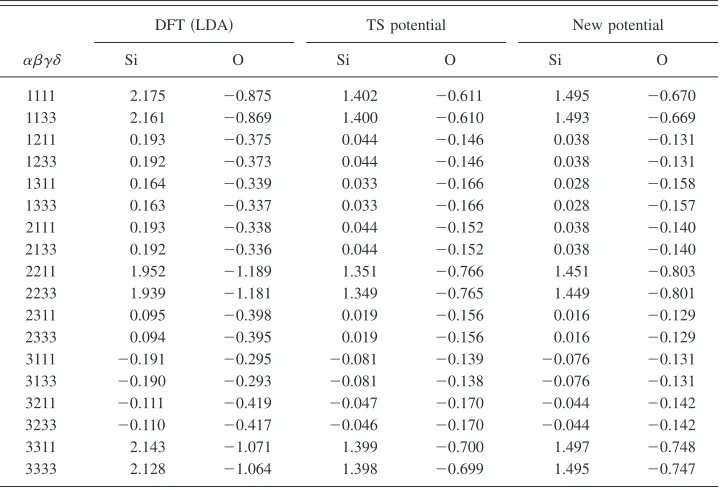
[image:7.612.124.485.615.756.2]symmetry dictates that this tensor has 18 independent
com-ponents, the values of which are given in TableVIfor DFT,
the TS potential, and our new screened potential. While the agreement between DFT and either potential is not very good, the two potentials are quite consistent with one an-other. This suggests that it is the still somewhat limited func-tional form, rather than the inclusion or exclusion of long-range electrostatic interactions, which is preventing a greater accuracy.
D. Amorphous silica
The new potential has also been tested for amorphous silica. We obtained amorphous structures following the ap-proach of Ref. 48. In particular, we slightly distorted a 576 atom␣-quartz cell to make it cubic, setting the density to the experimental value of 2.2 g/cm3. The system was initially
thermalized at 5000 K for 50 ps and then cooled down to room temperature at an annealing rate of 0.01 K/fs. The 0.1 fs time step used for the high temperatures regime was sufficiently small to guarantee energy conservation within 10−6 k
BT/ps. The final 300 K configuration was then struc-turally optimized, relaxing both the lattice vectors and the atomic positions. The elastic properties of the optimized con-figuration, as obtained with the new potential and the origi-nal TS potential, are shown in TableVII. As was the case for
␣-quartz, the agreement with experiment improves slightly
using the new LDA-fitted potential. The system was, at this point, annealed back to room temperature and, successively, atT= 3000 K to evaluate its dynamical structural properties.
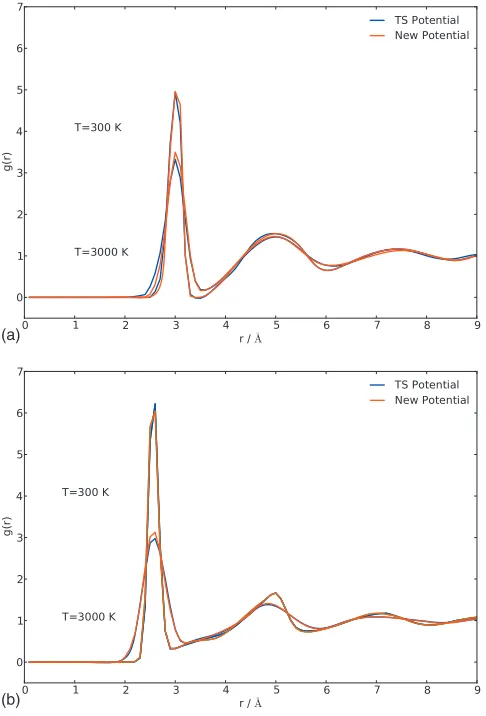
In Fig. 4 we compare the radial distribution functions
pre-dicted by the two potentials computed at T= 300 K and
T= 3000 K for the Si–Si and O–O coordinations. While very
good agreement is obtained throughout, the two potentials compare better at room temperature than at 3000 K. We also thermalized the amorphous system at significantly higher
temperatures, up to 5000 K, and found a slightly worsened agreement with the TS potential. This is not unexpected, since the new potential was parametrized including fewer distorted configurations in the fit database, making it slightly less suitable for describing the high temperature liquid phase. Si–O–Si bond angle distributions obtained at 300 K us-ing the two potentials are shown in Fig. 5. These
distribu-tions were obtained from 100 ps long NVT molecular
dy-namics simulations carried out after independent structural and cell optimizations starting from the same 72-atom amor-phous configuration. Since the volume and shape of the simulation cell play a role in determining the shape of the bond angle distribution, this procedure is expected to reveal possible discrepancies between the original TS and our new potential. Moreover, the small cell size used in this test al-lows direct comparison with the distribution produced by a reference 14 ps long first principles simulation. This is also shown in Fig.5, revealing that while the two classical poten-tials are reasonably consistent with one another, their differ-ence is of roughly the same magnitude as their discrepancy from the LDA results and the discrepancy between LDA and GGA presented in Ref.49. This suggests that the new linear
TABLE VI. Nonzero components of the screened effective charge tensorZ␣ⴱ /冑⑀␥␦for␣-quartz for the silicon atom with fractional coordinates共u, 0 , 2/3兲and the oxygen atom at共x,y, 2/3 +z兲, in atomic units.
␣␥␦
DFT共LDA兲 TS potential New potential
Si O Si O Si O
[image:8.612.125.486.72.317.2]1111 2.175 ⫺0.875 1.402 ⫺0.611 1.495 ⫺0.670 1133 2.161 ⫺0.869 1.400 ⫺0.610 1.493 ⫺0.669 1211 0.193 ⫺0.375 0.044 ⫺0.146 0.038 ⫺0.131 1233 0.192 ⫺0.373 0.044 ⫺0.146 0.038 ⫺0.131 1311 0.164 ⫺0.339 0.033 ⫺0.166 0.028 ⫺0.158 1333 0.163 ⫺0.337 0.033 ⫺0.166 0.028 ⫺0.157 2111 0.193 ⫺0.338 0.044 ⫺0.152 0.038 ⫺0.140 2133 0.192 ⫺0.336 0.044 ⫺0.152 0.038 ⫺0.140 2211 1.952 ⫺1.189 1.351 ⫺0.766 1.451 ⫺0.803 2233 1.939 ⫺1.181 1.349 ⫺0.765 1.449 ⫺0.801 2311 0.095 ⫺0.398 0.019 ⫺0.156 0.016 ⫺0.129 2333 0.094 ⫺0.395 0.019 ⫺0.156 0.016 ⫺0.129 3111 ⫺0.191 ⫺0.295 ⫺0.081 ⫺0.139 ⫺0.076 ⫺0.131 3133 ⫺0.190 ⫺0.293 ⫺0.081 ⫺0.138 ⫺0.076 ⫺0.131 3211 ⫺0.111 ⫺0.419 ⫺0.047 ⫺0.170 ⫺0.044 ⫺0.142 3233 ⫺0.110 ⫺0.417 ⫺0.046 ⫺0.170 ⫺0.044 ⫺0.142 3311 2.143 ⫺1.071 1.399 ⫺0.700 1.497 ⫺0.748 3333 2.128 ⫺1.064 1.398 ⫺0.699 1.495 ⫺0.747
TABLE VII. Equilibrium density and elastic properties of amorphous silica.
Experiment TS potential New potential
Density共g/cm3兲 2.20a 2.26 2.26
Bulk modulusB共GPa兲 38.0b 43.3 36.9 Young’s modulusE共GPa兲 69.1b 74.3 69.1 Poisson ratio 0.197b 0.166 0.174
C11共GPa兲 76.5b 81.6 73.7
C12共GPa兲 18.8b 25.6 21.7
C44共GPa兲 28.9b 32.1 30.1
aExperimental data from Ref.8
scaling potential describes amorphous silica at low tempera-tures no less accurately than the original one. We note that fixing the cell as we do in ourNVTsimulations may slightly bias the Si–O–Si distribution toward larger angles,49so that the distributions obtained cannot be expected to fully match that of real silica.
At room temperature and below, almost all silicon atoms
within the amorphous structure are fourfold coordinated. We occasionally observe defects, principally threefold and five-fold coordinated atoms, and even less frequently we detect two-membered silicon rings with the structure previously
re-ported in ab initio surface calculations.19 While
two-membered rings are almost never encountered in the bulk, they are known to play an important role in chemical pro-cesses on amorphous silica surfaces, for which they are thought to provide the main reaction sites.50 We have tested our potential on the dehydrogenated amorphous surface and we observe the systematic formation of two-membered rings which remain stable at room temperature.
V. CONCLUSIONS
We have developed a short-ranged version of the Tang-ney and Scandolo polarizable potential for silica, reparam-etrized from first principles calculations without any reliance on experimental data. Despite an effective cutoff distance of
⬃10 Å, our potential reproducesab initioand experimental
structural, elastic, and vibrational properties of both␣-quartz and amorphous silica to a high degree of accuracy. Due to its short range, our potential is linear scaling with respect to the number of atoms in the simulation and is thus suitable for modeling extended systems.
ACKNOWLEDGMENTS
J.R.K. and A.D.V. acknowledge funding from the Rio Tinto Centre for Advanced Mineral Recovery, based at Im-perial College, London. P.T. acknowledges support from the European Commission within the Marie Curie Support for Training and Development of Researchers Programme under Contract No. MIRG-CT-2007-208858. S.C. and A.D.V. ac-knowledge funding from the EU-FP7-NMP Grant “ADG-LASS.”
1B. Dorner, H. Grimmt, and H. Rzanyg,J. Phys. C 13, 6607共1980兲. 2B. Dorner and D. Strauch,J. Phys.: Condens. Matter 5, 6149共1993兲. 3F. Gervais and B. Piriou,Phys. Rev. B 11, 3944共1975兲.
4E. Gregoryanz, R. Hemley, H.-K. Mao, and P. Gillet,Phys. Rev. Lett.84,
3117共2000兲.
5H. J. McSkimin, P. Andreatch, and R. N. Thurston,J. Appl. Phys. 36,
1624共1965兲.
6Q. Wang, G. Saunders, H. Senin, and E. Lambson,J. Non-Cryst. Solids
143, 65共1992兲.
7L. Levien, C. T. Prewitt, and D. J. Weidner, Am. Mineral. 65, 920 共1980兲.
8R. Brückner,J. Non-Cryst. Solids 5, 123共1970兲.
9P. Vashishta, R. Kalia, J. Rino, and I. Ebbsjö,Phys. Rev. B 41, 12197 共1990兲.
10B. van Beest, G. Kramer, and R. van Santen,Phys. Rev. Lett. 64, 1955 共1990兲.
11A. Carré, L. Berthier, J. Horbach, S. Ispas, and W. Kob,J. Chem. Phys.
127, 114512共2007兲.
12J. Horbach and W. Kob,Phys. Rev. B 60, 3169共1999兲.
13T. Demuth, Y. Jeanvoine, J. Hafner, and J. Angyan,J. Phys.: Condens. Matter 11, 3833共1999兲.
14M. Catti, B. Civalleri, and P. Ugliengo, J. Phys. Chem. B 104, 7259 共2000兲.
15N. Choudhury and S. Chaplot,Phys. Rev. B 73, 094304共2006兲. 16B. Holm and R. Ahuja,J. Chem. Phys. 111, 2071共1999兲.
17N. Flocke, W. Zhu, and S. B. Trickey,J. Phys. Chem. B 109, 4168 共2005兲.
18H. Kimizuka, S. Ogata, J. Li, and Y. Shibutani,Phys. Rev. B75, 054109 共2007兲.
0 1 2 3 4 5 6 7 8 9
r / ◦
A
0
1
2
3
4
5
6
7
g(
r)
T = 3 0 0 K
T = 3 0 0 0 K
T S P o t e n t i a l N e w P o t e n t i a l
(a)
0 1 2 3 4 5 6 7 8 9
r / ◦
A
0
1
2
3
4
5
6
7
g(
r)
T = 3 0 0 K
T = 3 0 0 0 K
T S P o t e n t i a l N e w P o t e n t i a l
[image:9.612.52.295.48.406.2](b)
FIG. 4. Radial distribution function for共a兲Si–Si and共b兲O–O as computed at two different temperaturesT= 300 K andT= 3000 K.
100 110 120 130 140 150 160 170 180 Si-O-Si angle (degrees)
TS Potential New Potential LDA
FIG. 5. Si–O–Si bond angle distributions for the two potentials and DFT LDA, computed at a temperature ofT= 300 K.
[image:9.612.54.292.549.731.2]19D. Ceresoli, M. Bernasconi, S. Iarlori, M. Parrinello, and E. Tosatti,Phys. Rev. Lett. 84, 3887共2000兲.
20R. Hemley, J. Badrom, and D. Teter, in Physics Meets Mineralogy:
Condensed-Matter Physics in Geosciences, edited by H. Aoki and Y. Syono共Cambridge University Press, New York, 2000兲, pp. 173–204.
21G. Csányi, T. Albaret, M. Payne, and A. De Vita,Phys. Rev. Lett. 93,
175503共2004兲.
22J. R. Kermode, T. Albaret, D. Sherman, N. Bernstein, P. Gumbsch, M. C.
Payne, G. Csányi, and A. De Vita,Nature共London兲 455, 1224共2008兲.
23N. March and M. Tosi,Coulomb Liquids共Academic, London, 1984兲. 24A. Rowley, P. Jemmer, M. Wilson, and P. Madden,J. Chem. Phys. 108,
10209共1998兲.
25P. Tangney and S. Scandolo,J. Chem. Phys. 117, 8898共2002兲. 26A. Laio, S. Bernard, G. Chiarotti, S. Scandolo, and E. Tosatti,Science
287, 1027共2000兲.
27D. Herzbach, K. Binder, and M. H. Muser,J. Chem. Phys. 123, 124711 共2005兲.
28P. Ewald,Ann. Phys. 64, 253共1921兲.
29J. Perram, H. Petersen, and S. De Leeuw,Mol. Phys. 65, 875共1988兲. 30K. Esselink,Comput. Phys. Commun. 87, 375共1995兲.
31D. Wolf, P. Keblinski, S. R. Phillpot, and J. Eggebrecht,J. Chem. Phys.
110, 8254共1999兲.
32A. Pedone, G. Malavasi, M. C. Menziani, U. Segre, F. Musso, M. Corno,
B. Civalleri, and P. Ugliengo,Chem. Mater. 20, 2522共2008兲.
33J. C. Fogarty, P. Beck, H. M. Aktulga, A. Y. Grama, A. C. T. van Duin,
and S. A. Pandit,J. Chem. Phys. 132, 174704共2010兲.
34P. Brommer, P. Beck, A. Chatzopoulos, F. Gähler, J. Roth, and H.-R.
Trebin,J. Chem. Phys. 132, 194109共2010兲.
35S. J. Clark, M. D. Segall, C. J. Pickard, P. J. Hasnip, M. I. J. Probert, K.
Refson, and M. C. Payne,Z. Kristallogr. 220, 567共2005兲.
36J. P. Perdew,Phys. Rev. B 33, 8822共1986兲. 37A. D. Becke,Phys. Rev. A 38, 3098共1988兲. 38D. R. Hamann,Phys. Rev. Lett. 76, 660共1996兲.
39P. Tangney and S. Scandolo,J. Chem. Phys. 119, 9673共2003兲. 40N. Bernstein, J. R. Kermode, and G. Csányi, Rep. Prog. Phys. 72,
026501共2009兲.
41G. Csányi, S. Winfield, J. Kermode, A. Comisso, A. De Vita, N.
Bern-stein, and M. C. Payne, “Expressive programming for computational physics in Fortran 95+,” inIoP Comput. Phys. Newsletter, Spring 2007
共2007兲. Seehttp://www.libatoms.org.
42A. Togo, F. Oba, and I. Tanaka,Phys. Rev. B 78, 134106共2008兲. 43K. Kunc and R. Martin,Phys. Rev. Lett. 48, 406共1982兲.
44K. Parlinski, Z. Li, and Y. Kawazoe,Phys. Rev. Lett. 78, 4063共1997兲. 45K. Refson, P. Tulip, and S. Clark,Phys. Rev. B 73, 155114共2006兲. 46M. Born and K. Huang,Dynamical Theory of Crystal Lattices共Oxford
University Press, Oxford, 1954兲.
47X. J. Han, L. Bergqvist, P. H. Dederichs, H. Müller-Krumbhaar, J. K.
Christie, S. Scandolo, and P. Tangney,Phys. Rev. B 81, 134108共2010兲.
48M. Szymanski, A. Shluger, and A. Stoneham,Phys. Rev. B 63, 224207 共2001兲.
49R. Van Ginhoven, H. Jónsson, and L. Corrales,Phys. Rev. B 71, 024208 共2005兲.