Simulating Ion Permeation Through the ompF Porin Ion Channel Using
Three-Dimensional Drift-Diffusion Theory
T.A. VAN DER STRAATEN
Beckman Institute for Advanced Science and Technology, University of Illinois at Urbana-Champaign, 405 N Mathews Ave., Urbana, IL 61801, USA; Department of Molecular Biophysics and Physiology,
Rush Medical College, 1750 W Harrison St., Chicago, IL 60612, USA
J.M. TANG
Department of Molecular Biophysics and Physiology, Rush Medical College, 1750 W Harrison St., Chicago, IL 60612, USA
U. RAVAIOLI
Beckman Institute for Advanced Science and Technology, University of Illinois at Urbana-Champaign, 405 N Mathews Ave., Urbana, IL 61801, USA
R.S. EISENBERG
Department of Molecular Biophysics and Physiology, Rush Medical College, 1750 W Harrison St., Chicago, IL 60612, USA
N.R. ALURU
Beckman Institute for Advanced Science and Technology, University of Illinois at Urbana-Champaign, 405 N Mathews Ave., Urbana, IL 61801, USA
Abstract. Ionic channels, natural nanotubes found in biological cells, are interesting to the electronics community because they display a range of device-like functions. The purpose of this paper is to illustrate how the solution methodology, developed for 3-D drift-diffusion models of semiconductor devices, can be applied to ion permeation in ionic channels. For this study we select theompFporin channel, found in the membrane of theE. colibacterium. The self-consistent 3-D model is based on the simultaneous solution of Poisson’s equation, which captures Coulomb interactions, and a current continuity equation for each ion species, describing permeation down an electrochemical gradient. Water is treated as a uniform background medium with a specific dielectric constant. For demonstration, a simple model is assumed for the mobility/diffusivity of each ionic species and we compute the current-voltage relations forompFporin in a wide range of conditions. Agreement with experimental measurements is surprisingly good given that the model uses the ion diffusivity as the only calibrated parameter.
Keywords: drift-diffusion simulation, numerical methods, ionic channels, bioelectronics,ompFporin
1. Introduction
Ion channels are a class of proteins found in the mem-branes of all biological cells. Each channel consists of
side chains of the amino acids (hereafter referred to as residues) are ionizable via the addition or subtrac-tion of protons. The ionizasubtrac-tion state of a given residue depends on the pH and salt concentration of the so-lution in which the protein is immersed. Thus every ion channel carries a strong and steeply varying dis-tribution of permanent charge, which depends on the particular combination of channel and prevalent phys-iological conditions. The charge distribution residing on the channel plays a critical role in determining the permeation characteristics of the open channel.
From a physiological standpoint ion channels reg-ulate the transport of ions in and out of the cell, and in and out of compartments inside cells like mitochon-dria and nuclei, thereby maintaining the correct inter-nal ion composition that is crucial to cell survival and function. Many channels have the ability to selectively transmit or block a particular ion species and most ex-hibit switching properties similar to electronic devices. Malfunctioning channels cause or are associated with many diseases, and a large number of drugs act di-rectly or indidi-rectly on channels (Ashcroft 1999). From a device point of view, ion channels can be thought of as elements in an electrical circuit, behaving like resistors, diodes or batteries depending on the specific channel and environmental factors. Some channels per-form specialized functions resembling that of complex electronic systems. Indeed, equivalent circuit models have a long tradition in the theory of ion channels (Jack, Noble and Tsien 1975, Eisenberg, Barcilon and Mathias 1979).
The wide range of device-like functions exhibited by ionic channels has generated a great deal of inter-est in the engineering community. On the one hand, it is appealing to exploit the functionality of natu-rally occurring channels in traditional devices and cir-cuits, e.g. for extreme miniaturization of sensors and achieve single molecule detection. On the other hand, a clear understanding of channel operation may pro-vide a template for the design of functional elements based on synthetic molecular systems or nanotubes. The use of molecular elements for nanoscale integra-tion would have the distinct advantage of perfect struc-ture duplication and self-assembly, while the solid-state nanoscale device counterparts tend to be strongly affected by statistical fluctuations and defects. The methods of molecular genetics and biology often al-low the control of channel proteins with atomic res-olution. By replacing or deleting one or more of the amino acids many channels can be mutated, altering
the charge distribution along the channel (http://hoshi-o.physiology.uiowa.edu/Mutations/Home.html). Engi-neering channels with specific conductances and se-lectivities is therefore conceivable. As device features continue to shrink the possibility, or perhaps, necessity of incorporating biological ion channels in the design of novel bio-devices becomes increasingly apparent.
With the availability of standardized software and computing power, Molecular Dynamics (MD) has be-come the most widely employed tool for studying ion dynamics in protein channels. Although MD simu-lations can resolve channel physics in atomic detail, the present computational requirements of such large-scale simulations prohibit the direct calculation of steady-state channel currents, particularly when chan-nels are controlled by trace concentrations of ions or co-factors (Hille 2001). Alternatively, drift-diffusion theory, used widely in the engineering community (Selberherr 1984) to describe charge transport in semi-conductor devices and plasma discharges, can be used to compute macroscopic current with a modest amount of computational effort. Drift-diffusion theory sacri-fices the resolution of molecular detail. However, when used with an appropriate value of ion diffusivity it has been found to describe ion permeation through ion channels surprisingly well (Schuss, Nadler and
Eisenberg 2001, Kurnikova et al. 1999, Hollerbach
et al. 1999, Cardenas, Coalson and Kurnikova 2000, Eisenberg 1996, 1999).
In this paper we a present a self-consistent three-dimensional (3-D) drift-diffusion model of ion (K+ and Cl−) permeation through theompFporin channel, a trimeric protein channel that spans the outer mem-brane of the E. coli bacterium to allow the passive diffusion of small hydrophilic solutes. ompF is one of the few channels whose three-dimensional molec-ular structure is well-known from X-ray crystallogra-phy (Tieleman and Berendsen 1998, Weiss and Schulz
1992, Schirmer 1998, Cowan et al.1992, Philippsen
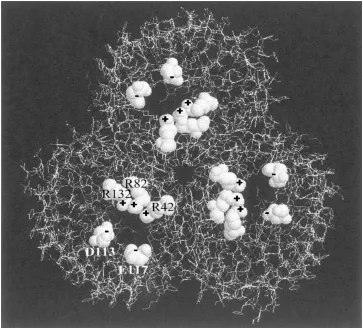
Figure 1. Molecular structure ofompF, a porin channel found in the outer membrane of theE-colibacterium. This projection along the length of the channel shows the three-fold symmetry of the trimer. Several ionized residues in the constriction region of each pore are highlighted.
residues (Phaleet al.2001), as shown in Fig. 1. Here, R stands forarginineand E forglutamate, both acidic amino acid residues. The number identifies the location of the residue in the linear sequence of amino acids that form any protein. The arrangement of these charges gives rise to a very strong electric field transverse to the direction of ion flow, parallel to the plane of the membrane. The function of this transverse field is not known, although some of us believe it may be a bind-ing site for a natural channel blocker, the identity of which is not yet known. Whatever the function, how-ever, recent simulations (Im and Roux 2001, Schirmer and Phale 1999) show that it results in two separate strands of anionic and cationic current. The net charge residing on the entire porin molecule is equivalent to approximately−30|e|, whereeis the electron charge. The ease with whichompFcan be mutated, together with its robust structure makeompFa good choice for
and average ion concentration in different regions of the channel. Section 5 summarizes the current work and outlines our plans to extend the drift-diffusion model to describe physical effects that are not adequately rep-resented by the continuum theory in its present form.
2. Drift-Diffusion Transport Model
Drift-diffusion theory of charge transport is the cor-nerstone of classical transport theory. Although it is usual to compute the electric field self-consistently in most semiconductor device applications by coupling the transport equations with Poisson’s Equation, in principle it is possible to use drift-diffusion theory with a given background field. Since the concept of evalu-ating the electrostatic potential self-consistently may be relatively unfamiliar to the ion channel community, we hereafter refer to drift-diffusion theory as Poisson Drift-Diffusion (PDD) theory, to avoid confusion and emphasize that the transport equations are coupled with Poisson’s Equation. The theory is known as Poisson-Nernst-Planck (PNP) theory in the ion channel litera-ture, where it was introduced independently but much later (Eisenberg 1996, Barcilon 1992, Barcilon, Chen and Eisenberg 1992, Barcilonet al.1993). When fluxes are all identically zero, the theory is identical to (non-linear) Poisson Boltzmann theory used to describe pro-teins (Eisenberg, Klosek and Schuss 1995, Antosiewicz
et al.1995, Sharp and Honig 1990, Honig and Nichols 1995, Warshel and Russell 1984). The drift-diffusion equation for the current density may be obtained from the lowest order moment of the Boltzmann equation (Ferry 1991), under the assumption that the distribu-tion funcdistribu-tion is close to equilibrium. A consequence of this assumption is that in the diffusive term, obtained from moment integration of Boltzmann equation, one may use the average thermal energy for the carriers at the given temperature to evaluate the average of the square velocity,v2, which can only be known if the distribution function is accessible. A discussion on the implications of assuming a near-equilibrium distribu-tion funcdistribu-tion in the model hierarchy in semiconduc-tor device simulation can be found in Ravaioli (1998). The drift-diffusion model is adequate not only in con-ditions of low bias voltage, but also when scattering events thermalize the carriers very quickly towards an equilibrium distribution, transferring to the environ-ment the excess energy acquired by the carriers under the influence of the accelerating fields. Charged ionic
computational physics. On the other hand, molecu-lar dynamics simulations in the tradition of protein chemistry do not, since they cannot predict current and therefore cannot satisfy Ohm’s law or Fick’s law (Eisenberg 1999), the latter invariably requiring ther-mostats to supply or remove kinetic energy every 10– 100 femtoseconds.
2.1. Theory
The electrostatic potentialφis described by Poisson’s Equation,
∇ ·(ε∇φ)= −(ρfixed+ρ++ρ−) (1)
whereεis the dielectric constant andρfixed,ρ+andρ− are the densities of fixed charge residing on the protein, and of mobile K+ions and Cl−ions, respectively. The current density j± flowing down an electrochemical gradient is given by,
j±= −(D±/kT)ρ±∇ψ± (2)
whereD±is the diffusion coefficient andψ±is the total electrochemical potential of each species, given by
ψ±=qφ±kTlnρ±+ψ±ex
The first two components of ψ± describe the ideal
chemical potential for a system of point charges. The last termψex
±, known as the “excess” chemical poten-tial, accounts for departures from ideality due to the fi-nite volume occupied by the ions (Davis 1996, Barthel, Krienke and Kunz 1998, Waisman and Lebowitz 1972a, 1972b, Durand-Vidal, Simonin and Turq 2000, Simonin and Blum 1996, Simonin, Bernard and Blum 1998, 1999, Simonin, Blum and Turq 1996, Simonin
1997, Nonner et al.2001, Nonner, Catacuzzeno and
Eisenberg 2000). Since most ion channels are typically only 4–8 ˚A wide while the permeating ions are 2–4 ˚
A in diameter, the non-zero ion volume is likely to be important. Nonner, Gillespie and Eisenberg (2002) have recently combined a treatment of excess chemical potential using Density Functional Theory with one-dimensional drift-diffusion transport theory to describe ion permeation and selectivity for a calcium channel. Their results show that the finite volume of the ions is enough to account for most of the selectivity proper-ties of channels, if they are computed at equilibrium with standard methods of modern physical chemistry.
The work reported here was done at the same time as the work of Gillespie and Nonner and so finite volume effects will have to be considered in a later publication. Upon setting ψ±ex = 0 the drift-diffusion Eq. (2) reduces to its more usual form
j±= −(µ±ρ±∇φ±D±∇ρ±)
where the ion mobilityµ± is related to the diffusion coefficient via the Einstein relations. Conservation of charge is enforced via the continuity equation
∇ · j±+∂ρ±
∂t =S± (3)
whereS±captures the details of ion binding and other chemical phenomena that may populate or deplete the ion densities. We do not consider such phenomena in this present work and setS±=0.
The channel system contains a single porin molecule
in situ in a lipid bilayer (membrane), immersed in an aqueous bath of KCl. The three pores provide an aqueous pathway for K+and Cl−ions to cross the bi-layer. Experimentally different salt concentrations are set on either side of the bilayer (hereafter referred to
as Cleft and Cright). Electrodes are immersed in the
baths to maintain a fixed bias voltage across the chan-nel/membrane system. We seek a steady-state solution forφ,ρ+andρ−that simultaneously satisfies the cou-pled partial differential equations (PDEs) (1)–(3) sub-ject to the following Dirichlet boundary conditions (4) enforced at the electrodes.
φright−φleft=V bias
ρ±,right=Cright (4)
ρ±,left=Cleft
2.2. The PROPHET Simulator
(2D) and three-dimensional (3-D) meshes in feasi-ble runtimes on workstations are now readily avail-able (http://www.ise.ch, http://www.synopsys.com, http://www.silvaco.com). However, most of these solvers are oriented toward the simulation of semi-conductor devices for which the system geometry is relatively simple. Application of “off-the-shelf” pack-ages to geometrically complex systems such as those found in ion channels is generally not possible since the latter requires a detailed representation of the channel geometry.
The model described above was implemented using the PROPHET simulator (http://www-tcad. stanford.edu/∼prophet/), a computational platform originally developed at Lucent Technologies for semi-conductor process modeling, and currently being ex-tended to include a variety of device simulation models at Stanford University. The PROPHET simulator pro-vides a convenient scripting framework for defining, discretizing and solving an arbitrary system of PDEs. Physical properties such as dielectric constant and mo-bility can be assigned to the different regions of the computational domain at run-time.
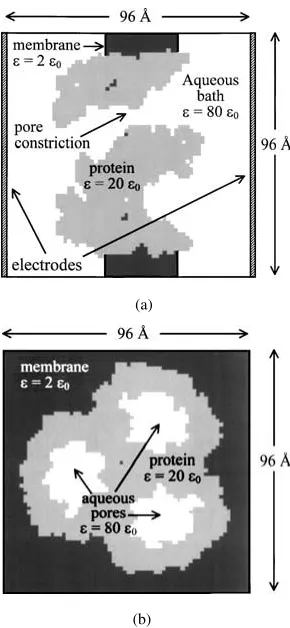
Equations (1)–(4) are readily constructed using ex-isting PROPHET operators, and discretized using fi-nite volume methods. The resulting system of non-linear algebraic equations is then solved by Newton’s method, using sparse iterative techniques (Selberherr 1984). In contrast to most commercial PDE solvers, PROPHET has the flexibility of being able to handle arbitrary geometries such as those encountered in bio-logical systems. A customized mesh, shown in Fig. 2, was created for theompFmolecular structure, defining three regions—protein, membrane and electrolyte—on a 1.5 ˚A uniform rectilinear mesh. The protein and mem-brane are assigned relative dielectric constants of 20 and 2 respectively, and the electrolyte is assigned a value of 80. There are two electrodes placed at oppo-site ends of the domain approximately 15 ˚A from the ends of the porin molecule as shown.
2.3. Physical Parameters
The density of fixed charge on the protein,ρfixedwas modeled by associating a fractional point charge (in units of|e|) to each atom, and then interpolating the charge to the mesh. The charges residing on isolated amino acids in neutral electrolyte solutions can be cal-culated usingab initioquantum chemistry codes. Here we have used the tabulated OPLS partial charges, a
(a)
[image:6.595.344.489.124.438.2](b)
Figure 2. PROPHET mesh representation of theompFtrimerin situ in a membrane, immersed in an electrolyte solution (potassium chlo-ride) showing (a) longitudinal and (b) cross-sectional slices through the 3-D computational domain generated on a uniform rectilinear grid (1.5 ˚A mesh size). Electrodes placed at both ends of the domain maintain a fixed bias across the channel/membrane system.
force field used widely in MD simulations of pro-tein molecules (Jorgensen 1998, Jorgensen and Tirado-Rives 1988), with modifications to account for the di-electric environment, proximity of neighboring amino acids in the folded of the protein, and electrolyte con-centration (van der Straatenet al.2002, Antosiewicz, McCammon and Gilson 1994).
The diffusion coefficient for ions freely diffusing in bulk electrolyte transport can be inferred from ex-periments (Tyrrell and Harris 1984, Newman 1991, Harned and Owen 1958, Robinson and Stokes 1959,
Conway 1969, Zematiset al.1986) and is well
Buchner and M¨unsterer 1995). In the confined vol-umes of ionic channels, where additional sources of friction (Kurnikova, Waldeck and Coalson 1996, Nee and Zwanzig 1970, Wolynes 1980, Bagchi and Biswas 1998) will also restrict ion motion, the diffusion coeffi-cient is expected to differ from bulk values, and cannot be obtained by experimental means. Recent MD sim-ulations of K+ and Cl− ions inside the porin channel indicate that the diffusion coefficient is substantially reduced from its bulk (van der Straaten et al. 2002). However, physical analysis of the diffusion coefficient, even in homogeneous ionic solutions, presents major difficulties for MD (Evans and Morriss 1990, Ciccotti and Hoover 1990, Hoover 1986, 1991, Alder 1992, Mareschal and Holian 1992). In the inhomogeneous environment of an ion channel, where ion transport is governed by atomic motions occurring over extremely disparate time-scales, the determination of the diffu-sion coefficient from MD poses considerable difficul-ties in principle as well as practice: it is possible that estimating an effective diffusion coefficient requires a simulation in atomic detailon the time scale of exper-imental measurements(i.e., milliseconds). Such sim-ulations are not likely to become practical in the near future, particularly if they depend in an important way on the trace concentrations of ions.
For this reason we have adopted an engineering ap-proach, assuming a spatially uniform diffusion coeffi-cient. Since we compute the current-voltage relations for potassium chloride KCl, for which the diffusion coefficients in bulk electrolyte are approximately the same for both species (DK+ =2.00×10⁻⁵ cm2s−1,
DCl− = 1.98×10⁻⁵ cm2s−1 (Lide 1994)), we as-sume the same constant diffusion coefficient for each
ion species D+ = D− = D. In that case the
com-puted current scales linearly with the diffusion coeffi-cient (Eq. (2)), and can be adjusted to give the best fit to the measured curves, yielding an appropriate value for the effective diffusion coefficient. The simulations presented here with the choice of diffusivities illus-trated above should be taken mainly as demonstration of the TCAD approach with PROPHET. The use of a best fit for the diffusivities follows a purely engineer-ing approach. From a physical point of view, each ionic species may be characterized by its own diffusivity that is spatially dependent inside the channel. The simple choice of uniform diffusivity fit followed in this pa-per does not affect the generality and robustness of the solution approach. Work is in progress to determine space-dependent diffusivities for the porin channel
us-ing Molecular Dynamics simulations, and we plan to report on these results later.
3. Experiments
In this section we describe the experimental proto-cols followed in order to record single-channel current-voltage curves forompFporin, which were used to cal-ibrate the value of the effective diffusion coefficient. The importance of using a single porin molecule for these measurements cannot be overstated: measure-ments from an ensemble of channels are difficult to interpret because they include channels that insert with opposite orientations. The measured properties depend on the orientation (because the molecule is asymmet-rical) and the orientation of insertion is not the same under different experimental conditions (because the charge density on the protein which helps control in-sertion is asymmetrical and varies with experimental conditions). Thus, measurements must be made on sin-gle trimers if they are to be reliable.
3.1. Porin
The porin proteinompFwas provided in a solution
con-taining 100 mM KCl, 1 mMEDTA, 20 mM NaH2PO4
and 1% detergent n-octyl-polyoxyethylene (O-POE:
product number P-1140, Bachem Bioscience Inc., King of Prussia, PA 19406) and then diluted into a 100 mM KCl solution containing 1% O-POE. Solutions were
buffered with 20 mM HEPES (pKa=7.55) to pH 7.4.
Porin molecules were reconstituted one at a time into a painted planar bilayer stretched over a 150µm aper-ture, area ∼0.02 mm2, separating 4 ml of salt solu-tion in a grounded bilayer chamber and 3 ml of salt solution in a Delrin cup. Ag/AgCl electrodes were connected to the bathing solution by 3 M KCl-3% agar bridges to minimize liquid junction potentials. To minimize electrical and mechanical artifact, solutions were stirred with a dc powered magnetic stirrer (Cole Palmer, Model 4804, using a micro-stirring bar) and changed in the grounded bilayer chamber (held at zero potential) using two peristaltic pumps with constant flow.
3.2. Bilayers
Bilayers were made from lipids
Alabaster, AL 35007) and phosphatidyl-choline
(#840053) dissolved in chloroform. Lipids (PE:PC 4:1)
were evaporated with argon, dissolved in n-Decane
(Sigma D4384) at a concentration of 10 mg/ml and used within 2 weeks. Otherwise, insertion was rarely ob-served. The resistance from the ground chamber to the
voltage bath chamber was∼50–100 G. Experiments
were started with 0.1 M, 0.25 M, or 0.5 M KCl salt so-lutions on both sides of the bilayer. Porin (0.1 ng) was then placed in the 4 ml of the grounded chamber and insertion of a single trimer was typically observed after 5–10 minutes of stirring. The solution on the grounded side was changed after a trimer inserted. Single chan-nel currents were recorded from the same porin trimer with a range (0.1 M to 3 M KCl) of solutions on the grounded side.
3.3. Current Measurements
With these precautions, it was possible to measure sin-gle channel currents in the same porin trimer in many
solutions: recordings were made from thesameporin
trimer with 0.1, 0.25, 0.5, 1, and 3 M KCl solutions on the grounded side. The solution in the voltage cham-ber was not changed when recording from one porin trimer, although, of course, that solution was different in different experiments, i.e., 0.1, 0.25 and 0.5 M. Cur-rent was recorded in response to step or ramp poten-tials, with current-voltage characteristics being mea-sured with ramps. The gating processes that open and close porin were not studied. Figure 3 shows a typ-ical histogram of the currents through a single porin molecule with 1 M solutions of KCl on either side of the bilayer under an applied voltage of−100 mV. Cur-rent peaks occurring at regular intervals indicate the number of conducting pores, the largest current cor-responding to all three pores being in the open state, for example. Figure 4 shows the traces of current as a function of time after bias voltages of (a)+80 mV and (b)−80 mV are applied. The four evenly spaces levels of current correspond to all three pores closed (zero current), and one, two or all three pores open.
4. Simulations
4.1. Nernst Potential
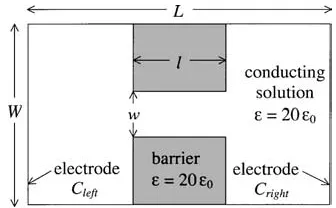
[image:8.595.313.518.125.293.2]The net flux of particles in a system that has reached thermodynamic equilibrium is zero. Simulations of
Figure 3. The amplitude histogram of the currents through a single trimer ofompFreconstituted into a lipid bilayer, in a symmetric 1 M KCl solution under−100 mV applied voltage. The four main peaks at 0±2.5 pA (Baseline), 128±3.7 pA, 250±2.4 pA and 370± 1.0 pA correspond to current flowing through none, one, two and three pores. In addition the graph exhibits a smaller peak at 10± 3.8 pA (pedestal current), the origin of which is not yet known. The conductances of the individual pores are similar at about 1.2 nS while the conductance of the pedestal current is about 10 times smaller. The seal resistance was 20 G.
ion channels and proteins are almost always done at equilibrium (Tieleman and Berendsen 1998, Roux and Karplus 1991a, 1991b, Roux 1999, Tieleman
et al. 2001). However, the primary function of ion channels—the translocation of ions—takes place only when the system is driven away from equilibrium. An electrochemical gradient must be present to cause a net flow of ions through the channel. The Nernst Potential is the holding potential required to balance a density gradient across a barrier having an aperture that allows only one species of ion to flow, such that the net flow of charge is zero (Newman 1991)
VNernst= −
kT q ln
Cleft
Cright
(5)
(a)
[image:9.595.68.284.131.502.2](b)
Figure 4. Current through a single trimer ofompFas a function of time under bias voltages of (a)+80 mV and (b)−80 mV. In addition to the four main conductance states (none, one, two and three pores) these current traces show evidence of many short-lived subconductance states.
[image:9.595.318.515.138.288.2]Figure 5. Barrier structure used to compute the Nernst potential. The widthW, depthWand lengthLof the three-dimensional sim-ulation box were all set to 96 ˚A.
Table 1. Nernst potential for a barrier structure.
VNernst(mV) VNernst(mV)
l/L w/W Cright/Cleft (Eq. (5)) (PROPHET)
1/2 1/4 2.5 −23.7 −23.7
5 −41.6 −41.6
10 −59.5 −59.3
1/2 1/8 2.5 −23.7 −23.8
5 −41.6 −41.7
10 −59.5 −59.1
1/4 1/8 2.5 −23.7 −23.7
5 −41.6 −41.6
10 −59.5 −59.2
(Cleft/Cright), applied biases, barrier thickness l and square aperture widthsw. The KCl concentration on the left side of the barrier was held fixed atCleft=0.1 M KCl while the concentration on the right side was
var-ied between 0.25 and 1 M. K+ was chosen to be the
permeable ion by suppressing the Cl− diffusivity by a factor of 103 relative to the K+ diffusivity. For all combinations of conditions the PROPHET simulator matches the theoretical value of the Nernst Potential given by Eq. (5) to within 0.5%. Table 1 summarizes the results.
4.2. Current-Voltage Relations
[image:9.595.93.261.588.692.2](a)
[image:10.595.94.261.121.494.2](b)
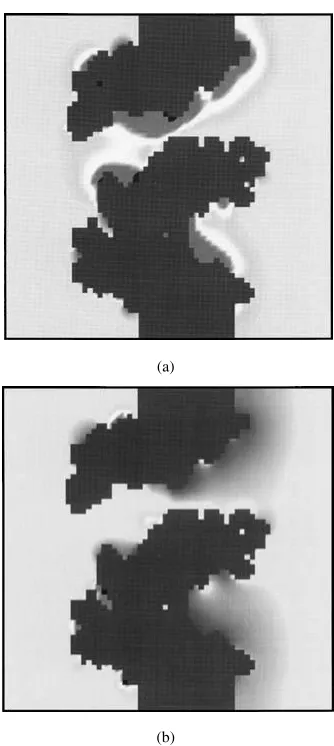
Figure 6. Steady state (a) K+ion density and (b) Cl+ion density on a two-dimensional slice through the computational domain for a 0.1 M symmetric (Cleft=Cright) KCl under an applied bias of 200 mV. Typical performance on the NCSA SGI Origin 2000 allows 15 current-voltage curves to be calculated in approximately 36 CPU hours.
Figure 6 shows the steady state ion densities, (a) K+ion density and (b) Cl−ion density, on a 2D slice intersecting one of the three pores. A bias voltage
Vbias=200 mV was applied across the electrodes. The concentration of KCl electrolyte in the baths on either side of the membrane was held atCleft=Cright=0.1 M (1 M =1000NA m−3, where NA = 6.02×1026 is Avogadro’s number). As expected, ions accumulate in regions of strong fixed charge residing on the amino acids.
Figure 7 compares the experimentally measured I-V curves obtained in symmetric solutions of (a) 0.1 M, (b)
0.25 M, (c) 0.5 M and (d) 1 M KCl with those computed from the drift-diffusion model. At lower salt concen-trations (0.1 M and 0.25 M) the measured I-V curves, shown by the unbroken line, exhibit a significant de-parture from linearity and an asymmetry with respect to the applied bias. This weakly rectifying behavior is also evident from the simulation results (shown by sym-bols), and reflects the longitudinal asymmetry inherent in the distribution of fixed charges lining the channel. The agreement between experiment and simulation is reasonable, considering that the latter were computed with spatially uniform diffusion coefficients. As the salt concentration is increased, the non-linearity disappears suggesting more effective electrostatic shielding of the charges lining the pore of the channel. At higher salt concentrations (0.5 M and 1 M KCl), the computed I-V curves fit the experiment very well.
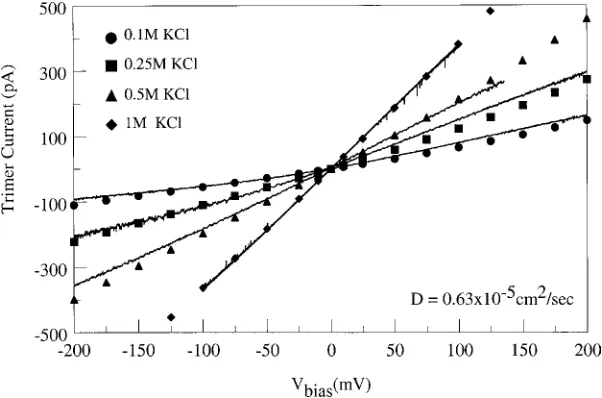
Separate fits were performed for each set of concen-trations shown in Fig. 7, giving effective diffusion coef-ficients in the rangeD=(0.58–0.67)×10−5cm2s−1. These values are comparable to the average diffusion coefficient inside the channel obtained from Molecular Dynamics simulations (van der Straatenet al.2002). Unlike the free diffusion of ions in bulk electrolyte so-lution, ionic transport inside the restricted and highly charged volume of an ion channel is likely to be a dy-namic coupled function of the protein and its environ-ment. As such it is hardly surprising that the effective diffusion coefficient varies with salt concentration. In fact, Schirmer and Phale (1999) have shown that the pathways for diffusion of anions and cations inompF
are separate. It would be remarkable if this bifurcation in pathways did not result in a concentration dependent diffusion coefficient. For comparison, the same fitting procedure was applied to the entire data set covering all four concentrations, yielding a single effective dif-fusion coefficient D = 0.63×10⁻⁵ cm2s−1. Again, the agreement between the experimental and computed I-V curves, shown in Fig. 8, is reasonable.
Figure 7. I-V curves computed for symmetric solutions of (a) 0.1 M (•D=0.67×10⁻⁵cm2s−1), (b) 0.25 M (D=0.68×10⁻⁵cm2s−1), (c) 0.5 M (D =0.58×10⁻⁵ cm2s−1) and (d) 1 M (D= 0.64×10⁻⁵cm2s−1) KCl. Experimentally measured curves, indicated by the continuous line, are shown for comparison. The diffusion coefficient that provides the best fit to the measured I-V curve was determined separately for each concentration.
Figure 8. Measured and computed I-V curves in symmetric solutions (a) 0.1 M (•), (b) 0.25 M (), (c) 0.5 M () and (d) 1 M () KCl. The symbols represent the I-V curves computed using a single value of diffusion coefficient (D=0.63×10⁻⁵cm2s−1) that gives the best fit to the
entire set of measured data.
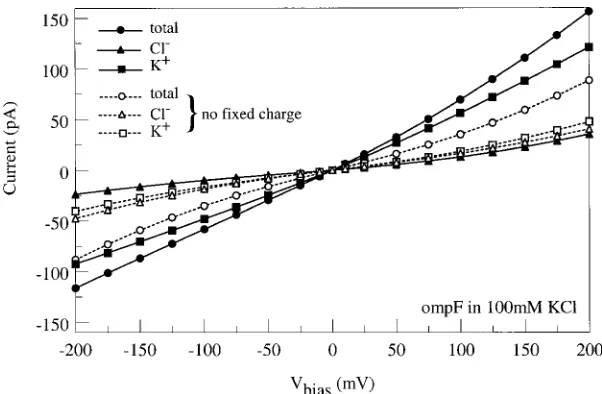
with respect to the magnitude of the applied bias. Sec-ondly, in the absence of fixed charge the model pre-dicts a slight selectivity that depends on the polarity of the applied bias. For positive bias the channel fa-vors cationic current, while for negative bias it fafa-vors anionic current. The individual cation and anion I-V curves are slightly rectifying but add to yield a total
[image:11.595.147.448.389.588.2]Figure 9. Computed I-V curves for symmetric solutions of 0.1 M KCl computed with (solid lines, filled symbols) and without (dashed lines, open symbols) the fixed charge. The individual K+() and Cl−(), and the net current (•) is shown for each case.
fixed charge of approximately −30|e|, is included in the model the channel now becomes significantly se-lective for cation current irrespective of the bias po-larity. The combination of the geometry-induced se-lectivity and that induced by the fixed charged would explain to some extent the mild rectifying behavior in the complete I-V curve. We conclude that it is impor-tant to use a realistic three-dimensional channel ge-ometry to capture the details of the transport in ionic channels.
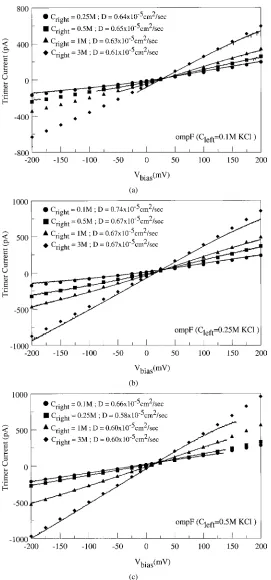
It is very important to study asymmetric solutions because the I-V curves predicted by traditional barrier and diffusion models, which do not compute the local electric field in a self-consistent manner, are strikingly different from those predicted by models that compute the electric field consistently (Hille 2001, Eisenberg 1996, 1999, Chen and Eisenberg 1993). Figure 10(a)– (c) compare the experimental I-V curves measured in asymmetric concentrations of KCl with those com-puted from the drift-diffusion model. The discontinu-ities evident in some of the experimental data indicate that the channel has closed spontaneously over that particular range of applied voltages. Each figure cor-responds to experimental conditions in which the con-centration of KCl in one bath, Cleft, is held constant while the concentration in the other, Cright, is varied. For each value ofCleftthe spread in effective diffusion coefficients is fairly small (within 4 to 8% of the av-erage). Interestingly, the value of diffusion coefficient that provides the best fit to the measured curve is not
the same when the bath concentrations are swapped. That is, the effective diffusion coefficient depends on the alignment of the porin molecule with respect to the baths, e.g., forCleft:Cright = 100 mM : 250 mM we findD=0.64×10⁻⁵cm2s−1while forC
left:Cright= 250 mM : 100 mM we findD=0.74×10⁻⁵cm2s−1. This result is hardly surprising considering the evident asymmetry of the molecule but it has the unfortunate effect of making measurements of properties of ensem-bles of channels difficult to interpret.
4.3. Channel Selectivity
Porin is known to be moderately selective for cations (over anions) (Schirmer 1998, Im and Roux 2001, Saint
et al.1996a, 1996b, Schindler and Rosenbusch 1978,
Mauro, Blake and Labarca 1988, Younget al.1983).
(a)
(b)
[image:13.595.163.434.122.702.2](c)
Figure 11. K+selectivity, defined here as the fraction of total current carried by K+ions, as function of KCl concentration, at a fixed applied voltage of 100 mV.
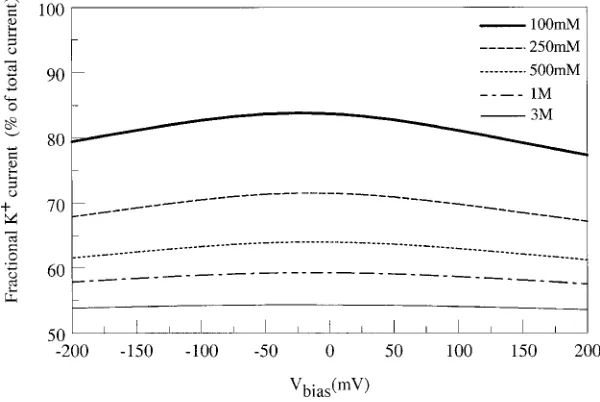
Figure 12. K+selectivity as a function of applied voltage, for various of symmetric concentrations of KCl.
preference for cationic current, with roughly 54% of the current being carried by K+ ions in 3 M KCl. As the salt concentration is reduced, the channel becomes increasingly selective for cationic current, with more than 80% of the total current being carried by K+ions at 0.1 M KCl. However, when simulations are con-ducted again with the fixed charge removed to test its effect, the fractional K+current in 0.1 M KCl drops to about 50%, confirming that the channel selectivity is strongly linked to the degree to which the fixed charges
on the protein are screened by the mobile charge inside the pore. Electrostatic screening effects alone do not determine channel selectivity. There are issues related to the finite ion size that have been shown to dominate the selectivity in some channels. Volume exclusion ef-fects are not addressed in the present model, which treats the ions as a charged fluid.
(a)
[image:15.595.145.452.123.555.2](b)
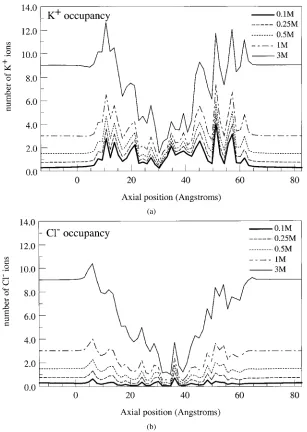
Figure 13. Equilibrium (no applied voltage) ion occupancy as a function of axial position along the pore for (a) K+and (b) Cl−for symmetric bath concentrations of 0.1 M, 0.25 M, 0.5 M, 1 M and 3 M KCl.
the fractional K+current is weakly dependent on ap-plied voltage, decreasing slightly as the magnitude of the applied bias increases. As the bath concentration is increased, the fraction of current carried by K+ions decreases and the mild dependence on applied bias dis-appears altogether.
4.4. Ion Occupancy
The ion occupancy—the integral of the ion
concentration—in a given region of the channel
represents the average number of ions likely to be found there at any given time. Figure 13 shows (a) K+ and (b) Cl− ion occupancy profiles in the direction normal to the lipid membrane and electrodes, under conditions of zero bias, for the same five symmetric KCl bath concentrations. The occupancy exhibits a similar profile at all concentrations. Near the mouths of the channel, the K+, and to a lesser extent, the
Cl− occupancies increase from their values in the
Figure 14. Net K+and Cl−occupancies for a single pore of theompFtrimer as a function of symmetric KCl bath concentration.
Figure 15. Net K+and Cl−occupancy in the pore constriction (z=30–40 ˚A) as a function of symmetric KCl bath concentration.
the channel, except at very high (3 M) salt con-centration, presumably because of the electrostatic attraction of the K+ to the negative charge residing
on the channel. In contrast, the Cl− occupancy
inside the channel is always lower than in the bulk electrolyte.
This preference for cations over anions is even clearer in Figs. 14 and 15, which show respectively the total occupancy for a single pore, and the occu-pancy in the constriction region, for the same range of bath concentrations.
5. Conclusion
[image:16.595.146.448.356.556.2]of KCl. At low salt concentrations the comparison be-tween measured and computed I-V curves is reasonably good; the simulations reveal the rectifying properties of the channel that are also seen experimentally. At higher salt concentrations where the I-V characteristics are more linear the computed curves match the measured curves very well. In all cases, the calibrated K+and Cl− ion diffusivities agree to within a factor of 3 with the ex-perimentally determined values for bulk salt solution.
The usefulness of the continuum Poisson Drift-Diffusion formalism lies in its ability to reproduce the input-output characteristics of the system, using a fit-ted diffusivity. For a single isolafit-ted channel system, a spatially uniform diffusivity is adequate for such pur-poses. However, for multiple channel systems coupled together the ion diffusivity in the bath solutions con-necting the channels must be unique. Given the re-cent evidence for two separate permeation pathways for cationic and anionic current (Im and Roux 2001, Schirmer and Phale 1999) it is unlikely that K+ and Cl−will have the same profile of diffusion coefficient, despite the fact that their values in bulk solution agree to within a few percent. Work is currently in progress to develop a position-dependent model for the ion dif-fusivity, inferred from the ion mean square deviation correlation function obtained from Molecular Dynam-ics simulations. The goal is to determine a diffusivity profile for each ionic species that returns to the correct bulk value in the baths and yields the measured channel I-V characteristics.
In addition, Poisson Drift-Diffusion theory, as it is presented here, does not include any representation of the finite ion volume, treating the ions as though they occupy a negligible fraction of the total volume of the system. The use of a continuum model to describe ion flow in regions where the ion diameter is comparable with the pore dimensions requires special care how-ever, since the ion volume and the charge distribution introduce entropic and electrostatic effects that are not accounted for in the present formalism. Extension of the drift-diffusion model to include the effect of the finite ion size by introducing a correction to the total electrochemical potential of the system is the subject of ongoing work.
Acknowledgments
The authors are grateful Professor Tilman Schirmer and Dr. Raimund Dutzler for providing the molecular structure ofompFand for valuable discussions; to Dr.
Duanpin Chen, Professor Eric Jakobsson, Dr. See-Wing Chiu and Sameer Varma for helpful discussions; to Professor Bob Dutton, Dr. Zhiping Yu and Dr. Dan Yergeau for assistance with PROPHET imple-mentations. This work was supported by financial grants from the National Science Foundation (KDI Grant No. 9873199), Defense Advanced Research Projects Agency (DARPA F30 602-012-0513) and by the National Center for Supercomputing Applications (NCSA).
References
Alder B.J. 1992. In M. Mareschal and B. L. Holian (Ed.), Mi-croscopic Simulations of Complex Hydrodynamic Phenomena. Plenum Press, New York, p. 425–430.
Antosiewicz J., Gilson M.K., Lee I.H., and McCammon J.A., 1995. Acetylcholinesterase: Diffusional encounter rate constants for dumbbell models of ligand. Biophysical Journal 68: 62. Antosiewicz J., McCammon J.A., and Gilson M.K. 1994.
Predic-tion of pH-dependent properties of proteins. Journal of Molecular Biology 238: 415.
Ashcroft F.M. 1999. Ion Channels and Disease. Academic Press, New York, p. 481.
Bagchi B. and Biswas R. 1998. Ionic mobility and ultrafast solvation: Control of a slow phenomenon by fast dynamic. Accounts of Chemical Research 31: 181.
Bank R.E., Burgler J., Coughran W.M., Jr., Fichtner W., and Smith R.K. 1990. Recent progress in algorithms for semiconductor de-vice simulation. International Series on Numerical Mathematics 93: 125.
Bank R.E., Rose D.J., and Fichtner W. 1983. Numerical methods for semiconductor device simulation. IEEE Transactions on Electron Devices ED-30(9): 1031.
Barcilon V. 1992. Ion flow through narrow membrane channels: Part I. SIAM Journal on Applied Mathematics 52: 1391.
Barcilon V., Chen D., Eisenberg R.S., and Ratner M. 1993. Bar-rier crossing with concentration boundary conditions in biological channels and chemical reactions. Journal of Chemical Physics 98: 1193.
Barcilon V., Chen D.P., and Eisenberg R.S. 1992. Ion flow through narrow membranes channels: Part II. SIAM Journal on Applied Mathematics 52: 1405.
Barcilon V., Cole J., and Eisenberg R.S. 1971. A singular perturbation analysis of induced electric fields in nerve cells. SIAM Journal on Applied Mathematics 21(2): 339.
Barthel J., Buchner R., and M¨unsterer M. 1995. Electrolyte Data Col-lection Vol. 12, Part 2: Dielectric Properties of Water and Aqueous Electrolyte Solutions. DECHEMA, Frankfurt am Main. Barthel J., Krienke H., and Kunz W. 1998. Physical Chemistry of
Electrolyte Solutions: Modern Aspects. Springer, New York. Berry S.R., Rice S.A., and Ross J. 2000. Physical Chemistry. Oxford
University Press, New York, Oxford, p. 1064.
Chen D., Eisenberg R., Jerome J., and Shu C. 1995. Hydrodynamic model of temperature change in open ionic channels. Biophysical Journal 69: 2304.
Chen D.P. and Eisenberg R.S. 1993. Charges, currents and potentials in ionic channels of one conformation. Biophysical Journal. 64: 1405.
Ciccotti G. and Hoover W.G. (eds.). 1990. Molecular-Dynamics Sim-ulations of Statistical-Mechanical Systems. North Holland, New York, p. 326.
Conway B.E. 1969. Electrochemical Data. Greenwood Press Pub-lishers, Westport CT, p. 374.
Conway B.E., Bockris J.O.M., and Yaeger E. (eds.). 1983. Com-prehensive Treatise of Electrochemistry. Plenum, New York, p. 472.
Cowan S.W., Schirmer T., Rummel G., Steiert M., Ghosh R., Pauptit R.A., Jansonius J.N., and Rosenbusch J.P. 1992. Crystal structures explain functional properties of twoE. coliporins. Nature 358: 727.
Davis H.T. 1996. Statistical Mechanics of Phases, Interfaces, and Thin Films. Wiley-VCH, New York, p. 712.
Durand-Vidal S., Simonin J.-P., and Turq P. 2000. Electrolytes at Interfaces. Kluwer, Boston.
Eisenberg R.S. 1986. Impedance measurements as estimators of the properties of the extracellular space. Annals of the New York Academy of Science 481: 116.
Eisenberg R.S. 1996. Computing the field in proteins and channels. Journal of Membrane Biology 150: 1.
Eisenberg R.S. 1999. From structure to function in open ionic chan-nels. Journal of Membrane Biology 171: 1.
Eisenberg R.S. and Mathias R.T. 1980. Structural analysis of elec-trical properties of cells and tissues. CRC Critical Reviews in Bioengineering 4(3): 203.
Eisenberg R.S., Barcilon V., and Mathias R.T. 1979. Electri-cal properties of spheriElectri-cal syncytia. BiophysiElectri-cal Journal 25(1): 151.
Eisenberg R.S., Klosek M.M., and Schuss Z. 1995. Diffusion as a chemical reaction: Stochastic trajectories between fixed concen-trations. Journal of Chemical Physics 102: 1767.
Evans D.J. and Morriss G.P. 1990. Statistical Mechanics of Nonequi-librium Liquids. Academic Press, New York, p. 302.
Ferry D.K. 1991. Semiconductors. McMillan Publishing Company, New York.
Gillespie D. and Eisenberg R.S. 2002. Physical descriptions of ex-perimental selectivity measurements in ion channels. European Biophysics Journal 31: 454.
Harned H.S. and Owen B.B. 1958. The Physical Chemistry of Elec-trolytic Solutions. Reinhold Publishing Corporation, New York. Hess K. 2000. Advanced Theory of Semiconductor Devices. IEEE
Press, New York, p. 350.
Hille B. 2001. Ionic Channels of Excitable Membranes. Sinauer As-sociates Inc., Sunderland, p. 388.
Hodgkin A.L. 1937. Evidence for electrical transmission in nerve. I. Journal of Physiology 90: 183.
Hodgkin A.L. 1992. Chance and Design. Cambridge University Press, New York, p. 401.
Hollerbach U., Chen D., Nonner W., and Eisenberg B. 1999. Three-dimensional Poisson-Nernst-Planck theory of open channels. Bio-physical Journal 76: A205.
Honig B. and Nichols A. 1995. Classical electrostatics in biology and chemistry. Science 268: 1144.
Hoover W. 1986. Molecular Dynamics. Springer-Verlag, New York, p. 138.
Hoover W.G. 1991. Computational Statistical Mechanics. Elsevier, New York, p. 313.
http://hoshi-o.physiology.uiowa.edu/Mutations/Home.html Im W. and Roux B. 2001. Brownian dynamics simulations of ions
channels: A general treatment of electrostatic reaction fields for molecular pores of arbitrary geometry. Biophysical Journal 115(10): 4850.
ISE Integrated System Engineering TCAD software (http://www.ise.ch).
Jack J.J.B., Noble D., and Tsien R.W. 1975. Electric Current Flow in Excitable Cells. Clarendon Press, New York, Oxford. Jorgensen W.L. 1998. OPLS force fields. In P.v.R. Schleyer (Ed.),
The Encyclopedia of Computational Chemistry, John Wiley & Sons Ltd., Athens, USA.
Jorgensen W.L. and Tirado-Rives J. 1988. The OPLS (Optimized Potentials for Liquid Simulations) potential functions for proteins, energy minimizations for crystals of cyclic peptides and crambin. Journal of the American Chemical Society 110: 1657.
Kurnikova M.G., Coalson R.D., Graf P., and Nitzan A. 1999. A lat-tice relaxation algorithm for 3-D Poisson-Nernst-Planck theory with application to ion transport through the gramicidin a chan-nel. Biophysical Journal 76: 642.
Kurnikova M.G., Waldeck D.H., and Coalson R.D. 1996. A molecu-lar dynamics study of the dielectric friction. Journal of Chemical Physics 105(2), 628.
Lide D.R. 1994. (editor-in-chief), CRC Handbook of Chemistry and Physics. CRC press, Boca Raton, p. 5–90.
Lundstrom M. 1992. Fundamentals of Carrier Transport. Addison-Wesley, New York.
Mareschal M. and Holian B.L. (eds.). 1992. Microscopic Simulations of Complex Hydrodynamic Phenomena. Plenum Press, New York. Mathias R.T., Levis R.A., and Eisenberg R.S. 1980. Electrical mod-els of excitation-contraction coupling and charge movement in skeletal muscle. Journal of General Physiology 76(1): 1. Mauro A., Blake M., and Labarca P. 1988. Voltage gating of
conduc-tance in lipid bilayers induced by porin from outer membrane of Neisseria Gonorrhoease. Proceedings of the National Academy of Science 85: 1071.
Nee T.-w. and Zwanzig R. 1970. Theory of dielectric relaxation in polar liquids. Journal of Chemical Physics 52: 6353.
Newman J.S. 1991. Electrochemical Systems. Prentice-Hall, Englewood Cliffs, NJ, p. 560.
Nonner W., Catacuzzeno L., and Eisenberg B. 2000. Binding and se-lectivity in L-type Ca channels: A mean spherical approximation. Biophysical Journal 79: 1976.
Nonner W., Gillespie D., and Eisenberg B. 2002. Flux and selectivity in the Ca channel: A density functional approach. Biophysical Journal 82: 340a.
Nonner W., Gillespie D., Henderson D., and Eisenberg B. 2001. Ion accumulation in a biological calcium channel: Effects of sol-vent and confining pressure. Journal of Physical Chemistry B 105: 6427.
Phale P.S., Philippsen A., Widmer C., Phale V.P., Rosenbusch J.P., and Schirmer T. 2001. Role of charged residues at the OmpF porin channel constriction probed by mutatgenesis and simulation. Bio-chemistry 40: 6319.
channels: Atomic probe microscopy of Ompf porin. Biophysical Journal 82(3): 1667.
PROPHET Web site at Stanford University (http://www-tcad.stanford.edu/∼prophet/).
Ravaioli U. 1998. Hierarchy of simulation approaches for hot carrier transport in deep submicron devices. Semiconductor Science and Technology 3: 1–10.
Robinson R.A. and Stokes R.H. 1959. Electrolyte Solution. Butter-worths Scientific Publications, London.
Roux B. 1999. Statistical mechanical equilibrium theory of selective ion channels. Biophysical Journal 77: 139.
Roux B. and Karplus M. 1991. Ion transport in a gramicidin-like channel: Dynamics and mobility. Journal of Physical Chemistry 95: 4856.
Roux B. and Karplus M. 1991. Ion transport in a model gramicidin channel. Structure and thermodynamics. Biophysical Journal 59: 961.
Saint N., Lou K.-L., Widmer C., Luckey M., Schirmer T., and Rosenbusch J.P. 1996. Structural and functional characterization of Ompf porin mutants selected for large pore size. II. Functional characterization. Journal of Biological Chemistry 271(34): 20676. Saint N., Prilipov A., Hardmeyer A., Lou K.-L., Schirmer T., and Rosenbusch J. 1996. Replacement of the Sole Hisdinyl Residue in Ompf Porin fromE. coliby threonine (H21t) does not affect chan-nel structure and function. Biochemical and Biophysical Research Communications 223: 118.
Schindler H. and Rosenbusch J.P. 1978. Matrix protein from Escherichia coliouter membranes form voltage controlled chan-nels in lipid bilayers. Proceedings of the National Academy of Science USA 75: 3751.
Schirmer T. 1998. General and specific porins from bacterial outer membranes. Journal of Structural Biology 121: 101.
Schirmer T. and Phale P.S. 1999. Brownian dynamics simulation of ion flow through porin channels. Journal of Molecular Biology 294: 1159.
Schmickler W. 1996. Interfacial Electrochemistry. Oxford University Press, New York.
Schuss Z., Nadler B., and Eisenberg R.S. 2001. Derivation of Pois-son and Nernst-Planck equations in a bath and channel from a molecular model. Physical Review E 64: 036116-1.
Selberherr S. 1984. Analysis and Simulation of Semiconductor De-vices. Springer-Verlag, Vienna.
Sharp K. and Honig B. 1990. Electrostatic interactions in macro-molecules: Theory and applications. Annual Review of Biophysics and Bioengineering 19:301.
Shockley W. 1950. Electrons and holes in semiconductors. Van Nos-trand, Princeton, NJ.
Silvaco TCAD (http://www.silvaco.com).
Simonin J.-P. 1997. Real ionic solutions in the mean spherical ap-proximation. 2. Pure strong electrolytes up to very high concen-trations and mixtures, in the primitive model. Journal of Physical Chemistry B 101: 4313.
Simonin J.-P. and Blum L. 1996. Departures from ideality in pure ionic solutions using the mean spherical approximation.
Journal of the Chemical Society, Faraday Transactions 92: 1533.
Simonin J.-P., Bernard O., and Blum L. 1998. Real ionic solutions in the mean spherical approximation. 3. Osmotic and activity coeffi-cients for associating electrolytes in the primitive model. Journal of Physical Chemistry B 102: 4411.
Simonin J.-P., Bernard O., and Blum L. 1999. Ionic solutions in the binding mean spherical approximation: Thermodynamic proper-ties of mixtures of associating electrolytes. Journal of Physical Chemistry B 103: 699.
Simonin J.-P., Blum L., and Turq P. 1996. Real ionic solutions in the mean spherical approximation. 1. Simple salts in the primitive model. Journal of Physical Chemistry 100: 7704.
Synopsis TCAD (http://www.synopsys.com).
Tieleman D.P. and Berendsen H.J.C. 1998. A molecular dynamics study of the pores formed byEscherichia ColiOmpf Porin in a fully hydrated palmitoyloleoylphosphatidylcholine bilayer. Bio-physical Journal 74: 2786.
Tieleman D.P., Biggin P.C., Smith G.R., and Sansom M.S.P. 2001. Simulation approaches to ion channel structure-function relationships. Quarterly Reviews of Biophysics 34: 473.
Tyrrell H.J.V. and Harris K.R. 1984. Diffusion in Liquids. Butter-worths Monographs in Chemistry, Boston.
Valdiosera R., Clausen C., and Eisenberg R.S. 1974. Circuit models of the passive electrical properties of frog skeletal muscle fibers. Journal of General Physiology 63: 432.
van der Straaten T., Varma S., Chiu S.-W., Tang J., Aluru N., Eisen-berg R., Ravaioli U., and Jakobsson E. 2002. Combining com-putational chemistry and comcom-putational electronics to understand protein ion channels. In The Technical Proceedings of the Sec-ond International Conference on Computational Nanoscience and Nanotechnology, pp. 60–63.
Waisman E. and Lebowitz J.L. 1972. Mean spherical model integral equation for charged hard spheres. I. Method of solution. Journal of Chemical Physics 56: 3086.
Waisman E. and Lebowitz J.L. 1972. Mean spherical model integral equation for charged hard spheres. II. Spheres. Journal of Chemical Physics 56: 3093.
Warshel A. and Russell S.T. 1984. Calculations of electrostatic inter-actions in biological systems and in solutions. Quarterly Review of Biophysics 17: 283.
Weiss M.S. and Schulz G.E. 1992. Structure of porin refined at 1.8 ˚A resolution. Journal of Molecular Biology 227: 493.
Wolynes P. 1980. Dynamics of electrolyte solutions. Annual Reviews Physical Chemistry 31: 345.
Young J.D., Blake M., Mauro A., and Cohn Z.A. 1983. Properties of the major outer membrane protein from Neisseria Gonorrhoeae incorporated into model lipid membranes. Proceedings of the Na-tional Academy of Science 80: 3831.