Problematic Situation Analysis and Automatic Recognition for
Chi-nese Online Conversational System
Yang Xiang
†, Yaoyun Zhang, Xiaoqiang Zhou
‡, Xiaolong Wang,
Yang Qin
Key Laboratory of Network Oriented Intelligent Computation,
Harbin Institute of Technology Shenzhen Graduate School, China
†
[email protected] ‡[email protected]
Abstract
Automatic problematic situation recogni-tion (PSR) is important for an online conversational system to constantly im-prove its performance. A PSR module is responsible of automatically identifying users’ un-satisfactions and then sending feedbacks to conversation managers. In this paper, we collect dialogues from a Chinese online chatbot, annotate the problematic situations and propose a framework to predict utterance-level problematic situations by integrating in-tent and sentiment factors. Different from previous work, the research field is set as open-domain in which very few domain specific textual features could be used and the method is easy to be adapted to other domains. Experimental results show that integrating both intent and sen-timent factors gains the best performance.
1
Introduction
Automatic conversational systems are computer programs that interact with human users based on their knowledge bases. Developers of conver-sational systems devote plenty of efforts and time in collecting and verifying knowledge so as to maximize the information needs of potential users. However, problematic situations are inevi-table due to several reasons (i.e. human verifiers would make mistakes or omissions, or quality of some answers couldn’t be judged without certain contexts). So it is necessary to equip a conversa-tional system with an automatic PSR module to keep its performance constantly improved. The program is responsible of monitoring whether the dialogue or some utterances are problematic
dur-ing interactions and then providdur-ing feedbacks to the dialogue managers.
Problematic situations reflect that a human us-er is not satisfied with answus-ers that a convus-ersa- conversa-tional system offers. From one perspective, some of these un-satisfactions can be captured through a human user’s dialogue acts. For example, if a user repeats requesting the same question or fre-quently changes topics, it is likely that the sys-tem provides unsatisfactory answers (Chai et al., 2006). From another perspective, some explicit manners (i.e. sentiment-related expressions or dissatisfied feelings) that reflect the change of a user’s mentality would also indicate a problemat-ic situation occurs. Some previous systems use surveys to capture users’ satisfactions: they let users to vote or evaluate whether the system has perfectly help them complete certain tasks (Has-tie et al., 2002; Higashinaka et al., 2010) so as to collect users’ satisficing scores. However, for a real-world conversational application, there are very few users who are willing to provide this kind of feedbacks.
The dialogue materials for this research come from a Chinese online chatting robot—BIT, which is developed for chatting and entertain-ment. It also integrates real-time data query func-tions about share price, weather report, post-code and telephone area code lookup. In addition to queries about real-time data, the corpus is totally open-domain and the number of topics that a dia-logue could be related is unlimited. We annotat-ed problematic situation labels in the utterance level (whether a question-answer pair is prob-lematic/whether an answer is problematic) and took a deeper analysis towards different cases. Finally, we introduce the PSR framework. This framework is simple but efficient: we mapped the user intent and user sentiment categories to two groups of representative features and pre-dicted problematic situations with supervised learners.
Our main contributions stem from the features, domains and language: Unlike most previous researchers who considered only user intent (Chai et al., 2006) or took offline satisfaction scores provided by users as user sentiment (Has-tie et al., 2002; Higashinaka et al., 2010), our method integrates intent and sentiment in an online manner, which automatically identifies these two factors and gives the managers real-time feedbacks. The domain of the dialogue is open which is different from (Hastie et al., 2002; Chai et al., 2006). Another contribution is that this is the first work that solves this issue on the Chinese language, which has very different lan-guage specific features and resources from Eng-lish.
We experimented on the corpus through 10-fold cross validation. In each individual 10-fold, we compare our method with two baselines and with four popular classifiers. Results show that inte-grating both user intent and user sentiment fac-tors gains the best performance with an average F1 of 0.62 (by SVM).
Following, we first introduce related work o PSR from different perspectives. Introduction to the corpus are arranged next. The feature selec-tions and the recognition framework are pro-posed in Section 4. Experiments, future work and conclusions constitute the rest.
2
Related Work
Previous researches in this literature differed in research grains, input features and research do-mains.
2.1 Dialog-level vs. Utterance-level
Most early work focused on the prediction of a complete dialogue. Hastie et al.(2002) predicted problematic dialogues from a series of DARPA Communicator dialogues according to user satis-faction rates, task completion predictors and some interaction based features. Walker et al. (2002) presented their prediction model on the basis of information the system collected early in the dialogue and in real time. Oulasvirta et al. (2006) reported relations between users’ satisfac-tion rates among the goal-level, concept-level, task-level and command-level, and captured a number of qualified user features. Möller et al. (2008) evaluated performance of different mod-els including linear regression modmod-els and classi-fication trees on predicting dialog-level user sat-isfaction in three spoken dialoguedatasets.
Although the predictions of progress towards dialogue completion might be used as a cue to the dialoguemanager, the results couldn’t reflect in which position a dialogue began to become problematic. Chai et al. (2006) proposed the def-inition of user intent and incorporate a few matching features to predict utterance-level prob-lematic situations (whether an immediate answer is satisfactory). Engelbrecht et al. (2009) employ the Hidden Markov Model (HMM) to model the whole dialogue into a sequence where each node of the sequence corresponds to the quality of the utterance. Higashinaka et al. (2010a; 2010b) also use HMM to model the good/bad sequence and testing the effects of turn-wise and overall rat-ings. Similar spirit also exists in (Hara et al., 2010). Support Vector Machines (SVM) are used by Schmitt et al. (2011) for the quality prediction on the CMU’s Let’s Go Bus Information system (Raux et al., 2006) and ASR features are com-pared in their experiments.
2.2 Features
There are many factors that could affect the performance of judging whether a dialogue is problematic or not, i.e. time attributes like the total time of a dialogue and the time delays be-tween utterances (Hastie et al., 2002; Walker et al., 2002; Möller et al., 2008), dialogue acts that may reflect user intents (Hastie et al., 2002) and users’ satisfaction ratings toward the system’s performance (Hastie et al., 2002). To avoid the side effects by Automatic Speech Recognition (ASR) and concentrate on the pure textual fea-tures in dialogues, several researchers only study the effect of dialogue acts and users’ satisfaction ratings (Chai et al., 2006; Higashinaka et al., 2010). However, it has also proved that users’ satisfaction ratings could not be always relied on since different groups of users may have differ-ent predictive powers (i.e. from novices to ex-perts) (Möller et al., 2005).
2.3 Research Domains
restrict-ed scenarios (Chai et al., 2006), bus schrestrict-edule information (Schmitt et al., 2011), music infor-mation (Hara et al., 2010), animal discussion and attentive listening (Higashinaka et al., 2010a; Higashinaka et al., 2010b).
3
Problematic Situation Analysis
This section will first introduce the characteris-tics of the corpus we construct and then provide definitions and examples for what we have learned from the dialogues.
3.1 Corpus Description
The corpus includes 479 dialogues with totally 3111 QA pairs. The dialogues are extracted from log files of the BIT robot from May to June, 2013. Each dialogue has a specific session ID, identifying that the dialogues are collected from different users or on different time. Chatting (> 2/3), stock real-time inquiries (<1/6) and weather report inquiries (<1/7) account for the largest proportion. The dialogues are almost original which contains a number of curse words (alt-hough we have removed some too dirty words), facial expressions (by expressing moods through several punctuations such as ―:)‖), boring state-ments (i.e. I am boring uh) as well as duplicate questions, indicating the irregular and informal characteristics of the online chatting contexts. The language of the corpus is Chinese, with very few English utterances (<1/100). The length of dialogues ranges from 1 to 64 QA pairs1.
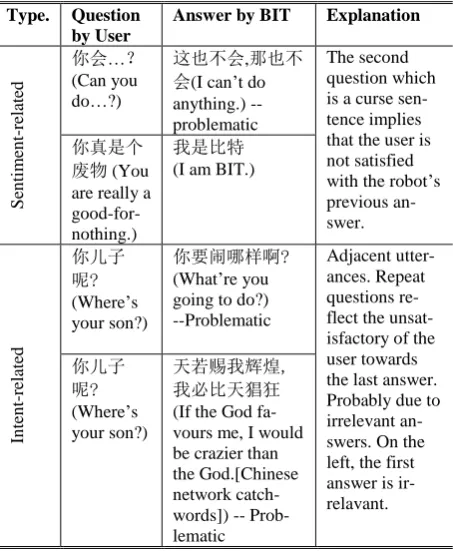
To collect users’ un-satisfactions, the develop-ers place good/bad comment buttons for each answer but it seems to be useless (seldom users would click the buttons). Through observation, we found that users’ behaviors, including the type of both inquiries and responses, provide important cues to determine whether a user is satisfied with an answer or not. To show this re-lation, two examples are listed in Table 1.
We asked two annotators to label whether each answer is problematic or not. They gave their judgment according to whether they consid-ered the answer provided by the chatting system was reasonable or not, but ignored whether it was not precise (i.e. a factual answer that is out of date). When labeling the current pair, they were asked to refer to the above interactions so as to take the context restrains into consideration. By using Cohen’s kappa coefficient, the inter
1
In this paper, we will use the notion ―utterance‖ and ―QA pair‖ exchangeablely.
agreement of the two annotators is P^o 0.933, ^
0.602 e
[image:3.595.303.530.227.503.2]P , and 0.833 which is relatively high. Most conflicts occur when the two annotators have different under standings towards a ques-tion or one of them couldn’t understand what a question really means. The conflict labels are resolved by a third annotator. Finally, 832 out of 3111 pairs (26.7%) are labeled as problematic, indicating that the chatting system still has a lot of room for improvement.
Table 1. Examples of problematic situations in BIT.
3.2 Corpus Deeper Analysis
According to observation, the style of sen-tences raised by users could be roughly divided into two groups: questions and state-ments(corresponding to inquiries and responses in the previous section). Questions are sentences that send inquiries to the system, indicating that users have some information needs. Contrarily, statements are sentences that reflect no infor-mation needs, but could express complains, ex-clamations or some other affections. We’ve also observed that a specific group of features is much related to questions while another group is more likely to co-occur with statements.
Type. Question by User
Answer by BIT Explanation
S
en
ti
m
en
t-re
late
d
你会…?
(Can you do…?)
这也不会,那也不
会(I can’t do anything.) -- problematic
The second question which is a curse sen-tence implies that the user is not satisfied with the robot’s previous an-swer. 你真是个
废物 (You are really a good-for-nothing.)
我是比特 (I am BIT.)
In
ten
t-re
late
d
你儿子 呢? (Where’s your son?)
你要闹哪样啊? (What’re you going to do?) --Problematic
Adjacent utter-ances. Repeat questions re-flect the unsat-isfactory of the user towards the last answer. Probably due to irrelevant an-swers. On the left, the first answer is ir-relavant. 你儿子
呢? (Where’s your son?)
Category Utterance Explanation
Int. switch 1. 中国(China) The current question belongs to a different topic from the last one. The beginning of a new dialogue (other than greeting) is classified to switch.
retry 2. 中华人民共和国 (People’s Republic of China)
The current question has the same idea as the last one but may be expressed in a different style.
continue 3. 中国首都
(The capital of China)
The current question belongs to the same topic as the last one. The example is a detailed question about the topic ―China‖.
clarify 4. 中国首都在哪里?
(Which city is the capital of China?)
Negotiate with the system to refine or coarsen the last question for a clearer intent.
Sen. greeting 早上好(Morning)/ 亲爱的! (Honey!)
Usually a beginning or ending of a dialog. Intimate speeches are also categorized into greeting. criticize/
response 你好聪明!说对了(You are right) (You are so clever!) / 你 Criticism or response towards the last answer. Positive or negative criticisms frequently occur in the corpus, indicat-ing users’ (un)satisfactions.
exclaim/
statement 好烦啊!**. (I love someone.) (It’s so boring!) / 我喜欢
Exclaims or statements that the user delivers which are not aiming at the chatbot.
curse Dirty words. Explicit curse words that are inevitable in chatting dia-logues. They sometimes show unsatisfactory, but some-times occur dues to that the user has been ridiculed by the robot.
order 讲个笑话!(Tell me a joke!) Order the system to provide information or do something. other 。。。/ !!! Utterances other than the above such as punctuations or
[image:4.595.69.528.69.357.2]symbols that might show speechless(。。。), exclaiming / warning(!!!) or some facial expressions.
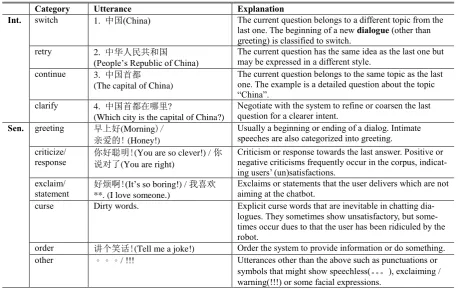
Table 2: Examples and definitions for user intent (Int.) and user sentiment (Sen.).
Based on this intuition, we define two con-cepts as:
User Intent – the action of a user when rais-ing a question, indicatrais-ing that the user is execut-ing an inquiry to the system.
User Sentiment – the sentiment or affection that a user expresses through his/her utterances, including negative and non-negative.
The definition of user intent follows (Chai et al., 2006). It mainly contains four lower-level types: switch, continue, retry, and clarify. Switch means to start a new topic or a new dialog. Con-tinue, retry and clarify are restricted in the same topic, with different dialogue acts. User senti-ment is associated with the following cases: greeting, criticize/response, exclaim/statement, curse, order and other. Other contains punctua-tions, facial expressions and special symbols that are frequently used in Chinese daily chatting. Examples with explanations for user intent and sentiment are listed in Table 2.
The annotations towards the lower-level cate-gories have more conflicts (with an average κ about 0.5) than the problematic labels. The disa-greements are solved after declaring some issues: 1) if intent and sentiment characteristics both occur, label according to the type of the sentence (question correlates with intent and statement with sentiment) 2) Criticizes are towards the sys-tem’s last response while curses are not.
Problematic situations that originate from the following types are more direct and easier to un-derstand: a) repeat the last question (retry, 4.95%-45.45%); b) change the topic (switch, 32.27%-32.17% with 6.97% at the beginning); c) try to clarify what the user intended to ask (clari-fy, 1.29%-50%) d) negative criticisms towards the last answer (criticize, 13.79%-15.85%); e) negative words toward the robot (curse, 6.59%-11.7%). The percentages 4.95%-45.45% stand for that retry accounts for 4.95% in all, and among all the retry cases, 45.45% are problemat-ic. We also have the polarity (negative or non-negative) of each user provided utterance anno-tated and find that nearly all the negative occur in statements. The rest problematic situations mostly come from the other type (8.61%-48.13% with 36.19% facial expressions that the system is not able to recognize), continue (8.01%-28.4%), exclaim (10.83%-19.58%) and order (7.23%-19.55%).
inspires us to synthesize both user intent and user sentiment attributes for an utterance.
4
Recognition Framework for
Problem-atic Situations
Based on a simple dependency analysis for a dia-logue, we first map user intent and user senti-ment into related feature groups, and then use the features to predict problematic situations.
4.1 Utterance Dependency Analysis
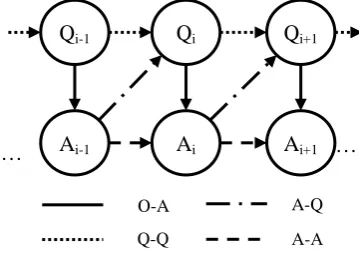
A dialogue could be modeled using a directed graph constituted by the question sequence Q
and the answer sequence A. In the graph, a node stands for an utterance (question/answer), and edges are drawn from each Qi-1 to Qi, Qito Ai, A i-1 to Aiand Ai-1 to Qi. The edges stand for
[image:5.595.87.267.326.458.2]depend-encies or constrains between utterances (Figure 1).
Figure 1. Dependencies or constrains in dia-logues
In this work, the edges from Ai-1 to Qi and from
Qi-1 to Qi are the main dependency types we
re-search. Ai-1 to Qi shows the last answer affects the
current question in a dialog, always reflected by user sentiment. Constrains between questions are more related to user intent, i.e. the current ques-tion would have a high similarity with the last one if one attempts to retry an inquiry. The fol-lowing example typically shows the two types of constrains:
Qi-1: Who did you go with yesterday?
Ai-1: My advantage is that I am handsome.
Qi: Who did you go with yesterday?
Ai: If the God favours me, I would be crazier
than the God.
Qi+1: You are an idiot.
In the example, the retry case from Qi-1 to Qi
implies that Ai-1 should not be a good answer.
The negative curse Qi+1indicates that Ai may be
problematic.
4.2 Mapping to problematic situations
To avoid cascade errors brought about by low-er-level classifications, we weaken the category constrains by mapping the taxonomy to related features. The four types for user intent could be distinguished by features considering about simi-larity between sentences, which descends from retry, clarify to continue and switch. For the six types in user sentiment, we define word features, word polarity features and pattern features to make the types distinguished.
In our proposed framework, the automatic PSR problem is simplified into a one level binary classification task in which utterances are mod-elled with general features, user intent specific features and sentiment specific features. General features are textual and non-textual features that have nothing to do with user intent or user sen-timent, including: whether the answer is from the system’s default response list to underdeveloped knowledge, whether the question is a real-time inquiry, the number of utterances before and fol-low (especially to distinguish the beginning or ending of a dialog), the similarity between the question and its corresponding answer.
User intent specific features are those extract-ed from the perspective of user intent, mainly related to the similarity between two adjacent questions. User sentiment specific features are those extracted from the perspective of user sen-timent, which focus on whether a user-raised ut-terance contains any sentiment information.
4.3 Intent Specific Feature Selection
Specifically, we tag whether the current ques-tion is retry because retry always corresponds to a very high similarity which is easy to be identi-fied and many of them are related to problematic situations. We also use the similarity between two questions to distinguish the other types of intents. Typical features are listed in Table 3(NE stands for Name Entity).
The semantic similarity measure between questions (labeled by * in Table 3) is based on a Chinese semantic web, HowNet (Dong and Dong, 2006). The defined semantic similarity in HowNet is a normalized real value ([0,1]) of the shortest path connecting two words in the HowNet Concept Relation Net. Suppose two questions P and Q (word sequence size m and n, respectively), the semantic similarity between them is defined as:
… …
Qi+1 Qi
Qi-1
Ai+1 Ai
Ai-1
Q-A
Q-Q
A-Q
1 1
1
( , ) ( )
2
n m
j i
j i
Q P ssim P Q
m n
where
P
iandQ
jare denoted as:1 2
max( ( , ), ( , ),..., ( , ))
i i i i n
P ssim P Q ssim P Q ssim P Q
1 2
max( ( , ), ( , ),..., ( , ))
j j j m j
Q ssim P Q ssim P Q ssim P Q
ssim(Pi,Qm) denotes the semantic similarity of
the ith word in QuestionP and the mth word in QuestionQ. If two words are the same, the simi-larity is set to 1.
The final similarity is defined as:
,
1
,
2
,
sim P Q
ns
im P Q ss
im P Qnsim(P,Q) is the normalized real value of the number of words the two questions share. λ1 and
λ2 are the weighted parameters (set to be 0.5,0.5
in our experiment).
Feature Description
Exact match
(Boolean) After removing punctua-tions and stop words. No. of NEs By analyzing results of
LTP.
NE similarity The match No. and con-tents for NEs.
Ques. Similarity Weighted similarity based on lexicon and se-mantics*.
Ques. similarity without NEs
Target word
Weighted similarity based on lexicon and se-mantics*.
The target word in a question.
Dependency
[image:6.595.310.520.186.405.2]similarity Dependency pattern simi-larity. Table 3. User intent specific features.
The target words, name entities and dependen-cy trees are identified or generated by LTP (LTP, Liu et al., 2011). Target words are defined as the direct objects that the root verb governs in a de-pendency parse tree in questioning sentences. The dependency similarity is computed by count-ing the number of common dependency relations (normalized to [0,1]).
4.4 Sentiment Specific Feature Selection
User sentiment is a good reflection of a user’s current mood. The difficulty lie on that curse sentences and negative criticisms are not easy to be distinguished, especially for the Chinese lan-guage where many sentences have no subjects at all. A solution is that considering both the similar key words between the last answer and the
cur-rent statement, and whether a second person pro-noun (i.e. you/BIT) exists.
This work models the possible relations from sentiments to problematic situations by defining a series of sentiment related features. We employ dictionary-based method (Zhao et al., 2010) to judge the polarity of words in a sentence. Typical features are shown in Table 4.
Feature Example
Key words 弱智(stupid), 次(weak)
Question word/
question mark 为什么(what), (why), 是谁(who), ? 是什么 Target word 天气(weather), 人名
(person name)
Ending word 好吗(is it ok?), 吗(modal) Sent. pattern 你好/真/太傻(you’re
quite/very/too stupid) Part-of-Speech Adjectives, nouns Polarity Polarity of a word Person pronoun 你(you), 比特(the name
of the robot)
Dependency Subject-verb-object (SBV and VOB by LTP) Table 4. User sentiment specific features.
Cursing sentences or negative criticisms are usually expressed in certain patterns which could be captured through regular expressions after removing adverbs and modals. Adjective and noun words are good indicators for sentiment which could be looked up in sentiment dictionar-ies. We employ two general Chinese sentiment dictionaries (NTUSD2 and HowNet) to determine the polarity of a word (including both nouns and adjectives for the consideration of both You’re a fool and You’re foolish.). In addition, we tag the sentence as negative if it only contains negative words (key words) after removing useless com-ponents. Real-time inquiries are special cases that we should filter out through key words matching.
There are also something special that we should consider. Suppose there are three contin-uous pairs: A->B->C: If the question in B con-tains negative criticism information but A is a real-time inquiry, we couldn’t directly judge A is problematic. A typical example is that the answer is closely related but is not precise (i.e. out of date). Inquiry includes questions about weather,
2 [image:6.595.79.284.310.524.2]
stock, post code, telephone and identity code in this system.
In addition to un-satisfactions for not achiev-ing the desired answer, curse/criticism sentences could also grow out from some other cases: (1) the user has been ridiculed by the system thereby becomes irritated; (2) the user just wants to ex-press his/her feelings to the system through re-peated statements. These cases are not directly related to problematic situations, which, however, haven’t been well recognized yet, hindering the improvements of the learners.
4.5 The Recognition Framework
We expected that the lower-level category in-formation could be well modeled through fea-tures and classifiers. General feafea-tures, user intent specific features and user sentiment specific fea-tures are extracted for each QA pair. Intuitively, the feature groups for user intent and user senti-ment have relatively different emphasis and the hybrid features should naturally increase the sys-tem’s recall.
Suppose the sequences are Q and A, in which Qi is to be determined (see Figure 1). The
auto-matic PSR model is described as the follows: a) Pre-processing: tokenization, POS tagging,
parsing, removing stop words, and filtering system specified inquires (weather, stock, post code, telephone and identity code); b) Extract sentiment specific features for Qi
based on Qi;
c) Extract intent specific features for Qi based
on Qi-1andQi;
d) Tag whether Qi is retryor not, tag whether
Qi is negative or not;
e) Determine problematic of Qi according to
sentiment (retry or not) and intent labels (negative or not), specific features (Table 3 and 4) and general features (§4.2), as well as the labels for Qi-1 (retry, negative, and
prob-lematic);
f) Post-processing: For the last QA pair in a dialog, if a same pair exists before and is la-beled as problematic, Qiis labeled
problem-atic.
The reason why we also take the labels of Qi-1
into account is based on the fact that the labels of Qi-1 may help determine the current label. For
example, if the last intent indicates a retry and the current question indicates a switch (a much lower similarity with the last one), it is very like-ly that the user has tried at least twice but hasn’t received a satisfactory answer. In this case, the previous retry could also increase the probability
of switch, which is helpful for the final determi-nation.
Post processing mainly deals with the last ut-terance in a dialogue which doesn’t have any followings.
5
Experiments and Analysis
To prove the effectiveness of our model, we compare it with two baselines on four classical classifiers through 10-fold cross-validation.
The baselines include the model with general features (GF) and intent specified features (ISF), the model with GF and sentiment specified fea-tures (SSF). We name our hybrid model that with hybrid features as GF+ISF+SSF. We report the detailed performance gains of the GF+ISF+SSF model compared with the two baselines with in-tense experiments on the corpus. General fea-tures (GF) only contains little useful information towards our task and has very poor performance, therefore we didn’t set it as a baseline. We test the model with SVM, Naïve Bayes, Decision Tree and CRF so as to find out an efficient and stable learner for the task.
GF+SSF
Prec. Rec. F1
SVM 92.97 44.44 60.05
J48 85.03 22.94 35.85
NB 95.37 22.53 36.37
CRF 89.20 40.06 55.01
GF+ISF
Prec. Rec. F1
SVM 93.77 43.80 59.57
J48 88.76 21.72 34.67
NB 96.39 23.24 36.42
CRF 88.74 44.89 59.46
GF+ISF+SSF
Prec. Rec. F1
SVM 85.73 49.38 62.19
J48 79.15 24.89 37.75
NB 85.97 29.09 43.35
[image:7.595.320.514.390.657.2]CRF 91.08 45.02 60.16
Table 5. Average performance by cross-validation.
fold Prec. Rec. F1 Percent. Best Learner im-in im-sen
1 89.21 49.01 63.27 26.69 intent CRF -0.03 +6.1
2 84.57 50.51 63.25 30.24 hybrid SVM +3.16 +1.74
3 92.41 42.07 57.82 29.51 hybrid CRF +0.12 +6.38
4 85.47 47.52 61.08 28.85 hybrid SVM +3.16 +3.16
5 84.82 54.92 66.67 28.41 hybrid SVM +3.61 +3.61
6 95.42 44.17 60.39 25.94 sentiment SVM -0.07 -0.07
7 78.45 55.69 65.14 26.90 hybrid SVM +3.12 +3.72
8 85.33 52.46 64.97 32.50 hybrid SVM +2.93 +3.42
9 83.03 51.31 63.43 26.90 hybrid SVM +5.47 +4.0
[image:8.595.96.503.69.228.2]10 94.29 39.87 56.05 28.55 sentiment SVM +1.3 -0.2
Table 6. Detailed results in 10-fold cross validation.
―im-in‖ and ―im-sen‖ stand for the improvements of the hybrid model than intent and sentiment spe-cific models. ―Percent.‖ stands for the proportion% of problematic utterances in this fold of data.
2009). CRF is provided by CRF++3, a C++ im-plementation. Metrics of precision, recall and F1
are used for evaluation.
We list results for the average performance of cross-validation in Table 5. From the data we notice, all the four learning models perform well in precision but a little poor in recall (no matter for which model). And the case of Naïve Bayes is especially obvious. According to analysis to-wards the output, the performance of high preci-sion and low recall mainly due to the following reasons: Firstly, we select features empirically which may generate strong rules: if some condi-tion is satisfied, some conclusion is drawn. Sec-ondly, there are still a number of situations that we couldn’t resolve by training our models. For example, not all retry result in problematic situa-tions, and sometimes the users’ intents are hard to understand. Finally, there are many negative sentences that are not related to problematic situ-ations which could confuse the learners.
We also notice that SVM and CRF have much better results than J48 and Naïve Bayes, imply-ing the effectiveness of the two classifiers. The hybrid model outperforms the two baselines mainly by recall, reflecting the reasonability of considering both user intent and sentiment. More evidence for the robustness of the hybrid features and the learners can be recognized through a detailed report of the cross validation (Table 6). From the table we observe two im-portant things: one is that SVM performs much more stable than other classifiers, and CRF is not so good as what we have expected, considering there are sequential features; the other is that the hybrid model outperforms other baselines in most cases, and it also has comparative results in
3
http://crfpp.googlecode.com/svn/trunk/doc/index.html
other cases (fold 1, 6, and 10).
What we have also noticed is that although Naïve Bayes doesn’t achieve a better score in F1,
it always performs well in precision (Table 5). Its characteristics of running fast, easy implemented and with high precision enable the developers to integrate the automatic recognizer in the system and send back precise predictions in real time.
6
Future Work
We left two problems for future work. Firstly, although we have defined lower-level categories for user sentiment and user intent, we failed to well identify each of them. More representative features (maybe word embedding or something else) should be extracted to clearly identify their boundaries. Secondly, there is much noise in the original corpus which may affect the model per-formance. An automatic sieve should be devel-oped to deal with the noisy information.
7
Conclusion
This paper analyses different problematic situ-ations under the chatting context for the Chinese language. Other than previous work, we propose the problematic situation recognition model from two perspectives—user sentiment and user intent, and test the proposed model on a totally open-domain corpus. Experiments verify that integrat-ing both the two factors gains the best predictintegrat-ing result. More representative features and more efficient approaches will be developed for further improvement.
Acknowledgements
Shenzhen(JC201005260118A, ZDSY20120613-125401420, JCYJ20120613151940045, and JC201005260175A).
Reference
Joyce Y. Chai, Chen Zhang, and Tylor Baldwin. 2006. Towards Conversational QA: Automatic Identification of Problematic Situations and User Intent. In Proceedings of COLING/ACL. C. C. Chang and C. J. Lin. 2011. LIBSVM : A Library for Support Vector Machines. ACM Transactions on Intelligent Systems and Tech-nology, 2(27)1-27.
Zhendong Dong, and Qiang Dong. 2006. HowNet and the Computation of Meaning. River Edge, NJ: World Scientific, 25-76. Klaus-Peter Engelbrech, et al. 2009. Modeling
User Satisfaction with Hidden Markov Model. In Proceedings of the SIGDIAL 2009 Confer-ence. Association for Computational Linguis-tics.
Sunao Hara, Norihide Kitaoka, and Kazuya Takeda. 2010. Estimation Method of User Sat-isfaction Using N-gram-based Dialogue Histo-ry Model for Spoken DialogueSystem. LREC. Mark Hall, Eibe Frank, Geoffrey Holmes,
Bern-hard Pfahringer, Peter Reutemann, Ian H. Wit-ten. 2009. The WEKA Data Mining Software: An Update; SIGKDD Explorations, Volume 11, Issue 1.
Helen Wright Hastie, Rashmi Prasad, Marilyn-Walker. 2002. What's the Trouble: Automati-cally Identifying Problematic Dialogues in DARPA Communicator Dialogue Systems. In
Proceedings of ACL.
Ryuichiro Higashinaka, et al. 2010. Issues in Predicting User Satisfaction Transitions in Di-alogues: Individual Differences, Evaluation Criteria, and Prediction Models. Spoken Dia-logue Systems for Ambient Environments. 48-60.
Ryuichiro Higashinaka, et al. 2010. Modeling User Satisfaction Transitions in Dialogues from Overall Ratings. In Proceedings of the SIGDIAL 2010 Conference.
Ting Liu, Wanxiang Che, Zhenghua Li. 2011. Language Technology Platform. Journal of Chinese Information Processing. 25(6): 53-62.
Sebastian Möller, et al. 2005. Quality of Tele-phone-based Spoken Dialogue Systems. Sebastian Möller, Klaus-Peter Engelbrecht, and
Robert Schleicher. 2008. Predicting the Quali-ty and UsabiliQuali-ty of Spoken Dialogue Services. Speech Communication 50.8: 730-744.
A.Oulasvirta, S.Möller, S. Engelbrecht, et al. 2006. The Relationship of User Errors to Per-ceived Usability of a Spoken Dialogue System. In Proceedings of the 2nd ISCA/DEGA Tuto-rial and Research Workshop on Perceptual Quality of Systems, Berlin.
A. Raux, D. Bohus, B. Langner, A. W. Black, and M. Eskenazi. 2006. Doing Research on a Deployed Spoken Dialogue System: One Year of Let’s Go! Experience. In Proceedings of the International Conference on Speech and Lan-guage Processing.
Alexander Schmitt, Benjamin Schatz, and Wolf-gang Minker. 2011. Modeling and Predicting Quality in Spoken Human Computer Interac-tion. In Proceedings of the SIGDIAL 2011 Conference.
Marilyn A. Walker, et al. 2002. Automatically Training a Problematic Dialogue Predictor for a Spoken Dialogue System. Journal of Artifi-cial Intelligence Research, Vol.16(1): 293-319. Yanyan Zhao, Bing Qin, and Ting Liu. 2010.