22
A Real Time Stream Data Processing and Analysis
Model and Catchments over Twitter Stream Data
Ankit Sarawagi
Department of Computer
Science & Engineering,
UIT RGPV, Bhopal; India
Rajeev Pandey
Department of Computer
Science & Engineering,
UIT RGPV, Bhopal; India
Raju Barskar
Department of Computer
Science & Engineering,
UIT RGPV, Bhopal; India
S. P. Pandey
RBS Engg Technical
Campus Bichpuri, Agra;
India
ABSTRACT
Big data processing is an important aspect in todays world. Twitter produce a large number of tweets and different segment of data according user usage and post. Understanding the proper sentiments, extracting the proper meaning from it is an objective task which is required different processing tools and methodology. Real time data gathering, storing them and analyzing efficiently to produce effective and fast accessible result approach is always a required work today. For this purpose in this research work a technique PSWNSWAP is proposed, which use Twitter stream data gathering in real time as well as Fast indexing, processing and performed sentiment analysis of gathered data. Distance computation, finding the right place to perform some operation is the tedious task for business operation or any brand to get established in new areas. Here‟s an algorithm which is St-QAP algorithm, is investigated and processed with the Apache Storm tool and NLP library. The Objective is to produce an efficient path mapping and catchments for new brands to establish in a new area and solving investigation behind it. Our proposed algorithm computed efficient result, while comparing with existing traditional solution with it.
Keywords
Big Data processing, Real Time streaming, Twitter, NLP computation, Storm processing, PSWNSWAP, St-QAP, Distance computation, Catchments.
1.
INTRODUCTION
Stream data analysis in a Real time [1], emerging as the quickest and most proficient way to get useful information about what is going on now such as tweets on Twitter [2], enabling associations to respond immediately when issues show up or to identify new patterns enhancing their performance. Large number of data processing, finding an efficient pattern and solution for them is an important task. This must be important for SNA (social network analysis) [3]. Massive or huge amount of complex data generated rapidly per unit time [4] from various social sites such as Twitter, Facebook, YouTube, Instagram and other Big Data application domains [5]. Micro blogging and social media Twitter gather millions of data in a day for any specific post or product. This processing and analysis of massive amount of stream data must be needed to perform in Real Time. This research paper offers a framework for processing and analyze the Real Time stream data in an efficient manner.
Natural language processing [6] is an important library and approach to understanding the data‟s significance. Data mining [7] and processing large data keeps a track of usable entity . Sentiment Analysis [8] is an overall attitude of a speaker, writer, reader, or any other entities, with respect to
some topic written in a piece of text. It is an effective technique for discovering public opinions. So a technique PSWNSWAP is proposed, which use Twitter stream data gathering in real time as well as Fast indexing, processing and performed sentiment analysis on gathered data.
Various offline market research and directory investigation is required for any company or brand to get established in new areas [9]. In this paper an approach to investigate a brand occupancy over an area and performing the visiting area by their defined rule is performed. St-QAP is an approach which used for Catchments in business, distance mapping and solve the travelling salesman problem, short distance and path optimization issue.
2.
PROBLEM DEFINITION
In the previous research work, There are different techniques with the data mining and twitter data analysis [10] with the data storage, it‟s applicability over the data center, server and accessing is performed by different user. Previous techniques worked on data analysis provided by their static dataset which is not real time stream data and thus a proper analysis cannot be performed. As the study is taken and performed with various strategies & techniques and distinct outcomes from the algorithms were monitored such as PSWAP [11] and various other approaches to solve the tweet analysis and further be finding efficient locality data over it. Spatial data distribution [12], data location description, bandwidth determination and other relevant research performed are limited to particular area and moreover limited to statically investigation or research. Upon verifying distinct scenario and the available strategies, techniques various short comes with the Existing algorithm for Geo-tagging [13] and relevant data, finding with twitter file based sentiment detection, which is taken as a base for our analysis work.
The following are the issue which can be monitored and identify as a problem. These problems can be analyzed and performed further with upgrades and enhancements-
i. Previous technique such as twitter analysis over the formulation to find relevant location is limited to the statically defined dataset (not in real time stream dataset). Thus the approach can‟t be able to work beyond the given data. [13]
23 iii. Multiple user from anywhere, tweets over the
different product, data availability, data review and comment on them. These reviews or comments become more important for any company or brand. Existing approach not specify this, in real time. iv. A combination of twitter and data optimization is
taken in the consideration which is neither more reliable while talking about accuracy, again an extra procedure is required to do the real time data exchange. Thus, it exhibits extra computational time as well as computation cost for cloud server. [11] v. FP growth algorithm makes a repeated computation
and accuracy over the repeated value.
vi. Sarcastic keyword analysis outperforms low accuracy, precision and other parameter analysis over the data. [11]
vii. A bulk number of Spam tweets give poor data combination, data verification over large noise tweets are observed.
viii. The existing approach for KDE [13], it allows the fixed bandwidth over the data availability.
ix. Previous shortest path derivation algorithm such as ANT, Dijkstra‟s and other approach works on the fixed pattern and no dynamic decision is described. x. Spatial key distribution is performed over statical
map. [13]
3.
PROPOSED METHODOLOGY
In this proposed Methodology, we modify the existing technique [13] by new and more efficient technique of data, finding and collection as well as trend finding. We replace some previous concept which is necessary for retail market searching, an aspect that will help to increase accuracy and reduce the computation cost, computational time as well as total execution time.
i. In this proposed architecture Processing and analysis of twitter data can be performed in Real time. So the Real time stream data is used for this research work. This can reduce the issues and problems identified in the existing framework. ii. Perform proper sentiment analysis of comments,
reviews, Tweets, Opinion of users in Real Time. PSWNSWAP is used in this proposed architecture for the purpose of sentiment analysis. PSWNSWAP is enhancement of PSWAP. The algorithm performed using NLP library. This can reduce limitation of existing framework.
iii. Storm [14] framework is used for calculating Tweet value.
iv. Use an improved form of assignment problem, St-QAP technique in place of existing distance finding technique.
[image:2.595.68.517.404.735.2]v. Perform large file integrity processing in the proposed system.
24 In proposed architecture there are three components called
Storm & Twitter API, Proper sentiment analysis of real time stream data, Location Matching &St-QAP technique, which are used to provide a location finding in cloud [15]. Detailed descriptions of these components are shown below.
i.
Tweet Collection API & StormA collection by providing input as the keyword and keys for the tweet searching API is given by the input values. Storm is the framework available with Zookeeper and other programming tool, a platform which help in working with the authentication with the high dimensional spatial platform. It also gives the input to the availability of data. Data tweets in real time collection is performed by the Storm, which is useful for a proposed work analysis.
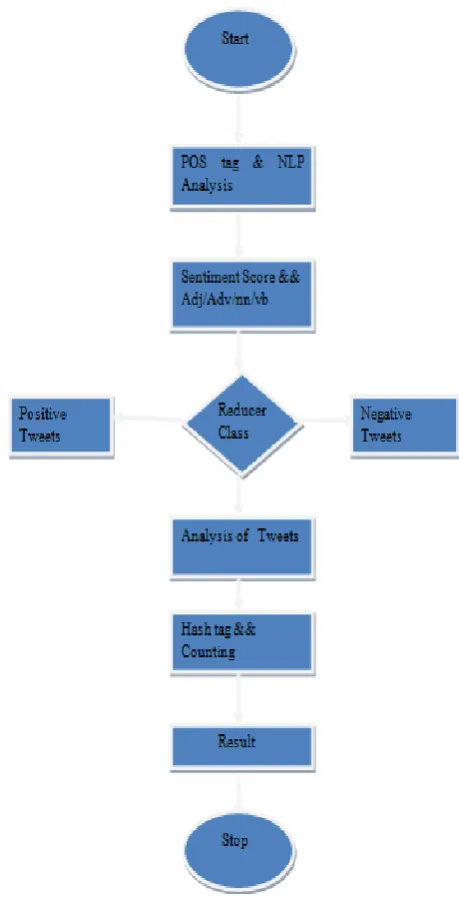
[image:3.595.318.548.78.533.2]ii. Sentiment analysis of Twitter Real Time Stream data At Step 2 and 3 on fig 1: there is more architecture and process is performed which is processed using NLP (Natural language processing). The algorithm PSWNSWAP performed using NLP library, which is able to process tweets extracted. Thus, in order to understand the tweet semantics NLP is applied. PSWNSWAP (positive sentiment with negative sentiment with antonym pair) algorithm is used in this research work for sentiment analysis on real time stream Twitter data. This algorithm calculates the positive or negative tweets, comments, reviews, from Twitter data. This must be important for any company for marketing, business purpose in analyzing the product rating or review. PSWNSWAP performed using NLP library, which is able to process tweets extracted. Thus, in order to understand the tweet semantics NLP is applied. First of all segmentation is performed over the tweet, further recognizing nouns, pronouns, verb, adjective are determined from the input sentence. A further steps pruning and thus sentence understanding are performed at step 3, which process the input tweets.
Fig 2: Flowchart of PSWNSWAP
Pre-processing Training Data
Cleaning the data: Since tweets contain several syntactic features that may not be useful for machine learning, the data needs to be cleaned. The module provides these functions:
Remove quotes - provides the user to choose to remove the quotes () from the text.
Remove @ - provides a choice of removing the @ symbol, removing the @ along with the user name, or replace the @ and the user name with a word 'USERNAME'.
Remove # - removes the HashTag.
25 lexicons that here saw above as features. Then the dataset can
be represented by these features using either their presence or frequency.
There are following steps are used for that purpose:
Firstly input of that dataset is provided, then a parsing technique is used to provide a part of speech tagging for that data.
Sentiwordnet is used to define polarity of the reviews.
Then frequency of the keywords is also calculated. Pruning is performed to refine these reviews. Then FP (frequent Pattern) algorithm is used to generate different patterns from the data, for that purpose Pattern technique is used, in that for any topic frequency of the word is calculated if any word having frequency more than 3 will be considered for review and then reviews are categorized as positive or negative. Following are the benefits to apply proposed PSWNSWAP-
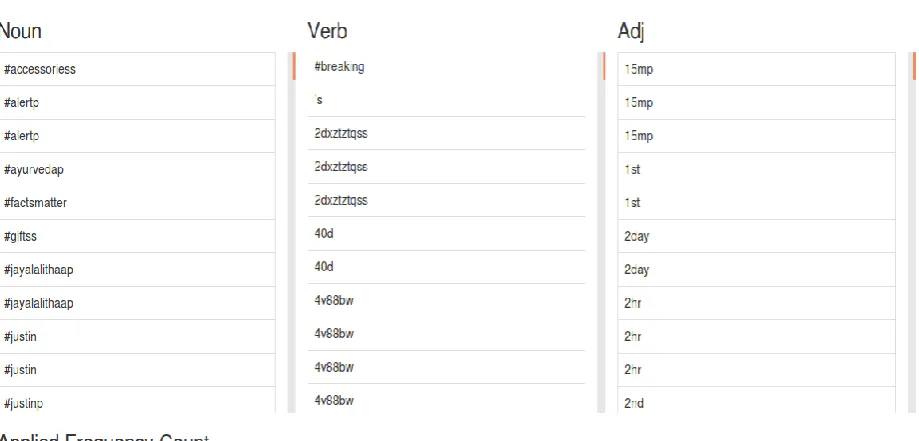
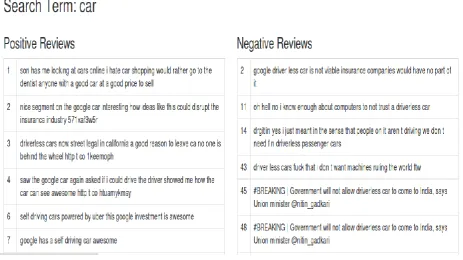
1:- Find positive and negative tweets, comments antonym pair. And to generate score, noun, verb and adjective on using tweets.
2:- Then find out top # HashTag and bottom # HashTag count and location.(see fig 3,4,5,6,7,8,9)
Pseudo code of PSWNSWAP
Input :-Real time Data Set Twitter
Result :- Algorithm process, parameter computation and find sarcastic twitt &&hash tag
Steps :-
Active Proposed Algo. Twitter processing (); If (Scorefunc())
While (Sentence in corpus) do If (word = “_NN”){
Current _ tag = NLP tag of current word Add func (Current _ tag);
} End if
Else if ( Word = “_Abj”){
Current_ tag = NLP tag of current word. Add func (current_ tag);
} End if
Else if (word = “_VB”){
Current_ tag =NLP tag of current word. Add func (current_ tag);
} End if End Count = 0
Sarcasmflag = false; While (word in tweet){
If (word == positive sentiment ){ Count = 1;
Continue; }
Else if (word = negative sentiment ){ Sarcasm flag = true
break ; } End if Else
Give tweet is not sarcastic End
End
While (sentence = #){ Hashtag = find _ has_ tag(); Addfunc(Hashtag);
} If (sentence ! = #){
Hashtag = find_ hash_ tag (); Hashtag = “# no hash tag”; Add (Hashtag); }
End if
26 Fig 3: Identify Tweets with their location
[image:5.595.62.539.379.701.2]27 Fig 5: HashTag Counts in Real time
Fig 6: Identify Trend HashTags with location
[image:6.595.67.527.472.692.2]28 Fig 8: Identify Positive and Negative Reviews
[image:7.595.62.526.138.398.2]29 iii St-QAP for Catchments
[image:8.595.322.537.452.768.2]A distance finding and finding the least measure in between the given scenario is driven in this approach. This research work proposes a new more fast algorithm St-QAP is performed along with Map functionality and Similarity measure score as a more stable value approach. St-QAP is the catchment approach used in order to find the least distance over a MAP. It helps in lowest distance to cover maximum point on a given location. As per observation about the existing technique and their limitations in different terms and scenario„s. This work represents a new approach which consumes low travel time and therefore travel costs over the number of available locations. Our algorithm also checks for proper access control using more secure and reliable parameters.
Fig 10: St-QAP arrangement flow diagram
Algorithm Pseudo Code :
Enhance StQAP approach:
Input : Input Tweets, Input brand, City .
Output : Communication process, data matching result MS, Computation time.
Steps : While(true) do{
Tweet file listing{t1,t2….tN}; DataUploadRequest(); Authentication Storm(); Performing Tweet collection(); FetchTweet();
session Verificatoin : If(session()==true) {
Tweet processed(); Input mybrand;
Set status=Active; generate statistics (); generateRelevantCity();
Apply StQAP(); StQAP function(); Plotting over Map(); }else
{
Status=exit;
generating data for request; }
Return Computation time; }
End.
4.
IMPLEMENTATION ENVIRONMENT
& RESULT ANALYSIS
Java language over NETBEANS IDE simulator with the Twitter API, in Storm framework is used to implement the proposed methods and a comparison of results with the existing technique is presented. Zookeeper framework installation and further starting its shell, which is going to help in authentication and initialization. Here we have demonstrated our work in various respects and observed the result and measure the results based on the experiment performance. Both The algorithm are developed in Java language with storm framework, Java net-beans tool setup using Intel i3 processor, 750 GB hard disk, 8 GB RAM. The comparison analysis and execution result shows that our proposed approach outperform best while comparing with existing algorithm
4.1 Computation Time
A training time of a dataset in Java is computed with the help of start and end time class variables defined in the tool and here as we load the dataset and verifies the eligibility and taking their features for consideration or not is the time taking process to identify and to load the data and selection of twitter data and retail location comes under the training time of a dataset, extracting the properties and making them in process format is training time.
CT = final time completion – initial time
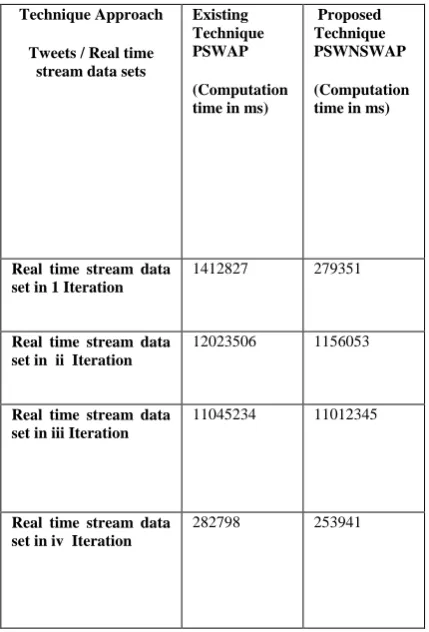
In the figure 11, the comparison between both the technique computation is presented through line chart graphically. The proposed and existing technique is performed with the different real time stream data sets, where the data is processed and following output results were monitored:
Table1: Statically analysis of computation time
Technique Approach
Tweets / Real time stream data sets
Existing Technique PSWAP
(Computation time in ms)
Proposed Technique PSWNSWAP
(Computation time in ms)
Real time stream data set in 1 Iteration
1412827 279351
Real time stream data set in ii Iteration
12023506 1156053
Real time stream data set in iii Iteration
11045234 11012345
Real time stream data set in iv Iteration
30 Fig 11: Comparison Line graph for Technique Analysis
4.2 Computation Cost Comparison
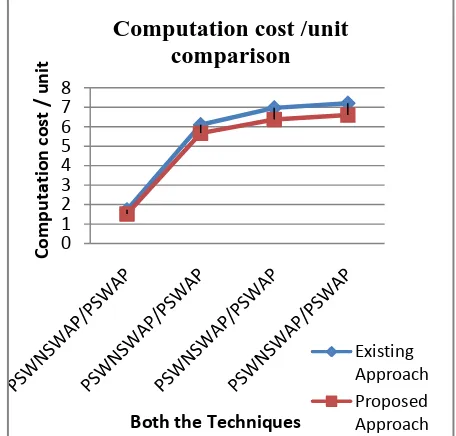
The graph representation shows the efficiency of our proposed algorithm work and it outperform the low computational time, thus the low computational cost with the number of different query and data processing. The proposed and existing technique is performed with the different real time stream data sets, where the data is processed and following output results were monitored:
Table2: Statically analysis of computation cost
Technique Approach
Tweets / Real time stream data sets
Existing Technique PSWAP
(
Computation cost/Unit)Proposed Technique PSWNSWAP
(Computation cost/ Unit)
Real time stream data set in 1 Iteration
1.73 Cost/Unit 1.52 Cost/Unit
Real time stream data set in ii Iteration
6.10 Cost/Unit 5.67 Cost/Unit
Real time stream data set in iii Iteration
6.97 Cost/Unit 6.37 Cost/Unit
Real time stream data set in iv Iteration
7.21 Cost/Unit 6.60 Cost/Unit
Fig 12: Comparison Line graph for Technique Analysis
0
2000000
4000000
6000000
8000000
10000000
12000000
14000000
Time
in
ms
Both the Techniques
Computation time comparison
Existing
Approach
Proposed
Approach
0
1
2
3
4
5
6
7
8
Compu
tation
cos
t
/
un
it
Both the Techniques
Computation cost /unit
comparison
[image:9.595.52.283.431.632.2]31 Fig 13: Map Optimization
4.3 Map Optimization
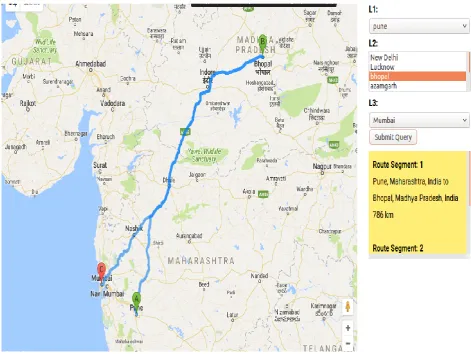
In figure 13, a map page for the user is presented. This page helps companies or brands to show locations for catchments. Which maintains user‟s action over analysis and details.
4.4 St-QAP Catchments Results
32 Fig 14: Travel Time Between Locations
33
5.
CONCLUSION & FUTURE WORK
5.1 Conclusion
Data processing is a platform which use for different type of analysis, it works with the input data processing and extracting proper knowledge from it. Twitter data generation having its diversity in various fields and tweets over multiple concept help in utilizing for various decisions . Here the problem associate with the previous knowledge extraction approach and twitter analysis is discussed. In various research work, processing and analysis can be performed on static data set. The existing base paper discussed about the static distribution and They also used statical graph analysis for distance computation. The existing data matching algorithm also not much effective . This research work proposed an efficient framework for processing and analysis the massive amount of complex stream data in Real Time. This framework covers the real time data fetching using storm framework, data processing through NLP, use PSWNSWAP algorithm for proper sentiment analysis with comparison parameter as computation time as well as computation cost to compute the comparative analysis and use St-QAP distance measure and finding distance optimization. The proposed algorithm St-QAP takes an input brand name and find proposition for it, with efficient results having parameters travel time and travel cost. The data processing technique produces efficient parameter computation with real time fast and effective process over Zookeeper server.
5.2 Future work
1. In future the real time implementation can be done to determine the largest number of tweets, which can apply over the industry level cloud infrastructure and to find it more secure, reliable than the other alternate available over the web.
2. Categorize implementation with the largest real time stream dataset.
3. This research work will be use in future for various types of analysis such as-
Mobility pattern analysis Business Planning & Marketing Flow of business analysis Catchments for Business Social Network Analysis
6.
REFERENCES
[1]. Saeed Shahrivari, “Beyond Batch Processing: Towards Real-Time and Streaming Big Data”, Computers, Vol. 3, pp. 117.129, 2014.
[2]. Intel IT center. Big Data in the Cloud: Converging
Technologies [online]. Available:
http://www.intel.com/content/www/us/en/big-data/big-data-cloud-technologies-brief.html. Date accessed: (April 2015).
[3]. Jos´e Antonio Iglesias, Aaron Garc´ıa-Cuerva, Agapito Ledezma and Araceli Sanchis, "Social Network Analysis: Evolving Twitter Mining", 2016 IEEE International Conference on Systems, Man, and Cybernetics • SMC 2016 |October 9-12, 2016 • Budapest, Hungary
[4]. Susan Gunelius, The Data Explosion in 2014 [Online]. Available: http://aci.info/2014/07/12/the-data-explosion-in-2014-minute-by-minute-infographic/ Date accessed: July 12, 2014.
[5]. Ankit Sarawagi, Rajeev Pandey, Raju Barskar, “Big data Applications: A Technical Review” International Journal of Computer Technology & Applications, Vol 8(4) ,431-440 July-August 2017 Available [email protected].
[6]. Xabier Artola, Zuhaitz Beloki, German Rigau, Aitorsoroa “Big data for natural language processing: A Streaming Approach“ in knowledge-based systems volume 79, May 2015, pages 36–42.
[7]. Bharati Punjabi, Sonal Honale, "A Research on Big Data Analysis & Processing With Data Mining Techniques", International Journal of Scientific Engineering and Applied Science (IJSEAS) - Volume-1, Issue-9, December 2015.
[8]. Walaa Medhat, Ahmed Hassan, Hoda Korashy,"Sentiment analysis algorithms and applications:A survey"Production and hosting by Elsevier B.V. on behalf of Ain Shams University.accepted 19 April 2014Available online 27 May 2014.
[9]. "Big Data Analytics: managing business data costs and data quality in the capital markets, available online- https://www.emc.com/collateral/software/white-papers/h10834-business-data-cost-optimization-wp.pdf. [10]. L.Jaba Sheela, "A Review of Sentiment Analysis in
Twitter Data Using Hadoop", International Journal of Database Theory and Application, Vol.9, No.1(2016), pp.77-86, http://dx.doi.org/10.14257/ijdta.2016.9.1.07. [11]. S.K. Bharti n, B.Vachha, R.K.Pradhan, K.S.Babu,
S.K.Jena, “Sarcastic sentiment detection in tweets streamed in real time: a big data approach” Contents lists available at Science Direct Digital Communications and Networks, Accepted 15 June 2016 , Available online 12 July 2016
[12]. M. R. Evans, D. Oliver, K. Yang, X. Zhou, S. Shekhar, “Enabling Spatial Big Data via CyberGIS: Opportunities and Challenges,” M. F. Goodchild, Ed. S. Wang, CyberGIS: Fostering a New Wave of Geospatial Innovation and Discovery. Springer, 2014.
[13]. Alyson Lloyd, James Cheshire, “Deriving retail centre locations and catchments from geo-tagged Twitter data” , Contents lists available at Science Direct Computers, Environment and Urban Systems, Article Accepted 28 September 2016 , Available online 20 October 2016.
[14]. J.P. Nivash, Ebin Deni Raj , L.D. Dhinesh Babu, M. Nirmala, V. Manoj Kumar, "Analysis on enhancing storm to efficiently process big data in real time', Published in: Computing, Communication and Networking Technologies (ICCCNT), 2014 International Conference, Date of Conference: 11-13 July 2014.Publisher: IEEE, Date Added to IEEE Xplore: 23 April 2015.
[15]. Thanh Trung Nguyen,Tin Khac Vu, Minh Hieu Nguyen,"BFC: High-Performance Distributed Big-File CloudStorage Based On Key-Value Store",978-1-4799-8676-7/15copyright 2015 IEEE,SNPD 2015, June 1-3 2015, Takamatsu, Japan.