XU, YI. Understanding the Performance and Resilience of Large-Scale Multi-Hop Wireless Networks. (Under the direction of Professor Wenye Wang.)
Wireless networks are becoming an important supplementary technology to the traditional wired networks. They offer convenient and flexible network access for the users to communicate with each other. However, wireless networks confront many technical challenges that limit their full utilization. Especially in large-scale multi-hop networks, the communication quality received by each user depends highly on the cooperation of other users in the network, which is constrained by many factors such as the heterogeneity of user communication devices, the limited availability of radio bandwidth, the difficulty in user coordinations, the mobility of users, and the failure of user devices.
We intend to understand the performance and resilience of large-scale multi-hop wireless networks in this dissertation, which will help us utilize the wireless networks ef-fectively, efficiently and reliably. We identify four fundamental performance and resilience aspects to investigate, namely, the information propagation speed, the communication ca-pacity, the topological stability, and the failure resilience. The study on the first two perspectives attempts to minimize the delay and maximize the capacity of large wireless networks, while the study on the last two perspectives evaluates and mitigates the impact of user mobility and failure on the network structure.
by Yi Xu
A dissertation submitted to the Graduate Faculty of North Carolina State University
in partial fullfillment of the requirements for the Degree of
Doctor of Philosophy
Computer Engineering
Raleigh, North Carolina 2010
APPROVED BY:
Dr. Arne A. Nilsson Dr. Yannis Viniotis
Dr. Wenye Wang Dr. Khaled Harfoush
DEDICATION
BIOGRAPHY
ACKNOWLEDGMENTS
First of all, I would like to express my wholehearted gratitude to my academic advisor, Professor Wenye Wang, for her guidance and support throughout my Ph.D. study. For many times in the progress of my research work, it was her enlightening thoughts and patient advices that helped me overcome the difficulties when I was challenged by the research problems. Especially at times when I felt frustrated, she was always my source of encouragement to reestablish my confidence and recover my momentum to move on. I feel myself so fortunate to have the opportunity to learn from her research passion, vision, widsom, and much more, the attitude toward life. I believe that the knowledges and skills that she has imparted to me are far beyond this dissertation. I owe a lifetime-long appreciation to her for the education that I have received.
I would also like to thank the professors in my advisory committee, Professor Arne A. Nilsson, Professor Yannis Viniotis, and Professor Khaled Harfoush, for their support to my research work. Their valuable and insightful suggestions and comments have helped me broaden my research view and improve my work quality. I am also grateful to all the professors that have taught me in and out of classes at NC State for imparting their knowledges, which allows me to be prepared for my future career.
My special thanks also go to my labmates and friends: Ming Zhao, Fei Xing, Nurcan Tezcan, Avesh Algawal, Shawqi Kharbash, Xinbing Wang, Lei Sun, Entong Shen, Chi Yi, Zhuo Lv, Mohit Khanna, Yujin Li, Haiyang Zheng, and Xiang Lu. It has been my great pleasure to work closely with them. My research discussions with them have always been one of my most important sources of fresh ideas that I have benefited from significantly. The time spent with them will remain a great memory for me.
TABLE OF CONTENTS
LIST OF TABLES . . . viii
LIST OF FIGURES . . . ix
Chapter 1 Introduction . . . 1
1.1 Motivation . . . 1
1.2 Research Objectives . . . 8
1.2.1 Understanding the Information Propagation Speed . . . 8
1.2.2 Understanding the Communication Capacity . . . 10
1.2.3 Understanding the Topological Stability with Node Mobility . . . . 11
1.2.4 Understanding the Network Resilience against Correlated Failures . 12 1.3 Contributions . . . 13
1.4 Organization . . . 13
Chapter 2 The Speed of Information Propagation in Wireless Networks . . 15
2.1 Motivation and Related Work . . . 15
2.2 Problem Formulation . . . 20
2.2.1 Reference Network Model . . . 21
2.2.2 Information Propagation Speed . . . 22
2.3 The Speed Upper Bound . . . 24
2.3.1 Bound in Broadcast Communications . . . 24
2.3.2 Bound in Unicast Communications . . . 25
2.3.3 Solution of Optimal Transmission Radius . . . 31
2.4 The Speed Upper Bound under Network Connectivity Constraint . . . 33
2.4.1 γ-Feasible Packet Delivery . . . 33
2.4.2 Noise Models . . . 34
2.4.3 γ-Feasible Speed Upper Bound . . . 35
2.4.4 Comparison of the Noise Models . . . 37
2.5 The Gap between Achieved Speed and Upper Bound . . . 39
2.6 The Fastest Packet Transmission Algorithm . . . 48
2.7 Summary . . . 49
Chapter 3 The Capacity of Wireless Networks . . . 51
3.1 Motivation and Related Work . . . 52
3.2 Problem Formulation . . . 53
3.2.1 Network Models . . . 54
3.2.2 Capacity Formulation . . . 56
3.3 Main Results on Network Capacity . . . 58
3.4 Sufficient Condition for Maximum Capacity . . . 61
3.4.2 Link Rate with Localized Scheduling . . . 63
3.5 Necessary Condition for Maximum Capacity . . . 72
3.6 Design of Localized Scheduling Scheme . . . 75
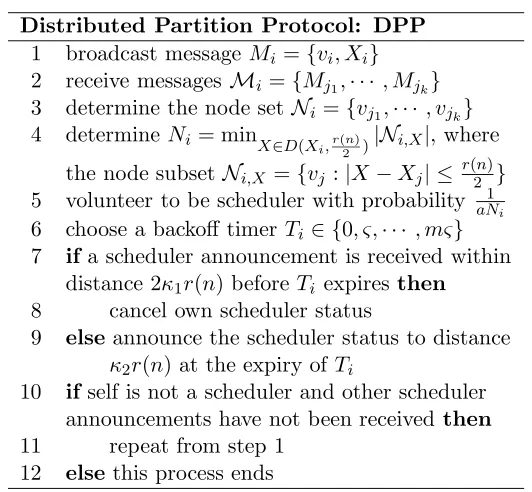
3.6.1 Distributed Partition Protocol . . . 75
3.6.2 Localized Scheduling Algorithm . . . 81
3.7 Relax of Time Synchronization . . . 85
3.7.1 Clock Non-Synchronization in Partitioning . . . 85
3.7.2 Clock Non-Synchronization in Scheduling . . . 86
3.8 Summary . . . 86
Chapter 4 The Topological Stability of Hierarchical Wireless Networks . . . 88
4.1 Motivation and Related Work . . . 88
4.2 Models and Assumptions . . . 90
4.2.1 Mobility Model . . . 90
4.2.2 Network Model . . . 90
4.3 Lifetime Analysis of the Hierarchical Architecture . . . 91
4.3.1 Cluster Lifetime . . . 91
4.3.2 Inter-Cluster Link Lifetime . . . 98
4.3.3 Path Lifetime . . . 100
4.3.4 Numerical Results . . . 101
4.4 The Mobility and Energy Aware Clustering Algorithm . . . 103
4.5 The Clustered Network Overlay Routing Protocol . . . 106
4.6 Performance Evaluation . . . 108
4.7 Summary . . . 112
Chapter 5 The Wireless Network Resilience against Correlated Failures . . 113
5.1 Motivation and Related Work . . . 113
5.2 Problem Formulation . . . 115
5.2.1 Network and Failure Models . . . 116
5.2.2 Preliminaries of Percolation . . . 119
5.2.3 Failure Percolation . . . 120
5.3 Spread of One-Time Failures . . . 122
5.3.1 Percolation with Constant Failure Impact Radius . . . 123
5.3.2 Percolation with Random Failure Impact Radius . . . 123
5.3.3 Simulation Results . . . 126
5.4 Spread of Persistent Failures: Constant Failure Correlations . . . 127
5.4.1 Sufficient Condition of Percolation . . . 128
5.4.2 Sufficient Condition of Non-Percolation . . . 132
5.4.3 Simulation Results . . . 134
5.5 Spread of Persistent Failures: General Failure Correlations . . . 134
5.5.1 Sufficient Condition of Percolation . . . 136
5.5.2 Sufficient Condition of Non-Percolation . . . 137
5.5.3 Simulation Results . . . 138
5.6 Applications in Failure Control . . . 139
Chapter 6 Conclusion and Future Directions . . . 141
6.1 Conclusion . . . 141
6.2 Future Directions . . . 143
LIST OF TABLES
Table 2.1 Comparison between y(α) and eα−1 . . . 32
LIST OF FIGURES
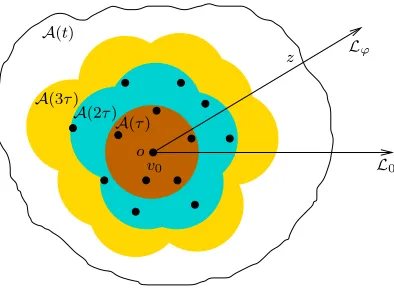
Figure 2.1 Information propagation in multihop wireless networks. The packet broad-casting duration isτ for each node. . . 23 Figure 2.2 The packet relay path in directionϕ. . . 24 Figure 2.3 The packet transportation time via 1-hop and 2-hop relay paths, B = 100
KHz,L= 1024 bits, PN = 103, α= 2. . . 28 Figure 2.4 The node removal and relocation process. (a) Finding the node set{vj|dvivj ≤
d∗, j = i+ 1,· · ·, i+k}. (b) Removing the nodes {vj, j = i+ 1,· · ·, i+k −1}. (c) Relocating the nodevi+k such that dvivi+k =dvi+kvi+k+1 (ifk >0) or the node
vi+1 such thatdvivi+1 =dvi+1vi+2 (ifk = 0). . . 30
Figure 2.5 The end-to-end packet transportation time, B = 100 KHz, L= 1024 bits, P
N = 103,α= 2. Whendv0vd=2m,Ru=2m; whendv0vd=15m, 30m, 60m,Ru=15m;
when dv0vd=120m, Ru=17.14m. . . 32
Figure 2.6 The optimal transmission radius R. . . 33 Figure 2.7 Wγ(λ) in the constant-interference model, B = 100 KHz, L = 1024 bits,
P
N = 103, λC = 50. . . 38 Figure 2.8 Wγ(λ) in the increasing-interference model, B = 100 KHz, L= 1024 bits,
P
N(1) = 103, λI = 50. . . 38 Figure 2.9 Information propagation in multihops in direction ϕ.. . . 40 Figure 2.10 A comparison of the packet propagation speeds in six randomly chosen
directions, in which the normalized speed is defined as the ratio of the minimum speed to the maximum speed in the six directions,λ= 30. . . 41 Figure 2.11 Definitions of Xmax andXmin.. . . 43 Figure 2.12 The propagation distanceZm in direction ϕ. . . 44 Figure 2.13 The mth-hop propagation distance ρm = Zm −Zm−1 in direction ϕ,
dzm−1u4 =dzm−1u5 =dzm−1u6 =du1u2 =du1u3 =Rγ(λ),∠u4zm−1u6=∠u5zm−1u6 =
π
Figure 2.16 The fastest packet transmission algorithm running on nodevithat forwards a packet to destination vd. The vectors vi and vd denote the locations of vi and vd. The environmental parameters α, B,P andN are constant and known. . . 49
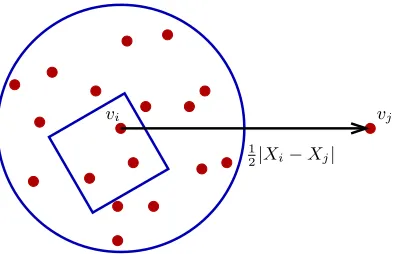
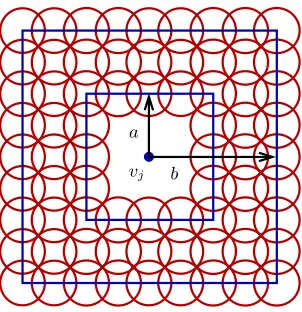
Figure 3.1 Density determination of the concurrent senders in the physical model. The disk has radius 21|Xi−Xj|. The square has edge length 2√12|Xi−Xj|. . . 62 Figure 3.2 Determination of the bounds on r(n) in the generalized physical model. . . 63 Figure 3.3 The relative locations of the co-centric disks and an overlapping partition.
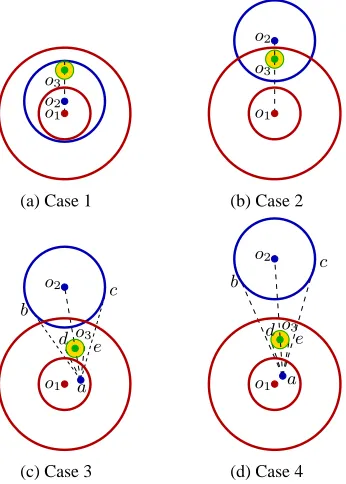
The co-centric disks are centered at o1, denoted as D(o1, κ1r) and D(o1, κ3r) respectively. The annulus is denoted as D(o1, κ3r)\D(o1, κ1r). The partition is centered ato2. For clarity, we have only shown the inner disk of radiusρ, denoted asD(o2, ρ), but ignored the partition boundary as well as the outer disk of radius
σρ. Point a is inside D(o1, κ1r). Lines ab and ac are tangent to D(o2, ρ). Lines
ad andae are tangent to D(o3, ). d=|o1o2|. . . 64 Figure 3.4 Proof of Theorem 3.6 in the protocol interference model. In unicast, we
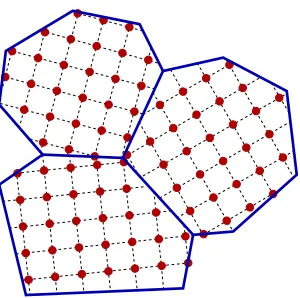
define disks D(vj,(1 + ∆)r(n)), D(vj,2(1 + ∆)r(n)), D(o3, ) and D(o4,4(1 + ∆)r(n)). In broad/multi-cast, we define disks D(vi,(2 + ∆)r(n)), D(vi,2(1 + ∆)r(n)),D(o3, ) andD(o4,4(1 + ∆)r(n)). The area ofD(o3, ) is at leastc2r2(n). The polygon denotes a neighbor partition. . . 67 Figure 3.5 Node locations on grids. . . 68 Figure 3.6 Aggregate interference from the region bounded between distance aandb. 70 Figure 3.7 Proof of Theorem 3.7 in the protocol interference model. Case (a) proves
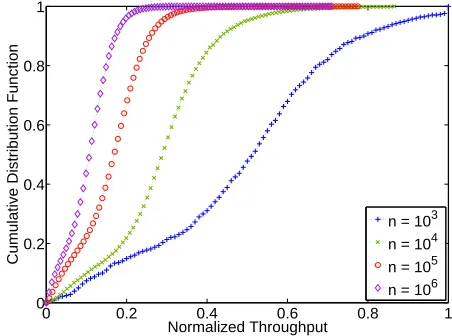
ρ(n) = Ω(r(n)), in which we define disksD(vi,2σρ(n)) and D(p,2σρ(n)). Case (b) proves ξ(n) = Ω(r(n)), in which we define disk D(p, ξ(n)). In both cases, |vip|= ∆r2(n). . . 73 Figure 3.8 The process of determining the role of nodevi. . . 77 Figure 3.9 Probability distribution of the partition sizes normalized against r(n). . . . 79 Figure 3.10 Upper and lower bounds on the partition sizes normalized against r(n). . . 80 Figure 3.11 Protocol convergence. . . 80 Figure 3.12 Protocol overhead.. . . 81 Figure 3.13 A localized scheduling algorithm that runs in each partition and in each
Figure 3.15 Scaling of partition size, ρ(n) =r(n). . . 83
Figure 3.16 Scaling of scheduling density,δ(n) =r32(n). . . 84
Figure 3.17 Scaling of scheduling density,ξ(n) =r12(n). . . 84
Figure 4.1 The intervals of pauses and movements. . . 92
Figure 4.2 The movements inside and beyond the coverage area of another node. . . 92
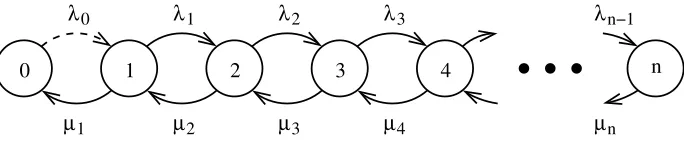
Figure 4.3 The Markov transition diagram. . . 96
Figure 4.4 The connection types and the logical link. . . 98
Figure 4.5 E(Tm). . . 102
Figure 4.6 E(Th). . . 102
Figure 4.7 E(Tl). . . 102
Figure 4.8 E(Tp).. . . 102
Figure 4.9 The MEACA clustering algorithm. . . 104
Figure 4.10 An example connection table.. . . 107
Figure 4.11 The node status determination time (MEACA). . . 108
Figure 4.12 The ripple effect of Lowest-ID and GDMAC.. . . 109
Figure 4.13 The time distribution of the clusterhead status (MEACA). . . 109
Figure 4.14 The time distribution of the clusterhead status (Lowest-ID). . . 110
Figure 4.15 The time distribution of the clusterhead status (GDMAC). . . 110
Figure 4.16 E(Tm). . . 111
Figure 4.17 E(Th). . . 111
Figure 4.18 E(Tl). . . 111
Figure 4.19 E(Tp).. . . 111
Figure 4.20 Throughput comparison. . . 112
Figure 5.2 Spread of one-time failures. . . 122
Figure 5.3 Functions a2R1 a f(x)dx and (1−a2) Ra 0 f(x)dx when r is a constant, i.e., f(x) =δ(x−r). . . 125
Figure 5.4 Failure percolation with pλ= 9.8 and uniformly distributed f(x). . . 126
Figure 5.5 Failure percolation with pλ= 2.3 and uniformly distributed f(x). . . 127
Figure 5.6 Spread of persistent failures. . . 128
Figure 5.7 Mapping from continuum percolation to discrete percolation. . . 129
Figure 5.8 Failure percolation with λ= 5, r= 1, andp= 0.38. . . 135
Figure 5.9 Failure percolation with λ= 5, r= 1, andp= 0.0025. . . 135
Figure 5.10 Function Ψ(g0(x), Xo,∆),R ∆g0(kXo−Xεk)dε. . . 136
Figure 5.11 Failure percolation withλ= 5, r0 = 1, andg0(x) = 1−0.56x. . . 138
Chapter 1
Introduction
1.1
Motivation
In recent years, wireless networks attracted increasing attention from researchers because of their promising and indispensable usages in a wide range of communication scenarios. In places where the conventional wired networks are inconvenient, uneconomic or infeasible to be deployed, wireless networks provide an alternative or supplementary networking service. In fact, various types of wireless networks have already become an integral part of our daily lives, changing the traditional ways for communication in our many work and social activities.
The most widely observed example is the cellular network. Almost everyone in the world is benefiting from the communication convenience offered by this wireless cel-lular technology. Especially when the high-rate data transmission service is provided in the current 3G networks, the usage of and dependence on cellular networks are becoming unprecedentedly high. The deployment of cellular networks has enabled their users to have both voice communications and information exchanges anytime and anywhere in the areas covered by the networks.
In home and office areas, the wireless LAN and bluetooth technologies are present-ing a much convenient data communication paradigm by removpresent-ing the requirement of wired connections between different electronic devices. For example, the computers in an office are able to exchange files and access Internet resources through a wireless router, which provides the equivalent data transmission speed as the wired links. By using a bluetooth headphone, we can listen to music or have phone conversations when moving in the office.
In places that need to be monitored for security and protection reasons, wireless sensor networks are being studied for their potentials in deployment. When deployed, the sensor networks can provide automatic and continuous surveillance for the protected area. An example of the application is the forest fire detection. Using a sensor network to monitor the temperature change in a forest is a far more accurate and economic method than using human patrols, since sensors work days and nights without interruptions in all weather conditions.
The wireless network technologies have also made many traditional human tasks much easier to accomplish. For example, in the traditional way of reading electricity meters, the energy facility company needs to send workers to read the electricity meter of each apartment. The current research progress in the application of wireless network technologies is expected to substitute the human workers with the wireless meter reading devices that automatically and instantaneously acquire all the readings of a building.
The limitation of radio frequency spectrum is one of the major constraints on the wireless network performance. As the wireless signals transmitted on the same frequency carrier interfer with one another, a wireless network can only use a small fraction of the frequency spectrum. Once a band of frequency spectrum is allocated to a wireless network, other wireless networks cannot utilize the same frequency band unless they are separated far away from one another. Given the limitation of the total available frequency spec-trum, optimal allocation of the scarce radio resource is a research problem that requires deliberation and planning. On the other hand, the various real-time and peer-to-peer appli-cations require an ever increasing bandwidth demand, which intensifies the radio resource scarcity problem further. Managing the allocated frequency spectrum efficiently to satisfy the service requirements is hence important in wireless networks.
Due to the communication openness, every packet transmitted in a wireless net-work is broadcast in nature. For all the non-intended nodes, a packet transmission in fact imposes an interference. When multiple nodes transmit concurrently in a contention to access the shared wireless medium, their transmitted signals may collide such that none of the transmitted packets is received correctly. The potential packet collisions hence require a coordination mechanism among the multiple senders if all have data to transmit. In order to meet the transmission requirement of every node, the coordination mechanism may need to collect the information of the link collisions and the node buffers to generate an optimal transmission schedule. It is a challenging research problem to collect the necessary infor-mation from the network and construct an efficient transmission schedule with moderate signaling overhead.
Compared to the wired links, the transmission capacity on wireless links is much limited due to the attenuation of transmitted signals and the high environmental noise and interference. Packets are transmitted with comparatively longer delays on wireless links. Besides, because of the increased bit error rate in the wireless settings, packets may not be received correctly. In case that a received packet cannot be decoded, the packet must be retransmitted until it is decoded correctly by the receiver. Every retransmission results in additional delay of the packet in the network. Furthermore, as the overall traffic carried in a wireless network increases, each packet also expects long delay on its path to the destination. Finally, as the network topology in wireless networks is dynamic, a packet may have to be buffered at an intermediate node before it can find a viable path to its destination. Hence, design of strategies to reduce the end-to-end delay in wireless networks is a non-trivial problem.
To utilize a wireless network to the fullest extent, we expect each packet in the network to be delivered to its destination in the shortest possible time and meanwhile every node to be able to send as much traffic as possible. As the traffic flows from different sources compete for the network resources, each node cannot take an arbitrarily large share of network resources for the transmission of its traffic, and hence its data sending rate must have a maximum bound. For instance, when a node sends, the other nodes within the interference region of the sending node cannot send. Otherwise, the packets from the interfering senders collide and none of the transmitted packets can be received by the intended receivers. In addition, when a packet travels through multiple relay nodes to reach its destination, it takes the transmission resources from each relay node in a competition with all the other traversing traffic. Under the constraint of limited network resources, throughput maximization is important and necessary.
Further, if all the nodes are movable in the network, the mobility management becomes even challenging. Effective solutions for the user mobility support in wireless networks are therefore another challenging research problem.
Like all other complicated systems, wireless networks have to deal with failures. Failures may occur in a wireless network due to a variety of reasons, for example, including the design errors, device malfunctions, environment changes, and power outages. Failures need to be considered at the time of network design and deployment to prevent them at the beginning, mitigate them at the occurrence, and eliminate them after the network restoration. In some cases, failures are random and independent from one another. In other cases, however, failures are correlated, which may result in a cascading sequence of many component failures in the network. To maintain a wireless network functional all the time, we need to investigate carefully the causes of various types of failures and take measures to minimize the possible impact created by failures in a wireless network. Given the complexity of wireless networks, failure prevention and resilience are quite complicated but important research problems.
User privacy and information security are also important in wireless networks. The information transmitted on wireless links is easily overheard by the non-intended users due to the broadcast nature, which may leak a user’s private information to others. Malicious users may take unauthorized usage of other person’s information, compromising the affected user’s privacy. In other forms of attacks targeting the wireless networks and their users, the sophisticated attackers may even interrupt the normal communications of legitimate users, falsify the information transmitted by others, drop the data packets from other users, and jam the wireless channel to disconnect the users from the network. In fact, there has been an increasing attention from both the research community and the network industry to the potential threat on the wireless network security. Privacy and security concerns with wireless networks need to be addressed properly in order to provide trustworthy services to the users.
networks to allow fair use of each user, and the control of traffic congestion at the gateway node. In other practical scenarios, wireless networks may be connected to the Internet, in which many inter-operability problems need to be solved satisfactorily. For example, we may want to treat the packet loss in such scenarios differently based on the specific causes. If packets are lost due to the congestion in the wired segment of transmission, a node should send slowly. On the contrary, if packets are lost due to the low signal quality in the wireless segment, a node should send aggressively to compensate for the packet loss.
Service personalization and customization are also interesting research problems in wireless networks. Users in a wireless network may have different service requirements that depend on the particular network usages of respective users. For example, a user who displays regular mobility and activity patterns may access the network at specific loca-tions with specific requests, a user who is interested in certain news topics or technology developments may access specific network resources frequently, and a user who keeps com-munications with a group of social contacts may access specific types of social connection tools and services from time to time. Given the various network usage characteristics of different users, providing personalized and customized wireless network services to individ-ual users or groups will be an attractive feature, which is however not an easy task due to a number of technical challenges including the estimation of network usage patterns and the design of user interested services.
On one hand, the deployment and utilization of wireless networks will continue increasing to offer pervasive and ubiquitous networking services. On the other hand, many technical problems still await satisfactory solutions in order to optimize the services. In this dissertation, we are dedicated to understand the performance and resilience of large-scale wireless networks, which lays the foundation for the further efforts in designing and operating large wireless networks in an efficient and resilient way. Specifically, we target two fundamental performance metrics, delay and throughput, and two network resilience aspects, mobility and failure, in this dissertation. Ideally, we expect a network to be oper-ated with short delay and large capacity. Additionally, when mobility and failure occur, we also expect the network to continue working as normally as before.
packet is determined by the waiting time in each relay hop before the packet is transmitted. However, in some application scenarios, such as sensor networks, the traffic load is usually not significant. Rather, due to the limited bandwidth and long transportation distance, the packet delay may be dominated by the transmission time spent on each link that the packet traverses. In this example, the existing results do not provide the answer for the fastest information propagation with light traffic load. In order to transport a message in the fastest speed, which could be urgent in some application scenarios, we need to re-consider the packet delay problem in large wireless networks.
Similarly, we observe an incomplete understanding of the communication capacity in large wireless networks. The existing studies have proven an upper bound on the capacity of large wireless networks. To achieve the maximum capacity, the transmissions in the network need to be coordinated carefully. All the existing solutions on the transmission scheduling employ a global control mechanism that assigns the transmission permission to each link and synchronizes all the concurrent transmissions. Such global mechanism is however not practical for large wireless networks. When the network size is large, collection of the network information regarding the node transmission requests and their interfering relations is difficult. Even if the required information is collected and a globally optimized transmission schedule is generated, the synchronization of transmissions is another challenge for the application of such a mechanism. Hence, we need to seek a practical scheme to maximize the capacity of large wireless networks.
The node mobility in wireless networks brings a concern on the stability of network structure. There are many studies in the literature that attempt to mitigate the impact of node mobility on the network architecture. For example, a hierarchical structure may be established to keep the topological framework intact when mobility occurs in local areas, the routing protocol may compare and select the most stable paths consisting of the low mobility nodes in the routing backbone, and a set of nodes may be used to bridge a connection between two nodes that are in and out of direct contact intermittently. Though the impact of node mobility on the network topology is alleviated by using these techniques, we do not know yet the possible extent of further stabilization in the network topology. We thus need to understand the wireless network topological stability with further insights, which will allow us to design optimized solutions to mitigate the impact of node mobility with improved effectiveness.
The current studies on the failures in wireless networks have mainly focused on particular types of failures and their prevention and mitigation strategies. Though the existing work in the literature helps improve the wireless network resilience to certain types of failures, there lacks a general understanding of the failure impact on the overall wireless network structures and functions. In complex systems like a large wireless network, the countermeasures for single and random failures are usually taken into consideration in the phase of network design and deployment such that the network is quite resilient to isolated and occasional failures. However, in case that the failures are correlated to one another, the failure impact will be significantly larger than the case of isolated failures. Understanding the wireless network resilience to interdependent failures is hence necessary in order to prevent the network from potentially catastrophic failure impact.
Given the importance of these research problems, we are hence motivated to ex-plore further the performance and resilience properties of large-scale wireless networks to gain a comprehensive understanding towards the maximal network utilization. We intend to determine the solutions for fast packet transportation, high traffic throughput, stable network structure and resilient counter-failure capability. Our work is helpful for the de-signers and operators of large-scale wireless networks to evaluate, improve and optimize their network usage.
1.2
Research Objectives
We will investigate four specific problems related to the performance and resilience of large-scale wireless networks, namely, the information propagation speed, the commu-nication capacity, the topological stability with node mobility, and the network resilience against correlated failures. We next elaborate on these individual problems respectively.
1.2.1 Understanding the Information Propagation Speed
for transmission. The existing works seen in literature all have focused on the load-incurred delay, where the statistical average of many packets [19–27] is investigated. In these studies, the delay is conditioned on the specific load in the network. In networks where the traf-fic load is low, the bandwidth-incurred delay becomes the dominant component, which is however not understood sufficiently yet. By determining the minimum bandwidth-incurred packet delay, we will gain the knowledge of the shortest possible packet delay in all traf-fic load cases, since traftraf-fic load incurs extra delays in addition to the bandwidth-incurred delay. Therefore, we are motivated to determine the minimum packet delay with arbitrary traffic load by considering the available bandwidth of transmission links and furthermore to find methods that achieve the fastest packet transportation in large wireless networks when traffic load is light.
In order to understand the fastest packet transportation in large-scale wireless networks, we define a new metric called the information propagation speed. The information propagation speed measures the geographical distance traveled by a packet within a given time period. We intend to achieve the following research objectives regarding this new network performance metric:
• The upper bound on information propagation speed will be determined, which reflects the minimum packet delay in a wireless network due to the constraint of link capacities. • The conditions to achieve the maximum information propagation speed will be
iden-tified.
• In case that the ideal conditions are not satisfied in a wireless network, the gap between the upper bound and the actually achieved speed will be evaluated.
• A new packet transmission and relay scheme will be designed to minimize the packet delay in lightly-loaded networks.
are not available. In these situations, we determine the gap between our achieved perfor-mance and the expected best perforperfor-mance in packet delay. Finally, we use the identified network conditions and configurations to design a simple routing scheme that expedites packet transportation and delivery. Compared to the pervious works on packet delay mini-mization, our work determines the fundamental delay bound applicable to arbitrary traffic load, and our routing scheme supplements the existing routing strategies in the light-loaded network scenarios. This study will maximize the network performance from the packet delay minimization perspective.
1.2.2 Understanding the Communication Capacity
Besides packet delay, network capacity is an equally important metric for network performance. It measures the total volume of packets that can be served simultaneously. When we consider all the packets inside a wireless network, the strategy that minimizes the delay of a specific packet may not maximize the network throughput, because the limited network resource may not be able to accommodate the same transportation service to all the packets. Many studies in the literature [1, 7, 12, 34–37, 48, 53] have investigated the capacity of large-scale wireless networks, in which methods have been proposed to achieve at least a constant fraction of the capacity bound. As part of the proposed capacity-achieving methods, all the current studies assume that the links in the entire network can be synchronized for collision-free transmissions, which is used in constructing joint routing and scheduling schemes to prove the achievability of order optimal network capacity. However, global link synchronization is very difficult to implement in large wireless networks. Hence, we are interested in determining whether the same order optimal capacity is still achievable in practical and realistic network settings in which links are synchronized only within local areas. If the answer is positive, we will be able to obtain the maximum network throughput in the order sense with significantly reduced implementation complexity and hence improved scheme practicality. We attempt to achieve the following research objectives:
• The capacity of large-scale wireless networks with localized link scheduling schemes will be determined, which is proven to be as optimal as the capacity achieved by using global link scheduling strategies.
• A distributed network partitioning protocol and a localized link scheduling algorithm will be designed to achieve the optimal network capacity with significantly reduced complexity and overhead.
As the first step toward designing realistic capacity-achieving schemes, we prove that the same order of network capacity is in fact achievable by using localized link schedul-ing only. Furthermore, we determine the network conditions and configurations that are both sufficient and necessary in order for localized link scheduling to achieve the order op-timal network capacity. The identified conditions provide informational guidelines on the design of scheduling schemes, based on which we propose a distributed network decompo-sition protocol and a localized link scheduling scheme to maximize the network capacity in the sense of scaling order.
1.2.3 Understanding the Topological Stability with Node Mobility Node mobility creates a significant impact to the stability of network structure. Due to the limited transmission power, a node may communicate only to the other nodes that are close enough within the reach of its transmission. When a node moves, its neighbors change over time. Since the moving node relies on its neighbors to relay its packets and the moving node may also be actively forwarding the packets from others, node movement results in frequent network topology changes and communication interruptions. When the broken communication links and paths are repaired, network overhead, packet delay and packet loss are incurred inevitably. The mobility impact is even greater in large-scale networks than the small ones because the average path length is longer in the former and any link break causes the path failure. We are hence motivated to stabilize the network topology in a mobile environment. Specifically, we construct a hierarchical network architecture and attempt to achieve the following research objectives:
• Through mathematical modeling of the random node mobility, the maximum topo-logical stability will be determined in the hierarchical mobile wireless networks. • A new node clustering algorithm will be designed to maximize the structural stability
of clusters.
The mathematical modeling and analysis lay the foundation for understanding and maximizing the topological stability in mobile wireless networks. To facilitate our study, we first choose a general node mobility model, which represents the typical node movements. Then we analyze the network topological stability in terms of the lifetimes of clusters, links and paths using the chosen node mobility model. The analytical results indicate the maximum stability of network topology in mobile environment and provide the guidelines for network design that maximizes the topological stability. Finally, we propose a new node clustering algorithm and a hierarchical routing protocol to stabilize the topology of mobile networks. Our study maximizes the network topology lifetime and avoids the excessive overhead associated with the topological changes incurred by node mobility.
1.2.4 Understanding the Network Resilience against Correlated Failures Failures pose a significant threat to the correct network functioning. In large-scale wireless networks, node failures happen due to a variety of reasons including, for example, the device defects, battery depletions, and malicious alterations. When failures occur, not only the failed nodes suffer from the inability to communicate, but also the rest of the network may be impacted, as the failed nodes might serve as intermediate routers for the other portion of the network. Ideally, we want a wireless network to be robust such that it continues working when failures occur. In the scenario that the failures happen independently, we may ensure network resilience by deploying extra nodes in the network as backup. However, in some scenarios, failures display an interdependence in the way that an earlier failure might trigger the occurrence of follow-up failures, which exists as a complicated form of failure occurrence and a challenging problem for failure resilience. In order to design effective strategies to enhance the counter-failure capability of large-scale wireless networks, we must understand the spread of correlated failures first. Therefore, we target the following research objectives:
• A general mathematical model will be established to formulate the interdependent correlations among various types of failures.
failure containment strategies to enhance the network resilience.
The first step in determining the scope of failure spread is to understand the logical connections between failures. We thus propose a mathematical framework to model the failure interdependence. Given the failure correlation model, we then determine the conditions on the correlation strength in which failures will and will not spread out to a significant portion of the network. Intuitively, stronger correlation implies higher chance of spreading. We attempt to reveal quantitatively the characteristic regimes of failure correlations for both the failure spreading occurrence and non-occurrence. Finally, we will suggest counter-failure strategies in large-scale wireless networks.
1.3
Contributions
Our work in this dissertation contributes toward a comprehensive understanding of the fundamental performance aspects of large-scale wireless networks. As we are unable to study exhaustively all the possible aspects of wireless networks, we have identified four of them in this research, namely, the information propagation speed, the communication capacity, the topological stability with node mobility, and the network resilience against correlated failures. Because these performance and resilience indicators reflect the funda-mental expectations for large-scale wireless networks, we believe that our work provides useful insights for the network designers and operators to manage their wireless networks effectively, efficiently and reliably. More specifically, our research result on the information propagation speed determines the fastest message dissemination strategy, our result on the communication capacity offers a practical solution for maximizing the throughput in large wireless networks, our result on the topological stability extends the network architectural lifetime, and our result on the failure resilience provides a theoretical foundation to un-derstand the impact of correlated failures on wireless networks. The analytical results and proposed solutions in this dissertation can be used to evaluate, improve and optimize the utilization of large-scale wireless networks.
1.4
Organization
Chapter 2
The Speed of Information
Propagation in Wireless Networks
In this chapter we investigate the speed of information propagation in large wireless networks, which provides fundamental understanding of the fastest information transporta-tion and delivery that a wireless network is able to accommodate. We show that there exists a unified speed upper bound for broadcast and unicast communications in large-scale wireless networks. When network connectivity is considered, this speed bound is a func-tion of node density. If the network noise is constant, the bound is a constant when node density exceeds a threshold; if the network noise is an increasing function of node density, the bound decreases to zero when node density approaches infinity. As achieving the speed bound places strict requirements on node locations, we also quantify the gap between the actually achieved speed and the desired bound in random networks in which the relay nodes are not located as desired. We find that the gap converges to zero exponentially as node density increases to infinity.
2.1
Motivation and Related Work
is discovered that higher throughput is indeed obtainable if extra network conditions are considered, for example node mobility [2], infrastructure support [3], transmission cooper-ation [4] and ultrawide bandwidth [5]. Besides the theoretical bounds, algorithm design [6] has also been proposed to maximize the network capacity.
Different from the previous works, we study in this chapterpacket delayinstead of throughput of wireless networks. Packet delay is a performance metric equally important as throughput, especially in the Quality-of-Service sensitive real-time communications, in which the delay perceived by each packet is more pertinent to the communication quality than the throughput of the entire network. Specifically, we are interested in determining the lower bound on the packet delay in wireless networks. The delay bound provides the understanding of how fast a packet can be transported and paves the way for the further investigation on the feasibility of supporting delay-sensitive traffic in wireless networks.
The delay perceived by a packet is the combined result of various factors including path length, link bandwidth, traffic load, and channel access overhead. Fortunately, these factors can be decoupled as they represent different delay components. For instance, the path length determines the number of hops traversed by the packet; the link bandwidth determines the transmission time on each hop; and the traffic load comes into effect in the form of packet queuing, processing and wireless medium access delay at each intermediate node. In order to obtain generic results on packet delay, we do not assume any particular traffic pattern. Instead, we study a lightly-loaded network in which the packet queuing, processing and medium access delays are negligible as compared to the transmission delay. Decoupling the bandwidth-incurred delay and the load-incurred delay allows us to treat them separately and to reach conclusions that are not limited to specific traffic distributions. The additive property of packet delay guarantees that the lower bound discovered in the lightly-loaded networks also applies to the arbitrarily-loaded networks, though the tightness of the bound needs further investigation in the latter scenario.
the selection of few links with long distance per link versus the selection of many links with short distance per link. Obviously, short link distance improves the capacity of the link and therefore transmission finishes fast on the link, but a packet needs to go through many hops before reaching its destination. Zheng shows in [7] that there exists an upper bound W on the information propagation speed that is attainable under three conditions: i) every relay node uses an optimal transmission radius R, ii) the transportation distance between the source node and the destination node is a multiple ofR, and iii) the relay nodes are aligned with equal separation distance R. We study in this chapter the generalized speed limit problem in which the above three conditions may not hold and, in addition, the network connectivity and the node location randomness are taken into account.
To be specific, we are interested in the following three questions. First, if the packet transportation distance between the source and the destination is known not to be a multiple of R, what is the upper bound on the information propagation speed? Obviously, it should be tighter than W since W is unreachable in this case. Second, does network connectivity place any constraint on the speed upper bound and, if yes, how? As achieving the maximum speed W requires using a specified transmission radiusR, it is possible that the network is not fully connected by using R. Should this case occur, a packet may not be able to reach all the intended recipients and the speed upper bound W may not be feasible. Third, even if the optimal transmission radius R is used, it may not be possible to find the relay nodes at the desired locations due to the randomness in node distribution. When the relay nodes are not located as desired, information propagates at a lower speed and a gap exists between the actually achieved speed and the upper bound W. How to quantify this gap? We attempt to answer these questions, which provide the foundation for optimal network planning and protocol design to expedite packet delivery in multi-hop wireless networks.
As the first contribution, we show that the optimal transmission radius depends on the end-to-end transportation distance. In order to transport a packet at the fastest speed, the relay nodes must be equally spaced and use the same transmission radius. The value of the transmission radius is a divisor of the straightline distance between the source and the destination nodes. Interestingly, the optimal transmission radius converges to a constant in large-scale wireless networks.
connectivity and examine the feasible speed bound in two noise models: the interference model and the increasing-interference model. We show that in the constant-interference model the speed bound is a constant when node density exceeds a threshold and in the increasing-interference model the speed bound decreases to zero when node density increases to infinity.
As the third contribution, we quantify the gap between the actually achieved speed and the desired upper bound. The gap exists due to the randomness of node locations. We prove that a packet propagates omnidirectionally in large-scale wireless networks and the gap reduces as node density increases. We also show that in both noise models, there exists a threshold node density below which the gap is bounded by constants and above which the gap converges to zero exponentially.
Before we start to investigate the properties of information propagation speed in large-scale wireless networks, we first review the current efforts in the literature on both network capacity and packet delay.
Since the work by Gupta and Kumar [1], many efforts have been made to under-stand the fundamental performance limits of wireless networks, most of which have focused on the network throughput. Gupta and Kumar demonstrated that the throughput per node is Θ √1
n
that decreases to zero as the number of nodesngoes to infinity. In the follow-up research, it is found that higher throughput can be achieved under various conditions and by using different techniques.
Grossglauser and Tse [2] discovered that mobility increases throughput. As the throughput of wireless networks is constrained by the interference of concurrent transmis-sions, minimizing interference improves throughput. Node mobility increases the chance of transporting a packet using a short path, which reduces the number of relay transmissions and alleviates the intensity of interference. Garettoet al.[8] further proved that the asymp-totic capacity of ad hoc networks varies from Θ √1n to Θ 1 under anisotropic mobility patterns.
Liuet al.[3] studied the wireless networks with infrastructure support. They found that throughput increases linearly with the number of base stations if there are sufficient base stations in the network. Kozat and Tassiulas [9] showed similar improvement that the throughput per node is Θ log1n if the number of access points is large enough such that each access point serves limited number of wireless nodes.
that throughput can be improved by cooperation in transmissions. It is shown that the throughput per node pair scales as logn asymptotically when the nodes collaborate in transmissions. Ozguret al.[4] extended the network scenario to multiple source-destination pairs. They showed that an almost linearly-scaling capacity Θ n1−can in fact be achieved by intelligent node cooperations and distributed multi-input multi-output (MIMO) commu-nications.
Negi and Rajeswaran [11] proved that each wireless node can obtain a throughput bounded between O (nlogn)α2−1 and Ω n(α−1)/2
(logn)(α+1)/2
if infinite bandwidth is available. Zhang and Hou [5] further demonstrated that the throughput per node scales in fact as Θ nα−21if the bandwidth is unlimited and the Shannon channel capacity is attainable.
All the works discussed above enhance the network utilization by increasing the total volume of transported packets within a given time period. It was meanwhile discovered that by allowing some packet delay the network throughput can be further improved [12–14] and the node energy consumption can be reduced [15, 18]. However, because packet delay cannot be arbitrarily relaxed, for example the real-time communications (e.g., voice con-versations) and the time-sensitive messages (e.g., urgent event reports in sensor networks) require timely delivery, mechanisms are needed to guarantee satisfactory packet delay in the delay-constrained communication scenarios.
Krunz and Kim [19] analyzed the packet delay distribution and discard rate in wireless networks, from which they determined the wireless effective bandwidth subject to the delay constraint. The computed effective bandwidth allows the enforcement of con-nection admission control. Wang et al. [20] proposed two admission control schemes to guarantee packet delay based on the statistical delay analysis.
Liebeherret al.[21] and Verloop [22] studied packet scheduling policies to minimize the flow-level delays. In bandwidth-sharing networks, multiple classes of flows compete for the limited transmission bandwidth. Their competition is coordinated by a scheduling policy. Optimally configuring the scheduling policy not only achieves fairness among the flows but also minimizes the delay experienced by each flow.
Ekici [24] optimized the network throughput and delay by implementing interference-aware packet injection mechanisms that coordinate the packet waiting times at the competing nodes. Liang and Dong [25] took the approach of urgency ranking by scheduling the trans-missions of the most urgent packets first.
Link scheduling was also studied to minimize the end-to-end packet delay by coor-dinating the transmission orders of wireless links. Djukic and Valaee [26] designed heuris-tics to select transmission order that minimizes the packet delay at each node incurred by synchronization mismatch between inbound and outbound links. Chafekar et al. [27] con-sidered the concurrent packet transmissions between multiple source-destination pairs and presented a scheduling algorithm that minimizes the delivery delays of all the packets.
Though the existing research results on characterizing and minimizing packet de-lay have provided profound insights into the dede-lay composition in wireless networks and valuable suggestions on the delay control methodologies, they all address the problem from a statistical perspective that minimizes theaveragedelay of packet flows. In all these stud-ies, traffic load is the essential factor contributing to packet delay. Quite differently, we consider in this chapter the delay of a single packet in lightly-loaded networks. As there are few other packets competing for the resources, the queuing and medium access delays are negligibly small. Instead, the end-to-end packet delay is dominated by the bandwidth of the links along the packet transportation path.
Till now, only Zheng [7] has studied this bandwidth-limited delay in wireless net-works. In the pioneering paper [7], Zheng defined the concept ofInformation Diffusion Rate that measures the time required for disseminating a packet to every node in the network. It is shown that a packet cannot be disseminated faster than a constant upper bound. The fastest rate is achieved only if the packet travels through a straightline path consisting of
R-distance equally spaced relay nodes and the farthest node in the network is a multiple of
R-distance away from the source, whereR is a constant.
2.2
Problem Formulation
lightly-loaded network where the packet delay and hence the packet propagation speed are solely determined by the link bandwidth. The speed upper bound is, nonetheless, still valid for networks with any load distributions. Before starting the investigation, we first describe our network model and define the metric Information Propagation Speed.
2.2.1 Reference Network Model
We study a square-shaped wireless network of n nodes in a very large area B = [−l
2,2l]2 (l→ ∞) with the following assumptions regarding the node locations and commu-nications.
• The nodes are static and randomly distributed obeying a Poisson point process [28] with densityλ.
• All the nodes share aB Hz available frequency band.
• Any two nodes can communicate over the direct link between them. The link is characterized by an Additive White Gaussian Noise (AWGN) channel with path loss exponent α ≥ 2 [29] and its bandwidth is subject to the Shannon Limit [30]: C =
Blog2(1 + SNR), where SNR is the signal-to-noise ratio. Advanced coding techniques are used such that the link bandwidth approximates the Shannon limit [31].
• A uniform transmission powerP is used by every node.
• The noiseN present at each node is the sum of the ambient noiseNAand the interfer-ence noiseNI: N =NA+NI. For tractable modeling and analysis, we assume thatNA is a constant andNI is either a constant or a variable, depending on the density of con-currently transmitting nodes. We consider two cases: i) theconstant-interferencenoise model in which NI is a constant when λincreases and ii) the increasing-interference noise model in which NI increases as λ increases. In the second model, since NI dominates in the total noise whenλincreases, we ignoreNAand assume N =NI. In both models, the total noiseN is assumed to be homogeneous in the network. • No directional antenna is used and no large signal-blocking obstacle exists in the
network.
For the purpose of clearer presentation, we make the following comments and clarifications on the assumptions stated above.
• Throughout this chapter, the area of the wireless network |B| is fixed, though it can be arbitrarily large. When we study the limit case of infinite node density (λ→ ∞), the density scales by increasing the node population n while keeping the area |B| constant.
• All the distances in this chapter are the Euclidean distance.
• The path loss attenuation exponentαis 2 in free space. In all other environments, α
is bigger than 2 due to multipath fading effects.
• Given two nodes vi and vj separated by a distance dvivj, the signal strength ofvi as
received by vj is P d−viαvj. Hence, the capacity of the direct link between vi and vj is Cvivj =Blog2(1 + PNd−viαvj).
• If vi sends a packet to vj at the full bit rate Cvivj, a node vk also receives the same
packet ifdvivk ≤dvivj, sinceCvivk ≥Cvivj. On the other hand, ifdvivk > dvivj, vk
can-not receive the packet correctly, as Cvivk < Cvivj. We definervi = maxs{dvis|Cvis ≥ Cvivj}as the transmission radiusofvi andAvi ={s|dvis≤rvi, s∈ B}as thecoverage
area ofvi in this transmission.
2.2.2 Information Propagation Speed
In multihop wireless networks, the transportation of a packet is via rebroadcast-ing. As illustrated in Fig. 2.1, when nodev0 initiates a packet transportation, it broadcasts the packet to all the neighbors inside its coverage area Av0 and these neighbors continue
v0
o
z
A(τ)
A(2τ)
A(3τ)
A(t)
L0
Lϕ
Figure 2.1: Information propagation in multihop wireless networks. The packet broadcast-ing duration is τ for each node.
assume that a random η percentage of nodes are scheduled for transmission at any time. Thus, considering packet routing and node scheduling, only a subset of the nodes that have received the packet from v0 rebroadcast to transport the packet.
Denote V(t) as the set of nodes that have received the packet by time t and
e
V(t)⊂ V(t) as the subset that have forwarded the packet by timet. The total area that the packet has reached by time t is then expressed asA(t) =∪vi∈Ve(t)Avi. In addition, denote
Lϕ as the line starting fromv0 in the direction ϕ∈[0,2π) and defineLϕ(t) =Lϕ∩ A(t). In Fig. 2.1,Lϕ(t) is the line segment oz. The Information Propagation Speed in the direction
ϕis then defined to be
wϕ(t) = |Lϕ(t)|
t =
maxs{dv0s|s∈ Lϕ(t)}
t . (2.1)
By definition,wϕ(t) is the distance fromv0 to the farthest location reached by the packet in direction ϕ divided by the time elapsed since the packet departure fromv0. As we will show in the rest of this chapter, maximizing wϕ(t) requires all the packet relay nodes use a specified transmission radius. We name such a radius as optimal transmission radius in the sense of wϕ(t) maximization.
We will next formally derive the upper bound onwϕ(t), examine the feasibility of the upper bound under the network connectivity constraint, and determine the gap between
24
v0
v1 v2 vm−1
A(t)
Lϕ
o z
Figure 2.2: The packet relay path in directionϕ.
2.3
The Speed Upper Bound
Zheng shows in [7] that there exists a constant upper bound onwϕ(t) that is at-tainable when several conditions are satisfied simultaneously. One of the conditions requires that the source and the destination be separated by a distance that is multiple of the op-timal transmission radiusR, where R is a constant independent of the source-destination distance. We note that in broadcast communications R might be the best transmission strategy for fast packet dissemination, since the number of destinations may be large and their locations may not be known. However, in unicast communications there is only one destination, the location of which is possibly known to the source and relay nodes. If the known source-destination distance is not a multiple ofR, we show that there exists a tighter speed upper bound that is achieved at a different transmission radius. For completeness of presentation, we first reproduce the result of [7], as shown next in the case of broadcast communications.
2.3.1 Bound in Broadcast Communications
Suppose by timeta packet originated fromv0 has reached the locationzin direc-tion ϕ, as shown in Fig. 2.2. Let P ={v0, v1,· · ·, vm−1}denote the relay path from oto z and τvi =
L Blog2(1+P
Nr− α
vi ) denote the transmission duration of node vi. By definition, wϕ(t) ≤
Pm−1
i=0 rvi
Pm−1
i=0 τvi
≤ max
i
rvi τvi
≤ B
L maxr rlog2(1 +
P Nr
The maximum of rlog2(1 + NPr−α) occurs when r = R
b = (N yP(α))
1
α, where y(α) is the
non-zero root of the equation
(1 +y) log2(1 +y) = α
ln 2y. (2.3)
Thus,
wϕ(t)≤Wb =
B
LRblog2(1 + P NR
−α
b ). (2.4)
If B, L, P, N and α are constant, Rb and Wb are constant. This is the same result as Zheng has obtained in [7]. Inequality (2.4) demonstrates that wϕ(t) is upper bounded by the constantWb, which is achieved when each step in (2.2) takes equality, i.e., the following conditions are satisfied: i) every relay node uses the optimal transmission radiusRb, ii) relay nodes are lined up and equispaced by Rb, and iii) the distance from v0 to the destination node vd (or the farthest recipient node in broadcast communications) is a multiple of Rb.
2.3.2 Bound in Unicast Communications
In unicast communications, though we can always require every node transmit in the radius Rb, the distance dv0vd between the source and the destination nodes may be
known and not equal to a multiple of Rb. Should this case occur, we show next thatwϕ(t) is upper bounded more tightly by another constantWu that is achievable when a different transmission radius Ru is used, as specified in the following theorem.
Theorem 2.1. wϕ(t)is maximized when the optimal transmission radius Ru is determined by:
Ru =
dv0vd if dv0vd < d∗, dv0vd/G(dv0vd/Rb) if dv0vd > d∗,
(2.5)
in which d∗ = (N(2Pα−2))
1
α and functionG(·)rounds dv
0vd/Rb to the nearest integer. In both
cases, wϕ(t)≤Wu = BLRulog2(1 +NPR−uα).
Remark 2.1. Theorem 2.1 states the fact that there exists a threshold distance d∗ such that: i) if the source-destination distance is shorter than d∗, direct transmission fromv0 to
In order to prove Theorem 2.1, we introduce a few notations and lemmas. Denote Pm(v
0, vd) = {v0, v1,· · ·, vm−1, vd} (m ≥ 1) as an m-hop straightline relay path from v0 to vd, and T(Pm(v0, vd)) as the packet transmission time along Pm(v0, vd). We have the following lemmas.
Lemma 2.1. Consider P1(v
0, vd) andP2(v0, vd). Definingmintv0vd = min{T(P
1(v 0, vd)),
T(P2(v
0, vd))}, we have
mintv0vd = L Blog2(1+P
Nd− α
v0vd) if dv0vd < d ∗,
2L Blog2(1+P
N( dv0vd
2 )−α)
if dv0vd > d∗.
(2.6)
Remark 2.2. Lemma 2.1 states the fact that: i) ifdv0vd< d∗, 1-hop direct transmission is
faster than any 2-hop relay transmission; ii) ifdv0vd> d∗, choosing a relay node equidistant
from the source and the destination results in the fastest transmission among all the 2-hop relay paths, and it is also faster than the 1-hop direct transmission; iii) ifdv0vd =d∗, 1-hop
direct transmission is as fast as the 2-hop relay transmission with the relay node placed exactly at the middle, and both are faster than any other 2-hop transmissions.
Proof. Definet(x) = L Blog2(1+PNx−α)
andtv0vd(x) =t(x) +t(dv0vd−x), in whichx∈[0, dv0vd]
is the distance between the source node and the relay node. Whenx= 0 orx=dv0vd, it is
a 1-hop transmission. Otherwise, it is a 2-hop transmission. In order to find the minimum of tv0vd(x), we determine the convexity of t(x) andtv0vd(x) first.
By definition, functiont(x) has these properties:
t0(x) = (ln 2)αLP x− α−1
BN(1 +NPx−α) ln2(1 + P Nx−α)
>0,
t00(x) = αLP x−
α−2
(ln 2)2BN(1 + P
Nx−α)2log32(1 +NPx−α) ·[2αP
Nx−
α−(α+ 1 + P
Nx−
α) ln(1 + P
Nx−
α)].
Define y = NPx−α and f(y) = 2αy−(α+ 1 +y) ln(1 +y). We have f0(y) = 2α−[ln(1 +
y) +1+αy + 1]. It is not difficult to find the following properties off0(y):
ii) f0(y) increases monotonically wheny∈[0, α−1),
iii) f0(y) decreases monotonically wheny∈(α−1,∞), iv) limy→∞f0(y) =−∞.
These properties indicate ∃y1>0 s.t.
f0(y)>0 0≤y < y1,
f0(y)<0 y1< y <∞. Since f(0) = 0, ∃ y2 > y1 s.t.
f(y)>0 0< y < y2,
f(y)<0 y2< y <∞. Define x2 = (N yP2)
1
α and f(x) = 2αP
Nx−α−(α+ 1 +NPx−α) ln(1 +PNx−α). Then,
f(x)<0 0< x < x2,
f(x)>0 x2 < x <∞. Since ∀x >0, αLP x−α−2
(ln 2)2BN(1+P
Nx−α)2log
3
2(1+PNx−α)
>0, we have
t00(x)<0 (i.e., t(x) is strictly concave) 0< x < x2,
t00(x)>0 (i.e., t(x) is strictly convex) x2 < x <∞.
Next, we determine the convexity of tv0vd(x). Note that tv0vd(x) is symmetric
with respect to x = dv0vd
2 . In addition, t0v0vd(
dv0vd
2 ) = 0 and t00v0vd(0) = t00v0vd(dv0vd) < 0
(because t00(0) = −∞, t00(dv
0vd) < ∞, t00v0vd(0) = t00v0vd(dv0vd) = t00(0) +t00(dv0vd) = −∞).
The convexity as well as the minimum oftv0vd(x) is discussed in three cases.
i) dv0vd ∈ (0, x2]. t(x) and t(dv0vd −x) are concave on [0, dv0vd], so tv0vd(x) is concave
with no local minimum, as shown in Fig. 2.3(a).
ii) dv0vd ∈ (x2,2x2]. t(x) is concave on [0, x2] and convex on [x2, dv0vd]. t(dv0vd −x)
is convex on [0, dv0vd −x2] and concave on [dv0vd −x2, dv0vd]. So, tv0vd(x) must be
concave on [dv0vd−x2, x2], while either concave or convex on [0, dv0vd−x2]∪[x2, dv0vd].
However, t00v0vd(0) =t00v0vd(dv0vd)<0 indicates concavity. Thus,tv0vd(x) is concave on
0 0.5 1 1.5 2 0 0.5 1 1.5 2 2.5x 10
−3
Ralay Node Location (m)
Packet Transportation Time (sec)
PSfrag replacements
t(x) t(dv0vd−x)
tv0vd(x)
(a) 0< dv0vd= 2m≤2x2
0 5 10 15
0 1 2 3 4 5 6x 10
−3
Relay Node Location (m)
Packet Transportation Time (sec)
PSfrag replacements
t(x) t(dv0vd−x)
tv0vd(x)
(b) 2x2< dv0vd= 15m<∞
0 10 20 30
0 0.002 0.004 0.006 0.008 0.01 0.012
Relay Node Location (m)
Packet Transportation Time (sec)
PSfrag replacements
t(x) t(dv0vd−x)
tv0vd(x)
(c) 2x2< dv0vd= 30m<∞
Figure 2.3: The packet transportation time via 1-hop and 2-hop relay paths,B= 100 KHz,
L= 1024 bits, NP = 103, α= 2.
iii) dv0vd ∈ (2x2,∞). Similar to the discussion in case ii), tv0vd(x) must be convex on
[x2, dv0vd −x2], while either concave or convex on [0, x2]∪[dv0vd−x2, dv0vd]. Again, t00v0vd(0) =t00v0vd(dv0vd)<0 indicates concavity. So, tv0vd(x) has one local minimum at x= dv0vd
2 and two local maxima in [0, x2] and [dv0vd−x2, dv0vd], as shown in Fig. 2.3(b)
and 2.3(c).
Summarizing all the three cases, tv0vd(x) has at most one local minimum which occurs at x= dv0vd
2 . Hence,
mintv0vd = min{tv0vd(0), tv0vd( dv0vd
2 ), tv0vd(dv0vd)}
= L Blog2(1+NPd−
α
v0vd) if dv0vd < d ∗,
2L Blog2(1+NP(
dv0vd
2 )−α)
if dv0vd > d∗.
Next, we generalize the result of Lemma 2.1 to the cases of any-hop path length and introduce Lemma 2.2.
Lemma 2.2. Consider Pm(v0, vd) (m≥1) and define mintv0vd = minm{T(P
m(v
0, vd))}.
mintv0vd=
T(P1(v
0, vd)) if dv0vd< d∗,
minm{T(Pm
e (v0, vd))} if dv0vd> d∗,
(2.7)
in whichPm
Remark 2.3. Lemma 2.2 states the fact that: i) if dv0vd < d∗, 1-hop direct transmission
is faster than any multihop transmissions; ii) if dv0vd > d∗, the fastest transmission must
be achieved along a relay path in which the relay nodes are separated equally. Proof. By Lemma 2.1, ifdv0vd < d∗, T(P
1(v
0, vd))< T(P2(v0, vd)). ∀m ≥2, asdvm−1vd < dvm−2vd<· · ·< dv0vd< d∗, apply the result of Lemma 2.1 recursively,
T(P1(v0, vd)) < 0
X
i=0
T(P1(vi, vi+1)) +T(P1(v1, vd))
<
1
X
i=0
T(P1(vi, vi+1)) +T(P1(v2, vd)) ..
.
<
mX−2
i=0
T(P1(vi,vi+1)) +T(P1(vm−1,vd)) = T(Pm(v0, vd)).
Therefore, mintv0vd =T(P
1(v
0, vd)) whendv0vd < d∗.
In order to prove mintv0vd = minm{T(P
m
e (v0, vd))} when dv0vd > d∗, it is
equiva-lent to show that for any path Pm(v
0, vd), there is another path Pem0(v0, vd) that satisfies
T(Pm0
e (v0, vd)) ≤ T(Pm(v0, vd)). We consider the following node removal and relocation process to prove the existence of Pm0
e (v0, vd). For each node vi ∈ Pm(v0, vd), we make the two changes below in sequence.
1. Node removal. Find the set of nodes{vj |dvivj ≤d∗, j=i+ 1,· · ·, i+k}. Ifk >1,
remove the nodes{vj, j=i+ 1,· · · , i+k−1} fromPm(v0, vd).
2. Node relocation. If vi is the last relay node or vi =vd, skip this step. Otherwise, ifk = 0 (k is the number of nodes found in step 1), relocate vi+1 such thatdvivi+1 =
dvi+1vi+2; ifk >0, relocatevi+k such thatdvivi+k =dvi+kvi+k+1.
This process initiates at v0, proceeds node by node toward vd, and iterates until there is no more node removal and no more node relocation in the resulting relay pathPm0
e (v0, vd). Fig. 2.4 depicts an example of these two procedures.
First, we show that the resulting relay path has shorter transmission time than the original path, i.e., T(Pem0(v0, vd)) ≤ T(Pm(v0, vd)). In the node removal step, since