Theoretical Analyses of Cross-Validation Error and
Voting in Instance-Based Learning
Peter Turney
Knowledge Systems Laboratory
Institute for Information Technology
National Research Council Canada
Ottawa, Ontario, Canada
K1A 0R6
613-993-8564
[email protected]
Theoretical Analyses of Cross-Validation Error and
Voting in Instance-Based Learning
Abstract
This paper begins with a general theory of error in cross-validation testing of algorithms
for supervised learning from examples. It is assumed that the examples are described by attribute-value pairs, where the values are symbolic. Cross-validation requires a set of
training examples and a set of testing examples. The value of the attribute that is to be
predicted is known to the learner in the training set, but unknown in the testing set. The theory demonstrates that cross-validation error has two components: error on the training
set (inaccuracy) and sensitivity to noise (instability).
This general theory is then applied to voting in instance-based learning. Given an
example in the testing set, a typical instance-based learning algorithm predicts the
desig-nated attribute by voting among the k nearest neighbors (the k most similar examples) to the testing example in the training set. Voting is intended to increase the stability
(resis-tance to noise) of ins(resis-tance-based learning, but a theoretical analysis shows that there are
circumstances in which voting can be destabilizing. The theory suggests ways to minimize cross-validation error, by insuring that voting is stable and does not adversely affect
accuracy.
1 Introduction
This paper is concerned with cross-validation testing of algorithms for supervised learning from examples. It is assumed that the examples are described by attribute-value pairs,
where the attributes can have a finite number of symbolic values. The learning task is to
predict the value of one of the attributes, given the value of the remaining attributes. It is assumed that each example is described by the same set of attributes.
Without loss of generality, we may assume that the attributes are restricted to boolean
values. Let us suppose that each example has attributes. We may think of an example
as a boolean vector in the space . The learning task is to construct a function
from to , where is the space of the predictor attributes and is the
space of the attribute that is to be predicted.
Cross-validation testing requires a set of training examples and a set of testing r+1
0 1 { , }r+1
0 1
examples. The learning algorithm (the student) is scored by a teacher, according to the
student’s performance on the testing set. The teacher knows the values of all of the attributes of all of the examples in the training set and the testing set. The student knows
all of the values in the training set, but the student does not know the values of the attribute
that is to be predicted in the testing set. The student uses the training set to develop a model of the data. The student then uses the model to make predictions for the testing set.
The teacher compares the student’s predictions with the actual values in the testing set. A
mismatch between the student’s prediction and the actual value is counted as an error. The student’s goal is to minimize the number of errors that it makes on the testing set.
In a recent paper (Turney, 1993), a general theory of error in cross-validation testing of
algorithms for predicting real-valued attributes is presented. 1 Section 2 of this paper extends the theory of Turney (1993) to algorithms for predicting boolean-valued
attributes. This section shows that cross-validation error has two components: error on the training set and sensitivity to noise. Error on the training set is commonly used as a
measure of accuracy (Fraser, 1976). Turney (1990) introduces a formal definition of
stability as a measure of the sensitivity of algorithms to noise. Section 2 proves that
cross-validation error is bounded by the sum of the training set error and the instability. The optimal cross-validation error is established, and it is proven that the strategy of
minimiz-ing error on the trainminimiz-ing set (maximizminimiz-ing accuracy) is sub-optimal.
Section 3 examines the cross-validation error of a simple form of instance-based
learning (Aha et al., 1991; Kibler et al., 1989). Instance-based learning is not a single learning algorithm; it is a paradigm for a class of learning algorithms. It is related to the
nearest neighbor pattern classification paradigm (Dasarathy, 1991). In instance-based
learning, the student’s model of the data consists of simply storing the training set. Given an example from the testing set, the student makes a prediction by looking for similar
examples in the training set. Section 3 proves that this simple form of instance-based
learning produces sub-optimal cross-validation error.
Looking for the single most similar example is sub-optimal because it is overly
sensitive to noise in the data. Section 4 deals with instance-based learning algorithms that
look for the k most similar examples, where . In general, the k most similar examples
will not all agree on the value of the attribute that is to be predicted. This section examines
algorithms that resolve this conflict by voting (Dasarathy, 1991). For example, suppose
and the value of the attribute that is to be predicted is 1 for two of the three
examples and 0 for the remaining example. If the algorithm uses majority voting, then the k≥1
Section 4 presents a detailed theoretical analysis of voting in instance-based learning.
One motivation for voting is the desire to make instance-based learning more stable (more resistant to noise in the data). This section examines the stability of voting in the best case,
the worst case, and the average case. It is shown that, in the worst case, voting can be
destabilizing. That is, in certain circumstances, voting can actually increase the sensitivity to noise.
Section 5 discusses the practical application of this theory. It is shown how it is possible to estimate the expected cross-validation error from the training set. This section
presents estimators that can indicate whether voting will increase or decrease stability for
a particular set of data. This gives a method for choosing the value of k that will minimize the cross-validation error.
Section 6 compares the work presented here with related work. The most closely
related work is Turney (1993), which first introduced many of the concepts used here.
There are interesting differences, which arise because Turney (1993) involves real-valued
attributes and classes, while this paper involves boolean-valued attributes and classes. This theory is closely related to Akaike Information Criterion statistics (Sakamoto et al.,
1986), as is discussed elsewhere (Turney, 1993). There is also an interesting connection
with some prior work in nearest neighbor pattern classification (Cover & Hart, 1967).
Finally, Section 7 considers future work. One weakness of this general theory of cross-validation error is that it does not model interpolation and extrapolation. Another area for
future research is applying the theory to problems other than voting in instance-based
learning.
2 Cross-Validation Error
This section presents a general theory of error in cross-validation testing of algorithms for
predicting symbolic attributes. In order to make the exposition simpler, the discussion is
restricted to boolean-valued attributes. It is not difficult to extend the results presented
here to n-valued attributes, where n is any integer larger than one.
2.1 Exclusive-Or
This paper makes extensive use of the boolean exclusive-or operator. Suppose x and y are
boolean variables. That is, x and y range over the set . We may write for “x
exclusive-or y”. The expression has the value 1 if and only if exactly one of x and y
has the value 1. Here are some of the properties of exclusive-or: 0 1
{ , } x⊕y
(1)
(2)
(3)
(4)
(5)
(6)
These properties can easily be verified with a truth-table.
The following results use exclusive-or with boolean vectors. Suppose and are
boolean vectors in the space . The expression represents the vector that
results from applying exclusive-or to corresponding elements of and :
(7)
(8)
(9)
(10)
2.2 Accuracy and Stability
Suppose we have a black box with r inputs and one output, where the inputs and the output
can be represented by boolean values. Let the boolean vector represent the inputs to the
black box:
(11)
Let y represent the output of the black box. Suppose that the black box has a deterministic component f and a random component z. The deterministic component f is a function that
maps from to . The random component z is a random boolean variable. The
probability that z is 1 is p. The probability that z is 0 is . The black box is represented
by the equation:
(12)
The variable p is a probability in the range . x⊕0 = x x⊕1 = ¬x
x⊕y = y⊕x
x⊕x = 0 x⊕¬x = 1
x⊕ (y⊕z) = (x⊕y) ⊕z
x y
0 1
{ , }n x⊕y
x y
z = x⊕y
x = x1 … xn
y = y1 … yn
z = x1⊕y1 … xn⊕yn
v
v = x1 … xr
0 1
{ , }r { , }0 1
1−p
y = f v( )⊕z
If p is close to 0, then z is usually 0, so the deterministic component dominates and the
output y is usually (see equation (1) above). If p is close to 1, then z is usually 1, so the
output is usually (see (2)). We may think of p as the probability that will be
randomly negated. If p is 0.5, then the random component z completely hides the
deter-ministic component f. When p is between 0.5 and 1.0, will be negated more often than
not. When we know that p is greater than 0.5, we can negate the output of the black box:
(13)
This counteracts the expected negation of by the random component z. In (12) the
output y is with probability . In (13) the output y is with probability p.
Suppose we perform a series of n experiments with the black box. We may represent
the inputs in the n experiments with a matrix X:
(14)
Let the i-th row of the matrix X be represented by the vector , where:
(15)
The vector contains the values of the r inputs for the i-th experiment. Let the j-th
column of the matrix X be represented by the vector , where:
(16)
The vector contains the values of the j-th input for the n experiments. Let the n outputs
be represented by the vector , where: f v( )
f v( )
¬ f v( )
f v( )
y = ¬(f v( )⊕z)
f v( )
f v( ) 1−p f v( )
X
x1 1, … x1 r, … xi j, … xn 1, … xn r, =
vi
vi = xi 1, … xi r, i = 1,…,n
vi
xj
xj
x1 j, … xn j,
= j = 1,…,r
xj
(17)
The scalar is the output of the black box for the i-th experiment.
The function f can be extended to a vector function , where:
(18)
Our model for the n experiments is:
(19)
The vector is a sequence of n independent random boolean variables, each having the
value 1 with probability p:
(20)
Let us suppose that we are trying to develop a model of f. We may write to
represent the model’s prediction for , given that the model is based on the data X and
. We can extend to a vector function:
(21)
Thus represents the model’s prediction for , given the data X and .
Suppose we repeat the whole sequence of n experiments, holding the inputs X y
y1 … yn =
yi
f X( )
f X( )
f v( )1 … f v( )n =
y = f X( )⊕z
z
z
z1 … zn =
m v X y( , )
f v( )
y m v X y( , )
m X X y( , )
m v( 1 X y, ) … m v( n X y, ) =
(22)
(23)
The outputs of the first set of n experiments are represented by and the outputs of the
second set of n experiments are represented by :
(24)
Although the inputs X are the same, the outputs may have changed, due to the random
component. That is, assuming p is neither 0 nor 1, it is possible that :
(25)
Let the data be the training set and let the data be the testing set in
cross-validation testing of the model m. The cross-cross-validation error vector is:
(26)
(27)
is 1 if and only if the prediction of the model differs from the output
in the testing data. We may write for the length of the cross-validation error vector:
(28)
In other words, is the number of errors that the model makes on the
testing set.
y1 = f X( )⊕z1
y2 = f X( )⊕z2
y1
y2
y1
y1 1, … y1 n,
= y2
y2 1, … y2 n, =
z1≠z2
z1
z1 1, … z1 n,
= z2
z2 1, … z2 n, =
X y1
( , ) ( , )X y2
ec
ec = m X X y( , 1)⊕y2
ec
ec 1, … ec n,
m v( 1 X y, 1)⊕y2 1, …
m v( n X y, 1)⊕y2 n,
= =
ec i, m v( i X y, 1) y2 i,
ec
ec ec i,
i=1
n
∑
=
The model has been tuned to perform well on the training set .
Therefore the number of errors made on the training set may be deceptively low. To get a
good indication of the quality of the model, we must test it on an independent set of data.
Some authors call this error measure “cross-validation error”, while other authors call it “train-and-test error” (Weiss and Kulikowski, 1991). In this paper, the former terminology
is used.2
It is assumed that our goal is to minimize the expected number of errors that
the model makes on the testing set. is the expectation operator from probability
theory (Fraser, 1976). If is a function of a random variable x, where ( is the set
of possible values of x) and the probability of observing a particular value of x is ,
then is:
(29)
The expected cross-validation error depends on the random boolean vectors
and .
The next theorem gives some justification for the assumption that X is the same in the
training set and the testing set .
Theorem 1: Let D be an arbitrary probability distribution on . Let the n rows of X be independently randomly selected according to the distribution D. Let the
vector be randomly selected according to the distribution D. Let be the probability
that is not equal to any of . Then:
(30)
Proof: Let be the probability of randomly selecting with the distribution D. The
probability that is not equal to any of is thus:
(31)
The expected value of is:
m v X y( , 1) ( , )X y1
E e( c )
E( )…
t x( ) x∈S S
p x( )
E t x(( ))
E t x(( )) t x( )p x( )
x
∑
∈S=
E e( c ) z1
z2
X y1
( , ) ( , )X y2
0 1 { , }r
v1, ,… vn
v p*
v v1, ,… vn
E p*( )≤ (1−2−r)n
D v( ) v
v v1, ,… vn
p* = (1−D v( ))n
(32)
(33)
The expected value is at its maximum when D is the uniform distribution on . For
the uniform distribution, . Therefore:
(34)
(35)
(36)
The implication of Theorem 1 is that, as n increases, the probability that the inputs in the
training set and the testing set are the same approaches 1. Thus the assumption that X is the
same in the training set and the testing set is reasonable for large values of n.
Although it is assumed that the inputs are boolean, only Theorem 1 uses this
assump-tion; none of the following results depend on the assumption that the inputs are boolean.
The inputs could just as well be real numbers, so that f maps from to . However,
it is necessary to assume that the output is boolean. If the output is real-valued, then we
may turn to the analysis in Turney (1993).
Cover and Hart (1967) prove the following Lemma (their symbols have been changed
to be consistent with the notation used here):
Lemma 1: Let and be independent identically distributed random variables taking values in a separable metric space S, with metric d. Let be the nearest neighbor,
according to the metric d, to in the set . Then, as n approaches infinity,
approaches 0, with probability 1.
Proof: See Cover and Hart (1967)
Cover and Hart (1967) assume that n is large and the probability distribution for
is a continuous function of . It follows from Lemma 1 that, as n E p*( ) p* D v( )
v∈
∑
{ , }0 1 r=
1−D v( )
( )nD v( ) v∈
∑
{ , }0 1 r=
0 1 { , }r
D v( ) = 2−r
E p*( ) (1−2−r)n2−r v∈
∑
{ , }0 1 r≤
2r(1−2−r)n2−r =
1−2−r
( )n
=
.
ℜr { , }0 1
v v1, ,… vn
vi
v v1, ,… vn d v v( , i)
.
approaches infinity, approaches . This is similar to
Theorem 1 here, except that S is continuous. Note that, if the probability distribution for
is a continuous function of , then z must be a function of , , in order
to compensate for the fact that is discontinuous. Thus the assumption that the
distribu-tion is continuous is relatively strong.
For the rest of this paper, let us assume that f maps from to . We may
assume that X is the same in the training set and the testing set. This assumption may be
justified with Theorem 1. Alternatively, we could assume that f maps from to
and use Lemma 1 to justify the assumption that X is the same in the training set and the
testing set. However, the analysis is simpler when z is not a function of .
The error on the training set is:
(37)
(38)
is 1 if and only if the prediction of the model differs from the output
in the training data.
There is another form of error that is of interest. We may call this error instability:
(39)
(40)
Instability is a measure of the sensitivity of the model to noise in the data. If the model
resists noise, then will be relatively similar to , so will be
relatively small. If the model is sensitive to noise, then will be relatively
dis-similar from , so will be relatively large.
P f v(( )⊕z = 1) P f v(( )i ⊕z = 1)
P f v(( )⊕z = 1) v v z v( )
f v( )
0 1
{ , }r { , }0 1
ℜr { , }0 1
v
et
et = m X X y( , 1)⊕y1
et
et 1, … et n,
m v( 1 X y, 1)⊕y1 1, …
m v( n X y, 1)⊕y1 n,
= =
et i, m v( i X y, 1) y1 i,
es = m X X y( , 1)⊕m X X y( , 2)
es
es 1, … es n,
m v( 1 X y, 1)⊕m v( 1 X y, 2) …
m v( n X y, 1)⊕m v( n X y, 2)
= =
m X X y( , 1) m X X y( , 2) E e( s )
m X X y( , 1)
The following theorem shows the relationship between cross-validation error, error on
the training set, and instability.
Theorem 2: The expected cross-validation error is less than or equal to the sum of the expected error on the training set and the expected instability:
(41)
Proof: Let us introduce a new term :
(42)
Due to the symmetry of the training set (22) and the testing set (23), we have (from (26)
and (42)):
(43)
Recall the definition of (37):
(44)
It follows from this definition that differs from in locations. Recall the
definition of (39):
(45)
It follows from this definition that differs from in locations.
Therefore differs from in at most locations. Thus:
(46)
Finally:
(47)
The next theorem is a variation on Theorem 2.
Theorem 3: If and are statistically independent, then:
(48)
Proof: Assume that and are statistically independent. Let us introduce a new term E e( c )≤E e( t )+E e( s )
eω
eω = m X X y( , 2)⊕y1
E e( c ) = E e( ω )
et
et = m X X y( , 1)⊕y1
y1 m X X y( , 1) et
es
es = m X X y( , 1)⊕m X X y( , 2)
m X X y( , 1) m X X y( , 2) es
y1 m X X y( , 2) et + es
eω ≤ et + es
E e( c ) = E e( ω )≤E e( t + es ) = E e( t )+E e( s )
.
et es
E e( c ) E e( t ) E e( s ) 2
nE e( t )E e( s ) −
+ =
:
(49)
We see that:
(50)
Recall the definition of (37):
(51)
Recall the definition of (39):
(52)
We have:
(53)
(54)
(55)
(56)
Let us introduce the following terms:
(57)
(58)
(59)
Since and are statistically independent and , we have:
(60)
Therefore:
(61)
(62)
(63)
(64) eω
eω = m X X y( , 2)⊕y1
E e( c ) = E e( ω )
et
et = m X X y( , 1)⊕y1
es
es = m X X y( , 1)⊕m X X y( , 2)
et⊕es = (m X X y( , 1)⊕y1) ⊕ (m X X y( , 1)⊕m X X y( , 2))
m X X y( , 1)⊕m X X y( , 1)
( ) ⊕ (y1⊕m X X y( , 2))
=
y1⊕m X X y( , 2) =
eω =
pt = E e( t )⁄n
ps = E e( s )⁄n
pω = E e( ω )⁄n
et es eω = et⊕es
pω = pt(1−ps) +ps(1−pt) = pt+ps−2ptps
E e( c ) = E e( ω )
npω =
n p( t+ps−2ptps) =
E e( t ) E e( s ) 2
nE e( t )E e( s ) −
+ =
The assumptions of Theorem 3 are stronger than the assumptions of Theorem 2, but
Theorem 3 gives a closer relationship between , , and .
The next theorem shows the optimal expected cross-validation error.
Theorem 4: Suppose that f and p are known to the modeler. To minimize the expected cross-validation error, the modeler should set the model as follows:
(65)
With this model, we have:
(66)
(67)
Proof: Suppose that . By (4), (39), and (65):
(68)
Thus the model is perfectly stable. This is natural, since the model is not based on the data; it is based on the a priori knowledge of f. Consider the cross-validation error:
(69)
(70)
(71)
(72)
Thus:
(73)
Consider the error on the training set:
(74)
Therefore:
(75) E e( c ) E e( t ) E e( s )
m X X y( , i) f X( ) if p≤0.5 f X( )
¬ if p>0.5 =
E e( s ) = 0
E e( c ) E e( t ) np if p≤0.5 n 1( −p) if p>0.5
= =
p≤0.5
E e( s ) = E f X( ( )⊕f X( ) ) = 0
ec = f X( )⊕y2
f X( )⊕ (f X( )⊕z2) =
f X( )⊕f X( )
( ) ⊕z2
=
z2 =
E e( c ) E z( 2 ) E z2 i,
i=1
n
∑
E z
2 i,
( )
i=1
n
∑
pi=1
n
∑
np= = = = =
et = f X( )⊕y1 = z1
Now, suppose that . For instability, we have:
(76)
Consider the cross-validation error:
(77)
(78)
(79)
(80)
Thus:
(81)
Consider the error on the training set:
(82)
Therefore:
(83)
It is clear that no model can have a lower than this model, since cannot be
predicted
The next theorem considers models that minimize the error on the training set.
Theorem 5: Let our model be as follows:
(84)
Then we have:
(85)
(86)
Proof: Consider the expected error on the training set:
(87)
Consider the cross-validation error: p>0.5
E e( s ) = E( ¬f( )X ⊕¬f( )X ) = 0
ec = ¬f X( )⊕y2
f
¬( )X ⊕ (f X( )⊕z2) =
f
¬( )X ⊕f X( )
( ) ⊕z2
=
z ¬ 2 =
E e( c ) E( ¬z2 ) E ¬z2 i,
i=1
n
∑
E ¬z
2 i,
( )
i=1
n
∑
n 1( −p)= = = =
et = ¬f( )X ⊕y1 = ¬z1
E e( t ) = E( ¬z1 ) = E( ¬z2 ) = E e( c ) = n 1( −p)
E e( c ) z2
.
m X X y( , i) = yi
E e( t ) = 0
E e( c ) = E e( s ) = 2np−2np2
(88)
(89)
(90)
(91)
(92)
Therefore:
(93)
(94)
(95)
(96)
Consider the expected instability:
(97)
These theorems are variations on theorems that first appeared in Turney (1993).
Theorems 2, 3, 4, and 5 in this paper correspond to Theorems 1, 12, 2, and 3 in Turney (1993). The difference is that the theorems in Turney (1993) cover real-valued variables,
while the theorems here cover boolean-valued variables. A comparison will show that
there are interesting contrasts between the continuous case and the discrete case.
We shall call the model of Theorem 4 :
(98)
We shall call the model of Theorem 5 :
(99)
Let us compare for and . Let be for :
ec = m X X y( , 1)⊕y2
y1⊕y2 =
f X( )⊕z1
( ) ⊕ (f X( )⊕z2) =
f X( )⊕f X( )
( ) ⊕ (z1⊕z2)
=
z1⊕z2 =
E e( c ) = E z( 1⊕z2 )
E z1 i, ⊕z2 i,
i=1
n
∑
=
E z( 1 i, ⊕z2 i, )
i=1
n
∑
=
2np−2np2 =
E e( s ) = E m X X y( ( , 1)⊕m X X y( , 2) ) = E y( 1⊕y2 ) = E e( c )
.
mα
mα(X X y, i) f X( ) if p≤0.5 f X( )
¬ if p>0.5 =
mβ
mβ(X X y, i) = yi
(100)
Let be for :
(101)
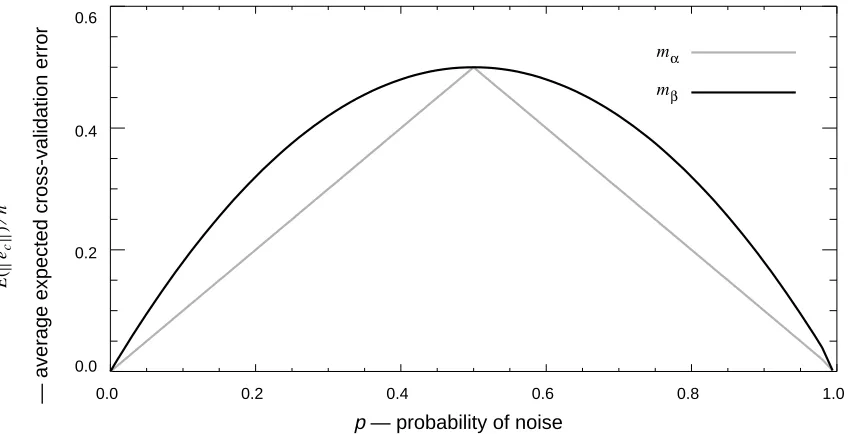
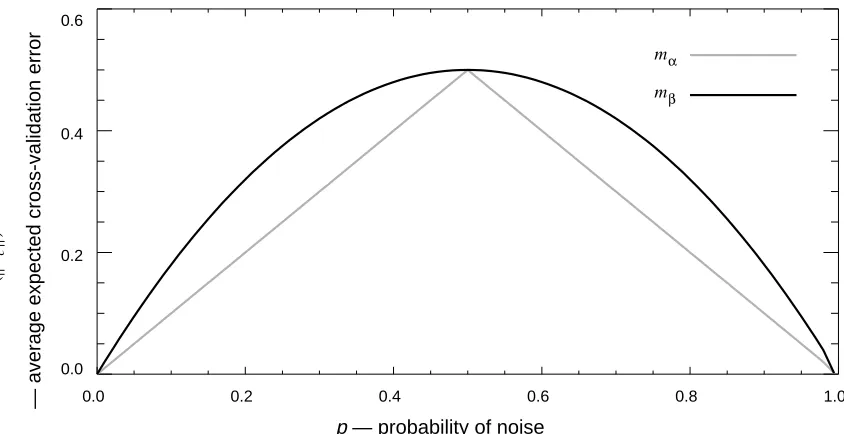
Figure 1 is a plot of as a function of p, for and . has lower expected
cross-validation error than , except at the points 0, 0.5, and 1, where has the same
expected cross-validation error as . When p equals 0 or 1, there is no noise in the black
box, so and have the same expected cross-validation error. When p equals 0.5, the
noise completely hides the deterministic component f, so again and have the same
expected cross-validation error. In general, when p is neither 0, 0.5, nor 1, models that
minimize error on the training set (such as ) will give sub-optimal cross-validation
error.
Figure 1. Plot of as a function of p.
The next theorem shows the relation between and .
pα p if p≤0.5
1−p
( ) if p>0.5 =
pβ E e( c )⁄n mβ
pβ = 2p−2p2
E e( c )⁄n mα mβ mα
mβ mα
mβ
mα mβ
mα mβ
mβ
0.0 0.2 0.4 0.6 0.8 1.0
0.0 0.2 0.4 0.6
mα
mβ
p — probability of noise
Ee
c
()
n
⁄
— average expected cross-validation error
E( ec )⁄n
Theorem 6: For :
(102)
Proof: When , . Therefore we have:
(103)
When , . Therefore we have:
(104)
(105)
(106)
Theorem 6 shows that, for small values of p, is approximately twice the optimal .
At this point, it may be worthwhile to summarize the assumptions that are made in this
theory:
1. It is assumed that the inputs (the features; the attributes; the matrix X) are the same in
the training set and the testing set . This assumption is the weakest
ele-ment in this theory. It is discussed in detail earlier in this section and also in Section 7.
It is also discussed in more depth in Turney (1993). Note that the outputs and are
not the same in the training and testing sets.
2. It is assumed that the inputs are boolean-valued. This assumption is only used in
The-orem 1. The purpose of TheThe-orem 1 is to increase the credibility of the above
assump-tion 1. Theorem 1 can easily be adapted to the case of multi-valued symbolic
attributes. Lemma 1 covers the case of real-valued attributes. Thus there is nothing
essential about the assumption that the inputs are boolean-valued.
3. It is assumed that the noise vector is a sequence of n independent random boolean
variables, each having the value 1 with probability p. That is, is a sequence of
sam-ples from a Bernoulli(p) distribution (Fraser, 1976). This is a very weak assumption,
which is likely to be (approximately) satisfied in most real-world data (given
assump-tion 6 below).
0≤ ≤p 1
pβ = 2pα−2pα2
0≤ ≤p 0.5 pα = p
pβ = 2pα−2pα2
0.5<p≤1 pα = 1−p
2pα−2pα2 = 2 1( −p) −2 1( −p)2
2−2p−2+4p−2p2 =
pβ =
.
pβ pα
X y1
( , ) ( , )X y2
y1 y2
z
4. It is assumed that there is noise in the class attribute (assumption 3 above), but noise in
the input attributes is not addressed (due to assumption 1 above).
5. It is assumed that the data consist of a deterministic component f and a random
compo-nent z. This assumption is expressed in the model . One implication of
this assumption is that the target concept f does not drift with time or shift with
con-text.
6. It is assumed that the output (the class attribute) is boolean-valued. The theory can
easily be extended to handle multi-valued symbolic class attributes. Turney (1993)
discusses real-valued outputs (and real-valued noise vectors).
With the exception of the first assumption, these assumptions are relatively weak.3
This section has presented some general results that apply to any algorithm for
predict-ing boolean-valued attributes. The rest of this paper focuses on a particular class of
algo-rithms: instance-based learning algorithms. This section has presented a general theory and the remainder of the paper will demonstrate that the theory can be fruitfully applied to
a real, concrete machine learning algorithm.
3 Single Nearest Neighbor
Instance-based learning may be used either for predicting boolean-valued attributes (Aha et al., 1991) or for predicting real-valued attributes (Kibler et al., 1989). Instance-based
learning is a paradigm for a class of learning algorithms; it is not a single algorithm. It is
related to the nearest neighbor pattern recognition paradigm (Dasarathy, 1991).
With instance-based learning, the model is constructed by simply storing the
data . These stored data are the instances. In order to make a prediction for the input
, we examine the row vectors of the matrix X. In the simplest version of
instance-based learning, we look for the row vector that is most similar to the input .
The prediction for the output is , the element of that corresponds to the
row vector .
There are many ways that one might choose to measure the similarity between two vectors. It is assumed only that we are using a reasonable measure of similarity. Let us say
that a similarity measure is reasonable if:
y = f v( )⊕z
y
m v X y( , )
X y ( , )
v v1,…,vn
vi v
m v X y( , ) = yi y
vi
(107)
That is, the similarity between distinct vectors is always less than the similarity between
identical vectors.
The k row vectors in X that are most similar to the input are called the k nearest
neighbors of (Dasarathy, 1991). We may use to represent instance-based learning
with k nearest neighbors. This section focuses on .
The next theorem shows that instance-based learning using the single nearest
neighbor gives sub-optimal cross-validation error.
Theorem 7: Let the model use instance-based learning with the single nearest neighbor. That is, if the row vector is the most similar to the input of all the row
vectors of the matrix X, then . If uses a reasonable measure of
similarity and no two rows in X are identical, then .
Proof: Since is based on a reasonable measure of similarity and no two rows in X are
identical, no vector is more similar to than itself, so . Thus it follows
from (21) that
Theorem 7 shows that satisfies the assumptions of Theorem 5. Therefore has the
following properties:
(108)
(109)
In other words, is equivalent to . We know from Section 2 that gives
sub-optimal cross-validation error.
If there are two (or more) identical rows in X, then (109) still holds, but (108) is not
necessarily true. will, in general, no longer be equivalent to . The proof is a small
variation on Theorem 5.
The problem with is that it is unstable. It is natural to consider increasing the
stability of instance-based learning by considering . u1≠u2→sim u( 1,u2)<sim u( 1,u1)
v
v mk
k = 1
m1
m1
vi v
v1,…,vn m1(v X y, ) = yi m1
m1(X X y, ) = y
m1
vi vi m1(vi X y, ) = yi
m X X y( , ) = y .
m1 m1
E e( t ) = 0
E e( c ) = E e( s ) = 2np−2np2
m1 mβ m1
m1 mβ
m1
4 Voting
This section examines . Suppose the model is given the input vector . Let
be the k nearest neighbors to . That is, let be the k row vectors in X
that are most similar to the input vector . Let us assume a reasonable measure of
similar-ity. Let be the outputs corresponding to the rows . The model
predicts the output for the input to be the value of the majority of (Fix &
Hodges, 1951):
(110)
Let us assume that k is an odd number, , so there will never be a tie in
majority voting with . Of course, we require that . In general, .
More generally, let us consider the following model (Tomek, 1976):
(111)
In this model, t is a threshold, such that . With majority voting, . When
, it may be appropriate to consider values of k other than the odd numbers.
The motivation for voting is the belief that it will increase stability; that it will make the model more resistant to noise in the data. The following sections give a formal analysis
of the stability of instance-based learning with voting. They examine the best case, the
worst case, and the average case.
4.1 Best Case
The next theorem concerns the best case, when stability is maximal.
k≥1 mk v
v1, ,… vk v v1, ,… vk
v
y1, ,… yk v1, ,… vk mk
v y1, ,… yk
mk(v X y, )
0 if yi
i=1
k
∑
<k 2⁄1 if yi
i=1
k
∑
>k 2⁄ =k = 3 5 7, , ,…
y1, ,… yk k≤n k«n
mk(v X y, )
0 if yi
i=1
k
∑
<tk1 if yi
i=1
k
∑
>tk =0< <t 1 t = 0.5
t≠0.5
defined as follows:
(112)
That is, is the frequency with which f takes the value 1, in the neighborhood of
. Assume that we are using majority voting, , and that . Suppose
that:
(113)
This is the most stable situation; other values of are less stable. for is
deter-mined by the following formula:
(114)
In this formula, depends on . has the following values for , , , and :
(115)
(116)
(117)
(118)
Proof: Let be the k nearest neighbors to . Let be the
correspond-ing elements in . Let be the corresponding elements in . The stability of
is determined by the probability that:
(119)
If we can find this probability for each row vector in X, then we can find the stability of
. Suppose that is the probability of (119) when the input to is . Then is the
probability that:
(120)
ρi 1
k f v( )j
vj∈Nk( )vi
∑
= i = 1, ,… n
ρi Nk( )vi
vi t = 0.5 k = 3 5 7, , ,…
i ∀
( ) ((ρi= 0) ∨ (ρi = 1))
ρi E e( s ) mk
E e( s ) = 2nPk−2nPk2
Pk mk Pk m1 m3 m5 m∞
P1 = p
P3 = 3p2−2p3
P5 = 6p5−15p4+10p3
P∞
0 if p<0.5 0.5 if p = 0.5 1 if p>0.5 =
v1, ,… vk v y1 1, , ,… y1 k,
y1 y2 1, , ,… y2 k, y2
mk
y1 i,
i=1
k
∑
<k 2⁄ and y2 i,i=1
k
∑
>k 2⁄mk pi mk vi 2pi
Therefore:
(121)
The best case — the case with minimal expected instability — arises when
or . Without loss of generality, we may assume that . In this case,
we have:
(122)
Therefore (119) becomes:
(123)
Let us introduce the term :
(124)
That is, is the probability that the majority of are 1, given that
are all 0. The probability of (119) is:
(125)
If the best case holds for every row vector in X — that is, if (113) is true — then we have:
(126)
Let us consider the case . We have:
(127)
Recall that for we have (109):
(128)
Thus . For , we have:
(129) E e( s ) E m( k(vi X y, 1)⊕mk(vi X y, 2))
i=1
n
∑
2pii=1
n
∑
= =
E e( s )
ρi = 0 ρi = 1 ρi = 0
yi j, = f v( )j ⊕zi j, = 0⊕zi j, = zi j, i = 1 2, j = 1, ,… k
z1 i,
i=1
k
∑
<k 2⁄ and z2 i,i=1
k
∑
>k 2⁄Pk
Pk P z1 i,
i=1
k
∑
>k 2⁄
=
Pk y1 1, , ,… y1 k,
f v( ) …1 , ,f v( )k
Pk(1−Pk)
E e( s ) 2Pk(1−Pk)
i=1
n
∑
2nPk(1−Pk)= =
k = 3
P3 = p3+3p2(1−p) = p3+3p2−3p3 = 3p2−2p3
k = 1
E e( s ) = 2np−2np2
P1 = p k = 5
To find the behavior of the model in the limit, , we can use the Central Limit Theorem
(Fraser, 1976). Consider the following sum:
(130)
The mean and variance of this sum are:
(131)
(132)
Consider the following expression:
(133)
By the Central Limit Theorem, the distribution of (133) approaches a standard normal
dis-tribution as k approaches infinity. Recall the definition of :
(134)
Let be a random variable with a standard normal distribution. As k approaches infinity,
approaches:
(135)
We see that:
(136)
Therefore:
m∞
z1 i,
i=1
k
∑
E z1 i,
i=1
k
∑
= kp
var z1 i,
i=1
k
∑
= kp 1( −p)
z1 i,
i=1
k
∑
−kp kp 1( −p)Pk
Pk P z1 i,
i=1
k
∑
>k 2⁄
=
zα
Pk
P zα (k 2⁄ ) −kp kp 1( −p) >
k 2⁄
( ) −kp
kp 1( −p)
klim→∞
∞ if p<0.5 0 if p= 0.5
∞
(137)
(138)
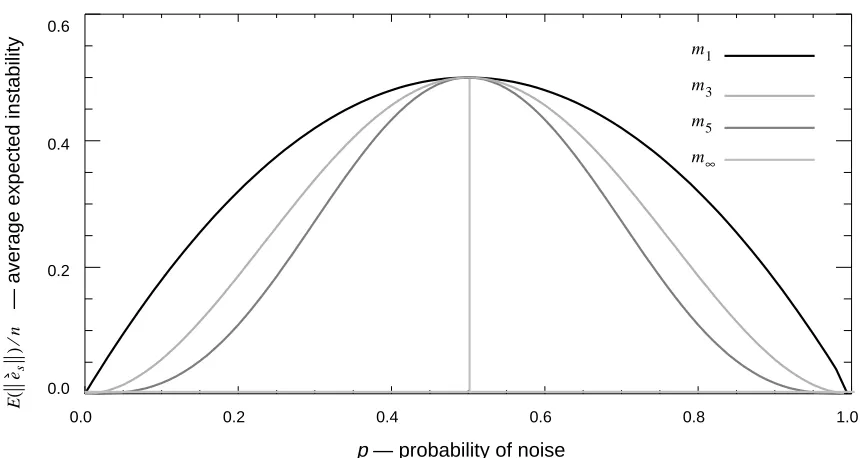
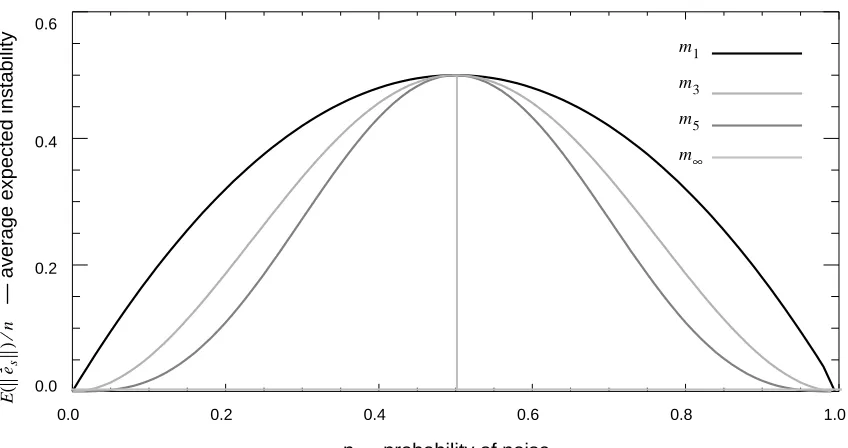
Theorem 8 implies that, in the best case, grows increasingly stable as k increases,
unless . Figure 2 is a plot of as a function of p, for the models , ,
, and .
Figure 2. A plot of as a function of p.
When comparing Figure 1 with Figure 2, note that Figure 1 is a plot of ,
while Figure 2 is a plot of . In general, we cannot plot for ,
because will depend on the data. Theorems 2 and 3 show that depends on
both and . The exception is , where we know that .
P∞
0 if p<0.5 0.5 if p = 0.5 1 if p>0.5 =
E e( s )
n 2P∞(1−P∞)
0 if p≠0.5 0.5 if p =0.5
= =
.
mk
p = 0.5 E e( s )⁄n m1 m3
m5 m∞
0.0 0.2 0.4 0.6 0.8 1.0
0.0 0.2 0.4 0.6
m5
m1
m3
m∞
p — probability of noise
— average expected instability
Ee
s
()
n
⁄
E( es )⁄n
E e( c )⁄n
E e( s )⁄n E e( c )⁄n mk
E e( t ) E e( c )
(Recall that .)
Theorem 8 does not necessarily mean that we should make k as large as possible, even
if we assume that the best case (113) holds. It is assumed that our goal is to minimize the
expected cross-validation error. Theorems 2 and 3 show that the expected cross-validation error has two components, the error on the training set and the instability. In the best case,
increasing k will increase stability, but increasing k is also likely to increase the error on
the training set. We must find the value of k that best balances the conflicting demands of accuracy (low error on the training set) and stability (resistance to noise). This value will,
of course, depend on f and p.
4.2 Worst Case
The next theorem concerns the worst case, when stability is minimal.
Theorem 9: Assume that we are using majority voting, , and that .
Suppose that:
(139)
This is the least stable situation; other values of are more stable. for is
determined by the following formula:
(140)
In this formula, depends on . has the following values for , , , and :
(141)
(142)
(143)
(144)
Proof: Let be the k nearest neighbors to . Let be the
correspond-ing elements in . Let be the corresponding elements in . The stability of
m1 = mβ
t = 0.5 k = 3 5 7, , ,…
i ∀
( ) ρi 1
2 1 2k +
= ρi 1
2 1 2k − = ∨
ρi E e( s ) mk
E e( s ) = 2nPk−2nPk2
Pk mk Pk m1 m3 m5 m∞
P1 = p
P3 = 2p−3p2+2p3
P5 = 3p−9p2+16p3−15p4+6p5
P∞
0 if p = 0
0.5 if 0< <p 1
1 if p = 1
=
v1, ,… vk v y1 1, , ,… y1 k,
is determined by the probability that:
(145)
The worst case — the case with maximal expected instability — arises when:
(146)
Without loss of generality, we may assume that:
(147)
(148)
(149)
We see that:
(150)
(151)
Therefore:
(152)
We may use the term to indicate the probability of (152). That is, is the probability
that the majority of are 1, given (148) and (149). If the worst case holds for
every row vector in X — that is, (139) is true — then we have:
(153)
Let us consider the case . We have:
(154)
For , we have:
(155) mk
y1 i,
i=1
k
∑
<k 2⁄ and y2 i,i=1
k
∑
>k 2⁄E e( s )
f v( )i
i=1
k
∑
k+1 2= or f v( )i
i=1
k
∑
k−1 2 =s k+1
2 =
f v( )1 = … = f v( )s = 1
f v( s+1) = … = f v( )k = 0
yi j, = ¬zi j, i = 1 2, j = 1, ,… s
yi j, = zi j, i = 1 2, j = s+ …1, ,k
P y1 i,
i=1
k
∑
>k 2⁄
P z
1 i,
i=1
s
∑
z1 i,i=s+1
k
∑
≤ =Pk Pk
y1 1, , ,… y1 k,
E e( s ) 2Pk(1−Pk)
i=1
n
∑
2nPk(1−Pk)= =
k = 3
P3 = 2p−3p2+2p3
k = 5
Again, to find the behavior of the model in the limit, we can use the Central Limit
Theorem. Let and be independent random variables with a standard normal
distribu-tion. As k approaches infinity, approaches:
(156)
Therefore:
(157)
(158)
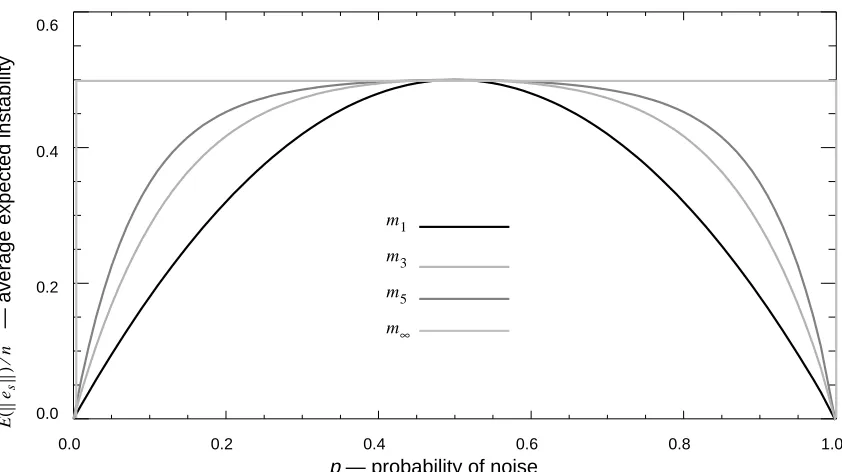
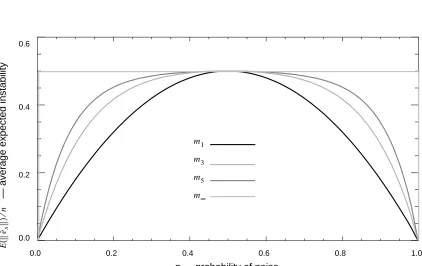
Theorem 9 implies that, in the worst case, grows increasingly unstable as k increases,
unless or . Figure 3 is a plot of as a function of p, for the models
, , , and .
Figure 3. A plot of as a function of p. m∞
zα zβ
Pk
P z( α≤zβ)
P∞
0 if p = 0
0.5 if 0< <p 1
1 if p = 1
=
E e( s )
n 2P∞(1−P∞)
0 if (p =0)or p( =1) 0.5 if 0< <p 1
= =
.
mk
p = 0 p = 1 E e( s )⁄n
m1 m3 m5 m∞
0.0 0.2 0.4 0.6 0.8 1.0
0.0 0.2 0.4 0.6
m5
m1
m3
m∞
p — probability of noise
— average expected instability
Ee
s
()
n
⁄
4.3 Average Case
Sections 4.1 and 4.2 show that voting can be either very beneficial or very detrimental,
depending on the relationship between the function f and the voting threshold t. The
function f determines , the frequency with which f takes the value 1, in the
neighbor-hood of . In the previous sections, we assumed majority voting, . When
is near 0.5, majority voting is detrimental. When is far from 0.5, majority voting is
beneficial. These results generalize to voting with other values of t. When is near t,
voting is detrimental. When is far from t, voting is beneficial.
We would like to know how majority voting performs with an average f. For the
average function f, is dangerously close to 0.5, or is it usually safely far away? This is a
difficult question: What exactly is an average f?
The next theorem uses a simple model of an average f.
Theorem 10: Assume that we are using majority voting, . Let us suppose that we can treat as a random boolean variable, with probability that is 1, and
proba-bility that is 0. In the limit, as k approaches infinity, tends to be stable,
unless either or .
Proof: We see that:
(159)
Recall that:
(160)
Therefore:
(161)
(162)
Thus:
(163) ρi
Nk( )vi vi t = 0.5
ρi ρi
ρi ρi
ρi
t = 0.5
f v( )i p' f v( )i
1−p' f v( )i mk
p = 0.5 p' = 0.5
E f v( )i
i=1
k
∑
= kp'
yi j, = f v( )j ⊕zi j, i = 1 2, j = 1, ,… k
P y( i j, = 0) = (1−p') (1−p) +p'p
P y( i j, = 1) = p 1( −p') +p' 1( −p)
E y1 i,
i=1
k
∑
(164)
Consider:
(165)
By the Central Limit Theorem, as k approaches infinity, (165) approaches a standard
normal distribution. As before, we define as the probability:
(166)
Let be a random variable with a standard normal distribution. As k approaches infinity,
approaches:
(167)
We see that:
(168)
Therefore:
(169)
(170)
Thus tends to be stable, unless:
(171) var y1 i,
i=1
k
∑
= k p 1[ ( −p') +p' 1( −p)] [(1−p') (1−p) +p'p] = σ2
y1 i,
i=1
k
∑
−µ σPk
P y1 i,
i=1
k
∑
>k 2⁄
zα
Pk
P z( α> ((k 2⁄ ) µ− ) σ⁄ )
k 2⁄
( ) µ−
( ) σ⁄
( )
klim→∞
∞ if [p 1( −p') +p' 1( −p)] <0.5 0 if [p 1( −p') +p' 1( −p)] = 0.5
∞
− if [p 1( −p') +p' 1( −p)] >0.5 =
P∞
0 if [p 1( −p') +p' 1( −p)] <0.5 0.5 if [p 1( −p') +p' 1( −p)] = 0.5 1 if [p 1( −p') +p' 1( −p)] >0.5 =
E e( s )
n 2P∞(1−P∞)
0 if [p 1( −p') +p' 1( −p)] ≠0.5 0.5 if [p 1( −p') +p' 1( −p)] = 0.5
= =
mk
Some algebraic manipulation converts (171) to:
(172)
Therefore tends to be stable, unless either or
Let us now consider the general case (111), when the threshold for voting t is not nec-essarily equal to 0.5.
Theorem 11: Let t be any value, such that . Let us suppose that we can treat as a random boolean variable, with probability that is 1, and probability that
is 0. Let us introduce the term :
(173)
In the limit, as k approaches infinity, tends to be stable, unless .
Proof: This is a straightforward extension of the reasoning in Theorem 10
Presumably p (the probability that z is 1) and (the probability that f is 1) are not under
the control of the modeler. However, t can be adjusted by the modeler. If the modeler can
estimate p and , then can be estimated. Theorem 11 implies that the modeler should
make sure that t is relatively far from .
The assumption that we can treat as a random boolean variable is somewhat
unre-alistic. Let us consider a more sophisticated analysis.
Theorem 12: Let us define as follows:
(174)
In the limit, as k approaches infinity, tends to be stable for , unless t is close to .
Proof: This is a straightforward extension of the reasoning in Theorem 10
Let us define as the average of the :
(175)
Note that:
2p−1
( ) (1−2p') = 0
mk p = 0.5 p' = 0.5 .
0< <t 1 f v( )i
p' f v( )i 1−p'
f v( )i τ
τ = p 1( −p') +p' 1( −p) = p+p'−2pp'
mk t = τ
.
p'
p' τ
τ
f v( )i
τi
τi = p+ρi−2pρi i = 1, ,… n
mk vi τi
.
p' ρi
p' 1
n ρi
i=1
n
∑
(176)
We can use (173) and (175) to calculate . Theorem 12 implies that it is possible for to
be stable even when , if t is far from each .
Theorem 13: We can estimate from the data as follows:
(177)
is an unbiased estimator for .
Proof: We have:
(178)
(179)
(180)
(181)
Using (177), we can estimate for any k and any i. is the frequency of the output 1, in
the neighborhood of .
Theorem 14: If we know the value of p, then we can also estimate from the data :
(182)
is an unbiased estimator for .
Proof: We have:
p' 1
n f v( )i
i=1
n
∑
≠
τ mk
t = τ τi
τi ( , )X y1
ti 1
k y1 j,
vj∈Nk( )vi
∑
= i = 1, ,… n
ti τi
E t( )i 1
k E y( 1 j, )
vj∈Nk( )vi
∑
=
1
k E f v(( )j ⊕z1 j, )
vj∈Nk( )vi
∑
=
p+ρi−2pρi =
τi =
.
τi ti
Nk( )vi vi
ρi
X y1 ( , )
ri ti−p 1−2p =
ri ρ
(183)
(184)
(185)
(186)
Using (177) and (182), we can estimate for any k and any i. Once we have an estimate
of , we can establish whether we are closer to the best case (Section 4.1) or the worst
case (Section 4.2).
We now have some understanding of the average behavior of in the limit. Let us
consider the average behavior of for and .
Theorem 15: Suppose that n is even. Let and . Suppose that:
(187)
(188)
Then:
(189)
Proof: We know from Section 4.2 that is unstable when:
(190)
We know from Section 4.1 that is stable when:
(191)
For the unstable case, , we have (154):
(192)
For the stable case, , we have (127):
(193)
Therefore (126):
E r( )i E t( )i −p 1−2p =
τi−p
( ) ⁄ (1−2p) =
p+ρi−2pρi−p
( ) ⁄ (1−2p)
=
ρi =
.
ρi ρi
mk
mk k = 3 t = 0.5
k = 3 t = 0.5
ρi = 1 3⁄ or ρi = 2 3⁄ i = 1, ,… n 2⁄ ρi = 0 3⁄ or ρi = 3 3⁄ i = n 2⁄ + …1, ,n
E e( s ) = n 2p( −4p2+12p3−26p4+24p5−8p6)
m3
ρi = 1 3⁄ or ρi = 2 3⁄ i = 1, ,… n
m3
ρi = 0 3⁄ or ρi = 3 3⁄ i = 1, ,… n
i = 1, ,… n 2⁄
Pu 3, = 2p−3p2+2p3
i = n 2⁄ + …1, ,n