Preservation of vitamin C and phenolic compounds from Umbu(spondias tuberosa arr. Cam.) via spray drying
Thays Muniz1, Hanndson Araujo2, Eudeson Gustavo Paiva1, Iara Bezerra de Oliveira3, Maria
Elita Duarte Martins1, Mario Cavalcanti-Mata3, Hugo M. Lisboa*1, Matheus A. B. Pasquali1
Programa Pós Graduação Engenharia Alimentos, Universidade Federal de Campina
Grande, Av. Aprigio Veloso, 882, 58429-900 Campina Grande, Paraiba, Brasil
Programa Pós Graduação Engenharia de Processos, Universidade Federal de
Campina Grande, Av. Aprigio Veloso, 882, 58429-900 Campina Grande, Paraiba,
Brasil
Programa Pós Graduação Recursos Naturais, Universidade Federal de Campina
Grande, Av. Aprigio Veloso, 882, 58429-900 Campina Grande, Paraiba, Brasil
*Corresponding Author: [email protected]
Abstract
Umbu is a tropical fruit with high content of bioactive compounds. However, maturation causes
significant losses on nutrient density reducing the nutritional value of this highly appreciated
fruit. Thus, the objective of the present work was to encapsulate the Umbu fruit bioactive
compounds using spray drying and identify the variables affecting the biomolecules
preservation. A Box-Behnken experimental design with 3 factors was set varying inlet
temperature, atomization flow rate, and maltodextrin concentration for process otimization.
Then the powder physicochemical and chemical properties were characterized, and results
were modeled using a polynomial equation. Results revealed that the droplet size and
maltodextrin concentration had a significant influence on the conservation of the biomolecules.
Drying kinetics favoring fast formation of a particle crust increases encapsulation efficiency.
Bioactive compounds retention was achieved by increasing maltodextrin even at high
temperatures, where a matrix is formed hindering chemical degradation. Process optimization
was validated and revealed low inlet temperatures (122ºC), high atomization flow rate (5kg/h)
and high maltodextrin concentration (20%) to be the most desirable conditions for bioactive
2
Keywords: Spray Drying; Umbu; Preservation; Modeling; Optimization
1. Introduction
Recently there has been an increase in interest in bioactive compounds and their
presence on human diet, mostly because these compounds help in maintaining the cellular
metabolic homeostasis on different tissues[1]. The functionality and preservation of these
compounds on foods have influenced the individual choice for healthyl eating. Additionally,
properties such as antioxidants, anti-inflammatory, and hypoglycemic present in foods that
contain bioactive compounds contribute to preventive health care [2].
Fruits are a food category that is rich in bioactive compounds, principally compounds
with antioxidant activity such as polyphenols and vitamins C, along with carotenoids and
flavonoids with less extent. Exotic tropical and subtropical fruits respectively present high
content bioactive compounds as well[3]. One of those tropical fruits is Umbu (Spondias tuberosa Arr. Cam.) which is a typical fruit from the north and northeast Brazil[4]. However, it still is underexploited and has low consumption because of high perishability, which presents
a significant challenge that hinders its full potential.
Umbu is highly appreciated mostly because of refreshing and acidic flavors[5]. After
harvest, and under ambient temperatures the fruit is conserved for three days, while under
refrigeration at 5 ºC lasts 15 days. Nutritional values of Umbu fruit derives from a combination
of sugars, phenolic compounds, carotenoids, and vitamin C[6]. Therefore, depending of
maturation period the concentration of these bioactive compounds can range from 10-40
mg/100g for vitamin C, 10-90 mg/ 100g for phenolic compounds, 1.5-10g/g of carotenoids and
7- 40 mg/100g of flavonoids[6,7].
Market expansion and increasing interest in tropical fruits represent an opportunity for
the small farmers business to explore tropical fruit economically [8]. However, fruits like Umbu
terms, an excellent alternative to improve consumption and distribution of fruit such as Umbu
is the use of industrial drying methods, as the spray-drying process that is known principally
due to the efficiency [9]. The advantages of the dried powder over the conventional fruit are the
lower storage costs, lower transportation cost, higher concentration and the increased stability
of active substances[10].
Spray drying is already widely used for fruit preservation and production of fruit powders
from juices[11]. In this process, a product stream is atomized inside a drying chamber where
it meets a passing drying gas at high temperatures that convert the product droplets into
powder[12]. Typically, the produced powders present low residual moisture and water activity
both consider critical for preservation and storage[13]. Because of the high amount of low
molecular weight molecules such as sugars, it is often required the use of encapsulation
additives to ensure higher yields and lower powder hygroscopic. Also noteworthy is the use of
polysaccharides additives to create an encapsulation matrix to increase bioactive compounds
retention. Encapsulation additives like maltodextrin have already proven to be beneficial for
higher retention of bioactive compounds within the powder by forming a protective matrix or
crust around the droplet [11,14].
Over the recent years many studies have focused on spray drying process of common
fruit juice such as oranges[15], apples[16], and fruit berries[17]. Reports on spray drying of
exotic tropical fruits juice comprisejussara pulp[18], soursop[19], cashew apple[20],
cupuassu[21]. However, no work has been studied on umbu (Spondias tuberosa Arr. Cam.) spray drying.
Careful selection of spray drying conditions is crucial to obtain high quality products.
Therefore the objective of the present work was to spray drying umbu fruit pulp with
maltodextrin and assess the influence of the spray drying conditions on the physicochemical,
functional and chemical properties of the umbu powder. Additionally, optimization using
response surface methodology was used to determine which were the best spray drying
parameters to increase bioactive compounds content.
2. Materials and Methods
4
The Umbu (Spondias tuberosa Arr. Cam.) was purchased between January and March 2018 from a local market on Campina Grande – Paraiba - Brazil, at a stage of green maturation,
which is suitable for pulp preparation. The fruits were hand-picked and visually selected using
as standard a similar size, shape, color, and degree of maturation. Maltodextrin DE10
(ingredion, food grade) was used as encapsulation agent. Chemicals used to assay the
composition of the blends and powders were purchased from Sigma-Aldrich Chemical Co. (St.
Louis, MO, USA).
2.2 Umbu pulp preparation
The Umbus were washed in running water to remove the coarse soils, then sanitized
with sodium hypochlorite solution at a concentration of 20 ppm, and then rinsed. Umbu pulp
was cooked for 5 min to increase pulp extraction and then homogenized at 500 rpm for 10 min.
The resultant pulp was finally sieved using a 1 mm mesh. Maltodextrin was also added
accordingly to the design of experiments.
2.3 Spray Drying Process
Spray drying was performed using a LABMAQ model SD-10, with a 2.0 mm two-fluid
nozzle and cyclone for powder collection on open loop. Atmospheric air with 0.014 g H2O / g
air was withdrawn without any treatment and blown at a constant drying gas flow rate of 500
kg/h. Umbu pulp, with 13%wt solids content, was pumped at a constant feed flow rate of 4
kg/h. Drying experiments followed a 33 Box-Behnken design of experiments with a random
sequence. The selected factors were the inlet temperature, atomization flow rate, and
maltodextrin concentration. All factors had three levels, where, inlet temperature varied
between 110, 140 and 170 ºC, the atomization flow rate varied between 2, 3, and 4 kg/h, and
maltodextrin concentration varied between 5%wt, 10%wt and 15 %.
2.4 Analytical Methods
2.4.1 Process yield and moisture content
Process yield was determined by the ratio between the amount of powder collected
𝑃𝑟𝑜𝑐𝑒𝑠𝑠 𝑌𝑖𝑒𝑙𝑑 (%) =𝑃𝑜𝑤𝑑𝑒𝑟 𝐶𝑜𝑙𝑙𝑒𝑐𝑡𝑒𝑑 𝑖𝑛 𝐶𝑦𝑐𝑙𝑜𝑛𝑒
𝑇𝑜𝑡𝑎𝑙 𝑆𝑜𝑙𝑖𝑑𝑠 ∙𝑆𝑎𝑚𝑝𝑙𝑒 𝑣𝑜𝑙𝑢𝑚𝑒∙ 100 (Eq.1)
Solids content and powder moisture content were determined using gravimetric
methodology according to the Association of Official Analytical Chemists [22].
2.4.2 Color
Sample color was determined using a MiniScan XE Plus colorimeter with the function
COLOR PLOT D65/10º. Browning index was determined by equation 2 [23] .
𝐵𝑟𝑜𝑤𝑛𝑖𝑛𝑔 𝐼𝑛𝑑𝑒𝑥 =100(𝑥−0.31)
0.172 (Eq.2)
Where x, is
𝑥 = (𝑎∗+1.75𝐿)
(5.645𝐿+𝑎∗−3.012𝑏∗ (Eq.3)
2.4.3 Particle Size Distribution and Particle Morphology
Scanning electron microscopy(SEM) was used to evaluate both particle size
distribution and particle morphology. A TESCAN VEGA 3, operated at 5kV was used without
samples coating. SEM images were analyzed using ImageJ to determine the particle size
distribution. Bulk density was determined by pouring 30 samples into an empty 100 mL
graduated measurement cylinder. The volume was registered, and the ratio of mass with
occupied volume cylinder gives the bulk density. Tap density was determined similarly, but the
powder samples where tapped 100 times until the new volume was registered.
2.4.5 Chemical composition
The total phenolic content was determined using an adapted Folin-Ciocoateu method
6
equivalent / g of samples. Vitamin C content was determined using the method proposed by
Freebairn [25] where results are expressed as ascorbic acid equivalents.
2.5 Process modeling
Results were modeled by non-linear regression using a second order polynomial
equation. All models were assessed using ANOVA for lack of fit.
𝑦 = 𝛽0+ 𝛽1∙ 𝑇𝑖 + 𝛽2∙ 𝑇𝑖2+ 𝛽3∙ 𝐹𝑎+ 𝛽4∙ 𝐹𝑎2+ 𝛽5∙ 𝐶𝑚+ 𝛽6∙ 𝐶𝑚2 + 𝛽7∙ 𝑇𝑖 ∙ 𝐹𝑎+ 𝛽8∙ 𝑇𝑖 ∙ 𝐶𝑚+ 𝛽9∙
𝐹𝑎∙ 𝐶𝑚 (Eq.4)
Where, Ti is the inlet temperature, Fa the atomization flow rate and Cm the maltodextrin
concentration.
3. Results and Discussion
A Box-Behnken design of experiments was used to establish and optimize
microencapsulation of umbu fruit bioactive compounds using spray drying. The rationale for
choosing this type of design is related with its proven efficiency when compared to other
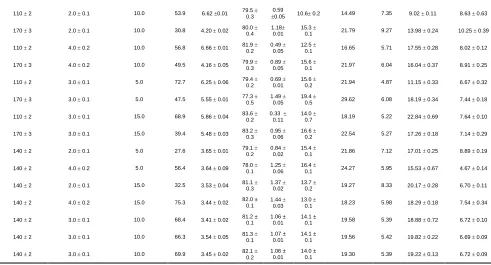
experimental designs[26]. Table 1 presents the results of the powder characterization.
(insert table 1)
Results were modeled using a second-order polynomial equation to understand the
influence of each process parameter and the combination of parameters on powder properties.
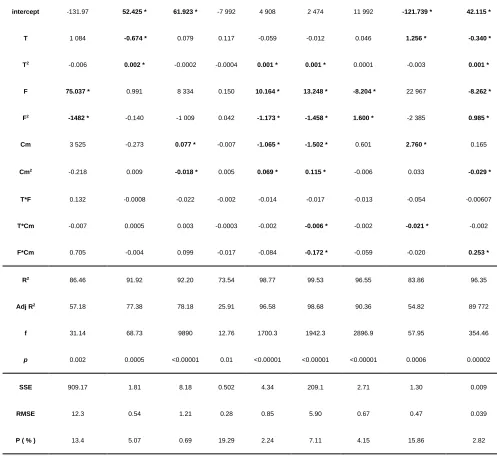
The results of the fitting are presented in table 2.
(insert Table 2)
3.1 Process Yield
Process yield is calculated by the ratio of the mass of powder collected with the mass
of total solids fed into the spray. Yield is an crucial process response because it indicates the
process performance. Process yield varied between from 27.63 % to 75.33 % depending on
process conditions. The results are satisfactory for a process in developing and in a range that
corroborates with other fruit dehydration processes. Low process yield reflects the powder
accumulation inside the drying chamber. Considering the results presented in table 2, process
Both parameters influence the droplet size because increasing atomization flow rate produces
smaller droplets then lower atomization flow rate. Authors have related that powder
accumulation can occur due to the deposit of wet droplets, which are not sufficiently dry when
hit the wall, or because of the material properties at drying temperatures . The size of the
droplet influences yields suggesting that larger droplets hit the walls still wet and stick, while
smaller droplets do not. Thus, when higher atomization flow rates are used, droplets have
higher velocity forming a smaller angle and thus hit the wall at a lower region with less moisture.
Similar results were obtained by [27] when spray drying black mulberry juice and [28] when
drying xylooligosaccharides.
𝑦𝑖𝑒𝑙𝑑(%) = 75.04 ∗ 𝐹𝑎− 1482 ∗ 𝐹𝑎2
(eq.5)
3.2 Residual moisture
Residual moisture has a direct influence on water activity and thus on powder chemical
and microbiological stability. The residual moisture varies between 6.62 % to 3.41 % depending
on process inlet temperature. These results corroborate with the range observed in other works
with fruit juices [29]. After fitting the polynomial equation, our results revealed that linear inlet
temperature and quadratic inlet temperature have a significant effect on residual moisture (p < 0.05). Quadratic coefficients reveal a peak within the range of temperatures used. A minimum
moisture content is obtained for 140 ºC while for 110 ºC, and 170 ºC results reveal higher values.
Higher moisture contents at 110 ºC inlet temperature are due to higher relative humidity on
drying gas resulting in a lower mass transfer from the droplet into the drying medium. As for
170 ºC, a possible justification may be the fast formation of a crust on the droplet surface that
hinders water diffusion, and thus the powder retains more water. This factor mostly occurs
when maltodextrin concentration is also high because both parameters favor the formation of
a thicker wall .
𝑅𝑒𝑠𝑖𝑑𝑢𝑎𝑙 𝑀𝑜𝑖𝑠𝑡𝑢𝑟𝑒 (%) = 52.43 − 0.67 ∗ 𝑇𝑖+ 0.002 ∗ 𝑇𝑖2
(eq.6)
8
Color is an important factor for acceptability because it rules visual attractiveness[30]. After
initial processing, umbu fruit pulp was light greenish with a* =1.85, b* = 22.49 and L = 52.15.
Similar values were reported by [31] After processing, powder samples revealed a* values
varying from 0.59 to 1.44, b* values from 10.57 to 19.36 and L values varying from 79.46 to
82.22. From modeling, linear and quadratic maltodextrin concentration had a significant
influence on L values. For b* values, quadratic temperature, linear and quadratic atomization
flow rate and linear and quadratic maltodextrin concentration had a significant influence on
response. For a* values, no independent variable had significant influence. An increase in L is
expected with higher maltodextrin concentration because maltodextrin is white and because of
Umbu concentration decreases. Similar results were found for purple sweet potato[32]. b*
values on powder samples are smaller than the unprocessed pulp reflecting a loss on
yellowness due to processing. However, high inlet temperature(170 ºC) do not reduce powder
yellowness as much as it occurs at lower temperatures(110 ºC). Temperature influences b*
values possibly due to chemical degradation reactions that turn food brown. Browning index
reveals the purity of color brown and is considered an important parameter in processes where
enzymatic or non-enzymatic browning reactions might occur. Model analyses returned that
almost every parameter was significant on the browning index. Higher inlet temperature
reveals higher browning index possibly because of higher browning reaction kinetics. Green
pigments (chlorophyll) are thermally unstable and form a brown pheophytin due to loss of Mg
under acidic conditions. However, when maltodextrin concentration is also high, less browning
is verified. A possible justification can be the protection from temperature and oxygen offered
by the maltodextrin crust at the droplet surface[33]. When atomization flow rate is assessed,
smaller particles become less brown at higher temperatures, while at lower temperatures the
browning index is similar for any atomization flow rate. This increase in browning index can be
a result from higher moisture content or water activity on larger droplets that increases browning
reactions kinetics.
𝐿 = 61.92 + 0.08 ∗ 𝐶𝑚 − 0.02 ∗ 𝐶𝑚2
(eq.7)
𝑏 = 0.001 ∗ 𝑇𝑖2+ 10.16 ∗ 𝐹𝑎− 1.17 ∗ 𝐹𝑎2− 1.07 ∗ 𝐶𝑚 + 0.07 ∗ 𝐶𝑚2
𝐵𝑟𝑜𝑤𝑛𝑖𝑛𝑔 𝐼𝑛𝑑𝑒𝑥 = 0.001 ∗ 𝑇𝑖2+ 13.25 ∗ 𝐹𝑎− 1.46 ∗ 𝐹𝑎2− 1.5 ∗ 𝐶𝑚 + 0.12 ∗ 𝐶𝑚2− 0.01 ∗ 𝑇 ∗
𝐶𝑚 − 0.17 ∗ 𝐹𝑎∗ 𝐶𝑚 (eq.9)
3.4 Particle size and morphology
Properties like reconstitution, handling or chemical stability can be influenced by smaller
particles sizes[34]. The diameter of one hundred particles was determined directly from SEM
micrographs of each sample and repeated three times. Particle size varied from 5.2 µm to 9.3
µm mostly influenced by atomization flow rate as expected. The range of particle size is similar
to other works using a two-fluid nozzle which results in smaller particles then hydraulic
nozzles[35]. The atomization flow rate parameter was initially chosen to influence droplet size
during drying. Thus, linear and quadratic coefficients have a significant influence on particle
diameter as expected. Droplet formation results from an energy balance between atomization
gas kinetic energy and the cohesive liquid energy like viscosity. Therefore, if liquid viscosity is
the same, then higher atomization flow rate creates smaller droplets. Inlet temperature has
some influence on particle size distribution due to the ballooning effect. From our results
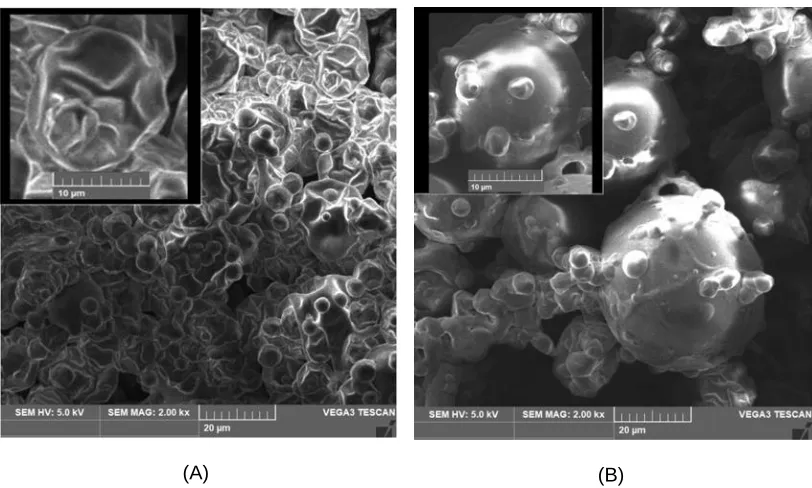
maltodextrin concentration has no evident influence on particle size. Analyzing figure 1 some
degree of agglomeration is verified especially at lower temperatures. The agglomeration at
lower temperatures can be related to higher moisture content which leads to particle bridging
due to hydrogen bonds between water hydroxyl groups[36]. No cracks or fissures were
detected at particles surface suggesting that water diffusion was never catastrophic to the
particle surface.
𝐷𝑁50(𝜇𝑚) = −8.2 ∗ 𝐹𝑎+ 1.6 ∗ 𝐹𝑎2 (eq. 10)
3.6 Vitamin C content
Bioactive compounds preservation during a thermal process is a critical factor when assessing
the impact of process parameters. Vitamin C is one of the most important nutrients present on
umbu fruit pulp and one of the most important on human diet because humans are unable to
synthesize Vitamin C. Values ranging between 10-40 mg of vitamin C per 100 g of pulp are
10
the powder presented vitamin C content ranging from 9.0 to 22.8 mg/ 100g meaning that
retention ranged from 36% to a maximum of 90%. Modeling revealed the linear inlet
temperature and maltodextrin concentration and the linear interaction between the inlet
temperature and maltodextrin concentration to influence vitamin c content significantly. Three
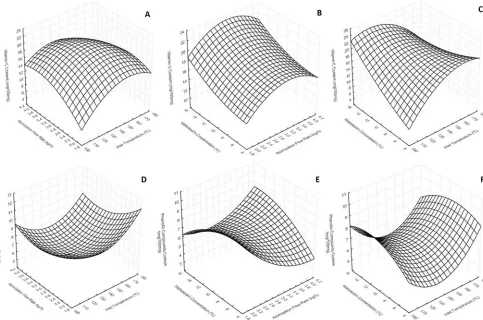
response surfaces were generated from the fitted polynomial equation and are presented on
figures 2a-c. The negative influence of temperature can be attributed to increased degradation
kinetics that results in vitamin C loss. Similar results were found for mandarin (Citrus unshiu)[37] Influence of maltodextrin can be attributed to its higher molecular weight and hydrogen bonding
interactions that reduces vitamin C diffusion into the droplet surface thus reducing the exposure
to air and temperature[38]. Then, the interaction between temperature and maltodextrin can be
attributed to the formation of a crust on the droplet surface that is favored by high drying
temperatures and maltodextrin concentration. This barrier becomes impermeable to labile
molecules thus increasing its retention. Therefore, according to our results, it can be expected
higher retention when maltodextrin concentration is high. Considering the atomization flow rate,
it was found that droplet size has a low impact on vitamin C retention.
𝑉𝑖𝑡𝑎𝑚𝑖𝑛 𝐶 𝑐𝑜𝑛𝑡𝑒𝑛𝑡 (𝑚𝑔/100𝑚𝑔) = −121.74 + 1.26 ∗ 𝑇 + 2.76 ∗ 𝐶𝑚
(eq.12)
3.8 Phenolic compounds content
Phenolic compounds are another category of bioactive compounds important on food
quality and human diet thus maintaining high content levels is critical for product quality. Umbu
pulp typically presents values ranging from 10-90 mg/100g while in our work value of 48
mg/100g was found for the unprocessed pulp. A higher decrease of phenolic compounds was
found, with values ranging from 4.66 to 10.25 mg/ 100g. Analyzing the regression coefficients
almost every factor was significant (p < 0.05) for phenolic compounds content. The relation between factors influencing phenolic compounds content is depicted at figures 2d-f. Similarly
to vitamin C, higher inlet temperatures cause chemical degradation of phenolic compounds.
[39] using microwave-assisted extraction found that temperatures above 150 ºC cause a
significant loss on most phenolic compounds, while at temperatures ranging 100° to 125 ºC the
because of increased surface area contacting heated drying air [40]. However, an interaction
between atomization flow rate and maltodextrin concentration was also determined by
regression meaning that larger droplets do not require as much maltodextrin as a smaller
droplet to maintain high contents of phenolic compounds. This result suggests molecular
diffusion can be a very relevant factor on maintaining high phenolic compounds content. Higher
phenolic contents also suggests that intermolecular interactions with maltodextrin can be
beneficial on stabilizing phenolic compounds by encapsulation as propose by [14].
𝑃ℎ𝑒𝑛𝑜𝑙𝑖𝑐 𝐶𝑜𝑛𝑡𝑒𝑛𝑡 (𝑚𝑔/100𝑚𝑔) = 42.12 − 0.34 ∗ 𝑇𝑖 + 0.001 ∗ 𝑇2− 8.26 ∗ 𝐹
𝑎+ 0.99 ∗ 𝐹𝑎2−
0.03 ∗ 𝐶𝑚2 (eq.13)
3.9 Process optimization
On our work, the desirability approach was used for three optimizations each focusing
three different goals. First, process yield was maximized, then a second run was performed
where powder properties were maximized, and finally, on a third run, the bioactive compounds
retention were maximized. The results for all objectives are presented in table 3. All goals
reached desirability’s above 0.9. Analyzing results, it is clear that mid inlet temperatures favor
all objectives, while the atomization flow rate has different behaviors depending on the
maximization goal. Maltodextrin concentrations above 10% also maximize all goals. The results
obtained after process optimization reflect the analyses provided on process assessment.
Validation experiments were preformed to confirm the optimization results and are summarized
in table 3. Results from validation experiments are similar to the obtained values when using
the optimization function for each of the objectives. Therefore, the optimization can be trusted.
4. Conclusions
Umbu fruit pulp was successfully spray dried in the presence of maltodextrin to maintain
high bioactive compounds content by encapsulation. By analyzing the influence of the process
parameters through mathematical modeling, it was possible to identify the most influencing
factors for powder physicochemical, sensory, and functional properties. Results also indicate
that maltodextrin creates a matrix of molecular interactions that hinder chemical degradation of
12
revealed that mid inlet temperatures (122 ºC) along with high atomization flow rate (5 kg/h) and
high maltodextrin concentration (20 %) provide the highest bioactive compounds retention
possible.
Conflict of interest
The authors have no conflict of interest to declare.
Acknowledgements
The authors acknowledge CAPES and CNPq for grants funding. Hugo Lisboa acknowledges
CNPq for grant 311341/2017-9
5. References
1.
Szabo, K.; Cătoi, A.
-F.; Vodnar, D.C. Bioactive compounds extracted from
tomato processing by-products as a source of valuable nutrients.
Plant foods
for human nutrition
2018
,
73
, 268-277.
2.
Rangel-Huerta, O.D.; Pastor-Villaescusa, B.; Aguilera, C.M.; Gil, A. A
systematic review of the efficacy of bioactive compounds in cardiovascular
disease: phenolic compounds.
Nutrients
2015
,
7
, 5177-5216.
3.
Stafussa, A.P.; Maciel, G.M.; Rampazzo, V.; Bona, E.; Makara, C.N.; Junior,
B.D.; Haminiuk, C.W.I. Bioactive compounds of 44 traditional and exotic
Brazilian fruit pulps: phenolic compounds and antioxidant activity.
International Journal of Food Properties
2018
,
21
, 106-118.
4.
Rodrigues, S.; de Oliveira Silva, E.; de Brito, E.S.
Exotic Fruits Reference Guide
;
Academic Press: 2018.
5.
de Sousa Galvão, M.; Narain, N.; dos Santos, M.d.S.P.; Nunes, M.L. Volatile
compounds and descriptive odor attributes in umbu (Spondias tuberosa)
fruits during maturation.
Food Research International
2011
,
44
, 1919-1926.
6.
Narain, N.; Bora, P.S.; Holschuh, H.J.; Vasconcelos, M.A.d.S. Variation in
physical and chemical composition during maturation of umbu (Spondias
tuberosa) fruits.
Food Chemistry
1992
,
44
, 255-259.
7.
Maria do Socorro, M.R.; Alves, R.E.; de Brito, E.S.; Pérez-Jiménez, J.;
Saura-Calixto, F.; Mancini-Filho, J. Bioactive compounds and antioxidant capacities
of 18 non-traditional tropical fruits from Brazil.
Food chemistry
2010
,
121
,
996-1002.
8.
Genovese, M.; Da Silva Pinto, M.; De Souza Schmidt Gonçalves, A.; Lajolo, F.
Bioactive compounds and antioxidant capacity of exotic fruits and
commercial frozen pulps from Brazil.
Food Science and Technology
9.
Zhang, M.; Chen, H.; Mujumdar, A.S.; Tang, J.; Miao, S.; Wang, Y. Recent
developments in high-quality drying of vegetables, fruits, and aquatic
products.
Critical reviews in food science and nutrition
2017
,
57
, 1239-1255.
10.
Nascimento, A.; Cavalcanti‐Mata
, M.E.; Martins Duarte, M.E.; Pasquali, M.;
Lisboa, H.M. Construction of a design space for goat milk powder production
using moisture sorption isotherms.
Journal of Food Process Engineering
2019
,
10.1111/jfpe.13228, e13228, doi:10.1111/jfpe.13228.
11.
Dantas, D.; Pasquali, M.A.; Cavalcanti-Mata, M.; Duarte, M.E.; Lisboa, H.M.
Influence of Spray Drying Conditions on the Properties of Avocado Powder
Drink.
Food Chemistry
2018
,
266
, 284-291,
doi:10.1016/j.foodchem.2018.06.016.
12.
Lisboa, H.M.; Duarte, M.E.; Cavalcanti-Mata, M.E. Modeling of food drying
processes in industrial spray dryers.
Food and Bioproducts Processing
2018
,
107
, 49-60, doi:
https://doi.org/10.1016/j.fbp.2017.09.006
.
13.
Shishir, M.R.I.; Chen, W. Trends of spray drying: A critical review on drying of
fruit and vegetable juices.
Trends in Food Science & Technology
2017
.
14.
Sun-Waterhouse, D.; Wadhwa, S.S.; Waterhouse, G.I. Spray-drying
microencapsulation of polyphenol bioactives: a comparative study using
different natural fibre polymers as encapsulants.
Food and Bioprocess
Technology
2013
,
6
, 2376-2388.
15.
Goula, A.M.; Adamopoulos, K.G. A new technique for spray drying orange
juice concentrate.
Innovative Food Science & Emerging Technologies
2010
,
11
, 342-351.
16.
Sarabandi, K.; Peighambardoust, S.; Mahoonak, A.S.; Samaei, S. Effect of
different carriers on microstructure and physical characteristics of spray dried
apple juice concentrate.
Journal of food science and technology
2018
,
55
,
3098-3109.
17.
Darniadi, S.; Ho, P.; Murray, B.S. Comparison of blueberry powder produced
via foam‐mat freeze‐drying versus spray‐drying: evaluation of foam and
powder properties.
Journal of the Science of Food and Agriculture
2018
,
98
,
2002-2010.
18.
Santana, A.A.; Cano-Higuita, D.M.; de Oliveira, R.A.; Telis, V.R.N. Influence of
different combinations of wall materials on the microencapsulation of jussara
pulp (Euterpe edulis) by spray drying.
Food chemistry
2016
,
212
, 1-9.
19.
Neta, M.T.S.L.; de Jesus, M.S.; da Silva, J.L.A.; Araujo, H.C.S.; Sandes, R.D.D.;
Shanmugam, S.; Narain, N. Effect of spray drying on bioactive and volatile
compounds in soursop (Annona muricata) fruit pulp.
Food Research
International
2018
.
20.
Pereira, A.L.F.; Almeida, F.D.L.; Lima, M.A.; da Costa, J.M.C.; Rodrigues, S.
Spray-drying of probiotic cashew apple juice.
Food and bioprocess technology
2014
,
7
, 2492-2499.
21.
da Costa, R.S.; Teixeira, C.B.; Gabbay Alves, T.V.; Ribeiro-Costa, R.M.; Casazza,
A.A.; Aliakbarian, B.; Converti, A.; Silva Júnior, J.O.; Perego, P. Optimization of
spray drying conditions to microencapsulate cupuassu (Theobroma
grandiflorum) seed by-product extract.
Natural product research
2018
, 1-9.
22.
A.O.A.C.
Official methods of analysis of AOAC International
, 20th ed.; AOAC
14
23.
de Oliveira, A.H.; Mata, M.E.R.M.C.; Fortes, M.; Duarte, M.E.M.; Pasquali, M.;
Lisboa, H.M. Influence of spray drying conditions on the properties of whole
goat milk.
Drying Technology
2020
, 10.1080/07373937.2020.1714647, 1-12,
doi:10.1080/07373937.2020.1714647.
24.
Singleton, V.L.; Orthofer, R.; Lamuela-Raventós, R.M. [14] Analysis of total
phenols and other oxidation substrates and antioxidants by means of
folin-ciocalteu reagent. In
Methods in enzymology
, Elsevier: 1999; Vol. 299, pp.
152-178.
25.
Freebairn, H. Determination and stabilization of reduced ascorbic acid in
extracts from plant materials.
Analytical Chemistry
1959
,
31
, 1850-1851.
26.
Ferreira, S.C.; Bruns, R.; Ferreira, H.; Matos, G.; David, J.; Brandao, G.; da
Silva, E.P.; Portugal, L.; Dos Reis, P.; Souza, A. Box-Behnken design: an
alternative for the optimization of analytical methods.
Analytica chimica acta
2007
,
597
, 179-186.
27.
Fazaeli, M.; Emam-Djomeh, Z.; Ashtari, A.K.; Omid, M. Effect of spray drying
conditions and feed composition on the physical properties of black mulberry
juice powder.
Food and bioproducts processing
2012
,
90
, 667-675.
28.
Zhang, L.; Zeng, X.; Fu, N.; Tang, X.; Sun, Y.; Lin, L. Maltodextrin: A
consummate carrier for spray-drying of xylooligosaccharides.
Food Research
International
2018
,
106
, 383-393.
29.
Moghaddam, A.D.; Pero, M.; Askari, G.R. Optimizing spray drying conditions
of sour cherry juice based on physicochemical properties, using response
surface methodology (RSM).
Journal of food science and technology
2017
,
54
,
174-184.
30.
Sánchez-Madrigal, M.Á.; Quintero-Ramos, A.; Amaya-Guerra, C.A.;
Meléndez-Pizarro, C.O.; Castillo-Hernández, S.L.; Aguilera-González, C.J. Effect of Agave
Fructans as Carrier on the Encapsulation of Blue Corn Anthocyanins by Spray
Drying.
Foods
2019
,
8
, 268.
31.
Oliveira, E.A.d.; Borges, S.V.; Furtado, Â.A.L.; Modesta, R.C.D.; Godoy, R.d.O.
Heat processing (HTST) of umbu (Spondias tuberosa Arruda Câmara) pulp.
Food Science and Technology
2011
,
31
, 923-928.
32.
Grabowski, J.; Truong, V.D.; Daubert, C. Spray‐drying of amylase hy
drolyzed
sweetpotato puree and physicochemical properties of powder.
Journal of
food science
2006
,
71
, E209-E217.
33.
Ferrari, C.C.; Marconi Germer, S.P.; Alvim, I.D.; de Aguirre, J.M. Storage
stability of spray-dried blackberry powder produced with maltodextrin or
gum arabic.
Drying Technology
2013
,
31
, 470-478.
34.
Gong, Z.; Zhang, M.; Mujumdar, A.S.; Sun, J. Spray drying and agglomeration
of instant bayberry powder.
Drying Technology
2007
,
26
, 116-121.
35.
Nuyttens, D.; Baetens, K.; De Schampheleire, M.; Sonck, B. Effect of nozzle
type, size and pressure on spray droplet characteristics.
Biosystems
engineering
2007
,
97
, 333-345.
36.
Rocha, A.P.T.; Lisboa, H.M.; Alsina, O.L.S.; Silva, O.S. Coating process of
Phyllanthus niruri Linn granules using spouted bed.
Powder Technology
2018
,
336
, 85-91, doi:
https://doi.org/10.1016/j.powtec.2018.05.052
.
37.
Lee, K.-C.; Yoon, Y.S.; Li, F.-Z.; Eun, J.-B. Effects of inlet air temperature and
evaluation of spray-dried mandarin (Citrus unshiu) beverage powder.
Applied
Biological Chemistry
2017
,
60
, 33-40.
38.
Sun-Waterhouse, D.; Waterhouse, G.I. Spray-drying of green or gold kiwifruit
juice
–
milk mixtures; novel formulations and processes to retain natural fruit
colour and antioxidants.
Food and bioprocess technology
2015
,
8
, 191-207.
39.
Liazid, A.; Palma, M.; Brigui, J.; Barroso, C.G. Investigation on phenolic
compounds stability during microwave-assisted extraction.
Journal of
Chromatography A
2007
,
1140
, 29-34.
40.
Patil, V.; Chauhan, A.K.; Singh, R.P. Optimization of the spray-drying process
for developing guava powder using response surface methodology.
Powder
Technology
2014
,
253
, 230-236.
Table 1 – Summary of spray drying process conditions and powder properties
Inlet Temperature (°
C)
Atomization Flow Rate ( kg/h )
Maltodextrin Concentration
( % )
Yield (% )
Residual Moisture Content ( % )
L a* b* Browning Index DN50 (m)
Vitamin C* ( mg/100g )
16
110 2 2.0 0.1 10.0 53.9 6.62 0.01 79.5
0.3 0.59
0.05 10.6 0.2 14.49 7.35 9.02 0.11 8.63 0.63
170 3 2.0 0.1 10.0 30.8 4.20 0.02 80.0
0.4 1.18
0.01 15.3
0.1 21.79 9.27 13.98 0.24 10.25 0.39
110 2 4.0 0.2 10.0 56.8 6.66 0.01 81.9
0.2 0.49
0.05 12.5
0.1 16.65 5.71 17.55 0.28 8.02 0.12
170 3 4.0 0.2 10.0 49.5 4.16 0.05 79.9 0.3 0.89 0.05 15.6 0.1 21.97 6.04 16.04 0.37 8.91 0.25
110 2 3.0 0.1 5.0 72.7 6.25 0.06 79.4
0.2 0.69
0.01 15.6
0.2 21.94 4.87 11.15 0.33 6.67 0.32
170 3 3.0 0.1 5.0 47.5 5.55 0.01 77.3
0.5 1.49
0.05 19.4
0.5 29.62 6.08 18.19 0.34 7.44 0.18
110 2 3.0 0.1 15.0 68.9 5.86 0.04 83.6
0.2 0.33
0.11 14.0
0.7 18.19 5.22 22.84 0.69 7.64 0.10
170 3 3.0 0.1 15.0 39.4 5.48 0.03 83.2
0.3 0.95
0.06 16.6
0.2 22.54 5.27 17.26 0.18 7.14 0.29
140 2 2.0 0.1 5.0 27.6 3.65 0.01 79.1 0.2 0.84 0.02 15.4 0.1 21.86 7.12 17.01 0.25 8.89 0.19
140 2 4.0 0.2 5.0 56.4 3.64 0.09 78.0
0.1 1.25
0.06 16.4
0.1 24.27 5.95 15.53 0.67 4.67 0.14
140 2 2.0 0.1 15.0 32.5 3.53 0.04 81.1
0.3 1.37
0.02 13.7
0.2 19.27 8.33 20.17 0.28 6.70 0.11
140 2 4.0 0.2 15.0 75.3 3.44 0.02 82.0 ±
0.1 1.44
0.03 13.0
0.1 18.23 5.98 18.29 0.18 7.54 0.34
140 2 3.0 0.1 10.0 68.4 3.41 0.02 81.2 ± 0.1 1.06 ± 0.01 14.1 ± 0.1 19.58 5.39 18.88 0.72 6.72 0.10
140 2 3.0 0.1 10.0 66.3 3.54 0.05 81.3 0.1 1.07 ± 0.01 14.1 ± 0.1 19.56 5.42 19.82 0.22 6.69 0.09
140 2 3.0 0.1 10.0 69.9 3.45 0.02 82.1
0.2 1.06 ±
0.01 14.0 ±
0.1 19.30 5.39 19.22 0.13 6.72 0.09
*(Ascorbic Acid Equivalents)
Table 2 – Responses coefficients of data fitting by non-linear regression
Yield
Residual Moisture Content
L a* b* Browning
Index DN50 Vitamin C* Total Phenolic
intercept -131.97 52.425 * 61.923 * -7 992 4 908 2 474 11 992 -121.739 * 42.115 *
T 1 084 -0.674 * 0.079 0.117 -0.059 -0.012 0.046 1.256 * -0.340 *
T2 -0.006 0.002 * -0.0002 -0.0004 0.001 * 0.001 * 0.0001 -0.003 0.001 *
F 75.037 * 0.991 8 334 0.150 10.164 * 13.248 * -8.204 * 22 967 -8.262 *
F2 -1482 * -0.140 -1 009 0.042 -1.173 * -1.458 * 1.600 * -2 385 0.985 *
Cm 3 525 -0.273 0.077 * -0.007 -1.065 * -1.502 * 0.601 2.760 * 0.165
Cm2 -0.218 0.009 -0.018 * 0.005 0.069 * 0.115 * -0.006 0.033 -0.029 *
T*F 0.132 -0.0008 -0.022 -0.002 -0.014 -0.017 -0.013 -0.054 -0.00607
T*Cm -0.007 0.0005 0.003 -0.0003 -0.002 -0.006 * -0.002 -0.021 * -0.002
F*Cm 0.705 -0.004 0.099 -0.017 -0.084 -0.172 * -0.059 -0.020 0.253 *
R2 86.46 91.92 92.20 73.54 98.77 99.53 96.55 83.86 96.35
Adj R2 57.18 77.38 78.18 25.91 96.58 98.68 90.36 54.82 89 772
f 31.14 68.73 9890 12.76 1700.3 1942.3 2896.9 57.95 354.46
p 0.002 0.0005 <0.00001 0.01 <0.00001 <0.00001 <0.00001 0.0006 0.00002
SSE 909.17 1.81 8.18 0.502 4.34 209.1 2.71 1.30 0.009
RMSE 12.3 0.54 1.21 0.28 0.85 5.90 0.67 0.47 0.039
P ( % ) 13.4 5.07 0.69 19.29 2.24 7.11 4.15 15.86 2.82
T – Temperature; F- Atomization Flow rate; Cm- Maltodextrin concentration; * – significant for p < 0.05
18
Factor LowerLimit Upper Limit Desirability Lower Limit Desirability Upper Limit Factor settings / Predicted responses Factor settings / Predicted responses Factor settings / Predicted responses Validation Experiment Settings Validation Experiment Settings Validation Experiment Settings
Inlet temperature ( ºC ) 100 200 - - 114 132 122 115 130 120
Atomization Flow Rate
( kg/h ) 1 5 - - 3.32 1.24 5 3.3 1.2 5
Maltodextrin Concentration ( % )
0 20 - - 11.64 14.68 20 11.5 15 20
Responses
Yield ( % ) 27.6 75.3 0.0 1.0 74.86 - - 70.3 26.01 44.1
Residual Moisture
Content ( % ) 3.4 6.6 1.0 0.0 - 3.51 - 5.64 0.05 3.9 0.04 4.87 0.07
Browning Index ( % ) 14.49 29.61 1.0 0.0 - 15.02 - 19.2 15.23 18.87
Vitamin C Content
( mg/100g ) 9.02 22.84 0.0 1.0 - - 23.04 19.87 0.43 20.3 0.22 22.33 0.12
Phenolic Comp. Content
( mg/100g ) 4.66 10.25 0.0 1.0 - - 12.58 7.34 0.34 6.6 0.45 9.83 0.67
(A) (B)
20
Figure 2 – Response surface curves for vitamin C content for (A) 10% Maltodextrin (B) 140ºC
Inlet temperature (C) 3kg/h atomization flow rate and for phenolic compounds contents for (D)