University of South Carolina
Scholar Commons
Theses and Dissertations
1-1-2013
The Glass Cliff: An Examination of the Female
Superintendency In South Carolina
Blanche Boyd Bowles
University of South Carolina - Columbia
Follow this and additional works at:https://scholarcommons.sc.edu/etd
Part of theEducational Administration and Supervision Commons
This Open Access Dissertation is brought to you by Scholar Commons. It has been accepted for inclusion in Theses and Dissertations by an authorized administrator of Scholar Commons. For more information, please [email protected].
Recommended Citation
T
HEG
LASS CLIFF:
AN EXAMINATION OF THE FEMALE SUPERINTENDENCY INS
OUTHC
AROLINAby
Blanche Boyd Bowles
Bachelor of Arts Winthrop University, 1976
Master of Secondary Education Lesley University, 2002
Master of Secondary Education Winthrop University, 2006
Educational Specialist University of South Carolina, 2011
Submitted in Partial Fulfillment of the Requirements
For the Degree of Doctor of Philosophy in
Educational Administration
College of Education
University of South Carolina
2013
Accepted by:
Edward Cox, Major Professor
Joseph Flora, Committee Member
Steven Liu, Committee Member
Peter Moyi, Committee Member
DEDICATION
This work is dedicated to my family. My supportive and loving husband,
Tommy, always encourages me to seek new opportunities. My daughter, Hope, and my
two sons, Marshall and Ben, continue to inspire me by their curiosity, adventurous
ACKNOWLEDGEMENTS
I am grateful to my dissertation committee, Dr. Joe Flora, Dr. Peter Moyi, and Dr.
Steven Liu, for their support and feedback. I am especially thankful to my dissertation
chair, Dr. Ed Cox, for his patience and guidance throughout this journey.
I want to acknowledge my colleagues in the Olde English Consortium (OEC)
Cohort for their encouragement and collaboration throughout our four-year endeavor. I
will always be grateful to Dr. Mike Fanning, OEC Director, for making the “Grow Your
Own Leaders” program possible. Mike has worked tirelessly as our advocate and friend.
ABSTRACT
South Carolina public school districts are confronted with a series of difficult
circumstances and rely more on female superintendents than the national average. The
investigation of female South Carolina superintendents was guided by the glass cliff
conceptual framework. The glass cliff represents situations where females are promoted
over males to risky or precarious leadership positions where the chance of failure is high.
The purpose of this quantitative, non-experimental study was to examine the
relationship between the sex of South Carolina public school superintendents to (a)
self-reported transformational leadership behaviors and (b) select district indicators indicative
of the difficult circumstances confronted by public school districts. The indicators
selected for this study were the Elementary and Secondary Education Act (ESEA)
composite indices, identified priority schools, and school district poverty indices. The
Multifactor Leadership Questionnaire (MLQ)was selected to obtain self-reported
transformational leadership behaviors.
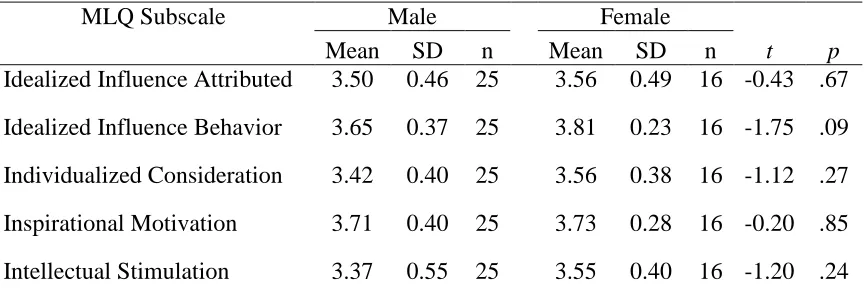
Female South Carolina public school superintendents rated themselves higher on
all transformational leadership MLQ subscales than did male South Carolina public
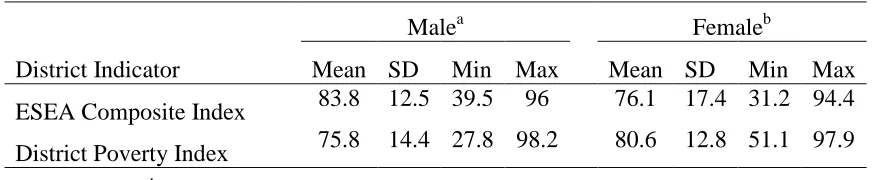
school superintendents but not at significant levels. Female South Carolina public school
superintendents had significantly lower ESEA composite indices than did male South
schools or poverty indices based on the sex of the superintendent. Implications and
TABLE OF CONTENTS
DEDICATION ... iii
ACKNOWLEDGEMENTS ... iv
ABSTRACT ... v
LIST OF TABLES ... ix
LIST OF FIGURES ... x
CHAPTER 1: INTRODUCTION ... 1
Purpose of the Study ... 2
Statement of the Problem ... 6
Background of the Study ... 7
Research Questions ... 9
Significance... 10
Delimitations ... 11
Definition of Terms... 12
Organization of Dissertation ... 13
CHAPTER 2: REVIEW OF LITERATURE ... 15
Historical Female Superintendent Representation ... 16
Superintendent Longevity ... 19
Barriers to Gender Equality ... 23
Full Range Leadership Model ... 31
Gender and Transformational Leadership ... 37
Summary ... 40
CHAPTER 3: METHODOLOGY ... 41
Methodology ... 41
Research Questions ... 41
Research Design... 42
Instrumentation ... 43
Reliability and Validity of the MLQ ... 45
Data Collections and Procedures ... 46
Analysis of Data ... 49
Validity of Data Collection ... 49
Summary ... 50
CHAPTER 4: RESULTS ... 51
Research Questions ... 51
Limitations ... 52
Results ... 52
Findings... 56
CHAPTER 5: SUMMARY, DISCUSSION AND CONCLUSIONS, AND RECOMMENDATIONS ... 58
Summary of Study Design and Results ... 58
Discussion ... 61
Conclusions ... 70
Implications and Recommendations for Future Research ... 72
REFERENCES ... 74
APPENDIX A: DEMOGRAPHIC QUESTION ... 93
APPENDIX B: LETTER OF INVITATION AND CONSENT ... 94
APPENDIX C: PERMISSION AND SAMPLE QUESTIONS ... 96
LIST OF TABLES
Table 3.1 Purpose of the Study ... 48
Table 4.1 Transformational Leadership Subscales ... 53
Table 4.2 ESEA and Poverty Indices ... 55
Table 4.3 Priority Schools... 56
Table 5.1 Population Sample ... 63
LIST OF FIGURES
Figure 1.1 Conceptual Framework ... 13
Figure 2.1 Full Range Leadership Continuum ... 32
Figure 3.1 Sequential Design and Timeline ... 42
CHAPTER 1: INTRODUCTION
School boards depend on superintendents to provide effective leadership to raise
student achievement and meet organizational goals under increasing pressures. The
stressful nature of the superintendency and the implications for superintendent longevity
and turnover are compounded by an increasing frustration with the political environment
(Byrd, Drews & Johnson, 2007), allocation of limited budget resources (Blair, 2010;
Bowers, 2009; Hohenstein, 2008), difficult school board relations (Hohenstein, 2008;
Yoder, 1994), and mounting federal accountability (Blair, 2010). Cultural, political, and
gender biases favor men when school boards seek superintendent candidates (Dana,
2009). However, over the last decade, the national percentage of female superintendents
increased by 10.9% (Kowalski, McCord, Peterson, Young, & Ellerson, 2011). As
pressures and demands for federal and state accountability increase, schools boards desire
superintendent candidates with relationship skills which are stereotypically viewed as
female. Superintendent search expert Benjamin Canada reinforced that relationship skills
are essential for the superintendency (Thomas, 2011).
A 2010 study completed by the American Association of School Administrators
(Kowalski et al., 2011) revealed that women are still underrepresented in the
superintendency. Historically, the majority of superintendents were married male white
Protestants (de Santa Ana, 2008). Nationally, the number of female superintendents is
increasing but women are still marginalized in leadership positions and do not reflect that
national percentage of female superintendents increased from 13.2% in 2000 to 24.1% in
2010 (Kowalski et al., 2011). South Carolina has a higher percentage of female
superintendents, 38% (South Carolina Association of School Administrators, 2013), than
the national average of 24.1%. The reason for the higher percentage of female
superintendents in South Carolina is unclear.
Purpose of the Study
Recent research on female leadership has focused on the glass cliff versus the
glass ceiling (Ashby, Ryan, & Haslam, 2007; Barreto, Ryan, and Schmitt, 2009;
Bruckmüller & Branscombe, 2010; Haslam & Ryan, 2008; Ryan & Haslam, 2005; Ryan,
Haslam, Hersby, & Bongiomo, 2011; Ryan, Haslam, Hersby, Kulich, & Wilson-Kovacs,
2009). The glass ceiling approaches the exclusion of women in leadership positions from
the point of view of inequality and gender bias. Barreto, Ryan, and Schmitt (2009) give a
more precise definition:
The word ceiling implies that women encounter an upper limit on how high they
can climb on the organizational ladder, whereas glass refers to the relative
subtlety and transparency of this barrier, which is not necessarily apparent to the
observer (p. 5).
Alternatively, the glass cliff means that women are appointed to leadership positions
when a company is in a time of crisis or failure (Bruckmüller & Branscombe, 2010; Ryan
& Haslam, 2005). Ryan, Haslam, Hersby, Kulich, and Wilson-Kovacs (2009)
differentiate the glass ceiling and the glass cliff explaining:
In this research we have demonstrated that women who do pass through the glass
leadership positions are more precarious than those of their male counterparts.
These positions are consequently associated with greater risk of failure and
criticism (p. 156).
Bruckmüller and Branscombe (2010) found that perceived stereotypical female
leadership characteristics were believed to be more desirable in crisis situations than male
leadership characteristics. The changing leadership roles and organizational practices,
closely associated with transformational leadership behaviors, have resulted in a female
leadership advantage (Eagly & Carli, 2003). Transformational leadership (Burns, 1978;
Bass, 1985) is focused on the future rather than present and strengthens organizations by
inspiring followers’ commitment and creativity (Eagly & Carli, 2003).
The purpose of this quantitative, non-experimental study is to investigate district
indicators associated with South Carolina female superintendents. Factors examined
were self-reported transformational leadership behaviors, district Elementary and
Secondary Education Act (ESEA) composite indices, identified priority schools, and
school district poverty indices. Since the percentage of female superintendents in South
Carolina is higher (38%) than the national average (24.1%), this study uses the premise
that school districts with low ESEA composite indices, identified priority schools, and
greater district poverty indices will have a higher percentage of female superintendents.
The conceptual framework for this study is the glass cliff.
Glass Cliff
The investigation of female South Carolina superintendents was guided by the
women who were promoted to leadership in risky or precarious positions where the
chance of failure is high.
Research regarding the glass cliff claimed that women are hired for leadership
positions over males in companies facing a crisis (Ashby, Ryan, & Haslam, 2007; Ryan
& Haslam, 2005). Women are selected for these risky positions because of stereotypical
beliefs regarding female leadership skills. These skills, which are associated with
transformational leadership behaviors, include collaboration, mentorship, and
empowerment and are viewed as more appropriate to leadership for modern organizations
(Eagly & Carli, 2007). Ryan, Haslam, Hersby, and Bongiomo (2011) hypothesized the
think crisis - think female connotation may result because females are viewed as more
suitable when the leader is expected to manage employees through a crisis or the
company has performed poorly.
To better understand the leadership styles of men and women, Eagly and
Johannesen-Schmidt (2001) completed a meta-analysis to gain an understanding of the
leadership roles of men and women. Women were found to display more
transformational leadership behaviors in the area of individualized consideration because
stereotypical feminine roles present women as being more attentive, nurturing,
encouraging, supporting, and considerate. Ryan and Haslam (2009) claimed a consistent
finding in their research revealed women attain leadership positions ahead of equally
qualified men only in situations where there is an increased risk of organizational failure.
Because female leadership styles may be seen as more charismatic or transformational,
Transformational leadership
During the superintendent selection process, school boards place a high priority
on candidates who are confident, personable, and can implement strategies to move the
district to greater levels of student achievement (Sampson, 2009). Leadership qualities
desired by these organizations are changing with additional emphasis placed on
individuals who possess adept relationship building skills. Burns (1978) emphasized that
power and leadership must be viewed in terms of relationships. Effective superintendents
build relationships through respecting the opinions of others, involving those with
different ideas and perspectives, and caring about those they lead. Grogan (2000)
indicated that leadership depends on the relationships a superintendent develops and
maintains. Relationship orientation is viewed as a characteristic of transformational
leadership. Transformational leaders are attuned to people’s emotions as evidenced
through the evaluation and satisfaction of their followers’ needs (Northouse, 2010).
Kouzes and Posner (2002) suggest leaders must have the ability to manage their
own emotions. The authors stressed emotional intelligence is vital to leadership. In a
study that analyzed the relationship of emotional intelligence and transformational
leadership, Mandell and Pherwani (2003) identified a significant gender difference exists
between male and female managers’ emotional intelligence scores. They found females’
emotional intelligence scores were higher than males. The researchers claimed their
results indicate females may be better managing their emotions and the emotions of
others. They determined a significant predictive relationship exists between
transformational leadership behaviors and emotional intelligence. The shift to
transformational leadership behaviors has been described as the feminization of
journal, boards search for CEOs who can demonstrate exceptional people skills when
working with employees or other stakeholders while sustaining consistent results
(Tischler, 2005).
Although there are various instruments that assess transformational leadership, the
Multifactor Leadership Questionnaire (MLQ) (Avolio & Bass, 2004) is the most widely
used instrument to measure transformational leadership (Northouse, 2012). A component
of the MLQ provides a self-rater form for leaders. Substantial evidence exists that
transformational leadership, as measured by the MLQ, significantly correlates with
transformational leadership behaviors (Bass & Riggio, 2006).
Statement of the Problem
To meet the increasing demands of the superintendency, school boards seek
candidates whose leadership behaviors promote the realization of organizational goals
and increased student achievement during periods of educational reform and system
change. Such a period exists in South Carolina. According to KidsCount.org (The Annie
E. Casey Foundation, 2013), in 2011, South Carolina ranked nationally as 45th in children
living in poverty, 42nd in teens aged 16 to 18 who were not in school or high school
graduates, and 38th in unemployment.
The focus of the issues addressed in this study revolves around the fact that South
Carolina school districts are confronted with a series of difficult circumstances and rely
more on female superintendents than the national average. This study examines the
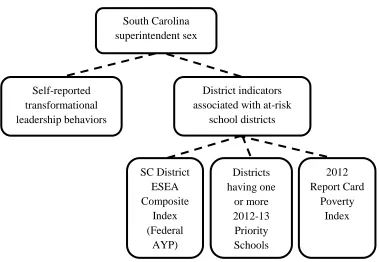
relationship between South Carolina superintendent sex and self-reported
transformational leadership behaviors. It examines the relationship between
superintendent sex and three measures associated with at-risk school districts: low ESEA
Background of the Study
Pressure from No Child Left Behind Act (NCLB) (2002), a depressed economy,
reduced fiscal resources, increased accountability, revisions of curriculum, increased
diversity, and the lack of qualified teachers in critical content areas require that South
Carolina superintendents use effective leadership behaviors to promote organizational
growth and improve student achievement. Moffett (2011) reported that most
superintendents and board presidents believed improving pupil performance was the most
important superintendent objective.
In a climate of changing instructional, political, and managerial adversities, South
Carolina superintendents strive to improve student achievement under difficult
circumstances and an evolving series of accountability challenges. Affirming the strain
of the superintendency, Michael Casserly, Executive Director of the Council of the Great
City Schools, declared that the superintendency was a high-pressure position under the
best circumstances and now the pressure has increased exponentially (Pascopella , 2011).
Three indicators of at-risk school districts in South Carolina are low ESEA composite
indices, identified priority schools, and school district poverty.
The education goals of NCLB include reducing the gap between low-income and
minority students and their peers in graduation and college access by 2020 (U. S.
Department of Education, n. d.). In 2012, the South Carolina Department of Education
(SCDE) petitioned and received an Elementary and Secondary Education Act (ESEA)
flexibility waiver from the United States Department of Education (State of South
Carolina, 2012). The ESEA waiver replaced the NCLB adequate yearly progress rating
of ‘Met’ or ‘Not Met’ with a district and school grading scale of A, B, C, D, or F. The
connections to student learning outcomes (State of South Carolina, 2012). The ESEA
waiver established guidelines that determine priority schools. The rationale written in the
ESEA waiver asserted that letter grades increased transparency and helped the public
understand the rating system.
The ESEA composite index is generated from a complex matrix with categorical
weighting to calculate a district or school numerical grade. The numerical grade falls in a
range which is used to determine a letter grade. The SCDE’s rationale to submit the
waiver was that the all or nothing AYP of ‘Met’ or ‘Not Met’ resulted in an
over-identification of schools and districts needing assistance. Schools and districts were
imposed with sanctions or punishments because they did not meet the AYP criteria which
required the state to provide financial assistance resulting in a reduction of state resources
(State of South Carolina, 2011). Only one school district in South Carolina, Saluda
School District One, made AYP in 2011 (State of South Carolina, 2011).
Priority schools, defined in the ESEA waiver, are the lowest 5% of Title 1
schools. Priority schools are identified based on the percentage of students who do not
perform at proficient levels or have significant performance gaps between subgroups
(State of South Carolina, 2012). These schools are required to work with parents,
community members, and district administrators to establish turnaround plans. The
turnaround plans must follow the US Department of Education’s turnaround principles
and address the needs of the student population. Priority schools will hold their status for
three years, unless they meet the exit criteria. These schools are required to set aside
Carolina, 2012). Priority schools were first identified for the 2012-13 school year by the
SCDE.
Poverty negatively impacts student performance. The achievement gap between
high-income and low-income students grew to nearly 40% in a 25-year period with
family income almost as predictive of a child’s achievement level as parental educational
(Reardon, 2011). The Southern Education Foundation (2010) defines extreme poverty as
a family of four living on an income of approximately $11,000 per year. South Carolina
has 10.3% of children living in extreme poverty which presents enormous challenges for
schools (Southern Education Foundation, 2010). Schools and districts with high poverty
rates are viewed negatively by the media, the community, and by other educators because
of poor academic performance on school report cards (Suber, 2011). The poverty index,
a measure for school report card ratings, is calculated by dividing the number of students
who receive free and reduced lunch by the average daily membership on the 135th day of
school. A high poverty index is associated with a greater level of poverty.
Research Questions
The purpose of this study is to investigate variables associated with South
Carolina female superintendents. Factors examined were self-reported transformational
leadership behaviors, district ESEA composite indices, identified priority schools, and
school district poverty indices. The research questions are:
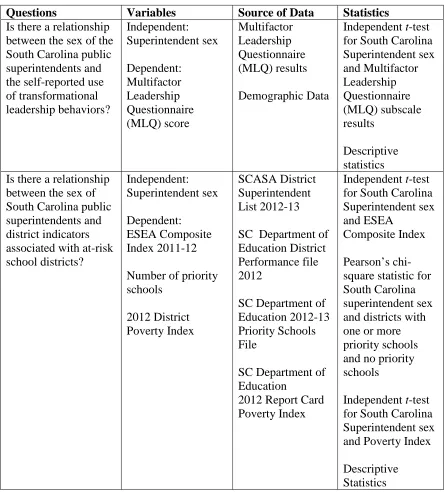
1. Is there a relationship between the sex of the South Carolina public school
superintendents and the self-reported use of transformational leadership
behaviors?
2. Is there a relationship between the sex of South Carolina public school
Significance
The importance of effective superintendent leadership behaviors, the challenges
faced by educational leaders in South Carolina, and the factors associated with more
reliance on female superintendents in South Carolina make this study significant.
Women represent 24.1% of superintendents nationally (Kowalski et al., 2011).
Gender-specific investigations are important because they help our understanding of factors
related to female superintendent leadership.
South Carolina is a critical case (Patton, 2002) because of the South’s patriarchal
history. If patriarchal beliefs are still prevalent in society, then these beliefs are likely
manifested in South Carolina. Political statistics support the generally patriarchal views
of South Carolinians. The Southeastern Institute for Women in Politics (n.d.) reported
that South Carolina ranked 50th nationally in the percentage of women in the state
legislature. Historically, South Carolinians have never elected a female U. S. Senator
(United States Senate, n. d.). There have been only five female U.S. Representatives with
four of them elected upon the death of their husbands (Southern Institute for Women in
Politics, n.d.). Nuwer (2000) claimed that, “Regardless of the fact that the South has
experienced many historical and political changes, this region has retained one
continuous aspect of its culture: it maintains patriarchal attitudes toward women” (p.
449).
Understanding differences in leadership behavior related to sex is important.
More women are aspiring to and securing the superintendency in South Carolina. How
these women perceive their leadership style is valuable to them, to universities with
programs in educational administration, and to South Carolina school boards. Since
studying their leadership behavior preferences and underlying district variables like
accountability ratings, identified at-risk schools, and poverty will provide deeper insight
regarding females in the superintendent position.
This study will add to previous knowledge regarding self-reported
transformational leadership behaviors of superintendents, how these behaviors are
associated with the sex of superintendents in South Carolina, and patterns associated with
female superintendent leadership in South Carolina. The proposed research may reveal
implications for educators who aspire to district leadership in South Carolina and the
district leaders who employ them.
Delimitations
Delimitations are factors controlled by the researcher and describe the scope and
boundaries of a study, the information that was included or excluded, and criteria for the
study (Roberts, 2010).
1. This study is limited to practicing, public school district superintendents in South
Carolina who responded to an invitation to participate in the study during the
2012-2013 school year.
2. Data for the South Carolina Department of Juvenile Justice, the South Carolina
Public Charter School District, and the Palmetto Unified School District are not
included in this study.
3. Three Marion school districts (Marion 1, Marion 2, and Marion 7) were
consolidated into one district in April 23, 2012. Data files obtained from the
SCDE for the year 2011-12 contained the three Marion districts. This data was
Composite Index, identified priority Schools, and the school district poverty
index.
4. Because of the consolidation of the three Marion school districts in April 23,
2012, only 81 surveys were mailed to the 2012-13 South Carolina public school
superintendents in May 2013.
Definition of Terms
1. Adequate Yearly Progress (AYP): A NCLB annual measurement of student
progress based on standardized tests.
2. Barrier: A barrier is any circumstance or factor that restricts females’ leadership
advancement in an educational setting (Edgehouse, 2008).
3. Emotional Intelligence: Daniel Goleman’s definition of emotional intelligence
comprises four fundamental capabilities: self-awareness, self-management, social
awareness, and social skill (Kouzes & Posner, 2002).
4. Effective superintendent: Based on standards of the American Association of
School Administrators (AASA) and the work of R. J. Marzano, the Educational
Consultants and Research Associates (ECRA) Group (2010) produced a
superintendent assessment that represents six behaviors of effective
superintendents. These are vision and values, core instructional competencies,
instructional leadership, community and relationships, communication and
collaboration, and management.
5. Leadership: Bass defines leadership as encouraging followers to act on the goals
Figure 1.1 Conceptual Framework. The conceptual analysis of the relationship between South Carolina superintendent sex and self-reported transformational leadership behaviors and district indicators associated with at-risk school districts.
Organization of Dissertation
The study is organized into five chapters. Chapter One contains the purpose of
the study, the statement of the focus, the background of the problem, research questions,
significance, conceptual framework, delimitations, and definition of terms. Chapter Two
includes a review of literature and research related to (a) a historical review of female
superintendents, (b) superintendent longevity and differences in longevity based on
gender, (c) barriers to gender equality, and (d) the full range leadership model and the
relationship between gender and transformational leadership. Chapter Three explains the
research methods, research instrument, validity and reliability of the research instrument,
participant selection, process of data collection, and data analysis. Chapter Four provides
South Carolina superintendent sex Self-reported transformational leadership behaviors District indicators associated with at-risk
descriptive data analysis. In Chapter Five, conclusions, implications, and
CHAPTER 2: REVIEW OF LITERATURE
The quality of all our lives is dependent on the quality of our leadership.
Warren Bennis
The review of literature situates this study in the existing knowledge regarding
female superintendents and provides a tool to examine the relationship between female
superintendents in South Carolina and the challenges of the districts they lead. The
relevant literature is divided into four sections.
First is a review of the historical representation of females in the superintendency.
This literature helps position the current representation of female South Carolina
superintendents within a historical perspective.
Second, superintendent longevity and gender differences in longevity are
presented. The literature regarding instability in superintendent tenure, job pressures, and
longevity provides insight into potential opportunities for female leadership.
Third, barriers to gender equality are included through an examination of the glass
cliff, females’ access to the superintendency, and variations in career paths based on
gender. The organization of this section will help broadly situate the challenges faced by
females who seek the superintendency.
Fourth, the review of literature ends with the full range leadership model.
Transformational leadership is one of the behavioral leadership styles of the model. The
from recent studies illustrates the need for further research concerning the representation
of female superintendents in South Carolina.
The review of literature provides the foundation for studying female South
Carolina superintendents and the districts they serve. This review also provides a
background to better understand the pressures and the challenges encountered by female
superintendents in South Carolina.
Historical Female Superintendent Representation
When she became the superintendent of Chicago schools in 1909, Ella Flagg
Young was the first female superintendent of a large-city school district. When elected
as president of the National Education Association (NEA) in 1910, she optimistically
proclaimed that soon more women than men would serve in executive school leadership
positions (Tyack & Hansot, 1982). Although women made modest gains in educational
leadership during the first portion of the 20th century, Ella Flagg Young’s prediction has
yet to be realized.
Tallerico and Blount (2004) described the composition of the superintendency by
sex in three distinct periods. During the 20th century, the authors affirmed the
superintendency was a male occupation. From 1910 to 1970, the number of female
superintendents increased from 9% in 1910 to a high of 11% in 1930, and then declined
to approximately 3% in 1970. Between 1970 and 1998, the percentage of female
superintendents increased to approximately 10% (Tallerico & Blount, 2004). Nationally,
during these three historical periods, the percentage of female superintendents ranged
from a high in 1930 of 11% to a low in 1970 of 3%.
The first period, prior to 1910, reflected that society was segregated by sex and
and Hansot (1982) described this period as one where the feminization of teaching was
closely connected to educational bureaucracy and mirrored the power given to men in
society. Men were viewed as leaders with authority and women were seen in the role of
teachers whose primary function was cooperation and service (Tallerico & Blount, 2004).
The second period occurred from 1910 to 1970. In the early portion of this
period, the number of female superintendents increased. The increase in female
superintendents was attributed to the suffrage movement and superintendents were
elected to the office (Tallerico & Blount, 2004). In the early twentieth century, women
were securing a greater number of supervisory positions (Tyack & Hansot, 1982). States
west of the Mississippi allowed women to vote in local elections which resulted in a
greater number of female county superintendents in the West (Tyack & Hansot, 1982).
However, from 1930 to 1970, the number of female superintendents actually
decreased. States implemented special training and credential requirements and the
predominately male educational administration professors recruited and sponsored
primarily males (Tyack & Hansot, 1982). Tyack & Hansot (1982) acknowledged that,
“the sponsor system was not called the ‘old-boy’ network by accident” (p. 192). This
system of sponsorship:
placed a premium on similarity of opinions and background characteristics
and probably did much unconsciously to insure that the top positions in public
education rarely went to women, to minorities, or to others deviating from the
male, white, Anglo-Saxon Protestant norm (p. 143).
Other factors contributed to the decline of female superintendents. After World
degrees (Tallerico & Blount, 2004) and schools initiated aggressive campaigns to recruit
men for the classroom with plans to promote them into administration (Blount, 1999).
Women also had fewer opportunities to become school superintendents because districts
consolidated during the 1950s (Tallerico & Blount, 2004). By 1970, the superintendency
mirrored extreme occupational sex segregation (Tallerico & Blount, 2004). School
administration was structured and maintained for men in education to surround and judge
themselves by other men (Blount, 1999).
During the third period from 1970 to 1998, the 3% to 10% increase in female
superintendents was attributed to the feminist movement, increased career opportunities
for women, and the recruitment of females to leadership positions (Tallerico & Blount,
2004). However, gains for female superintendents were inconsistent. Even in a liberal
state such as Wisconsin, no female superintendents were hired between 1970 and 1975
(Tyack and Hansot, 1982).
In the most recent 2010 American Association of School Superintendents
(AASA) study, Kowalski et al. (2011) found a significant increase in the percentage of
female superintendents. The number of female superintendents rose from 13.2% in 2000
to 24.1% in 2010. Although approximately one-fourth of superintendents nationwide are
female, that number remains far below Ella Flagg Young’s hopeful 1910 prediction.
While various reasons are presented to explain the historical fluctuation in the
percentage of female superintendents, the fact remains that the current percentage of
female South Carolina superintendents is 13.9% higher than the national average
Superintendent Longevity
In the current political climate of accountability and educational reform,
superintendents not only strive to increase student achievement but must also navigate the
politics of the position to maintain their jobs. Both female and male superintendents
express they feel stressed from increased demands, complex problems, and complicated
and ambiguous expectations (Orr, 2006).
Leadership ability has less impact when there is rapid turnover in the
superintendent’s office (Pascopella, 2011). Superintendent turnover creates an insecure
atmosphere that lacks consistency in instructional initiatives as well as evaluations of
district office personnel and principals. Speaking out regarding the lack of superintendent
longevity, AASA Executive Director Dan Domenech explained that even three years in
the superintendency is inadequate to create reforms and initiate programs which impact
student achievement (Pascopella, 2011).
Superintendents are being asked to do more with less. Increased accountability,
in addition to the aging of experienced superintendents, has created a shortage in
qualified candidates for the superintendency. Interim superintendents are in high
demand, yet the exact number of interim superintendents is hard to ascertain (Black,
2009). In 2007, superintendent longevity was 5 to 6 years (Byrd, Drews, & Johnson,
2007). A study by the Council of the Great City Schools (2010) reported that
superintendent tenure expanded from 2.33 years in 1999 to 3.64 years in 2010. Research
indicates the academic environment is impacted by frequent superintendent turnover
(Libka, 2012; Plotts, 2011; Scherz, 2004: Sybrant, 2012). Stability in district leadership
Some recent studies have examined factors contributing to reduced superintendent
longevity. Mid-west principals and superintendents reported they were living in survival
mode where cutbacks forced them to focus on fundamental processes and nothing more
(Ginsberg & Multon, 2011). Reporting on a 2012 Public School Superintendent Salary &
Career Report by the District Administration Leadership Institute, Solomon (2012)
attributed superintendent dissatisfaction to under-funded mandates, difficulty in reducing
academic achievement gaps, negotiating politics, extremely long work hours, and
managing job cuts. Many superintendents acknowledged that the job was becoming
untenable, and retirement or other avenues of work were more appealing (Ginsberg &
Multon, 2011).
In a quantitative study of Texas superintendent turnover, the average tenure of the
145 participants was five years (Byrd, Drews & Johnson, 2007). The average tenure for
female participants was 6.2 years while the average male tenure was 4.8 years.
Superintendents expressed increased political pressures as the primary factor in
professional instability. As the ratings of the role politics played in career instability
increased, longevity decreased. Problems working with the board president, the inability
of the board to make decisions, and superintendent and board relations were statistically
significant factors in determining Texas public school superintendent tenure. The results
of this study reinforced the importance of good relationships with the school board and,
especially, the board president.
Another Texas superintendent study found statistically significant relationships
existed between longevity and superintendents’ perceptions of inadequate funding and
superintendents served in their district, the more likely they were to report that economic
and personnel challenges were important concerns. These researchers noted that the
number of female superintendents was low, as would be expected.
Recent studies of South Carolina superintendents and longevity addressed its
relationship to change style preferences (Melton, 2009), characteristics of school districts
(Anderson, 2009), accountability (Greer, 2011), and reasons for superintendent turnover
(Goodman, 2012).
Change style preferences and their relationship to superintendent longevity and
student achievement was researched through a mixed methods study by Melton in 2009.
Melton defined change style preferences as how one’s personality relates to an approach
to change. Although no significant relationships were found, follow-up interviews
revealed that South Carolina superintendents shared similarities in systems thinking and
transformational leadership. Superintendents interviewed generally expressed
transformational leadership behaviors when discussing employee motivation,
collaboration, and relationships.
Anderson (2009) defined successful school districts in South Carolina as those
that sustained performance ratings of Average, Good, or Excellent during the study’s
seven-year period. Struggling school districts, those with lower absolute ratings, suffered
from difficult circumstances. More challenged school districts had higher levels of
poverty, lower teacher retention rates, and smaller student enrollments. Anderson
emphasized that struggling districts were forced to confront more complex instructional
76% had stable superintendent leadership. Only 26% of challenged districts maintained
superintendent stability.
A quantitative study by Greer (2011) examined South Carolina superintendent
longevity since the implementation of NCLB. Greer found that greater superintendent
longevity was associated with improved accountability levels. Of the 16 schools
identified as challenged-based on their 2006 report card, no principal or superintendent
remained in place by 2010-2011.
Analyzing shorter superintendent longevity in South Carolina, Goodman (2012)
concluded that 54.8% of South Carolina superintendents remained in their position for
three years or less. The average longevity of South Carolina superintendents between
2000 and 2010 was 3.1 years. Results of superintendent interviews found that 53% of
South Carolina superintendents believed inadequate funding inhibited success. South
Carolina superintendents sometimes moved from low performing smaller districts to high
performing larger districts for salary increases and job security. However, through
interviews, superintendents revealed that school board relationships were the most
important factor determining superintendent longevity. Goodman’s study noted that
small, underperforming districts often suffer because of the challenges superintendents
must overcome to be successful.
In the 2010 AASA study, 32.7% of superintendents indicated they served as a
superintendent five years or less (Kowalski et al., 2011). Information reported by gender
revealed that 7% of female superintendents had one year of experience and 36.2% of the
female superintendents had 2 to 4 years of experience. Of the male superintendents,
43.2 % of female superintendents had four years or less experience while only 29.9% of
male superintendents were in the same group. The experience level of female
superintendents was decidedly less than male superintendents.
Superintendent success depends on the ability to motivate people, improve
curriculum, and manage finances to support student learning. Small school districts have
the greatest superintendent turnover rate, meaning that superintendents often lack the
tenure necessary to make a substantial difference in their district and student achievement
(Scherz, 2004).
Together, these studies indicate that superintendent longevity is influenced by
economic factors, personnel issues, and school board relationships. As reported by
Kowalski et al. (2011), 50.7% of superintendents plan to leave the superintendency by
2015 which forecasts the probability of substantial turnover. The potential for
superintendent turnover may have a considerable impact on the opportunity for females
to successfully secure a superintendency if female candidates overcome barriers to
advancement.
Barriers to Gender Equality
Although obstacles are often difficult to see, the barriers to gender equality
influence females’ access to leadership positions. Women who fail to recognize barriers
to their advancement will have difficulty overcoming them (Schmitt, Spoor, Danaher, &
Branscombe, 2009). Because of the breadth of gender inequality, it is useful to consider
three major barriers to gender equality in the superintendency. These barriers are the
glass cliff, access to the superintendency, and career paths. Due to the often hidden force
of gender discrimination, each one of these topics is important for placing the study of
The first barrier is the glass cliff. Gender discrimination has been described by
many terms, but one of the most common is the glass ceiling. The glass ceiling was first
used in a Wall Street Journal article by Hymowitz and Schellhardt in 1986 (Barreto,
Ryan, & Schmitt, 2009) and represents the phenomenon whereby men dominate upper
levels of management. Researchers have used the glass ceiling as a metaphor to explain
the underrepresentation of women in management and leadership positions by unseen
barriers founded in stereotypical beliefs (Barreto, Ryan, & Schmitt, 2009). Other
researchers and writers have coined different terms to represent gender discrimination. In
2005, the glass cliff was first used by Ryan and Haslam to represent a “new and subtle
form of gender discrimination” (Barreto, Ryan, & Schmitt, 2009, p. 10) where women are
hired in high-risk leadership positions associated with criticism and potential failure.
The 2005 Ryan and Haslam study was in reaction to an article which claimed that
poor company performance was caused by women board members. Ryan and Haslam
believed that it was because of the company’s poor performance that women rather than
men were appointed to the board. Their archival study of prominent companies found
that women were more likely to attain leadership positions in companies with financial
downturns or deteriorating performance.
Extending the research of the glass cliff, Ashby, Ryan, and Haslam (2007) sought
to determine if women attorneys were more likely to be selected to take on problematic
legal cases. They found that females were more likely to be appointed as lead counsel on
a high-risk legal case than male candidates. In addition, female attorneys were seen to
have better leadership skills for high-risk cases. When a case was low-risk, gender was
women are more transformational in their leadership styles and possess the skills needed
to handle change and crisis.
Gender inequality is often represented by the saying think manager-think male
(Ryan, Haslam, Hersby, & Bongiorno , 2011). What is seen as acceptable managerial
behavior for men is often viewed as unacceptable for women. Ryan and Haslam (2007)
defined an alternative glass cliff connotation as think crisis - think female. Three studies
by Ryan et al. (2011) further examined the glass cliff phenomena by investigating
perceptions that women may be more suitable leaders in times of crisis. Their study
revealed that feminine characteristics were more desirable under conditions of poor
company performance such as managing people, taking responsibility for poor company
performance, or silently enduring the crisis in the background (Ryan et al., 2011). The
opposite was found when the managers were expected to improve performance or be
spokespersons (Ryan et al., 2011). The authors claimed that when a scapegoat was
needed, there was a clear preference for female traits.
There are mixed opinions as to why women accept difficult leadership positions.
To determine if women accepted glass cliff positions without evaluating the
circumstances, Rink, Ryan, and Stocker (2012) found that women and men understand
the resources available for the positions, and that stereotypical beliefs influence the type
of positions women and men accept.
The literature on the glass cliff has focused on female leadership in the business
environment. However, although no studies were found citing female superintendents
and the glass cliff, there is evidence that female superintendents are aware of this type of
“where things are in so much trouble that nobody will notice that you are a woman” (as
cited by Tyack & Hansot, 1982, p. 233).
The second barrier is females’ access to the superintendency. Research regarding
females’ access to the superintendency has taken various approaches including
perceptions of gender bias (Garn & Brown, 2008), self-imposed barriers (Derrington &
Sharratt, 2008), the influence of mentoring (Promisee-Bynum, 2010), limited networking
and negotiating skills (Montz & Wanat, 2008), and access influenced by marketing
constraints (Mahitivanichcha & Rorrer, 2006). Through an examination of females’
access to the superintendency, the uniqueness of the higher proportion of female South
Carolina superintendents becomes evident.
Barriers for aspiring female superintendents include both gender bias and
self-imposed barriers. Gender inequity is prevalent within the career cycle for women in
leadership (Mullen, 2009). While there is greater diversity in national superintendent
population as more females and minorities hold the previously male-dominated
superintendent position, gender bias remains a barrier for aspiring female superintendents
(Garn & Brown, 2008; Mahitivanichcha & Rorrer, 2006; Wallin & Crippen, 2007).
When females are employed as superintendents, they are more likely to be in smaller
districts that have financial difficulties, community controversy, or declining enrollment
(Montz & Wanat, 2008).
Gender bias remains a factor in superintendent searches. Beliefs still prevail that
females lack assertiveness, self-confidence, desire for power, and motivation to aspire to
the superintendency (Newton, 2006). Even females sometimes fail to support other
not lead like men (Dana, 2009). Alternatively, females perpetuate gender bias by
remaining silent when they feel ignored, degraded, or treated unfairly and change jobs
instead of voicing their concerns (Bañuelos, 2008).
Some females perceive barriers to the superintendency. Derrington and Sharratt
(2008) used questions from a 1993 study and replicated the study in 2007. Their findings
revealed females think immovable barriers still exist that prevent them from securing a
superintendency but barrier rankings changed during this time period. Sex role
stereotyping and sex discrimination were ranked as the top barriers in 1993, but
self-imposed barriers rose to the top in the 2007. The primary self-self-imposed barriers were
family obligations and unwillingness to relocate. Many females are unwilling or unable
to resolve responsibilities of child-rearing, homemaking, or caring for elderly parents.
Katz (2008) found female superintendents described gendered differences to include a
greater focus on establishing relationships, lack of networking skills, few trusted friends,
longer work hours, and a heightened work ethic because females feel they must be
perfect. Many females overcome barriers because family and community members
encourage them to maximize their potential by seeking further education to expand their
careers choices (Lane-Washington & Wilson-Jones, 2010).
The old boys’ network is identified as a barrier for aspiring female
superintendents (McDonald, Lin, & Ao, 2009; Montz & Wanat, 2008; Ryder, 2008;
Tyack & Hansot, 1982). The old boys’ network gives men a network of informal
friendships that excludes females (Montz & Wanat, 2008). Social and professional
networks provide vital information to aspiring superintendents about job openings and
Santa Ana, 2008; McDonald et al., 2009). Although female leadership opportunities have
improved, females receive less information and remain more isolated because they are
not members of networks. To alleviate the network gap for females, researchers suggest
veteran female leaders create formalized networks for aspiring female leaders (Grogan &
Brunner, 2005; Sherman, Muñoz, & Pankake, 2008).
Recruitment language and established networks influence female and minority job
access. When seeking superintendent candidates, school boards often favor men over
women because of gender bias, cultural beliefs, or political views (Dana, 2009).
Language used in superintendent recruitment messages significantly influences job
attraction ratings (Newton, 2006). There remains a white male advantage to job access
information because the white male advantage is at its strongest in the highest levels of
management (McDonald et al., 2009).
Females are underrepresented in the superintendency. Many women feel gender
and social barriers persist, with their chances of obtaining a superintendency remaining
significantly lower than men (Peckham, 2007).
The third barrier, career paths, further weakens many opportunities for females to
attain the superintendency. Female career paths to the superintendency are more
complicated than male career paths. Many females’ career choices lead them into areas of
curriculum and instruction, district office experience (Edgehouse, 2008), or assistant
superintendent positions prior to becoming a superintendent (Pascopella, 2008).
Numerous researchers have studied female superintendents’ career paths (Brunner &
Tallerico, 2000). Few research studies addressed male career paths to the
superintendency (Maienza, 1986; McDonald et al., 2009; Miller, 2008; Newton, 2006).
In a study of Texas superintendents whose participants were 91% male, the most
common superintendent career path was secondary teacher, secondary principal, and
superintendent (Farmer, 2005). Farmer specified that the position cited as key for
superintendent preparation, no matter the district size, was the secondary principalship.
Similarly, in a national sample, the typical career path for a male superintendent was
secondary teacher, athletic coach, assistant secondary principal, secondary principal, and
superintendent (Kim & Brunner, 2009). Many males move directly from a secondary
principalship to the superintendency, skipping central office employment (Kim &
Brunner, 2009).
Glass, Bjork and Brunner (as cited by Glass, 2006) pointed out that over 70% of
superintendents previously held a secondary school principalship which gave them extra
opportunities to work with budgets, manage facilities, and participate in personnel
activities. However, the National Center for Educational Statistics reported 59% of
elementary principals were female as compared to 29% holding secondary principalships
(Aud, Hussar, Kena, Bianco, Frohlich, Kemp, & Tahan, 2011). Secondary principalships
allow for greater visibility and access to district-wide activities (de Santa Ana, 2008).
The background experience for most females who obtained a superintendency included a
secondary principalship (Brunner & Kim, 2010). The lack of a secondary principalship
experience reduced the chances that female candidates would advance directly from a
Female superintendents’ career paths often involve district office positions. In a
Texas study, female superintendents were more likely to follow a director career path to
the superintendency more often than males (Farmer, 2005). However, positions in
curriculum and instruction, without a secondary principalship, result in school boards
who are not confident that these female candidates have the ability and experience to
manage budgets and finances (Brunner & Kim, 2010; Dana, 2009). The low number of
practicing female superintendents may signal the prevalence of gender-biased career
access (Brunner & Kim, 2010). Brunner and Kim argued, however, that women’s career
paths give them additional experience in areas of curriculum and instruction which
actually better prepares them for the superintendency.
In a 2010 quantitative study, Styles examined the career paths, skills necessary for
career advancement, and barriers of female South Carolina superintendents. Career paths
varied, but the most common path was teacher, principal, and central office/curriculum.
Only 10.7% of female respondents moved directly from a principalship to the
superintendency. Additionally, 79.3% of female superintendents held only one
superintendent position with 62% being appointed to the superintendency in their same
district. Skills viewed as most essential to career advancement were relationships,
interpersonal skills, and being responsive to parents and the community. Improving
instruction was ranked as the most important superintendent skill at 82.7%. Female
superintendents perceived their school boards hired them to be change agents. As noted
by Styles (2010), this perception was different from the 2003 AASA study which found
stated that since female South Carolina superintendents view their primary role as change
agents, there may be a shift in the way female superintendents perceive their roles.
Full Range Leadership Model
Transformational leadership is one component of the full range of leadership
model described by Avolio and Bass (Antonakis, Avolio, & Sivasubramaniam, 2003).
Based on the relationship between the leader and the follower, the model places
leadership behaviors on a continuum from laissez-faire to transactional then to
transformational leadership (Bass, 1999). Laissez-faire leaders avoid action.
Transactional leaders use rewards or punishments. Transformational leaders emphasize
follower development (Hogg, 2010).
Particular behaviors are associated with each one of the three leadership styles in
the full range model. These leadership behaviors are assessed by the Multifactor
Leadership Questionnaire (MLQ) (Avolio, Bass, & Jung, 1999). The literature describes
the full range leadership model starting with laissez-faire leadership on the low end of the
continuum, progressing to transactional, and concluding with transformational leadership
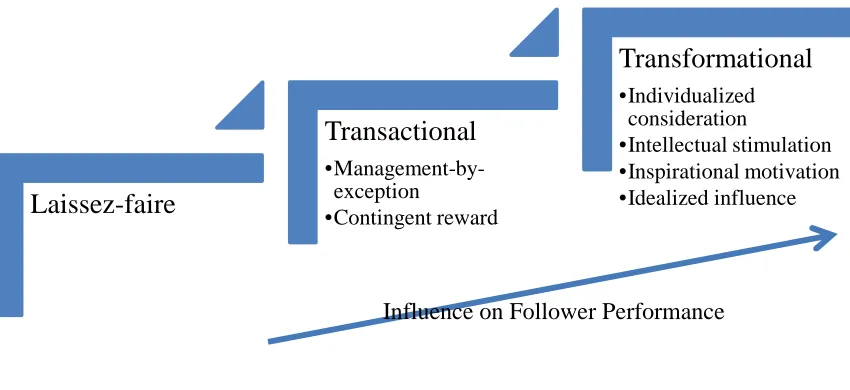
at the upper end of the continuum (Figure 2.1). The influence on follower performance
Figure 2.1 The Full Range Leadership Continuum. Adapted from Kirkbride (2006).
The lowest level of the full range leadership model is laissez-faire leadership.
These supervisors fail to utilize leadership behaviors, avoid making decisions, and
abdicate duties (Avolio & Bass, 2002). This results in employee ineffectiveness,
dissatisfaction, and conflict (Bass, 1999). Laissez- faire leadership is characterized by
passiveness, avoidance of decision-making, or failing to take corrective action until a
problem becomes worse (Bass, 1999). Laissez-faire leaders reject employee management
duties (Eagly & Johannesen-Schmidt, 2001).
Promoting a more sinister view of laissez-faire behaviors, Skogstad, Einarsen,
Torsheim, Aasland, and Hetland (2007) argued that laissez-faire leadership is a
destructive, counterproductive leadership behavior which is better described as zero
leadership. Laissez-faire behaviors create stressful work environments characterized by
significant role stress and social conflict. Because workplace stressors are not handled,
bullying and high levels of psychological anxiety occur (Skogstad et al., 2007).
Laissez-faire
Transactional
•Management-by-exception
•Contingent reward
Transformational
•Individualized consideration
•Intellectual stimulation •Inspirational motivation •Idealized influence
Transactional leadership behaviors fall in the middle of the full range of
leadership continuum. Transactional leadership behaviors are characterized by
punishment or rewards based on the follower’s performance (Avolio & Bass, 2002;
Bielenia, 2011) and built on equitable exchange (Seyranian, 2010). Transactional leaders
construct their reputation centered on subordinates’ self-interest and often fail because
they cannot deliver rewards (Bass, 1985). Transactional leadership behaviors are either
classified as management-by-exception or contingent reward.
Although management-by-exception leadership may be necessary in some
situations, it is the least effective of transactional behaviors. These leaders take punitive
action if followers do not meet expectations (Avolio & Bass, 2002). This leadership style
may be either active or passive. In the active form, the leader actively monitors followers
looking for mistakes, errors, or deviations from standards and takes disciplinary action
(Avolio & Bass, 2002). Active management-by-exception leaders constantly monitor
subordinates through observation (Bielenia, 2011).
In the passive form, the leader waits for followers to make errors or mistakes and
then takes corrective action (Avolio & Bass, 2002). Leaders who exhibit the passive
form only intervene when something goes wrong (Bass, 1985; Bielenia, 2011). Often,
these leaders believe poor performance is related to the follower’s lack of ability, so they
often distort their feedback making it more positive than it should be (Bass, 1985).
Another transactional leadership behavior, contingent-reward, incentivizes
employees, through follower self-interest, to perform (Avolio & Bass, 2002). Using
contingent reward behaviors, the leader assigns or gets follower consensus on required
accomplishing the duties (Avolio & Bass, 2002). Contingent reward behaviors are
perceived as a task-oriented approach because the focus is on goal attainment (Bielenia,
2011). Contingent reward leadership is relatively effective as long as the leader awards
the incentive (Bielenia, 2011).
On the upper end of the end of continuum of the full range of leadership model is
transformational leadership. Transformational leadership is a behavioral theory.
Behavioral theories focus on identifying effective leadership behaviors that can be taught
(Kirkbride, 2006; Tichy & Devanna, 1986; Warrick, 2011). Drucker (2006) professed
that leadership effectiveness can be learned.
The initial concept of transforming leadership was presented by James Burns in
1978, and by the mid-1980s Bernard Bass extended his model to transformational
leadership (Hogg, 2010). The transformational leader promotes higher quality, increased
innovativeness, and enhanced follower development (Bass, 1985) which greatly
influences follower’s job satisfaction (Bass, 1999). Transformational leaders earn the
trust and confidence of members of their organization, are innovative, are mentors,
empower others, and encourage those around them (Bass, 1999; Eagly, 2007).
Transformational leaders create relationships that move followers beyond their
own self-interest by inspiring, influencing, and developing their leadership abilities
(Bass, 1999; Bass & Riggio, 2006). Walumbwa, Avolio, and Hartnell (2010) emphasized
that transformational leaders increase group motivation, confidence, and performance by
affirming mission, collaboration, and encouraging the alignment of individual goals with
collective goals. These leaders inspire employees to develop innovative solutions, create
their own expectations (Avolio, 2011; Hobb, 2010; Kouzes & Posner, 2002; Vinkenburg,
van Engen, Eagly, & Johannensen-Schmidt, 2011). Transformational leadership has a
significant impact on employees’ work engagement and organizational knowledge
creation (Hoon Song, Kolb, Hee Lee, & Kyoung Kim, 2012).
Empirical research on effective schools identified transformational leadership as a
critical factor in organizational effectiveness and student engagement (Bass & Riggio,
2006; Leithwood & Jantzi, 2005). These leadership behaviors improve human behavior,
generating a transforming effect (Kouzes & Posner, 2002). Northouse (2010) identified
transformational leaders as ones who are:
Recognized as change agents who are good role models, who can create and
articulate a clear vision for an organization, who empower followers to meet
higher standards, who act in ways that make others want to trust them, and who
give meaning to organizational life (p. 200).
Avolio (2011) described the four components of the transformational leadership
model as the four I’s: individualized consideration, intellectual stimulation, inspirational
motivation, and idealized influence. The first component, individualized consideration,
means the manager is responsive to the individual’s need for growth and achievement
and serves as a mentor, teacher, and counselor (Avolio, 2011). Using individualized
consideration, the leader is aware of the follower’s aspirations, provides support, and
delegates duties which promote individual growth (Bass, 1999). The leader focuses on
the uniqueness of each person and gives some attention to everyone (Bielenia, 2011).
Leaders display intellectual stimulation, the second component of
intuition, encourage innovation, and stimulate new thinking (Avolio, 2011; Bass, 1985).
Leaders who exhibit intellectual stimulation draw followers into problem-solving
activities and decision-making processes (Bielenia, 2011). Jandaghi, Matin, and Farjami
(2009) asserted that intellectual stimulation encompasses advocating nontraditional
thinking to resolve traditional problems.
The third component of transformational leadership, inspirational motivation, is
displayed when leaders present an optimistic view of the future and are the first to act
even if their action presents a risk to themselves (Avolio, 2011). Leaders who use
inspirational motivation are enthusiastic when discussing work that has to be done, are
confident that the task will be accomplished, and readily take on challenging problems
(Jandaghi et al., 2009). Inspirational motivation is attributed to the leader when
emotional bonds are developed with followers that result in employee engagement and
commitment to organizational goals (Bielenia, 2011).
The final component, idealized influence, was originally termed charisma by
Avolio and Bass in 1991 (Bass, 1999). Bass (1999) described idealized influence as
incorporating power over ideology, ideals, and significant issues. Leaders who display
idealized influence “set examples for showing determination, displaying extraordinary
talents, taking risks, creating in followers a sense of empowerment, showing dedication
to the cause, creating a sense of joint mission, dealing with crisis, using radical solutions,
and engendering faith in others” (Avolio, 2011, p. 71). Idealized influence behaviors are
demonstrated when leaders are self-aware and influence the entire organization by
As a final point, leaders benefit when they understand their own leadership style
which helps them become more effective when leading others (Manz & Sims, 1991;
Pearce; 2007). Since superintendents face many challenges related to instructional needs
and fiscal shortfalls, understanding their own leadership behaviors is important to
enhancing their strengths and addressing their weaknesses in order to maximize their
followers’ leadership abilities and performance. If transformational leadership behaviors
motivate followers to achieve more, then these leaders are well-positioned to set the stage
for educational improvement despite difficult circumstances.
With increasing social, political, economic, and managerial adversities faced by
school districts, it is important to study superintendents’ transformational leadership
behaviors. Superintendents are responsible for motivating all stakeholders to move
beyond their own self-interests to achieve their maximum potential. The need for
transformation has placed more emphasis on democratic, relationship-oriented,
participatory, and considerate leadership (Bass, 1985). The presence of a single
transformational leader increases the potential success of an organization (Warrick,
2011).
Gender and Transformational Leadership
Numerous research studies regarding gender and transformational leadership
behaviors have been conducted (Duehr, 2006; Eagly, 2007; Eagly, Johannesen-Schmidt,
& van Engen, 2003; Lopez-Zafra, Garcia-Retamero, & Berrios Martos, 2012; Mak &
Kim, 2009; Mandell, & Pherwani, 2003). A meta-analysis by Eagly (2007) found that
female leaders were more transformational than males and exceeded men in supporting
and encouraging others. Eagly et al. (2003) reported their study revealed that femininity