A Monthly Double-Blind Peer Reviewed Refereed Open Access International e-Journal - Included in the International Serial Directories International Journal in Commerce, IT & Social Sciences
http://www.ijmr.net.in email id- [email protected] Page 25 FOUR E'S AND TWO C'S STRATEGY TOWARDS GLOBALIZATION
Dr. Sandeep Bansal, Deptt. of Commerce,
Indira Gandhi National College, Ladwa, Kurukshetra
ABSTRACT
This is because any transformation spells a short-term loss for some. Governments do not
want to lose their sovereign rights, and vested interests do not want to surrender their
privileges. However, the process of economic integration is not dead. It is forging ahead in
the form of regional economic blocs, each bloc covering a number of specified member
countries. In several cases, a single country has managed to become a member of two or more
regional blocs. This form of regional economic integration is assuming all forms and shapes
and its coverage is increasing rapidly. It has acquired a dynamism and volatility of its own.
With the progress of globalization the business companies of the countries all over the world
are engaged in international business. Most of the companies that go global fail because of
lack of global competitiveness. The decision of private business firm to invest or to do
business in any country depends upon the competitiveness of that country. It is perhaps on
account of rapidly growing dimension of globalization i.e. with barrier free integration of all
national economies into one single world entity. Even though the feasibility of this goal is
A Monthly Double-Blind Peer Reviewed Refereed Open Access International e-Journal - Included in the International Serial Directories International Journal in Commerce, IT & Social Sciences
http://www.ijmr.net.in email id- [email protected] Page 26 Introduction
Changes have always been taking place in the past and will continue to be so in future too.
But the pace at which these changes have occurred in the recent past is indeed phenomenal.
World economy has become highly dynamic and has acquired an unprecedented growth
potential in areas such as technology, finance, IT, tourism and other fields. It is perhaps on
account of rapidly growing dimension of globalization i.e. with barrier free integration of all
national economies into one single world entity. Even though the feasibility of this goal is
there for all to see, there is a stiff resistance to it. This is because any transformation spells a
short-term loss for some. Governments do not want to lose their sovereign rights, and vested
interests do not want to surrender their privileges. However, the process of economic
integration is not dead. It is forging ahead in the form of regional economic blocs, each bloc
covering a number of specified member countries. In several cases, a single country has
managed to become a member of two or more regional blocs. This form of regional economic
integration is assuming all forms and shapes and its coverage is increasing rapidly. It has
acquired a dynamism and volatility of its own. Many developed countries continue to believe
that they can benefit more from regional grouping than from a full-fledged and
non-discriminatory world-wide integration.
To participate in globalization, every economy has to pass the litmus test of investment
worthiness. Developing countries suffer from several constraints like infrastructural
bottlenecks, institutional deficiencies, shortage of skilled manpower, etc., besides
macroeconomic difficulties. Access to globalization and its benefits demand that developing
countries first put in place a conducive environment necessary to ensure higher returns and
larger markets for foreign investors. Foreign investment will not flow to the countries
handicapped by problems like political instability, bureaucratic inefficiency, corruption,
inefficient institutional facilities, ineffective governance, etc.
Economic reform process in India was introduced in the form of New Economic Policy in
July 1991. Economic process was born out of the crisis of June 1991 in the economy.
A Monthly Double-Blind Peer Reviewed Refereed Open Access International e-Journal - Included in the International Serial Directories International Journal in Commerce, IT & Social Sciences
http://www.ijmr.net.in email id- [email protected] Page 27 Highlights of Economic Reforms
(a) The stabilization reforms were meant to correct the weakness on the fiscal and the balance
of payments fronts.
(b) The structural reforms were meant for removing some of the rigidities of the economy.
(c) The objective is simple and that is to improve the efficiency of the system, by removing
the barriers to entry and the restrictions on growth of firms.
(d) For tile desired results and to improve the efficiency of the system, the two forms of
reforms are in fact complimentary to each other in creating a more competitive environment
in the economy.
(e) The private sector is being given a larger space for operation as some of the areas earlier
reserved exclusively for the public sector are also now allowed to the private sector.
(f) The public sector to compete with the private sector. The critics of the reform process
have to understand that state and public sector have an important role to play. The public
sector is not to be substituted by private sector rather public sector is to compete with private
sector.
(g) The reform process has not necessarily diminished the role of the state, rather it has only
been redefined, expanding in some areas and reducing in some others.
(h) If public sector is truly to play its role, it must generate necessary surpluses through
improved efficiency and productivity.
(i) It is only an efficient public enterprise system that can enable the government to meet its
social obligations.
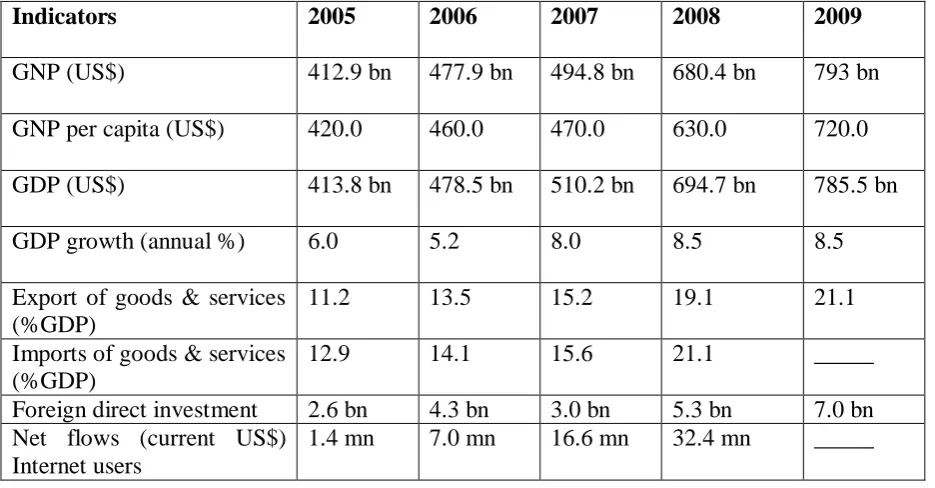
India is fast becoming a part of the globalize economy. Table-1 demonstrates how India has
become increasingly closely connected with the world economic and trading system in the
decade So India searched for other options for economic openness and integration between
A Monthly Double-Blind Peer Reviewed Refereed Open Access International e-Journal - Included in the International Serial Directories International Journal in Commerce, IT & Social Sciences
http://www.ijmr.net.in email id- [email protected] Page 28 globalization. It is not to say that in earlier times India was not a part of the process, but
rather India was more of a passive bystander than an active participant.
Table 1 : The Economic Indicators of India (2005-2009)
Indicators 2005 2006 2007 2008 2009
GNP (US$) 412.9 bn 477.9 bn 494.8 bn 680.4 bn 793 bn
GNP per capita (US$) 420.0 460.0 470.0 630.0 720.0
GDP (US$) 413.8 bn 478.5 bn 510.2 bn 694.7 bn 785.5 bn
GDP growth (annual %) 6.0 5.2 8.0 8.5 8.5
Export of goods & services (%GDP)
11.2 13.5 15.2 19.1 21.1
Imports of goods & services (%GDP)
12.9 14.1 15.6 21.1 _____
Foreign direct investment 2.6 bn 4.3 bn 3.0 bn 5.3 bn 7.0 bn Net flows (current US$)
Internet users
1.4 mn 7.0 mn 16.6 mn 32.4 mn _____
Strategies towards Globalization
India can strive to become a global player and can sustain the current positive trends (2008
-2009) if the policy makers and executors keep in mind the following factors:
(i) Re-emphasis on economic reforms process as is being done in China. In a falling
dollar environment, besides drastically cutting down the subsidy, reworking of China's
currency regime could be an increasingly important item on its reform agenda. It has been
decided to cut down the subsidy bill of Rs. 45,780 crores on food products, fertilizers and
petroleum products so to make the fiscal deficit to manageable levels. To attain the
objective, the intention of the government is to introduce food coupons for Below Poverty
Line (BPL) families to replace PDS delivery, pruning of FCI expenses on buffer stocks,
freezing the support price for food grains like wheat and rice, phasing out subsidy on
cooking gas and kerosene and opening up LPG and kerosene market to competition
including decentralizing urea imports and setting up of units abroad. The resolutions,
A Monthly Double-Blind Peer Reviewed Refereed Open Access International e-Journal - Included in the International Serial Directories International Journal in Commerce, IT & Social Sciences
http://www.ijmr.net.in email id- [email protected] Page 29 (ii) Focus on quality improvement, employees’ involvement and customer satisfaction in
both manufacturing and services. This suggestion made by William Deming, the quality
control advisor in US Army to Japan in 1948 is still valid in 21st century business
environment.
(iii) To promote employment and poverty reduction, improve agriculture through
re-emphasis on improved farm practices, enlarged irrigation facilities and scientific cropping
pattern along with appropriate pricing and procurement policies.
(iv) Create good manufacturing base in terms of infrastructure for attracting foreign
investment in major areas and build up necessary marketing and service infrastructure so
to promote trading in services.
(v) Target specific areas and industries for special concessions in order to meet social
obligations. Govt. bound to stick to subsidy regime at least in case of petroleum products.
In Dec. 2004, Govt. of India has to face deficit of Rs. 11,000 crore on account of subsidy
given on cooking gas, kerosene oil, petrol and diesel. Subsidy on gas cylinder is Rs.
210.40 and on kerosene oil it was Rs. 11.05 per liter. It is true that serious social
imbalance will emerge in the economy, if the fruits of development do not reach the
urban poor & rural poor.
(vi) Family run business need to comply strictly with the norms of corporate governance.
It will take some time. Audit practices need to be strengthened to discipline erring
managements.
(vii) Look for new segments of service sector such as traditional, Indian medicine system
A Monthly Double-Blind Peer Reviewed Refereed Open Access International e-Journal - Included in the International Serial Directories International Journal in Commerce, IT & Social Sciences
http://www.ijmr.net.in email id- [email protected] Page 30 (viii) Ensure that public sector is to compete with the private sector and there is need to
reform the labour market and a proper exit policy for loss making enterprises.
(ix) At the global level, Indian business and industry must enter into strategic alliances
with MNCs and other leading players in production and marketing sectors to benefit from
expending opportunities. India does not have the image of a traditional and reliable
exporter and Indian brands are not well known in world markets.
Four E's and Two C's Strategy towards Globalization
In nut shell, it would be more appropriate to expand on the four E’s and two C’s of the
Strategy towards globalization.
1. Efficiency: There are different components that constitute efficiency. The need of the
hour is to considerably improve India's productivity all around. The second aspect of the
efficiency is technology up gradation and improving the organization's cost
competitiveness. Higher capacity utilization in existing plants needs to be given the
highest priority in this context. A mere one percent increase in capacity utilization in the
manufacturing industry will mean Rs. 25 billion of additional output per annum. The
same is true in case of service organizations. The gain in terms of cost reduction per unit
could be significant. Third area is energy efficiency in industry and service sectors. India
is an energy deficient country depending on imports for one third of its oil demand.
Therefore any improvement in energy consumption norms will not only enhance the
country's competitive strength but also reduce the burden on ex-chequer.
2. Excellence: This aspect of the operation strategy deals with overall quality
improvement and value enhancement. For result oriented international marketing, the
business organizations need to achieve high standards of excellence and competitiveness.
This will require induction of new technology, as well as major improvements in labour
A Monthly Double-Blind Peer Reviewed Refereed Open Access International e-Journal - Included in the International Serial Directories International Journal in Commerce, IT & Social Sciences
http://www.ijmr.net.in email id- [email protected] Page 31 choice to the customer, quality was a neglected aspect of industrial operation.
Competition in the international marketing can be faced safely, only if quality products
and services are produced.
3. Employee Involvement: Edward Deming had emphasized the need for building up
such an environment in the business organization that each employee from bottom to top
is considered an integral part of the organization. Mindset of employees across the
organization has to make proactive. The culture of continuous improvement has to be
generated in the employees.
The New Age Managers- the managers of global companies need to take initiative to
develop individual competence and commitment. It would lead to improve the cost
competitiveness of the organization.
4. Exports: India needs to aim for a steady growth rate of exports of 20 to 25% in real
terms. The entire trade policy and fiscal mechanism should be supportive of this effort. In
today's globalize environment enormous size of market is essential for existence and it is
not possible without aiming at increasing exports.
5. Customer Satisfaction: It is regarded as one of the important elements of an optimal
marketing strategy for a global company. Customer preferences, liking, suggestions have
to be honored. The business leaders ought to be effective facilitators in the promotion of
excellence. It is essential for global recognition.
6. Communication: One should remember that technology alone is never enough in
difficult times. This is because the means of communication are readily available, does
A Monthly Double-Blind Peer Reviewed Refereed Open Access International e-Journal - Included in the International Serial Directories International Journal in Commerce, IT & Social Sciences
http://www.ijmr.net.in email id- [email protected] Page 32 survey found that the bright young people can crunch numbers, analyses markets and
device business plans. But when it comes to teaching human relation skills, it seems to be
the area where improvements are needed. Sure technological sophistication will still be
important as the world races ahead. But that is just the price of the admission to the new
business arena.
The winners will be the service organizations with smart and creative leaders who know
how to communicate and motivate effectively. Good communication skills therefore are
to constitute as one of the important elements of optimal service marketing strategy.
The four E’s and two C’s strategic model for globalization is shown in the Chart 1.
Figure 1 - Components of Strategic Model towards Globalisation
1.
5. 2.
3.
6.
4.
The four E's and two C's infact, constitute the fundamental elements of strategic model
towards globalisation efficiency that improves cost competitiveness. Excellence means
quality improvement, exports imply linkage with foreign exchange employee involvement
again improves cost competiveness, communication leads to valve enhancement and
customer satisfaction involves global recognition.
Efficiency
Customer
Satisfaction Excellence
Strategic Model
Towards Globalisation Employee
Involvement Communication
A Monthly Double-Blind Peer Reviewed Refereed Open Access International e-Journal - Included in the International Serial Directories International Journal in Commerce, IT & Social Sciences
http://www.ijmr.net.in email id- [email protected] Page 33 Reliance, Ranbaxy, Arvind Mills and Bajaj Auto have been included in the list of the top
fifty most competitive Asian firms simply because these firms have derived cost advantage
from cheap basic factors such as raw materials and labour scale of production and process
technology. These firms have focused their attention on four Es and Two Cs which are
essential elements of international benchmarks. Ranbaxy normally uses cost data from
world's four most competitive drug manufacturers for bench marking its operations,
Sundaram Fastners constantly looks for quality conscious customers who are extremely
demanding. It uses the customer pressure to motivate employers for internalizing the valve of
quest for quality.
Conclusion
Any form of economic integration, by its very nature, necessitates a corresponding
compromise of national sovereignty; and it is more so in the case of global economic
integration. This poses a very difficult and often unacceptable choice for national
governments, For example, a national government may find itself forced to abandon
measures for providing food security, or jobs during a natural calamity, etc. Though several
economists from the 'developed countries have been arguing that long run sustainable growth
and prosperity of the developed countries can be ensured only by the growing prosperity of
the developing countries, the former are not ready to adopt and pursue this approach, Instead,
A Monthly Double-Blind Peer Reviewed Refereed Open Access International e-Journal - Included in the International Serial Directories International Journal in Commerce, IT & Social Sciences
http://www.ijmr.net.in email id- [email protected] Page 34 References
1. Dr. Raj Kumar, Gupta Kuldip (2006), Managerial Economics, UDH Publishers, New
Delhi.
2. Deepak Nayyar, Globalisation: The Past in our Present, Presidential Address at the
78th Annual Conference of Indian Economic Association, Chandigarh, Dec. 26-30,
1995.
3. Peter Drucker, Management Challenges for the 21st century, Harper Business, New
York, 1999.
4. UNCTAD, Human Development Report (Annual).
5. Stiglar, Joseph E., Globalisation and its Discontents, Allen Lane, London.
6 Francis Cherunilam, “International Business” 4th edition PHI Learning Private Ltd
New Delhi, 2009. PP452
7 J. A. Frankel, “Globalisation of Economy”, National Bureau of Economic Research,
working paper No. 7858, 2000
8. J. Bhagwati, Protectionism (Cambridge, MA: MIT Press 1980)
9. Charles W L Hill & Arun k. Jain, “International Business sixth edition Tata McGraw
Hill Publishing Company Ltd. New Delhi, 2009
10. Raj Kumar, International Economics, Excel books New Delhi, 2006
11. World Trade Organization, International Trade Trends and Statistics, 2003 (Geneva:
WTO, 2003)
12 United Nations, World Investment Report, 2004