Fine-Tuning Decentralized Anonymous Payment
Systems based on Arguments for Arithmetic
Circuit Satisfiability
Kamil Kluczniak and Man Ho Au
Department of Computing, The Hong Kong Polytechnic University
[email protected],[email protected]
Abstract
Digital currencies like Bitcoin and other blockchain based systems pro-vide means to record monetary transfers between accounts. In Bitcoin like systems transactions are published on a decentralized ledger and reveal the sender, receiver and amount of a transfer, hence such systems give only moderate anonymity guarantees.
Payment systems like ZCash attempt to offer much stronger anonymity by hiding the origin, destination and value of a payment. The ZCash sys-tem is able to offer strong anonymity, mainly due to use of Zero-Knowledge Succinct Non-interactive Arguments of Knowledge (ZK-SNARK) of arith-metic circuit satisfiability. One drawback of ZCash is that the aritharith-metic circuit is rather large, thus requires a large common reference string and complex prover for the ZK-SNARK. In fact, the memory and prover com-plexity is dominated by the ZK-SNARK in use and is mainly determined by the complexity of the circuit.
In this paper we design a Decentralized Anonymous Payment system (DAP), functionally similar to ZCash, however with significantly smaller arithmetic circuits, thus greatly reducing the memory and prover com-plexity of the system. Our construction is based on algebraic primitives, from the realm of elliptic curve and lattice based cryptography, which satisfiability might be efficiently verified by an arithmetic circuit.
1
Introduction
a replica of the current state and the history of previous states and inputs to the machine. The fact, that all nodes in the network keep the history of states and inputs gives the ability to verify the consistency of the current state to parties which dynamically join and leave the protocol. In a digital currency users are given the possibility to create accounts on a distributed ledger and register monetary transactions. In Bitcoin for instance, an account is identified by a public key of a signature scheme and is associated with some value. Users might exchange value simply by signing the amount they wish to send and the recipient address. When nodes of the network obtain a transaction as above, they verify whether the signature is correct and whether the sender has enough value on his account. Then the system changes the state by subtracting the value from the senders’ account and advancing the receivers account. Obviously, this change in state is then replicated among all nodes in the system. For clarity, we omit here animosities related to realizing the distributed ledger, consensus or the network layer. What is worth noting however, is that every participant, not only needs to posses a replica of the current state, but also the history of all states in order to verify the consistency of the transaction record.
Since the public keys on a distributed ledger, such as Bitcoin, have no tight link with their legal identity and can be created “on-the-fly”, it has become a popular claim that Bitcoin and other digital currencies, offer strong privacy. However, it is easy to see that such claims are actually not strongly grounded in reality. In Bitcoin type currencies a transaction does not hide the values of the transactions nor the public keys of the sender or recipient. In fact methods for tracing Bitcoin transactions are becoming more advanced and effective [47, 3, 48, 42]. Therefore, most digital currencies offer only moderate privacy guaranties, sometimes called pseudonymity.
There have been proposals of digital currencies which offer much stronger privacy guarantees. One line of solutions is to use mixing services, which in essence operate very similarly to mix nets, or onion routing. Such approaches have been applied in protocols [41, 51, 50] and incorporated in some digital currencies like for instance Dash. However, the very idea requires to involve third parties or additional distributed infrastructure which results in less scalable systems and higher operational costs.
Another approach is to design a payment system which by design does not reveal anything except the correctness of the transaction. We will call such sys-tems Decentralized Anonymous Payment syssys-tems (DAP)1. In principle, DAPs
contrast to Bitcoin, but instead exploits the properties of zero-knowledge proofs to provide consistency of the transaction while simultaneously hiding the sender and recipient addresses, and values transferred between them. One notable pro-tocol called RingCT [44] and based on CryptoNote [52], has been implemented by the Monero digital currency. The protocol makes use of some clever tricks with Schnorr type Σ-protocols [25] for proving statements about linear relations of discrete logarithms. In short, the RingCT protocol uses so called one-time ring signatures, i.e. the signer produces a signature of knowledge that he has a private key related to one of the public keys in a given set. The signature is one-time in the sense that attempts to use the same secret signing key will lead to the same serial number what can be detected. Furthermore, the coin public keys for the ring signature are created in a Diffie-Hellman manner, where, in contrast to the Diffie-Hellman protocol, only the recipient can compute the secret key. Since, the protocol applies Schnorr type Σ-protocols for discrete logarithm statements and proofs of set membership, the size of the signature depends linearly on the size of the ring, i.e. the anonymity set. This is a serious obstacle since the protocol does not scale well and in practice the anonymity set includes 2 to 4 coins. Several proposals have been made to improve RingCT in order to make the protocol scale better. For instance [32] proposed a set membership proof of logarithmic size. In [54] the authors design a constant size proof, but use pairing based accumulators to accumulate integers. The asymp-totic proof size from [54] is very promising, however system parameters grow linearly in the maximal size of the anonymity set. Moreover, in order to instan-tiate the system in practice the parameters for the system need to be relatively large, since the accumulator needs to accumulate group elements (integers) in which the discrete logarithm is hard. Another obstacle is hiding the mounts of a transaction, which is realised by commitment schemes and expensive, in terms of size, range proofs.
circuits and the size of the argument is a few group elements. For instance the argument size of the system from Parno et al. [45] is only 8 group elements. Later improvements resulted only 3 groups elements [31, 33]. Succinctness of the arguments make ZK-SNARKs especially attractive for applications like dis-tributed ledgers. The major drawbacks of practical ZK-SNARKs are related to their reliance on a common reference string (CRS). First of all, the CRS has to be generated by a trusted party. In practice, this may be accomplished by a dis-tributed setup process [21, 22]. Second, the size of the common reference string and the prover complexity depend on the complexity of the circuit. Moreover, the security assumptions are not falsifiable and the strength of the assumptions also depends on the circuit complexity. In other words, the more complex the circuit, the bigger the system parameters, the more complex the prover and the weaker the soundness guarantees of the argument system. Therefore it is crucial to have a relatively small circuit.
In Zerocoin [53] the authors exploit the succinctness and the generality of the argument system, and give a generic construction of a Decentralized Pay-ment System (DAP). The generic construction is build from collision-resistant hash functions, commitment schemes and pseudorandom functions. Later these building blocks may be instantiated by any primitive satisfying the require-ments. In Zerocoin and later ZCash [36], these building blocks are instantiated by standard symmetric primitives like the SHA256 hash function. The ZK-SNARK then proofs that the transaction is consistent and that the user knows all the secret keys, without revealing any additional information. The ZK-SNARK in use in ZCash is based on [7] and shows satisfiability of arithmetic circuits. Most of the statements circuitry in the ZCash protocol checks satisfi-ability of boolean operations, hence the arithmetic circuit for the ZK-SNARK needs to realize boolean operations what is quite expensive in terms of the cir-cuit size. Therefore, in order to reduce the circir-cuit size, it seems to be reasonable to redesign the protocol such that its build from primitives which can directly be implemented by the arithmetic circuit of the ZK-SNARK.
Our Contribution. We propose a semi-generic construction of a Decentral-ized Anonymous Payments (DAP) scheme. Our construction relies on similar design principles as ZCash [53, 36], however we do not follow the ZCash generic construction faithfully. The main difference lies in the way we construct ad-dresses, coins and their serial numbers. Below we give an (over) simplified description of our system. In our case an address is a single group element X = gx ∈
G, where x ∈ Zq is the address secret key. Then a coin is build
also from a coin public keypk =gxga
1gb2, where awill be used to compute the
serial number andb is an additional blinding, and a commitment of the coins value. The coin public key is created by a payer, who chooses the secret masks a, b∈Zp. In order to “bind” and compress the commitment and the coin public
[27], i.e sn=g1/x+a. Similarly, as in ZCash, in our scheme a spender creates a non-interactive zero-knowledge argument of knowledge that, his coin is well formed, he knows all secrets of the coin, the serial number if well formed and the coin is in a hash tree. Moreover, the spender also has to create a new coin with a public key as described above and a commitment of its value. We describe our system for two input coins and two output coins, thus the non-interactive argument also needs to show that the values of the coins are consistent.
Our scheme is semi-generic. In particular, we may instantiate commitment schemes, hash functions and hash trees with different building blocks. A signifi-cant part of our contribution includes two instantiations from discrete logarithm based primitives and lattice based primitives.
To instantiate discrete logarithm based primitives we follow the suggestions given by Kosba et al. in [38], and instantiate the underlying group on twisted Edwards curves. Moreover, we apply a few optimisations which result in smaller arithmetic circuits like scalar multiplication using the windowed method when the based point is known. Using the windowed method was suggested at a blog post [58] with a window of size w = 4. We show that actually the optimal window size is w = 3. This is because the cost of multiplexing precomputed elements grows much faster. Our construction also requires to perform general scalar multiplications on unknown points. In this case we cannot precompute a table for the windowed method, therefore we provide a few optimisations for general scalar multiplication by exploiting doubling formulas with slightly smaller arithmetic circuits. As mentioned earlier, the membership proofs are usually done by showing that a coin is in a hash tree. Previous work [5, 53], focused mostly on binary Merkle trees. In our work we investigate whether 3-ary or 4-ary hash trees may give better performance, and we found that 3-ary trees result in smaller arithmetic circuits.
Additionally, we provide an instantiation on lattice based primitives. In particular, we instantiate the hash functions on the Ajtai hash [1]. The use of Ajtai hash was first suggested by Ben-Sasson et al. in [5], where the authors build Merkle trees. However, the parameter choices for collision-resistance made in [5] were further questioned by Kosba et al. in [38], who provide additional analysis for the Ajtai hash. In our case we complement the analysis given in [38] with additional analysis using combinatorial methods suggested for lattice based hash functions in [43]. Beside collision-resistant hash functions, we additionally investigate the use of Ajtai hash for building statistically-hiding commitment schemes. In [37] Kawachi et al. give a commitment scheme which is essentially the Ajtai hash where half of the input bits are the randomness bits and the other half is are the bits of the message. The authors show that if the hash input is big enough relative to the output, then the distribution of the output bits are statistically close to uniform. In our setting the message space of the commitment scheme is small. Therefore, using directly the constraints on the parameters from [37] would result in a bigger arithmetic circuit than necessary. For our construction we set the number of bits in the message, and we extend the randomness space of the randomness to “blur” the committed message.
for the argument system. In order for our results to be accountable, we show the design of the arithmetic circuits and calculate their cost.
Concurrent work. We are aware that some parallel work on a similar sys-tem is in progress by the ZCash team. However, little is known by far about the details. At a blog post [57], the ZCash team announced a major update codenamed “Sampling”, which aims to improve performance and usability of the payment system. In a series of blog posts [17, 20, 19] Sean Bowe described the BLS12-381 curve which will be used to instantiate the ZK-SNARK [31] for the “Sampling” update. In a later blog post [18] by Sean Bowe, we learn that the new system for the arithmetic circuit will not be instantiated by symmetric primitives, but with elliptic curve based primitives. Additionally, there is an explainer page given [58] with the description of a twisted Edwards curve called Jubjub. The explainer page announces plans of using windowed exponentiation at window sizew= 4 and hash functions based on the Pedersen commitment. At this point however, we don’t know whether the designed system will fol-low the generic construction from [53], and, if so, what other building blocks (especially which PRF’s) will be used.
In order to provide an easier comparison in the future, we evaluate the size of our circuits for the bit size of the field and group order over the Jubjub curve.
2
Preliminaries
In this section we give our denotations and recall the fundamental definitions we use throughout the article. Some definitions, however, are given in other sections where there will be needed. We denote asx= [xi∈ S]mi=0−1a string of elementsxi
from the setS. In particular we will denote asx= [xi ∈ {0,1}]mi=0−1 a bit string
of lengthms.t. x=Pm−1
i=0 2
ix
i. When such a string in input to an algorithm,
then we implicitly input its string representations, e.g. bit representation and not the corresponding integer, unless its clearly marked. LaterFdenotes a finite field andFq denotes a finite field withqelements. We denote asGa cyclic group
usually of orderp. The operatora||b denotes concatenation of two bit strings.
Definition 1(Commitment Scheme). A commitment scheme consists of proba-bilistic polynomial-time algorithmsC= (CommSetup,Comm)defined as follows:
CommSetup(1λ): The key generation algorithm takes as input a security
pa-rameter 1λ and outputs the commitment public key pk. The commitment
public key determines the message space Mand randomness spaceR.
Comm(pk, m, r): The commitment algorithm takes as input the commitment public keypk, a messagem∈ Mand randomness r∈ R, and outputs the commitment cm.
advantageAdvHideC,A as follows.
Pr
"
pk←CommSetup(1λ); (m
1, m2)← A(pk);r
R
← R: A(Comm(pk, m0, r))
#
−Pr "
pk←CommSetup(1λ); (m
1, m2)← A(pk);r
R
← R: A(Comm(pk, m1, r))
# ≤Adv
Hide C,A (1λ)
We say that C is perfect hiding if for all Aand λ,AdvHide
C,A (1λ) = 0. We say
that C is computationally hiding if for all PPT adversaries A, AdvHide C,A (1λ) is
negligible inλ.
Definition 3 (Binding). A commitment scheme is binding if it is hard to find a collision, i.e. two message/randomness pairs which result in the same com-mitment. More formally, for a commitment schemeC = (CommSetup,Comm)
and an adversaryA, we definite the advantageAdvBind
C,A as follows.
Pr
pk←CommSetup(1λ); (m
0, r0, m1, r1)← A(pk) :
(m0, r0)6= (m1, r1)∧Comm(pk, m0, r0) =Comm(pk, m1, r1)
≤AdvC,BindA (1λ)
We say that C is computationally binding if for all PPT adversaries A,
AdvBind
C,A (1λ)is negligible inλ.
Definition 4 ((Keyed) Hash Function). A (Keyed) Hash Function consists of algorithmsH = (SetupH,Hpk)defined as follows:
SetupH(1λ): The key generation algorithm takes as input a security parameter
1λ and outputs the hash public key pk. The public key determines the
message spaceM.
Hpk(m): The commitment algorithm takes as input the public keypk, a message
m∈ M and outputs the hashh.
Definition 5(Collision-Resistance). Similarly as for binding commitment schemes, a hash function if collision-resistant if it is hard to find collisions. For a (keyed) hash function H = (SetupH, Hpk)and an adversary A, we definite the the
ad-vantageAdvH,CRA as follows.
Pr
pk←SetupH(1λ); (m
0, m1)← A(pk) :
(m0)6= (m1)∧Hpk(m0) =Hpk(m1)
≤AdvH,CRA(1λ)
We say that K is a collision-resistant (keyed) hash function (CRHF) if for all PPT adversariesA,AdvH,CRA(1λ)is negligible in λ.
Definition 6(Pseudorandom Function). LetP RF:K×M →Rbe a efficiently computable function, whereK is the key space, M is the domain space and R
is the range. For an adversary A define the advantage of braking theP RF as follows.
were the oracle O on input a massage from M chooses a uniformly random output and saves the output for future queries on the same message.
We say that the the function PRF is a pseudorandom function ifAdvAP RF(λ)
is negligible in the security parameter.
Non-interactive zero-knowledge arguments of knowledge. We recall the definition of non-interactive zero-knowledge arguments of knowledge from [31]. A NP-relationR(x, ω) is a binary relation which can be tested in polyno-mial time, i.e. havingxandω we can verify whetherR(x, ω) = 1 in polynomial time. LetLR ={x: ∃ω R(x, ω) = 1} denote the language defined by R. We
define a relation generatorRλwhich on input 1λoutputs a relationR from the
set of possible relations.
Definition 7. An non-interactive proof systemΠR= (SetupCRS,Prove,Verify,
Sim) for an NP-relationR(x, ω) is defined by the following PPT algorithms.
SetupCRS(R,1λ): This procedure given a relation Rand security parameterλ, outputs a common reference stringcrs and a simulation trapdoorτ.
Prove(R,crs, x, ω): The prover takes as input the relationR, a common refer-ence stringcrs and(x, ω)∈R, and returns an argument π.
Verify(R,crs, x, π): The verification algorithm takes as input the relation R, the common reference string crs, the statement x and argument π, and outputs 0 (reject) or1 (accept).
Sim(R, τ, x): The simulator takes as input the relation R, the trapdoor τ and statementx, and outputs an argumentx.
Definition 8. Perfect Completeness Completeness says that, given any true statement, an honest prover should be able to convince an honest verifier. For allλ∈N,R∈LR,(x, ω)∈R
Pr[(crs, τ)←SetupCRS(R,1λ);π←Prove(R,crs, x, ω) :Verify(R,crs, x, π)] = 1.
Definition 9. Perfect zero-knowledge. An argument is zero-knowledge if it does not leak any information besides the truth of the statement. We say ΠR
= (SetupCRS, Prove, Verify, Sim) is perfect zero-knowledge if for all λ ∈ N,
(R, z)←R(1λ),(x, ω)∈R and all adversaries A.
Pr
(crs, τ)←SetupCRS(R,1λ);π←Prove(R,crs, x, ω) :
A(R, z,crs, τ, π) = 1
= Pr
(crs, τ)←SetupCRS(R,1λ);π←Sim(R, τ, x) :
A(R, z,crs, τ, π) = 1
Prove,Verify,Sim)be an argument system and letXAbe a non-uniform
polyno-mial time extractor. We define the advantage for any non-uniform polynopolyno-mial time adversariesAas
Pr
(R, z)←R(1λ); (crs, τ)←SetupCRS(R); ((x, π);ω)←(A||XA)(R, z,crs) : (x, ω)6∈R∧Verify(R,crs, x, π)
≤AdvExtA,Π(1λ]).
We say the proof systemΠRis computationally knowledge sound ifAdvAExt,Π(1λ])
is negligible in the security parameterλ.
Definition 11. We call a non-interactive zero-knowledge argument of knowl-edge a ZK-SNARK if for allλ∈N,R∈LR,(x, ω)∈R,(crs, τ)←SetupCRS(R,1λ)
and honest executions π←Prove(R,crs, x, ω), we have that |π| =polylog(|x|), i.e. the size of the proofs is bounded poly-logarithmically in the size of the state-ment.
Quadratic Constraints. In this article we consider arithmetic circuits con-sisting of addition and multiplication gates over a finite fieldFq. We may view
some of the publicly known wires of such arithmetic circuit as specifying a statement and all other wires as specifying the witness. The arithmetic circuit specifies a binary relation where a statement consisting of public wires and a witness consisting of all other wires belong to the relation only if these variables corresponding to the wires satisfy the arithmetic circuit. Throughout the paper we will revere to wires corresponding to the witness as variables, whereas to wires corresponding to the statement as constants.
We may represent the satisfiability problem of an arithmetic circuit as a system of equations. The equations will takes variablesx0, . . . , xn−1 ∈ F and
be of the form
(
n
X
i=0
xiai)·( n
X
i=0
xibi) = ( n
X
i=0
xici),
whereai, bi, ci∈Ffor all 0≥i≥nandxn= 1.
Analogically, Ben-Sasson et al. [6], characterizes such systems using vector operation and calls such systems Rank-1 Constraint Systems (R1CS).
The arithmetic circuits we build in this paper are rather big and complicated. Thus we will build them from smaller procedures and develop convenient no-tation. We will usually denote variables which are on input to a procedure in bold e.g. a. Additional variables which appear within a procedure are denoted with fraktur font e.g. a. Constants are denoted in plain. A procedure will have the following form.
1. Quadratic constrains in form of
(
n
X
i=0
xiai)·( n
X
i=0
xibi) = ( n
X
i=0
xici),
2. and subprocedures.
Cost: (Constraint number) constraints and (Variable number) additional variables.
We present our constraint system in Appendix A.
3
Decentralized Anonymous Payments
Definition 12. A Decentralized Anonymous Payment system consists of al-gorithms (SetupDAP, CreateAddressDAP, CreateCoinDAP, MintDAP, PourDAP,
VerifyDAP,ReceiveDAP)defined as follows.
SetupDAP(1λ): On input a security parameterλoutputs the public parameters
ppDAP.
CreateAddressDAP(ppDAP): On input the public parameters ppDAP, outputs
addressaddrand address secret keyaddrSK.
CreateCoinDAP(ppDAP,addr,addrSK, v): On input the public parametersppDAP,
an addressaddrand valuev, this algorithm outputs a coincoin, a proofπ
and coin spending key coinSK.
MintDAP(ppDAP,coin, v, π, L): On input the public parametersppDAP, a coin
coin, value v and a proof π, this algorithm appendscoin to the ledgerL, or outputs⊥.
PourDAP(ppDAP,coin1,coin2,coinSK1,coinSK2,addr1,addr2, v1, v2, vpub, L): This
algorithm takes as input the public parameters ppDAP, two input coins
coin1, coin2 and the corresponding spending keys coinSK1, coinSK2, two
output addresses addr1,addr2, output valuesv1,v2, the public value vpub
and the ledger L. The algorithm outputs two output coinscoinout1 ,coinout2
and their decodingscoinDecout1 ,coinDecout2 , and a transactiontrP OU R.
VerifyDAP(ppDAP,trP OU R,coin1,coin2, L): On input the public parametersppDAP,
a pour transaction trP OU R, two coins coin1,coin2 and the ledger L, this
algorithm appends trP OU R,coin1,coin2 to the ledger, or outputs⊥.
ReceiveDAP(ppDAP,coin, v,coinDec,addr,addrSK): On input the public
The Zerocash paper [53] defines security of a DAP system by three prop-erties called ledger indistinguishability, transaction non-malleability and bal-ance. Informally, ledger indistinguishability captures the fundamental privacy requirement, that is, that the DAP scheme reveals no information beyond what is publicly-revealed. In particular, a DAP scheme hides everything except the values of minted coins, public values and the total number of transactions. Note, that the public values are necessary in practice to pay transaction fees. In this case the adversary may sent coins to an address, and receive payments from an address. Transaction non-malleability requires that transaction data returned by a pour transaction cannot be altered by a third party. Finally, balance re-quires that the amount of value on the ledger is determined only by the mint transaction. In practice, that means that the pour transaction cannot create new value or delete existing value. Moreover, this property also captures the infeasibility of double spending (a double spend would create new value).
Unfortunately, there have been issues with the definitions given in [53], some of them pointed out by Kosba et al. [39]. In particular, the ledger indistin-guishability game can be won by any adversary since the adversarial model leaks unintended information. Garman et al. [28] introduce a simulation based definition and outline a ideal functionality. Then, they present an incomplete sketch of a proof for the Zerocoin [53]. This leaves us without a reliable security definition and security analysis for any DAP scheme. Unfortunately, because of time constraints we also have to leave the definition and security analysis for a further iteration of the article.
4
Our DAP Protocol
In this section we describe our basic scheme.
SetupDAP(1λ): The procedure takes as input the security parameterλ based
on which it generates the following: 1. A groupGof prime orderp.
2. Random generatorsg,¯g1,g¯2∈G.
3. A bit commitment functionComm:{0,1}`R+`max →D
Comm.
4. Collision-resistant functions: H : {0,1}`I → D
H, HS{0,1}∗ → Zp,
HP :{0,1}log(p)×`P RF →Zp.
5. Set`maxto be the maximal value of a coin.
6. Set the height of the Merkle tree asN. If necessary define an addi-tional hash function.
7. A non-interactive proof system Πcrs with common reference string
crs.
8. A one-time signature schemeS= (SetupSig,SignSig,VerifySig).
The procedure outputs the public parameters ppDAP = (G,p, g, ¯g1, ¯g2,
CreateAddressDAP(ppDAP): A user chooses uniformly random x ∈ Zp,
com-putesX =gxsets the addressaddr= (X) and address secret keyaddrSK= (x).
CreateCoinDAP(ppDAP,addr,addrSK, v): The procedure takes as input the
pub-lic parametersppDAP, an addressaddr= (X) and its secret keyaddrSK=
(x), and value v = [vi ∈ {0,1}]`i=0max−1. A user chooses y ∈ {0,1}
`P RF,
b ←R Zp, computesa← HP RF(y), sets sk ←(x, y, b) andpk ← gx¯ga1,g¯2b.
Then the user chooses a bit string r = [ri ∈ {0,1}]`i=0R−1 uniformly at
random, computes c ← Comm(r, v) and cm = H(pk||c). Finally, the user sets coin = (cm), a proof π = (pk, c, r, v) and coin spending key coinSK= (sk, pk, c, r, v).
MintDAP(ppDAP,coin, v, π, L): The verifier takes as input the public
parame-tersppDAP, a coincoin= (cm), valuev= [vi∈ {0,1}]`i=0max−1 and a proof
π= (pk, c, r, v). Ifcm6=H(pk||c) orc6=Comm(r, v) or the user didn’t pay v, the procedure outputs ⊥and aborts. Otherwise the verifier appends (coin, π) to the ledgerL.
PourDAP(ppDAP,coin1,coin2,coinSK1,coinSK2,addr1,addr2, vout,1, vout,2, vpub, L):
The prover takes the public parameters ppDAP the ledger L and for j, k∈ {1,2} the following:
• The input coinscoinj = (cmin,j =H(pkin,j||cin,j)).
• The input coin spending keycoinSKj= (skin,j, pkin,j, cin,j, rin,j, vin,j)
where skin,j = (xin,j, yin,j, bin,j)∈
Zp, ain,j =HP RF(yin,j||gx in,j
), pkin,j =gxin,j¯ga1in,j¯gb
in,j
2 , cin,j =Comm(rin,j, vin,j),rin,j = [r
in,j
i ∈
{0,1}]`Ri=0−1 and vin,j = [vin,j
i ∈ {0,1}] `max−1
i=0 . We denote X
in,j =
gxin,j.
• The public valuesvpub= [vpub
i ∈ {0,1}] `max−1 i=0
• Output values vout,k = [vout,k
i ∈ {0,1}] `max−1
i=0 , s.t. vout,1+vout,2 =
vpub+vin,1+vin,2.
• Output addressesaddrk= (Xout,k ∈G).
To spend the input coins and create new output coins with values vout,1
andvout,2, forj, k∈ {1,2}the user does the following:
1. Compute hash a Merkle tree rootMroot s.t. cmin,j are leaves in the
tree andMpathj are the corresponding paths toMroot. The
computa-tion is done using the ledgerL.
2. Compute ˆskj= 1/(xin,j+ain,j) modpand the serial numberssnj←
gskjˆ . Additionally, compute ˆpkj ←gxin,j+ain,j.
3. Compute the output coins:
• Choose yout,k ∈ {0,1}`P RF, bout,k ∈
Zp and rout,k = [rout,ki ∈
{0,1}]`R−1
• Compute the coin public keys, by computingaout,k ←HP RF(yout,k||Xk)
andpkout,k= ¯gaout,k
1 ¯gb
out,k
2 ·Xk.
• Compute the commitmentscout,k =Comm(rout,k, vout,k).
• Computecmout,k =H(pkout,k||cout,k). • Setcoinoutk = (cmout,k) andcoinDecout
k = (yout,k, bout,k,pkout,k,
cout,k,rout,k,vout,k)).
4. Run (P KSig, SKSig)←SetupSig(1λ) and compute the following:
• hS ←HS(P KSig),
• skS
j = 1/(xin,j+ain,j+hS) modpand
• sn0j←gskSj.
5. Set
• the statement stmt = (ppDAP, Mroot, sn1, sn2, hS, sn01, sn02,
cmout,1,cmout,2,vpub), and
• the secret input ω = (M1
path, Mpath2 pkin,1, pkin,2, cin,1, cin,2,
ain,j, bin,j, xin,j, Xin,j, pkˆj, skˆ
1, skˆ2, skS1, skS2, rin,1, rin,2,
vin,1, vin,2, pkout,1, pkout,2, cout,1, cout,2, rout,1, rout,2, vout,1,
vout,2).
6. Compute the proofπ←Πcrs.Prove(stmt, ω).
7. Compute the signatureσ←SignSig(SKSig;stmt, π).
8. Output the transaction trP OU R = (Mroot, sn1, sn2, sn01, sn02, π,
P KSig,σ,vpub), the output coinscoin1,coin2and sendcoinDec1and
coinDec2 to the new coin owners.
VerifyDAP(ppDAP,trP OU R,coin1,coin2, L): On input the public parameters
ppDAP, a transaction trP OU R = (Mroot, sn1, sn2, sn01, sn02, π, P KSig,
σ, vpub) and two coins for the transaction coin
1 = (cmout,1), coin2 =
(cmout,2), the verifier
1. restores the Merkle tree with rootMroot,
2. checks whethersn16=sn2 orsn1 orsn2 appears onL,
3. computeshS ←HS(P KSig),
4. sets the statement asstmt= (ppDAP,Mroot,sn1,sn2,hS,sn01,sn02,
cmout,1,cmout,2),
5. verifies the proof Πcrs.Verify(stmt, π) = 1,
6. verifies the signatureVerifySig(P KSig;stmt, π;σ) = 1,
7. updates the Merkle tree to containcmout,1 andcmout,2, and 8. appendscoin1,coin2andtrP OU R to the ledger.
ReceiveDAP(ppDAP,coin, v,coinDec,addr,addrSK): a user withaddr= (X) and
a share of the coin secret key y ∈ {0,1}`P RF, the blinding b ∈
Zp the
commitment random bits r = [ri ∈ {0,1}]i`R=0−1 and the bits v = [vi ∈
{0,1}]`max−1
i=0 of the coin value. If any of the given values is outside in the
required domain, the user rejects. Ifa=HP(y||X) is on the users internal
list, i.e. he got the same randomness earlier ora= 0, then return⊥. The user checkspk =gx¯ga
1¯gb2 andc=Comm(r, v) and whethercm=H(pk||c)
is on the ledger. The user sets keysk= (x, y, b) and the coin secret key ascoinSK= (sk, pk,c,r,v).
• Public input: stmt= (ppDAP,Mroot,sn1,sn2,hS,sn01,sn02,cmout,1,cmout,2, vpub),
• Secret input: ω= (Mpath1 ,M
2
path pk in,1
,pkin,2, cin,1,cin,2,ain,j, bin,j,xin,j, Xin,j,pkˆj,skˆ1, skˆ2, skS
1, sk2S,rin,1, rin,2, vin,1, vin,2,pkout,1,pkout,2,cout,1, cout,2,rout,1,rout,2,vout,1,vout,2).
• Prove that the inputs which are supposed to be bits are bits. • Forj∈ {1,2}andk∈ {1,2}proof that:
1. pkin,j are well formed and the prover knows the secret keys.
– gxin,j =Xin,j,
– ¯g1ain,jg¯b
in,j
2 ·Xin,j=pkin,j and – Xin,j·gain,j = ˆpkj.
2. snjare well formed and the prover knows the secret key.
– ( ˆpkj)skˆj =gand
– snj=g
ˆ
skj.
3. Prove thatsn0jis well formed and the prover knows the secret key.
– ( ˆpkj·ghS)skSj =gand
– sn0j=gsk
S j.
4. The commitments and values are correct
– cin,j=Comm(rin,j, vin,j),
– cout,k=Comm(rout,k, vout,k), – cmout,k=H(pkout,k||cout,k),
– vpub+vin,1+vin,2=vout,1+vout,2.
5. cmin,j=H(pkin,j||cin,j) are in the Merkle tree rooted atMroot.
Scheme 1: The Prove statement Πcrs
cmout,k =H(pkin,k||cin,k) for both output coins. However then we need to set the output coins tocoinout,k = (pkin,k, cin,k)what may cost more space on the ledger. Moreover, we would also have to make surecoinout,k is signed, to avoid substitution attacks.
Remark 2. In our description we didn’t specify how the coin decodingscoinDec
are transported to the new owner. It can obviously be realized similarly as in the ZCash protocol [53], by using a key-private encryption scheme [4] or it may be just sent out-of-band. In case of using a key-private encryption scheme, we need to alter the user address, and add an encryption public key. In order to avoid malleability attacks, we have to make sure that the ciphertexts are signed in the pour procedure. Additionally, theReceiveDAP procedure, would have to
be altered to reject payments which incorrectly encrypt the secrets.
Furthermore, using public key encryption allows us a user to delegate the decryption key to a third party, who then might monitor incoming transactions to this address.
Remark 3. As noticed above using public key encryption to transport coinDec
through a public ledger may allow chosen third parties holding the decryption key, to monitor incoming transactions.
With some modifications we can also allow to monitor output transactions. First we may reveal that the coin has been spent, by publishing an encryption of the coin public key. In order to enable to monitor to who the coin has been sent, we may also publish the encryption of the share a ∈ Zp, s.t. the output coin
public keypkout =ga·Xout for the output address Xout. In the above method
one must take care to sign the ciphertexts to avoid malleability attacks.
Note however, that the above method relies on “good will” of the coin owner. In order, to provide some sort of accountability and force the coin owner to provide correct encryptions we would have to make some more serious modifi-cations. First of all the proof from the poor transaction would have to include a membership proof of the outgoing address. Without such membership proof, the payment sender can always send the coin to an address which is not on the ledger. Second, the pour proof should also include a proof that the values in the ciphertexts are consistent with the values used to spend the coin and create the output coins.
Remark 4. We can drastically simplify the protocol by making an addressX = gx
1g2rand the public key coinpk=g0bgx1g2r. Then, we have to proof knowledge of
b, x, r, and we can use a generic generic PRF to compute the serial numbers, i.e. sn= P RFx(b) and sn0 =P RFx(b+hS modp). The PRF then may be
5
Instantiation
In this section we show two instantiations of the building blocks. In particular, we discuss the instantiation of the elliptic curve E over Fq, the CRHF H, the
commitment schemeCommand the Merkle tree.
Both instantiations share a common ground, which includes operations in groupG, the signature scheme S and HS and HP RF. What differs, is the way
Comm, H and the Merkle tree are instantiated. Thus we will first present the common operations and then, in Section 5.1 we show an instantiation solely based on discrete logarithms commitments and in Section 5.3 we show an in-stantiation exploiting lattice based primitives. The design of most constraint systems for the ZK-SNARK are given in Appendix A.
The group G. As noticed in the construction of our DAP scheme, G is a
group of points on an elliptic curveE overFq, whereq is prime. Moreover, we
require the orderpofGto be and odd prime.
We will mainly focus on Edwards and twisted Edwards curves [9, 34] since, as noticed in [38], the arithmetic on these curves is very efficient when implemented on arithmetic circuits overFq.
Definition 13. LetFbe a finite field of characteristicchar(F)6= 2. Leta, d∈F.
The Edwards curve with coefficientdis defined as follows.
Ed(F) =x2+y2= 1 +dx2y2.
The group is instantiated over the Twisted Edwards curves.
Definition 14. LetFbe a finite field of characteristicchar(F)6= 2. Leta, d∈F
and a 6= d. The Twisted Edwards curve with coefficients a, d is defined as follows.
Ea,d(F) =ax2+y2= 1 +dx2y2.
We say that an Twisted Edwards curve is a Edwards curve ifa= 1. The neutral element isO= (0,1) and negative of(x1, y1)is(−x1, y1).
Let us now focus on the general case of Twisted Edwards curves, and recall the affine addition formulas.
Definition 15. Affine Addition Formula Let(x1, y1),(x2, y2)be points onEa,d(F).
Then
(x1, y1) + (x2, y2) = ((
x1y2+y1x2
1 +dx1x2y1y2
),(y1y2−ax1x2 1−dx1x2y1y2
)) = (x3, y3). (1)
Definition 16. Affine Doubling Formula Let (x1, y1) be a point on Ea,d(F).
Then
2(x1, y1) = ((
2x1y1
1 +dx2 1y21
),( y
2 1−ax21
1−dx2 1y12
As shown in [8], the formulas 15 and 16 are complete ifdis not a square in
F.
Additionally, we will consider the addition formulas from given in [34].
Definition 17. Affine Addition Formula independent of dLet(x1, y1),(x2, y2)
be points onEa,d(F). Then
(x1, y1) + (x2, y2) = ((
x1y1+x2y2
y1y2+ax1x2
),(x1y1−x2y2 x1y2−y1x2
)) = (x3, y3). (3)
Definition 18. Affine Doubling Formula independent of d Let (x1, y1) be a
point onEa,d(F). Then
2(x1, y1) = ((
2x1y1
ax2 1+y12
),( y
2 1−ax21
2−ax2 1−y21
)) = (x3, y3). (4)
Note, that the addition formula given by Definition 17 doesn’t work for point doubling. Moreover, as shown in [34] there are exceptional cases even whendis not a square inF. On the other hand, if both points are not equal and are of odd order, then the the formula is correct as shown in [34]. As for doubling formula given by Definition 18 the same exceptional cases apply as for the formula given by Definition 16. Note also that theEa,d(Fq) has another special point (0,−1)
of order 2.
In our instantiation we will only consider the fieldFqwhereqis an odd prime.
Additionally, we will exploit point compression on twisted Edwards curves by reducing the x coordinate to its lest significant bit. In other words, given a point (x, y)∈Ea,d(Fq), the compressed point is (x mod 2, y). We can rewrite
the curve equation forEa,d as
1−y2
(a−dy2) =x 2.
First, note that ifa=dy2, then the curve equation would becomeax2+y2 =
1 +ax2, what is only satisfied by y = 1 and y = −1, for any x. However, y2= 1 would imply thatax2+ 1 = 1 +dx2, what holds for x= 0 (the neutral element) and the point of order 2. But forx 6= 0 we have that a =d, what contradicts the definition ofEa,d. Lets denote ˆx=
q 1 −y2
(a−dy2), thenq−xˆ modq
is another solution. Since q is a odd prime, we have that x mod 2 uniquely encodes thexcoordinate. In this paper we will only be interested in the above fact about point compression. In particular, we will not explicitly use any point decompression algorithms.
Proving consistency of the coin public key. Bellow, we show the con-straint system for showing knowledge of a = [ai ∈ {0,1}]
log(p)−1
i=0 , b = [bi ∈
{0,1}]ilog(=0p)−1, x= [xi∈ {0,1}]
log(p)−1
i=0 , andX,pk, ˆpk∈G, satisfyinggx=X,
¯ ga
1¯gb2·X= ˆpkandX·ga= ˆpk. For brevity, we will assume the procedure takes
PK-Consistency(a,b,x,X,pk,pk:ˆ gx=X∧g¯a
1g¯2b·X=pk∧X·ga = ˆpk):
1. WindowMul(x,X: gx=X)
2. WindowMul(a,g1: ¯ga1 =g1)
3. WindowMul(b,g2: ¯g2b=g2)
4. WindowMul(a,g3: ga=g3)
5. EdAdd(X,g3: ˆpk=X·g3)
6. EdAdd(X,g1: g4=X·g1)
7. EdAdd(g4,g2: pk=g4·g2)
Cost: 4 log(wp)(fpm+ 7)−7 constraints and
4 log(p)
w (gpm+ 9)−19 additional
variables.
Proving the consistency of the serial numbers. Note, that for the con-struction presented in Section 4, we compute the serial numbers as sn ←
g1/(a+x), where gx is the address public key and a=H
P RF(y||gx). Moreover,
the coin secret keysk, is constructed assk=x+a, whereX =gxis a users
ad-dress andais chosen by the sender of the coin, thus potentially by the adversary. This construction resembles the Dodis-Yampolskiy [27] verifiable pseudorandom function. In our case however, we do not need pairings to verify the correct-ness of the PRF output and thus we may reduce the pseudorandomcorrect-ness to the weakerq-DDHI assumption.
Definition 19. (q-DDHI problem [15, 27]) Let(g, gx, . . . , gxq
, g1/x)∈
G. We
define the advantage of an adversaryAof breaking the q-DDHI problem as
|Pr[A(g, gx, . . . , gxq, g1/x)]−Pr[Γ←R G;A(g, gx, . . . , gx q
,Γ)]| ≤Advq-DDHI(λ)
We say theq-DDHI problem is hard in G if Advq-DDHI(λ) is negligible in the
security parameter.
One important thing to note, is that this PRF is only able to process a rela-tively small message space. This is because, in the reduction of pseudorandom-ness to theq-DDHI problem, the solver needs to guess the challenged message. In our case, the messages for the PRF are log(p) bits long, however there are only `P RF such messages since we require that a message a = HP RF(y||X),
fory ∈ {0,1}`P RF. Hence in the reduction we may choose the these messages
beforehand and the program the ROM to output the messages we need. Ad-ditionally, we have serial numbers obtained from the messagesa+H(P KSig),
wereP KSig is a public key of the signature scheme. In this case, we may also
reduction. We recall the reduction in Appendix B. In [16] Boneh et al. general-ize the Dodis-Yampolskiy PRF and apply it into a cascade construction, which may process a messages from a larger space, but divided into chunks of size `max. In our construction we use only one chunk.
Below we show the construction of the constraint system for checkingsnj =
g1/skˆj and sn0 j = g
1/( ˆskj+hS). Both systems use procedures defined in
Ap-pendix A. Unfortunately, in both procedures will not be able to exploit the efficiency of the window scalar multiplication. This is because, we need to op-erate on the basepoint ˆpkj which is secret and therefore we cannot precompute
a lookup table.
InvPRF(sk= [ski∈ {0,1}]
log(p)−1
i=0 ,pk∈G: pk
sk
=g∧sn=gsk):
1. Double-Add(sk,pk: pksk=g)
2. WindowMul(sk: gsk=sn)
Cost: 14 log(p)+log(wp)(fpm+7)−14 constraints and 14 log(p)+log(wp)(gpm+
9)−18 additional variables.
InvPRF+(sk= [ski∈ {0,1}]
log(p)−1
i=0 ,pk∈G: (pk·c)
sk=g∧sn=gsk):
1. EdAddConst(g,pk: g=pk·c) 2. Double-Add(sk,g: gsk=g)
3. WindowMul(sk: gsk=sn)
Cost: 14 log(p)+log(wp)(fpm+7)−11 constraints and 14 log(p)+
log(p)
w (gpm+
9)−15 additional variables.
The Circuit. Now we will sum up the sub-procedures of the constraint system we have to proof.
• Forpkin,1, pkin,2 we have in total 2 times PK−Consistency, on input bit strings xin,1, xin,2, ain,1, ain,2, bin,1, bin,2 and points Xin,1, Xin,2, ˆpk1,
ˆ pk2.
• Forsn1, sn2, we have in total 2 timesInvPRF, on input the bit strings of
ˆ
sk1and ˆsk2 and the pointspkin,1andpkin,2.
• Forsn01, sn02, we have in total 2 times InvPRF+, on input the bit strings ofskS
1 andskS2 and the pointspkin,1andpkin,2.
At this point we know we have 4·(log(p) +`max) + 4 variables and we to verify
that 4·(log(p) +`max) variables are bits.
Furthermore, the parts which are instantiation specific are as follows. • Forcin,1, cin,2, cout,1, cout,2, we have in total 4 times Comm, on input the
bit stringsrin,1,rin,2,rout,1,rout,2,vin,1,vin,2, vout,1 andvout,2.
• Forcmin,1, cmin,2, cmout,1 andcmout,2, we have to check in total 4 time
Hon input two points. Note that we will need to add additional variables only forcmin,1 andcmin,2.
• Verifying 2k-ary trees of heightN.
Later we have to remember that we have additionally 4·`R variables which
are bits. Furthermore, the paths for thek-ary tree of heightN require in total 2N(k−1) bits. The commitments, hash outputs and the hash elements on the paths depend on the instantiation.
5.1
Instantiating from DLP based Primitives
In this section we briefly describe how to instantiateCommandHusing Discrete Logarithm based primitives. As mentioned earlier we give the design for the constraint systems in Appendix A.
The commitment schemeComm. The Pedersen commitment schemeComm: {0,1}`R+`max→D
Comm may be defined as follows.
SetupP(G): Chooseg,h←R Gand outputppCom= (G, g, h).
CommP(ppCom, m, r): On input a message m∈ Zp and randomness r∈ Zp,
returncm=gm·hr.
The domain of the Pedersen commitment CommP is DComm = G. Note,
that we omitted to recall the opening algorithm. We omit this intentionally to reduce the number of procedures, however knowledge the opening is actually used implicitly in the ZK-SNARK verification, where we proof the knowledge of (m, r), s.t. cm=gm·hr. According to our notation from Section 4, the bit length of the randomness`R is log(p), where the max bit length of the values
`maxmay be arbitrary.
The Collision Resistant Function. As our hash function H we use the function introduced by Chaum et al. [23] and further analysed in [56, 35].
SetupHP(G,1`): Chooseh i
R
←Gfori∈ {0, . . . , `}and outputppH= (G,[hi]`i=0).
HP(ppH, m): The hash takes as input a bit string [mi]`i=0−1 and returns h =
h`Q `−1
i=0h
Putting the DLP Based instantiation together. Although it may be easy to see how the building block fit to each other “outside” the ZK-SNARK, here we will discuss how to fit them together for statement of the ZK-SNARK.
How to fit the commitment is straightforward. In order to verify the com-mitment of will simply use the
WindowCommP([xi∈ {0,1}]`maxi=0 −1,[ri∈ {0,1}]
log(p)−1
i=0 ,c:g x
·hr=c)
constraint system, where the number of message bits is`maxand the number of
randomness bits is log(p). Then we alter the plain DLP hash function. Since we input 2 points, we would need to hash 4 log(q) bits. We may optimise that by hashing the compressed points, which would result in hashing only 2(log(q) + 1) bits. We do this simply putting only the least significant bit of thexcoordinate into the DLP hash. Note, that if the secret key bit size is not divisible by the window size, we need to complement the secret key with zeros.
For the hash function for the Merkle tree, we may use the same hash as above, but as for now we will assume the the hash is more general and takesk points, thusk·2 log(q) bits. As before, we will hash only the compressed points, thus the DLP hash needs to consumek(log(q) + 1) bits. This setting will later be necessary for analysing the applicability ofk-ary trees fork >2. Note, that fork= 2, we can simply reuse the precomputations from the hashH.
To sum up, we input 4 commitments in total, thus we add 8 variables in
Fq and 4·log(p) variables which are bits (for the commitment randomness).
Furthermore, we have additionally 4 variables inFq forcmin,1andcmin,2. Note
that cmout,1 and cmout,2 are public. For the hash functions we assume the
inputs are already verified bits. Therefore, we additionally have to count the cost of splitting 16 variables into log(q) bit strings. The input to the Merkle tree does not assume the variables are already split into bit strings.
5.2
Performance Estimates for DLP Instantiation
In this section we discuss the performance of our instantiations. We will first set the bit size of the field underlying the arithmetic circuit as log(q) = 255 and the order ofGas log(p) = 251. This corresponds to the Jubjub curve given in [58]. At Table 1 we show the costs of scalar multiplication, and theInvPRFand InvPRF+procedures for different windows values. Table 2 depicts calculations for thePK−Consistencyprocedure. At Table 3 we present the calculations for the DLP based commitment scheme and in Table 4, Table 5 and at Table 6 we show the costs for the DLP based hash with different input size. For window sizew= 1 we count theScalarMulconstraint system instead of theWindowMul constraint system. As we may notice from our calculations the optimal window size isw= 3 instead ofw= 4 as suggested in [58].
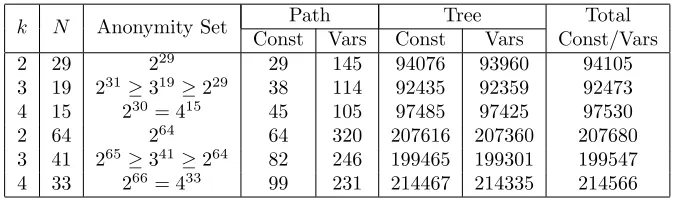
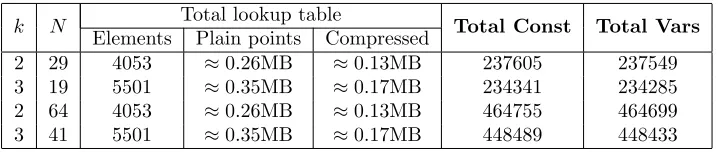
In Table 8 we summarize the costs for our system, but without counting the costs of the hash trees. Finally, in Table 9 we give the total costs for 2 and 3-ary hash trees and sizes of anonymity sets≈229 and 264.
To give a comparison with existing schemes we recall the cost estimates for ZCash [36] and the original Zerocoin paper [53] in Table 10. However, these costs include only the number of constraints (multiplication gates) and do not provide the number of variables. On the other hand, in practice the number of variables should approximately be the same as the number of multiplication gates.
w Scalar Lookup table Multiplication InvPRF InvPRF Const Vars Const Vars Const Vars
1 251 251 1252 1250 - - -
-2 252 504 1127 1125 4648 4644 4651 4647
3 252 672 1085 1083 4606 4602 4609 4605
4 252 1008 1316 1314 4837 4833 4840 4836
5 255 1632 1880 1878 5443 5439 5446 5442
6 252 2688 2891 2889 6412 6408 6415 6411
Table 1: Cost estimates for scalar multiplication, InvPRF and InvPRF+. For scalar multiplication at window sizew= 1 we summarize the cost forScalarMul. For all other window sizes we count the windowed versions of the operations. The scalar is of size log(p) = 251, however in the scalar column we rounded up the scalar to be divisible by the window sizew.
w Scalar Lookup table size Const Vars
2 252 1512 4529 4517
3 252 2016 4361 4349
4 252 3024 5285 5273
5 255 4896 7541 7529
Table 2: Cost of PK−Consistency with log(p) = 251 bit randomness rounded up to be divisible byw. Lookup table size includes tables forg, ¯g1, ¯g2, thus we
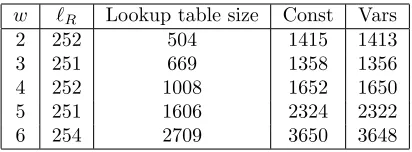
w `R Lookup table size Const Vars
2 252 504 1415 1413
3 251 669 1358 1356
4 252 1008 1652 1650
5 251 1606 2324 2322
6 254 2709 3650 3648
Table 3: Cost for the commitmentCommPwith `max= 64 and log(p) =`R =
251 bit randomness rounded up to be divisible byw.
w Bit input Lookup table size Const Vars
1 512 512 2560 2558
2 512 1024 2297 2295
3 513 1368 2216 2214
4 512 2048 2681 2679
5 515 3296 3804 3802
6 516 5504 5927 5925
Table 4: Cost for the hashWindowCRHFDLPwith 2(log(q) + 1) = 512 bit input rounded up to be divisible byw.
w Bit input Lookup table size Const Vars
1 768 768 3840 3838
2 768 1536 3449 3447
3 768 2048 3321 3319
4 768 3072 4025 4023
5 770 4928 5691 5689
6 768 8192 8825 8823
w Bit input Lookup table size Const Vars
1 1024 1024 5120 5118
2 1024 2048 4601 4599
3 1026 2736 4439 4437
4 1024 4096 5369 5367
5 1025 6560 7578 7576
6 1026 10944 11792 11790
Table 6: Cost for the hashWindowCRHFDLPwith 4(log(q)+1) = 1024 bit input rounded up to be divisible byw.
k N Anonymity Set Path Tree Total
Const Vars Const Vars Const/Vars
2 29 229 29 145 94076 93960 94105
3 19 231≥319≥229 38 114 92435 92359 92473
4 15 230= 415 45 105 97485 97425 97530
2 64 264 64 320 207616 207360 207680
3 41 265≥341≥264 82 246 199465 199301 199547
4 33 266= 433 99 231 214467 214335 214566
Operations Const Vars
2·PK−Consistency 8722 8698
2·InvPRF 9212 9204
2·InvPRF+ 9218 9210
4·Comm 5432 5424
4·H 8864 8856
16·SplitIntegerToBitfor splittingpkin,j,pkout,k,cin,j,cout,k for input toH
4096 4080
CheckBit for ˆskj, skjS, rin,j, rout,k, xin,j, ain,j, bin,j and the
coin values (rounded to fit the windoww= 3)
3784 3784
CheckValues 67 65
Other variables: pkin,j, pkout,k,cin,j, cout,k, sn
j,sn0j,cmin,j,
Xin,j, ˆpkj
0 18
Total: 49395 49339
Table 8: Size of the arithmetic circuit for our pour transaction without counting the hash trees.
k N Total lookup table Total Const Total Vars
Elements Plain points Compressed
2 29 4053 ≈0.26MB ≈0.13MB 237605 237549
3 19 5501 ≈0.35MB ≈0.17MB 234341 234285
2 64 4053 ≈0.26MB ≈0.13MB 464755 464699
3 41 5501 ≈0.35MB ≈0.17MB 448489 448433
Operations Const Checkcmold1 , cmold2 are in the Merkle tree for 29 levels 2·816669
Checkcmold1 , cmold2 are in the Merkle tree for 64 levels 2·1802304
(Cost of a single level) (28161)
Check computation ofsnold1 , snold2 2·27904
Check computation ofaoldpk,1, aoldpk,2 2·27904 Check computation ofcmold1 , cmold2 , cmnew1 , cmnew2 4·83712 Ensure thatv1new+vnew2 +vpub=vold1 +v
old
2 1
Ensure thatvold
1 +vold2 <264 65
Verifying the computation ofh1andh2 2·27904
Misc 2384
Total for k= 29according to [36]: 2138060
Total for k= 64according to [53]: 4109330
Table 10: The estimated number of constraints according to the ZCash specifi-cation [36] (smaller anonymity set) and the Zerocash paper [53].
5.3
Instantiation from SIS
In this section we describe an instantiation of the commitment scheme and CRHF using the Ajtai function [1]. First we recall some fundamental definitions.
Definition 20. A full-dimensional lattice in Rm is a discrete subgroup L =
{Bx: x∈ Zm}, where B = [~b1, . . . ,~bm] ∈Zm×m is a matrix of linearly
inde-pendent vectors. The matrix B is called the basis ofL. The rank of L is the rank ofB and if the rank equalm, the lattice is called full rank.
Definition 21. A lattice L is called a q-ary if qZ ⊆ L. For q ∈ N and A∈
Znq×m, we define the following q-ary’s.
Λ⊥q(A) ={~v∈Zm:A~v=~0 modq}.
Definition 22. Short Integer Solution (SIS) Givenn, m, q∈N, a matrix A∈ Znq×mchosen uniformly at random and a norm bound1≤β < q, theSISn,q,β,m
problem is to find~v∈Λ⊥q(A)with0<||~v|| ≤β.
Definition 23. Ajtai Hash Given n, m, q ∈ N, a matrix A ∈ Znq×m chosen
uniformly at random, the Ajtai hash function HA :{0,1}m →Znq is defined as
follows.
HA(~z)→A~z∈Znq.
It is easy to see that given a collision in the Ajtai hash, i.e. vectors~v1, ~v2∈ {0,1}ms.t. A~v
1−A~v2=~0, we may easily compute~v1−~v2=~v∈ {−1,0,1}m, s.t. A~v=~0. The vector~vis then the solution to theSISn,q,β,m, where 0< β≤
√
In order to evaluate the security level of lattice-based hash functions Mic-ciancio and Regev in [43] suggest to use a variant of the generalized birthday attack [14, 55], which has been used to choose parameters for the SWIFFT hash function [40]. The method solves the SIS problem for aq-ary Λ⊥q(A). We recall
this method at Algorithm 1.
Algorithm 1Combinatorial algorithm for SIS from [43, 40]. 1: procedureSIS-Solver(A∈Zn,mq , b∈N, k∈N)
2: Divide columns ofAin 2k groups [Ti∈Zm/2 k q ]2
k−1 i=0 .
3: for i∈ {0, . . . ,2k−1} do
4: Create a list L
0
i from linear combinations of columns inTi with
coefficients in{−b, . . . , b}. 5: end for
6: forj ∈ {0, . . . , k−1}do
7: fori∈ {0, . . . ,2k−j−1−1} do
8: For all ~x ∈ L
j
2·i and ~y ∈ L j
2·i+1, let ~z = ~x+~y = [~0 z~0]
t. If
dim(z~0) =log
q(2b+ 1)m/2 k
, then add~zto Lji+1. 9: end for
10: end for
11: Return the linear combination corresponding to the
~0 vector in Lk
0 if there is such.
12: end procedure
As shown in [43] the parameter k in Algorithm 1, is chosen such thatn ≈ (k + 1) logq(2b+ 1)m/2k
. Then, we can expect the list Lk
0 to contain a all
zero vector which is given by a combination of the columns of A bounded by b, hence with coefficients in {−1,0,1}. This combination is the desired short lattice vector. In our case we will only be interested in the caseb= 1.
Let us now, assess the complexity of Algorithm 1. After Step 2, we obtain 2k groups T
i ∈ Zm/2 k
q . This step is for free. Then we create 2k lists L0i, each
containing (2b+ 1)m/2k
linear combinations of the columns fromTi. Thus we
have to create 2k·(2b+ 1)m/2k vectors in Znq. Then we create a binary tree
from the leavesL0i. To create a parent node we sum two vectors from both its children nodes and add the summed vector if it starts with jlogq(2b+ 1)m/2k
zeros, wherej is the level of the tree. Note that the parent also contains around (2b+ 1)m/2k vectors. Since, we build a full-binary tree we have need to create 2k−1−1 nodes (not counting the leaves), thus going up the tree we need to create (2k−1−1)(2b+ 1)m/2k vectors giving us in total (2k −1)(2b+ 1)m/2k
vectors to create.
m n k (k+ 1) logq(2b+ 1)m/2 k
vectors
512 1 4 0.9944 ≈2254
512 2 3 1.5911 ≈2104
512 3 2 2.3867 ≈2204
768 1 5 0.8950 ≈242
768 2 4 1.4917 ≈279
768 3 3 2.3867 ≈2154
1024 1 5 1.1933 ≈255
1024 2 4 1.9889 ≈2105
1024 3 3 3.1823 ≈2205
Table 11: Cost of executing algorithm 1 for modulusq≈2255. In our case we are only interested inb= 1.
Kosba et al. in [38] gave an analysis for the SIS problem based on lattice reduction attacks. In more detail, they repeat the experiments from [49] on BKZ with modulusq= 2254and provide an estimate security level based on [2]
and [24]. We recall the method proposed in [38] for calculating the bit security in Algorithm 2.
Algorithm 2Calculating SIS bit security [38]. 1: procedureSIS-Bit(n, m, q, β)
2: Computedm∗← 2nlog(log(β)q)e. 3: Computeδ0←(qn/mβ ∗)
1/m∗.
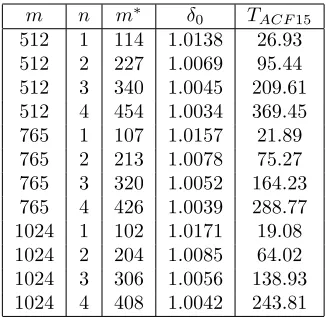
4: Compute BKZ2.0 estimation for TACF15(δ0).
5: end procedure
In Algorithm 2, the functionTACF15(δ0) introduced by Albreht et al. in [2]
is defined asTACF15(δ0) = 20.009/(log
m n m∗ δ0 TACF15
512 1 114 1.0138 26.93
512 2 227 1.0069 95.44
512 3 340 1.0045 209.61 512 4 454 1.0034 369.45
765 1 107 1.0157 21.89
765 2 213 1.0078 75.27
765 3 320 1.0052 164.23 765 4 426 1.0039 288.77 1024 1 102 1.0171 19.08 1024 2 204 1.0085 64.02 1024 3 306 1.0056 138.93 1024 4 408 1.0042 243.81
Table 12: Estimates for the security level according to Algorithm 2 for modulus q≈2255 andβ=√m.
The commitment scheme. Kawachi et al. [37] study the usability of the Ajtai hash as a statistically hiding commitment scheme. Let us consider the following construction.
SetupA(1`m,1`R, n
C, q) : The algorithm takes as input the message bit length
`m and the modulus and the output lengthnC. The algorithm chooses a
uniformly random matrix A ←R ZnC×`m+`R
q and outputs the parameters
pp= (A).
CommA(pp, m): Given the parameters pp and the messagem~ ∈ {0,1}`m, this
algorithm chooses ~r ← {R 0,1}`R uniformly at random, computes ~c ←
HA(~r||m~) and outputs the commitment~c.
The computationally binding property immediately follows from the collision-resistance ofHA. Kawachi et al. in [37] showed that the above construction is
also statistically-hiding for `m=`R and 2`m ≥10nClog(q). Let us recall the
definition of statistical distance.
Definition 24. Letφ1 andφ2 be probability density functions on a finite setS.
We define the satatistical distance betweenφ1 andφ2 as
∆(φ1, φ2) =
P
x∈S|φ1(x)−φ2(x)|
2 .
Their the analysis of statistical hiding from [37], the authors rely on a claim from [46], which we recall below.
Claim 1. LetGbe some finite Abelian group and let`be some integer. For any
` elements g1, . . . , g` ∈G consider the statistical distance between the uniform
of g1, . . . , g`. Then the expectation of this statistical distance over a uniform
choice ofg1, . . . , g` ∈G is at mostp|G|/2`. In particular, the probability that
this statistical distance is more than p4
|G|/2` is at most p4 |G|/2`.
In our case the modulusqwill be rather big and the requirement that 2`m≥
10nClog(q) makes the parameter choices rather impractical. For example, even
fornC = 1, we would have that`m= 1275, which is a huge waste. In our setting
we will set`m= 64. Then, we allow`Rto be a multiple of`m. In particular we
denote`R=c·`mfor somec∈N. Moreover, we will assume the`m= log(q)/4.
Taking the above into account we can write`R =c·log(q)/4. By Claim 1 we
have the following.
qnC 2`R
1/4
= qnC 2clog(q)/4
1/4
Letc= 4(4c0+ 1), for somec0∈N. Then
qnC 2clog(q)/4
1/4
= qnC
2(4c0+1) log(q)
1/4
= nC
2(4c0) log(q)
1/4
=
4
√
nC
qc0
Now we can estimate`R= (4c0+1)log(q). So the statistical distance between
CommA(pp, ~0) and the uniform distribution is ≤ 4
√
nC
qc0 . Equivalently we may
write that for `R = c·log(q)/4 bits of randomness, the statistical distance
is 4 √
nC
q(c−4)/16. Note, that in case the bits of the message would be distributed
uniformly, then we have `R +`max = clog(q)/2, and the the distance is ≤ 4
√
nC
q(c−2)/8. Hence, we may write that for any messagesm~ ∈ {0,1}
`max, the distance
ofCommA(pp, ~m) and the uniform distribution with high probability is at most
4
√
nC
qc0 , thus the statistical distance between commitments of two messages is as
most 24 √
nC
qc0 . At Table 13 we present the results of estimating the number of
random bits `R. In our calculation we take only small nC into account. In
particular nC ≤ 16, so we round up 4
√
nC ≤ 2. We denote the probability
Pstat(q, c0) = q2c0.
`max c0 Pstat(q, c0) `R m∗ δ0 TACF15
64 1/3 ≈2−84 594 327 1.0050 179.62 64 2/5 ≈2−101 663 322 1.0051 169.24
64 1/2 ≈2−126 765 316 1.0053 156.71
Table 13: Estimates for the number of randomness bits for modulusq≈2255.
The security parameter for binding is calculated form=`max+`RandnC= 3.
The Collision Resistant Hash. The hash function will simply be instan-tiated with HA. Here however the input to the hash is one point and the
We will use the same optimisation as in the DLP case and input only the compressed point toHA. In the DLP commitment version we have 2(log(q) + 1)
bit input. For the SIS based commitment the input to this hash function will be log(q) + 1 +nClog(q) bits.
Later we will need to define a hash function for the k-ary Merkle tree. In this case we will need to set the output of the hash to fit the requirements of a k-ary hash tree. In particular, the dimensions for A∈Znq×m, will be set to
n=kmlog(q).
Putting the SIS instantiation together. According to our security esti-mates a reasonable way to chose the parameternC andnfor the commitment
scheme and hash is nc = n= 3. The, we need to remember to count 3 split
gates for each commitment output. Then the commitment scheme will take as input in total 727 bits (`max = 64 and `R = 663). The hash H will take as
input (nC+ 1)·log(q) + 1 = 1021 bits (3nCelements inZq and one compressed
point). For a 2 and 3-ary binary tree be will instantiationHwith the same hash function as for the binary tree with a random public padding.
For the hash tree may consider to following parametrization for the Ajtai hash. For a binary tree n = 3 and m = 1530. For a 3-ary tree n = 3 and m= 2295. Finally, a 4-ary treen= 4 and m= 4080.
At Table 14, we show the security estimate for the above parameter choices.
m n m∗ δ
0 TACF15 k (k+ 1) logq(2b+ 1)m/2 k
vectors
727 3 322 1.0051 169.24 3 2.2593 ≈2145
1021 3 307 1.0057 139.17 3 3.1730 ≈2204
1530 3 290 1.0064 111.74 4 2.9718 ≈2154
2295 3 275 1.0071 90.89 5 2.6746 ≈2117
4080 4 341 1.0061 119.92 6 2.7736 ≈2105
Table 14: Estimates for the security level according to the combinatorial method at Algorithm 1 and Algorithm 2 for modulusq≈2255 andβ=√m.
5.4
Performance Estimates for SIS Instantiation
k N Anonymity Set Path Tree Total
Const Vars Const Vars Const Vars
2 29 229 29 116 44805 44631 44834 44747
3 19 231≥319≥229 38 95 44061 43947 44099 44042
4 15 230= 415 45 105 61860 61740 61905 61845
2 64 264 64 256 98880 98496 98944 98752
3 41 265≥341≥264 82 205 95079 94833 95161 95038
4 33 266= 433 99 231 136092 135828 136191 136059
Table 15: Cost of ak-ary Merkle tree instantiated with Ajtai hash withn= 3 for 2 and 3-ary trees andn= 4 for 4-ary trees. The path includes the nodes (hash outputs) and the control bits. The constraints on the path include verifying that the control bits are bits. The path verification has not been included in the total constraint number for the tree.
Operations Const Vars
2·PK−Consistency 8722 8698
2·InvPRF 9212 9204
2·InvPRF+ 9218 9210
4·Comm 12 0
4·H 12 0
20·SplitIntegerToBitfor splittingpkin,j,pkout,k,cin,j,cout,k for
input toH
5120 5100
CheckBit for ˆskj, skjS, rin,j, rout,k, xin,j, ain,j, bin,j and the
coin values (rounded to fit the windoww= 3)
5172 5172
CheckValues 67 65
Other variables: pkin,j, pkout,k,cin,j, cout,k, sn
j,sn0j,cmin,j,
Xin,j, ˆpkj
0 38
Total: 37535 37487

![Table 10: The estimated number of constraints according to the ZCash specifi-cation [36] (smaller anonymity set) and the Zerocash paper [53].](https://thumb-us.123doks.com/thumbv2/123dok_us/7985788.1324994/26.612.136.479.122.284/table-estimated-constraints-according-speci-smaller-anonymity-zerocash.webp)