Hybrid Shape Based Image
Retrieval-Performance Improvement Using Parallel
Processing
Girija G. Chiddarwar, S. Phani Kumar
Abstract: Shape-Based Image Retrieval (SBIR) is an image mining process which extracts images based on contents of the query image. SBIR is being used in several applications like medicine, digital libraries, biodiversity information systems, historical research, and crime prevention etc. Generally, SBIR is implemented using either local features (texture, color, intensity, etc.) or global features (edges, points, contours, shape, etc.). Computation of local features for image retrieval gives high precision but low performance; while computation using global features gives high performance by sacrificing precision. To overcome the limitation of local and global features, the proposed method uses hybrid technique. And to make SBIR faster, we tried towards adventure a GPU (graphics processing unit) to parallelize both feature extraction and the similarity matching process. Meanwhile GPUs have numerous processing units; we can apply enormous parallelism in both steps. In similarity matching process, locality sensitive hashing (LSH) is used to convert descriptors to bitsets, which is further used for similarity matching. To conclude, the proposed system has increased the accuracy, precision and retrieval performance as compared with other techniques.
Keywords: Shape Based Image Retrieval, Graphics Processing Unit, Locality Sensitive Hashing, Global descriptors, Local descriptors
————————————————————
1.
INTRODUCTION
In digital era of human life, multimedia has become a key conveyor of carrying information in diverse forms [1]. The driving force of internet has made netizens to upload and share billions of photos per day to socialize their presence on the huge platform [2]. Images are also being used for analysis in medical domain, astronomy and computer vision. Now-a-days, images are widely available and used by scientists for assessment of celestial bodies, too [3]. This thus adds huge amount to the already huge size of image databases. As of 2018, it was stated by online social media platform Facebook that over 300 million images are uploaded daily on it worldwide [4]. Due to such vast growth in number of images, designing an effective image retrieval system has always been a challenge for researchers [5]. Need of effective image retrieval system arose in computer vision where text based image retrieval systems cannot work effectively [6]. Describing the image with exact keywords or phrases becomes difficult when huge amount of images need to be searched for retrieval [7]. An efficient and advanced image retrieval scheme would be prepared to obtain pictures based on the resemblance of content between the query picture and the database picture. This requires the use of Content Based Image Retrieval (CBIR) technologies. [8]. Fulfilled Built Image Retrieval focuses on image satisfied rather than its description (metadata). Content within any image can be of three forms: a) Color of the object in the image, b) Texture of the object in foreground and c) Shape of the object. Of all, Shape Based Image Retrieval (SBIR) systems prove to be more efficient as shape is closer to Human Visual System (HVS) than the other two. Hence, the system which applies SBIR is closer to human eye than the system which applies the other two [9]. To implement SBIR, shape descriptors need to be extracted from the image. Shape descriptors again fall into two categories [10]:
A) Contour Based Shape descriptors:
These descriptors extract boundary information of the shape. Easy to compute, acquire and robust in representation known as “global” descriptors.
B) Region Based Shape descriptors:
These descriptors exploit the interior information of the object. It is weighty in computation but efficient than Contour based descriptors known as “local” descriptors [11].
This article proposes a technique to enhance the accuracy of the present SBIR schemes by implementing a Hybrid Descriptor whereas the SBIR in spatial domain is vulnerable to compression which restricts the quality and leads to geometric distortion and increases the need for filtering. Further, effort is made to improve the retrieval rate by decreasing the retrieval time by compact representation of descriptors and through parallel computation by exploiting Graphics Processing Unit (GPU).
2.
RELATED
WORK
In the system by Yousouf et.al. [12], a method is proposed which retrieves the pictures are based on the worldwide and local characteristics of the picture. The scheme is invariant with rotation, scaling and translation. The restriction of the current CBIR scheme is to decrease the recovery time when the amount of pictures in the database is large. In the method projected by Alsmadi et.al. [13], local besides global features are combined for efficient image retrieval. The result demonstrates filtering mechanism works efficiently than hybrid method for image retrieval based scheduled color and shape. CBIR system based on Locality Sensitive Hashing by Zheng et.al [14] exploits GPU for speeding up the image retrieval tasks. In this system dimension of the SIFT descriptor is reduced by using Locality Sensitive Hashing. The speed up achieved in this system is 2.9 times as compared to the parallel implementation on CPU while 55 times in comparison to the serial counterpart. Asha et.al [15] has implemented a CBIR scheme based on the descriptor Pyramid of this Histogram through Oriented Gradients (PHOG). They have stated an approach in which ________________________
Gitam University, Gitam School of Technology,
Rudraram, Patancheru Mandal, Hyderabad, Telangana, Sangareddy Dist- 502329
Gitam University, Gitam School of Technology,
enhancing edges of the image and division of image into blocks yields accurate results for PHOG than applying the algorithm without preprocessing the image. They have further stated that the image retrieval takes time due to just one thread running for the retrieval task. Hu et.al [16] have defined a picture retrieval machine for the interactive seek of image collections Use of free-hand drawings showing shapes. The Gradient Field HOG (GF-HOG) is described as an adapted form of the HOG descriptor appropriate for Sketch Based Image Retrieval (SBIR). We integrate GF-HOG into the Visual Words Bag (BoVW) recovery framework and demonstrate how this aggregate can be used both for powerful SBIR and for localizing sketched items inside an image. GFHOG focuses on trendy descriptors with common range measurements and language fashions for photography retrieval, and explores how the affine deformation of comic strip effects seeks to achieve general efficiency. GFHOG is shown to always outperform retrieval versus SIFT, HOG multi-resolution, Self-similarity, Shape Context and Structure Tensor. From the above the discussion of related work it is observed that the image retrieval process posses with many vital drawbacks such that in [12] retrieval time for huge image database is more so it reduces the performance and also in [13] the color and shape based retrieval without consideration of global features, in [14] Locality Sensitive Hashing and the speed up time has much more to get improved. Similarly, in [15] CBIR system based on PHOG which fails to provide accurate results in image retrieval and in [16] Gradient Field-HOG for better feature extraction which fails in outperformance consistently.
3.
PROPOSED
METHODOLOGY
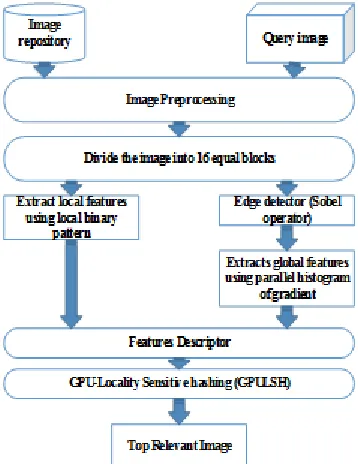
Content-based image retrieval Research has produced many results over the last decades. Starting with worldwide functions, then neighborhood characteristics, and currently with convolutionary neural networks, a wide range of visible record recovery issues have been difficult to investigate. The most significant advantage of extracting worldwide capacities while describing the content of the image is the low cost of single-function area computing. On the other side, global vectors, which basically contain statistics computed across the entire picture, often fail to discriminate between the constituent components of the photo. So as get far other than the discrimination inflicting factors the Shape based totally Image Retrieval (SBIR) for the process whereas the retrieval price to be must be stepped forward and further the retrieval time additionally to be stepped forward for this reason there is a want for retrieval image primarily based at the Contour and place features also it is needed to be consider for both. Thus new framework is formulated with consideration prolonged image retrieval. The architecture of the projected framework remains as exposed in Fig.1.
Figure 1: Construction of proposed SBIR system
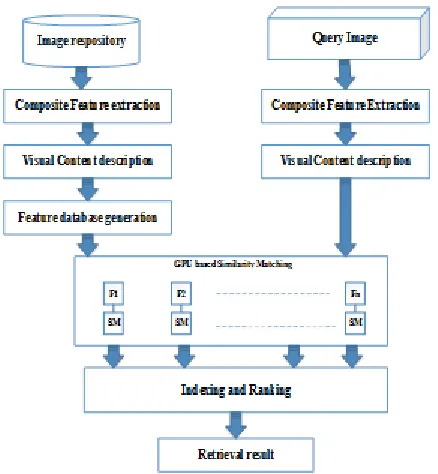
As shown in fig 1. Offline processing is a method in which the character descriptors are pre-calculated and stored in the database. When a query picture is sent to the scheme, its characteristics are obtained. Then both query image features and each database image features are compared using similarity measures. In proposed model similarity matching is divided among the massive number of processors present in Graphics Processing Unit (GPU), to reduce the time required for comparison when huge numbers of images are present in the database. The weightage given by the similarity measure algorithm is then used to rank each image. Based on rank top relevant images are displayed.
Fig.2 gives detailed view of the architecture along with the methods used at each step:
Each block of Fig.2 is described in detail as below:
a. Preprocessing:
Before feature extraction image preprocessing is done. These include image standardization, scaling and transformation to generate uniform feature vectors. The image is also divided into 16 blocks of equal size to increase the accuracy of the image representation in the vector feature.
b. Pyramid of Histogram of Oriented gradients(PHOG):
Figure 2: Architecture of proposed SBIR system with methods
In pyramid HOG, the picture is decomposed into a series of increasingly fine sub-regions called cells at several pyramid concentrations. In this way, level l of the pyramid has 2L of cells, and at each stage the cells have distinct grid resolutions. The PHOG descriptor is then produced by mixing the histogram of the orientation of the edge of each cell. HOG vector for each cell (a sub-region) is calculated. Here the local shape is defined by the events of edge orientation in cells at each stage. Thus, PHOG reflects both the direction of the edge and the place. In addition, the PHOG descriptor is able to detect even a slight shift in the form of the object in the picture. When constructing a pyramid, the picture at level l is split into 2l cells along both directions of the 2D axis. As a result, level 0 is represented by the K-vector corresponding to the K bins of the histogram, level 1 by the 4K-vector, and so on. Thus, the PHOG descriptor of the entire image is a vector of size* 4l L K. For example, for levels up to L= 3 and K= 9 bins, the PHOG descriptor dimension will be 765. The PHOG descriptor is normalized to compensate for illumination by unit.This provides the 10,880-element size vector function.
c. Local Binary Pattern:
Local Binary Pattern (LBP) represent local features of the image. This local representation is computed by comparing each pixel with its surrounding fixed number of pixels (usually 8). To extract efficient descriptors, image is first converted to grayscale. Then a neighborhood of the pixel is selected; it can be called as radius of the pixel. The pixel value less than the central pixel value are marked as “1” while those greater as “0”. The resulting 8-bit array (for r=8) is then arranged and place values of all 1 in the binary array are added. The pixel value is then replaced by the now calculated value. Fig. 3 illustrates the procedure clearly.
Figure 3: Local Binary Pattern illustration
This gives feature vector of size 416 elements.
d. Hybrid appraoch:
To get the best of both the algorithms, the feature vectors obtained from both are appended to form a hybrid descriptor. This improves the accuracy of image retrieval and image representation.
Figure 4: Hybrid vector of both features
These two features are extracted and then appended to obtain the descriptor vector of total 11,296 elements.
e. Locality Sensitive Hashing
Locality-sensitive hash (LSH) decreases the dimensionality of high-dimensional information. One of the simplest ways to build your own LSH family is by using bit sampling. This method is used for Hamming distance over d-dimensional vectors (0, 1). Here, the family of hash functions is truly the circle of parents of all predictions of points on one of the coordinates, i.e.
F={h:{0,1}d-> {0,1}|h(x)=xi} for some i€{1,….,d} (1)
Where, xi is the Ith of x.
Features from the query image are converted into bitsets, for representing features into binary format. Following steps are undertaken:
(a) A random hyper plane is generated.
(c) Each value in the vector is checked against a condition. If value is greater than 0, then resulting value becomes 1 else 0 as shown in Equation 1.
In offline phase these bitsets are stored in database.
The feature vector size of 11,296 is reduced to 10, 000 bits using Locality Sensitive Hashing.
f. Similarity Matching
Bitsets obtained for the query image are then matched with the pre-stored bitsets. This matching is done through following steps:
a). To increase the efficiency for matching, pre-stored bitsets are then transferred to GPU.
b). Bitsets of Query images are then matched with database bitsets.
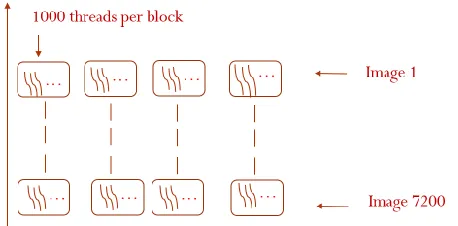
c). To achieve fast processing, logical mapping of bitsets to blocks is done.
d). This logical mapping is done by dividing each binary feature vector to 10 logical blocks along x-axis, each block consisting of 1000 bits.
e). Similar method is applied to each binary feature vector stored in database. Therefore, we obtained the logical representation consisting of 10 blocks along x axis for each feature vector and along Y-axis, number of rows is equal to database images.
f). Each thread then does a bit-by-bit X-ORing of the bit at respective position and update the global memory count if the respective bits are same.
g). In this procedure, similarity count of all images are obtained.
h). Of the relevant, top 100 are retrieved.
i). On these 100, Braycurtis similarity matching algorithm is applied with respect to query image. From these, top 12 are displayed.
Figure 5: Logical representation of mapping of threads on GPU
4.
RESULTS
To evaluate the system, Columbia Object Image Library-100 dataset exploited. It consists of 7200 images in total of 100 objects. Each object is kept in dark background and rotated by 5 degrees each time the picture is clicked, until it again reaches its original position. This gives 72 images of 100 objects, thus 7200 in total. To evaluate the performance of parallel system, NVidia GeForce GPU was used. It has 6 Multi-processors with 768 cores and 2 GB of global memory. The objects in the dataset are divided into following 5 categories and then the algorithms are evaluated:
Table 1: Precision and recall of proposed system Category Precision (%) Recall (%)
Category 1 72 80
Category 2 95 35
Category 3 84 70
Category 4 100 15
Category 5 100 10
The precision and recall of the proposed system is depicted in terms of categories where the category 1 has the precision value of about 72% and recall of about 80%. Similarly, the categories 2 consist of precision value of 95% and recall value of 35. Category 3 has precision and recall value of about 84 and 70 and also the category 4 has precision and recall value of about 100 and 15 whereas for the category 5 the precision and recall is given as 100 and 10 and the corresponding plot is given along the Figure 6.
Table 2: Comparison of individual algorithms and proposed system
Category Precision
LBP PHOG Hybrid approach (proposed approach)
Category_1 49 48 72
Category_2 59 95.5 95
Category_3 82.2 100 84
Category_4 64.8 85.3 100
Category_5 97.7 100 100
Average accuracy
73.1 85.82 90.2
Figure 6: Precision vs. Recall
Figure 7: Speed up achieved by proposed system on images of count 7200
5.
CONCLUSION
Image retrieval based on image content has become an important requirement due to the enormously increasing amount of application fields where image search is obvious. The article suggested a SBIR with a hybrid descriptor technique for the extraction of characteristics that are rotation, scale and translation invariant, based on decomposition and singular value of shape data. This study is applied to the Retrieval System and achieves the success of the retrieved large amount of appropriate images. Further in proposed model, features extraction and similarity matching is carried out on Graphics Processing Unit (GPU), to reduce the time required for comparison when huge numbers of images are present in the database.
REFERENCES
[1] Acharyya, Mausumi, and Malay K. Kundu. ”An adaptive approach to unsupervised
[2] texture segmentation using M-Band wavelet transform.”, Signal Processing 81.7 (2001):1337-1356.
[3] Castelli, Vittorio, Alexander Thomasian, and Chung-Sheng Li. ”CSVD: Clusteringand singular value decomposition for approximate similarity search in high-dimensionalspaces.”, IEEE Transactions on
knowledge and data engineering 15.3 (2003): 671-685.
[4] ]Celebi, M. Emre, and Y. Alp Aslandogan. ”A comparative study of three moment-basedshape descriptors.”Information Technology: Coding and Computing, 2005. ITCC 2005.International Conference on. Vol. 1. IEEE, 2005.
[5] Chaux, Caroline, Laurent Duval, and J-C. Pesquet. ”Image analysis using a dual-treeM-band wavelet transform.”,IEEE Transactions on Image Processing 15.8 (2006): 2397-2412.
[6] Do, Yen, et al. ”Image retrieval using wavelet transform and shape decomposition.”,Proceedingsof the 7th International Conference on Ubiquitous Information Management and Communication.ACM, 2013.
[7] mage Database:
COIL-100.http://www1.cs.columbia.edu/CAVE/software/sof tlib/coil-100.php.
[8] Jian, Muwei, and Liang Xu. ”Trademark image retrieval using wavelet-based shapefeatures.” Intelligent Information Technology Application Workshops, 2008. IITAW’08.International Symposium on. IEEE, 2008.
[9] Kokare, Manesh, P. K. Biswas, and B. N. Chatterji. ”Rotation-invariant texture imageretrieval using rotated complex wavelet filters.”IEEE Transactions on Systems, Man, andCybernetics, Part B (Cybernetics)36.6 (2006): 1273-1282.
[10] Leila Kabbai, Mehrez Abdellaoui,Ali Douik. ”Content Based Image Retrieval using Lo-Dept. of Computer Engineering, SCOE 53 2017-18Hybrid Shape Based Image Retrieval-Performance Improvement using Parallel Processing G26cal and Global features descriptor,2nd International Conference on Advanced Technologiesfor Signal and Image Processing - ATSIP’2016 March 21-24, 2016, Monastir, Tunisia.
[11] Likas, Aristidis, Nikos Vlassis, and Jakob J. Verbeek. ”The global k-means clusteringalgorithm.”,Pattern recognition,36.2 (2003): 451-461.
[12] Lin, Chuen-Horng, Rong-Tai Chen, and Yung-Kuan Chan. ”A smart content-basedimage retrieval system based on color and texture feature.”,Image and Vision Computing.
[13] Yousuf, M., Mehmood, Z., Habib, H.A., Mahmood, T., Saba, T., Rehman, A. and Rashid, M., 2018. A novel technique based on visual words fusion analysis of sparse features for effective content-based image retrieval. Mathematical Problems in Engineering, 2018.
[14] Alsmadi, M.K., 2018. Query-sensitive similarity measure for content-based image retrieval using meta-heuristic algorithm. Journal of King Saud University-Computer and Information Sciences, 30(3), pp.373-381.
[15] Zheng, L., Yang, Y. and Tian, Q., 2018. SIFT meets CNN: A decade survey of instance retrieval. IEEE transactions on pattern analysis and machine intelligence, 40(5), pp.1224-1244.
Conference on Advanced Computing and Communication Systems (pp. 1-5). IEEE.
[17] Hu, R. and Collomosse, J., 2013. A performance evaluation of gradient field hog descriptor for sketch based image retrieval. Computer Vision and Image Understanding, 117(7), pp.790-806.
[18] https://github.com/kayzhu/LSHash
[19] http://scikit-learn.org/stable/tutorial/index.html [20] https://bitbucket.org/rpetek/phog-descriptor/src [21]