CONCEPTUALISATION OF ABNORMAL BEHAVIOUR AMONG RESIDENTS OF KIBERA INFORMAL SETTLEMENT IN NAIROBI COUNTY, KENYA:
IMPLICATIONS FOR MENTAL HEALTH INTERVENTIONS
NTHANGI AGNES C82/11345/08
A THESIS SUBMITTED TO THE SCHOOL OF HUMANITIES AND SOCIAL SCIENCES IN FULFILMENT OF THE REQUIREMENT FOR THE AWARD OF THE DEGREE OF DOCTOR OF PHILOSOPHY (COUNSELLING PSYCHOLOGY)
OF KENYATTA UNIVERSITY
ii
DECLARATION
This thesis is my original work and has not been presented for a degree in any other University or any other award.
--- ---
Signature Date
Nthangi Agnes
Department of psychology
We confirm that the work reported in this thesis was carried out by the candidate under our supervision
--- ---
Signature Date
Dr. Christine Wasanga
Department of Psychology Kenyatta University
--- ---
Signature Date
Dr. Merecia Sirera
iii
DEDICATION
iv
ACKNOWLEDGEMENTS
This has been a laborious academic journey to which I owe my gratitude to several entities. First, I am grateful to the almighty God for granting me the gift of life and for keeping me safe and healthy for the entire duration that I worked on this thesis. Secondly, I would wish to appreciate several people who made it possible for me to complete this work.
I would wish to sincerely appreciate the invaluable input of my two supervisors Dr. Christine Wasanga and Dr. Anne Merecia Sirera of the Department of Psychology, Kenyatta University. My two supervisors selflessly accorded me professional guidance, support and understanding throughout this journey. Indeed, I am greatly indebted to them for their patience. I would also wish to thank Dr. Khasakhala Lincoln of Daystar University for giving me valuable guidance during the initial proposal writing stages. My Head of Department Dr. Beatrice Kathungu gave me untiring support and encouragement throughout this journey.
v
My gratitude also go to Kenyatta University for paying my fee through the staff development initiative and to the dean‘s grant initiative for funding my data collection exercise. I am also grateful to the National Council for Science and Technology and Innovation (NACOSTI) for granting me the research permit to collect data in Kibera informal settlement. My sincere thanks go to chief Omollo and elder Maureen both of Kibera informal settlement for the incredible assistance they accorded me in mobilising the respondents for this study. I thank my research assistants for their dedication, commitment and patience during the data collection exercise. Special thanks go to all the residents of Kibera who participated in this study by filling in questionnaires or by giving input in the various Focus Group Discussions.
vi
TABLE OF CONTENTS
DECLARATION……….………..…….….... ii
DEDICATION ………...……….…….…….….iii
ACKNOWLEDGEMENTS ……….………...v
TABLE OF CONTENT………………..…...…vi
LIST OF TABLES………...…...x
LIST OF FIGURES………...xii
OPRATIONAL DEFINITIONS OF TERMS ………...……..…..xiii
ABBREVIATIONS AND ACRONYMS ……….…..………....xiv
ABSTRACT………... xv
CHAPTER ONE: INTRODUCTION 1.1 Background to the Study………....1
1.2 Statement of the Problem……….…..9
1.3 Purpose of the Study………....10
1.4 Objectives of the Study………....10
1.5 Research Questions………..…....10
1.6 Research Hypothesis……….……….………..…....11
1.7 Justification and Significance of the Study………...11
1.8 Scope and Limitations of the Study………...…….…………..…...13
1.9 Assumptions of the Study………14
CHAPTER TWO: LITERATURE REVIEW 2.1 Introduction……….…….……..…………...15
vii
2.2.1 Biopsychosocial Model of Abnormal Behaviour………….………...15
2.3 Review of Related Studies ………..………19
2.3.1 Nature of Abnormal behaviour………...………..………...19
2.3.2 Causes of Abnormal Behaviour………...…….……….………..….…...25
2.3.3 Treatment Interventions for Abnormal Behaviour………...……….…...30
2.3.4 Sociodemographic Variables and Abnormal Behaviour ……….34
2.4 Measures to Reduce Abnormal Behaviour ……….…36
2.5 Summary of Literature Review………....38
2.6 Conceptual Framework………....40
CHAPTER THREE: RESEARCH METHODOLOGY 3.1 Introduction……….……42
3.2 Research Design………...42
3.3 Study Variables……….….…..43
3.4 Location of the Study………...………...….……...43
3.5 Target Population………...44
3.6 Sample Size and Sampling Techniques………..………..…...44
3.7 Research Instruments………...……….…….…..47
3.8 Validity and Reliability of the Instruments………...………….………..48
3.8.1 Validity……….………...………....48
3.8.2 Reliability……….………..….…….49
3.9 Pilot Study………50
3.10 Data Collection Procedures………..………....51
viii
3.12 Data Management and Ethical Considerations………..…………..……....55
CHAPTER FOUR: DATA PRESENTATION, ANALYSIS AND DISCUSSION 4.1 Introduction………..………....56
4.2 Demographic Characteristics of Respondents ……….………...57
4.2.1 Gender of the Respondents …….………...….57
4.2.2 Age of Respondents………... ………..………...57
4.2.3 Level of Education of the Respondents ……….………...58
4.2.4. Ethnicity of the Respondents………...……..………. 59
4.3.5 Religion of the Respondents …………..……….………...…….…60
4.2.6 Occupation of the Respondents………...61
4.2.7 Residential Village of the Respondents………..…….61
4.3 Findings of the Study………..62
4.3.1 Conceptualisation of the Nature of Abnormal Behaviour………...63
4.3.2 Conceptualisation of the Causes of Abnormal Behaviour………..……….74
4.3.3 Sociodemographic Variables and Conceptualisation of Abnormal Behaviour……...87
4.3.3.1 Gender and Conceptualisation of Abnormal Behaviour …….………88
4.3.3.2 Age and Conceptualisation of Abnormal Behaviour……….………….………...….92
4.3.3.3 Education and Conceptualisation of Abnormal Behaviour………...…..…96
4.3.4. Conceptualisation of Treatment Interventions……… …….………….104
4.3.5 Conceptualisation of Causes and Treatment Interventions Sought….. ………111
ix
CHAPTER FIVE: SUMMARY, CONCLUSIONS AND RECOMMENDATIONS
5.1 Introduction……….…………..………...123
5.2 Summary of the Findings ……….……….…....124
5.3 Conclusions of the Study ………...……...129
5.4 Recommendations of the Study………..………...131
5.4 Suggestions for Further Research………...…………...…………...133
REFERENCES………..….135
APPENDICES Appendix 1: Questionnaire………..…...………...143
Appendix 2: Focus Group Discussion Guide………..………..147
Appendix 3: Position of Kibera in Nairobi County………..….149
Appendix 4: Residential Villages in Kibera……….………..…………...150
Appendix 5: Results on Conceptualisation of Nature of Abnormal Behaviour...151
Appendix 6: Results on Conceptualisation of Causes of Abnormal Behaviour………153
Appendix 7: T-Test Results on Gender and Nature of Abnormal Behaviour ……….……154
Appendix 8: ANOVA Test Results on Age and Nature of Abnormal Behaviour………….155
Appendix 9: ANOVA Test Results on Education and Nature of Abnormal Behaviour…..156
Appendix 10: ANOVA Test Results on Religion and Nature of Abnormal Behaviour……157
Appendix 11: ANOVA Test Results on Religion and Causes of Abnormal Behaviour….158 Appendix 12: ANOVA Test Results on Ethnicity and Nature of Abnormal Behaviour…..159
x
LIST OF TABLES
Table 3.1: Questionnaire Sample Distribution by Level of Education and Gender……...….46
Table 3.2: FGDs Sample Distribution by Ethnicity and Gender……….……...47
Table 3.3: Cronbach's Alpha Reliability Statistics………...50
Table 4.1 Distribution of Respondents by Gender……….………..………….….57
Table 4.2: Distribution of Respondents by Age………..…58
Table 4.3: Distribution of Respondents by Level of Education………...58
Table 4.4: Distribution of Respondents by Ethnicity………...59
Table 4.5: Distribution of Respondents by Religion…………...………..…………...60
Table 4.6: Distribution of Respondents by Occupation………...………....61
Table 4.7: Distribution of Respondents by Residential Village ………...62
Table 4.8: Conceptualisation of the Nature of Abnormal Behaviour………..……....64
Table 4.9: Conceptualisation of the Nature of AB by and Mean Scores……….……....67
Table 4.10: Conceptualisation of the Causes of Abnormal……….75
Table 4:11: Conceptualisation of Causes of AB by Mean Scores……….………...77
Table 4.12: T-Test Results on Gender and Nature of Child Developmental Disorders……..89
Table 4.13: T-Test Results on Gender and of Causes of Abnormal Behaviour…………...90
Table 4.14: ANOVA Test Results on age and Causes of Abnormal Behaviour…………...93
Table 4.15: Scheffe‘s Post Hoc Test on Age and Conceptualisation of Scientific Causes……….….94
Table 4.16: Scheffe‘s Post Hoc Test on Age and Conceptualisation of Non-Scientific Causes……..95
Table 4.17: ANOVA Test on Education and Causes of Abnormal Behaviour………..…...….100
Table 4.18: Scheffe‘s Post Hoc Test on Education and Scientific Causes………..101
xi
xii
LIST OF FIGURES
xiii
OPERATIONAL DEFINITIONS OF TERMS
Abnormal behaviour: Behaviour that departs from some norm and that harms the affected individual or others; behaviour symptomatic of mental disorder/illness; also mental disorder/mental illness.
Conceptualisation: The act of forming an idea on a given concept out of observation or experience; or how a given concept is understood.
Circular causality: A causal pattern that involves more than one factor
Informal settlement: A district of a city or town which is characterised by inferior living conditions and usually by overcrowding.
Misconception/
Misconceptualisation: A false or mistaken view, opinion or attitude about a concept.
Mental disorder/illness: Arrested or incomplete development of the mind or disability of the mind; a recognisable pattern of abnormal behaviour.
Mental health: Absence of a mental disorder/ illness/abnormal behaviour.
Nature of abnormal Diagnostic symptoms of mental illness/disorder
behaviour:
Non-Scientific Causes: Supernatural causes based on the supernatural model of abnormal behaviour.
Normal behaviour: Behaviour that is not indicative of mental disorder/illness.
Psychotic Behaviour: Behaviour that indicates an individual is not in touch with reality
xiv
ABBREVIATIONS AND ACRONYMS
APA: American Psychiatric Association
AB: Abnormal Behaviour
ANOVA: Analyses of Variance
BPS: Biopsychosocial
CDD: Child Developmental Disorders
DSM: Diagnostic and Statistical Manual of Mental Disorders
DSM-IV-TR: Diagnostic and Statistical Manual of Mental Disorders, Fourth Edition, Text Revised.
ECT: Electo-Convulsive Therapy.
FGDs: Focus Group Discussions.
GAD: Generalized Anxiety Disorder.
HICs: High Income Countries.
LMICs: Low and Middle Income Countries.
MDD: Major Depressive Disorder.
SPSS: Statistical Package for Social Sciences.
UN United Nations.
UN-HABITAT: United Nations Human Settlement Programme.
xv
ABSTRACT
Abnormal behaviour is on the increase globally, with one in every four persons in the world expected to be afflicted by one form of a mental or neurological disorder at some point in their lives. Although great advancements have been made in its understanding and treatment, abnormal behaviour is still misconceptualised by many individuals, sub-cultures and cultures world-wide. The purpose of this study was to investigate how abnormal behaviour is conceptualised by residents of Kibera informal settlement in Nairobi County, Kenya; and how this conceptualisation influences the mental health interventions sought by the residents. The Biopsychosocial (BPS) model of abnormal behaviour and the Fourth Edition (revised text) of Diagnostic and Statistical Manual of Mental Disorders (DSM-IV-TR) informed the formulation of research objectives and instruments. A cross-sectional survey design employing a mixed concurrent triangulation method of data collection was adopted for the study. Quantitative data was gathered via a researcher-generated questionnaire while qualitative data was generated via a focus group discussion (FGD) guide. Purposive, stratified, simple random and snowball sampling techniques were used to select 433 study participants. The Statistical Package for Social Sciences (SPSS) aided in the analysis of quantitative data from the questionnaire; which were subjected to descriptive analysis using percentages, frequencies and mean scores; and inferential statistical analysis using Independent T-tests, one way Analysis of Variance (ANOVA) test and subsequent Post-Hoc test; and Pearson Correlation Coefficient (r) test. Textual thematic analysis was done for qualitative data from FGDs. The study established a substantial misconception of the nature of abnormal behaviour (Mean=29.36); an average support for scientific psychosocial causes (Mean=54.39) and a causal misconception (Mean=74.07). Gender variable significantly influenced how the nature of child developmental disorders was conceptualised (t=2.639,df=382,p=0.009). Gender, age, and level of education variables significantly
influenced how scientific causes of abnormal behaviour were conceptualised (t=-3.983,df=383,p<0.001), (F(3,381)=5.547,p=0.001), F(3,381)=4.240,p=0.006); while age
1
CHAPTER ONE
INTRODUCTION
1.1 Background to the Study
Across history and cultures, people have attempted for years to explain and treat abnormal behaviour (Berrios, 1996; Lefley, 1998; Roy, 2002; Sue & Sue 2004). This natural trend has resulted to multifaceted culture-based beliefs and assumptions about what abnormal behaviour is, what causes abnormal behaviour and what treatment interventions should be adopted for abnormal behaviour (Berrios, 1996; Lefley, 1998; Roy, 2002; Sue & Sue 2004). For example, behaviours predominantly conceptualised as abnormal by ancient Egyptians included hysteria, disordered attention and melancholia, which they attributed to demon possession. Treatment interventions adopted included drugs, applying of bodily fluid, therapeutic retreats, music and exorcism (Mohit, 2001; Millon, 2004). On the other hand, behaviours predominantly conceptualised as abnormal by ancient Greeks included aimless wondering, delusions and violence which they attributed to gods, imbalanced humors or circumstances. Treatment interventions adopted included drugs, talking therapy, blood-letting, incubation, exorcism and torture methods such as stoning, starvation and beatings (Mohit, 2001; Millon, 2004). While these culture-based views and assumptions on the nature, causes and interventions for abnormal behaviour were and are still important in helping societies to deal with the problem of mental illness (Roy, 2002), they do not capture the holistic scientific essence of abnormal behaviour due their contextualised nature (Berrios, 1996; Roy, 2002; Sue & Sue, 2004) hence they amount to misconception.
2
& Lisa 2005; Sue & Sue 2004), great scientific advancements have been made in understanding of the concept. Modern science has defined, explained and highlighted treatment interventions for abnormal behaviour; and huge success in its diagnosis and treatment based on the scientific criterion continue to be recorded (Bennett, 2003; Comer, 2006; Davison, 2008; Hansell & Lisa 2005; Sue & Sue, 2004). Proper conceptualisation of abnormal behaviour therefore entails an understanding of the nature and causes of abnormal behaviour on the basis of the established scientific criterion; while misconception means an understanding of the nature and causes of abnormal behaviour that deviates from the established scientific criterion (Bennett, 2003; Comer, 2006; David & Vincent, 2004; Davidson, 2008; Hansell & Lisa 2005; Sue & Sue, 2004). The World Health Organisation (WHO, 2005) observed that mostly due to lack of knowledge on the scientific basis of abnormal behaviour and deeply-rooted cultural beliefs, misconception of abnormal behaviour is common in many cultures of the world especially in the low and middle income countries (LMICs). Regrettably, misconception of the concept is associated with seeking of improper treatment interventions, belated scientific intervention and non-intervention for mental illness (Aino, 2004; Deribew & Tamirat, 2005; Martin, Andreoli, Pinto, Hourneaux, Barreira, 2011; Nsereko, Kizza, Kigozi, Ssebunnya, Flisher, Cooper, 2011; Sorsdahl, Flisher, Wilson &Stein, 2000) which heightens the suffering for victims of mental illness.
3
integrated definition which views abnormal behaviour from three vintage points: that of the individual, that of the society and that of the mental health professional (Sue & Sue, 2004). Abnormal psychologists however agree that though each of these definitions give an insight on what constitutes abnormal behaviour, none of them can provide a holistic basis for conceptualising the nature of abnormal behaviour as none is complete in itself (Sue & Sue, 2004; Comer, 2006; Davidson, 2008). Yet, a holistic conceptualisation of the nature of abnormal behaviour is essential in curbing non-intervention for mental illness (de Boer et al., 2008; WHO, 2008).
In view of the above limitations, abnormal psychologists recommend a definition that encompasses the various criteria for abnormal behaviour as a basis for proper conceptualisation of its nature (Bennett, 2003; Sue & Sue, 2004). Consequently, they support the definition that conceptualises abnormal behaviour as ‗a behaviour that departs from some norm and that harms the affected individual or others,‘ (Sue & Sue, 2004, p. 11). This definition tallies with that of the Diagnostic and Statistical Manual of Mental Disorders (DSM) which defines abnormal behaviour as ―a clinically significant behavioural or psychological syndrome or pattern that occurs in an individual that is associated with present distress (for example, a painful symptom) or a disability (that is, impairment in one or more important areas of functioning) or with a significantly increased risk of suffering death, pain or disability, or an important loss of freedom‖ (4th ed., text rev.; DSM–IV–TR; American Psychiatric Association (APA), 2000).
4
conceptualised (Bennett, 2003; Comer, 2006; Davidson, 2008; David & Vincent; Hansell & Lisa 2005; Sue & Sue, 2004). Thus, misconception of the nature of abnormal behaviour occurs when single culture specific criteria, rather than the DSMcriterion, are used to conceptualise abnormal behaviour (Roy, 2002; Sue & Sue, 2004). Roy (2002) and Sue & Sue (2004) observed that the use of single culture-based criteria in conceptualising abnormal behaviour is common in many cultures; implying that misconception of the nature of abnormal behaviour is still prevalent in many cultures worldwide. Yet, proper and timely treatment interventions for mental illness can only be sought if proper holistic conceptualisation of the nature of abnormal behaviour is achieved by individuals and cultures.
5
misconception still persists as evidenced by current studies. For example, Sorsdahl et al. (2000) established that only psychotic behaviours were viewed as abnormalby traditional healers in Mpumulanga, South Africa. Similar findings were also established by Aino (2004) in West Africa, Deribew & Tamirat (2005) in Ethiopia, Gureje, Lasebikan, Ephraim, Olley & Kola (2005) in Nigeria and Mburu, (2007) in Karatina Kenya. In these studies, no treatment intervention was sought for people manifesting non-psychotic behaviours. These findings raise a pertinent concern that there could be many individuals across cultures manifesting non-psychotic symptoms of mental illness; yet these individuals are not helped to access any form of mental health intervention because they are not perceived to be mentally ill. Moreover, abnormal psychologists observe that non-psychotic symptoms if left unattended may develop into full blown psychotic disorder (Ndetei, 2008; Smith, Weston, Lieberman, 2010). WHO (2008) observed that misconception of abnormal behaviour is one factor accounting for the high treatment gap for mental illness which is currently estimated at 76-85% for Low and Middle Income Countries (LMICs) and 35-50% for High-Income Countries (HICs). Yet proper conceptualisation of the nature of abnormal behaviour could enhance proper intervention and help avert the ever increasing disastrous outcomes associated with non-intervention for mental illness which include disabilities, homicide, death and huge economic burdens to families and nations (de Boer et al., 2008; WHO, 2008, 2010).
6
& Sue, 2004). Recommended treatment interventions include drug therapy within conventional medical facilities or psychotherapy within clinical settings or more effectively, a combination of the two interventions (Engel, 1970; Rosenthal, 1970; Slade, 2002; Smyth,1999; Sue & Sue, 2004). Proper conceptualisation of the causes of abnormal behaviour entails an understanding that abnormal behaviour results from both scientific biological causes and scientific psychosocial causes. Consequently, unholistic conceptualisation of causes occurs when only when one category of factors (either biological or psychosocial) is understood to cause abnormal behaviour (Engel, 1977, 1980; Slade, 2002; Smyth,1999; Sue & Sue, 2004). Engel (1977, 1980) observed that holistic intervention for mental illness can only be sought if abnormal behaviour is conceptualised on the basis of a holistic biopsychosocial etiology.
7
extreme treatment interventions resulted to immense physical and emotional suffering, disability and even death of the victims (de Boer et al., 2008; Sue & Sue, 2004; WHO, 2008). Studies indicate that this form of causal misconception (where abnormal behaviour is attributed to supernatural causes) still persists in many cultures (Aino, 2004; Gureje, et al., 2005; Kapungwe, et.al., 2010; Mburu, 2007; Nsereko, et al., 2011; Teferra&Shibre, 2012); implying that victims of mental illness in many cultures still continue to be subjected to the aforementioned debilitating treatment interventions. Yet, proper conceptualisation of what causes abnormal behaviour by individuals and cultures can arrest this unfortunate trend.
8
conjectured that this adverse characterlogy of informal settlements influences how residents of informal settlements conceptualise abnormal behaviour. However, littleinformationis available to support or dispute this claim which further rouses the curiosity for this study. Moreover, WHO (2008) observed that the adverse characterlogy of informal settlements makes residents of informal settlements more vulnerable to abnormal behaviour compared to other populations as these adverse conditions act as precipitating causes of abnormal behaviour. This observation is supported by studies on prevalence of abnormal behaviour in informal settlements which record a high prevalence of abnormal behaviour in informal settlements across the world. For example, Ezpeleta, Guillamón, Granero, de la Osa, María &Moya (2007), Martin, Andreoli, Pinto, Hourneaux, & Barreira (2011) and Puertas, Ríos &del Valle (2006) established a high prevalence of abnormal behaviour among residents of informal settlements in Columbia (27%), Brazil (44%) and Spain (30%) respectively. Moreover, Ndetei & Aillon (2010) found out that more than 50% of patients attending Ruaraka Uhai Neema Hospital (a hospital integrating psychiatric basic care and attending to residents of informal settlements in Nairobi, Kenya) had abnormal behaviour. In view of this high prevalence of abnormal behaviour in informal settlements, the need for proper conceptualisation of the concept by residents of informal settlements cannot be overemphasized; hence the choice of Kibera informal settlement as the site for this study.
9
health interventions sought by the residents. This study is thus an endeavour by the researcher to investigate this pertinent concern.
1.2 Statement of the Problem
10
1.3 Purpose of the Study
The purpose of this study was to investigate how abnormal behaviour is conceptualised by residents of Kibera informal settlements of Nairobi County, Kenya; and to establish how this conceptualisation influences the mental health interventions sought by the residents.
1.4 Objectives of the Study
The study was guided by the following objectives:
i) To establish how residents of Kibera informal settlement conceptualise the nature of abnormal behaviour.
ii) To find out how residents of Kibera informal settlements conceptualise the causes of abnormal behaviour.
iii) To investigate if there is any significant statistical difference in how residents of Kibera informal settlement of different sociodemographic characteristics conceptualise abnormal behaviour.
iv) To find out how residents of Kibera informal settlement conceptualise the treatment interventions for abnormal behaviour.
v) To establish if there is any relationship between how residents of Kibera informal settlement conceptualise the causes of abnormal behaviour and the treatment interventions that they seek.
vi) To identify measures that residents of Kibera informal settlement think should be put in place to mitigate abnormal behaviour.
1.5 Research Questions
11
ii) How do residents of Kibera informal settlement conceptualise the causes of abnormal behaviour?
iii) How do residents of Kibera informal settlement conceptualise treatment interventions for abnormal behaviour?
iv) What measures do residents of Kibera informal settlement think should be put in place to mitigate abnormal behaviour?
1.6 Hypotheses of the Study
H01: There no significant difference in conceptualisation of abnormal behaviour
among residents of Kibera informal settlement of different sociodemographic variables.
H02: There is no significant relationship between how residents of Kibera informal
settlement conceptualise the causes of abnormal behaviour and the treatment interventions that they seek.
1.7 Justification and Significance of the Study
12
taken into consideration, facilitate proper prognosis of the problem. Understanding how residents of informal settlements conceptualise abnormal behaviour and how this conceptualisation informs the interventions sought for mental illness is crucial in informing appropriate mental health interventions within informal settlements. Yet this can only be achieved through an empirical study such as this study. It is for this reason that I find this study justified.
13
(biopsychosocial theory), facilitate its modification or lead to the development of a new model altogether. Finally, it is hoped that the study will stimulate interest for further research in the domain of abnormal psychology.
1.8 Scope and Limitations of the Study
i) The study was confined to Kibera informal settlement in Nairobi County of Kenya. The findings will therefore only be generalised to informal settlements within Nairobi County since informal settlements outside Nairobi may have features unique to themselves that may influence how residents conceptualise abnormal behaviour.
ii) The study focused only on conceptualisation of abnormal behaviour (that is on how residents of Kibera informal settlement conceptualise the nature, causes and interventions for abnormal behaviour) as opposed to any other facet of abnormal psychology.
iii) Some respondents, especially those with basic class 8 education, experienced difficulties in interpreting the questionnaire items. The researcher mitigated this limitation by using duly trained research assistants, who were all students of psychology to interpret the items and questions where difficulties arose.
14
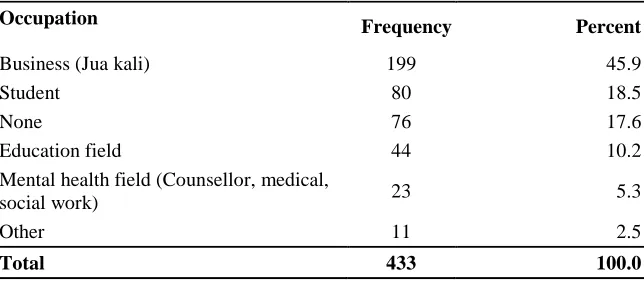
sociodemographic variable with the aim of controlling its effects statistically. Results of analysis of the variable however revealed that only a small number of the respondents 23 (5.3%) had any form of training in the domain ofmental health. Consequently, effects of occupation sociodemographic variable on the outcome were assumed to be insignificant and consequently ignored.
v) Results of the focus group discussion could be limited by ‗researcher effect,‘ where the respondents may tell the researcher what he/she wants to hear. This limitation was mitigated by the moderator asking questions in a neutral manner as much as possible in order to avoid influencing the responses of the respondents.
1.9Assumptions of the Study
The study was based on the following assumptions:
i) Participants would cooperate and give truthful responses on questionnaire items and focus group discussion questions.
ii) A variety of abnormal behaviours were present in informal settlements.
iii) Residents of Kibera informal settlement were familiar with the concept of ‗abnormal behaviour‘. This means that they had an idea of the nature, causes and treatment interventions for mental illness.
iv) Sociodemographic variables had an influence on how residents of informal settlements conceptualise abnormal behaviour.
15
CHAPTER TWO
LITERATURE REVIEW
2.1 Introduction
The purpose of this study was to investigate how abnormal behaviour is conceptualised by residents of informal settlements of Nairobi County, Kenya; and to establish how this conceptualisation influences the mental health interventions sought by the residents. This chapter contains a review of literature related to the study in four sections which include: theoretical framework, review of related studies according to the research objectives, a summary of literature review and the conceptual framework.
2.2 Theoretical Framework
Due to circular causality (a causal pattern that involves multiple factors) attributed to abnormal behaviour (Michael & Anestis, 2009; Zuckerman, 1999), the concept ‗abnormal behaviour‘ is best explained on the basis of several theories. Mental health professionals throughout the world use biomedical model and some key psychosocial modelsto explain abnormal behaviour (Comer, 2008; Hansell & Lisa, 2005; Sue & Sue, 2004). All these models can be positioned within the scientific biopsychosocial (BPS) model of abnormal behaviour theorised by Engel (1977). Consequently, the scientific BPS model of abnormal behaviour (Engel, 1977) was used to guide this study.
2.2.1 Biopsychosocial Model of Abnormal Behaviour
16
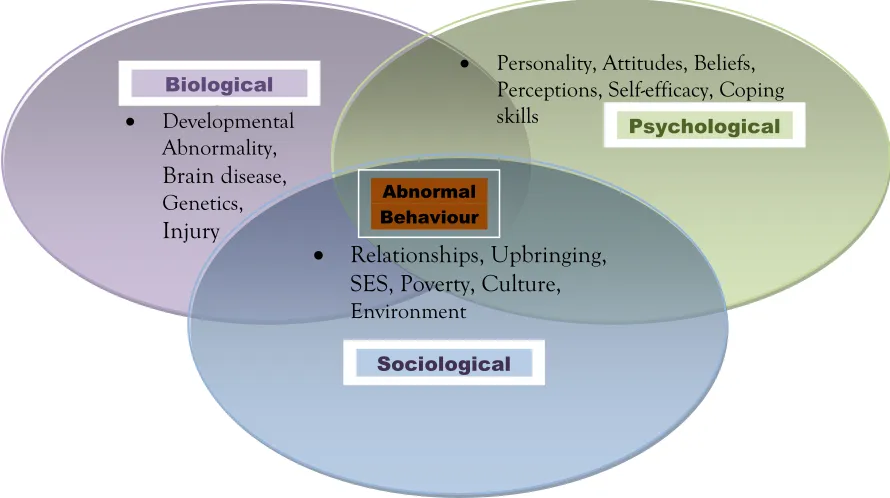
was limited in explaining health and illness due to its dualistic nature (separating mind and body); materialistic and reductionisticorientation (that everything must be objectively explainedat cellular and molecular level); and its exclusion of the human dimensionof the physician and the patient as an area of focus for scientificstudy. The BPS model is a holistic model that posits that biological, psychological and sociological factors all play a significant role in human functioning in the context of health and illness (Engel, 1977, 1980). Consequently, the BPS model of abnormal behaviour posits that abnormal behaviour is best conceptualised on the basis of biological, psychological and sociological causal factors (Smyth,Stone, Hurewitz & Kaell, 1999) as shown in the figure below.
Figure 2.1: An illustration of the core causes of abnormal behaviour in view of the BPS model
Source: Engel (1977).
Developmental Developmental
Abnormality, Brain disease, Genetics, Injury
Personality, Attitudes, Beliefs, Perceptions, Self-efficacy, Coping skills
Relationships, Upbringing, SES, Poverty, Culture, Environment
mmmm
Culture
Psychological
Sociological
Biological
17
Research done on the model reveals that the all three factors indicated in figure 2.1 interact in the context of abnormal behaviour (Bruns & Disorbio, 2006; Gilbert, 2009; Halligan & Aylward, 2006; Smyth et al., 1999; Slade, 2002; Tugade et al., 2004; Zuckerman, 1999).
The biologicalcomponent of the BPS model (Engel, 1977, 1980) is attuned to the biomedical theory which is concerned with the biological or somatic (bodily) basis of abnormal behaviour. The theory makes a basic assumption that the brain, neuroanatomy and related biochemical are all physical entities and work together to mediate psychological processes; hence abnormal behaviour is due to some form of biological malfunctioning resulting from brain disease, genetics, developmental abnormality or injury (Engel, 1977, 1980; Rosenthal, 1970).
The psychological component of the BPS model on the other hand looks at potential psychological causes of abnormal behaviour including personality, thoughts, belief patterns, perceptions, emotions and behaviours (Engel, 1977, 1980). In view of this model, negative thoughts, irrational beliefs patterns, low self-efficacy, distorted perceptions and people‘s negative cognitive and emotional response to daily stressors accruing from environmental demands cause abnormal behaviour (Engel, 1977, 1980; Halligan & Aylward, 2006).
18
Like circular causality, the BPS model also recommends a holistic treatment intervention for abnormal behaviour that combines biological treatment (drug therapy, Electro-Convulsive Therapy (ECT), surgery, diet or some variations of somatic therapy) and psychosocial treatment interventions (counselling & psychotherapy and modification of certain social contexts). A treatment intervention combining the two has been found to be the most appropriate for abnormal behaviour (Gilbert, 1995; Slade, 2002).
Moreover, theholistic nature of abnormal behaviour can be understood on the basis of the BPS model. For example abnormal behaviours such as fainting, pouring saliva and memory loss are predominantly biological in nature; while behaviours such as suicidal ideation, continuous crying, depressed mood and social withdrawal are predominantly psychosocial in nature. This implies that the holistic nature of abnormal behaviouris best understood on the basis of the BPS model.
19
scientific basis on which the appropriateness of the responses on the variables under study can be tested.
2.3 Review of Related Studies
This section reviews literature on how abnormal behaviour is conceptualised. The literature reviewedis organised in different subtopics informed by research objectives. The subtopics include: nature of abnormal behaviour; causes of abnormal behaviour; treatment interventions for abnormal behaviour; sociodemographic variables and abnormal behaviour and measures to mitigate abnormal behaviour.
2.3.1. Nature of Abnormal Behaviour
As noted in the background of the study "abnormal behaviour" is a subjectively understood concept that still remains a contentious issue even in modern abnormal psychology (Comer, 2006; Davidson, 2008; Hansell & Lisa, 2005; Sue & Sue, 2004). Thus, a multi-definition approach to the understanding of the concept is still adopted (Sue & Sue, 2004). The field of abnormal psychology recognises four key definitions of abnormal behaviour that have been widely embraced by mental health professionals to date. These are conceptual; practical; integrated and the DSM definitions (Comer, 2006; Davidson, 2008; David. & Vincent,2004; Hansell & Lisa, 2005; Sue & Sue, 2004).
20
multicultural perspective (that focuses on culture and on how abnormal behaviour is manifested within the culture) (Sue & Sue, 2004).
Practical definitions of abnormal behaviour are based on pragmatic or clinical criteria concerning the effect of the behaviour on the person exhibiting it or on others. The criteria for judging normality and abnormality is also threefold: discomfort (based on report of physical or psychological discomforts e.g. ulcers and asthma); deviance (that stresses bizarre or unusual e.g. anti-social act or a false perception of reality (disorientation, hallucinations and delusions); or dnysfunction (inability or loss of efficiency in fulfilling duties and responsibilities as required by the person‘s roles) (Sue & Sue, 2004).
Integrated definitions propose a multiple perspective approach to understanding of abnormal behaviour (Sue & Sue, 2004). According to this approach, abnormal behaviour can be judged from three vantage points: (1) that of the society (2) that of the individual and (3) that of the mental health professional. Each ―judge‖ operates from a different perspective, perhaps even using different criteria. Only if the three ―judges‖ taking these viewpoints agree, is a person categorised as either mentally healthy or mentally disturbed.
21
22
Figure 2.2: A diagrammatic illustration of the key categories of mental disorders Source: DSM-IV-TR (APA, 2000).
Each mental disorder in each of the above categories is manifested through some recognisable pattern of abnormal behaviours. For example, key abnormal behaviours that characterise schizophrenia/psychosis disorders include delusions, hallucinations, disorganised speech and grossly disorganised behaviour; while key abnormal behaviours that characterise Major Depressive Disorder (MDD) include depressed mood, diminished pleasure, insomnia, fatigue, feelings of worthlessness, diminished concentration and suicidal ideation (4th ed., text rev.; DSM–IV–TR; APA, 2000). Like schizophrenia/psychosis and MDD, all the other mental disorders in the above categories are characterised by some recognisable pattern of abnormal behaviours. Individuals and cultures conceptualise the nature of abnormal behaviour appropriately if they support the DSM-IV-TRdiagnostic criterionfor abnormal behaviour. As earlier observed, misconception of the nature of abnormal behaviour occurs when some abnormal behaviours listed in the DSM-IV-TR are
23
conceptualised as normal. However, most of the studies conducted do not take into consideration the holistic DSMcriterion in conceptualising the nature ofabnormal behaviour.
24
25
conceptualised would yield more holistic results. Moreover, all these studies were conducted in non-informal settlement cultures and sub-cultures; yet as observed earlier, it is conjectured that residents of informal settlements may view abnormal behaviour differently due their unique sub-culture. The studies reviewed above found that little treatment intervention was sought for people manifesting non-psychotic abnormal behaviours; implying that many mentally ill people manifesting abnormal non-psychotic behaviours remain untreated in many cultures across the world. This was a pertinent concern which this study sought to investigate.
2.3.2 Causes of Abnormal Behaviour
The term "cause" has many meanings in abnormal behaviour. It may mean etiology, which means the causes of abnormal behaviour. It may also mean a condition that must exist for the abnormal behaviour to occur (primary or necessary cause). It could also be a condition which is enough to produce abnormal behaviour (a sufficientcause). Cause can also be a factor that paves the way thus making abnormal behaviour more likely (a predisposingcause). It can also be atrigger for abnormal behaviour (aprecipitating cause); a condition that increases the probability of abnormal behaviour (contributory cause); or afactor that maintains abnormal behaviour but only after it is present (a reinforcing or maintaining cause)(Michael & Anestis, 2009).
26
it a causal misconception (Bennett, 2003; Comer, 2006; Hansel & Lisa, 2004; Sue & Sue, 2004). Abnormal psychologists acknowledge that the causes of abnormal behaviour are complex and it is not always possible to isolate and evaluate the multiple causal factors involved; a situation thatSue & Sue (2004) observed can be attributed to many difficulties: (1).The classes of mental disorders are many and each specific clinical type included in these broad classifications has its own independent etiology. (2). Mental disorders are usually due to the interaction of two or more agents (circular causality) which often makes it difficult to ascertain the relative importance of each contributory factor. (3).The same symptom patterns may arise from a variety of different causes. (4). The symptoms are not always tailored to fit standard disease entities. These observations are supported by other abnormal psychologists including Bennett (2003), Comer (2006), Davidson (2008), Hansel & Lisa (2005) and Michael & Anestis (2009). Despite these difficulties, abnormal psychologists have come up with a scientific criterion based on intensive research, on which the causes of abnormal behaviour should beunderstood. Their findings reveal that abnormal behaviour is best conceptualised on the basis of a scientific biopsychosocial etiology; implying that the scientific causes of abnormal behaviour are biological, psychological and sociological (Berrios & Hugh, 1991; Comer, 2006; Davidson, 2008; Hansel & Lisa, 2005; Michael & Anestis, 2009; Sue & Sue, 2004; Zuckerman, 1999).
27
stimulation and activity for the developing embryo and deprivation of basic survival needs such as food, shelter and water. These factors interfere with the normal, adequate, functioning of the neurotransmitters (chemical messengers) in the brain. Because the neurotransmitters regulate level of mood, anxiety and cognitive functioning in individuals, interference with their normal functioning results to a myriad of abnormal behaviours ranging from mild such as sweating, to severe such as delusions & hallucinations (Comer, 2006; Davidson, 2008; Hansel & Lisa, 2005; Rosenthal, 1970; Sue & Sue, 2004).
28
residents of England, Wales, andScotland (n=7726) established that poverty and unemployment caused chronic anxiety in individuals. In a study involving mothers and one child from 231 Arizona families, Sharlene & Sandler (1999) found out that divorce was associated with withdrawal from social interactions and depression in children. Dwairy, Achoui, Abouserie & Farah (2006) in a study of Arab adolescents in Saudi Arabia (n=431), established that permissive parenting style among boys was associated with increased anxiety, phobia, depressive and conduct disorders; while Gruebner et al. (2012) in a study of residents of nine slums of Dhaka Senegal (n=1,938) established that mental well-being was significantly associated with various factors such as physical environment, flood risk, sanitation and housing quality, sufficiency and durability.Apart from the study by Gruebner et al. (2012) all these studies were conducted in non-informal settlement. It would be interesting to find out how residents of informal settlement in Kenya conceptualise psychosocial the causes of abnormal behaviour.
29
30
Kenya (n=384), Mburu (2007) established that 48% of the respondents inappropriately attributed mental illnesstodemonic attack. All these studies reveal that a causal misconception for abnormal behaviourwithin the communities where they were conducted. This means that causal misconception still exists in many cultures and sub-cultures across the world and especially in Africa. In all these studies, a positive relationship between causal perceptions and treatment interventions sought was found. Treatment interventionssought by people in these cultures and sub-cultures were inappropriate (reflecting the established causal misconception); and they predominantly included consulting of indigenous/traditional healers and prayers. These findings imply that many victims of mental illness across the world are still being subjected to improper treatment intervention arising from a causal misconception for abnormal behaviour.However, none of the additional studies reviewed in this sub-section measured the strength of the relationship between causal perceptions and the treatment interventions sought. This could be attributed majorly to the qualitative design used in most of the studies. This study used a mixed concurrent triangulation design in data collection; hence it was possible to test hypotheses using data from the questionnaires. Moreover, none of the study was conducted in an informal settlement sub-culture, yet as noted earlier, this sub-culture is characterized by factors that could make residents vulnerable to abnormal behaviour. Moreover, the reviewed studies did not use the holisticBPS model as a basis for conceptualising the causes of abnormal behaviour, meaning that some causes may not have been investigated.
2.3.3 Treatment Interventions for Abnormal Behaviour
31
32
33
In addition to facilitating improper treatment interventions, misconception of the nature and causes of abnormal behaviour was found to facilitate belated scientific intervention and non-intervention for mental illness.For example, in these studies reviewed earlier, Deribew & Tamirat (2005) in their study of people Agaro town of Ethiopia and Sorsdahl et al. (2000) in his study of the traditional healers of Mpumulanga, South Africa found out that when the nature of abnormal behaviour was misconceptualised,no treatment intervention was sought for the victims of mental illness in these communities. In addition, Martin, Andreoli, Pinto, Hourneaux & Barreira (2011) found out that no treatment intervention was sought for persons with abnormal behaviours by residents of Santos informal settlement in Brazil mostly because they were ignorant of the nature and causes of abnormal behaviour; while Kapungwe et al. (2010) and Ssebunnya et al.(2009) in their studies of mental health stigma in Uganda and Zambia respectively found out that when cultures attributed abnormal behaviour to supernatural causes, partial blame was apportioned to the victim and this resulted to unorthodox interventions, belated scientific intervention or to non-intervention for mental illness altogether. These studies however did not investigate the strength of the correlation between conceptualisation of the causes of abnormal behaviour and the treatment interventions sought. As noted earlier, these negative mental health outcomes are also associated with intense suffering and even death for victims of mental illness (de Boer et.al 2008; Ssebunnya et.al2009; WHO, 2008).
34
for abnormal behaviour. Moreover, apart from the additional study by Martin et al. (2011), none of the other studies were conducted in an informal settlement setting.
2.3.4 Sociodemographic Variables and Abnormal Behaviour
35
36
construct under study.Moreover, allreviewed studies measured the effect of sociodemographic variables on abnormal behaviour within non-informal settingsas opposed to this current study which measured their effects within an informal settlement setting.
2.4 Measures to Mitigate Abnormal Behaviour
37
improvement ofsanitation and housing quality, sufficiency and durability and reduction of flood risks could significantly improve the mental well-being of residents of informal settlement in Dhaka Senegal.
38
poor housing, inaccessibility to safe drinking water, sanitation, inaccessible and unaffordable health care services, inadequate nutrition and overcrowding (Mutisya & Yarime, 2010; UN-Habitat, 2008; WHO, 2005); which according to WHO (2008), make residents of informal settlement more susceptible to mental illness. This study,which was conducted in Kibera informal settlement allowed the researcher to find out if the residents would perceive reduction of some of these psychosocial stressors as measures that should be put in place to mitigate abnormal behaviour.
2.5 Summary of the Literature Review
39
socioeconomic status andlevel of education (deToledo et al., 2004; Deribew & Tamirat, 2005; Mburu, 2007; Sadik et al., 2010); which consequently influences the treatment interventions sought by these cultural groupings. Overall however, the studies reviewed did not use the holistic BPSmodel as a basis for conceptualising abnormal behaviour; hence their findings were not holistic.Moreover, while some studies were cross-sectional, most of them adopted a qualitative study design. This study will adopt a concurrent mixed(triangulation) designwhich will allow for gathering of both quantitative and qualitative data; and subsequent hypotheses testing. Though some studies measured the effects of various sociodemographic variables on conceptualisation of abnormal behaviour, none of them measured the effect of ethnicity (tribe of affiliation); yet in view of Marsella & Kameoka, (1989) ethnicity is a strong predictor of culture. Moreover, most of the studies only implied a positive relationship between perceived causes of abnormal behaviour and treatment interventions sought without measuring the strength of the relationship. In addition, apart from the study by Gruebner (2012) all studies reviewed were conducted within non-informal settlement settings as opposed to the current study whose setting is aninformal settlement.
40
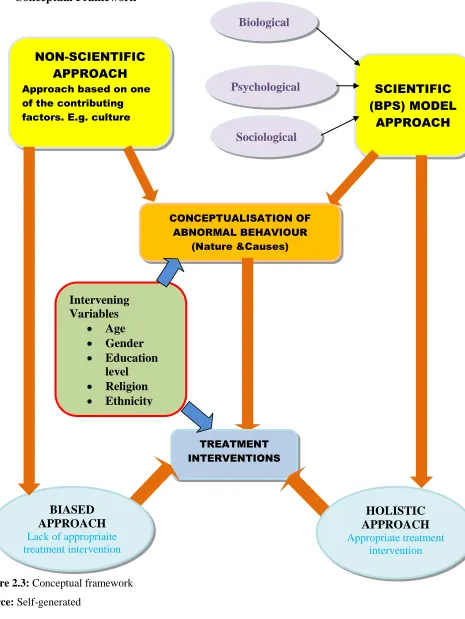
2.6 Conceptual Framework
Figure 2.3: Conceptual framework
Source: Self-generated
Biological
SCIENTIFIC (BPS) MODEL
APPROACH NON-SCIENTIFIC
APPROACH Approach based on one of the contributing factors. E.g. culture
Psychological
Sociological
CONCEPTUALISATION OF ABNORMAL BEHAVIOUR
(Nature &Causes)
Intervening Variables
Age
Gender
Education
level
Religion
Ethnicity
TREATMENT INTERVENTIONS
BIASED
APPROACH
Lack of appropriaite treatment intervention
HOLISTIC APPROACH
41
42
CHAPTER THREE
RESEARCH METHODOLOGY
3.1 Introduction
The purpose of this study was to investigate how residents of Kibera informal settlements conceptualise abnormal behaviour and how this conceptualisation influences the mental health interventions sought by the residents. This chapter discusses a set of methods that were adopted in the study. These methods include research design; study variables; study location; target population; sample size and sampling techniques; research instruments; validity and reliability of instruments; pilot study; data collection procedures; data analysis and presentation and data management and ethical considerations.
3.2 Research Design
43
because the FGDs allowed the researcher to gather more in depth information about abnormal behaviour that complimented the information gathered through questionnaires.
3.3 Study Variables
The independent variable for this study was ‗conceptualisation of abnormal behaviour‘ while the dependent variable was ‗treatment interventions‘. The concept ‗abnormal behaviour‘ was a latent variable which according to Borsboom, Mellenbergh & van Heerden, (2003) is a variable that cannot be directly observed but is rather inferred from other variables that can be directly measured. Consequently, the operational variables that described the concept ‗abnormal behaviour‘ were: (i) nature of abnormal behaviour and (ii) causes of abnormal behaviour. For this study therefore, the operationalised independent variable was ‗conceptualisation of the nature and causes of abnormal behaviour.‘ It was hypothesised that how residents of Kibera informal settlement conceptualised abnormal behaviour (independent variable) would influence the treatment interventions sought (dependent variable). The intervening variables were sociodemographic characteristics of gender, age, level of education, religion and ethnicity. It was hypothesised that these characteristics would have an effect on how abnormal behaviour was conceptualised and the treatment interventions sought.
3.4 Study Location
44
established that Kibera houses over 42 ethnic groups; the major ones being: Luo, approximated at 30%; kikuyu at 20%; Kamba at 19%; Luhya at 14%; Kalenjin at 6% and others at 11%. These varied sociodemographic characteristics made Kibera a suitable site for this study as it allowed the researcher to generate a sample that was representative of other informal settlements in Nairobi County. (Refer to Appendix 3 for more details).
3.5 Target Population
The target population for this study was all male and female residents of Kibera informal settlement of Nairobi County, Kenya aged between 13 and 65 years; and who had completed a minimum of class 8 education. The lower age limit of 13 years was guided by Kohlberg (1981) and Piaget (2001) who argued that persons of that age had attained the cognitive ability to understand abstract concepts and to respond critically to life issues. The age upper limit (65 years) was guided by the assumption that the researcher may find it a challenge to get elderly persons of above 65 years in the Kibera informal settlement who had a basic class 8 education. Choice of class 8 as the minimal education level for the respondents was pegged on the assumption that persons with basic class 8 education would be able to respond to the questionnaire items and participate in FGDs with minimal need for assistance in interpreting the items presented in the tools.
3.6 Sample Size and Sampling Techniques
The sample comprised 433 respondents: 385 being respondents for the questionnaire and 48 being respondents for the FGDs (6 groups x 8 participants). The questionnaire sample of 385 was based on Kathuri &Pals (1993) formula of sample determination.
n = 2NP (1-P)
2
45 Where:
n = required sample size
N = the given population size from the sampling frame which was assumed to be more than 100,000
P = Population proportion, assumed to be 0.50 (because researcher was not sure of the variability of the population on the given study variables)
2
= the degree of accuracy whose value is 0.05
2
= Table value of chi-square for one degree of freedom, which is 3.841
The choice of the FGD sample was guided by proposals of Creswell (2003) who proposed 3 to 6 FGDs to complement quantitative data in a mixed research design. He further observed that FGDs comprising of members ranging from 6-12 have been found by most researchers to be the most appropriate in facilitating maximum participation for each member. This guided the researcher‘s choice of 6 FGDs each comprising 8 participants.
46
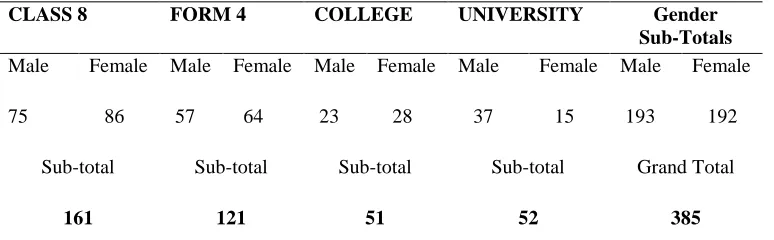
Stratification was done based on the various sociodemographic variables under study (gender, age, level of education, religion and ethnicity). The researcher identified the number of respondents that were to be included in each stratum. The respondents were then randomly selected from across the 13 villages that constitute Kibera informal settlement; taking into consideration the pre-identified numbers per each stratum. Snowball sampling technique was used to identify university students as they were few in number and difficult to trace.
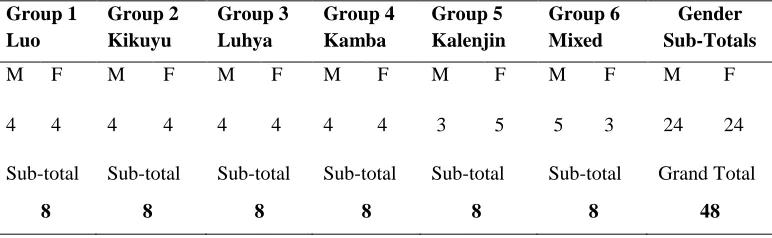
The researcher conducted five homogeneous FGDs based on ethnic homogeneity and one heterogeneous FGD based on mixed ethnicity. The participants of the homogenous ethnic groups were: Luo; kikuyu; Kamba; Luhya and Kalenjin. The groups were identified based on the statistics of Umande Trust (2007) which listed them as the major ethnic groups in Kibera. The heterogeneous group was drawn from other ethnic groups apart from those comprising the homogeneous groups. The ethnic groups represented were Maasai, Taita, Teso, Meru and Kisii. Again the sociodemographic variables of gender, age, level of education and religion were taken into consideration in selecting FGD respondents. Presented on the tables below are the sample distributions of questionnaire and FGDs respondents.
Table 3.1: Questionnaire Sample Distribution by Level of Education and Gender
CLASS 8 FORM 4 COLLEGE UNIVERSITY Gender
Sub-Totals
Male Female Male Female Male Female Male Female Male Female
75 86 57 64 23 28 37 15 193 192
Sub-total Sub-total Sub-total Sub-total Grand Total
47
Table 3.2: FGDs Sample Distribution by Ethnicity and Gender
Group 1 Luo
Group 2 Kikuyu
Group 3 Luhya
Group 4 Kamba
Group 5 Kalenjin
Group 6 Mixed
Gender Sub-Totals
M F M F M F M F M F M F M F
4 4 4 4 4 4 4 4 3 5 5 3 24 24
Sub-total Sub-total Sub-total Sub-total Sub-total Sub-total Grand Total
8 8 8 8 8 8 48
3.7Research Instruments
Data was collected using a researcher-generated questionnaire and a focus group discussion guide. Questions in the questionnaire generated descriptive data on sociodemographic variables and on the various themes of the concept under study ‗abnormal behaviour.‘ Section A of the questionnaire gathered descriptive data on the respondents‘ sociodemographic variables of gender, age, level of education, religion, ethnicity, residential village and occupation.
Section B of the questionnaire gathered the respondents‘ views on the nature of abnormal behaviour. Construction of this section was guided by the DSM-IV-TR (APA, 2000); whichguided the researcher in identifying the nature of abnormal behaviour (that is, the diagnostic symptoms of various mental disorders under study) which the researcher used as questionnaire items in this section.
48
scientific, psychosocial causes of abnormal behaviour that were presented as questionnaire items in this section.
Section D of the questionnaire gathered views on treatment interventions for abnormal behaviour. The BPS model again guided the researcher in identifying the various scientific (BPS) interventions which guided the researcher in constructing of the questionnaire items that were tested in this section.
Finally, section E of the questionnaire gathered views on measures that respondents felt could be put in place to mitigate abnormal behaviour in Kibera informal settlement. Construction of the test items for this section was also informed by the scientific (BPS) model of abnormal behaviour.
Further, a FGD guide was used to gather in-depth qualitative data of group members views on the various themes under study which included the nature, causes, interventions and measures to mitigate abnormal behaviour. The two instruments concurrently informed each other and helped the researcher to compare perspectives (Creswell, 2003; Howitt, 2010).
3.8Validity and Reliability of Instruments
3.8.1 Validity
49
To further enhance the validity of the findings, the researcher sorted out the answered questionnaires to establish item response. The questionnaires with high item non-response were replaced. Sorting also enabled the researcher ensure that the pre-identified strata had a substantial number of questionnaires per category in order to ensure viability of the statistical analysis. Moreover, concurrent mixed triangulationdesign adopted in this study enabled the researcher to validate the findings by comparing responses from the two instruments used in the study. The findings were also compared to the results of other past studies. To enhance the validity of the FGD findings, the researcher, who acted as the moderator in FGDs, presented the questions in a neutral, non-leading format across all the six focus groups.
3.8.2 Reliability
Internal consistency technique was used to establish reliability. Cronbach‘s Coefficient Alpha was used to determine how items that measured the concept under study correlated among themselves in the rating scale. For an instrument to be construed as internally consistent, hence reliable, a reliability statistical score of 0.70 or higher is required (Cronbach & Shavelson, 2004; Mugenda& Mugenda, 1999).
50
each of these disorders. Internal consistency was also assessed for the items in sections C that sought to find out the respondents‘ views of the causes of abnormal behaviour.
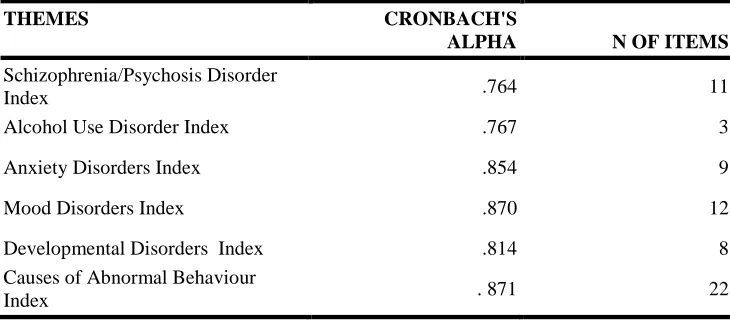
A correlation coefficient of above 0.70 was established for all the group of items in each of the 5 sub-sections of section B; and for the group of items in section C, with the lowest being 0.764 and the highest being 0.871 as reflected on Table 3.3.
Table 3.3: Cronbach’s Alpha Reliability Statistics
THEMES CRONBACH'S
ALPHA N OF ITEMS
Schizophrenia/Psychosis Disorder
Index .764 11
Alcohol Use Disorder Index .767 3
Anxiety Disorders Index .854 9
Mood Disorders Index .870 12
Developmental Disorders Index .814 8
Causes of Abnormal Behaviour
Index . 871 22
These results implied that the instrument used (questionnaire) was internally consistent and therefore reliable. To further enhance reliability of the findings, respondents who found it difficult to interpret some items in the questionnaire were assisted by the researcher and duly trained research assistants. To enhance the reliability of findings from FGD, data was transcribed by two different people and the results were duly compared.
3.9 Pilot study
51
Sociodemographic variables of gender, age, level of education, religion, ethnicity and residential village were taken into consideration when choosing the respondents of the pilot study. The respondents came from four villages in Mathare informal settlement namely: Kiamutisya, Kwa kariuki, Mabatini and Kosovo. One Focus Group Discussion comprising 8 respondents, 4males and 4 females was used to pilot the Focus Group Discussion guide. The pilot study assisted the researcher to identify and modify the items in the research instruments that were difficult, ambiguous and unclear; thus facilitating generation of relevant and consistent data. It alsoallowed for a pre-run of the descriptive, inferential and qualitative analytical procedures which helped the researcher to determine whether the tools would generate the data that was expected. The researcher used the findings of the pilot study to make the necessary adjustments, which further enhanced the validity and reliability of the instruments. Moreover, the pilot study also helped the researcher to determine the average amount of time needed to administer each of the two instruments, which assisted greatly during the data collection exercise.
3.10 Data Collection Procedures
52
criterion which took into consideration the various variables under study and which the research assistants and elders were helped to understand in advance. The main challenge encountered by the researcher in the questionnaire data collection exercise was thatsomeresidents who failed to be sampled in their appropriate stratum gave incorrect information in relation to their demographic characteristics so that they could be included in other strata that were lacking enough respondents at the time. The resultant effect was that the researcher was forced to destroy and replace some inappropriate questionnaires in every stratum after sorting them out. This behaviour was motivated by the residents‘ desire to get the small token of appreciation that the researcher was giving the study participants.
Another challenge was that though the study of Umande Trust (2007) showed the Kikuyu ethnic group as the second largest group in Kibera, the researcher found it difficult to get the pre-identified number of respondents fromthe Kikuyu ethnic group; consequently forcing the researcher to adjust the number downwards in the sampling frame. The researcher learnt that many Kikuyu had apparently left the informal settlement after the post-election violence of 2007/2008.
53
participated as questionnaire respondents wanted to participate in the FGD discussions so that they could get the aforementioned token for the second time. The chief‘s elders came in handy in helping the researcher to identify such residents.
3.11 Data Analysis and Presentation