EDGE Throughput Improvement by Selective
Channel Allocation from Abis Interface
Lin Ann Jose1, Dr. S. Perumal Sankar2
PG Student [Wireless Technology], Dept. of ECE, Toc H Institute of Science and Technology, Kochi, India1
Professor, Dept. of ECE, Toc H Institute of Science and Technology,Kochi, India, India2
ABSTRACT: Presently, data transfer rate is always lower than the maximum achievable throughput; hence it is necessary to device methods to improve the data rate of the network. Enhanced Data rate for GSM Evolution specifically designed for data traffic rather than voice. The presence of nine modulation and coding schemes (MCS) are responsible for the different data rates and are depending on the radio conditions. Numerous ideas introduced to improve the data transfer rate in the EDGE network like introduction of new modulation scheme instead of 8PSK. EDGE throughput is based on factors like EDGE capability at the Mobile Station (MS), number of Base Transceiver Stations (BTSs), Packet Control Unit (PCU) dimensioning in the Base Station Controller (BTC) and Gb interface between BSC and Servicing GPRS Support Node (SGSN). This work mainly concentrates on the throughput enhancement by dynamic allocation of channels from EDAP (EDGE Dynamic Abis Pool) in the Abis interface between BTS and BSC. Simulation will be done by Network Simulatot-2(NS2).
KEYWORDS: Abis link, E1/T1 line, EDAP, MCS
I. INTRODUCTION
Initially, telephonic services are the main consideration in the GSM (Global System for Mobile communication) mobile cellular networks. While voice communication is still the main purpose of this mobile communication system, improvement of data communication over the air interface is also taking place. It can provide data rate up to 9.6kbps/s for the data services [1]. Increasing the number of subscribers in the GSM network requires more reliable services offered by the network also certain data services like Web browsing, access to corporate data bases etc requires high speed data service in the cellular network.
However, the introduction of GPRS or EDGE (Enhanced Data rates for GSM Evolution), leads to significant improvement in the data services through GSM cellular networks. EDGE having 9 Modulation and Coding Schemes (MCS) that is not present in the existing GSM provides better performance in the data services. EDGE networks are designed to be considered as a best effort network [2].The amount of data traffic in the networks introduces capacity problems and collapse of the Quality of Service (QoS), the most important QoS in the EDGE network is the throughput. Network throughput is the important consideration in the data traffic. Network throughput is the ratio of message or packet delivery over a communication channel. Data belongs to the packet or message pass over a physical or logical link. The throughput is also considered as data rate. EDGE throughput is the measure of the rate at which data can be sent through the EDGE network [4].
The throughput/data rate of the network is given as,
Throughput= Number of bits transmitted per second Number of bits received
For the performance evaluation of an EDGE network, some technical characteristics of the architecture needs to taken into account and also considering the selection of channel between voice and data in the EDGE system. Allowable carrier to interference ratio here is of 20 to 35 dB and beyond [3].
II. RELATED WORK
Huseyin Arslan et al (2001), this paper studies further improvements to the spectral efficiency and capacity of EDGE through the use of more sophisticated adaptive modulation schemes based on QAM, and the use of novel turbo coding schemes. Harish Viswanathan et al (2002), proposed training sequences that have good auto-correlation and cross-correlation properties that can be used in a practical system such as EDGE. In this paper presented detailed link level simulations that include channel estimation for the proposed schemes. Jarkko Itkonen, et al (2002), proposed available air interface capacity for the packet based GPRS/ EDGE service when circuit switched GSM speech or data traffic is already loading the air interface in the cellular radio network. The target of the paper is to create planning criteria for the capacity of the combined GSM+GPRS/EDGE air interface.
Ari Viinikainen et al (2005),propose the use of a spectral and power efficient modulation scheme, a combination of frequency and phase modulation NFSK/LPSK to improve the performance of the GSM EDGE system. David Navratil et al (2006), proposed 16 QAM modulation scheme for the improvement of EDGE throughput. The application of 16-QAM on current MCSs results in improvement of BLER performance. Neetesh Purohit et al (2007) presented a performance analysis of EDGE after a BTS failure. If a BTS stops functioning (i.e. fails) then packets could not be delivered to users of this area. Osama Ali Abdullah et al (2014), in this paper , Enhanced Data rate for GSM Evolution (EDGE) mobile communication system is analyzed and modelled assuming to operate in both Additive White Gaussian Noise (AWGN) channel and Rayleigh fading channel
.
III. EDGE SYSTEM
Enhanced Data rate for GSM Evolution (EDGE) mainly carries data traffic rather than voice. Time Division multiple Access (TDMA) technique, is the multiplexing technique used by the EDGE system. TDMA means the same frequency can be shared by the different subscribers at different timeslots within an area. Hence the EDGE is the modified version of GPRS, its concepts and architecture are similar. Also with the same GSM frequency bands as 800 MHz, 900 MHz, 1800MHz and 1900MHz.
There are nine Modulation and Coding Schemes (MCSs) are included in the EDGE system, is mainly for the enhancement in the data communications throughout the network. The proper selection of MCSs depending on the radio condition leads to data rates ranging from 8.8 Kbps/s up to 59.2 Kbps/s. Lower MCSs are used with GMSK (up to MCS4) and higher with 8-PSK (MCS5 and above). The table-1 shows the MCSs and corresponding throughput. The PDTCH channel is used for the data traffic while, PACCH is for signaling purpose. [8]
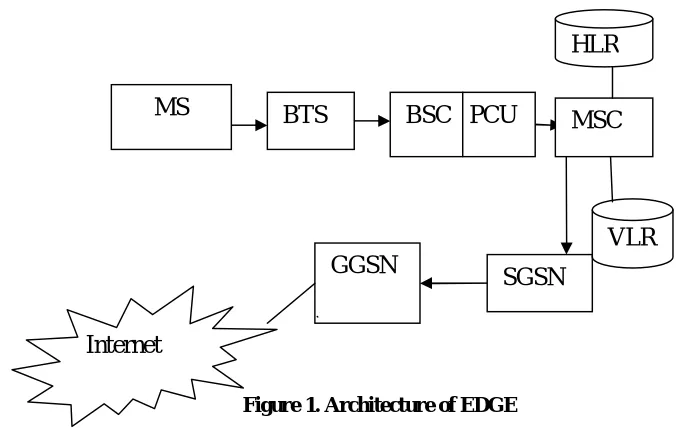
The EDGE architecture consists of Mobile Station (MS), Base Transceiver Station (BTS), Base Station Controller (BSC), Mobile Switching Centre (MSC), Servicing GPRS supporting Node (SGSN) and Gateway GPRS Supporting Node (GGSN).
Table 1. MCS and corresponding Throughput
Modulation and Coding Schemes
Modulation Throughput, Kbps
MCS-1 GMSK 59.2
MCS-2 GMSK 54.4
MCS-3 GMSK 44.8
MCS-4 GMSK 29.6
MCS-5 8-PSK 22.4
MCS-6 8-PSK 17.6
MCS-7 8-PSK 14.8
MCS-8 8-PSK 11.2
MCS-9 8-PSK 8.8
The architecture of EDGE system is shown in figure 1.There are mainly 4 interfaces between different subsystems in the EDGE networks. The interfaces are Um interface, Abis interface, A interface and Gb interface between MS and BTS, between BTS and BSC, between BSC and MSC also between SGSN and GGSN respectively. This work mainly focuses on the Abis interface between BTS and BSC for throughput improvement [7].
Figure 1. Architecture of EDGE
GGSN
SGSN
BTS
VLR
BSC PCU
MS
MSC
HLR
IV. ABIS INTERFACE
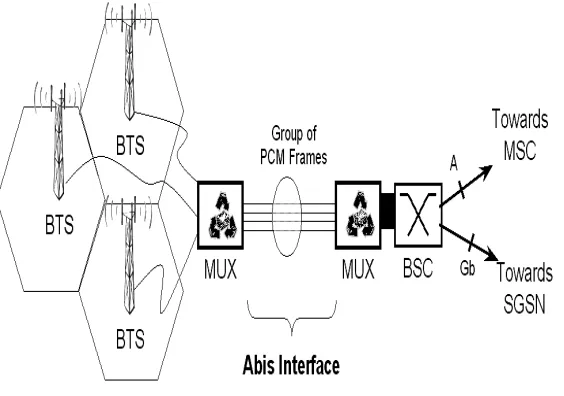
The Abis interface is considered to be the physical connection for a call and is between BTS and BSC. The Abis interface have 2.084Mbps E1/T1 TDM configuration with digital data multiplexing technology. The E1 links consists of 32 timeslot allocation with 64 kbps channel and are sub divided into16kbps channels. Timeslot0 is stands for synchronization purpose while, remaining stands for data or voice traffic. The interface having three layers. Layer-1 is the physical layer and which carries E1 link. Next layer is the data link layer and the last layer mainly for radio link management. The primary function of this interface is to provide proper allocation of frequency and proper signaling between voice and data traffic. The figure 2 represents the Abis link architecture [6].
Figure 2. Abis interface
V. SIMULATION MODEL
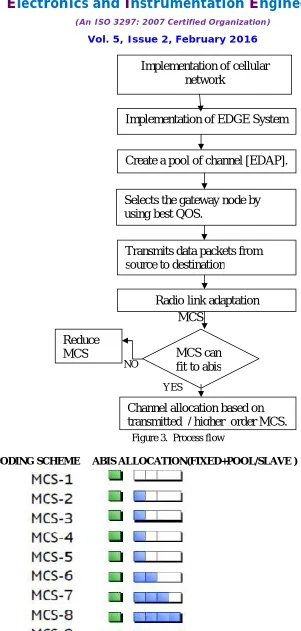
The entire procedure for this work is given in the figure 3. As per the first stage of the procedure the simulation of cellular network is done by TCP protocol and CBR traffic using NS2 simulation tool by considering the EDGE as a routing protocol for the analysis of throughput. The CBR (Constant Bit rate) service is for constant bit delivery in the network. Implementation of EDGE is done by the MAC protocol and EDGE is considered as the routing protocol for the implementation of cellular network with EDGE. The proposed model is the implementation of EDGE Dynamic Abis Pool (EDAP) and dynamic allocation of channels from the EDAP in order to improve throughput of the network. For this scenario, needs to consider the fixed channel allocation at the abis link for all nine MCSs in the EDGE system as shown in the figure 4.
MCS
NO
YES
Figure 3. Process flow
CODING SCHEME ABIS ALLOCATION(FIXED+POOL/SLAVE)
Figure 4. Abis allocation for MCSs
Implementation of cellular
network
Implementation of EDGE System
Create a pool of channel [EDAP].
Selects the gateway node by
using best QOS.
Transmits data packets from
source to destination
Channel allocation based on
transmitted / higher order MCS.
Radio link adaptation
Reduce
MCS
MCS can
Figure 5. NAM window for EDGE with EDAP
Figure 6.EDGE with EDAP Throughput graph
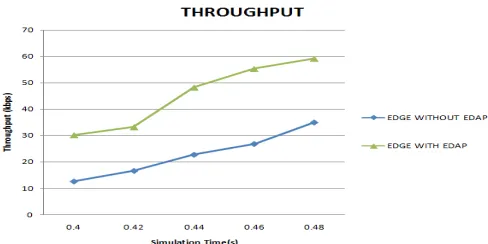
Figure 7. Comparison between throughput of EDGE and EDGE with EDAP
VI. CONCLUSION
(EDAP) based on transmitted MCS is proposed. The simulation results shows that the existing EDGE network can achieve a data rate 33.7kbps then, the proposed system can provide a data rate upto 59.2kbps. The simulation of cellular network and the EDGE is done by the network simulator-2 with necessary modification at the backend C++.
VII. ACKNOWLEDGMENT
This work has been supported by Prof.(Dr) S. Perumal Sankarand the TIST laboratory for NS2. I express my sincere thanks to my father for his constant support and encouragement.
REFERENCES
[1] Sherratt, R.S., Zhang, K. and Wilkes, “A block coprocessor for user data rate improvements to GPRS coding scheme 4”, in Journal of Circuits Systems and Computers,Vol 6 (4), pp 541-551, 2007.
[2]Huseyin Arslan, Jung-Fu Cheng, Kumar Balachandran,”Physical Layer Evolution for GSM/EDGE”, inIEEE communication, Vol 9, pp 7803-7206, 2001.
[3]Harish Viswanathan, ”Space–Time Signaling for High Data Rates in EDGE”, in IEEE Transactions on vehicular technology, Vol 51, No 6, November 2002.
[4]Jarkko Itkonen, Ville Salomaa, Jukka Lempiäinen, “Air Interface Capacity for GPRS/EDGE over GSM Traffic Load”, in IEEE transaction, Vol 3, pp 7803-7467, 2002.
[5]Ari Viinikainen Jarkko Vuori Jani Puttonen,” Improving GSM EDGE with NFSK/LPSK modulation scheme”, in IEEE communication conference, Vol 6 pp 7803-9392 , 2006.
[6]David Navratil “Higher Order Modulations and GSM/EDGE Radio Access Network Evolution”, in IEEE conference on wireless communication, Vol 9, pp 7803-9392, 2006
[7]Neetesh Purohit, Sanjiv Tokekar, “Performnance Analysis of EDGE after a BTS Failure”, in IEEE conference on wireless communication, Vol 7, pp 978-4244,2007.
[8]Osama Ali Abdullah, Asaad M. Jassim Al-Hindawi, “Analysis And Modeling Of GSM/EDGE Mobile Communication System”, IOSR Journal of Engineering (IOSRJEN) www.iosrjen.org ISSN (e) 2250-3021, ISSN Vol 04, pp 2278-8719, Issue 12 , December 2014.