An Effective Multi-domain Facial Feature Based Improved
FRS
Pushpa Sherlin.JP
1
P
, S.Princy Suganthi BaiP
2
P
1
P
PG student, Department of Computer Application, Francis Xavier Engineering College, Tirunelveli, TamilNadu, India.
P
2
P
Assistant professor, Department of Computer Application, Francis Xavier Engineering College, Tirunelveli, TamilNadu, India.
Abstract-Biometrics is a readily available metric
that is playing a vital role in face recognition. There are many domain areas for the features extractionsuch as frequency measures, geometrical measures and statistical measures. In the proposed Face Recognition System (FRS)the extraction of features are done using frequency and statistics measures. The FFT,DCT, variation, standard deviation, mean, median and entropy are the five features extracted from the ORL dataset for recognition process. A local normalization technique is applied to the extracted features. The training and testing are performed with normalized features using Back PropagationNeural Network (BPNN).
Keywords – Face Recognition System (FRS),Discrete
Cosine Transformation (DCT), Fast Fourier Transformation (FFT), Back Propagation Neural Network (BPNN) classifier.
1.
Introduction
Biometrics makes a new boom in the field of face recognition system. Biometrics is defined as physical or behavioral characteristics of human. Face Recognition is the most commonly used biometrics for the secured life ofhuman. The biometrics in face recognition has many benefits such as easy integration, automated facial system andhigh success rate and fraud reduction.Z.chai and Z.sun et al.,[11] in their work, the discriminating of Gabor wavelet and robustness in ordinal measure are used to handle both intra person variation and inter-person similarities in face images. The work was based on combining Gabor with ordinal measures andextracted the feature using Gabor Ordinal Measures (GOM) Algorithm. The extracted features are phase,
magnitude, real part and imaginary part of the face image. The extracted features are classified using cascade learning method and Greedy block selection method. The cascade learning method is to classify the easy and hard features that are extracted.
Many researchers focused on the challenges on human face such as pose, illumination and Expression.H.Drira et al., [1]their work wasbased on 2D and 3D images.The ICP Algorithm is used for the 3D face recognition.As long as there are a sufficient number of distinct regions available on the probe face, this alignment can be performed.Next, after the alignment, the radial curves on the probe model are extracted using the plane P passing through the nose tip of the gallery model at an angle with the vertical. The important point in that only the nose tip of the gallery and a good alignment between the gallery probes is needed to extract good quality curves. The missing parts including its nose region the performance are also done.The most common advantages in the 3D method is that it is used to handle variation in facial expression, pose variation and it is also used to construct a low dimension subspace. It also has some common drawbacks such as there is no automatic method for nose tip detection in frontal views.
To achieve higher resilience toward covariates such as pose, expression and illumination for the 3D face recognitionssome algorithms are proposed. G. Goswami etal., [5] in theirwork, they have used a specialized 3D sensors and low-cost sensors. This low cost sensor known as Kinect, which captures the RGB-D images. There are many algorithms that are used in this method one of them is Iterative Closest Point (ICP) Algorithm.It is used to find the nearest and the closest point of the image in process. The
attribute based methodologies are used inADM Algorithm (Attribute Based on Depth Map) in this algorithm the following functions are performed. The Key point labeling is given for the image and geometric attribute computation. The geometric facial attributes are also extracted from the depth of the image and face recognition is performed by fusing both the descriptor and attribute match scores. The RISE Algorithmis used for extracting the Saliency and entropy features.Entropy is the measure of uncertainty in random variables. Thevisual saliency map and entropy mapare extracted. The extracted features are done by using HOG (Histogram of Oriented Gradients)method. The classification is doneusing NN (Nearest Neighbor), RDF (Random Decision Forest), and SVM (Support Vector Machines) classifier.There are many advantages in this work. The geometric facial attributes are also extracted from the depth image and face recognition is performed by fusing both the attribute and descriptor. The experiments indicate that the proposed algorithm achieves high face recognition accuracy on RGB-D image. It has a better performance than the 3D and 2D.There are also some drawbacks such as the failure of COTS can be attributed to the 3D reconstruction method. This method possibly suffers from low spatial resolution of RGB images.
In the proposed FRS the features are extracted from both frequency and statistical measures. In DCT and FFT the dc components are extracted for recognition. The mean, median, standard deviation, entropy and variation are used as features from statistical domain. The normalization function is applied to the image to get enhanced values for the image. The normalization is done by the following equation.
XRnewR=XRmax –R XRn R(1)
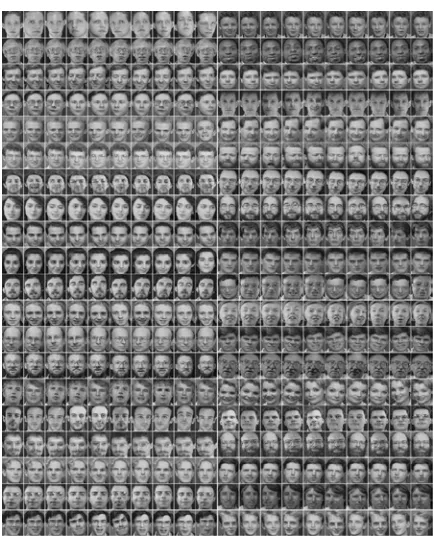
Fig. 1. The ORL Face Database.
Xnew is the enhanced value, Xn is the actual value and Xmax is the maximum value of X. The normalized features of statistical measure such asmean, median, entropy, standard deviation and variation are taken and training is done on these features. The classification of the features is done
using BPNN (Back Propagation Neural
Network).Back propagationis a supervised learning method. They are most useful for feed-forward networks. The main idea is to distribute the error function across the hidden layers corresponding to the effect on the output. The testing is done with the pattern that is matching the classified features. In the section 2, the existing FRS are discussed. In the section 3 features for the proposed FRS are analyzed, in section 4BPNN classifier is elaborated, section 5 includes the experimental result and section 6 contains the conclusion.
2.Related Works
N. Erdogmus et al., [12] in their work consider the spoofing attack as an open security issue in FRS. The face is the most serious among all biometrics because spoofing is done using the false image. It is an open security attack in biometrics. The algorithm such as ISV (Inter Session Variability) method is used for 2.5D and 2D face recognition and ICP (Iterative
Closest Point) method is used for 3D face recognition. The feature extraction is done mostly by LPB method. Anti-Spoofing algorithm is used for the texture analyses of the human face using LBP (Local Binary Pattern)method. Theregular block-based LBP shows the best performance for both 2D and 2.5D data. A possible extension to this work is to search for more generalizable algorithms to detect the mask attacks, in order to avoid large variations in error rates. Thedisadvantages such as vulnerability of recognition systems to spoofing attacks are still an open security issue in biometrics. A counter measure algorithm against spoofing should be able to decide whether the face image captured by the sensor belongs to a real face or not.
S.H. Lee et al.,[9] in their work local color vector binary pattern (LCVBP) is a method that is used for color norm pattern and color Angular Pattern. The extracted feature is color norm pattern and color Angular Pattern. TheFLDA (Fisher’s Linear Discriminant Analysis) is forEuclidian distance and RLDA (Regularized Linear Discriminant Analysis) for cosine distance. It is used for maximizing the complimentary effect of face recognition. The classification is done by using NN (Nearest Neighbor) classifier. There are many new technique that are used in FRS [9] but by using the NN classifier some problems cause degradation can be overcome in face recognition. S.Jia, L. L.Shen et al.,[10] in their workthe Gabor feature based collaborative representation are used for the classification of hyperspectral method. The 3GCR(3 Gabor Collaborative Representation) algorithm is used for HIS (Hyper Spectral Imaginary) classification. When a 3-D Gabor transformation could significantly improve the discriminant power, a non-parametric, efficient l2-norm is used for representing and calculating the coefficients.The computational cost is reduced by the extraction of the Gabor feature that are directly utilized to code. Some common classifier used in FRS are HIS classification for 3GCR,Nearest Neighbor classifier, Nearest-subspace classifier, Spare Representation Based Classification.The most common advantages are both the classifiers complexity and generalization ability are from very small training sets. There are also some disadvantages such as theNearest Subspace gives the worst result for the measures.
The tensor method are also used for the analysis of the color space in the face recognition with the
definition of n-mode between class scatter matrices and within-class scatter matrices,J.Yang et al.,[2] in their workto obtain one color space transformation matrix TDCS (Tensor discriminant Color Space). Theyconstruct an iterative procedure and two discriminant projection matrices by maximizing the ratio of these two scatter matrices. The CID (Color Images Discriminant Model) Algorithm and TDCS Algorithm are used for the analysis and feature extraction process. Advantages and the efficiency of the proposed method are better than those of the state-of-the-art color image discriminant model. Even though there are some advantages there are some disadvantages such as one color component is not enough for the discrimination of color images in more complex cases.Some theoretical justification for the convergence of the algorithm is still a problem in this field.
G.Mahalingam etal.,[6] in their work offinding the gender transformationusing periocular based image is based on find the medically altered face for gender transformation.Extracting the images from the videos sequence, then align and cropp the image. Repeat the steps byusing TPLBP (Three-Patch Local Binary Pattern), LBP (Local Binary Pattern), and HOG (Histogram of Oriented Gradients). The similarity between two feature vectors is measured as the Euclidean distance between two feature vectors. In the task of verification, two images are considered to be from the same subject if the Euclidean distance between their feature vectors is below the threshold value. The normalized Euclidean distance is converted to a similarity score by simply subtracting the distance from one. The most common advantages of this method are the effectiveness of the periocular region as a useful biometric trait for the unique scenario of recognizing individuals across gender transformations. In future possibly across other medical alterations and the periocular may be a replacement for full face matchers under the right circumstances.The similarity scores from the COTS systems indicate the significant facial variations across HRT (Hormone Replacement Therapy) resulting in a poor performance by these systems.
3.Features Extracted using Frequency
and Statistical metrics
The Frequency and statistical metrics have been used
for many decades. The FFT (Fast
FourierTransformation) is a common frequency
transformation that is used in the extraction of features in face. The Fourier transformation is applied in spatial images. In our proposed system the features are extracted from the ORL database and then it is processed. InDCT pyramid,an image that consists of reverse L shape block, in each high sub band images are displayed. Then the face image is displayed in a defined block. It contains huge amount of information and it was difficult for the classification, because the vector rate increases during the classification. Therefore, thedc component consideredas feature since it hold the maximum energy.The statistical measures are also extracted from the image such as mean, entropy, median, variation and standard deviation.The entropy (µRijR), mean (σP
2
PRijR) and variation (Hij)is calculated by the equation given below,
1 M1 N1
µRijR= Ʃ Ʃ (SRijR(y,x)) (2)
M1 X N1 y=1 x=1
1 M1 N1 σP
2
PRijR = Ʃ Ʃ (SRijR(y,x)µRijR)P
2
P
(3) M1 X N1 y=1 x=1
Hij = −Σ (p×logR2R (p)) (4)
As the extracted features lies between huge data rate for classification, normalization is done on the extracted features.
4. BPNN Classification
A FRS uses different types of classifiers. Such as Nearest Neighbor, Nearest Subspace, SVM classifier and Neural Network. The BPNN algorithm of Neural Networks as an efficient classifier gives a good impact on FRS. The neural networks are mostly based on empirical evaluation through simulation and experimental testing. The Neural Network includes methods for supervised and training of neural networks. The backpropagation neural network algorithm is the most commonly used training method in artificial neural networks. Back Propagationis a supervised learning method. It contains a data set of the desired output for the particular inputs, making up the training set. It is most useful for feed-forward networks. During the training phase weight are adjusted to match the input
pattern with the desired output pattern.The main idea is to distribute the error function across the hidden layers, belonging to their effect on the output. In our approach the classification is done based on Back Propagation Neural Network (BPNN) in which the training of samples is done.
5. Experimental Evaluation
The ORL database is used for analysis and experiment. It contains 40 subjects and each subject contains 10 samples of that subject. The samples are vary in pose. The first five images of each subject 40 samples are taken for feature extraction.
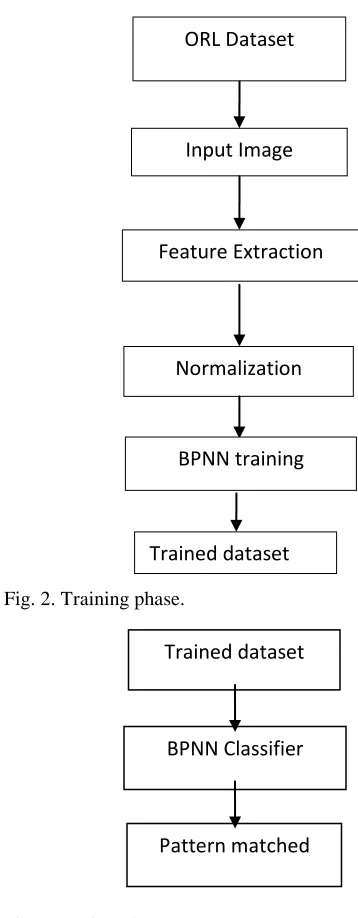
Fig. 2. Training phase.
Fig 3. Testing phase
Input Image
ORL Dataset
Feature Extraction
Normalization
BPNN training
Trained dataset
Trained dataset
BPNN Classifier
Pattern matched
Seven features are extracted from the samples; the features are FFT, DCT, entropy, median, standard deviation, variation and mean. As, the extracted feature has huge value variation it should be normalized to be trained.The normalized between 0 and 1. This is done with local normalization. The normalized features are given in table 1. The seven features are analyzed and five features were considered for recognition.
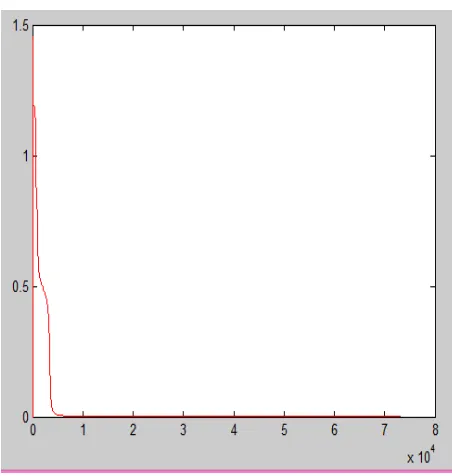
These five features of four samples are trained and tested to evaluate performance. The training is done by using BPNN classifier it consist of 5 input nodes, 3 hidden nodes and 2 output node. The number of Epoch in this training set is 73362. The input values are given in 5x4 matrix and the output values are represented in 2x4 matrix. The error convergence is shown using plotted graph as given in fig (4)
The output is obtained by giving the pattern that are trained and the pattern that matches the 2x4 output matrix are displayed.
Fig. 4. Graphical representation of error convergence
Table 1: Normalized values
6. Conclusion
In the proposed face recognition system extraction offacial features are done with the frequency and statistical domain. The frequency metrics such as FFT and DCT are used for extracting the features from ORL dataset. The statistical measures such as standard deviation, entropy, mean, variation and median are used as facial features from the ORL dataset. As the extracted features have huge values the normalization function is applied to the extracted features to reduce the values for training and then the training is done by taking the values of few samples. The training is done with Back Propagation Neural Network (BPNN) which is used to classify the best features among the extracted features. The collected features are very effective for face recognition process. Even though the epoch are huge there is no oscillation while error convergence. The ORL database is used for Experimental evaluation and testing.
Mean Standard
deviation Variation Median Entropy
0.867215 0.530162 0.254695 0.402143 0.926219
1 0.732239 0.306044 0.13736 0.877665
0.895982 0.828607 0.481773 0.203084 0.915536
0.96054 0.595538 0.231346 0.318476 0.939794
0.964758 0.672855 0.313977 0.293853 0.954704
0.756769 0.598058 0.312495 0.389894 0.938104
0.754752 0.624798 0.314642 0.368643 0.937398
Acknowledgement
We thank Olivetti Research Laboratory for providing ORL Dataset as open source.
References
[1] Srivastava, B. Ben Amor, H. Drira, M. Daoudi and R. Slamal, “3D face recognition under expressions, occlusions, and pose variations”, IEEE Trans. Pattern Anal. Mach.Intell.vol.35, no.9, Sep 2013.
[2] G. Zhou, J. Yang, N. Zhang and S. J. Wang, “Tensor Discriminant Color Space for Face Recognition”, IEEE Trans. Image Process. , vol. 20, no. 9, Sep 2011.
[3] Lee Giles and S. Lawrence,”A
Convolutional Neural Network Approach”, Accepted for publication, IEEE Tran. Neural Networks and Pattern Recognition.
[4] C.X. Ren, D. Qing Dai, X. Xin Li and Z. Rong Lai, ”Band-Reweighed Gabor kernel embedding for face image representation and recognition”, IEEE Trans. Image Process., vol. 23, no. 2, Feb 2014.
[5] G. Goswami, M. Vatsa and R. Singh, “RGB-D face recognition with texture and attribute features “,IEEE Trans. Inf. Forensic Security., vol. 9, no. 10, Oct 2014.
[6] G. Mahalingam, K. Ricanek, Jr and A. Midori Albert, “Investigating the
periocular-based face recognition across gender transformation”, IEEE Trans. Inf. Forensics Security., vol. 9, no. 12, Dec 2014.
[7] G. S. (Jison) Hsu, H. C. Peng, P. X. Wu and Y. L. Liu, “RGB-D based face reconstruction and recognition”, IEEE Trans. Inf. Forensics Security.,vol. 9, no. 12, Dec 2014.
[8] J. y. Choi, K. N. Plataniotis and Y. M. Ro, “Color face recognition for degraded face images”, IEEE Trans. Sys. Man and Cyber. vol. 39, no. 5, Oct 2009.
[9] J. Y. Choi, K.N. Plataniotis, S. H. Lee and Y. M. Ro, “Local color vector binary patterns from multichannel face images for face recognition”, IEEE Trans. Image Process., vol. 21, no. 4, Apr 2012.
[10]L. l. Shen, Q. q. Li and S. Jia,” Gabor feature-based collaborative representation for hyperspectral imagery classification”, IEEE Trans. Geosci. Sensor. vol.53, no. 2, Feb 2015.
[11]M. Vazquez, Ran He, T. Tan, Z. Chai and Z. Sun, H., “Gabor ordinal measures for face recognition”, IEEE Trans. Inf. Forensics Security, vol. 9, no. 1, Jan 2014.
[12]N. Erdogmus and S. Marcel, “Spoofing Face Recognition With 3D Masks”, IEEE Trans. Inf. Forensics Security., vol. 9, no. 7, July 2014.