GSM Controlled Robotics Using PIR
Prof. K. S. Jadhav
1, P. B. Madje
2Head of the Department, Dept. of Electronics, Hi-Tech College of Engineering, Aurangabad, India1
PG Student, Department of ECE, Savitribai Phule women’s Engineering College, Aurangabad, India2
ABSTRACT: In older trend, robot is controlled by wired system but in the recent trend wired communication system is replaced by wireless communication. Last few decades has a rapid development in GSM controlled robotic. GSM controlled robot plays an increasingly important role in the world economy. The project presented here, focuses on designing a GSM controlled robot. The movement of this robot is controlled by microcontroller. In premature day Video camera, ultrasonic sensor, radar is used to find the motion of human. In part of video camera one person has to monitor the video recording. If we use radar then transmitter and receiver is required. So, these are high in cost. But here we will use one most of important device for sensing that is PIR (pyroelectric infrared sensor). The most important function of PIR is to absorb the infrared radiation from the human body and create a corresponding signal. The detection range without a lens is about three feet but can be extended to up to 90 feet or more by placing an infrared Fresnel lens in front of the sensor. The wavelength of infrared radiation is 9.4 micro meter. This sensor can be used to find the human up to 3 meter to 90 meter distance. It has protection device that is Fresnel lenses. This type of PIR sensor is used for rescuing persons during earthquake also. We can operate a robot car anywhere in the word by using mobile phone and DTMF technique. The robot car is used the DTMF (Dual tone multi frequency) using GSM (mobile phone) having pyroelectric infrared sensor (PIR) on this head is find to motion of human body. This robot is used in military application for searching terrorist in forest or to find them in a closed room for counting and by using wireless camera we can detect the position of enemies.
KEYWORDS: ARM7 (LPC2148), DTMF Decoder (MT8870), PIR (Pyroelectric Infrared Sensor), GSM Modem, GPS and DC Motor.
I. INTRODUCTION
To implement this mechanism we used to different components to control the robot movement. The components of this GSM controlled robot are the DTMF Decoder, ARM7 (LPC2148), GSM, PIR Sensor, GPS and Motor Driver.This project mainly consists of two sections, one is mobile unit and the other one is robot unit. A Mobile Controlled Robot is a mobile device, which provides wide-range of wireless control ability to your robot unless your cell phone gets out of signal. A general concept of mobile controlled robot is that it can be controlled from any part of the world. We will definitely offer you the simplest method for developing this kind of robot in the coming days. The robot is a machine, which is controlled by a mobile phone, after receiving a call on attached mobile phone to the robot. Wireless-controlled robots use RF circuits, which have the drawbacks of limited working range, limited frequency range and the limited control. Use of a mobile phone for robotic control can overcome these limitations. It provides the advantage of robust control, working range as large as the coverage area of the service provider.
The robot can move forward, backward, right or left which depends on the numbers which you are pressing. This system consists of two technologies one is GSM and another one is GPS. GPS is one of the technologies that are used in a huge number of applications now days. GPS module provides reliable positioning, navigation, and timing services to worldwide users on a continuous basis in all weather, day and night, anywhere on or near the Earth. One of the applications is tracking your robot and keeps regular monitoring on them. GPS antenna receives the location values from the satellites. The system is about making robot more secure by the use of GPS, GSM technology and a web camera. The robot has an incorporated web-camera for taking pictures and an LCD screen for the display of pictures, image sequences, multimedia presentations or any other information the desire of making life better and easier is part of human nature.
II.RELATED WORK
Literature survey is the most important step in software and hardware development tool. Before developing the tool it is necessary to determine the time factor, economy. Once these things are satisfied, then next step is to determine which operating system and language can be used for developing the tool. Once the programmers start building the tool the programmers need lot of external support. This support can be obtained from senior programmers, from book or from websites. Before building the system the above consideration are taken into account for developing the proposed system.
Ladwa.T.M "Control of remote domestic system using DTMF" 2009 proposed a remote domestic system using DTMF. The proposed model was used to control home appliance using DTMF decode such as light ON and OFF, switching motor ON and OFF.
Chen Xiaojuan, Bu Leping "Research of Fire detection Method Basedon Multi-sensor Data Fusion" 2010, IEEE. Kumar, M. "Design of cell phone operated robot using DTMF for object research” 2013 proposed a robot controlled by DTMF and GSM. DTMF used to control the Robot and GSM is used to send and received sensors information and commends.
Felix, C. "Home automation using GSM," 2011 proposed a home automation using GSM. The proposed GSM model was better than Zig bee, RF, IR etc. it was able to control sensors, switching, temperature controlling.
Muhury, L . "Device control by using GSM network," 2012 proposed an application controlled by GSM modem. In GSM modem can able to send and receive data and information. GSM modem was used and the network is used in external device controlling
III. SYSTEM MODEL AND WORKING
During our literature survey we come across many journal papers in which robot is operated with the help of remote controls. In this manuscript, I am controlling a robot through wireless communication system using DTMF technology. It’s a wireless controlled robot here we are utilize the concept of GSM communication and this robot is controlled by using mobile phones. One is operator mobile and another mobile is stacked on the robot. The Control of Robot Involves Three Distinct Phases: Perception, Processing and Action. Generally, the Preceptors Are Sensors Mounted on the Robot, Processing is done by the On-board Microcontroller or Processor, and the Task is Performed Using Motors. In This Project the Robot is connected to GSM mobile (using DTMF technology) which is controlled by User Mobile Phone. With the Help of Commands We Can Move Our Robot in Desired Direction as Per Our Requirements. So we have found out about the DTMF technology which could be incorporated in system for controlling the movement of this robot. The DTMF tone is generated when the user pushes mobile phone keypad buttons. The remote control technologies have been used in the fields like factory automation, space exploration, in places where human access is difficult or risky. As the mobile phone enables us to connect with the outside devices via mobile communication network regardless of time and space, the mobile phone is a suitable device to control domestic systems.
The proposed method uses the DTMF (Dual Tone Multi Frequency) generated when a keypad button of the mobile phone is pressed by the user. The mobile phone user controls the system by sending the DTMF tone to the access point.
control the motors. It gets the signals from the PIR sensors and it drives the motors according to the sensor inputs.The live person can be detected by the body temperature radiation. T h e P I R s e n s o r w i l l b e designed like that it will activate when it will detect that much temperature.
IV. BLOCK DIAGRAM OF PROPOSED SYSTEM
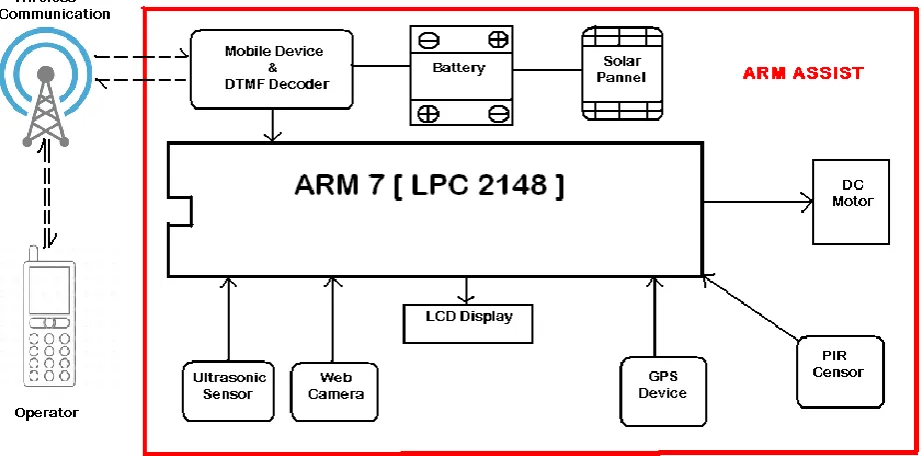
Fig 1 denotes the block diagram of proposed system. The main hardware components are ARM7 microcontroller, DTMF decoder, PIR sensor, ultrasonic sensor, LCD, DC motor, GSM, GPS, mobile phone, camera, solar panel and power supply. The main scope of project is to send commands from one cell phone to be received by another cell phone mounted on the robot. The controller also connected to the GSM module, which sends information to rescue person about the dangerous area where robot is climbing or running. Also attached camera can send the required information in the form of images or video to the rescue team.
Fig.1 Block diagram of proposed system
Power Supply: A device or system that supplies electrical energy to an output load or group of loads is called as power Supply unit. In our proposed system +5V DC supply is required for arm7 and DTMF Decoder +12V DC supply is required for DC motor and as an input to 7805 regulator to get +5V DC supply.
Mobile unit: This unit will receive the commands from the another mobile if we have to operate this robot from remote Place, and if we don’t want to operate robot remotely then we will press keys on this unit and the corresponding signals will be passed on the DTMF decoder.
DTMF: In this project the robot, is controlled by a mobile phone that makes call to the phone attached to the robot. In the course of the call, if any button is pressed control corresponding to the button pressed is heard at the end of the call. This is called Dual Tone Multi Frequency.
greatest advantage compared to remaining families of controllers available like PIC and AT mega, those are on chip resources availability speed of operation (operating frequency is 0 to 100MHz).Lines, hence we can interface many I/O devices and it is a 64pin controller.
PIR Sensor:Here we are using PIR sensor for detect the which are detect human. The project is mainly used in the PIR Sensor for Earth quake rescue. The infrared sensors are used to sense the live persons. All the above systems are controlled by the microcontroller. Two DC motors are used to drive the robot.
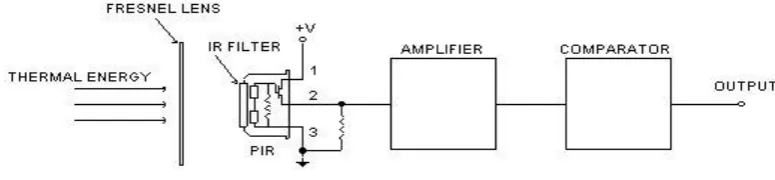
Fig.2 PIR working and Output Signal
A body passing in front of the sensor will activate first one and then the other element as shown in fig 2 whereas other source will affect both elements simultaneously and be cancelled. The PIR sensor internally is split into two halves, one half is positive and the other is considered as negative. Thus, one half generates one signal by detecting the motion of a hot body and other half generates another signal. The difference between these two signals is generated as output signal. Primarily, this sensor consists of Fresnel lens which is bifurcated to detect the infrared radiation produced by the motion of hot body over a wide range or specific area. If once the sensor gets warmed up, then the output remains low until it detects motion. If once it detects the motion, then the output goes high for a couple of seconds and then returns to a normal state or low. This sensor requires settling time, which is characteristically in the range of 10 to 60 seconds.
Fig.3 specification and dimension
The radiation source should pass in a horizontal direction so the elements are sequentially exposed to the IR source. The sensor also has a built-in infrared filter window. The detection range without a lens is about three feet but can be extended to up to 90 feet or more by placing an infrared Fresnel lens in front of the sensor. An infrared Fresnel lens with a focal length of 0.65 inch is recommended for longest range.
Fig.4 typical configuration
Fig 4 shows the pin configuration of the PIR sensor . PIR sensor consists of three pins, ground, signal, and power at the side or bottom. Generally, the PIR sensor power is up to 5V, but, the large size PIR modules operate a relay instead of direct output. This robots job is to detect the live person and indicates the signal to the helpers.
It is very simple and easy to interface the sensor with a microcontroller. The output of the PIR is (usually digital output) either low or high. This robot is very helpful in detecting live persons under the buried and pillars etc., whenever there is any earthquake occurred and building collapse. At the time of these effects people may fell down and buried under the bridges and under the pillars etc., in some cases we can’t get into that felled contacts and we can’t help them. In such cases to save them immediately we use this robot
Ultrasonic sensor: Ultrasonic sensors generate high frequency sound waves and evaluate the echo which is received back by the sensor. Sensors calculate the time interval between sending the signal and receiving the echo to determine the distance to an object.
SOLAR panel:
On GSM controlled robot we have mounted a 12V battery as the power supply for the circuit and the
motors, also we can add a solar panel for charging that 12V battery to long time use.Web camera: Here the robot is equipped with PIR sensor, GPS and cameras in order to send required information to rescue team before they take any necessary action.
GPS: The Global Positioning System (GPS) is a U.S. space-based global navigation satellite system. It provides reliable positioning, navigation, and timing services to worldwide users on a continuous basis in all weather, day and night, anywhere on or near the Earth.
GSM: GSM
stands for Global System for Mobile Communications. GSM Controlled Wireless Robot is wireless robot
which capable of receiving call and performs the necessary actions.In this project GSM is the important part to make a
call and receive the call. Operator can control the robot by the use of GSM module.DC motor: Output of controller is given to the dc motor driver. In this project we are using dc motor for the movement of robot. Following controls can be carried out using the dc motor by the crane.
In this car we use two 12V dc motors
for their motion. These motors are fixed with back wheels each with one. Front wheel is free to rotate.
A motor is used for driving the robot i.e., whenever the signals are given by the user the robot moves forward, backward, right, left with the help of the motor.V. OVERVIEW OF THE TECHNOLOGY USED
microcontroller is pre- programmed to take a decision for any given input and outputs it decisions to the motor drivers in order to drive the motors for forward or backward motion or a turn right or left. The version of DTMF used for telephone dialling is called touch tone. The project uses MT8870 DTMF decoder IC which decodes tone generated by the keypad of cell phone. These tones are based on the DTMF technology. Data is transmitted in terms of pair of tones. The receiver detects the valid frequency pair and gives the appropriate BCD code as the output of the DTMF decoder IC. The tones are decoded by the switching centred to determine the keys pressed by the user.
Table 1: Frequency assignments in DTMF system.
Frequencies 1209Hz 1336Hz 1477Hz 1633Hz
697 Hz 1 2 3 A
770Hz 4 5 6 B
852Hz 7 8 9 C
941Hz * 0 # D
Table 2 denote the tones and assignments in a DTMF system. The DTMF keypad is arranged such that each row will have its own unique tone frequency and also each column will have its own unique tone. Below is a representation of the typical DTMF keypad and the associated row/column frequencies. This code is consisting of two frequencies among which one is higher frequency and second one is lower frequency. The DTMF telephone keypad is laid out in a 4×4 matrix of push buttons in which each row represents the low frequency component and each column represents the high frequency component of the DTMF signal. Pressing a key sends a combination of the row and column frequencies. For example, the key 1 produces a superimposition of tones of 697 and 1209 hertz. This digital signal is send to microcontroller. Thus microcontroller is used to control and drive the robot car.
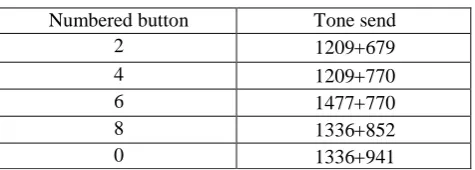
The table below shows the corresponding frequencies of the numbered buttons
Table 2: Tone send
Numbered button Tone send
2 1209679
4 1209770
6 1477770
8 1336852
0 1336941
Table 3: DTMF decoder.
FLOW
(Hz)
FHIGH
(Hz)
KEY Q4 Q3 Q2 Q1
697 1209 1 0 0 0 1 697 1336 2 0 0 1 0 697 1477 3 0 0 1 1 770 1209 4 0 1 0 0 770 1336 5 0 1 0 1 770 1477 6 0 1 1 0 852 1209 7 0 1 1 1 852 1336 8 1 0 0 0 852 1477 9 1 0 0 1 941 1209 0 1 0 1 0 941 1336 . 1 0 1 1 941 1477 # 1 1 0 0 697 1633 A 1 1 0 1 770 1633 B 1 1 1 0 852 1633 C 1 1 1 1 941 1633 D 0 0 0 0 - - ANY Z Z Z Z
VI. RESULT AND DISCUSSION
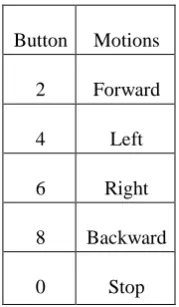
By pressing the number keypads in your cell phone, you will be able to move the robot in various directions. It is made possible with the help of Dual Tone Multi Frequency receiver (IC MT8870), in which the sleeve connection of the robot cell phone is connected to the IC MT8870. The ARM (LPC2148) controller acts as processing unit. The controller is mainly interfaced to DTMF decoder (MT8870) and driver circuits to drive the motors connected to the robot. The controller takes the signal from MT8870 decoder, which generates the 4 bit binary code equalling to the alphanumeric tone get generated by mobile. These binary digits will send to the microcontroller which is pre-programmed to take a decision and give command to motor drivers in order to drive the motors in forward or backward motion or turn to left or right as shown in below.
Table 4: Experimental Result
Button Motions
2 Forward
4 Left
6 Right
8 Backward
0 Stop
The below figure shows the prototype of the Design and Implementation of GSM controlled robot using PIR.
VII. CONCLUSIONS
The main aim of this paper is to explaining the controlling method used to operate the robot, DTMF technology is used, and with the help of this technology we can control the robot from any location of world. Initially after designing this robot it is tested with RF module but to overcome the limitations of RF, DTMF methodology is to be implemented. GSM can be used instead of CDMA which is highly secured and can’t be easily jammed or tapped. LPC2148 is used in this robot which is very accurate and speed to control all devices interfaced with it. PIR sensor is used for rescuing persons during earthquake also and this rescuing operation using PIR sensor is cheaper. Using image processing and artificial intelligence we can improve our project and if weapons are fixed with this robot it is also able to tackle with enemies. Thus we can save our Indian soldiers work and their life. It is suppose to make a humanoid robot for this type of searching operations in future. This robot is also helpful for rescue/military team, for this robot is designed with PIR sensor, GSM module and camera which monitor surrounding places.
REFERENCES
[1] V.S. Venkatesan, “GSM controlled robotics” Fourth International Conference on Advanced Computing & Communication Technologies 2014. [2] Amritanshu Srivastava, Hrishikesh Narayan Tripathi “GSM Calling based Multi-tasking Robot vehicle with Password protection”International Journal of Advanced Research in Computer Science and Software Engineering ,January 2014
[3] Vishveshwar Ramanathan Subramanian, “application of dual tone multi frequency technology and sensing in autonomous robotic navigation” International Journal of Research in Engineering and Technology
[4] Mohammed M. Ali, “GPRS-Based Remote Sensing And Tele-operation Of A Mobile Robot”, IEEE 2013 10th International Multi-Conference on Signals, systems and devices, Hammarnet, Tunisia, March 18-21 2013.