Effective Sentiment Analysis on Twitter Data using:
Apache Flume and Hive
Penchalaiah.C1,Murali.G2Suresh Babu.A3
1
Computer Science and EngineeringDept, JNTUACEP, Pulivendula, YSR Kadapa (District), Andhra Pradesh-516390, [email protected]
2
Asst.Prof.& HOD at Computer Science and EngineeringDept, JNTUACEP, Pulivendula, YSR Kadapa (District), Andhra Pradesh-516390, [email protected]
3
Additional Controller of Exams &Asst.Prof. atComputer Science and Engineering Dept, JNTU Ananthapuramu, Andhra Pradesh-515002, INDIA. [email protected]
Abstract
As of now we know present industries and some survey companies are mainly taking decisions by data obtained from web. As we see WWW is a rich collection of data that is mainly in the form of unstructured data from which we can do analysis on those data which is collected on some situation or on a particular thing. In this paper, we are going to talk how effectively sentiment analysisis done on the data which is collected from the Twitter using Flume. Twitter is an online web application which contains rich amount of data that can be a structured, semi-structured and un-structured data. We can collect the data from the twitter by using BIGDATA eco-system using online streaming tool Flume. And doing analysis on Twitter is also difficult due to language that is used for comments. And, coming to analysis there are different types of analysis that can be done on the collected data. So here we are taking sentiment analysis, for this we are using Hive and its queries to give the sentiment data based up on the groups that we have defined in the HQL (Hive Query Language). Here we have categorized this sentiment analysis into 3 groups like tweets that are having positive, moderate and negative comments.
Keywords:Analysis, BIGDATA, Comment, Flume, Hive, HQL, Sentiment Analysis, Structured, Semi-Structured, Twitter, Tweets, Un-Structured, WWW (Word Wide Web).
1. Introduction
From 20th century onwards this WWW has completely changed the way of expressing their views. Present situation is completely they are expressing their thoughts through online blogs, discussion forms and also some online applications like Facebook, Twitter, etc. If we take Twitter as our example nearly 1TB of text data is generating within a week in the form of tweets. So, by this it is understand clearly how this Internet is changing the way of living and style of people. Among these tweets can be categorized by the hash value tags for which they are
commenting and posting their tweets. So, now many companies and also the survey companies are using this for doing some analytics such that they can predict the success rate of their product or also they can show the different view from the data that they have collected for analysis. But, to calculate their views is very difficult in a normal way by taking these heavy data that are going to generate day by day.
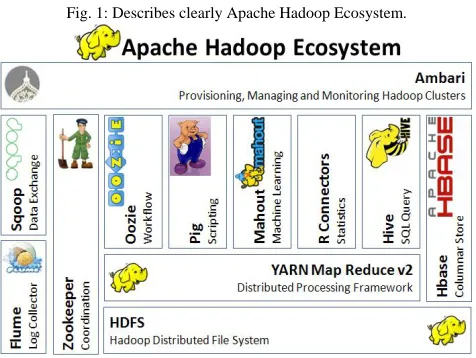
Fig. 1: Describes clearly Apache Hadoop Ecosystem.
The above figure shows clearly the different types of ecosystems that are available on Hadoop so, this problem is taking now and can be solved by using BIGDATA [15]Problem as a solution. And if we consider getting the data from Twitter [1] one should use any one
2. Problem Statement
2.1 Existing System
As we have already discussed about the older way of getting data and also performing the sentiment analysis on those data. Here they are going to use some coding techniques for crawling the data from the twitter where they can extract the data from the Twitter web pages by using some code that may be written either in JAVA, Python etc. For those they are going to download the libraries that are provided by the twitter guys by using thisthey are crawling the data that we want particularly.[1] After getting raw data they will filter by using some old techniques and also they will find out the positive, negative and moderate words from the list of collected words in a text file. All these words should be collected by us to filter out or do some sentiment analysis on the filtered data.[2],[7]. These words can be called as a dictionary set by which they will perform sentiment analysis. Also, after performing all these things and they want to store these in a database and coming to here they can use RDBMS[14] where they are having limitations in creating tables and also accessing the tables effectively.
2.2Proposed System
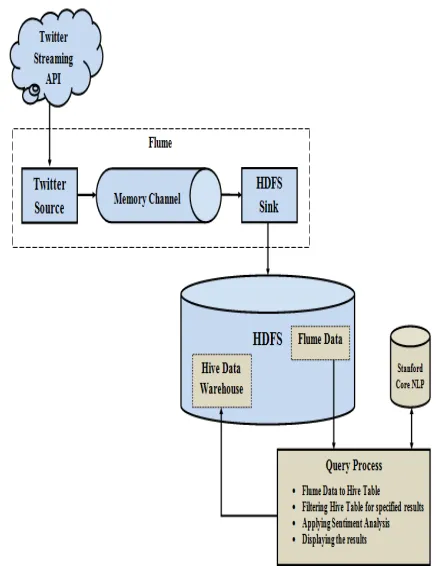
As it can have seen existing system drawbacks, here we are going to overcome them by solving this issue using Big Data problem statement. So here we are going to use Hadoop and its Ecosystems, for getting raw data from the Twitter we are using Hadoop online streaming tool using Apache Flume[13]. In this tool only we are going to configure everything that we want to get data from the Twitter.[3] For this we want to set the configuration and also want to define what information that we want to get form Twitter. All these will be saved into our HDFS (Hadoop Distributed File System)[12] in our prescribed format. From this raw data we are going to create the table and filter the information that is needed for us and sort them into the Hive Table. And form that we are going to perform the Sentiment Analysis by using some UDF’s (User Defined Functions) by which we can perform sentiment analysis by taking Stanford Core NLP[11] as the data dictionary so that by using that we can decide the list of words that coming under positive, moderate and negative.
The following figure shows clearly the architecture view for the proposed system by this we can understand how our project is effective using the Hadoop ecosystems and how the data is going to store form the Flume, also how it
is going to create tables using Hive also how the sentiment analysis is going to perform[8].
Fig. 2: Architecture diagram for proposed system.
3. Methodology
As we have seen the procedure how to overcome the problem that we are facing in the existing problem that is shown clearly in the proposed system. So, to achieve this we are going to follow the following methods:
Creating Twitter Application.
Getting data using Flume.
Querying using Hive Query Language (HQL)
3.1 Creating Twitter Application
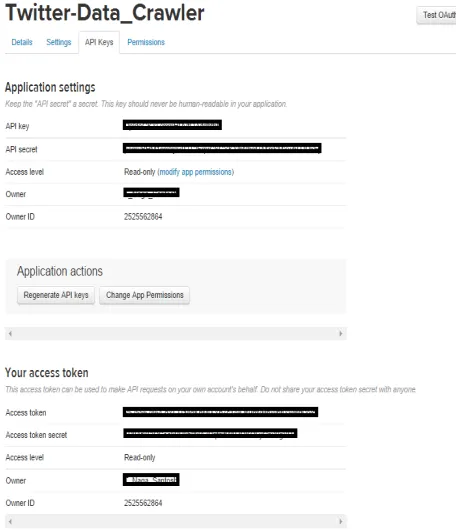
after creating the application and here it’s self we can see the consumer details and also the access token details. We want to take this keys and token details and want to set in the Flume configuration file such that we can get the required data from the Twitter in the form of twits.
Fig. 3: Creating Twitter application from Twitter Developer.
The figure show clearly the application keys that are generated after creating application and in this keys we can see the top two keys are the API key and API secret. And coming to the reaming two keys it is nothing but know as the access tokens that we want to generate it by ourselves by clicking the generate access token. After clicking that we can get the two keys that are our account access token and coming to that one is Access token and the other one is the Access token secret.
3.2 Getting data using Flume
After creating an application in the Twitter developer site we want to use the consumer key and secret along with the access token and secret values. By which we can access the Twitter and we can get the information that what we want exactly here we will get everything in JSON format and this is stored in the HDFS that we have given the location where to save all the data that comes from the
Twitter. The following is the configuration file that we want to use to get the Twitter data from the Twitter.
Fig. 4: Flume configuration files for Twitter data.
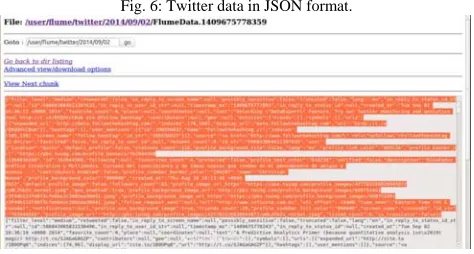
3.3 Querying using Hive Query Language (HQL)After running the Flume by setting the above configuration then the Twitter data will automatically will save into HDFS[6] where we have the set the path storage to save the Twitter data that was taken by using Flume. The following is the figure that shows clearly how the data is stored in the HDFS in a documented format and the raw data that we got form the Twitter is also in the JSON format that is shown clearly below:
Fig. 6: Twitter data in JSON format.
Fig. 7: Validating JSON data for HQL.
From these data first we want to create a table where the filtered data want to set into a formatted structured such that by which we can say clearly that we have converted the unstructured data into structured format. For this we want to use some custom serde concepts. These concepts are nothing but how we are going to read the data that is in the form of JSON format for that we are using the custom serde for JSON so that our hive can read the JSONdata[10]and can create a table in our prescribed format.
Fig. 8: HQL Query for creating Tweets table.
Fig. 9: Inserting data by performing sentiment analysis.
Also we are using another UDF’s (User Defined Functions) for performing the sentiment analysis on the tales that are created by using Hive.[5]From that we can perform the sentiment analysis. And acquire the results where a new table is created by partition concept such that all the comments that are having positive will go into the positive partition and all the comments that are having moderate will go into moderate partition and finally all the comments that are having negative will go into negative partition.
The following figure shows clearly how the rating is done and how the data is partitioned into 3 types.
4. Conclusions
There are different ways to get Twitter data or any other online streaming data where they want to code lines of coding to achieve this. And, also they want to perform the sentiment analysis on the stored data where it makes some complex to perform those operations. Coming to this paper we have achieved by this problem statement and solving it in BIGDATA by using Hadoop and its Eco Systems. And finally we have done sentiment analysis on the Twitter data that is stored in HDFS[6]. So, here the processing time taken is also very less compared to the previous methods because HadoopMapReduce and Hive are the best methods to process large amount of data in a small time.
5. Future Work
In this paper it has shown the way for doing sentiment analysis for Twitter data. Also, we can do this by using Oozie by creating a work flow so that we can give a time slang such that it will work based upon that time we allocated for performing a particular work. Also at last we can also visualize the word map i.e., the most frequent words that are used in positive, moderate and negative fields by using R language to visualize.
Acknowledgments
We are grateful to express sincere thanks to our faculties who gave support and special thanks to our department for providing facilities that were offered to us for carrying out this project.
References
[1] Go, A., Bhayani, R., & Huang, L. (2009). Twitter sentiment
classification using distant supervision. CS224N Project Report, Stanford, 1-12.
[2] Tang, H., Tan, S., Cheng, X., A survey on sentiment detection of reviews, Expert Systems with Applications: An International Journal, v.36 n.7, p.10760-10773, September, 2009.
[3] A. Pak and P. Parouek, “Twitter as a corpus for sentiment analysis and opinion mining,” in Proceedings of LREC, vol. 2010.
[4] J. Dean and S. Ghemawat, “MapReduce: Simplified Data Processing on Large Clusters,” Communications of the ACM, Vol. 51, Iss. 1, pp. 107-113, January 2008.
[5] S. Ghemawat, H. Gobioff and S-T. Leung, “The Google File System,” ACM SIGOPS Operating System Review, Vol. 37, Iss. 5, pp. 29-43, December 2003.
[6] K. Shvachko, H. Kuang, S. Radia, and R. Chansler, “The Hadoop Distributed File System,” in the 26th
IEEE Symposium on Mass Storage Systems and Technologies, pp. 1-10, May 2010.
[7] Bahrainian, S.A., Dengel, A., Sentiment Analysis using Sentiment Features, In the proceedings of WPRSM Workshop and the Proceedings of IEEE/WIC/ACM International Conference on Web Intelligence, Atlanta, USA, 2013.
[8]“Sentimental Analysis”, Inc. [Online]. Available: http://www.cs.uic.edu/~liub/FBS/sentiment-analysis [Accessed 23 March 2013].
[9] (Online Resource) Hive (Available on:http://hive.apache.org/).
[10] (Online Resource)http://jsonlint.com/
[11] (Online
Resource)http://nlp.stanford.edu/software/corenlp.shtml. [12]T. White, "The Hadoop Distributed Filesystem," Hadoop:
The Definitive Guide, pp. 41-73, GravensteinHighwaNorth, Sebastopol: O’Reilly Media, Inc., 2010.
[13] (Online Resource) http://flume.apache.org/
[14]S. W. Ambler. Relational databases 101: Looking at the whole picture.www.AgileData.org, 2009.
[15] J. Manyika, M. Chui, B. Brown, J. Bughin, R. Dobbs, C. Roxburgh, and A. H. Byers, “Big Data: The Next Frontier For Innovation, Competition, And Productivity”, May 2011.
First Author:Penchalaiah.Cwas born in Andhra Pradesh, India. He received the B.Tech Degree in Computer Science and Engineering from Jawaharlal Nehru Technological University Anantapur branch, India in 2011 andM.Tech Degree in also same branch and University. His research interests are in the area of Semantic Web and Big Data Analytics.
Second Author:Sri.G.Murali M.E.[Ph.D.] was born in Andhra Pradesh, India. He is working asAsst.Prof. & HOD in Computer Science & EngineeringDept, JNTUACEP,Pulivendula, YSR Kadapa(district),A.P.516390,INDIA.