ISSN 2286-4822 www.euacademic.org
Impact Factor: 3.4546 (UIF) DRJI Value: 5.9 (B+)
The Reasons behind Early Reading Problems
Encountered by Sudanese Basic Level Schools'
Pupils
ABOZAR YOUSIF ELAWAD ELFAKI
Ahfad University for Women
Dr. ABDALLA YASSIN ABDALLA
Sudan University of Science and Technology
Abstract:
Phenomenon of early reading problems in English language spreads wildly among the pupils at Sudanese Basic Level schools particularly in the First Circle (Grades1, 2 and 3). Most of the pupils in this stage find difficulties in reading English texts. To investigate that, the study adopted a mixed-methods approach such as: descriptive and analytical statistical methods. In addition to that, two tests (written and oral) were conducted for pupils of the 3rd grade at Basic level schools. In addition to that, a Questionnaire for English supervisors and teachers of the First Circle was designed as well as a classroom observation checklist. All these tools were conducted to address the study questions and objectives. To evaluate the data of the study, different techniques were used in the analysis. These techniques were: Statistical Package for Social Studies (SPSS), Alpha Cornapakh and Pearson Factor. The findings of the analysis confirmed that pupils in First Circle face a lot of problems in reading English texts and there are many reasons behind these problems.
INTRODUCTION
Pupils in the First Circle (Grades 1, 2 and 3) are expected to face a lot of difficulties in reading English texts. The pupil who faces early reading difficulty often continues to face difficulties in later stages of education. According to Alderson, (1984) and Carrell, (1983) the focus on developing reading ability in the early stage of education in learning a foreign language, particularly English language, increases motivation of the pupils to learn more about it and prevents many difficulties that might hinder their learning of English language.
The Statement of the Study
The statement of the study problem claims that most of the pupils at Sudanese Basic Level schools, particularly in the First Circle, have a lot of problems in early reading in English. Although, these problems differ from one to another, they result together in low level of reading ability among the pupils in this stage. Therefore, this study will investigate some early problems in English reading faced by Sudanese Basic Level schools’ pupils. Also, it will investigate the causes behind these problems in this important stage of education.
The Study Questions
In this study the following questions are raised:
1 – What are the early reading problems faced by pupils in the First Circle (Grades 1, 2 and 3) in Karary locality?
2 – Why do most of the First Circle’s pupils, in Karary locality, find difficulties in reading English texts?
Objectives of the Study
This study sets out to:
– ascertain factors responsible for early reading problems in the First Circle (Grades 1, 2 and 3).
Limits of the Study
This study will be done in Karary Locality, Omdurman for pupils of the 3rd grade at two different Basic level schools (boys and girls) to investigate early reading problems among the pupils in this grade.
LITERATURE REVIEW
Importance of Early Reading in English Language
Among the four language skills, reading is possibly the most extensively and intensively studied by experts in the field of language teaching. As a result, language educators can choose the appropriate of wide variety of teaching methods and techniques for students learning to read in their second language (L2) or foreign language (FL).
Reading is a part of a language, and the language is a mean of communication. Therefore, learning of any language, even if it's our first language (L1); depends largely on early reading. But for learning a foreign language as a second language, in this case English language (EL), early reading is an essential skill. Learning to read in English is a sequential process; each new skill builds on the mastery of the previous learned skills. Early on, for example, English language learners (ELLs) learn to break down words into their most basic sounds (phonemes) in a process called "decoding". Later, they begin to comprehend the meaning of words, sentences and, ultimately, getting entire meaning of the text.
lower overall academic achievement and first grade seems to be a critical developmental period." According to Gandara, (1997) "English language learners (ELLs), or students whom primary language is other than English and are learning English as a second language, often experience particular challenges in developing reading skills in the early grades".
The Nature of Early Reading Problems (ERPs)
The foundations of good reading are the same for all children. All readers, regardless of their age or gender, need to develop their reading competence in order to become successful readers. Reading is a difficult process. The brain must be doing several things at once in order to make sense out of the written word. Many things can go wrong when a pupil is learning to read. Kids who struggle with early reading struggle with life. Stanovich, (1986) Points out that: "Pupils who experience early reading difficulty often continue to experience failure in later grades and later in life." Therefore, children who experience early reading difficulties are no exception. They must be developed their basic foundations for reading, and they require the same types of learning experiences to do so.
Pupils with early reading problems (ERPs) lack many of the basic components of reading. Learning to read is a sequential process. Each new skill builds on the mastery of previously learned skills. Each step in this process relates to one of the three components of reading: decoding, comprehension and retention. Thereby, ERPs represent a breakdown somewhere in the process of reading. A breakdown might be in decoding, comprehension or retention. Any breakdown affects the child's reading ability. Although, problems of early reading may occur in any area – decoding, comprehension or retention– the root of the most early reading problems, in view of many experts, is decoding.
the sounds of the letters takes a lot of effort, their reading rate is slow, and their word identification on the contextual texts is hesitant and weak. All that because most of their cognitive or mental effort is spent trying to identify words, therefore, their comprehension suffers. So, the main prevention and early intervention strategies for these children are effective preparation for literacy and effective classroom instruction.
Who Face Early Reading Problems (ERPs)?
Early reading problems are inability to read a word, sentence or text loudly or silently, or inability to understand that. According to Dr. Fathi Elzayat, (2007), (Early reading problems are disorders, shortage or difficulties in growth connect with nerves which lead to difficulties in reading and understanding what is written, although the availability of little intelligence and circumstances of learning). Therefore, those who face ERPs are normal people. They don't have organic or psychological diseases. Also, they haven't got any defect in their parts of the bodies that connected with pronunciation. So, those who run into difficulties do not need different instruction from other children. They may need more focused, intense, and individual application. Any special services they receive should be integrated into high-quality classroom instructions.
Some Factors Lead to ERPs
There are some factors that lead to ERPs among the pupils in the First Circle:
Bodily and Healthily Factors:
Problems of audition and vision.
Some problems connected with the brain. Genetic factors.
Malnutrition.
Weakness of public health.
Psychological Factors:
Here are some of psychological factors which lead to difficulties in early reading:
Confusions in attention.
Weakness in recognition and perception. Psychological stress.
Feeling of uncomfortable to the teacher. Linguistic retardation.
Difficulty in adaptation with the school.
Family Factors:
Family trouble.
Absence of observation from the parents. Bad treatment.
Negative up-bringing.
Unconcern with children at home.
School Factors:
There are many school factors that lead to problems in early reading in the First Circle, such as:
Maltreatment of the teacher to the pupil.
Disregard of the teacher to differentiate between the pupils, in other words, concerning with some pupils than others.
Absence of cooperation between the house and school. Following unsuitable methods of teaching.
Discourage the pupil to the subject. Difficulty of the subject.
Long material of the syllabus which makes it boring. Unqualified teacher.
Some Early Problems face by the First Circle's Pupils
According to the researcher, as an English language teacher at different Sudanese Basic Level schools particularly in the First Circle (Grades 1, 2 and 3), notices that most of the pupils, in this early stage of education, have problems in early reading. These problems differ from one to another. Some pupils find it difficult to decode the words into phonemes. Their ability to break the words into individual phonemes is very weak. For example, they don't know that the word (cat) consists of three different phonemes which are: /k/, /æ/ and /t/. So, this group of pupils have problem in identification of English letters and their sounds.
Some of them confuse between vowel letters. The pupils in this group have problem in reading words that contain more than one vowel letter. They don't know that all vowel letters have more than one sound. According to the sounds of vowel letters, these sounds are divided into four types. The first one is short sounds, such as: /i/ city and /e/ bed. The second type contains long sounds, for example, /u:/ who, /i:/ police and /3:/Thursday. The third type involves diphthongs, which are when two vowel sounds come together, such as: /ei/ date and /ai/ night. The last one contains triphthongs, which are when three vowel sounds come together in a word, for example, /aiə/ fire. Also they don't realize that English vowel letters exchange their sounds, for example, any /eni/, ball /bɔːl/, problem /prɒbləm/, another /ənʌðə/…etc. This type of pupils finds difficulty in pronunciation of vowel letters correctly particularly when they read a text.
sentences among the pupils in the First Circle, so some pupils encounter this problem.
Some pupils, in the First Circle, find it difficult to differentiate between the names and sounds of English letters. This problem leads to mispronunciation of the words. So, pupils who have this problem find difficulty in differentiate between the names and sounds of the letters, in pronunciation of English words and their vocabulary is very poor.
Moreover, many pupils have problem in the letters that they don't exist in their first language (Arabic), for example, p /p/, v /v/, ch /tʃ/ and j /dʒ/. Pupils with this problem find difficulty in reading the words that contain these letters.
Another group of pupils, in this stage, their ability to discriminate between the names and sounds of both English and Arabic letters is very low. Some teachers use their first language (Arabic) in the classes, when they teach English language, to explain the meaning of the new words. Also, they translate all the sentences in an English textbook to the pupils’ first language, which is Arabic. Using the first language in teaching English language in the First Circle (Grades1, 2 and 3) leads to deficiency of reading skill among the pupils when they read an English text and to misunderstand the meaning of the words. This problem results in confusion between the sounds of the letters in both languages. So, this group of pupils have problem in pronunciation and remembering the meaning of English words.
Other type of pupils their issue deals with understanding what they read in English. This issue is relevant to the knowledge of morphological and syntactical rules of writing English sentence. Because the rules of writing sentences in English are different from what is found in Arabic language, therefore, this type of pupils have problem in understanding the English textbooks.
First Circle (Grades 1, 2 and 3) and their low level in the most important skill, according to some experts, no efforts, so far, have been done to improve the standards of early reading in English in this important and early stage of education.
METHODOLOGY OF THE STUDY
The data for the present study was obtained and collected by three tools. Firstly, two tests for the 3rd grade pupils were designed. One was a written test and the other was an oral test. These two tests were conducted to investigate the pupils' abilities in reading comprehension as well as to discover some problematic areas of early reading. The second tool was a questionnaire for English supervisors and teachers of the First Circle. The study used this questionnaire to investigate some problems of early reading in English encountered by the pupils in the First Circle particularly in grade 3, also to find out the reasons behind these problems. The third tool was used for collecting data of the study was a classroom observation checklist. The purpose of this tool was to focus on the pupils' reaction during the lessons have been done by their teachers, also to investigate additional early reading problems faced by the pupils in this grade.
The Study Population and Sample
Below are two tables. Table (1) shows distribution of the pupils according to schools, while table (2) explains distribution of the pupils according to sex.
School Frequency Percent
British Educational schools 117 60.3 %
Abdelmarouf Educational schools 77 39.7 %
Total 194 100%
Table (1) shows distribution of the pupils according to schools.
Sex Frequency Percent
Boys 107 55.2 %
Girls 87 44.8 %
Total 194 100%
Table (2) explains distribution of the pupils according to sex.
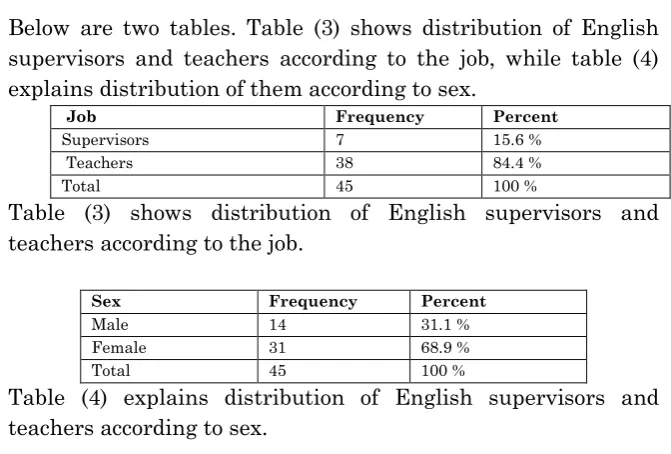
Below are two tables. Table (3) shows distribution of English supervisors and teachers according to the job, while table (4) explains distribution of them according to sex.
Job Frequency Percent
Supervisors 7 15.6 %
Teachers 38 84.4 %
Total 45 100 %
Table (3) shows distribution of English supervisors and teachers according to the job.
Sex Frequency Percent
Male 14 31.1 %
Female 31 68.9 %
Total 45 100 %
Table (4) explains distribution of English supervisors and teachers according to sex.
DATA ANALYSIS, RESULTS AND DISCUSSION
Package for Social Studies (SPSS), Alpha Cornapakh and Pearson Factor.
RESULTS OF THE TESTS
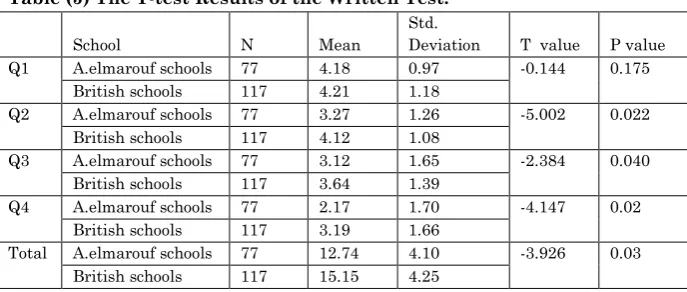
Table (5) The T-test Results of the Written Test.
School N Mean
Std.
Deviation T value P value
Q1 A.elmarouf schools 77 4.18 0.97 -0.144 0.175
British schools 117 4.21 1.18
Q2 A.elmarouf schools 77 3.27 1.26 -5.002 0.022
British schools 117 4.12 1.08
Q3 A.elmarouf schools 77 3.12 1.65 -2.384 0.040
British schools 117 3.64 1.39
Q4 A.elmarouf schools 77 2.17 1.70 -4.147 0.02
British schools 117 3.19 1.66
Total A.elmarouf schools 77 12.74 4.10 -3.926 0.03 British schools 117 15.15 4.25
As it appeared in the table above that all the T values of the four questions were negative which means that British schools scored high marks in all the questions than A.elamrouf schools. So, the differences tended to the side of British schools.
In conclusion, the results of table (5) confirmed validity of the test's questions and reinforced by the scores of standard deviations.
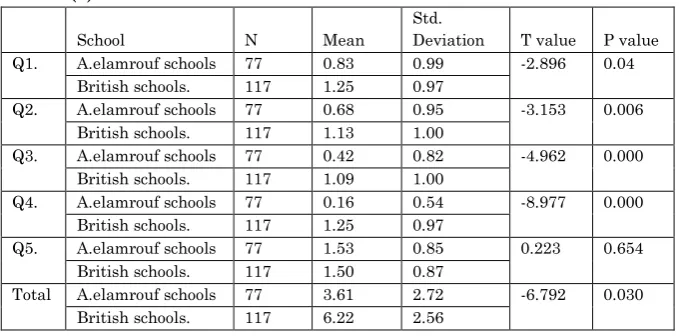
Table (6) The T-test Results of the Oral Test:
School N Mean
Std.
Deviation T value P value
Q1. A.elamrouf schools 77 0.83 0.99 -2.896 0.04
British schools. 117 1.25 0.97
Q2. A.elamrouf schools 77 0.68 0.95 -3.153 0.006
British schools. 117 1.13 1.00
Q3. A.elamrouf schools 77 0.42 0.82 -4.962 0.000
British schools. 117 1.09 1.00
Q4. A.elamrouf schools 77 0.16 0.54 -8.977 0.000
British schools. 117 1.25 0.97
Q5. A.elamrouf schools 77 1.53 0.85 0.223 0.654
British schools. 117 1.50 0.87
Total A.elamrouf schools 77 3.61 2.72 -6.792 0.030 British schools. 117 6.22 2.56
were (0.54) and (0.97). The total dimensions of the test indicated that the means were (3.61) for A.elmarouf schools and (6.22) for British schools, the difference was (2.61) while the standard deviations were (2.72) and (4.56). On the other hand no significant differences found between the two groups of the pupils in the fifth dimension of the test. It was found that the means of the fifth question were (1.53) for A.elmarouf schools and (1.50) for British schools, the difference was (0.03) while the standard deviations were (0.85) and (0.87).
From the above table, it can be seen that all the T values of all the questions were negative except number 5. That means that British schools scored high marks in all the questions of the oral test than A.elamrouf schools, while in question number 5 the score was semi equal. So, the differences in total tended to the side of British schools.
Results of the Questionnaire
The total samples of the questionnaire were 45 samples from different Basic level schools in Omdurman and Karary localities. All of them were English supervisors and teachers of the First Circle's pupils. They were 7 supervisors and 38 teachers.
Table (7) Opinion of the participants on importance of the 3rd grade:
Items SDA D Nut A SA
N % N % N % N % N %
1- The First Circle (Grades 1, 2 and 3) at Basic level schools is regarded the best stage for teaching English language as a
foreign language. 0 0 0 0.0 2 4.4 13 28.9 30 66.7
2 - Grade 3 in the First Circle is the best grade for developing
English reading skills. 2 4.4 7 15.6 2 4.4 22 48.9 12 26.7 3 - The level of reading English
texts among the pupils in grade
3 is below the level. 3 6.7 9 20.0 5 11.1 10 22.2 18 40.0 4 - Pupils in grade 3 have
problems in reading English
texts. 0 0.0 3 6.7 4 8.9 18 40.0 20 44.4
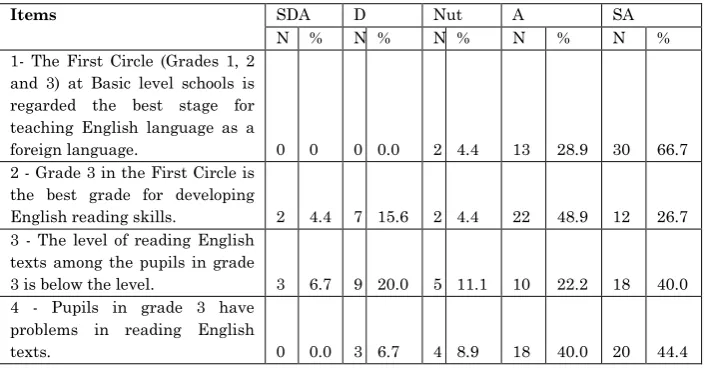
Table (7) shows the frequency and percentage of English supervisors and teachers of the First Circle (grades 1, 2 and 3) toward importance of the 3rd grade at Basic level schools for teaching English language as a foreign language.
When the participants were asked to answer item number 1, (The First Circle (Grades 1, 2 and 3) at Basic level schools is regarded the best stage for teaching English language as a foreign language.), 30 of the 45 participants responded (strongly agree) which represents (66.7 %), 13 of them responded (agree) which represents (28.9 %), whereas the 2 responded (neutral) which represents (4.4 %).
When the participants were asked to answer item number 3, (The level of reading English texts among the pupils in grade 3 is below the level.) 18 of the 45 participants responded (strongly agree) which represents (40.0 %), 10 of them responded (agree) which represents (22.2 %), 9 persons responded (disagree) which represented (20.0), 5 of them responded (neutral) which represents (11.1 %), while 3 of them responded (strongly disagree) which represents (6.7 %).
When the participants were asked to answer item number 4, (Pupils in grade 3 have problems in reading English texts.) 20 of the 45 participants responded (strongly agree) which represents (44.4 %), 18 of them responded (agree) which represents (40.0 %), 4 of them responded (neutral) which represents (8.9 %), while 3 of them responded (disagree) which represents (6.7 %).
From the results of this dimension, it was found that 95.6 % of the total participants agreed that the First Circle (Grades 1, 2 and 3) at Basic level schools is regarded the best stage for teaching English language as a foreign language. 75.6 % of them agreed that Grade 3 in the First Circle is the best grade for developing English reading skills. 62.2 % of them agreed that the level of reading English texts among the pupils in grade 3 is below the level. 84.4 % of the participants agreed that Pupils in grade 3 have problems in reading English texts.
Table (8) Opinions of the Participants on the Second Dimension:
Items
SD
A D
Nu
t A SA
N % N % N % N % N %
5- Majority of the pupils in grade 3 face Difficulties in reading in English, because of the difference between
Arabic and English in directionality. 4 8.9 8 17.8 7 15.6 19 42.2 7 15.6
6 - Most of the pupils in grade3 find difficulties in reading English texts, because of the difference between Arabic and English languages in
grammatical rules. 6 13.3 7 15.6 7 15.6 10 22.2 15 33.3
7 - Pupils in grade 3 have problems in early reading in English, because of
development of pupils' reading skills. 9 - Pupils who have problems in reading Arabic texts have also
problems in reading English texts. 4 8.9 13 28.9 4 8.9 13 28.9 11 24.4
10 - Most of the pupils in grade 3 don't
know the sounds of the letters. 9 20.0 6 13.3 3 6.7 5 11.1 22 48.9
11 - Nearly most of the pupils in this class find difficulties in reading vowel
letters. 2 4.4 7 15.6 4 8.9 10 22.2 22 48.9
12 - Majority of the pupils in this grade have problems in reading words
with silent letters. 1 2.2 2 4.4 8 17.8 12 26.7 22 48.9
13 - Most of the pupils in this class don't pay attention to punctuation
marks while reading English texts. 2 4.4 5 11.1 5 11.1 17 37.8 16 35.6
14 - Majority the pupils in grade 3 trace with their fingers when they
read in English. 1 2.2 8 17.8 9 20.0 11 24.4 16 35.6
15 - Pupils in grade 3 find difficulties in early reading because of lack of reading materials. (For example
listening and flashcards). 5 11.1 6 13.3 8 17.8 17 37.8 9 20.0
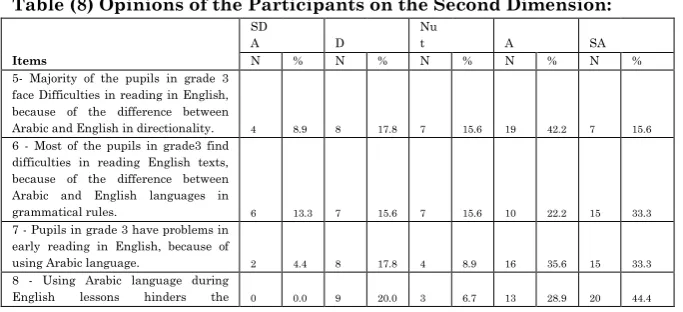
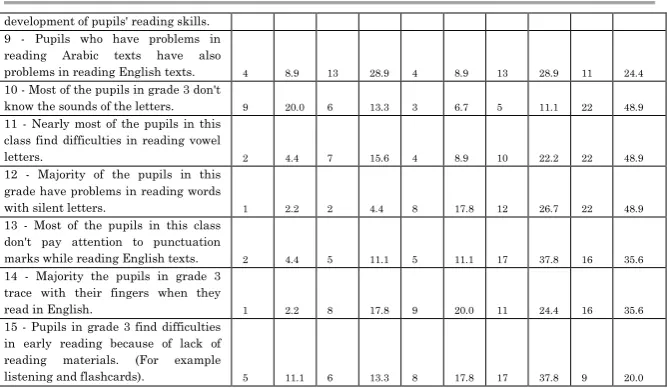
Table (8) shows opinions of the participants about the second dimension (some problematic areas of early reading in English and some reasons behind these problems.)
When the participants were asked to answer item number 5, (Majority of the pupils in grade 3 face difficulties in reading in English, because of the difference between Arabic and English in directionality.) 19 of the 45 participants responded (agree) which represents (42.2 %), 8 of them responded (disagree) which represents (17.8 %), 7 of them responded (strongly agree) which represents (15.6 %), 7 of them responded (neutral) which represents (15.6 %), while 4 of them responded (strongly disagree) which represents (8.9 %).
When the participants were asked to answer item number 7, (Pupils in grade 3 have problems in early reading in English, because of using Arabic language.) 16 of them responded (agree) which represents (35.6 %), 15 of the participants responded (strongly agree) which represents (33.3 %), 8 of them responded (disagree) which represents (17.8 %), 4 of them responded (neutral) which represents (8.9 %), while 2 of them responded (strongly disagree) which represents (4.4 %).
When the participants were asked to answer item number 8, (Using Arabic language during English lessons hinders the development of pupils' reading skills.) 20 of them responded (strongly agree) which represents (44.4 %), 13 of the participants responded (agree) which represents (28.9%), 9 of them responded (disagree) which represents (20.0 %), while 3 of them responded (neutral) which represents (6.7 %).
When the participants were asked to answer item number 9, (Pupils who have problems in reading Arabic texts have also problems in reading English texts.) 13 of them responded (agree) which represents (28.9 %), 13 of the participants responded (disagree) which represents (28.9 %), 11 of them responded (strongly agree) which represents (24.4 %), 4 of them responded (neutral) which represents (8.9 %), while 4 of them responded (strongly disagree) which represents (8.9 %).
When the participants were asked to answer item number 10, (Most of the pupils in grade 3 don't know the sounds of the letters.) 22 of them responded (strongly agree) which represents (48.9 %), 14 of the participants responded (agree) which represents (31.1 %), 6 of them responded (disagree) which represents (13.3 %), while 3 of them responded (neutral) which represents (6.7 %).
them responded (disagree) which represents (15.6 %), 4 of them responded (neutral) which represents (8.9 %), while 2 of them responded (strongly disagree) which represents (4.4 %).
When the participants were asked to answer item number 12, (Majority of the pupils in this grade have problems in reading words with silent letters.) 22 of them responded (strongly agree) which represents (48.9 %), 12 of the participants responded (agree) which represents (26.7%), 8 of them responded (neutral) which represents (17.8 %), 2 of them responded (disagree) which represents (4.4 %), while 1 of them responded (strongly disagree) which represents (2.2 %).
When the participants were asked to answer item number 13, (Most of the pupils in this class don't pay attention to punctuation marks while reading English texts.) 17 of them responded (agree) which represents (37.8 %), 16 of the participants responded (strongly agree) which represents (35.6 %), 5 of them responded (neutral) which represents (11.1%), 5 of them responded (disagree) which represents (11.1 %), while 2 of them responded (strongly disagree) which represents (4.4 %).
When the participants were asked to answer item number 14, (Majority the pupils in grade 3 trace with their fingers when they read in English.) 16 of the participants responded (strongly agree) which represents (35.6 %), 11 of them responded (agree) which represents (24.4%), 9 of them responded (neutral) which represents (20.0 %), 8 of them responded (disagree) which represents (17.8 %), while 1 of them responded (strongly disagree) which represents (2.2 %).
represents (13.3 %), while 5 of them responded (strongly disagree) which represents (11.1 %).
Table (9) Opinions of the Participants on the Role of the Syllabus:
Items
SD
A D
Nu
t A
S A
N % N % N % N % N %
16 - Pupils in grade 3 find difficulties in Reading English texts because of
shortage of their vocabulary. 3 6.7 6 13.3 3 6.7 17 37.8 16 35.6
17 - Pupils in grade 3 have problems in early reading in English, because
the selected texts are above their level. 5 11.1 12 26.7 7 15.6 12 26.7 9 20.0
18 - Pupils in grade 3 find difficulties in reading English texts, because the selected texts aren't sufficient to
develop their reading skills. 4 8.9 10 22.2 4 8.9 11 24.4 16 35.6
19 - Pupils in grade 3 have problems in early reading in English, because
the selected texts are not interesting. 7 15.6 14 31.1 6 13.3 12 26.7 6 13.3
20 - Pupils in grade 3 have problems in early reading in English, because the syllabus doesn't cope sufficiently
with early reading strategies. 4 8.9 7 15.6 6 13.3 17 37.8 11 24.4
Table (9) shows opinions of the participants about the third dimension (the role of the syllabus in early reading problems).
When the participants were asked to answer item number 16, (Pupils in grade 3 find difficulties in reading English texts because of shortage of their vocabulary.) 17 of the 45 participants responded (agree) which represents (37.8 %), 16 of them responded (strongly agree) which represents (35.6 %), 6 of them responded (disagree) which represents (13.3%), 3 of them responded (neutral) which represents (6.7 %), while 3 of them responded (strongly disagree) which represents (6.7 %).
When the participants were asked to answer item number 18, (Pupils in grade 3 find difficulties in reading English texts, because the selected texts aren't sufficient to develop their reading skills.) 16 of the 45 participants responded (strongly agree) which represents (35.6 %), 11 of them responded (agree) which represents (24.4 %), 10 of them responded (disagree) which represents (22.2 %), 4 of them responded (neutral) which represents (8.9 %), while 4 of them responded (strongly disagree) which represents (8.9 %).
When the participants were asked to answer item number 19, (Pupils in grade 3 have problems in early reading in English, because the selected texts are not interesting.) 14 of the 45 participants responded (disagree) which represents (31.1 %), 12 of them responded (agree) which represents (26.7 %), 7 of them responded (strongly disagree) which represents (15.6 %), 6 of them responded (strongly agree) which represents (13.3 %), while 6 of them responded (neutral) which represents (13.3 %).
When the participants were asked to answer item number 20, (Pupils in grade 3 have problems in early reading in English, because the syllabus doesn't cope sufficiently with early reading strategies.) 17 of the 45 participants responded (agree) which represents (37.8 %), 11 of them responded (strongly agree) which represents (24.4 %), 7 of them responded (disagree) which represents (15.6 %), 6 of them responded (neutral) which represents (13.3 %), while 4 of them responded (strongly disagree) which represents (8.9 %).
Table (10) Opinions of the Participants on the Role of the Teachers and Family:
Items
SD
A D Nu A
S A
N % N % N % N % N %
21 - Pupils in grade 3 find difficulties in early reading in
English because of unqualified teachers. 2 4.4 8 17.8 4 8.9 9 2 0. 0 2 2 4 8. 9
22 - Almost most of English teachers in the First Circle use
Arabic language very much during English lessons. 1 2.2 5 11.1 8 17.8 1 4 3 1. 1 1 7 3 7. 8
23 - English teachers in First Circle don't pay attention to
24 - Some English teachers in the First Circle prefer to read the texts word-by-word which causes reading slowly
to the pupils. 0 0.0 7 15.6 3 6.7
2 1
4 6. 7
1 4
3 1. 1
25 - Some Sudanese families don't
encourage their pupils in the First Circle to read in
English. 3 6.7 2 4.4 4 8.9 8
1 7. 8
2 8
6 2. 2
Table (10) shows opinions of the participants about the fourth dimension (the role of the Teachers and Family in early reading problems.)
When the participants were asked to answer item number 21, (Pupils in grade 3 find difficulties in early reading in English because of unqualified teachers.) 22 of the 45 participants responded (strongly agree) which represents (48.9 %), 9 of them responded (agree) which represents (20.0 %), 8 of them responded (disagree) which represents (17.8 %), 4 of them responded (neutral) which represents (8.9 %), while 2 of them responded (strongly disagree) which represents (4.4 %).
When the participants were asked to answer item number 22, (Almost most of English teachers in the First Circle use Arabic language very much during English lessons.) 17 of the 45 participants responded (strongly agree) which represents (37.8 %), 14 of them responded (agree) which represents (31.1 %), 8 of them responded (neutral) which represents (17.8 %), 5 of them responded (disagree) which represents (11.1 %), while 1 of them responded (strongly disagree) which represents (2.2 %). When the participants were asked to answer item number 23, (English teachers in First Circle don't pay attention to teach the pupils early reading strategies.) 17 of the 45 participants responded (strongly agree) which represents (37.8 %), 12 of them responded (agree) which represents (26.7 %), 8 of them responded (disagree) which represents (17.8%), 6 of them responded (neutral) which represents (13.3 %), while 2 of them responded (strongly disagree) which represents (4.4 %).
represents (46.7 %), 14 of them responded (strongly agree) which represents (31.1 %), 7 of them responded (disagree) which represents (15.6 %) while 3 of them responded (neutral) which represents (6.7 %).
When the participants were asked to answer item number 25, (Some Sudanese families don't encourage their pupils in the First Circle to read in English.) 28 of the 45 participants responded (strongly agree) which represents (62.2 %), 8 of them responded (agree) which represents (17.8%), 4 of them responded (neutral) which represents (8.9 %), 3 of them responded (strongly disagree) which represents (6.7 %), while 2 of them responded (disagree) which represents (4.4 %).
CONCLUSION
The study found out the following findings:
1. Majority of the pupils in the 3rd grade find difficulties in reading English texts.
2. Although its importance of using Arabic language during English lessons, the results showed that using it very much hinters the development of English reading skills. 3. Majority of the 3rd grade pupils don't know the sounds of
the letters which leads to the low level of early reading. 4. Pupils of the 3rd grade at Basic level schools suffer from
incorrect pronunciation of words. This is results in that they don't know the sounds of the letters.
5. Pupils in this stage have problems in reading English texts because of shortage of vocabulary.
Due to the fact that more than 62% of the participants greed that Pupils in this stage have problems in early reading in English, because the syllabus doesn't cope sufficiently with early reading problems. Moreover, the teachers in First Circle became one of the causes of early reading problems because of unqualified or using Arabic language very much during English lessons. This proved by that 70% of the participants agreed that problems of early reading in the First Circle cause by unqualified teachers. Finally the family has also an effective role in these problems. It was found that 80% of the participants indicated that most of the families don't encourage their pupils in this important stage to read more in English.
RECOMMENDATIONS
1. Qualified teachers should be selected for the First Circle (Grades 1, 2 and 3) to avoid early reading problems which are difficult to catch in the coming stages.
2. The relationships between the letters (graphemes) and the sounds (phonemes) should be taught in the First Circle (Grades 1, 2 and 3).
3. The correct pronunciation of sounds and words should be taken into consideration.
4. Pupils should be provided with vocabulary which is the basic for successful reading comprehension.
REFERENCES
1. Alderson, J. C. (1984). Reading in a Foreign Language: A Reading Problem or a Language Problem. London: Longman.
3. Arnold, J. (1999). Affect in language learning. Cambridge: Cambridge University Press.
4. Bowyer-Crane, C., Snowling, M., Duff, F., Carroll, J., Fieldsend, E., Miles, J., et al. (2008). Improving early language and literacy skills: Differential effects of an oral language versus a phonology with reading intervention. Journal of Child Psychology and Psychiatry, 49.
5. Carrell, P. (1983). Three Components of Background Knowledge in Reading Comprehension Language Learning.
6. Dr. Fathi Elzayat, (2007). Learning difficulties- teaching strategies.
7. Hatcher, P. J., Goetz, K., Snowling, M. J., Hulme, C., Gibbs, S., & Smith. (2006). Evidence for the effectiveness of the Early Literacy Support Programme. British Journal of EducationalPsychology (73).
8. Orton, S. T. (1937). Reading, writing and speech problems in children. London: Chapman & Hall.
9. Rose, J. (2006). Independent review of the teaching of early reading: Final report. London: Department for Education and Skills Publications.