Design and analysis of Architecture based integrating sensor
Networks with Cloud Computing
MARATY MEENA [email protected]
Abstract: Wireless sensor network (WSN) is widely
applied in many fields since its emergence. However, the limited resources of a sensor, especially limited battery life, limited bandwidth and limited processing power, are the main challenges for deploying and operating WSNs. This paper proposes a novel architecture based on cloud computing for wireless sensor network, which can improve the performance of WSN. Based on this architecture, a cloud acts as a virtual sink with many sink points that collect sensing data from sensors. Each sink point is responsible for collecting data from the sensors within a zone. Sensing data are stored and processed in distributed manner in cloud. Our simulation results show that the proposed architecture.
I. INTRODUCTION
The communication among sensor nodes using Internet isoften a challenging issue. It makes a lot of sense to integratesensor networks with Internet [1]. At the same time the data ofsensor network should be available at any time, at any place. Itis possibly a difficult issue to assign address to the sensor nodesof large numbers; so sensor node may not establish connectionwith internet exclusively. Cloud computing strategy can helpbusiness organizations to conduct their core business activitieswith less hassle and greater efficiency. Companies canmaximize the use of their existing hardware to plan for andserve specific peaks in usage. Thousands of virtual machinesand applications can be managed more easily using a cloud-likeenvironment. Businesses can also save on power costs as theyreduce the number of servers required.
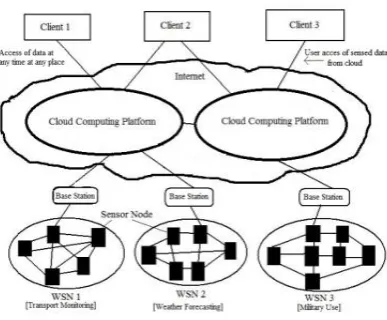
Fig.1 consists of WSNs (i.e. WSN1, WSN2, and WSN3),cloud infrastructure and the clients. Clients seek services fromthe system. WSN consists of physical wireless sensor nodes tosense different applications like Transport Monitoring, WeatherForecasting, and Military Application etc. Each sensor node isprogrammed with the required
application. Sensor node alsoconsists of operating system components and networkmanagement components. On each sensor node, applicationprogram senses the application and sends back to gateway inthe cloud directly through base station or in multi-hop throughother nodes. Routing protocol plays a vital role in managing thenetwork topology and to accommodate the network dynamics.Cloud provides on-demand service and storage resources to theclients. It provides access to these resources through internetand comes in handy when there is a sudden requirement ofresources.
Fig. 1 WSN- Cloud Computing Platform
Cloud: overview: Cloud computing is a term used
to describe both a platformand type of application. A cloud computing platformdynamically provisions, configures, reconfigures servers asneeded. Servers in the cloud can be physical machines orvirtual machines. It is an alternative to having local servershandle applications. The end users of a cloud computingnetwork usually have no idea where the servers are physicallylocated—they just spin up their application and start working.
andreleased with minimal management effort or service providerinteraction [2].
Sensor Network overview:A wireless sensor
network (WSN) consists of spatiallydistributed autonomous sensors to cooperatively monitorphysical or environmental conditions, such as temperature,sound, vibration, pressure, motion or pollutants.[4,5] Thedevelopment of wireless sensor networks was motivated bymilitary applications such as battlefield surveillance. They arenow used in many industrial and civilian application areas,including industrial process monitoring and control, machinehealth monitoring [6], environment and habitat monitoring,healthcare applications, home automation, and traffic control[4, 7].Each node in a sensor network is typically equipped witha radio transceiver or other wireless communications device, asmall microcontroller, and an energy source, usually a battery.
The size of sensor node may vary from shoebox down to agrain of dust. The cost of sensor nodes is also varies fromhundreds of dollars to a few pennies, depending on the size ofthe sensor network and the complexity required of individualsensor nodes [4]. Size and cost constraints on sensor nodesresult in corresponding constraints on resources such as energy,memory, computational speed and bandwidth [4].
II. RELATED WORK
Rajesh et. al. [1] presents Secured Wireless Sensor Network-integrated Cloud Computing architecture. The real-timesensor data must be processed and the action must be taken regularly. The integration controller module of theproposed architecture integrates the sensor network and Internet using
Cloud Technology which offers the benefit ofreliability, availability and extensibility.
Peter et. al. [5] discusses the idea of combining wireless sensor networks andcloud computing from the existing approach. The paper proposes wireless sensor network by virtual sensor in the cloud.The idea is to store the data on both the real sensor and virtual sensor. The paper proposes architecture to realizedistributed shared memory in WSNs with the help of a middleware called tiny DMS.
Tongrang Fan et. al. [8] proposessensor data storage solutions based on the Hadoop cloud computing framework. Due to the rapid growth of sensor datastorage and processing, traditional storage systems are not able to meet the data access requirements. By contrast to theprivate cloud system storage and traditional storage model, the characteristics and advantages of private cloud systemstorage are analyzed. The designed storage solutions were performed by MapReduce programming model, and theexperimental results indicated that the new cloud storage solution had higher data access performance.
Geoffrey et. al.[10] discusses the characteristics of distributed cloud computing infrastructure for collaboration sensor-centricapplications on the Future Grid. The paper mainly focuses on the performance, scalability and reliability at the networklevel using standard network performance tools.
Sajjade t. al. [11] proposes a new framework for Wireless Sensor Network integration with Cloud Computing modelwith a possibility of an existing Wireless Sensor Network getting connected to the proposed framework. The integrationcontroller unit of the proposed framework integrates the sensor network and cloud computing technology which offers.
Spanning tree based algorithm: In the paper [9] stated that (WSNs) employ batterypowered sensor nodes. Communication in such networks isvery taxing on its scarce energy resources. Convergecast –process of routing data from many sources to a sink – iscommonly performed operation in WSNs. Data aggregationis a frequently used energy-conversing technique in WSNs.The rationale is to reduce volume of communicated data byusing in-network processing capability at sensor nodes. Inthat paper, they addressed the problem of performing theoperation of data aggregation enhanced convergecast (DAC)in an energy and latency efficient manner. They assumedthat all the nodes in the network have a data item and thereis an a priori known application dependent data compressionfactor (or compression factor), c, that approximates theuseful fraction of the total data collected. The paper firstpresents two DAC tree construction algorithms. One is avariant of the Minimum Spanning Tree (MST) algorithmand the other is a variant of the Single Source Shortest PathSpanning Tree (SPT) algorithm. These two algorithms serveas a motivation for our combined algorithm (COM) whichgeneralized the SPT and MST based algorithm. The COMalgorithm tries to construct an energy optimal DAC tree forany fixed value of α (= 1 - У), the data growth factor.
One important function of many wireless sensornetworks (WSNs) is to gather data from hostile or remoteenvironments. It is expected of such networks to workuntended for a long duration. Due to limited energyresources, the above requirements put constraints on theenergy usage. Examining various functionalities of sensornetworks, communication can be singled out as one functionthat devours big share of the energy resources. Dataaggregation is an energy conservation technique which triesto reduce the volume of data communicated by collectinglocal data at intermediate nodes and forwarding only theresult of an aggregation operation, such as min and max,towards the sink node. Since a convergecast operationusually follows a broadcast operation [11], the path taken bya broadcast packet is also used for aggregating data in theconvergecast. However, research shows that performingdata aggregation along this routing path is not energyefficient [10]. In [11], authors study the general dataaggregation problem and propose several (suboptimal) dataaggregation techniques. The general data aggregationproblem is – given m
sources and one sink in a n nodenetwork (m < n), find a minimum weight sub graph thatincludes all sources. This is a well-known NP-completeproblem, known as the Steiner Tree Problem (STP) [14].
III. PROPOSED SYSTEM
Graphical models (GMs) provide a natural framework bothfor modeling the correlations amongst the sensor measurementsand for developing efficient distributed estimation algorithms[3].
The proposed system includes solving the problem of how to find polling points andcompatible pairs for each cluster. A discretization scheme is developed to partition thecontinuous space to locate the optimal polling point for each cluster. Then finding thecompatible pairs becomes a matching problem to achieve optimal overall spatial diversity.The second problem is how to schedule uploading from multiple clusters. An algorithm thatadapts to the transmission scheduling algorithms is included.
The first step in the software development life cycle is the identification of theproblem. As the success of the system depends largely on how accurately a problem isidentified. At present distributed load balanced clustering algorithm is presented at the sensorlayer in which the essential operation of clustering is the selection of cluster heads. Toprolong network lifetime, it is naturally expected the selected cluster heads are the ones withhigher residual energy.Hence, the percentage of residual energy of each sensor is used as the initialclustering priority. It is also assumed that a set of sensors, denoted by S = {s1, s2, …, sn}, arehomogeneous only. Since there is no application with the feature to have heterogeneousnodes in the network and to achieve optimal overall spatial diversity along with scheduleuploading from multiple clusters, this project solves the problem through the application. Theproposed system has following advantages.
o How to find polling points and compatible pairs for each cluster is studied.
o To achieve optimal overall spatial diversity is carried out.
o Schedule uploading from multiple clusters in done.
Initialization:In this section the network
initialization process (First phase of the algorithm) iscarried out. In the initialization phase, each sensor acquaints itself with all the neighbors in itsproximity. If a sensor is an isolated node (i.e., no neighbor exists), it claims itself to be acluster head and the cluster only contains itself. Otherwise, a sensor, say, si, first sets itsstatus as ―tentative‖ and its initial priority by the percentage of residual energy.
Then, si sorts its neighbors by their initial priorities and picks M-1 neighbors with thehighest initial priorities, which are temporarily treated as its candidate peers. The set of all thecandidate peers of a sensor is denoted as A. It implies that once si successfully claims to be acluster head, its up-to-date candiup-to-date peers would also automatically become the clusterheads, and all of them form the CHG of their cluster. si sets its priority by summing up itsinitial priority with those of its candidate peers.
Status claim:In this section status claim process (Second phase of the algorithm) is carried out. Inthis phase, each sensor determines its status by iteratively updating its local information,refraining from promptly claiming to be a cluster head. The node degree is used to control themaximum number of iterations for each sensor. Whether a sensor can finally become acluster head primarily depends on its priority.
Cluster forming:In this section cluster forming process (Third phase of the algorithm) is carried out.This process decides which cluster head a sensor should be associated with. The criteria canbe described as follows: for a sensor with tentative status or being a cluster member, it wouldrandomly affiliate itself with a cluster head among its candidate peers for load balancepurpose.
In the rare case that there is no cluster head among the candidate peers of a sensorwith tentative status, the sensor would claim itself and its current candidate peers as thecluster heads. It calculates the final result of clusters, where each cluster has two clusterheads and sensors are affiliated with different cluster heads in the two clusters. In case
acluster head is running low on battery energy, re-clustering is needed. This process can bedone by sending out a re-clustering message to all the cluster members. Cluster members thatreceive this message switch to the initialization phase to perform a new round of clustering.
Receive packet:
In this section during the cluster forming process, received packet steps are carriedout. Here what are the nodes in the clusters should be updated as potential cluster heads isdecided. Likewise what are the nodes in the clusters should be updated as candidate clusterhead peers are decided. In this module, for the given node (A), the nearest cluster heads(NCH) other than the current cluster head (CH) are found out and it can be used for clusterchanging by A.
IV. RESULTS AND DISCUSSION
Degree constrained tree
The number of time slots used = 3
Constrained Minimum Spanning Tree
Time Slot Allocation Algorithm in Light-Trail Network
V. CONCLUSION
It employs distributed load balanced clustering for sensor self-organization,adopts collaborative inter-cluster communication for energy-efficient transmissions amongCHGs, use dual data uploading for fast data collection. In the cluster head layer, inter-clustertransmission range is chosen to guarantee the connectivity among the clusters. Multiplecluster heads within a cluster are cooperating with each other to perform inter-clustercommunications. Through inter-cluster transmissions, cluster head information is forwardedfor its moving trajectory planning. The performance study demonstrates the effectiveness ofthe proposed framework. The results can greatly reduce energy consumptions by alleviatingrouting burdens on nodes and balancing workload among cluster heads. It is also justified theenergy overhead and explored the results with different numbers of cluster heads in theframework.
REFERENCES
TechnicalReport. Available in:
http://users.ece.gatech.edu/
[2] P. Mell and T. Grance, "Draft NIST working definition of cloud computing -v15," 21. Aug 2005, 2009.
[3] M. Armbrust, A. Fox, R. Griffith, A. Joseph, R. Katz, A. Konwinski, G.Lee, D. Patterson, A. Rabkin, and I. Stoica, "Above the clouds: A Berkeleyview of cloud computing," EECS Department, University of California,Berkeley, Tech. Rep. UCB/EECS-2009-28, 2009.
[4] Romer, Kay; Friedemann Mattern (December 2004), "The Design Space ofWireless Sensor Networks", IEEE Wireless Communications 11 (6): 54–61,doi:10.1109/MWC.2004.1368897,
http://www.vs.inf.ethz.ch/publ/papers/wsndesignsp ace.pdf
[5] Thomas Haenselmann (2006-04-05). Sensornetworks. GFDL WirelessSensor Network textbook.
http://pi4.informatik.unimannheim.de/~haensel/sn_ book. Retrieved 2006-08-29.
[6] Tiwari, Ankit et. al, Energy-efficient wireless sensor network design andimplementation for condition-based maintenance, ACM Transactions on SensorNetworks (TOSN), http:// portal.acm.org/citation.cfm?id=1210670
[7] Hadim, Salem; Nader Mohamed (2006), "Middleware Challenges andApproaches for Wireless Sensor Networks", IEEE Distributed
Systems Online7 (3): 1,
doi:10.1109/MDSO.2006.19,http://doi.ieeecompute
rsociety.org/10.1109/MDSO.2006.19 art. no. 0603-
03001.
[9] S. Upadhyayula and S. Gupta, ―Spanning tree basedalgorithms for low latency and energy efficient dataaggregation enhanced convergecast (dac) in wireless sensornetworks,‖ Ad Hoc Networks, vol. 5, no. 5, pp. 626–648,2007.
[10] Sarma Upadhyayula, Valliappan Annamalai, SandeepGupta, A low-latency and energy-efficient algorithm forconvergecast in wireless sensor networks, in: IEEE GlobalCommunications Conference, 2003.
[11] Bhaskar Krishnamachari, Deborah Estrin, StephenWicker, Impact of data aggregation in
wireless sensornetworks, in: International Workshop on Distributed EventBased Systems (DEBS’02) Vienna, Austria, July 2002.
[14] Steven S. Skeina, the Algorithm Design Manual,Springer-Verlag, New York, 1997, pp. 339–342.