Available online:
https://edupediapublications.org/journals/index.php/IJR/
P a g e | 191“DNN based Medication Recommender System in an
IoT based Environment”
Er. Manpreet Kaur Dhaliwal
Department CSEBGIET Sangrur(Punjab)
E-mail: manpreetdhaliwal3992@g mail.co m
Er. Abhinash Singla
Head of Department, CSEBGIET Sangrur(Punjab)
E-mail: [email protected]
Abst ract - T he int ernet of t hings (IoT ), is t he int ernetworking of physical devices, vehicles (also referred t o as "connected devices" and "smart devices "), buildings and other items embedded wit h elect ronics , soft ware, sensors, actuators, and network connect ivit y t hat enable t hese objects to collect and exchange data. We present t he results of the evaluations that demonst rat e it s suit abilit y t owards real world deployments. Our proposed middleware is built on Android p lat form. T he whole sy st em is incorporated in such a way that it is easy t o use and user friendly interface is designed. The designed system is mainly based on Deep Neutral Network (DNN) as backend for t he p rocessing and the application is designed on ANDROID p latform, which work in cooperat ion wit h M AT LAB as frontend. The system designed is known as “ DNN based M edicat ion Recommender Sy st em in an IoT based Environment”. The person who is suffering from any illness uses the system as a medicine recommender. The person fills up the details in symptom form aft er connect ing t o t he system. After filling all details of t he sy mp t om form is forwarded to the system, the system processes the data using deep neural network (DNN) and makes a decision. On t he basis of this decision the system gives output which result s t he name of disease from which the person is infect ed and t he name of medicine for cure of disease. The comparison is also performed in which the disease and medicine predict ed by system is compared with the disease and medicine which are recommended by the doctors with the given symptoms of a p erson. The results of the architecture shows that system is working very efficiently and the prediction of diseases and medicine same as done by the doctors and system is giving 100% efficiency .
Keywords - Internet of things, M OSDEN, Deep Neural Net work (DNN)
I. INT RODUCT I ON In tern et o f th in g s
The concept was simple but powerful. If all objects in daily life were equipped with identifiers and wireless connectivity, these objects could be communicating with each other and be managed by computers. Today, many of these obstacles have been solved. The size and cost of wireless radios has dropped tremendously. IPv6 allows us to assign a communications address to billions of devices. Electronics companies are building Wi-Fi and cellular wireless connectivity into a wide range of devices. ABI Research estimates over five billion wireless chips will ship in 2013.Mobile data coverage has improved significantly with many networks offering broadband speeds. While not perfect, battery technology has improved and solar recharging has been built into numerous devices. There will be billions of objects connecting to the network with the next several years. For example, Cisco’s Internet of Things Group (IoT G) predicts there will be over 50 billion connected devices by 2020. IoT describes a system where items in the physical world, and sensors within or attached to these items, are connected to the Internet via wireless and wired Internet connections. These sensors can use various types of local area connections such as RFID, NFC, Wi-Fi, Bluetooth, and Zigbee. Sensors can also have wide area connectivity such as GSM, GPRS, 3G, and LTE. The Internet of Things will:
Available online:
https://edupediapublications.org/journals/index.php/IJR/
P a g e | 192objects. The types of items range from gas turbines to automobiles to utility meters. It can also include living organisms such as plants, farm animals and people.
Us e s en s o rs fo r d ata co llectio n .
The physical objects that are being connected will possess one or more sensors. Each sensor will monitor a specific condition such as location, vibration, motion and temperature. In IoT, these sensors will connect to each other and to systems that can understand or present information from the sensor’s data feeds. These sensors will provide new information to a company’s systems and to people.
Ch ange what types of item communicate o v er an IP Netwo rk.
In the past, people communicated with people and with machines. Imagine if all of your equipment had the ability to communicate. What would it tell you? IoT-enabled objects will share information about their condition and the surrounding environment with people, software systems and other machines. This information can be shared in real time or collected and shared at defined intervals. Going forward, everything will have a digital identity and connectivity, which means you, can identify, track and communicate with objects. IoT data differs from traditional computing. The data can be small in size and frequent in transmission.
A p plications of Internet of Things
1. Smart h o me 2. W earab les 3. Smart City 4. Smart g rid s 5. In d u s trial in tern et
In troduction to Android
Defin itio n o f A n d ro id
Android is an open source and Linux-based Operating System for mobile devices such as smart-phones and tablet computers. Android was developed by the Open Handset Alliance, led by Google, and other
companies. Android offers a unified approach to application development for mobile devices which means developers need only develop for Android, and their applications should be able to run on different devices powered by Android. The first beta version of the Android Software Development Kit (SDK) was released by Google in 2007 where as the first commercial version, Android 1.0, was released in September 2008.
On June 27, 2012, at the Google I/O conference, Google announced the next Android version, 4.1 Jelly Bean. Jelly Bean is an incremental update, with the primary aim of improving the user interface, both in terms of functionality and performance.
The source code for Android is available under free and open source software licenses. Google publishes most of the code under the Apache License version 2.0 and the rest, Linux kernel changes, under the GNU General Public License version 2.
II. LI T E RAT URE RE VI E W
Perera et.al [1] proposed the results of the evaluations that demonstrate its suitability towards real world deployments. Their proposed middleware is built on Android platform. —The Internet of Things (IoT) is part of Future Internet and will comprise many billions of Internet Connected Objects (ICO) or ‘things’ where things can sense, communicate, compute and potentially actuate as well as have intelligence, multi-modal interfaces, physical/ virtual identities and attributes.
Available online:
https://edupediapublications.org/journals/index.php/IJR/
P a g e | 193Bo y i et.al [3] proposed an IoT-based system for emergency medical services to demonstrate how to collect, integrate, and interoperate IoT data flexibly in order to provide support to emergency medical services. The result shows that the resource-based IoT data accessing method is effective in a distributed heterogeneous data environment for supporting data accessing timely and ubiquitously in a cloud and mobile computing platform.
Fo rtin o et.al [4] suggested the integration of two complementary mainstream paradigms for large-scale distributed computing: Agents and Cloud. Agent-based computing can support the development of decentralized, dynamic, cooperating and open IoT systems in terms of multi-agent systems. Cloud computing can enhance the IoT objects with high performance computing capabilities and huge storage resources
III. ME T HODOL OGY OF W ORK
Step s to Fo llo w:
1. To study about machine Learning using DNN and DBN.
2. Implementation of a DNN based architecture for advance features.
3. Collect Database for such data and make image form.
4. Train the DBN/DNN to learn features from this set.
Test the system with testing data.
Observe the result.
M ethodology:
IV. RE SUL T S & DISCUSSIONS
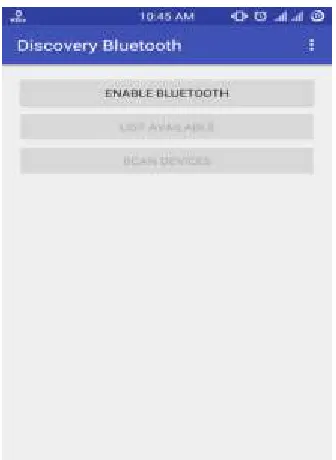
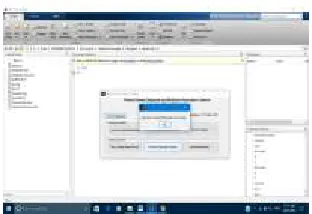
We are showing results of medication based recommender system. The very first step is the start up screen of matlab, in which various files and packages are shown we select our package. Then the android application that is designed is used and first layout is shown that is it asks for the bluetooth enabled or disabled. After enabling the bluetooth next screen is opened that show 2 more options like list available devices and scan for more devices.
Available online:
https://edupediapublications.org/journals/index.php/IJR/
P a g e | 194 Fig 1 shows the Start up Screen of Matlab.Fig 2 shows the layout frame for Bluetooth Recovery
Fig 3 shows the allowance of Bluetooth On / Off.
Available online:
https://edupediapublications.org/journals/index.php/IJR/
P a g e | 195 Fig 5 shows Bluetooth is waiting for connection to aparticular device
Fig 6 shows the list of Bluetooth devices available for Bluetooth Connection.
In above Figure it shows the list of Bluetooth devices available for Bluetooth Connection from nearby Bluetooth devices, it shows 4 devices that are shown in list and MATLAB is asking for selection of Bluetooth devices. After selecting the Bluetooth device it shows the available channel and it asks for connection in binary form like (0,1) in fig 7. If we want to connect to server we press 1 which means YES and it connects to the Bluetooth device and makes a server. The server is used to collect data which is provided by user using android application user interface and loads the data from the android application to MATLAB. If you want to stop the server press any key to stop. Whereas on the other hand, If you don’t want to connect to that particular device you can press 0, which means NO.
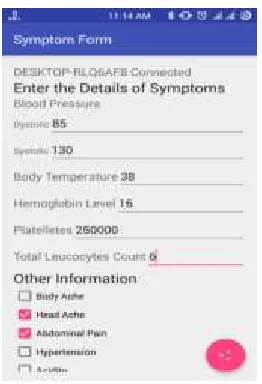
Now in fig 10 application layout is opening and it asks for details of symptoms. User has to fill the symptoms detail that is asking in frame and share that info with server by pressing share button. Then the info is shared with the server and it detects the disease using those symptoms and tells the user for disease and medicine to be taken.
Fig 7 shows the available channel for connection.
Fig 8 shows the opening channel that is successfully connected and connecting to a server.
Available online:
https://edupediapublications.org/journals/index.php/IJR/
P a g e | 196 Fig 10 Matlab is processing the data received fromandroid user interface
Fig 11 shows the symptom form with disease and medicine
Then the next steps shows the database selections in Matlab. Database selection is also very important for the application because the information entered by the user is stored in databases. 2 types of database is shown we have to select your database. If we want to switch our database we can switch using switch database button and select your database and that database is successfully loaded. In the screen other options should be appeared we have to choose what
we want to perform. If we press to test the patient profile and automatic testing it performs testing of that single profile and other options and generates results that could be shown below in figures.
Fig 12 shows if we press to switch database it asks for new database.
Fig 13 shows now new database is successfully loaded.
Available online:
https://edupediapublications.org/journals/index.php/IJR/
P a g e | 197 Fig 15 shows about the accuracy of disease detectionand accuracy of medicine prediction.
Fig 16 shows the generated results in the form of graph of Accuracy of disease detection and, medicine
prediction.
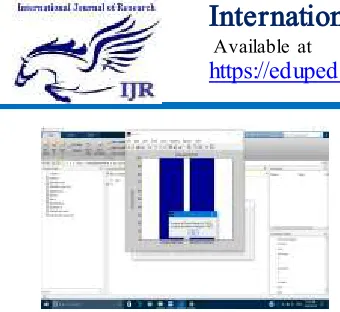
At the very last step it shows the result of the accuracy of disease detection and medicine prediction in the form of a graph.
V. CONCL USI ON
The Internet of Things (IoT) is part of Future Internet and will comprise many billions of Internet Connected Objects (ICO) or `things' where things can sense, communicate, compute and potentially actuate as well as have intelligence, multi-modal interfaces, physical/ virtual identities and attributes. Collecting data from these objects is an important task as it allows software systems to understand the environment better. Many different hardware devices may involve in the process of collecting and uploading sensor data to the cloud where complex processing can occur. In this we work on Mobile Sensor Data Processing Engine (MOSDEN), an plug-in-based IoT middleware for mobile devices, that allows to collect and process sensor data with programming efforts. Our architecture also supports sensing as a service model. We present the results of the evaluations that demonstrate its suitability towards real world
deployments. Our proposed middleware is built on Android platform. The results of the proposed system show that the system is fully efficient and giving 100% results.
As a future work of our implementation we can design such a system which is internet based and the user will able to access the system from anywhere in the world. Secondly, the database would be extended which would be able to store the patient detail and medication history.
REFERENCES
[1] CharithPerera, Peter Christen,"Mosden: An internet of things middleware for resource constrained mobile devices" ,System Sciences (HICSS), 2014 47th Hawaii International Conference on IEEE, 2014.
[2] Stefan Nastic, SanjinSehuc,"Provisioning Software-defined IoT Cloud Systems",Future Internet of Things and Cloud (ficloud), 2014 International Conference on IEEE, 2014.
[3] BoyiXu,Li Da Xu,"Ubiquitous data accessing method in IoT-based information system for emergency medical services", Industrial Informatics, IEEE Transactions on 10.2, 2014.
[4] Giancarlo Fortino, Antonio Guerrieri, "Integration of agent-based and Cloud Computing for the smart objects-oriented IoT", Computer Supported Cooperative Work in Design (CSCWD), Proceedings of the 2014 IEEE 18th International Conference on IEEE, 2014.
[5] Mukesh Taneja, "A framework for power saving in IoT networks", Advances in Computing, Communications and Informatics (ICACCI, 2014 International Conference on IEEE, 2014.
Available online: