Available online: https://edupediapublications.org/journals/index.php/IJR/ P a g e | 1256
Understanding the role of Nutritional Intervention Programme on
Cognitive Development: An Experimental study of Adolescent girls
Dr. Shashi Yadav* & Prof. Sangeeta**
*Ph.D, Department of Education, Kurukshetra University, Kurukshetra **Professor, Department of Education, Kurukshetra University, Kurukshetra
A bs tract : Role of Nutrition education in human beings health has been emphasized all through the available literature. However, there are very few studies which has explored the role of nutrition and cognitive development. This paper looks into the dynamics of nutrition from the vantage point of socio-institutional structure and traces the linkages between nutrition and cognitive development through experimental method. The study finds positive relationship between the two and gives an insight into role of intervention programme and their effectivity. The study raises the question of missing concern of adolescent girls at policy level.
Key wo rd s: Nutrition, Iron deficiency Anaemia, cognitive development, Adolescent Girls
Contextualizing the Role of Nutrition in Human Resource Development
No nation can afford to ignore its greatest national resource i.e. the human resource. The world economy has moved from pre-industrial to industrial and transiting towards a new economy. The transition requires that the rules and practices that determined success in the industrial economy need rewriting in an
interconnected, globalized economy where human resources, health, wellbeing, competencies, have gained prominence. Academia tend to find themselves in a tricky position when there is any discussion of growth, development, wellbeing and how we are going to achieve this. Classical economist believed in growth as in itself development, however, the modern paradigm focuses more on the capabilities, human resource, Institutions as the deep determinants of development (Bloch, 2004 & Rodrik, 2002).
Available online: https://edupediapublications.org/journals/index.php/IJR/ P a g e | 1257 analysis of the state of nutrition in India.
The “Global Nutrition Report 2016” once again demonstrates India’s slow overall progress in addressing chronic malnutrition, manifest in stunting & wasting. The situation is further widely discussed and debated in different UNICEF report1.One of the most serious concern raised by these reports is Anaemia. Anaemia in young children is a serious concern, because it can result in increased morbidity from infectious diseases and impaired cognitive performance, behavioral and motor development, coordination, language development, and school achievement.
Gender Dimension of Nutrition
Human health is a conceived notion though scientifically and rationally codified but its process has its root in our social milieu. It is explicitly seen in a country like India that how nutritional intake is a manifestation of social institutional structure. In our various ancient text, mythologies and anecdotes women have been depicted as subordinate to men. This kind of norm has lead to evolution of the institution called ‘patriarchy’ and this kind
1 :
http://unicef.in/Story/1124/Nutrition#sthash.rGQ7YzC9.d puf
of institution has produced a biased outlook towards female child and it is manifested in the form of female foeticide, infanticide and an overall discrimination in accessing knowledge, grooming her being, meeting her potential and harnessing her capabilities to live the life fullest. With this context and backdrop, the present study is an attempt to look into the linkages of nutrition and cognitive development of girl child, in a region which has social institutions of gender biasness. Thus, this whole complexity of social reality demands an analysis. This paper tries to link nutrition and education with special emphasis on the level of cognitive development in Iron Deficient adolescent girl students.
Tracing the Intersectionality and Interdisciplinarity
Available online: https://edupediapublications.org/journals/index.php/IJR/ P a g e | 1258 children differ because of environment not
because of nutrition as such their power of reason depends on environment, like in classical antiquity literature and the Middle Ages (Oerter & Montada, 2002). Based on his analysis of art work, the historian, Phillipe Aries (1962) found that the concept of childhood did not exist in the medieval period and concluded that children were considered as little adults. In the medieval period, most young people were apprentices, became workers in the fields and normally entered the adult world very early in life. Very important for the emergence of the concept of child development were two opposing philosophical views of human nature from the 17th and 18th century studied by De-Hart, Sroufe, & Cooper (2004). On the one hand, the English empiricist John Locke argued that at birth the mind of a child is tabula rasa, ‘a totally blank slate to be written on by life’s experience’. This blank slate view suggests that differences among children can be explained in terms of differences in their environments was also supported by Boyd & Bee (2009). On the other hand, Rousseau claimed that all human beings possess innate goodness and seek out experiences that help them grow (Boyd & Bee, 2009). According
to Rousseau, child development unfolds naturally in positive ways as long as society allows it to do so (Boyd & Bee, 2009).
Available online: https://edupediapublications.org/journals/index.php/IJR/ P a g e | 1259 interviews to assess large numbers of
children. This led to the first scientific study of child development that was published by Hall as an article entitled ‘The Contents of Children’s Minds on Entering School’ in 1891. He claimed that developmentalists should identify norms, or average age set which developmental milestones are attained, In line with this, around the turn of the century, a growing concern for disturbed, impaired, and disabled children provided an additional impulse to the emergence of developmental psychology particularly emphasizing the assessment and formal testing of children’s cognitive abilities. The 20th century, thus, dawned as a “century of the child”, (Lamb & Keller, 1991).
In Europe and the United States, research, theory building, and speculations started to flourish, both in newly founded research institutes and in the salons and consulting rooms, in which the revolutionary ideas of psychoanalysis were being formulated by Freud, (1899). Between 1890 and 1915, 26 institutes and 21 journals that focused on child development was founded, writes Buhler (1928). The rich heritage of this early phase of Developmental
Psychology was both conceptual and empirical. Sigmund Freud (1856-1939) increasingly concentrated on developmental processes and formulated the ‘crucial formative importance of early experiences’. However, Freud’s data were primarily based on increasingly circuitous interpretations of the free associations and a recalled memory of neurotic adults. This methodology was criticized by the majority of academic developmentalists. As a consequence, researchers in both Europe and North America started to develop descriptive developmental chronologies using observations, interviews and questionnaires as sources of information. Thus, Developmental Psychology evolved into a well established scientific discipline accumulating a rich body of theories and research attempting to identify factors that influence and explain developmental processes in several domains of psychological development, including behavioural and cognitive development.
Available online: https://edupediapublications.org/journals/index.php/IJR/ P a g e | 1260 medical science, also an increasing scientific
interest in psychological development, in particular behavioural and cognitive development, evolved within the field. Thus, the interest in cognitive development in a detailed way that too keeping in mind age and other factors is a recent phenomenon in the academia. The present study has various entry points like cognitive development, nutrition and iron deficiency. But nutrition is a broad theme which can be a good vantage point to look at all other dimensions. Although research on infants and children have shown cognitive, behavioural and anthropometric effects of iron deficiency, much less research has focused on the effects of iron deficiency on adolescent girl students very close to child bearing age. This research is important because changes in their cognitive functioning and behaviour could also impact their children’s functioning through impaired mother child interaction.
Paraphrasing the Objectives
The study tries to look in to the status of adolescent girl student, the level of cognitive development of iron deficiency anaemia. Further, this paper also look into the
dimension of nutritional education of iron deficient adolescent girls along with iron supplementation. To educate the iron deficient anaemic girl students about sources of nutrients and balanced diet particularly to eradicate anaemia and provide iron supplementation. This study has explored the effect of Nutritional Intervention Programme on the iron status (haemoglobin), weight and cognitive development of iron deficient anaemic adolescent girl students.
Outlining the spatial and administrative unit of the study area being investigated
Available online: https://edupediapublications.org/journals/index.php/IJR/ P a g e | 1261
Tab le-1 Lis t o f Samp le Sch o o ls an d Res p o n d en ts
Sr. No. Name of the Schools No. of St udent s
1 Government Girls Senior Secondary School, Ladwa 100
2 Government Senior Secondary School, Ismailabad 100
3 Government Girls Senior Secondary School, Thanesar 100
4 Government Girls Senior Secondary School, Pehowa 100
The sample of anaemic adolescent girl students was drawn by using purposive sampling technique after taking prior consent from their parents and determining their Iron status (haemoglobin level). The iron deficient anaemic adolescent girls were then randomly assigned to experimental and control group equally i.e 200 in each group.
The present study has used field experimentation method to assess the impact of nutritional intervention. A field experiment applies the scientific method to experimentally examine an intervention in the natural settings. Field experiments generally randomize subjects into treatment & control group and compare outcomes between these groups. Randomized group pre-test and post-test experimental design was used, in which subjects were assigned to the experimental and control group by random method and administered a pre-test as a measure of the dependent variable. The experimenter introduces the treatment only to the experimental group for a specified
period of time. At the end of the experiment, the experimental and control group were administered the post-test as the measure of dependent variable. The difference between the means of pre-test and post-test scores were found for each group and compared by t- test. The present study was conducted in Government Schools where confounding variables such as age, residence, gender, willingness to co-operate and educational level were controlled to some degree.
Available online: https://edupediapublications.org/journals/index.php/IJR/ P a g e | 1262 iron tablets and nutrition education by use of
audio-visual aids like charts, posters and power-point presentations. The third stage included post testing of the same group using the same tools after supplementation of 3 months of the intervention programme.
Nutritional status of Iron Deficient Anaemic Adolescent Girl Students
The results were analyzed by testing Haemoglobin levels of iron deficient subjects at the beginning of the study to find the prevalence of different degrees of anaemia.
Fig ure 1 Prevalence of Different Degree of Anaemia in Iro n Deficien t A d o les cen t Girl Stu d en ts o f Dis trict Ku ru ks h etra
Figure 1 reveals graphical representation of the prevalence and degree of anaemia in the adolescent girl students belonging to different tehsils and sub-tehsils of District Kurukshetra, Haryana. It has been noticed that all the surveyed adolescent girl students (400) of four tehsils and sub-tehsils suffered from different degree of anaemia with haemoglobin level less that 12g/dl of blood. Haemoglobin level of the subjects
was analyzed to identify the prevalence of anaemia. Analysis of the data showed that in all the anaemic girls, various degree of anaemia was prevalent. Maximum adolescent girl students belonging to the different tehsils and sub-tehsils were suffering from Moderate (75.5%) followed by mild (13.8%), severe (6.5%) and minimum (4.3%) with marginal anaemia.
% age of Anemic subjects, Severe,
6.5%
% age of Anemic subjects, Moderate ,
75.5,% % age of Anemic
subjects, Mild , 13.8%
% age of Anemic subjects, Marginal ,
4.3,%
Prevalence of Degree of Anaemia
Available online: https://edupediapublications.org/journals/index.php/IJR/ P a g e | 1263 The findings of the present study are in
agreement with the findings of study conducted by Survival of Women and Children (SWACH, 1997). This study
documented that prevalence rate of Anaemia in rural areas of Haryana as 82.9 percent among school going girls and 92.7 percent among those who are not going to schools.
Tab le-2 Level of Cognitive Development (IQ Scores) of Subjects belonging to different Tehsils and Sub-Tehsils o f Dis trict Ku ru ks h etra
Classification of IQ Scores Ladwa Ismailabad Pehowa Thanesar Total (N=400) Very Superior
130 and above
- - - - -
Superior 120- 129
- - - - -
High Average 110- 119
1 5 3 3 12
(3) Average
90- 109 52 59 56 53 (55) 220
Low Average 80- 89
46 35 39 44 164
(41) Borderline
70- 79 1 1 2 - (1) 4
Significantly Below Average
69 and below - - - -
Total 100 100 100 100 400
(100)
* figures in parentheses are percentages
As shown in table 2, the level of cognitive development of iron deficient anaemic adolescent girl students before giving the intervention programme. Among all the subjects, only fifty five percent were found to have average Intelligence Quotient (IQ) followed by subjects (41%) having less than average IQ. Almost sixty percent adolescent girl students of Ismailabad sub-tehsil were found to have average IQ, which was found better as compared to other tehsils and sub-tehsils. Thus, it can be assumed that there is a need for iron
supplementation, if we go by our hypothesis, as this may lead to better cognitive skills, which will improve the IQ of the respondents. The percentage of subjects having IQ scores below average was found almost equal in Ladwa and Thanesar i.e 46 and 44 percent respectively. The pre- test results well endorsed the path of this research enquiry which is going for nutritional intervention programme, iron supplementation and a post-test. The pre-test results set the background and reinforce the pursuit and objectives of the study.
Available online: https://edupediapublications.org/journals/index.php/IJR/ P a g e | 1264
b elo n g in g to d ifferen t Teh s ils an d Su b -Teh s ils o f Dis trict Ku ru ks h etra
T ehsils and
Sub-T ehsils Ladwa Ismailabad Pehowa Thanesar
Group s M ean SD M ean SD M ean SD M ean SD
Experimental
Pre-t est 8.02 0.84 9.46 1.51 8.45 1.21 8.85 1.26
Post-test 8.75 0.72 9.77 1.34 9.10 1.01 9.53 1.07
t -value 18.347* 9.162* 16.502* 17.945*
Control
Pre-t est 8.07 0.86 9.51 1.12 8.38 1.07 8.65 1.25
Post-test 8.08 0.86 9.54 1.07 8.40 1.01 8.70 1.23
t -value 0.667 0.682 0.609 1.930
*significant at 0.01 level of significance, SD- Standard Deviation, N= 400
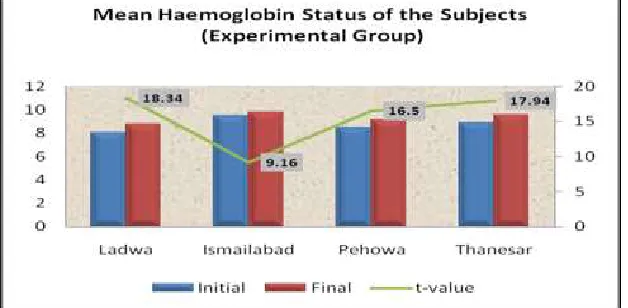
Analysis of data in table 3 indicates a significant increase in haemoglobin levels of the subjects of all experimental group hailing from different tehsils and sub-tehsils
of district Kurukshetra. The average haemoglobin level was found lowest among subjects belonging to Ladwa (8.02 mg/dl) followed by Pehowa (8.45mg/dl).
Fig u re 2- Mean Haemoglobin in the Subjects of Experimental Group
The mean pre-test & post-test scores of subjects belonging to different tehsils and sub-tehsils i.e Ladwa, Ismailabad, Pehowa and Thanesar were 8.02 & 8.75, 9.46 & 9.77, 8.45 & 9.10 and 8.85 & 9.53 respectively.
Among the subjects from different tehsils and sub-tehsils, the highest mean
Available online: https://edupediapublications.org/journals/index.php/IJR/ P a g e | 1265 Significant increase was observed in the
post-test values of haemoglobin in the subjects belonging to different tehsils and sub-tehsils in the experimental group as shown in figure 2.
On perusal of data, thus, it can be inferred that the level of haemoglobin increased after supplementation trials in the subjects of all experimental group. The t- values were found highly significant at 0.01 level of significance. A marginal increase in
haemoglobin levels of control group subjects. The t- values of control group subjects belonging to Ladwa, Ismailabad, Pehowa and Thanesar were 0.667, 0.682, 0.609 & 1.930 respectively, but were not found statistically significant. Hence, the results revealed a significant positive impact of Nutritional intervention programme on Haemoglobin level of subjects in the Experimental group.
Tab le- 4 Mean Weight (in Kgs) of the Subjects of Exp erimental and Control Group belonging to diffe ren t Teh s ils an d Su b -Teh s ils o f Dis trict Ku ru ks h etra
T ehsils and
Sub-T ehsils Ladwa Ismailabad Pehowa Thanesar
Group s M ean SD M ean SD M ean SD M ean SD
Experimental
Pre-t est 41.14 5.87 42.10 5.16 40.56 5.98 40.94 4.16 Post -t est 43.42 5.28 43.46 4.76 42.16 5.33 41.87 2.92
t -value 8.810* 8.192* 7.692* 3.587*
Control
Pre-t est 42.28 5.15 40.28 5.11 40.48 4.63 40.28 3.91
Post -t est 42.58 4.61 40.40 4.78 40.86 4.11 40.16 3.89
t -value 1.426 .903 1.591 .553
*Significant at 0.01 level of significance
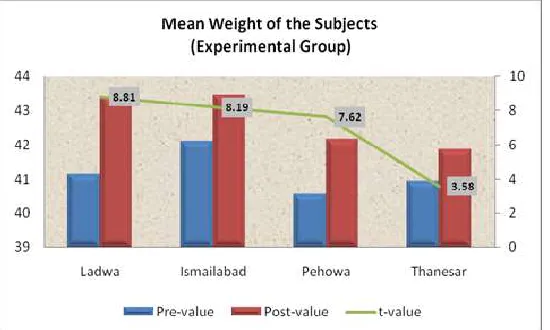
The mean increase in weight (Table 4) of the subjects in experimental group after giving nutritional intervention programme involving iron-folic acid tablets and nutrition education, was highest in Ladwa followed by Ismailabad i.e from 41.40 to 43.42 in Ladwa and from 42.10 to 43.46 in Ismailabad. The corresponding increase in weight of the subjects of Pehowa and Thanesar was observed in the mean
Available online: https://edupediapublications.org/journals/index.php/IJR/ P a g e | 1266 belonging to Pehowa i.e from 40.48 to
40.86. However, mean increase in weight of
the subjects in control group was not found significant at any level.
Fig u re 4- Mean Weight in the Subjects of Experimental Group
This increase in haemoglobin level in girls was obvious after giving iron supplementation. These results are in accordance with the observations done by Shobha & Sharda (2003), who stated that lower the initial haemoglobin level greater the increase in level on supplementation.
The increase in haemoglobin levels on supplementing with iron tablets everyday or twice a week has been reported by many workers (Kurz, 1997; Shobha and Sharda, 2003; Ajay, 1985; Zavaletta et. al., 1996; Agarwal et. al., 2003). In concurrence with the above findings Buzina et al. (2007) also observed the effects of iron supplementation on iron nutrition status and cognitive functions in children in a rural area of Central Croatia. The findings stated that Iron
supplementation had a positive effect on the biochemical measures of iron, with haemoglobin, haematocrit, transferrin saturation, RBC, MCH and MCHC all showing statistically significant increases (P<.05) and the effects of iron supplementation were more pronounced in children with initially lower haemoglobin values. The findings of Joshi & Gumashta (2013) were also found in support with this study, but the researchers emphasized that weekly supplementation of iron and folic acid in iron deficiency anaemia patients is as good as daily supplementation with added benefits of less adverse reactions and better compliance.
Available online: https://edupediapublications.org/journals/index.php/IJR/ P a g e | 1267 girls in India, with over 70 percent. Iron
Folic Acid (IFA) supplements have been shown to enhance adolescent growth elsewhere in the world. Results show that there was a high demand for IFA supplements and >90% of the girls consumed 85 out of 90 tablets provided. There was an increase of 7.3 g/dl haemoglobin in the group of girls receiving IFA supplements, whereas haemoglobin decreased slightly in girls in the control group.
The above mentioned findings are in
accordance with the studies conducted earlier by the researchers at different levels on different samples who found quite similar results. Lantham et al., 1990 have shown that daily supplementation with iron is associated with increased growth and improved appetite (Lawless et. al., 1994). The findings of the present investigation are in support with research of Liu et al (1995), who stated that weight of the subjects improved significantly post iron supplementation.
Tab le 5 Significance of Difference between the Mean Scores of Subjects belonging to different Teh s ils an d Su b -Teh s ils o f Dis trict Ku ru ks h etra with Reg ard to Co g n itiv e Dev elo p men t (M ISIC)
T ehsils and
Sub-T ehsils Ladwa Ismailabad Pehowa Thanesar
Group s Mean SD Mean SD Mean SD Mean SD
Experimental
Pre-t est 89.05 3.22 88.87 3.70 90.99 4.42 90.47 5.39 Post -t est 91.84 3.20 92.50 4.15 94.29 3.79 93.49 4.76
t -value 9.330* 10.639* 11.005* 6.133*
Control
Pre-t est 90.38 4.27 90.23 5.11 90.64 3.89 89.90 4.47 Post -t est 90.93 4.11 90.93 4.81 91.19 3.98 90.23 3.57
t -value 2.161 2.697 1.887 1.310
*significant at 0.01 level of significance
The perusal of data of table 5 indicates the mean values of experimental and control group subjects on total of Verbal & Non- Verbal cognitive development scores. The pre-test and post-test mean values of experimental group subjects belonging to Ladwa, Ismailabad, Pehowa and Thanesar were 89.05 & 91.84, 88.87 &
92.50, 90.99 & 94.29 and 90.47 & 93.49 respectively. Figure 4.30 indicated that their t-values came out to be 9.330, 10.639, 11.005 and 6.133 respectively, which were found significant at 0.01 level of significance.
Available online: https://edupediapublications.org/journals/index.php/IJR/ P a g e | 1268 pre-test and post-test scores of all the control
group but the increase was not found significant at 0.01 level of significance. The t-values in pre-test & post-test of Ladwa, Ismailabad and Pehowa were 2.161, 2.697, 1.887, which were not found significant at 0.01 level of significance. Thus Hypothesis II is retained i.e. nutritional interventional programme will have significant positive effect on the cognitive development of iron deficient adolescent girls students.
Some studies have shown that children and teens who have received less iron, score much lower in intelligence tests relatively (Pollit, 1993). In addition, other researchers have also shown results in agreement with the present study, which shows that low serum iron leads to decreased IQ, precision, concentration and learning in school age children, and iron supplementation in children, can increase their scores on intelligence and academic tests (Nachvak and Rezaei, 2006; Burton and Roberts, 2007). Obvious differences were observed in students with iron deficiency compared with healthy students in terms of doing home work, sensory abilities, attention & concentration, learning ability and memory capacity (Nachvak & Razaei, 2006).
Agarwal et al. (1989) conducted a study on rural primary school children (6-8years) and revealed a significant difference between the IQ scores of anaemic and non-anaemic groups (n=388) in Digit Span sub test of WISC. The study highlighted an effect of nutritional status on IQ score, low level of attention and concentration span in the arithmetic test exhibited by anaemic children of Varanasi. It also highlighted that the verbal performance and mean IQ score decreased with the severity of malnutrition. The stunted children had lower IQ scores than children with wasted muscles, opined that a moderate degree of malnutrition influences the IQ score. Multiple regression analysis showed that besides nutrition, socio-economic status also had significant influence on verbal IQ. Thus, the study indicates importance of nutritional status on cognitive performance of school children.
Available online: https://edupediapublications.org/journals/index.php/IJR/ P a g e | 1269 experimental group improved more and
found statistically significant than control group.
Conclusion
Cognitive development is a function of multidimensional factors, Nutrition is one of the crucial parameters which affect not only the cognition but the overall wellbeing of the child. This study tried to establish the link between these two parameters and the results shows a positive relationship. A wealth of further evidence on different aspects of the nutrition has been discussed and explored which traces the subtle aspects of food habits in a patriarchal society and traces the gender dimension of it. This paper traces the role of intervention education and highlights the importance of it for the policy. Policy related to nutrition in india mainly geared towards the overall nutrition however the paper explore the possibility of specific needs and target oriented policy imperatives. India was mainly concerned
towards promoting higher cereal
consumption since independence. Calorie deficiency is taken to be the most important form of nutritional deprivation. Further the State promotion of the Green Revolution, which led to major increases in the production of rice and wheat and helped to
make cereals more affordable. India’s public distribution system (PDS) also focused on subsidizing the consumption of cereals as discussed by Dreze (2007) at length. This cereal specific orientation neglects the role of iron and other micronutrients which are essential for growth and wellbeing of adolescents.
Further the present study gives evidence that the nutrition education and supplementation (intervention programme) is an impressive and effective tool to generate nutritional awareness, to enhance nutritional level and cognitive development of adolescent girl students in favorable directions. Hence, in many ways the findings of the present study can be beneficial for students, teachers, parents, social workers, policy makers and professionals in the field of nutrition.
References
Agarwal, D. K., Upadhyay, S. K., & Agarwal, K. N. (1989). Anaemia and mental functions in rural primary school children. Annual Tropical Journal of Pediatrics, 9, 194- 198 Agarwal, K. N., Gomber, S., Bisht, H., &
Available online: https://edupediapublications.org/journals/index.php/IJR/ P a g e | 1270 school girls. Indian Pediatrics, 40,
296-301
Ajay, O. A. (1985). Fe status of adolescent in a Nigerian rural community. Nutrition Research, 5, 699-705. Aries, P. (1962). Centuries of childhood: A
social history of family life. New York: Afred A. Knopf.
Bloch, H. and Tang, S. H. K. (2004), “Deep determinants of economic growth: Institutions, geography and openness to trade,” Progress in Development Studies, 4(3): 245-255
Boyd, D., & Bee, H. (2009). Lifespan development (5thed.). Boston: Allyn and Bacon.
Buhler, C. (1928). Kindheit and jugend. Leipzig: Hirzel.
Bulliyya, G., Mallick, G., Sethy, G. S., & Kar, S. K. (2007). Haemoglobin status of non- school going adolescent girls in three districts of Orissa. International Journal of Adolescence Medicine and Health, 19 (4), 395- 406.
Burton- Roberts, N. (2007). Varieties of semantics and encoding: negation, narrowing and numerical. In N. Burton- Roberts (ed.). Pragmatics (pp. 90-114). Houndmills: Palgrave
Macmillan.
Buzina, S. et al. (2007). Effects of iron supplementation on iron nutrition status and cognitive functions in children. Retrieved from http://archive.unu.edu/unupress/
food/ V194e/ch03.html
Darwin, C. (1859). On the Origin of Species by means of Natural selection or the preservation of Favoured Races in the struggle for Life Nature. London: Murray.
DeHart, G. B., Sroufe, L. A., & Cooper, R. G. (2004). Child development: its nature and course (5th ed.). New York: Mc Graw Hill.
Freud, S. (1899). Die Traumdeutung. Leipzig and Vienna: Franz Deuticke. Haeckel, E. (1898). The last link: Our
present knowledge of the descent of Man. London: Adam & Charles. Hall, G. S. (1969). Adolescence: its
psychology & relation to physiology, anthropology, sociology, sex, crime, religion and education. New York: Arno Press.
Available online: https://edupediapublications.org/journals/index.php/IJR/ P a g e | 1271 management of iron deficiency
anaemia. Global Journal of Health Sciences, 5(3), 1-7.
Kanani, S. (1990).Nutritional Status of well to do adolescent girls in Baroda. Abs Silver Jubilee celebrations, Nutrition Society of India, NIN: Hyderabad. Kurz, K. M. (1997). Adolescent nutritional
status in developing countries. Retrieved
from:www.fhi.org/en/about FHI/ contactFHI.htm
Lamb, M. E., & Keller, H. (1991). Infant development: Perspectives from German- speaking countries. Hillsdale, NJ: Lawrence Erlbaum Associates.
Lantham, M. C., Stephenson, L. S., Kinoti, S. N., Zaman, M. S., & Kurz, K. M. (1990). Improvements in growth following iron supplementation in young Kenyan school children. Nutrition, 6, 159- 165.
Lawless, J. W., Lantham, M. C., Stephenson, L. S., Kinoti, S. N., & Pertet, A. M. (1994). Iron supplementation improves appetite and growth in anaemic Kenyan Primary School Children. Journal of Nutrition, 124, 645-654.
Liu, X. N., Kang, J., Zhao, L., & Viteri, F. E. (1995). Intermitttent iron supplementation is efficient and safe. Food and Nutrition Bulletin, 16, 139-146
Malin. A. J. (1969). Malin’s intelligence scale for Indian children. Lucknow: Indian Psychological Association. Nachvak, M. & Razaei, M. (2006). The
relationship of iron deficiency and academic performance among mental low ability students. Journal of Exceptional Children, 1.
National Academies of Sciences (2002). Dietary Reference intake of Vitamin A, Vitamin K, Arsenic, Boron, Copper, Chromium, Iodine, Iron, Manganese, Molybdenum, Nickel, Silicon, Vanadium and Zinc: A report of the panel on Micronutrients. Washington, D.C: National Academy Press.
Available online: https://edupediapublications.org/journals/index.php/IJR/ P a g e | 1272 Oerter, R., & Montada, L. (2002).
Entwicklungspsychologie (5th edi.). Weinheim: Beltz Verlage
Pollitt, E. (1993). Iron deficiency and cognitive function. Annual Reviews in Nutrition, 13, 521-537.
Rodrik, D. 2002: Institutions, integration and geography: in search of the deep
determinants of economic
growth. http://ksghome.harvard.edu/
∼.drodrik.academic.ksg/growthintro.
Seshadri, S., & Gopaldass, T. (1989). Effect of anaemia in physical performance of children and the impact of iron supplement. Proceedings of the Nutrition Society of India, 35, 104. Shobha, S., & Sharda, D. (2003). Efficacy of
twice weekly supplementation in anaemic adolescent girls. Indian Pediatrics, 40, 1186-1190 doi: www.indianpediatrics.net/htm
Spencer, H. (1855). The Principles of Psychology. New York: Appleton & Company.
Survival of Women and Children (1997). Anaemia in Pregnant Women and Adolescent girls in rural areas of Haryana. Johnsow: Quarterly Progress Report
The Global Nutrition Report (2016)
accessed from
http://www.who.int/nutrition/globaln utritionreport/en/
The India Health Report on Nutrition (2015)
accessed from
http://www.ifpri.org/publication/indi a-health-report-nutrition-2015
Wechsler, D. (1991). Wechsler intelligence scale for children—3rd edition. San Antonio, TX