c e-ISSN: 2348-6848, p- ISSN: 2348-795X Volume 3, Issue 01, January 2016
International Journal of Research (IJR)
Available at http://internationaljournalofresearch.org“Android Wi-Fi - Direct Technology for Remote Operation of
Projectors”
G.Jayaramnaidu
*&R.Srinivas
**#
1Student of M.Tech, Computer Science & Engineering, Aditya Institute of Technology and Management, AP, India
#
2 Assoc. Prof, Computer Science & Engineering, Aditya Institute of Technology and Management, AP, India
ABSTRACT
Whenever an LCD projector is used for a presentation it basically needs a VGA cable between the VGA port of a computer and the projector. The projector displays whatever appears on the monitor of the PC on the projector screen. And the settings of the screen, volume and others can be changed with the help of switches placed on the projector or with the help of a wireless infrared remote. With this existing system it is difficult to maintain and control the projector with IR remote due to its line of sight property and short range it works in. This paper shows how these limitations can be overcome and also in addition ensures security from theft with the help of a PIR Sensor controlled with an android mobile via Wi-Fi. This paper aims at replacing the IR technology with WIFI technology. And the projector makes the
interface wireless using a Wi-Fi protocol.
Index Terms — Wi-Fi; motion detector; GUI;
PIR – Passive Infra Red
1. INTRODUCTION
The security and remote closed-circuit television is progressively distinguished feature on the mobile. The fashionable house is integrated with several automation technologies. The user will management door lock, light, air conditioning and alternative devices victimization remote. The Access system accustomed permit solely licensed members whereas the user far away from their house. Once the system gets
wrong parole in thrice than it signals to the door alarm. However this technology is incredibly effective once victimization net capable mobile devices. Developments in cloud computing and mobile technology permit net communication in automation and security systems to enhance versatile and quick communication, like Yale’s Locks & Hardware new device. This project exploits close to Field Communication through wireless fidelity direct. Victimization X 10 technologies, the mobile device will management home security system. Developed the house automation system through Bluetooth remote. Enforced good home system through zigbee
communication. This technique relays
information and command via SMS message. Developed the food ordering system by victimization the wireless fidelity communication to order things with real time feedback. Presents comparative study of various wireless technology usages for mobile golem controller like Bluetooth, wireless fidelity or Wireless LAN and 3G implements the mobile controlled golem, and communicates through 3G technology to use benefits of transmission options and net speed. The 3G technology offers quick communication
than 2G, is employed for economical
transmission information transmission. For future
communication, the 3G communication
c e-ISSN: 2348-6848, p- ISSN: 2348-795X Volume 3, Issue 01, January 2016
International Journal of Research (IJR)
Available at http://internationaljournalofresearch.orgembody performance-based wireless net, email,
in addition as video conferencing and
transmission services that mix voice and information streams. This paper discusses the event of security and video closed-circuit television that communicates via wireless fidelity direct protocol. This projected system permits user to lock, unlock a door at intervals short vary solely. The user also can monitor the house. The hooked up motion detector and CMOS camera is employed for remote police investigation. The mobile application needs parole to extend the safety of the system. The hardware on the door contains the AVR ATmega16 microcontroller to
manage a linear mechanism for lockup
mechanism and to produce a link between camera and humanoid mobile. The wireless fidelity direct protocol was chosen as communication protocol as a result of its advanced wireless fidelity protocol, operate as adhoc network. The wireless local area network |WLAN| wireless fidelity |Wi-Fi| local area network |LAN| direct protocol has giant cowl area, compared with Bluetooth. It are often accustomed communicate up to two hundred meters away. The protocol incorporates encryption for security and interference shunning.
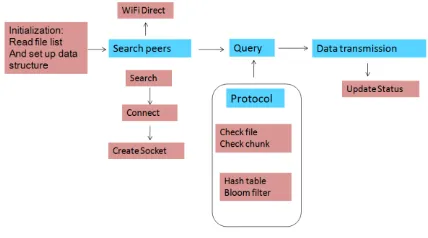
Fig 1: Wi-Fi Direct Block Diagram
2. EXISTING SYSTEM:
The existing system addresses the topic of specially designed remote police investigation cameras and residential appliances rather it
doesn’t focused on common or general appliances that square measure principally employed in today’s world. And it conjointly ends up in our more study on the wireless fidelity direct and also the most prospects of its applications. As Bluetooth is one amongst the most important drawbacks of this technique.
3. PROPOSED SYSTEM
c e-ISSN: 2348-6848, p- ISSN: 2348-795X Volume 3, Issue 01, January 2016
International Journal of Research (IJR)
Available at http://internationaljournalofresearch.orgFig 2: Block Diagram
4. Implementation
Wifi direct on Android mobile devices Wifi direct, is also said as wifi adhoc mode or wifi p2p. Wifi is the short name of wireless federation. It is a WLAN protocol, operates based on the IEEE 802.11standard. Wifi direct, is a protocol that allows wifi devices to communicate directly without wireless access point with reduced setup. Wifi direct is embedded with software access point that provides aversion of wifi Protected Setup with its push button or PIN based setup. When the device enters in the range of host, it can connect using adhoc protocol and protected Setup style transfer Connection. On comparing with Bluetooth, wifi has high bandwidth, high speed, and high coverage area. It is process on 2.4 to 5 GHZ frequency and 600 Mbps bit rate. The wifi direct is used as communication method, because the upcoming Android 4.0 or high versions has already available with embedded wifi direct protocol. To develop wifi direct applications, the API is needed. Android 4.0 SDK or higher versions will provide required libraries for wifi direct application development. The locking
mechanism consists of motion detection, linear actuator and magnetic switch. When the electric current is allowed in the actuator circuit then Actuator will move linearly. It is used as locker in this project. The motion detection is a human detection sensor, uses infrared. The magnetic switch makes connection, when the door is locked. It is used as lock identifier sensor. Android SDK and Arduino Firmware android uses a java based language. To develop an android application, a tool named Eclipses required as well as Android’s SDK, which is an add-on for the Eclipse program. To develop wifi direct applications, the Android 4.0 or later version is need.
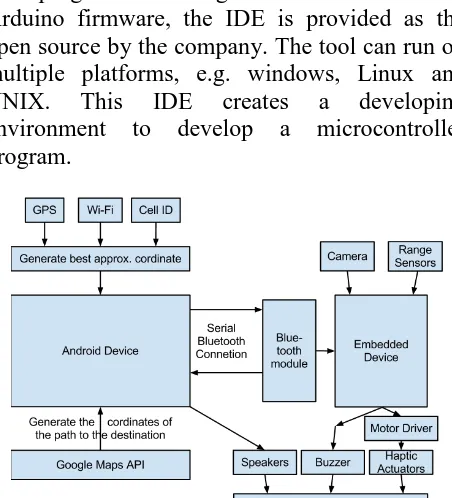
There is three main components are required to develop android application. The first one is Android application. It is a GUI,creates link with user and mobile. It also creates link with wifi module and communicate commands and video stream via a created link. The second one is high level program for Atmega16 microcontroller. For Arduino firmware, the IDE is provided as the open source by the company. The tool can run on multiple platforms, e.g. windows, Linux and
UNIX. This IDE creates a developing
environment to develop a microcontroller program.
Fig 3: Android Block Diagram
c e-ISSN: 2348-6848, p- ISSN: 2348-795X Volume 3, Issue 01, January 2016
International Journal of Research (IJR)
Available at http://internationaljournalofresearch.orgsecure connection. An Android application has two methods to create a link. The first one is using IP address of the wifi module directly coded into the app for initial
Testing. The second one is, it allow users to search for the device, which becomes a final decision. Then user can select the device from a list, for making connection. The basic steps for connecting to wifi module were the same for both versions of the application. Once got ip address of the destination then user can create socket with wifi module. The socket is yet another object in the program, and has to be connected before communications can occur. The input stream reader and output stream writer objects were used to read and write data to the other program. On comparing with Bluetooth wifi is more secure. The password entry gives more security to the application. Fig 2 shows the flow char to connect wifi to the mobile device. Then Android app decides to send appropriate string to the wifi module. The Atmega16 is programmed, how to response to the incoming string. Then it implements the appropriate process then response back to the Android application.
Fig 4: Flow Chart
5. Results
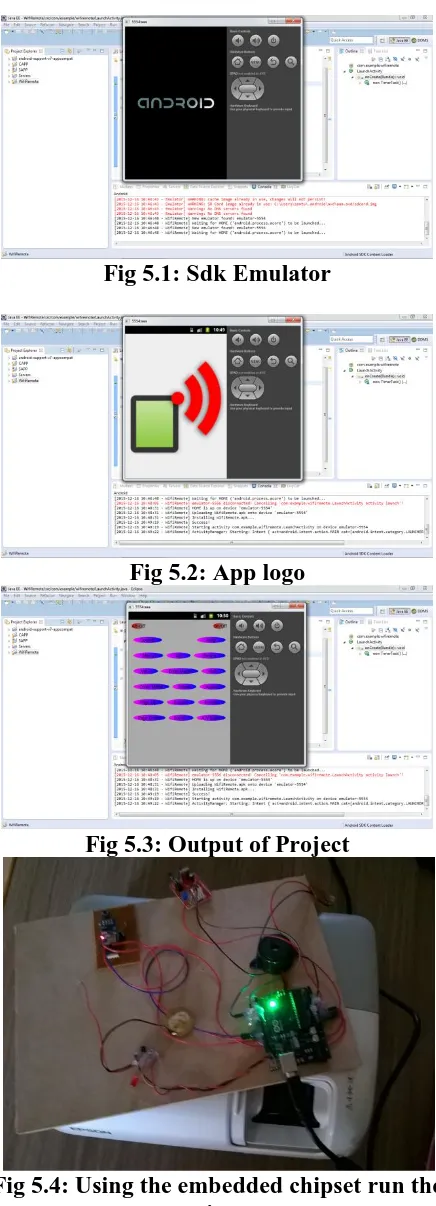
Fig 5.1: Sdk Emulator
Fig 5.2: App logo
Fig 5.3: Output of Project
c e-ISSN: 2348-6848, p- ISSN: 2348-795X Volume 3, Issue 01, January 2016
International Journal of Research (IJR)
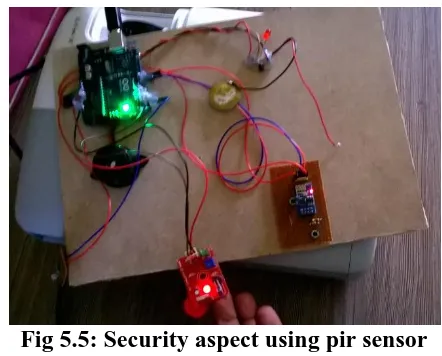
Available at http://internationaljournalofresearch.orgFig 5.5: Security aspect using pir sensor Conclusion
The goal of this project was to create a security interface to an Android mobile device. It was also to be a short range system that was simple to use. The range and security aspects were achieved through the use of the on board wifi direct of the mobile device. Simplicity was a constant factor in design of the user interfaces. The system was able to actuate a pin to lock or unlock a door from a short distance away with the push of a button on the mobile device. It can also display the remote video stream. Future work would include the design and building of a battery backup system. Improvements to the locking mechanism could also be another aspect for future work. This project could also be expanded to multiple doors and windows. It can be coupled with existing home automation devices to add thoroughness and completeness to the system.
References:
[1] Kaur, I., “Microcontroller based home automation system with security,” International Journal of Advanced Computer Science and Applications, vol. 1, no. 6, pp. 60-65, 2010.
[2] Wong, E.M.C., “A phone-based remote controller for home and office automation,” IEEE Transactions on Consumer Electronics, vol. 40, issue 1, pp. 28-34, 1994.
[3]http://www.engadget.com/2011/09/20/yale- demos-nfcenabledresidential-locks-germaphobes-rejoice-v/
[4] http:// www.sears.com/ shc/
s/p_10153_12605_00903043000P? Block No=
5&blockType= G5&prdNo=5 &i_cntr=
1323064631801
[5]Senthikumar.M,Padmavathy.N, ”Android
based security and remote surveillance system”, Graduate research in engineering and technology, International journal. pp.76-79, 2013
[6] Das, S.R., et al., “Home automation and security for mobile devices,” IEEE PERCOM Workshops, pp. 141-146, 2011.
[7] Sarijari, M.A.B., Rashid, R.A., Rahim, M.R.A., Mahalin, N.H., “Wireless Home Security and Automation System Utilizing ZigBee based Multi-hop Communication,” National Conference on Telecommunication Technologies, pp. 242-245, 2008.
[8] SaliyahKahar, RizaSulaiman, Anton
SatriaPrabuwono, _MohdFahmi. ” Data
Transferring Technique for Mobile Robot Controller via Mobile Technology“in Pattern Analysis and Intelligent Robotics, International conference. pp 103-108, 28-29 June 2011
[9] Xichun Li, AbudullaGani, RosliSalleh, Omar Zakaria. “The Future of Mobile Wireless Communication Networks”. In communication
software and networks, 2009International