University of South Carolina
Scholar Commons
Theses and Dissertations
2016
A Qualitative Study Of How Communities Think
About And Act Upon Hunger In The Presence Of
A Food Banking System
Eliza Miriam Fishbein
University of South Carolina
Follow this and additional works at:https://scholarcommons.sc.edu/etd
Part of thePublic Health Education and Promotion Commons
This Open Access Dissertation is brought to you by Scholar Commons. It has been accepted for inclusion in Theses and Dissertations by an authorized administrator of Scholar Commons. For more information, please [email protected].
Recommended Citation
A
QUALITATIVE
STUDY
OF
HOW
COMMUNITIES
THINK
ABOUT
AND
ACT
UPON
HUNGER
IN
THE
PRESENCE
OF
A
FOOD
BANKING
SYSTEM
by
Eliza Miriam Fishbein
Bachelor of Arts
Arizona State University, 2011
Submitted in Partial Fulfillment of the Requirements
For the Degree of Doctor of Philosophy in
Health Promotion, Education, and Behavior
Norman J. Arnold School of Public Health
University of South Carolina
2016
Accepted by:
Edward A. Frongillo, Major Professor
Christine E. Blake, Committee Member
Ruth P. Saunders, Committee Member
Cheri Shapiro, Committee Member
ii
iii
A
CKNOWLEDGEMENTSI would like to thank my advisor and committee chair, Dr. Frongillo for his
mentorship and guidance over the last five years. Thank you for your patience and for
helping me realize my potential. I am grateful for the support of my committee members
Drs. Blake, Saunders, and Shapiro: thank you for flexibility, words of encouragement,
and for challenging me throughout this process. I would not be here today, if it were not
for the support, sacrifices, and encouragement of my parents, younger sister Ruby, and
my husband, Adam. Thank you for fostering this dream and surrounding me with love
and understanding throughout my education. I also want to thank my entire HPEB cohort,
especially Drs. Casey Childers, Charis Davidson, Joni Nelson, Kristen Van De Griend,
Hanadi Wathen, and Ms. Andrea Warren for walking this path with me as colleagues and
friends.
I would like to dedicate this work to my faithful companion, Penny, who has
willingly sat at my feet during the many hours of writing it took to complete my
iv
A
BSTRACTHunger is often addressed by providing food directly to those experiencing
symptoms of food insecurity and hunger. Even with the availability of government food
assistance programs, food insecurity and hunger rates continue to rise. Many local
community organizations (e.g., small food banks, faith-based organizations, schools)
across the country have come together to create and implement a variety of
non-government food programs. Although there is no evidence these programs lower food
insecurity and hunger rates, community organizations appear to be strongly committed to
sustaining these programs. Little is known about the basis for this commitment, i.e., “ the
will to act and to keep acting until the job is done” (Heaver, 2005). Many of these
non-government food programs are implemented through the school system, and the effects of
such programs on the educational setting are unknown. To understand commitment and
the effects of non-government food programs, we conducted qualitative interviews with
key actors at community organizations. Specifically we articulated 1) how decisions are
made by community organizations to sustain commitment to non-government food
programs to hunger; and 2) the effects of one non-government food program, backpack
programs, on guidance counselors. In our first manuscript, we described how key actors
at community organizations think about hunger, what they want, what they assume, how
they identify themselves using tenants of Clark’s social policy theory; and what about
non-government food programs engenders their commitment. We learned that all
v
government food programs provide a variety of ways in which community members can
be involved. Faith-based organizations want to provide outreach programs that serve a
perceived need in the community, and are interesting to their congregants. Many school
participants reported that because of their commitment to students, they see themselves as
little more than a mechanism through which food programs are provided, and believe
they have little power to make suggestions to influence the food programs. Food bank
participants identified that their role is to provide best practices and financial and
logistical support for food programs. In our second manuscript, we described what types
of non-government food programs are implemented through schools, how the daily
routines of professional school counselors have changed to accommodate such programs,
and positive and negative effects of these programs on staff and their teaching
responsibilities. We learned that backpack programs provide professional school
counselors with additional opportunities to engage with students and families and bring
awareness of hunger to the local community. They can detract from professional school
counselors’ other responsibilities in schools (e.g., one-on-one meetings with students,
staff meetings). From both manuscripts, we learned that providing food to others is a
powerful act, and through these programs, food banks and faith-based organizations can
provide a highly positive experience to their volunteers. Many of these programs are
systematized and packaged by local food banks, making it accessible and easy for
faith-based and other organizations to adopt. Seeking to improve the well-being of the
community by ending hunger is not the primary value on which organizations focus;
instead, it is the process of fulfilling other values (i.e., forming or maintaining
vi
participants that strengthens their commitment to non-government food programs.
Similar to other non-government food programs, backpack programs obscure a
vii
T
ABLE OFC
ONTENTSACKNOWLEDGEMENTS ... iii
ABSTRACT ... iv
LIST OF TABLES ...x
LIST OF FIGURES ... xi
LIST OF ABBREVIATIONS ... xii
CHAPTER 1INTRODUCTION ...1
1.1PROBLEM STATEMENT ...1
1.2PRELIMINARY STUDIES ...4
1.3STUDY AIMS ...6
CHAPTER 2BACKGROUND AND SIGNIFICANCE ...8
2.1THE SHIFTING POWER OF FOOD BANKS ...8
2.2THE CHURCH AS A SETTING FOR NON-GOVERNMENT FOOD PROGRAMS ...10
2.3FOOD ASSISTANCE AS POLITICAL PRIORITY ...13
2.4COMMITMENT TO NON-GOVERNMENT FOOD PROGRAMS ...16
2.5EFFECTS OF FOOD INSECURITY AND HUNGER ON CHILDREN ...18
2.6GOVERNMENT FOOD ASSISTANCE PROGRAMS ...20
2.7SCHOOLS AND HUNGER ...21
2.8THE BACKPACK PROGRAM ...22
viii
3.1SIGNIFICANCE ...25
3.2INNOVATION ...27
3.3STUDY APPROACH ...28
3.4CONCEPTUAL FRAMEWORK ...28
3.5SETTING AND SAMPLE DESCRIPTION ...41
3.6RECRUITMENT ...42
3.7DATA ACQUISITION AND PROCEDURES ...43
3.8DATA MANAGEMENT ...45
3.9SPECIFIC AIMS METHODOLOGY ...46
3.10DATA QUALITY ...49
3.11DISSEMINATION OF RESULTS ...51
CHAPTER 4RESULTS ...52
4.1UNDERSTANDING COMMITMENT OF LOCAL FOOD BANKS, FAITH-BASED ORGANIZATIONS, AND SCHOOLS TO PROVIDE SUSTAINED NON-GOVERNMENT FOOD PROGRAMS ...53
4.2EFFECTS ON PROFESSIONAL SCHOOL COUNSELORS OF IMPLEMENTING NON -GOVERNMENT FOOD PROGRAMS AT ELEMENTARY AND MIDDLE SCHOOLS ...107
CHAPTER 5CONCLUSION ...158
5.1SUMMARY OF FINDINGS ...159
5.2UTILITY OF THE CONCEPTUAL FRAMEWORK ...162
5.3STUDY LIMITATIONS AND STUDY STRENGTHS ...163
5.4IMPLICATIONS FOR FUTURE RESEARCH ...164
REFERENCES ...167
APPENDIX A-CODE SCHEMATIC FOR SPECIFIC AIM 1 ...183
ix
APPENDIX C-INTERVIEW GUIDE...188
APPENDIX D-RECRUITMENT LETTER ...191
APPENDIX E-INFORMED CONSENT ...192
x
L
IST OFT
ABLESTable 3.1 Policy Framework ...31
xi
L
IST OFF
IGURESFigure 3.1 Food banking in the five sources of influence...30
xii
L
IST OFA
BBREVIATIONSNSLP ... National School Lunch Program
SNAP ... Supplemental Nutrition Assistance Program
USC ... University of South Carolina
1
CHAPTER
1
I
NTRODUCTION1.1
PROBLEM
STATEMENT
Despite the existence of government-supported food-assistance programs, such as
the Supplemental Nutrition Assistance Program (SNAP), Women, Infants, and Children
(WIC), and the National School Lunch Program (NSLP), there are still unmet food needs
as evidenced by over twenty percent of U.S. families experiencing food insecurity and
hunger (Nord, Andrews, & Carlson, 2005). As a response to an increased demand for
food assistance, large independent food banks that collect, systematize, and deliver food
to non-profit organizations have grown in number and size since the early 1980s (Janet
Poppendieck, 1999; Warshawsky, 2010). With the partnership of community
organizations (e.g., local food banks, faith-based organizations, and schools), the
food-banking-centered model of emergency food assistance has become one of the largest and
most influential food-delivery systems in the U.S (Warshawsky, 2010).
The development of large food banks was a response to decreased government
funding to food assistance programs post the Reagan administration and the economic
downturn of the early 1980s. Several events occurred which helped spur the rapid growth
of food banks and food donations. This included the implementation of federal tax
incentives for corporate donations that influenced the growth of food banks between 1970
2
Donation Act of 1996 (Tarasuk & Eakin, 2005; Warshawsky, 2010; Wilson, 2004). Both
acts provided incentives to donate food and funding for big businesses, while legally
absolving corporate donors of criminal and civil liability for food donations. The further
consolidation and growth of the grocery and agricultural businesses streamlined the
process of donating food. This prompted fewer, but larger, corporations to become
involved in the food banking system.
One of these corporations, Feeding America, is now one of the ten largest
charitable organizations in the country (America, 2014; Warshawsky, 2010). Feeding
America owes much of its wide acceptance to its large geographic footprint and four-
step food- banking model. First, food is donated from government organizations, private
donors, and the food industry. Second, food is then transported to larger, regional food
banks. Third, food donations are warehoused in these regional food banks until they are
transferred to local community food banks. Fourth, food is then transferred to community
organizations (e.g., schools, faith-based organizations), which provide non-government
food programs (e.g., local pantries, senior feeding) (Feeding America, 2016b).
Non-government food programs provide supplemental food and meals to families. The federal
government does not support or regulate these programs. Instead, private national
organizations (e.g., Feeding America, Salvation Army), and community organizations
(e.g., churches, local food banks) provide food programs through their own financial and
logistical support. Local food banks often pay a user fee to purchase food, programming
details, and ability to be affiliated with Feeding America. There have been many studies
examining the rise of food banks and their influence at the community level (Paulhamus
3
these studies articulate, for example, how the Feeding America model functions at a
corporate level, they do little to explain how it is that providing food through their
programs has become a favorable solution to hunger in many communities (Warshawsky,
2010).
Sustaining non-government food programs requires significant support from
communities. For example, local food banks often work with Feeding America to provide
faith-based organizations and schools logistical assistance with various non-government
food programs (Cotugna & Forbes, 2008; Y. E. Rodgers & Milewska, 2005;
Warshawsky, 2010). Additionally, faith- based organizations (through the work of their
ministries and volunteer programs) provide logistical support, finances, and other
resources for the implementation of their non-government food programs (Feeding
America, 2016b; Park & Smith, 2000; Warshawsky, 2010). Schools provide ready access
to families and children for food distribution (Fram, Frongillo, Fishbein, & Burke,
2014)f. The effort put forth by all of these different types of organizations working
together to provide non-government food programs suggests they are strongly committed
to providing these programs, with little known about the basis for this commitment, i.e.,
“the will to act and to keep acting until the job is done” (Heaver, 2005). Commitment can
further foster common interests, camaraderie, and trust between organizations, but may
also limit organizational growth and political involvement in addressing hunger for the
sake of maintaining status quo (Brown, 1996; Lok & Crawford, 1999).
Non-government food programs are frequently provided through the school
system (Ecker, 2012; Feeding America, 2016b). The literature provides varied results in
4
effects that implementation of non-government food programs has on the schools internal
structure. The provision of non-government food programs through schools may have
unknown benefits and consequences for staff members and students.
Fourteen percent of American households reported they have experienced food
insecurity in the last six months. Feeding America, only one food bank, serves over
twenty-five million Americans annually through over fifteen programs.. We must posit
then, that perhaps the interest in providing non-government food programs is not to
actually address hunger, but for something else. Because the factors that contribute to
effectiveness are complex, lack of complete effectiveness of existing programs does not
necessarily mean that these programs serve other purposes (although it may well be that
these programs also serve other purposes). This has implications for how communities
think about and act upon hunger, and how hunger is discussed in communities.
This research was conducted by studying a local food bank, various faith-based
organizations, and elementary and middle schools in central South Carolina. The research
objectives were to articulate: a) how and why communities are committed to providing
non-government food programs, b) how non-government food programs affect the setting
in which they are provided, and c) how hunger is discussed and acted upon in a southern
metropolitan area with a high prevalence of food insecurity.
1.2 PRELIMINARY STUDIES
Previous work and coursework completed in the student’s anthropology
undergraduate program at Arizona State University in the School for Human Evolution
5
indigenous women’s rights of native peoples in Colombia and Egypt. She was able to
apply her communication, research, and advocacy skills. After graduation, she
volunteered in women and children’s health clinics in India, Morocco, and Peru for nine
months exposing her to the system of international food aid. The student used this time to
refine her interviewing and observational skills.
While studying towards her Ph.D. at the University of South Carolina (USC), the
student took coursework that gave her the skills necessary to complete this dissertation.
As a graduate student researcher, the student aided in the development of the only
measure which has been shown to be valid and reliable for assessing child-level food
security status. During the 2012-2013 academic school year, the student was the project
manager for “Food for Thought” project, which aimed to develop a protocol to
systematically identify children experiencing food insecurity through the school system.
This dissertation is built upon questions and themes from both of these work experiences.
Additionally, the student convened a multidisciplinary committee with expertise
in the social work and public health fields. Dr. Cheri Shapiro holds dual associate
professor positions in the College of Social Work and at the Institute for Families in
Society at USC specializing in stakeholder engagement and parenting research. Dr. Ruth
Saunders is a Professor Emerita in the Arnold School of Public Health specializing in
health promotion programs in organizational settings. Dr. Christine Blake is an associate
professor in the Arnold School of Public Health. Her work focuses on child and family
nutrition through the use of qualitative methods. Dr. Edward Frongillo is the department
6
Health, and chair of the student’s dissertation committee. He has expertise in research
with food-insecure populations and nutrition policy analysis.
1.3 STUDY AIMS
This study used a qualitative approach to understand how communities come to
sustain non-government food programs. The study addressed the following specific aims:
SA1: To articulate how decisions are made by community organizations to sustain
commitment to non-government food programs.
RQ1: What is the problem community organizations are aiming to address
through the sustaining non-government food programs?
RQ2: How do community organizations identify themselves?
RQ3: What do community organizations want from their non-government food
programs?
RQ4: What are their assumptions about their non-government food programs?
SA2: To articulate the effects of backpack programs on professional school
counselors in schools.
RQ5: How do professional school counselors incorporate backpack programs into
their schools?
RQ6: How has the implementation of backpack programs influenced the
7
RQ7: What do professional school counselors need to implement the backpack
program?
RQ8: What activities have changed to incorporate the backpack program?
The dissertation is organized as follows: a review of the literature (Chapter 2), a
discussion of the theoretical framework and research methodology (Chapter 3), research
study results in the form of two manuscripts (Chapter 4), and discussion and
recommendations for future research (Chapter 5). Manuscripts are formatted in
8
CHAPTER 2
B
ACKGROUND AND SIGNIFICANCE2.1 THE SHIFTING POWER OF FOOD BANKS
Prior to the early 1980’s, food pantries were localized and community supported
often located in churches, outside of nearby schools, attached to grocery stores, or were
held in community centers (Biggerstaff, Morris, & Nichols-Casebolt, 2002; Daponte,
2000; Landers, 2007). Although the government may have donated some surplus food in
select locations, food pantries were thought of as “neighbors helping neighbors” rather
than large conglomerate corporations feeding the hungry (Lee & Frongillo, 2001;
Warshawsky, 2014). When President Reagan cut a majority of government funding to
SNAP, hunger rates rose in the early 1980’s (Leitner, Peck, & Sheppard, 2007; Wilson,
2004). Larger, more organized initiatives slowly took the place of community food
pantries in response to the unmet need. For example, Feeding America collected,
systematized, and delivered food to low- income communities, often utilizing the
infrastructure of the existing food pantries (Janet Poppendieck, 1995; Warshawsky,
2010).
Feeding America’s business model allows for enough autonomy for the local food
banks and pantries to remain quasi-independent in decisions they make about heir food
distributions. Local food banks and pantries have the ability to seek out other food
9
corporate manufactures and retailers through nationwide initiatives and facilitate the
acquisition of government supplied food (Warshawsky, 2010). Additionally, Feeding
America often provides internal grants and “seed money” for special local projects
(Feeding America, 2016b). Any organization that chooses to work with Feeding America
also has the ability to use the Feeding America brand and logo to command attention and
respect (Feeding America, 2016a, 2016b). Some literature has reported that Feeding
America is fully autonomous, as it has reached institutional stability, and has the potential
to influence national discourse on poverty and hunger (Janet Poppendieck, 1999;
Warshawsky, 2010).
Poppendieck raises concerns about the institutionalization of the food banking
system. The development, implementation, and perpetuation of the system allows for a
shift in the focus from the social inequality drivers behind hunger, to a focus on charity
and support for the social service mechanisms. By allowing the public through their
supported organizations to reconcile their personal guilt through participating in
non-government food programs, the food banking system encourages the continuation of
giving food masked as effective action (Jan Poppendieck, 1994; Janet Poppendieck,
1999).
Support for the food banking system comes from various corporate and private
organizations, and the media. With this support, the system is accepted as a legitimate
symbol for fighting hunger and improving communities (Tarasuk & Eakin, 2003, 2005).
To be part of this system, local food banks and other support organizations may be
limited politically to freely discuss hunger, and other possible solutions to addressing
10
organizations are choosing their affiliation with the larger system, over their ability to
advocate for addressing hunger differently. In this scenario, hunger can be easily
depoliticized and frequently disconnected from a broader discussion surrounding the
social determinants of poverty (Janet Poppendieck, 1995; Riches, 2002; Warshawsky,
2010).
The food banking system has been thoroughly studied in the Chicago area. Food
banks there have grown in size and financial robustness, but also have imposed their
institutional control over smaller food pantries, schools, and other community
organizations (Warshawsky, 2010). By promoting public-private partnerships and
third-party involvement in hunger, Chicago’s food banks play an important role by influencing
the conceptualization of hunger, the management and approaches to poverty, and how the
organizations of food distribution is determined.
2.2 THE CHURCH AS A SETTING FOR NON-GOVERNMENT FOOD
PROGRAMS
Given the rising rates of food insecurity and hunger in the southern U.S., there has
been a rise in church- supported programs aimed at alleviating this problem. Churches
have been considered an influential and important presence in communities across the
southeast, with many of their missions extending to social, economic, and political issues
affecting their congregants and communities (A. Ammerman et al., 2002). As an integral
part of the food banking system in Columbia, South Carolina, most non-government food
programs are provided through churches with the support of a food bank (Feeding
11
churches’ proactive stance on giving to the needy, and local food banks’ interests in
providing food to the local community.
When non-government food programs become a permanent fixture in a
community, “Wenceslas syndrome” can occur. Wenceslas syndrome is the process by
which the joys and demands of personal and organizational charity divert organizations
from the more fundamental solutions to the deepening poverty and growing inequality
(Janet Poppendieck, 1999). This creates a corresponding process in which this diversion
of efforts leaves the door open to those who want more inequality, not less. Seeing
someone eat at the hands of another is extremely powerful, and creates a “charitable
high”, increasing the likelihood of attachment to the act of giving (Kaplan, Pamuk,
Lynch, Cohen, & Balfour, 1996; Janet Poppendieck, 1999; Tarasuk & Dachner, 2009).
Organizations engaging in non-government food programs, which elicit this type of
response, are likely to continue to provide opportunities that satisfy the individual in this
way. Organizations may become distracted by the logistical challenges of acquiring food
and administering it, while the community as a whole has ignored the increasing gap
between themselves and those they are serving(Jan Poppendieck, 1994; Janet
Poppendieck, 1999; Silverman, 1996; Tarasuk & Dachner, 2009; Tarasuk & Eakin,
2005).
It is possible that as churches are the main mechanism in the southern United
States through which non-government food programs are provided have become more
occupied with concerns over the process of their programs and less focused on the
solutions’ intended outcomes. Churches in this way, are able to satisfy their members’
12
banking system (Anderson & Moore, 1978; Clary et al., 1998). Additionally, proximity to
the community in which one lives has been shown to increase volunteer efforts and
enthusiasm. Serving the immediate community may further incentivize churches to
provide non-government food programs(Anderson & Moore, 1978; Becker & Dhingra,
2001; Clary et al., 1998; Janoski, Musick, & Wilson, 1998).
There are two approaches used to frame, at an organizational level, how churches
obtain fulfillment from providing non-government food programs: (1) the symbolic
nature of a sociological approach, where motivation is part of a larger cultural
understanding or as an expression of certain values and beliefs; and (2) the functional
psychological approach, where motivation is an expression of pre-existing needs and
dispositions, and volunteering provides a match between the individuals’ psychological
needs and that of the organization (Brown, 1996; Cnaan & Amrofell, 1994). Churches
encourage serving the needy, allowing for their volunteers to fulfill a larger cultural
understanding of belonging to a community and giving back with religious fulfillment.
Simultaneously, volunteers may have had personal experiences with hunger, or may
enjoy the social aspect of volunteering, and are able to fill their own personal
psychological needs through non-government food programs.
Efforts through the church attract both volunteers and activists. These terms are
often used interchangeably, but have significantly different meanings because they attract
different types of people. Activists are concerned with social change, while volunteers are
concerned with improving individual problems (Allen, 2008; N. T. Ammerman, 1997;
Brown, 1996; Caputo, 1997). Church members self-identify as volunteers, not activists
13
on the individual, and the immediate relief of hunger. These initiatives do little to bring
focus to the greater socio-political issues that contribute to poverty.
2.3 FOOD ASSISTANCE AS POLITICAL PRIORITY
The food banking system is a collective action initiative, and presents itself as a
means to pursue both social and political change (America, 2014). Of central concern
with collective action initiatives is the role of power: the power of organizations who are
connected to the food banking system; the power of ideas used to define and describe
hunger; the power of the political contexts to inhibit or enhance political support; and the
power of some characteristics of hunger (e.g., statistics on hungry children in the U.S.)
(Clary et al., 1998; D. Pelletier, Kraak, McCullum, Uusitalo, & Rich, 1999; D. L.
Pelletier, Kraak, McCullum, & Uusitalo, 2000; Shiffman & Smith, 2007).
The power of the organizations involved in addressing hunger directly dictates
how influential the national food banking system is in the community(Shiffman & Smith,
2007). Initiatives for planning and addressing hunger are reliant upon the actors who have
the control to make decisions, often forming community advocates championed by
prominent leaders of food banks and churches. Feeding America and the local food banks
agree on basic issues (e.g., that hunger should be addressed through non-government
food programs), and are more likely to acquire political support if they are united on how
to solve hunger. Feeding America, local food banks, churches, and schools may have
different interests and values that are expressed and acted upon, but they all agree that
14
value-maintaining relationships within the community to provide programs they believe
will address hunger– but their interest to maintain those relationships may differ.
Hunger has been ideologically framed as a public health concern, a child
development problem, and humanitarian crisis. Internal framing used between large food
banks and community organizations ensures that food insecurity and hunger are issues
that are tangible, and can be remedied by their volunteerism and donation of food
(Bronfenbrenner, 1997; Shiffman & Smith, 2007). External framing is meant to resonate
with the public often used to gather funding and further support. Hunger, and in
particular, child hunger, has the potential to generate public support as it can draw on
emotions of the public. Framing the issue of hunger has been crucial in the development
and support of non-government food programs.
Policy windows are important for understanding moments in time when national
or global conditions align favorably for an issue, presenting with the opportunity for
advocates to influence decision makers(Shiffman & Smith, 2007). Policy windows are
open after major events, disasters, discoveries, or international forums. Although there
has not been a single “event” that has brought food insecurity and hunger into the
forefront of the U.S., many factors have contributed to the policy window that exists for
addressing hunger. For example, food insecurity and hunger are mentioned in the
Millennium Development Goals receiving global recognition. The continuing rising rates
of food insecurity and hunger have sparked interest across the country, creating a need
for altruism, which has helped the development of non-government food programs.
President Obama campaigned on a platform in the first election that included ending
15
have also been part of the national conversation due to other issues surrounding food
quality in the NSLP and after school snack programs.
Hunger triggers strong emotions with the public. The food banking system and
non-government food programs provide a way in which average Americans can partake
in addressing an issue important to them. Food insecurity and hunger rates are able to be
measured, lending findings to gaining more political support since policymakers and
advocates have information to confirm the severity and the progress in addressing the
issue (Shiffman & Smith, 2007). Additionally, giving food to those who are hungry is a
tangible, simple solution(Fram et al., 2014; Kendall, Olson, & Frongillo Jr, 1996; Nord &
Parker, 2010). Policymakers and advocates are able to devote resources to alleviating
hunger they think can be addressed effectively and less expensively than other options
while obtaining public support. The food banking system appeals to the emotional nature
of the policy, while capitalizing on a participating action plan that has helped generate
public attention.
The food banking system has capitalized on the use of power for ensuring hunger
will receive political priority and support (Shiffman & Smith, 2007). Each of these
concepts enhances the likelihood the issue of food insecurity and hunger will receive
priority, and will be addressed through the food banking system. The U.S. has generated
political support for the food banking system because the movement is cohesive, well led,
guided by a strong institution (Feeding America, 2016), and is backed by local systems
(Shiffman & Smith, 2007). Taking advantage of the political support system provided by
16
insecurity and hunger, and has since developed a framework that resonates with the
general public.
2.4 COMMITMENT TO NON-GOVERNMENT FOOD PROGRAMS
Sustaining non-government food programs requires significant support from
communities (Tarasuk & Eakin, 2005). Local food banks work through Feeding America
to provide faith-based organizations and schools logistical support for non-government
food programs (Warshawsky, 2010). Faith-based organizations, through the work of their
ministries and volunteers, provide logistical support, finances, and other resources for
solutions they support. Schools provide ready access to families and children for food
distribution. Sustaining non-government food programs by these organizations suggests
they are strongly committed to providing these programs, although little is known about
the basis for this commitment, i.e., “the will to act and to keep acting until the job is
done” (Heaver, 2005; Lintelo & Lakshman, 2015). Commitment is a binding pledge,
with the obligation that organizations are dedicated and will push through setbacks and
follow through with their commitment until they feel their job is completed. This
commitment is often the backbone of an organization, giving its members strength and a
common interest through which to direct their efforts (Brown, 1996; Hunt & Morgan,
1994; Lok & Crawford, 1999). The literature suggests that organizations cooperate at a
higher level when they share a commitment, and doing so can help to foster camaraderie,
trust, and caring (Brown, 1996; Lok & Crawford, 1999; te Lintelo & Lakshman, 2015).
In the context of non-government food programs, the greater basis there is for
17
Sustained non-government food programs are marketed to help “end hunger”
(Feeding America, 2016b; Janet Poppendieck, 1999; Tarasuk & Eakin, 2003;
Warshawsky, 2010). They are becoming increasingly common across communities, but
food insecurity rates continue to rise throughout the country (“USDA Economic Research
Service - Key Statistics & Graphics,” n.d.; Warshawsky, 2010). This seems
counter-intuitive, as it would be expected that food insecurity rates would decrease with an
abundance of additional food available in communities. Organizational commitment to
non-government food programs is perhaps not about “ending hunger,” but rather about
pursuing particular programs. This is consistent with literature documenting a
commitment to nutrition programs. For example, governments sometimes claim they are
improving child nutrition, even though the solutions they are committed to, have little
effect on the nutritional intake of children (Heaver, 2005). In this instance, the
commitment to particular programs may cause organizations to miss opportunities to
embrace new innovations to improve child nutrition.
Similarly, literature suggests that SNAP and WIC are helpful to those
experiencing very low levels of food security, but is unclear about the long term benefits
of providing food to families experiencing low and marginal food security (Wilde &
Nord, 2005). Although the literature suggests that providing food to these families may
not help their overall food security, the solution of giving food is continued. Commitment
to a particular solution to address hunger is consistent with many food security initiatives
worldwide (Curtis & McClellan, 1995; Heaver, 2005; Sridhar, 2007).
Organizations that are committed to a particular non-government food programs
18
Crawford, 1999). For example, if a particular ministry group acts with dedicated
commitment towards a non-government food program, other organizations not originally
involved may pay attention and get involved, or pioneer their own solution. Commitment
to non-government food programs can influence involvement, and how the community
discusses and thinks about those utilizing their programs (Anderson & Moore, 1978;
Becker & Dhingra, 2001; Cnaan & Amrofell, 1994; Janoski et al., 1998). This inherently
influences whether decisions about how to address hunger and food insecurity are made
locally, nationally, or globally, and also how to think about those who are utilizing these
services.
2.5 EFFECTS OF FOOD INSECURITY AND HUNGER ON CHILDREN
Many non-government food programs target arguably the most vulnerable
population in the U.S.: children. Children living in food insecure homes are less likely to
have access to foods that are healthy, and nutrient dense, and are therefore more likely to
consume foods that have a high-fat, high-calorie content (Dunifon & Kowaleski Jones,
2003; Figlio & Winicki, 2005; Winicki & Jemison, 2003). Due to limited access to
nutrient-rich foods, these children are often at risk for obesity, cardiovascular risk, and
diabetes(Dinour, Bergen, & Yeh, 2007; Drewnowski & Specter, 2004; Finney Rutten,
Yaroch, Colón-Ramos, Johnson-Askew, & Story, 2010; Lozoff, Jimenez, Hagen, Mollen,
& Wolf, 2000). The literature further suggests that children who experience limited
access to healthy foods are at risk for delays in both mental and social
development(Ashiabi & O’Neal, 2008; Campbell & Ramey, 1994; Fram, Frongillo,
19
Children who live in a food insecure household may be at risk for academic and
behavioral problems. Children from food insecure homes were found to be more likely to
have a repeated grade, and more likely to have seen a psychologist as compared with
children from food secure homes (Alaimo, Olson, & Frongillo, 2001; Murphy et al.,
1998). Likewise, Nord and Parker found significantly higher rates of repeating a grade
among children ages 6-11 from food insecure homes(Nord & Parker, 2010). Additionally,
food insecure children make fewer academics gains throughout the school year than their
food secure counterparts(Winicki & Jemison, 2003).
When compared with children from food secure homes, children experiencing
food insecurity are more likely to experience behavioral and emotional distress (Slopen,
Fitzmaurice, Williams, & Gilman, 2010). Children from food insecure homes may
display aggressive behavior, such as conduct issues (e.g. fighting, disobedience, drug
abuse, lack of attention)(Carr, 2006). These children also may experience emotional
behaviors including crying, worrying, and withdrawal more frequently(Carr, 2006; Fram
et al., 2013; Slack & Yoo, 2005). The United State Department of Agriculture reported
higher rates of anxiety, depression, and suicidal symptoms among school-aged children
experiencing food insecurity (USDA, 2010).
Fram et al. reported that children are cognitively aware of and have their own
experiences with food insecurity, regardless of their caregivers attempts to shield them
from hardship(Fram et al., 2013). Several studies have found a strong association
between parental depression and food insecurity(Ashiabi & O’Neal, 2008;
20
al., 2004). These studies suggest that parental depression may strain positive parenting
behaviors, and may have negative effects on child-well being.
The literature provides many example of the importance of proper nutrition and
food security. Children living in food insecure homes are at risk for physical, mental, and
developmental problems. In an effort to combat food insecurity and shield children from
the harms of food insecurity, many families rely on government food assistance
programs.
2.6 GOVERNMENT FOOD ASSISTANCE PROGRAMS
In an effort to assist families, the U.S. government provides a variety of federally
funded programs that provide nutritious food. SNAP and WIC are targeted to alleviate
food insecure families (USDA, 2010). The literature suggests these two federally funded
programs are effective in improving several areas of intellectual and psychosocial
functioning for participating children and adults. In a follow-up study comparing nineteen
pairs of siblings whose parents had enrolled in WIC, younger siblings who began the
program at an early age had significantly higher IQ scores when compared with their
older siblings(Hicks et. al., 1988) Additionally, children whose families are enrolled in
SNAP were reported to have greater increased in reading and math scores when
compared with children in households that discontinued the use of SNAP (Frongillo
et.al., 2006; Hicks et. al., 1988).
As many children who experience food insecurity at home attend public schools,
the government also funds the NSLP which aims to provide low-income students with
two nutritious meals at no, or a reduced cost to their families. The NSLP has been
21
the school day(Bro, Shank, Williams, & McLaughlin, 1994; Bryant, 1913; Dunifon &
Kowaleski-Jones, 2003). Additionally, in many places throughout the country, the NSLP
has expanded to also include a breakfast component(Bro et al., 1994; Bryant, 1913).
Despite some studies’ results, others have reported that participation in the NSLP
was not associated with improvement in child well-being (e.g. worrying, fighting, reading
achievement, and math scores). One study found that participation in the NSLP was
associated with higher rates of worrying, and lower scores in mathematics (Dunifon &
Kowaleski Jones, 2003). Additionally, Connell et al. reported on children’s
psychological perceptions of food insecurity results in feelings of worry, anxiety, and
sadness about their home food situations(Connell, Lofton, Yadrick, & Rehner, 2005;
Connell, Nord, Lofton, & Yadrick, 2004). Although their cohort of children had access to
the NSLP and school breakfast, children from food insecure homes still worried about
meals over the weekend and for dinner (Dunifon & Kowaleski-Jones, 2003). The
additional stress of finding food for times when they were not in school in addition to
other characteristics of experiencing poverty could explain why children did not show
improvement through NSLP participation.
2.7 SCHOOLS AND HUNGER
Beyond providing the NSLP and school breakfast programs, schools have a
history of responding to the needs of children and families. During the great depression,
schools became an epicenter for health related services including primary care, dentistry,
and providing surplus food to children and their families(Bryant, 1913; Gunderson,
22
responding to the needs of students and their families. In a recent national survey, 53%
of teachers reported purchasing extra food for students who did not have enough to eat
(Share our Strength, 2012). Many schools regularly organize holiday food baskets to
distribute to families, provide additional snacks to students throughout the day, or
establish onsite food pantries that are available to parents (Fram et al., 2014) . Fram et al
suggests that schools are well poised to address and respond to child hunger, but without
addressing both the physical and psychological contributors to food insecurity, the
perpetuation of hunger through non-government food programs is inevitable (Fram et al.,
2014).
2.8 THE BACKPACK PROGRAM
Federally funded government food programs require that participating families
demonstrate financial need(Ecker, 2012). For many families, the federally funded
supplement is not enough; or, families may sit just above the financial cut off, experience
a temporary hardship, or any other number of scenarios where a family needs food
assistance (Ecker, 2012). Feeding America and other large food banks typically do not
require financial information for a family to receive assistance (Ecker, 2012). Likewise,
with privatized non-government food programs, organization may set whatever
parameters they choose to select families to participate (Feeding America, 2016a; Y. E.
Rodgers & Milewska, 2005).
Feeding America’s backpack program serves over 450,000 students weekly across
38 states, and is one of the largest non-government food programs provided through
23
to a food bank, that affiliates with Feeding America, many communities have in place
developed their own “replica” backpack programs, which replicate the principals created
and implemented by Feeding America(Cotugna & Forbes, 2008; Ecker, 2012; Shanks &
Harden, 2015). Most backpack programs target families where children participate in the
NSLP.
The backpack program is designed to be a supplement for students experiencing
weekend hunger due to their dependence on the NSLP and school breakfast programs.
The goal of Feeding America’s backpack program is to reduce childhood weekend
hunger through the distribution of easy-to-prepare food given in separate backpacks
every Friday or the last day of school prior to a weekend(Feeding America, 2016a). For
extended breaks, the food is typically dropped off to families or held at a specific food
pantry for families to come and collect (Ecker, 2012). There is enough food in the
backpacks for the child to have breakfast, lunch and a snack throughout the time they are
not in school. The food is meant to be child- friendly, single serving, non- perishable
items that a child can prepare. Feeding America has worked closely with registered
dieticians to develop a menu full of balanced meals and snacks(Feeding America, 2016a).
The literature available on backpack programs in schools in inconclusive on their
efficacy. A study conducted in Minnesota reported that students participating in a
backpack program did not self-report a significant decrease in their hunger, nor did their
on-task behavior in the classroom increase significantly after receiving a backpack(Ecker,
2012). A study conducted by Cotunga et al., reported that participating backpack students
displayed positive psychological effects(Cotugna & Forbes, 2008). This is supported by
24
teacher and staff perceptions of students participating in backpack programs(Y. V.
Rodgers & Milewska, 2007; Shanks & Harden, 2015). In both, students, teachers and
staff reported participating students appeared to exhibit better overall classroom behavior,
and improved academic performance and focus(Cotugna & Forbes, 2008; Y. E. Rodgers
& Milewska, 2005; Shanks & Harden, 2015).
Some food insecure children experienced social consequences (e.g., shame) with
others knowing they took home a backpack of food, suggesting care must be exercised
when addressing food insecurity(Bernal, Frongillo, & Jaffe, 2016). The current literature
does not explore social consequences of other non-government food programs in schools
for students, nor provide concrete evidence that these programs reduce food insecurity
25
CHAPTER
3
R
ESEARCHD
ESIGN ANDM
ETHODS3.1 SIGNIFICANCE
“Among households in South Carolina, 90,000 adults and children have reported
skipping meals, going without food for a whole day, and cutting the quality of
their food because they did not have enough money for food. Household food
insecurity has detrimental effects on children, including adverse physical and
mental health outcomes.” (South Carolina Nutrition Center, 2012)
Nationally and internationally, hunger is addressed by providing food. In the
U.S., the act of giving food is packaged and marketed to end hunger, and is supported by
community efforts. These non-government food programs require a great deal of
organizational commitment (e.g., time, funding, volunteers). Given the rising rates of
food insecurity and hunger in an abundance of food programs, these programs may not
be most effective to address the complex issue of hunger. As community organizations
continue to sustain such programs, perhaps their commitment is to something other than
hunger. This is consistent with literature documenting commitment to nutrition programs.
For example, governments sometimes claim they are improving child nutrition, while
solutions to which they are committed have little effect on the nutritional intake of
26
overshadow new innovations to improving child nutrition. Similarly, literature suggests
that SNAP and WIC are helpful to those experiencing very low food security, but is
unclear about the long term benefits of providing food to families experiencing low and
marginal food security (Wilde & Nord, 2005). Although the literature suggests that
providing food to these families may not help their overall food security, the solution of
giving food is continued. Organizations that are committed to a particular cause or
program also position themselves to influence outsiders in the community (Clary et al.,
1998; Lok & Crawford, 1999). (Anderson & Moore, 1978; Becker & Dhingra, 2001;
Cnaan & Amrofell, 1994; Janoski et al., 1998). This inherently influences how locally,
nationally, and globally decisions are made about how to address hunger and food
insecurity, and how to think about those who are utilizing these services.
Many non-government food programs are provided through schools. Fram et al.
suggests that schools are well poised to address and respond to child hunger, but without
professionals in schools to use a holistic approach in addressing both physical and
psychological contributors to food insecurity, the perpetuation of hunger through such
programming is inevitable(Fram et al., 2014). The literature available provides some
insight into the backpack program effects (e.g., long-term outcomes, results, or
consequences) on participating students, but they do little to illuminate the effects of the
backpack program on the providing organization, schools (Tarasuk, 1996).
This dissertation makes a significant contribution to the literature, in that it
articulates how non-government food programs engender sustained commitment from
community organizations. It also explores the effects of non-government food programs
27
existing literature on the possible effects on participating students. In addition, the
dissertation adds to the conceptual framework for thinking about non-government food
programs in schools by recognizing new practices made to support these programs. The
results of this study can assist the continued efforts to address hunger in the U.S. by
providing a lens through which researchers can understand the provision of
non-government food programs being continued.
3.2 INNOVATION
This study provides a insight on what about non-government food programs
engender commitment, and the implications of this commitment. It explores how a shared
interest shapes the ways in which local communities think about and respond to hunger in
their community. The research articulates the relationships surrounding local food
assistance systems, and adding to the literature a greater understanding of how
communities are thinking about hunger, and how their perspectives translate into action.
A qualitative approach permitted an interpretation of the thought processes of
community organizations within the context of their geographic and social setting.
Specifically, this allowed for an in-depth look into how perspectives become translated
into local,non-government food programs and policies. This study provided insight into
how a local food bank functions within the presence of non-government food programs,
and how this presence has influenced the ways in which communities think about and
respond to hunger. Additionally, it provided important insight into relationships between
community organizations, how they work together (e.g. reconcile their wants and needs),
28
to our knowledge has assessed how local food banks and community organizations
function within this context.
3.3 STUDY APPROACH
The study had two specific aims: SA1) to understand what about non-government
food programs engenders commitment from community organizations, and SA2) to
understand how non-government food programs affect the responsibilities of professional
school counselors in schools through which they are provided. These specific aims were
accomplished by conducting qualitative, in-depth interviews with key actors at faith
based organizations, schools, and a food bank about their orientations to hunger, the basis
for their commitment to non-government food programs, and the implications of their
actions to provide non-government food programs.
The study was guided by the ecological perspective, Shiffman and Smith’s
collective action theory, Clark’s social policy theory, and Hawe’s systems-theory,
(Bronfenbrenner, 1997; Clark, 2002; Shiffman & Smith, 2007) and is supported by a
constructivist qualitative approach.
3.4 CONCEPTUAL FRAMEWORK
This research study used several theories and concepts. The socioecological
perspective (McLeroy et al., Bibeau, Steckler & Glanz, 1988), social determinants of
health (Marmont, 2008), the food banking system (Warshawsky, 2010), and the policy
process (Clark, 2002) guided the conceptual framework for the sampling, interview
guide, and first manuscript. Additionally, systems-theory (Hawe, 1998) was used to guide
29
Socioecological perspective describes how multiple levels of society influences
health behavior (McLeroy et al., 1988) and captures the structural factors influencing the
policy and systems environment of global food assistance. For example, the
socioecological perspective can inform how food assistance is delivered and available in
a local community, as well as how large food banks and the government can impact food
assistance accessibility.
The food banking system explains how non-government food programs are
delivered to participants through various organizations (Warshawsky, 2010). Large food
banks, which utilize their power, funding, and reach, recruit smaller food banks. Small
food banks must pay a monetary “user fee” to the larger food bank to acquire food, seed
money for small projects, and instructional materials. These small food banks are
geographically diverse, but almost all have access to a variety of supporting community
organizations (e.g., faith-based organizations, schools, banks, hospital systems). Through
these community organizations and their volunteer base, the smaller food bank is able to
provide non-government food programs (e.g., small food pantries at a church, senior
feeding programs). Smaller food banks have enough autonomy to make their own
decisions about their non-government food programs, and are able to affiliate with the
larger food bank.
Social determinants of health are the complex, overlapping social and economic
structures, including physical and social environmental factors that are responsible for
most health inequities (Marmot et al., 2008). Examples of physical environmental factors
of the food banking system include the availability and accessibility of food, and the
30
social environmental factor of the food system is organizational commitment or interest
in providing non-government food programs, or how community organizations interact
with non-government food programs to address hunger. Although social determinants of
health were not used explicitly in the development of our conceptual models, tenets of
social determinants of health helped guide our development of the interview guide and
probes. The first conceptual model is influenced by the socioecological perspective
(McLeroy et al., Bibeau, Steckler & Glanz, 1988) and the food banking system
(Warshawsky, 2010). “Food banking in the five sources of influence observed in South
Carolina” depicts the food banking system present in the Columbia, South Carolina
community (Figure 3.1, below):
Figure 3.1. Food banking in the five sources of influence observed in South Carolina
To further explore how organizations interact within the food banking system,
Clark’s policy process framework was utilized. We used this framework to develop the
31
frameworks was useful for articulating how community organizations in the food banking
system come to a consensus about, or choose a non-government food program, and how
they implement that solution. The framework aided in the understanding of what
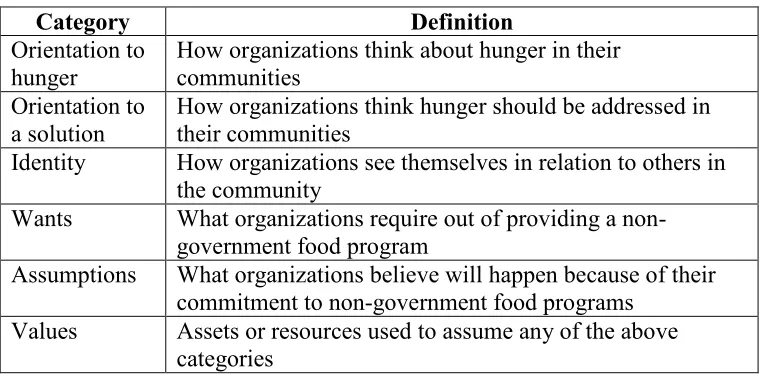
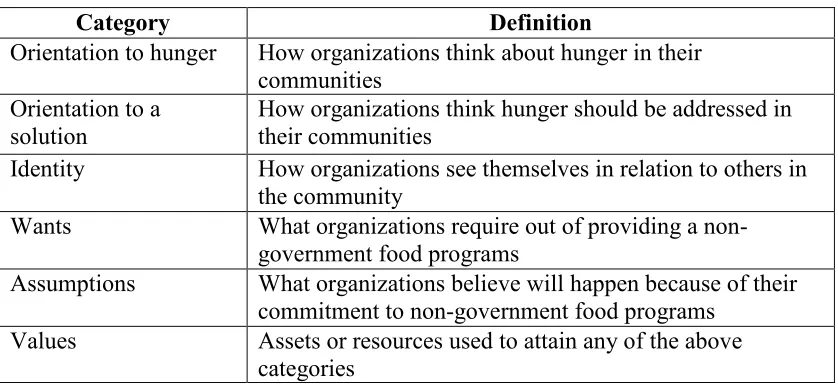
engenders commitment to non-government food programs (Table 3.1).
Table 3.1. Policy framework
Community organizations are likely to view hunger in their community in
different ways. It is therefore important to understand their orientation to hunger and their
solution to hunger as baseline for learning what engenders their commitment. Clark’s
policy process framework states that in addition to orientation to hunger and proposed
solution, one must also understand: 1) identity, or how an organization describes their
personality, role, or behavior; 2) assumptions, or what the expectations are of their
non-government food programs and those who use them in the past and in the future; and 3)
wants, or what the organization and participants want in terms of values.
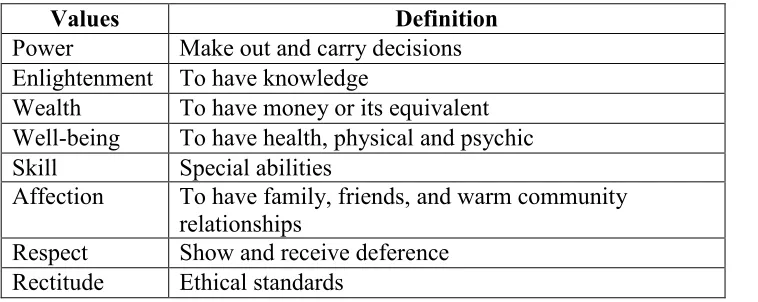
Values, as noted in Figure 3.1, are assets and resources that can be used by
organizations to help their organization acquire benefits. Values can be used to help
Category Definition
Orientation to hunger
How organizations think about hunger in their communities
Orientation to a solution
How organizations think hunger should be addressed in their communities
Identity How organizations see themselves in relation to others in the community
Wants What organizations require out of providing a non-government food program
Assumptions What organizations believe will happen because of their commitment to non-government food programs
32
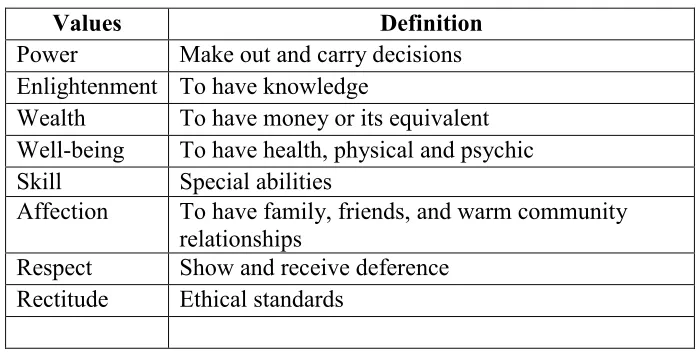
support their identities, wants and assumptions. They can also be used as a “currency” to
attain more or different values. For example, if a large church prioritizes creating
relationships (value of affection) as part of their non-government food programs, they
may use their position (value of power) in the community to negotiate meetings with
other influential community organizations:
Table 3.2 Policy Values
Values Definition
Power Make out and carry decisions
Enlightenment To have knowledge
Wealth To have money or its equivalent
Well-being To have health, physical and psychic
Skill Special abilities
Affection To have family, friends, and warm community relationships
Respect Show and receive deference
Rectitude Ethical standards
Hawe’s systems- theory guided the understanding and studying of the effects of
non-government food programs on professional school counselors in the second
manuscript. The analysis for the second manuscript draws attention to the networks of
social relationships that make up schools, activities, and materials – all relating to how
they are affected by introducing a backpack program. Four concepts of inquiry were
suggested to map the effects of the backpack program on school settings, and its
implications:
(i) Embedding: The sustainability of the backpack program in schools yields
insights into how the procedures around the program become part of the school’s
33
backpack program may become embedded in organizational school practices; the reach,
or how far across the system the backpack program is evident (e.g., orientation packets to
the entire school, mentioned in regular staff meetings), and the intensiveness of the
backpack program’s integration into routine practice (e.g., time and space dedicated to
the backpack program). How the backpack program becomes embedded, or part of the
school’s regular routine, is indicative of the institutionalization and acceptance of the
program. Understanding how the backpack program is embedded is important in the
context of what else is occurring simultaneously at the school, and what support is
available to aid with implementation.
(ii) Relationships: Relationships within the school setting (e.g., teachers and
guidance counselors) and outside partnerships (e.g., professional school counselors and
contacts at faith-based organizations) tying the school to outside support organizations
(e.g., churches, food banks) may influence how the backpack program functions, and
why the backpack program is sustained. We aimed to understand how the backpack
program affects the nature of relationships related to the backpack program.
(iii) Materials: Both raw and cultural materials are resources that are used in the
implementation of the backpack program (Haw et. al., Clark 2002). Raw materials may
be people (e.g., manpower required to pack backpacks), places (e.g., rooms in schools
storing the backpacks), money (e.g., funds to buy food), or other materials (e.g.,
backpacks, flyers about the program). Cultural materials may be ideas, beliefs, or social
norms (e.g., behavior, customs, traditions). The backpack program has the potential to
transform people, events, and places changing the setting (the school) that link all three in
34
(iv) Displaced activities: Intervention research has traditionally focused on the
new activity introduced, and the effects on the recipients of the new activity. As schools
have had to make changes to accommodate and incorporate them into their daily routine,
the actions that are displaced that might more truly account for changes in what outcomes
at the school setting level we observe. This is useful for articulating what activities are
dropped to accommodate the backpack program, and is vital for monitoring what roles
and services are compromised for staff to provide the backpack program.
Additionally, during our analysis process through the use of Hawe’s
systems-theory, new concepts related to effects were present throughout our interviews. We chose
to incorporate these concepts into our research questions as we purposefully coded for
them. The concepts include: additional non-government food programs provided in
schools besides backpack programs; benefits to school staff and students from the
perspective of our interviewees (e.g., more opportunities for interactions); consequences
for school staff and students from the perspectives of our interviewees (e.g., less attention
paid to behavioral issues by professional school counselors); and new activities created to
ease implementation of the backpack program (e.g., the inclusion of special education
students to aid with the implementation of the backpack program).
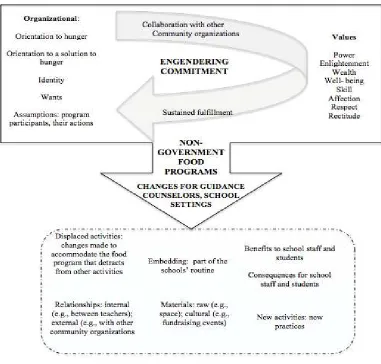
Below, we incorporate both Clark’s policy process model and Hawe’s systems
35
Figure 3.2. Commitment to non-government food programs and school context
As part of preparing the second manuscript, a combination framework of the
policy process and organizational changes was created to help future researchers
understand how communities sustain non-government food programs, particularly in the
school system. Community organizations have their own orientations to hunger, what
they believe will address hunger in their communities, their organizational identities,
what they want out of providing non-government food programs, and their assumptions
about their non-government food programs and those that utilize them. These are tenets
36
collaboration with other organizations that allow them to utilize vales of importance to
maintaining their identities, wants, and assumptions about hunger and non-government
food programs. Seeking to collaborate with other organizations through the use of values
allows community organizations to maintain their identities, wants, and assumptions
which what engenders their sustained commitment to non-government food programs. In
our study, this cycle occurred in all three types of organizations we interviewed: the food
bank, faith-based organizations, and schools. As the food bank and faith-based
organizations expanded their non-government food programs, the use of the school
system was an obvious choice for its access to students and their families. This included
(from Hawe’s theory) the schools’ external and internal relationships, the day-to-day
activities involving non-government food programs (embedding), resources and materials
that are used within the schools, and activities that have been displaced or changed to
accommodate the implementation of non-government food programs. Additionally,
through this dissertation study, new concepts related to effects were included: additional
non-government food programs provided in schools besides backpack programs; benefits
to school staff and students from the perspective of our interviewees; consequences for
school staff and students from the perspectives of our interviewees; and new activities
created to ease implementation of the backpack program.
Qualitative Approach
Most qualitative studies are focused on meaning-making and how it can use
perspectives from individuals or groups to further the understanding of a studied
phenomenon (J W Creswell, 2012; Fossey, Harvey, Mcdermott, & Davidson, 2002;
37
focus on the importance of the context of organizational actions and their influences by
historical, ecological, socio-economic, political, cultural and temporal conditions, as well
as subsequent interpretations of those interactions (Kelly, Terre Blanche, Durrheim, &
Painter, 1999; M Q Patton, 2002). In contrast to the rigid attributes of quantitative
scientific research using controlled experimentation, many qualitative approaches are
able to be more flexible, maintain validity, and emphasize the understanding of human
experience, all this being a vital aspect of this approach (Fossey et al., 2002; Greene,
1994).
The student explored the experiences of the community organization key actors,
and specifically inquired about their non-government food programs, and their
interactions with other community organizations. Through qualitative research methods,
including qualitative interviews with open-ended questions, the study captured what the
key actors perceive and/or believe to be about their non-government food programs, and
why they continue to be committed to them(Maxwell, 2012; M Q Patton, 2002). Key
actors provided ‘‘their reported perceptions, “truths,” explanations, beliefs, and
worldview” (M Q Patton, 2002) regarding hunger in their community (Miles &
Huberman, 1994).
Study Rationale
Given the inability to escape researcher subjectivity (e.g., bringing past
experiences, thoughts and perspectives to the study), a purely emic approach of the study
would not be easily attained. In contrast, a purely etic approach to the study would
potentially eliminate unique meanings, ideas and key concepts of key actors’ responses