Spin
S
hysics
K
ighlightsfromSTAR
A.Gibson1,aoQEHKDOIRItheSTARCollaboration
1ValparaisoUniversity,Valparaiso,Indiana,46383,USA
Abstract. As the world’s only polarized proton collider, the Relativistic Heavy Ion Col-lider (RHIC) at Brookhaven plays an important role in understanding the spin structure of the proton. The STAR detector, with its large acceptance for calorimetry and tracking, has been used to study polarized proton collisions for more than a decade with a range of jet, meson, and boson probes. We will discuss jets, neutral pions, and W bosons as probes of the proton’s helicity structure. Here STAR measurements have significant im-pact on global fits of sea quark polarizations and have provided the first firm evidence of non-zero gluon polarization within the proton. We will discuss W/Z bosons, jets, pions, and pion-jet correlations as probes of the transverse spin structure of the proton, and we will use the example of a proposed dijet measurement with an upgraded STAR detector to peer into the future.
1 Introduction
Understanding the proton’s spin structure is a fundamental goal of QCD and of nuclear physics. When polarized deep-inelastic scattering experiments in the 1980’s [1] showed that only about 30% of the proton’s spin was carried by quarks, as compared to naive expectations from the proton’s linear mo-mentum distribution, or from the charge distribution where quarks are the entire effect, the result was dubbed the proton spin “crisis”. Or, more prosaically, the proton spin puzzle. Equally puzzling, in the 1970’s large transverse spin asymmetries were observed in forward pion production from polarized proton collisions in a fixed target experiment [2], when, naively, extremely small transverse asymme-tries were expected. The decomposition of the proton’s spin, particularly the possible contributions from gluons and orbital angular momentum, and the mechanisms responsible for the large forward transverse spin asymmetries have continued to be active topics of experimental and theoretical inves-tigation. A recent review of spin physics provides further background [3].
As the world’s only polarized proton collider, the Relativistic Heavy Ion Collider (RHIC) at Brookhaven National Laboratory has an important role to play in understanding the spin structure of the proton. The STAR detector [4], with excellent tracking coverage from its time projection chamber (TPC) in the pseudorapidity region|η| < 1.3, extensive electromagnetic calorimeter coverage with
−1< η <4 and 2πazimuthal acceptance is well-suited to take advantage of the collisions provided by RHIC. The large-acceptance tracking and calorimetry coverage combine to make STAR an excellent detector for jets, the EM calorimeter coverage allows reconstruction of neutral mesons to forwardη, and the RHIC energy of up to √s=510 GeV allows the production ofW bosons. We will discuss
ae-mail: [email protected]
C
jet and pion probes of the gluon polarization within the proton in Section 2, studies of the sea quark polarization using W bosons in Section 3, probes of the proton’s transverse structure in Section 4, and we will use the example of a proposed dijet measurement with an upgraded STAR detector to peer into the future in Section 5.
An overview of the heavy ion physics program at STAR can be found in these same proceed-ings [5].
2 Probing the Gluon Polarization with Jets and
π
0’s
The gluon polarization within the proton can be accessed in polarized proton collisions with strongly interacting probes such as inclusive jet or hadron production by measuring the longitudinal double-spin asymmetry (ALL),
ALL=
(PBPY) (N++−rN+−)
(PBPY)2(N+++rN+−)
, (1)
in whichPB,Y are the measured beam polarizations, N++ andN+−are the inclusive jet (or hadron)
yields for equal and opposite proton beam helicity configurations, andris the relative luminosity. Each sum is over individual data acquisition runs that were 10 to 60 minutes long, a period much shorter than typical time variations in quantities such asPB,Y andr. Values ofrwere measured
run-by-run, and range from 0.8 to 1.2. A typical beam polarization is about 50%.
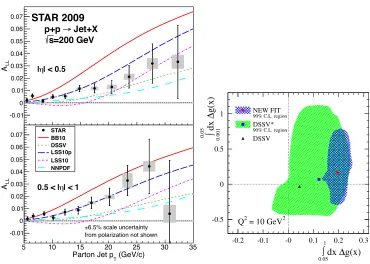
Early asymmetry measurements from STAR and PHENIX were included in the DSSV [6] global polarized parton distribution function (PDF) fit, the first to include new RHIC data along with data from fixed-target experiments. For the 2009 run, improvements at STAR, including larger jet trigger efficiency, and additional luminosity allowed a nearly 20-fold increase in the sample size for the inclu-sive jet measurement and a corresponding reduction in the uncertainty onALL. Jets are reconstructed
utilizing the anti-kTjet-reconstruction algorithm [7] with a radius of 0.6 and utilize energy deposition
in the barrel (BEMC) and endcap (EEMC) electromagnetic calorimeters as well as charged-particle tracks from STAR’s TPC. This result is presented in Fig. 1 and has recently been submitted for pub-lication [8]. The updated result has been included in a new fit by the DSSV collaboration [9] as also shown in Fig. 1. The integral over gluon momentum fraction 0.05 < x < 1 yields a result of 0.194+0.057
−0.054[10], the first firm evidence of a non-zero role for the gluon in determining the spin of the proton. By contrast, the role of the gluon at lowxremains quite poorly constrained.
Using the 2006 dataset, STAR also measuredALLfor neutral pions, with their different kinematics,
fragmentation, and systematics at central (|η|<0.95) [11] and forward (η =3.2,3.7) [12] pseudora-pidity. In a recent publication [13] we extended those measurements to the EEMC at intermediate
η, 1.0 < η < 2.0, still using the 2006 dataset at √s = 200 GeV. These results are presented in Fig. 2. Another recent global QCD analysis, by the NNPDF collaboration [14] incorporates RHIC jet measurements, and makes predictions forπ0 observables. In Fig. 3 we show their prediction for our EEMC measurement. Clearly improvements in statistics are needed to further constrain the global fit. To extend STAR’s sensitivity, including extending ourΔg(x) reach to lowerxvalues, we have several options. We can increase the statistics, we can increase the beam energy, we can probe lower pT π0’s (limited by our ability to trigger and reconstruct these events), and we can push to forwardη.
LL
A
-0.01 0 0.01 0.02 0.03 0.04 0.05 0.06 0.07
| < 0.5
η
|
STAR 2009 Jet+X
→
p+p =200 GeV s
(GeV/c)
T
Parton Jet p
5 10 15 20 25 30 35
LL
A
-0.01 0 0.01 0.02 0.03 0.04 0.05 0.06
0.07 STAR BB10 DSSV LSS10p LSS10 NNPDF
| < 1
η
0.5 < |
6.5% scale uncertainty
±
from polarization not shown
∫
dx
Δ
g(x)
0.001
0.05
∫ dx Δg(x)
1
0.05
Q2 = 10 GeV2 NEW FIT
DSSV*
DSSV 90% C.L. region 90% C.L. region
-0.5 0 0.5 1
-0.2 -0.1 -0 0.1 0.2 0.3
Figure 1.(Left) Midrapidity (|η|<0.5, upper panel) and forward rapidity (0.5<|η|<1, lower panel) inclusive jetALLvs. parton jetpT, compared to predictions from several NLO global analyses. The error bars are statistical.
The gray boxes show the size of the systematic uncertainties. (Right) The new DSSV fit [9], heavily influenced by these jet results. For high gluonxthe fit shows the first firm evidence of non-zero gluon polarization in the proton, while the low-xgluons remain poorly constrained.
3 Probing Sea Quark Polarizations with W’s
The flavor-separated helicity-dependent PDF’s of quarks in the proton can be probed at STAR through the production ofW+(−)bosons for which the dominant production process isu+d(d¯ +u). The parity-¯ violating weak production gives rise to large single-spin asymmetries,AL = σσ++−+σσ−−, whereσ+(−) is the cross section with the helicity positive (negative) proton beam (averaged over the other beam’s helicity states). TheWbosons are identified by an isolated high-pTelectron in the BEMC or EMC in
an event with imbalancedpT, as expected from the missing neutrino. The electron sign identification
is handled by the TPC (|η|<1.3). The STARWresults from 2012 have recently been published [17] and are shown in Fig. 4 along with a variety of theoretical predictions. The 2012 dataset is about six times larger than earlier datasets. As seen in Fig. 4, the STAR result has a significant effect on global fits to the sea quark polarizations.
4 Probing Transverse Structure with Jets,
π
0’s, and Other Probes
[GeV/c] T
p
5 6 7 8 9 10 11 12
LL
A
-0.1 -0.05 0 0.05 0.1
0.15 GRSV Δ g = g GRSV Δ g = std
g = -g
Δ
GRSV DSSV
0 π
STAR
+ X
0π
→
p
+
p
= 200 GeV s
< 2.0
η
0.8 <
6% Scale Uncertainty
Figure 2.The EEMCALLresults from 2006 data (blue markers) are presented with the DSSV prediction [6] and
the GRSV prediction [16] using the best fit to polarized DIS (Δg=std) and the maximum and minimum allowed
values for gluon polarization. The GRSV prediction includes no RHIC data. Statistical uncertainties are shown by the error bars, whereas systematic uncertainties are indicated by the error boxes. The 6% scale uncertainty is due to beam polarization uncertainty.
[GeV] T p
5 6 7 8 9 10 11
-0.1 -0.05 0 0.05 0.1 0.15
0 π
LL A
=200 GeV s
NLO QCD, NNPDFpol1.1
Figure 3. (Left) Projected statistical uncertainties for an inclusiveπ0 A
LLmeasurement using the 2012 EEMC
dataset, plotted on the same scale as the 2006 result [13] of Fig. 2. (Right) The data points are the 2006 EEMC result, while the green band represent the new NNPDF fit [14], with uncertainty, incorporating recent RHIC jet results.
summarized in Fig. 5. At STAR a number of features of these large asymmetries have been observed including their observation for forward observables but not for central ones, and for relatively isolated
π0’s but not for jets reconstructed from electromagnetic clusters, their diminution when significant
central activity is present in the event, some sign that the asymmetries are larger forη’s than forπ0’s,
and, as shown in Fig. 5, their originally unexpected persistence to significant pionpT.
η
lepton -2 -1 0 1 2 -0.5
0 0.5
= 2% error
2
χ /
2
χ Δ DSSV08 L0
-W
+
W
ν +
±
e →
±
W → +p p
=510 GeV
s 25 < EeT < 50 GeV L
A
Rel lumi syst
3.4% beam pol scale uncertainty not shown +
W W
-STAR Data CL=68% DSSV08 RHICBOS DSSV08 CHE NLO LSS10 CHE NLO
Figure 4.(Left) Longitudinal single-spin asymmetryALforW±production as a function of lepton pseudorapidity, η, in comparison to theory predictions. (Right) χ2 profiles forΔu¯ without (DSSV+) STAR W data, with a
preliminary version of the 2012 data (DSSV++), and with the preliminary 2012 data along with the uncertainties from projected 2013 results (DSSV++w/proj. W data) [18].
Figure 5.Transverse single spin asymmetry measurements for neutral pions at different center-of-mass energies as a function of Feynman-x(Left) andpTat
√
Figure 6. Preliminary results of the Collins moment for leading π+(red) andπ−(blue) particles within mid-rapidity jets reconstructed by the STAR detector. Statistical errors are shown on data points and the grey shaded band indicates the systematic error bar for theπ+andπ−separately. The momentum fraction of the jet carried by the pion isz=pπ/pjet.
to account for higher twist multi-parton correlators (“twist-3” formalism) [20, 21] or to account for in-trinsic transverse-momentum dependence (“TMD” formalism) [22, 23]. In the twist-3 formalism one can obtain asymmetries, in principle, from either the parton correlation functions or the fragmentation functions (e.g. Refs. [24, 25]). Similarly, in the TMD formalism one can obtain asymmetries, in prin-ciple, from either the parton distribution functions (the “Sivers effect” [22, 23]) or the fragmentation functions (e.g. the “Collins effect” [26]). The Sivers effect requires the presence of orbital angular momentum in the proton, while the Collins effect is sensitive to transversity, a fundamental distribu-tion funcdistribu-tion of the proton. Furthermore, it has been shown that the intrinsic transverse momentum integrals of the TMD functions are closely related to the twist-3 functions [27].
Measurements such as those in Fig. 5 of the transverse asymmetry in inclusive hadrons, or in jets while ignoring the jet substructure, can be sensitive to initial-state effects (such as the Sivers effect). To probe for final-state effects (such as the Collins effect in fragmentation) one can analyze the correlation between the pions fragmenting from a jet, and the jet axis. Such an analysis [28], from a limited statistics √s = 200 GeV dataset in 2006, is shown in Fig. 6. The Collins asymmetry is plotted againstzand jT, wherezis the fraction of the total momentum of the jet carried by the pion
andjTis the pion’s transverse momentum with respect to the jet axis. These preliminary results show
a tantalizing charge-sign separation between the pions, and a hint of a non-zero asymmetry. But, the systematic uncertainties prevent the result from being significant.
Figure 7.Projected statistical uncertainty of the Collins moment for leadingπ+(red) andπ−(blue) particles within
mid-rapidity jets reconstructed by the STAR detector, for a significantly larger dataset at √s =200 GeV, like
Fig. 6, but from 2012.
results of the 2012 Collins analysis were released after the date of the conference talk described in these proceedings. These preliminary 2012 results are exciting – the first statistically significant Collins measurement at a polarized proton collider – and are described elsewhere [32].
To test the full range of transverse physics phenomenology it is important to test the universal-ity, factorization, and evolution of the various phenomena and formalisms. So, it’s important to conduct tests with a range of probes, including changing the initial states (e.g. polarized DIS and semi-inclusive DIS, i.e. SIDIS vs. polarized proton collisions) and probing a range of final states
at differentQ2 scales. One prediction of QCD in the TMD framework is that the Sivers function is
not universal, experiencing a sign change as expressed for SIDIS as compared to Drell-Yan [33]. At STAR, it is possible to test this predicted non-universality using heavy boson production, as well as
with Drell-Yan itself or direct photon production. For the case ofW andZ bosons a preliminary,
proof of principle, measurement has been conducted using fully reconstructedW andZbosons from
transversely polarized data recorded in 2011. It is described in more detail elsewhere [34].
5 Looking to the Future
We have discussed a rich range of spin physics measurements from STAR at RHIC probing a variety of phenomena using a range of observables and both longitudinally and transversely polarized proton beams. Nevertheless, it does represent a biased selection of highlights, with important STAR re-sults, like the measurement of interference fragmentation functions as evidence for transversity in the proton [35], unfortunately left out. Most of the analyses we have discussed continue, with new pre-liminary and published results in preparation with datasets from 2011, 2012, and 2013: in many cases promising significantly greater sensitivity. Additional polarized data taking is foreseen in 2015 and
2016, with tests of TMD evolution and universality among the major targets, including theWandZ
boson transverse asymmetry results discussed above. An upgrade to the FMS subdetector is currently
underway, adding a preshower detector that will allow separation amongst forward (2.5 < η < 4.0)
photons,π0’s, charged hadrons, and electrons and will support direct photon and Drell-Yan
p 2014 - QCD2014
√
s
= 500 GeV
1 10 102 103 104 105 106 107 108
10-5 10-4 10-3 10-2 10-1 1 x1 (x2)
d σ /dx 1 (d σ /dx 2 ) (pb) x1 x2
-0.8 <η3 (4)< 0 / 2.8 <η4 (3)< 3.7
(EAST / FCS)
1 10 102 103 104 105 106 107 108
10-5 10-4 10-3 10-2 10-1 1 x1 (x2)
d σ /dx 1 (d σ /dx 2 ) (pb) x1 x2
ET3> 5GeV ET4> 8GeV
0 <η3 (4)< 0.8 / 2.8 <η4 (3)< 3.7
(WEST / FCS) Cone alg. (R=0.7) /
1 10 102 103 104 105 106 107 108
10-5 10-4 10-3 10-2 10-1 1 x1 (x2)
d σ /dx 1 (d σ /dx 2 ) (pb) x1 x2
1.2 <η3 (4)< 1.8 / 2.8 <η4 (3)< 3.7
(EEMC / FCS)
1 10 102 103 104 105 106 107 108
10-5 10-4 10-3 10-2 10-1 1 x1 (x2)
d σ /dx 1 (d σ /dx 2 ) (pb) x1 x2
2.8 <η3 (4)< 3.7 / 2.8 <η4 (3)< 3.7
(FCS / FCS)
Figure 8. Parton momentum fractions, x1 and x2, probed by dijets with at least one jet in the forward STAR
acceptance region inηof2.8< η <3.7, with proposed FCS calorimeter upgrades.
Looking farther to the future, the STAR collaboration anticipates a fairly continuous evolution of the current detector into an eSTAR detector [36] for the future electron-ion collider (EIC) [37]. This machine will probe an enormous range of QCD and heavy-ion phenomena and will have spin
physics capabilities, in polarized electron-proton collisions, with an unprecedented reach inQ2 and
x. One component of that future eSTAR detector, to be installed on an intermediate time frame (e.g. 2020) would be an upgraded Forward Calorimeter System (FCS) [38]. This system would involve a compact tungsten spaghetti calorimeter for an electromagnetic calorimeter and, for the first time at STAR, would involve significant hadronic calorimetry, with a lead-scintillating tile system, all
covering 2.5< η <4.0. This would allow forward jet measurements at STAR.
As one example of the proposed FCS functionality, we present projections for a dijetALL
measure-ment with 1fb−1of data at √s=500 GeV. Dijet and other two-to-two processes have the advantage
that, at leading order, you can calculate the initial-state particle momenta. So, at leading order, the
momentum fractions of the leading and sub-leading partons, x1 and x2, are identified. This
pro-posed measurement, discussed in more detail elsewhere [38, 39], is summarized in Figs. 8 and 9.
There, for various djiet topologies with at least one jet in the FCS acceptance, we present the partonx
probed along with the anticipated uncertainties onALL. The theoretically expectedALLvalues in this
kinematic region are tiny, of order 10−3. But, the anticipated experimental uncertainties are equally
minuscule, thus presenting an attractive possibility for probing the gluon polarization at extremely
δR = 5·10-4 ET3
>
5GeV E
T4
>
8GeV
Cone alg. (R=0.7) /
x 10-2 x 10-2
x 10-2 x 10⁻²
-0.15 -0.1 -0.05 0 0.05 0.1 0.15 0.2
30 35 40 45 50 55 60 M (GeV)
ALL
DSSV GRSV STD
(EAST / FCS)
-0.1 -0.05 -0 0.05 0.1 0.15 x 10⁻²
20 25 30 35 40 45 50 55 60 M (GeV)
ALL
DSSV GRSV STD
(WEST / FCS)
Delivered Luminosity = 1000pb-1 Polarization = 60%
-0.1 -0.05 0 0.05 0.1 0.15 0.2
10 15 20 25 30 35 40 M (GeV)
ALL
DSSV GRSV STD
(EEMC / FCS)
-0.15 -0.1 -0.05 0 0.05 0.1 0.15 0.2
10 11 12 13 14 15 16 17 18 19 20 M (GeV)
ALL
DSSV GRSV STD
(FCS / FCS)
√
s
= 500 GeV
Figure 9. NLO ALLcalculations for dijets with at least one jet having2.8< η < 3.7, together with projected
uncertainties.
References
[1] J. Ashman et al. (European Muon Collaboration), Phys.Lett.B206, 364 (1988)
[2] R. Klem, J. Bowers, H. Courant, H. Kagan, M. Marshak et al., Phys.Rev.Lett.36, 929 (1976)
[3] C.A. Aidala, S.D. Bass, D. Hasch, G.K. Mallot, Rev.Mod.Phys. 85, 655 (2013),
hep-ph/1209.2803
[4] K. Ackermann et al. (STAR Collaboration), Nucl. Inst. & Meth.A499, 624 (2003), and
refer-ences therein
[5] S. Shi (the STAR collaboration) (2014), in the Proceedings of the International Conference on
New Frontiers in Physics 2014,nucl-ex/1409.8371
[6] D. de Florian, R. Sassot, M. Stratmann, W. Vogelsang, Phys.Rev.Lett. 101, 072001 (2008),
hep-ph/0804.0422
[7] M. Cacciari, G.P. Salam, G. Soyez, J. High Energy Phys.04, 063 (2008)
[8] L. Adamczyk et al. (STAR Collaboration) (2014),hep-ex/1405.5134
[9] D. de Florian, R. Sassot, M. Stratmann, W. Vogelsang, Phys.Rev.Lett. 113, 012001 (2014),
hep-ph/1404.4293
[10] R. Sassot, M. Stratmann, private communication
[11] B. Abelev et al. (STAR Collaboration), Phys.Rev.D80, 111108 (2009),hep-ex/0911.2773
[12] S.W. Wissink (STAR Collaboration), AIP Conf.Proc.1149, 397 (2009)
[13] L. Adamczyk et al. (STAR Collaboration), Phys.Rev. D89, 012001 (2014),
[14] E.R. Nocera, R.D. Ball, S. Forte, G. Ridolfi, J. Rojo (NNPDF Collaboration), Nucl.Phys.B887, 276 (2014),hep-ph/1406.5539
[15] C. Dilks (STAR Collaboration) (2014), presented at the 21st International Symposium on Spin Physics (Spin2014)
[16] M. Gluck, E. Reya, M. Stratmann, W. Vogelsang, Phys.Rev. D63, 094005 (2001),
hep-ph/0011215
[17] L. Adamczyk et al. (STAR Collaboration), Phys.Rev.Lett. 113, 072301 (2014),
nucl-ex/1404.6880
[18] E. Aschenauer, A. Bazilevsky, K. Boyle, K. Eyser, R. Fatemi et al. (2013),nucl-ex/1304.0079
[19] G.L. Kane, J. Pumplin, W. Repko, Phys.Rev.Lett.41, 1689 (1978)
[20] A. Efremov, O. Teryaev, Yad. Fiz.36, 242 (1982), [Sov. J. Nucl. Phys. 36, 140 (1982)] [21] J.w. Qiu, G.F. Sterman, Phys.Rev.D59, 014004 (1998),hep-ph/9806356
[22] D. Sivers, Phys. Rev. D41, 83 (1990) [23] D. Sivers, Phys. Rev. D43, 261 (1991)
[24] K. Kanazawa, Y. Koike, Phys.Lett.B720, 161 (2013),1212.3071
[25] K. Kanazawa, Y. Koike, A. Metz, D. Pitonyak, Phys.Rev.D89, 111501 (2014),1404.1033
[26] J.C. Collins, Nucl.Phys.B396, 161 (1993),hep-ph/9208213
[27] D. Boer, P. Mulders, F. Pijlman, Nucl.Phys.B667, 201 (2003),hep-ph/0303034
[28] R. Fatemi (STAR Collaboration), AIP Conf.Proc.1441, 233 (2012),hep-ex/1206.3861
[29] J.K. Adkins (STAR Collaboration) (2013), presented at the Annual Fall Meeting of the APS Division of Nuclear Physics
[30] J. Drachenberg (STAR Collaboration), EPJ Web Conf.73, 02009 (2014)
[31] M. Anselmino, M. Boglione, U. D’Alesio, E. Leader, S. Melis et al., Phys.Rev.D73, 014020
(2006),hep-ph/0509035
[32] J.K. Adkins, J.L. Drachenberg (STAR Collaboration) (2014), presented at the 21st International Symposium on Spin Physics (Spin2014), proceedings forthcoming
[33] J.C. Collins, Phys.Lett.B536, 43 (2002),hep-ph/0204004
[34] S. Fazio, D. Smirnov (STAR), PoSDIS2014, 237 (2014) [35] A. Vossen (STAR), AIP Conf.Proc.1560, 519 (2013)
[36] L. Adamczyk et al. (STAR Collaboration) (2014), public STAR Note 592,
https://drupal.star.bnl.gov/STAR/starnotes/public/sn0592
[37] A. Accardi, J. Albacete, M. Anselmino, N. Armesto, E. Aschenauer et al. (2012),1212.1701
[38] L. Adamczyk et al. (STAR Collaboration) (2014), public STAR Note 605,
https://drupal.star.bnl.gov/STAR/starnotes/public/sn0605
![Figure 2. The EEMC ALL results from 2006 data (blue markers) are presented with the DSSV prediction [6] andthe GRSV prediction [16] using the best fit to polarized DIS (Δg = std) and the maximum and minimum allowedvalues for gluon polarization](https://thumb-us.123doks.com/thumbv2/123dok_us/8173349.1364888/4.482.45.428.325.468/presented-prediction-prediction-polarized-maximum-minimum-allowedvalues-polarization.webp)
![Figure 5.√fferent center-of-mass energiesas a function of Feynman- Transverse single spin asymmetry measurements for neutral pions at di x (Left) and pTats = 500 GeV (Right) [18].](https://thumb-us.123doks.com/thumbv2/123dok_us/8173349.1364888/5.482.45.439.69.301/erent-energiesas-function-feynman-transverse-asymmetry-measurements-neutral.webp)