A NEW SET THEORY FOR ANALYSIS
Juan Pablo Ramírez 0000-0002-4912-2952
Received: date; Accepted: date; Published: date
Abstract: We present the real number system as a generalization of the natural numbers. First, we prove the co-finite topology,Co f(N), is isomorphic to the natural numbers. Then we prove the power set 2Zcontains a subset isomorphic to the non-negative real numbers, with all its defining structure of operations and order. Finally, we provide two different constructions of the entire real number line, and we see that the power set 2Ncan be given the defining structure ofR. We give simple rules for calculating addition, multiplication, subtraction, division, powers and rational powers of real numbers, and logarithms. The supremum and infimum are explicitly constructed by means of a well defined algorithm that ends in denumerable steps. In section 5 we give evidence our construction ofNandRare canonical; these constructions are as natural as possible. In the same section, we propose a new axiomatic basis for analysis. This answers Benacerraf’s identification problem by giving a canonical representation of numbers as sets. In the last section we provide a series of graphic representations and physical models that can be used to represent the real number system. We conclude that the system of real numbers is completely defined by the order structure ofN.
Keywords: General Topology, Axiomatic Set Theory, Real Analysis, Continuum, Graph Theory, Benacerraf’s Identification Problem, Mathematical Structuralism
Introduction
In building the continuum we make use of properties of integers and sets. Apart from this, we assume the basic concepts of category theory. Mainly, the concept of isomorphism between categories. Background knowledge on previous axiomatic constructions of the real numbers will be of help. The more modern constructions of the real number system can be found in the references [1-5]. It is notable that the real number system has been studied in detail through the generations, and still new insights and more useful constructions are sought. The mathematical objects that have previously been denominated as real numbers, are objects of complex and illusive structure. The mathematician has always had to recur to advanced tools and objects in building the real number structure. In the words of Dr. K. Knopp [6](p. 4)
"...these preliminary investigations are tedious and troublesome, and have actually, it must be confessed, not yet reached any entirely satisfactory conclusion at all."
The construction provided here, stands out in the fact that we do not have to build a new structure. We prove the real number system is isomorphic in terms of structure (not only cardinality) to 2N. One can find many bijective functions from the set of real numbers to the power set of integers, but it is completely different to prove they have the same structure. Of course, the structure of 2Ncan be defined artificially in terms of any bijection, but that does not give us any new information or computational advantages. Our work is to define a simple structure for 2Nand prove this structure is equivalent to the real number system as a totally ordered field with the property of the supremum element (completeness). In other wrods, we provide a set of rules that define order and operations <,⊕,⊗in 2N, in such a way that Fa < Fbif and only if a < b, andF(a+b) = Fa⊕ Fband
F(a·b) =Fa Fb, for a bijectionF :R→2N.
Real numbers are usually presented axiomatically as a set that satisfies certain rules. In undergraduate school, constructions of this system are rarely taught, even in advanced courses
of analysis. This leads to a certain gap in the learning of the student. This problem is one of major motivations of the present work. We first provide an isomorphic structure toN, by defining order and operations for the closed sets of the cofinite topologyCo f(N). A similar construction is given for the discrete topology 2N; the continuum[0, 1]is isomorphic in structure to the collection of all subsets of N. We generalize these constructions to obtain a structure isomorphic toR+. We define order and operation for the closed sets of ¯Z, where ¯Zis the topology ofZwhose closed sets are the subsets ofZ that are bounded above. In other words, non-negative real numbers are represented by subsets ofZ that are bounded above. We define order, addition and product for these objects.
1. Motivation
Every positive integer has unique representation as sum of natural powers of 2. This expression is usually treated as a sequence of 0s and 1s. A 0 in then-th place indicates that 2nis not a summand in the expression. A digit 1 in that same place, would indicate that power is indeed a summand. This is the usual binary expression of natural numbers. We will refer to finite subsets ofNasset numbers. Given the binary representation of a positive integerN, we can naturally assign a set number to it. The elements of the set number are the natural numbers that correspond to spaces in the sequence with a digit 1. Where a 0 would appear we say that integer does not belong to the set number. For example, the number 5= (. . . , 0, 0, 0, 1, 0, 1)is assigned the set number{0, 2}because the 0-th and 2-nd space are occupied by the digit 1. The number 13= (. . . , 0, 0, 0, 1, 1, 0, 1)will be mapped to the set number{0, 2, 3}and the number 17= (. . . , 0, 0, 0, 1, 0, 0, 0, 1)would be given the set number{0, 4}. Given set numbersa,b, we saya<bif max(a4b)∈b, wherea4b= (a∪b)−(a∩b)is the symmetric difference of the two sets. This order is isomorphic to the order of natural numbersN<.
Next, we define a sum operation for set numbers, in the form of a recursive formula that ends in finite steps. We express the sum of two set numbersa,bas the sum of two new sets: the symmetric difference and the intersection, with a slight change. We add 1 to the elements of the intersection to form a new set,s(a∩b). In other words, to add two numbers, we add the powers of 2 that are not repeated, then we add the powers of 2 that appear repeated. In terms of set numbers, this means we carry out the set number addition between the symmetric difference, and the intersection (with the elements of the intersection increased by 1). We add 1 to the elements ofa∩b, because in terms of natural numbers it is equivalent to multiplication by 2. Thus, our formulaa⊕b = (a4b)⊕s(a∩b). The function s : 2N →2Nadds 1 to the elements of the argument; in specifics∅ = ∅ands{0} = {1}. The set number sum 13+5={0, 2, 3} ⊕ {0, 2}is equal to(20+22+23) + (20+22) = [23] +2∗[20+22] = [23] + [21+23] = (21) +2∗(23) = (21) + (24) = 18. In terms of set numbers,{0, 2, 3} ⊕ {0, 2} =
{3} ⊕ {0+1, 2+1}={3} ⊕ {1, 3}={1} ⊕ {3+1}={1} ⊕ {4}={1, 4} ⊕∅ ={1, 4}. In general,
the process ends in finite steps. The sum of two sets,a,bis equal to the sum of the setsa0 =a4band b0 =s(a∩b). The sum of these two is in turn equal to the sum ofa00 =a04b0andb00=s(a0∩b0), etc.... This process ends whenb(n)becomes the empty set (after a finite number of iterations). We give another example, 15+23 = {0, 1, 2, 3} ⊕ {0, 1, 2, 4}. Ifa = 15,b = 23, then 15+23 = {3, 4} ⊕s{0, 1, 2} =
{3, 4} ⊕ {1, 2, 3}={1, 2, 4} ⊕ {4}={1, 2} ⊕ {5}={1, 2, 5} ⊕∅={1, 2, 5}=38.
This process can be modeled with particles occupying energy levels. A set number will be represented by a column with numbered energy levels, and any given arrangement of particles occupying levels (with at most one particle on each level). To perform addition of two columns, we give one rule: two particles in the same level are replaced by a single particle, one level up. Let us describe this in detail. Given two columnsA,B, we call the ordered pairS= (A,B)astate. Thus, a state is determined by two columns with occupied levels. Call the levels of the left columnAiand the levels of the right columnBj, so thatA4meansthe fourth level of the left columnandB0meansthe lowest (or 0-th) level of the right column.
in the energy levelBj+1if the energy levelsAjandBjwhere both occupied during the statetn. To find the set number sum of two set numbers, we merge the two columns into a single column, by applying our sum formula. The observation is that the right column becomes the empty set in finite steps. We definex⊕∅=∅⊕x=x. See Figure 1.
1.png
It can be proven the state stabilizes in a finite number of steps. That is to say, there exists a state S(tn)such thatS(tk) =S(tn)for allk≥ n. SayAni represents the levelAi at timetn. Then stability means for alli,j≥0 and for alln≥ k, it is trueAni = Aki andBnj = 0. Notice, the same diagram is valid under vertical displacements. In figure 2 we illustrate the fact that the same system of states from Figure 1 holds under displacement of the energy levels (Figure 2).
2.png
Real numbers in the unit interval can be expressed as the sum of negative powers of 2. We use the same rules, now with arbitrary sets of negative integers. For example, 12 = 2−1 = {−1}, and 32 = {−1, 0}because 32 =2−1+20. Adding these, 21+32 ={−1} ⊕ {−1, 0} ={0} ⊕s{−1}=
{0} ⊕ {0}=∅⊕s{0}=s{0}={1}=21(Figure 3).
3.png
and we will see why this is consistent (Figure 4).
4.png
A subsetA⊆Z, with maximum inZ, is a positive real number where the integer part is given by the (finite) intersectionN∩Aand the fractional part is given by−N∩A.
2.N∼=Co f(N)
LetA⊂Nbe a closed set of the cofinite topology ofN. Equivalently,Ahas a maximum and we say thatAis aset number.
2.1. Order
Given two set numbersA6= B, we define an order relation<between them. We sayA<Bif max(A4B)∈B. In the contrary case, max(A4B)∈ Aand we defineB<A. Every two set numbers are comparable because the symmetric difference is non-empty and has maximum. It is not difficult to see that we have a well ordering on the family of set numbers. We give three examples in Figure 5.
5.png
2.2. Addition
We define the sum of two set numbers as a recursive formula that ends in finite steps. When adding powers of two, we have the following simple rule 2n+1=2n+2n. So, we ask the sum obey{x} ⊕ {x}= {x+1}, for everyx∈N. Given any set numberA={x}x∈A ⊂N, we definesA={x+1}x∈A. Then, define the operation asA⊕B = (A4B)⊕s(A∩B), whereA4B = (A∪B)−(A∩B)is the usual symmetric difference. Successive applications yield
A⊕B = (A4B)⊕s(A∩B)
= [(A4B)4s(A∩B)]⊕s[(A4B)∩s(A∩B)] = [((A4B)4s(A∩B))4s((A4B)∩s(A∩B))]
Before complicating things more, we stop here to see what is happening. LetCn+1 = Cn4Dnand
Dn+1 = s(Cn∩Dn), where C1 = A4BandD1 = s(A∩B). Then the previous equalities can be rewritten as
A⊕B = (C14D1)⊕s(C1∩D1) = C2⊕D2
= (C24D2)⊕s(C2∩D2) = C3⊕D3
= Ck⊕Dk ∀k∈Z.
We are calculatingCk⊕Dk as a sumCk+1⊕Dk+1, where the termDk+1 is dependent on the intersection. We call the termDk+1 the remainder, and although it is not getting smaller in value (as natural number), the cardinality (as set number) does go to 0. However, it can be the case that the cardinality of the remainder does not get smaller. It may stay constant for finite iterations. It is guaranteed that in a finite number of steps, the remainder becomes the empty set, and our result is now obvious because we have iterated the formula until we reachA⊕B=Ck+1⊕Dk+1, whereDk+1=∅. The system stabilizes whenDk+1=∅; we getA⊕B=Ck+1=Ck+2=· · ·=Ck∪Dk.
It is left to the reader to prove 1)Dk=∅in at most max(A∪B) +1 steps. 2)X⊕Y=X⊕ {y1} ⊕
{y2} ⊕ · · · ⊕ {yn}, for any set numbersX,Ywhere theyi are the elements ofY. The proofs of the
algebraic properties are not all trivial. It is not trivial to prove associativity for⊕. The best thing to do to avoid direct proofs of these properties, is to proveF(a+b) = Fa⊕ FbandF−1(A⊕B) = F−1A+F−1B, whereF is the isomorphism between natural numbers and set numbers.
2.3. Product
In defining the product, consider that multiplying by 2 is equivalent to adding+1 to the elements of the set number. For example, 2∗14= {1} {1, 2, 3}= {1+1, 2+1, 3+1}= {2, 3, 4}=28. In general, 2·x =s(X), whereXis the set number corresponding tox∈N. Recalls(X) ={a+1}a∈X. Multiplication by 4, is equivalent to adding+2 to all the elements ofX. In general, multiplication by 2nis equivalent to addingn, to the elements ofX. That is to say, 2n·x ={a+n}a∈X. The unit of this operation is the set{0}. To multiply numbers that are not powers of 2, we define using distributivity. Let us first give an example. To multiply 7·9={0, 1, 2} {0, 3}, one of the two numbers is going to be distributed over the other in a sense that will now be made clear. We form three new sets (one for each element of 7). These are the sets{0+0, 3+0},{0+1, 3+1},{0+2, 3+2}. Adding these set numbers,
{0, 3} ⊕ {1, 4} ⊕ {2, 5}= ({0, 3} ⊕ {1, 4})⊕ {2, 5}={0, 1, 3, 4} ⊕ {2, 5}={0, 1, 2, 3, 4, 5}=63. This
example is illustrated in Figure 6.
To define the product of two set numbers AB, we will refer toAas thepivotandBas the base. The product is the set number sum, of the set numbers obtained by displacing the base; the displacements of the base correspond to elements of the pivot. So to give another example, if we wish to multiply 32 and 12, and take 32 as pivot and 12 as base, we proceed as follows. We know 32={5}has one element so that we add 5 to the elements of{2, 3}to obtain{7, 8}which is indeed 384. If we chose 32 to be the base and 12 to be the pivot, then we would have to add the set numbers
{5+2} ⊕ {5+3}={7} ⊕ {8}={7, 8}. The product is then expressed by:
AB=M
a∈A
{a+b}b∈B
Leta1< a2< · · ·< anbe the elements ofA, andb1 <b2 <· · ·< bmthe elements ofB. Then
the formula is the set number sum{a1+b}b∈B⊕ {a2+b}b∈B⊕ · · · ⊕ {an+b}b∈B, where the set
{ai+b}b∈B={ai+b1,ai+b2, . . . ,ai+bm}. Developing the expression we get
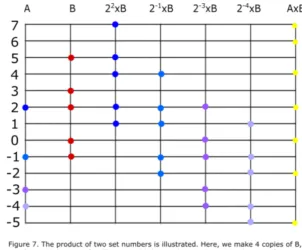
AB = {a1+b1,a1+b2, . . . ,a1+bm} ⊕ {a2+b1,a2+b2, . . . ,a2+bm} ⊕ · · · ⊕ {an+b1,an+b2, . . . ,an+bm}. Figure 7 illustrates that the product formula is also valid for negative integers.
7.png
The reader can proveF(a·b) =Fa Fb. which will be useful in proving commutativity and associativity of product. Commutativity can be rewritten as
M
a∈A
{a+b}b∈B = {a1+b1, . . . ,an+b1} ⊕ {a1+b2, . . . ,an+b2} ⊕ · · · ⊕ {a1+bm, . . . ,an+bm}
= {a1+b1, . . . ,a1+bm} ⊕ {a2+b1, . . . ,a2+bm} ⊕ · · · ⊕ {an+b1, . . . ,an+bm}
= M
b∈B
Direct proofs (in terms of sets) of the set sum are difficult, but direct proofs of the product for set numbers seems to be almost impossible. For instance, in proving commutativity, we have to prove that the set number sum ofnsets (each with cardinal numberm), is equal to a set number sum ofm sets (each with cardinal numbern). Again, the only easy way out of this is to use the isomorphismF. 2.4. Subtraction
We wish to give forms of inverse operating elements, namely we wish to provide well defined algorithms for finding the difference between two objectA Band their quotientA⊗Bin such a way that the corresponding operation in real numbers is equal. In this section we will concentrate on finding an algorithm (and, ultimately, a well defined formula) for subtraction.
Before defining the general case, let us begin with two set numbers subject to the relationA⊂B. Then the subtraction is defined byB A=B−A, whereB−Ais the usual set difference. So that if we put the two columns side by side, the resultB−Ais obtained by taking away the particles in the column ofBthat also appear inA. For example, 45={0, 2, 3, 5}and 9={0, 3}is a subset of 45, so that we can easily find 45−9={0, 2, 3, 5} − {0, 3}={2, 5}=36.
Next step to generality is to consider two set numbersA<Bsuch that maxA<maxBin the strict sense. We must use our basic rule of addition, now in reverse order, so that we can take away particles from any level of the columnB. We have described our basic rule as{x+1}={x}+{x}, for everyk=1, 2, 3, . . . . It can be rewritten as{x}={x−1} ⊕ {x−1}. Applying the same rule to {x−1}, we obtain{x}={x−1} ⊕({x−2} ⊕ {x−2}). Continuing in this manner, the result is
{x}={x−1} ⊕ {x−2} ⊕ · · · ⊕ {1} ⊕ {0} ⊕ {0}
Therefore,
X = (X− {k})⊕ {k} (1)
= (X− {k})⊕({k−1} ⊕ {k−2} ⊕ · · · ⊕ {1} ⊕ {0} ⊕ {0}).
for any set numberXand anyk∈ X. Now, we wish to find a set numberXsuch thatA⊕X=B, and to do this we rewrite B:
X = B A (2)
= [(B− {N})⊕({N−1} ⊕ {N−2} ⊕ · · · ⊕ {1} ⊕ {0} ⊕ {0})] A
whereN=maxB. We know A⊆ {x}Nx=−10 ={0, 1, 2, . . . ,N−1}. Thus,
B A= (B− {N})⊕ {n1,n2,· · ·,nk} ⊕ {0},
where{n1,n2, . . . ,nk}={0, 1, 2, . . . ,N−1} −A. Finally,
B A = (B− {N})⊕C⊕ {0}, whereC(N,A) ={ni}ik=1={0, 1, 2, . . . ,N−1} −A.
To findA BwithB=42={1, 3, 5}andA=21={0, 2, 4}.
B A = ({1, 3, 5} − {5})⊕({0, 1, 2, 3, 4} −A)⊕ {0}
= {1, 3} ⊕ {1, 3} ⊕ {0}
= {0, 2, 4}.
8.png
Figures 9 and 10 are also examples of subtraction.
9.png
10.png
LetA<Btwo set numbers, and letN0=max(A4B)∈B. We observeB A=B0 A0where A0 = A∩ {0, 1, . . . ,N0}andB0 = B∩ {0, 1, . . . ,N0}. The subtractionB Ais treated as in the last paragraph, maxA0< N0=maxB0. This defines subtraction in the most general case (Figures 11-13).
12.png
13.png
3. Continuum
We extend the family of set numbers to include sets that represent reciprocals of natural numbers. The unit interval continuum [0, 1] is the power set 2−N. First, we prove that every subset of 2−N has supremum and infimum. In particular sup(2−N) = −N < {0}, and{0}is the smallest set number larger than −N. We define {0} = −N without fear of contradiction. This translates to
∑i∈N2
−i =20 =1. In general,∑
i<n2i =2n, or equivalently,{n}= {i}i<n, for any integern. This means a bounded (above and below) subset ofZhas two representations. The inverse ofN⊂Nis
1
N ⊂ −Nsuch that N1 N=−N={0}. After describing the unit interval, we prove ¯Z∼= R+. The closed sets of the topology ¯ZareA⊂Zthat are bounded above. The integer part ofA∈R+is given byA∩Nwhile its fractional part isA∩ −N.
3.1.[0, 1]∼=2−N
Supremum and Infimum.We define a limiting process that defines a supremum function in the continuum[0, 1]. The order is defined as before, two sets relateA<Bif and only if max(A4B)∈ B. The only change is thatA,Bare arbitrary subsets of−N, instead of finite sets ofN. We must prove that the supremum of any family of subsets of−Nexists.
First, we give the intuitive idea for the more general case of finding the supremum of a bounded above setX, of positive real numbersAi⊂Z. The family of setsXis bounded above in the order of set numbers and every set number is also bounded above in the order of integers. Thereforex1=maxSX exists. The supremum ofXis among the setsAjthat contain the integerx1. We look to see which of those set numbers contains the second largest integer appearing in the family. Letx2 =maxSjAj where the indexjinclude only the elements ofXsuch thatx1∈ Aj. Now we know the supremum is among the sets that contain bothx1andx2. This procedure continues for denumerable steps and generates a denumerable set of integersx1>x2>x3>· · ·. The set of these integers is supX.
knowx1:=maxSXexists. Define the sub familyY1:={A∈X|x1∈ A}, of set numbers containing x1, and X1 := (SY1)− {x1}, then x2 := maxX1 < x1. Now makeY2 := {A ∈ Y1|x2 ∈ A}, and X2:= (SY2)− {x1,x2}, andx3:=maxX2. Continue in this manner, so thatxn+1:=maxXn, where
Xn := SYn− {xi}ni=1andYn := {A ∈ Yn−1|xn ∈ A}. The supremum is defined as supX = {xi}i, which is by construction greater than every set inX, and it is the least subset ofZthat is greater than all the sets ofX. In a countable number of steps we have determined a unique set number (Figure 14).
14.png
22−Nrepresents the power set, of the power set of−
N. The supremum function is a function of the form sup : 22−N →2−N. If sup(X) ∈ X, we say sup(X) =max(X). In particular, this is true if
Xis finite. There is also an infimum function of the form inf : 22−N →2−N, where the image of the family is its greatest lower bound. Given a familyX⊆2−N, defineX∗as the family of set numbers that are smaller than all the elements ofX. In other words a set number A ⊆ −Nis inX∗ if and only ifA<Y, for allY∈ X. Define inf(X) =sup(X∗). IfX∗ = ∅, then∅ ∈X, and inf(X) =∅. In particular, inf[0, 1] =0. To calculate the infimum, look for the largest integerx1such thatx1< A, for allA∈ X. If there is no such integer (the elements ofXare arbitrarily small) define inf(X) = ∅. If x1exists and{x1} ∈X, then inf(X) ={x1}. Ifx1exists and{x1}∈/X, then we compare{x1,x1−1} with the elements ofX. If{x1,x1−1} ∈X, then inf(X) ={x1,x1−1}. If{x1,x1−1}< Afor every A∈ X, thenx2 := x1−1∈ inf(X). The last possible case is{x1,x1−1} > Afor some A ∈ X, so that x1−1 /∈ inf(X), and we would then have to verify if x1−2 ∈ inf(X). This process ends in denumerable steps, with a set inf(X) ={xi}i⊆ −N.
Reciprocals.If we want to multiplyA⊂NbyB⊆ −N, we use distributivity. Define the product as a natural generalization of the last definition of product. The index of the operation is now a subset of −N. Refer to Figure 7. The unit of product,{0}, is bounded and therefore has a second representation, −N. This is the representation used in providing a well-defined algorithm for finding the reciprocal of a natural number. We illustrate our motivation with an example. To find the inverse (under set product) of the set number 137={0, 3, 7}. We seek out a set number N1 ={x1,x2, . . .} ⊂ −Nsuch that
−N = {x1+0,x2+0, . . .} ⊕ {x1+3,x2+3, . . .} ⊕ {x1+7,x2+7, . . .}. If we proposeN1 ={−7}we find we"go over"because:
{0, 3, 7} {−7} = {−7+0} ⊕ {−7+3} ⊕ {−7+7} = {−7,−4, 0}
Now we try N1 ={−8}and we see that we do not go over:
{0, 3, 7} {−8} = {−8+0} ⊕ {−8+3} ⊕ {−8+7}
= {−8,−5,−1} < −N.
Naturally, proceed to approximate N1 ={−8,−9}and find
{0, 3, 7} {−8,−9} = {−8+0,−9+0} ⊕ {−8+3,−9+3} ⊕ {−8+7,−9+7}
= {−1,−2,−5,−6,−8,−9} < −N
The reader can easily verify{0, 3, 7} {−8,−9,−10}={−1,−2,−3,−5,−6,−7,−8,−9,−10}. It is equally easy to prove{0, 3, 7} {−8,−9,−10,−11}>−N. Continue and verify Figure 15
{0, 3, 7} {−8,−9,−10,−12} = {−8+0,−9+0,−10+0,−12+0} ⊕ {−8+3,−9+3,−10+3,−12+3}
⊕{−8+7,−9+7,−10+7,−12+7}
= {−1,−2,−3,−4,−5,−10,−12} < −N.
15.png
Let us describe the procedure for finding the reciprocal of a set numberN={x1,x2, . . . ,xn} ⊂N,
with x1 > x2 > · · · > xn. We wish to find a set number N1 ⊂ −Nsuch thatN N1 = −N. The
reciprocal N1 = {y1,y2, . . .} ⊂ −Nwill be found in denumerable steps, as follows. First, make y1=−(x1+1)so that
Next find the largest negative integery2such that
{−1,x2−(x1+1), . . . ,xn−(x1+1)} ⊕ {x1+y2,x2+y2, . . . ,xn+y2}<−N.
We know there is at least one negative integer that satisifes this inequality. By the well ordering principle, we can find the maximum of such a set of solutions. This maximum is our integery2. The finitude of #(N)plays a fundamental role in allowing us to guarantee suchy2exists. Now, to findy3, we look for the largest negative integer such that
({−1,x2−(x1+1), . . . ,xn−(x1+1)} ⊕ {x1+y2,x2+y2, . . . ,xn+y2})⊕ {x1+y3,x2+y3, . . . ,xn+y3}<−N. If we continue in this manner we have well defined N1.
3.2.R+ ∼=Z¯
Topology of Bounded Subsets ofZ. A positive real number is a subset ofZ, bounded above. The intersection with the negative integers represents the fractional part, and the finite intersection with the positive integers represents the integer part. We use the continuum[0, 1], built in the last section, to produce a series of copies, squeezed in between consecutive natural numbers. We do not need to make any modifications to the basic rules and relations of order and operation already used. We extend the same relations to the closed sets of the topology ¯Z. For example, given a binary representation 110101.001011, the set number is{5, 4, 2, 0,−3,−5}. We have a natural bijection between binary sequences and closed sets of ¯Z. The bijection isA7→∑i∈A2ifor every closed setAof ¯Z.
The positive real line is constructed by piecing together copies of[0, 1]. Let A ⊂ −Nbe the corresponding set number to x ∈ [0, 1), so that x = ∑i∈A2i. Then A∪ {0} is the set number corresponding to 1+x =20+∑i∈A2i. More generally, letN⊂Nbe the set number corresponding to a natural numbern∈N; this meansn=∑i∈N2i. Now we haven+x=∑i∈N2i+∑i∈A2i =∑i∈(A∪N)2i.
We can summarize our work as follows:
i. N∼=Co f(N)where the cofinite topology uses the order and operations of set numbers. ii. [0, 1]∼=2−N, with∅=0 and−N=1, and the same definitions for set order and operations. iii. The continuum of non-negative real numbers is built as a natural generalization of bothCo f(N)
and 2−N. We piece together[0, 1],[1, 2],[2, 3], . . . , into a single continuum[0,∞). This is done by considering the upper bounded sets ofZand a proper extension of the set number relations.
We generalize the previous methods into a single structure isomorphic toR+. The main difference between our construction of the real numbers is that we do not build a complex space which we will have great difficulty in understanding. Our approach here is to prove the simplest set with cardinality of the continuum can be given the structure of positive real numbers, in a natural manner. In fact, gives reason to speculate we give a canonical construction of real numbers as sets.
Supremum. In the previous section we provided a well defined algorithm for finding the supremum of a familyX ⊆ [0, 1], where the elements ofXare arbitrary subsets of−N. Now, we generalize this process to define the supremum of a bounded set of positive real numbers.
Observe maxXexists if and only ifXis a bounded family, of bounded above subsets ofZ. That is to say, sup(X)exists if and only if there existsn∈Zsuch that for allA∈Xit is trueA<{n}. Notice it is not the same as saying"X is a set of bounded above subsets ofZ"; this would be written as"...for all A∈X there exists n∈Zsuch that A<{n}". We need to guarantee the existence of maxSXin order to find the supremum ofX. This is done by asking thatXbe a bounded above subset of ¯Z(each of the elements of the setXare bounded above subsets ofZ). For example, there is no maxSXfor
Let us find the supremum of a finite list of set numbers, obviously the result should be the maximum of the list. These are A = {4, 2, 1,−1,−3,−5,−7, . . .}, B = {4, 3,−1,−3,−5,−7, . . .}, C = {4, 2, 1, 0,−2,−4,−6, . . .},D= {4, 3, 0,−2,−4,−6, . . .},E = {4, 3, 0,−1,−2,−4,−6, . . .}. We wish to find sup(X), whereX ={A,B,C,D,E}. First we find the maximum ofS
X; the maximum integer that appears in our set numbers isx1=4. Then, we define the setY1⊆Xof those set numbers that have 4 as an element. In this caseA,B,C,D,Eall have 4 as element so thatY1=X. Now we find the maximum of(S
Y1)− {x1}; the second largest number that appears in the familyY1isx2 =3. NowY2={B,D,E}because these are the only set numbers ofY1that containx2=3. The maximum of(S
Y2)− {x1,x2}is the third largest number that appears in the familyY2. It isx3=0, and the only elements ofY2that contain 0 areD,Eso thatY3={D,E}. We findx4=max((SY3)− {4, 3, 0}) =−1 and−1 is not an element ofDbut it is an element ofE, thenY4= {E}. We findx5= −2,x6=−4, x7=−6,. . . . We conclude sup(X) =max(X) =E.
Division.We now describe division and rational numbers. Let us find the rational representation of the set number{5, 0,−2,−4,−5}=33.34375. Add 5 to the elements; the result is{10, 5, 3, 1, 0}= 1067. The action of adding 5 to the elements of a set number is actually multiplication by 25, so that {5, 0,−2,−4,−5}= 106732 . This fraction is said to be irreducible because 32={5}is the smallest natural number that we can multiply with{5, 0,−2,−4,−5}and obtain a subset ofN, which is the numerator 1067={10, 5, 3, 1, 0}. Given a finite subset of integers, we give an infinite collection of ordered pairs of natural numbers, which will be calledfractions. In other words, given a finite set numberA⊂Z, we can give infinite, but equivalent, representations of a single irreducible fraction mn. The set numbers N,M, corresponding ton,mare easy to find;N⊂Nis the smallest set number such thatNA⊂N. Then,Mis the result ofNA. More generally, any set numberB⊂Nsuch thatBA⊂N, allows the construction of a fractionα
β, whereα=∑i∈(AB)2
iandβ=∑ i∈B2i.
Consider the inverse problem of finding the set number corresponding to an ordered pair mn. We use our algorithm for finding the inverse, 1/N, and multiply that withM. We will approximate
51
137, by multiplying 1371 ≈ {−8,−9,−10,−12}with 51 = {5, 4, 1, 0}, to obtain 0.361083984375 = {−2,−4,−5,−6,−10,−11,−12}. For more precision, we must give a better approximation to the number 1371 ; for example 1371 ≈ {−8,−9,−10,−12,−13,−14,−17}.
Now, we know how to provide an irreducible fraction, given a set number. We can also approximate the set number corresponding to any given fraction of natural numbers. Now let us make our first consideration as far as infinite subsets of Z are concerned. Let A ⊂ Z be a set number with A∩ −N infinite. Then we are unable to give a set number B ⊂ N such that AB ⊂ N, with one crucial exception. If the set A∩ −N is infinite and periodic, then we can find a finite setB⊂Nsuch thatAB⊂N. In other words, infinite but periodic set numbers have rational representation as an ordered pair of natural numbers. Any set number that can be identified with two natural numbers, as just described, is called arational number. Approximate 13751 by two methods. First, finding 1/51 and multiplying that by{7, 2, 0}. Secondly, approximatingBsuch that {−2,−4,−5,−6,−10,−11,−12} B=−N. The set number associated with the form ab = a·1
b has inverse, under product, ba =b·1
a.
Sum and Product of Infinite Sets.We must define the set number sum of two infinite subsets of Z. Let them beA, the set of integersa1>a2>a3>· · ·, andBthe set of integersb1>b2>b3>· · ·. DefineAn ={ai}ni=1, and in a similar mannerBm. The sum is defined asA⊕B:=supn,m(An⊕Bm) for alln,m∈N. The reader can define the multiplication of two infinite set numbers.
Then we findA{0,1} = AA{0,1} {0} = AA{1} = A(AA{1} {0}) = A(AA). Finally, A{2}=A(A(AA)), as we expect since{2}=4.
127·127 = {0, 1, 2, 3, 4, 5, 6} {0, 1, 2, 3, 4, 5, 6}
= M
a∈127
{a+b}b∈127
= {0, 1, 2, 3, 4, 5, 6} ⊕ {1, 2, 3, 4, 5, 6, 7} ⊕ {2, 3, 4, 5, 6, 7, 8} ⊕ {3, 4, 5, 6, 7, 8, 9} ⊕{4, 5, 6, 7, 8, 9, 10} ⊕ {5, 6, 7, 8, 9, 10, 11} ⊕ {6, 7, 8, 9, 10, 11, 12}
= {0, 8, 9, 10, 11, 12, 13}
Now we take{0, 8, 9, 10, 11, 12, 13}as base and use{0, 1, 2, 3, 4, 5, 6}as pivot so that
1273 = {0, 1, 2, 3, 4, 5, 6} {0, 8, 9, 10, 11, 12, 13}
= M
a∈127
{a+b}b∈16,129
= {0, 1, 2, 3, 4, 5, 6, 8, 14, 16, 17, 18, 19, 20}
The reader can verify the final result, carrying out the following addition of set numbers.
1274 = {0, 1, 2, 3, 4, 5, 6} {0, 1, 2, 3, 4, 5, 6, 8, 14, 16, 17, 18, 19, 20}
= M
a∈127
{a+b}b∈1273
If the set numberA⊂Zhas infinite elementsa1>a2>a3>· · ·, we define the powerAB=sup m
ABm, whereAn ={ai}ni=1. For now, taking negative powers is only notation for symbolizing the reciprocal of another number, so we have nothing to do in that respect becauseA−3is simply 1/A3=1/A{0,1}. When we define negative real numbers, this will make sense as we will extend our definition. When taking powers, we notice two different behavior: 1) ifA<{0}=1 thenAXis a decreasing function 2) ifA>{0}=1 thenAXis an increasing function. ProvingAXis decreasing (or increasing, depending on the case) is not difficult but requires some labor. Before proving it for arbitrary set numbersX, it has to be proven forX⊂Nand 1/X.
Roots.The process of finding a root is to take a reciprocal power, that is to sayAB1, for some finite setB⊂N. To findX= A1B we must find a setX⊂Zsuch thatXB =A. Consider the setP(A,B)of all set numbersXsuch thatXB< A, then this set is bounded above. We defineAB1 =supP. Notice we have three cases: 1)A>{0}, 2)A={0}, 3)A<{0}. In the first case,AB1 <A, while in the last caseAB1 >A. Of course, ifA={0}, any power ofAis equal toA, so that{0}B1 ={0}, regardless ofB. We illustrate this with an example to find 31/4={0, 1}1/{2}. If we elevate{0,−1}to the fourth power, the result is greater than 3= {0, 1}. But, we find that{0,−2}4 < {0, 1}. In the next step we find {0,−2,−3}>{0, 1}. Later we find{0,−2,−4}<{0, 1}. We continue in this manner, with trial and error to elevate sets to fourth power all the time using larger numbers but making sure the result does not go over 3. If we are to take a rational powerAB, in the sense thatBis a periodic set as mentioned above, we find its irreducible fractionB= mn. Now we can sayAB= (Am)1n is well defined, since it can be proven(Am)1n = (An1)m. Consider next the more general case whereBis not rational. Consider
A,B⊂Zto be arbitrary set numbers, and the elements ofBareb1 >b2> b3· · ·. LetBk ={bi}ki=1, then to everyBkthere corresponds an irreducible fractionQk = mnkk. We define A
B = sup k
AQk. Of course, for this definition to be justified, we have to prove the set{AQk}∞
Logarithms.In the last section, we only extended the definition of powers. Now, we explore the inverse function. To find logBAwe find a set numberXsuch thatBX= A. It is not difficult to show we have two defining cases for the logarithm. ConsiderB>{0}=1, andA>{0}. ThenX>0 because there is a positive real numberXsuch thatBX =A. IfA<{0}, thenXis negative, because the negative powers ofBmap to numbers<{0}=1. For the caseB<{0}we have the contrary arrangement; if A>{0}thenX<0, and ifA< {0}thenX>0. Let us calculatelog2.53.125 which is thelogarithm base2.5of3.125; the numerical value is≈1.24353. We knowB={−1, 1}andA={−3, 0, 1}. We wish to find a set numberX= mn such that(Bn)m1 = A. We begin by calculating 2.52, to see if we go over 3.125 or not. Multiplying{−1, 1}by itself is equal to the set sum{−2, 0} ⊕ {0, 2}which is{−2, 1, 2}. Since the result is a set number larger than{−3, 0, 1}, we next tryYsmaller than{1}and bigger than {0} because 2.5{0} =2.5. We try with{0,−1}= 32, so that first we find the third power of 2.5.
2.53 = 2.52·2.5
= {−2, 1, 2} {−1, 1} = {−3,−1, 0, 1, 2, 3}.
Next we find the square root of {−3,−1, 0, 1, 2, 3}. It is not difficult to see {−1, 0, 1} ⊂ {−3,−1, 0, 1, 2, 3}12, so that 2.532 > {−3, 0, 1}. Our next candidate for Y is {0,−2,} = 5
4. The fifth power of 2.5 is equal to{−1, 1}5 = {−5,−3−1, 0, 5, 6}. Searching the fourth root of this last set number gives {−6,−3, 0, 1} ⊂ {−5,−3−1, 0, 5, 6}14. Our next approximation for Y is
{−3, 0} = 98. We find{−1, 1}{−3,0} < {−3, 0, 1}. Then we find{−1, 1}{−4,−3,0} < {−3, 0, 1}and {−1, 1}{−5,−4,−3,0} <{−3, 0, 1}so that we approximate log
2.53.125≈1.21875. Taking another step gives log2.53.125≈ {−6,−5,−4,−3, 0}=1.234375.
Properties of Operation.The axiomatic properties of the field of real numbers hold, taking into account that we have not yet described negative real numbers. The unit for set sum is∅, while the unit for product is{0}. Commutativity of set number addition is trivial because of the commutative properties of4and∩. It is not easy to give a direct proof of associativity for set number addition. We first have to show{n} ⊕(A⊕ {m}) = ({n} ⊕A)⊕ {m}, for any singletons{n},{m} ⊂ Z. Let N={x1,x2, . . . ,xn},M={y,12, . . . ,ym}andA={a1,a2, . . . ,ap}three finite subsets ofZ. The sum of these can be written
N⊕(A⊕M) = ({x1} ⊕ {x2} · · · {xn})⊕[A⊕({y1} ⊕ {y2} · · · {ym})]
= {x1} ⊕({x2} ⊕ · · · ⊕({xn} ⊕(((A⊕ {y1})⊕ {y2})⊕ · · · ⊕ {ym})))
From this it is possible to proveN⊕(A⊕M) = (N⊕A)⊕M. The commutativity and associativity of product is much more difficult to prove, and is left for future work. The same can be said of distributivity; the proof does not seem to be trivial. It is easy, however, to prove that 2ncommutes with any set numberX, under product. In virtue of this, if we prove distributivity then we have proven commutativity of product for two finite set numbers.
4. Construction ofR
space of functions; the positive real numbers are functions+xso that+x(a) =a+x. The negative real numbers are their inverse functions.
Unit Interval.In our first method, we fit the entire real number line into the unit interval. We give an explicit bijection 2−N∼= [0, 1]→Rsuch that the corresponding set numbers can be operated. Graphically, we will associate−∞to the set number∅ = 0, and+∞will be associated to the set number−N={0}=1. The real number 0∈Rcorresponds to the set number{−1}= 12.
16.png
The real numbers inI1= [0, 1)⊂Rare set numbers of the form{−1,x1,x2,x3, . . .}, withxi ≤ −3. Next, we make the numbers in the intervalI2= [1, 2)⊂Rbijective with the collection of set numbers of the form{−1,−2,x1,x2,x3, . . .}, withxi≤ −4. The intervalI3= [2, 3)⊂Ris bijective to the collection of set numbers{−1,−2,−3,x1,x2,x3, . . .}, withxi≤ −5. The negative interval−I1= [−1, 0)⊂Ris bijective with the collection of set numbers of the form{−2,x1,x2,x3, . . .}withxi≤ −3. In specific, the real number−1∈Ris identified with 14 ={−2}. Also,−1∈ Rcorresponds to the set number {−2}, and−1
2 ∈Ris the set number{−2,−3}.
To summarize, there are two types of set numbers: 1) If−1 ∈ Xthen we sayXis a positive set number 2) If−1 /∈ X thenX is a negative set number. Positive set numbers are of the form {−1,−2,−3, . . . ,−n,ai}with−2≥ −n−1> a1>a2> a3 >· · ·, while negative numbers are sets of the form{−n,a1,a2,a3, . . .}with−1>−n> a1> a2> a3 >· · ·. LetX∈ Z¯ a set number with {a1,a2,a3, . . .}=X∩ −Nand a finite set of natural numbersN= X∩N. Definen= ∑i∈N2i, then
X0={−1,−2,−3, . . . ,−n,a1−(n+1),a2−(n+1),a3−(n+1), . . .}is the new representation of the set numberX. The set numberXcan also be identified with another set we will call the negative of X0, and it is−X0={−(n+1),a1−(n+1),a2−(n+1),a3−(n+1), . . .}. To give another example, consider the numberX=7.28125={−5,−2, 0, 1, 2}. Its new representation is
X0={−1,−2,−3,−4,−5,−6,−7,−8,−2−(8+1),−5−(8+1)}={−1,−2,−3,−4,−5,−6,−7,−8,−11,−14} because the integer part is 7 and thereforen = 8. The negative is−X0 = {−9,−2−9,−5−9} =
{−9,−11,−14}. It is left as an exercise to prove every subset of−Ncorresponds to a unique real number, and vice-versa. We can obviously identify every real number with a unique subset ofN, now that we can identify it with a unique subset of−N. The main idea behind this construction is that we use the firstnnatural numbers of a set number to determine the sign and the integer part.
This construction of real numbers has been given mostly for its role in giving graphic representations of the real numbers. In this paragraph we have proven that there is a way of defining an order relation for 2N, and that this order is isomorphic to the order of the extender real number line R. The operations can be meticulously defined case by case, but we will not unnecessarily extend our discussion. These have a simple interpretation in our graphic representations. The operations of real numbers are developed in our next construction.
functions{+x}is given; the function+x : ¯Z →Rxis the bijection that acts by+x(a) = a+x. Let
R∗ = {+x} ∪ {(+x)−1}the set of functions that consists of the functions+xand their respective
inverse function(+x)−1:Rx→Z, plus the identity function.¯
We will define an operation on the elements ofR∗. Letx,y∈Z, and their functions¯ +x,+y∈R∗, respectively. We define the operation inR∗as the function+x◦+y: ¯Z→Rx+y. We have two classes of functions inR∗, as far as domain and range; the objects we call negative real numbers, as well as the positive real numbers. But, so far we have not defined an operation for all of these objects. Now we must find a suitable definitions for+x◦(+y)−1, and for the sum of two inverse functions inR∗.
First, let us find the sum of two negative elements inR∗. The sum of two positive elements inR∗is the composition, so given two negative real numbers (+x)−1,(+y)−1, it is natural to set (+x)−1◦(+y)−1:= (+x◦+y)−1∈R∗. Ify<x, then we can find the numberx−y>0 and a unique function ¯Z→Rx−yinR∗; this function is defined to be the result of+y−1◦+x= +x◦+y−1. Now, define+y−1◦+x= +x◦+y−1= (+y◦+x−1)−1∈R∗ifx<y. The operation we have defined for R∗is isomorphic to addition of real numbers.
Dual Function Space.The elements ofR∗will be represented with bold letters such asx,y,-x, and y+x= +x◦+y. We can build an isomorphism+:R∗→R∗∗, whereR∗∗is a collection of bijections of the formR∗ →R∗. Specifically, the elements ofR∗∗are the bijections+(x):R∗ →R∗such that y7→+(x)y+x. Our real numbers, the elements ofR∗, are functions on positive numbers. The spaceR∗∗ is a collection of bijective functions of the formR∗→R∗, and it is isomorphic toR∗under addition. In conclusionR∼=R∗∼=R∗∗, andR∗∗gives a complete description of addition for real numbers.
5. Universe of Finite Sets
Previous expositions of axiomatic set theory forR, begin describing natural numbers in two main forms [7](pp.21-22). These have become to be known as Zermelo ordinals, and Neumann ordinals. The first is the set{∅,{∅},{{∅}},{{{∅}}}, . . .}. That is to say, natural numbers have been characterized as 0 = ∅, 1 = {0}, 2 = {1}, and in generaln+1 := {n}(Zermelo, 1908). The second way, due to von Neumann, isN={∅,{∅},{∅,{∅}},{∅,{∅},{∅,{∅}}}, . . .}and in this case we have that every natural number is the set of all natural numbers smaller than it (the set of its predecessors) sox+1 := x∪ {x}. These constructions assign natural numbers to a certain kind of sets that are obtainable from the empty set. However, in both cases we do not have a surjective function because not all sets obtainable from are assigned a natural number. For example, the sets{∅,{{∅}}}and {∅,{{∅},{{∅}}}}is not a natural number in either ordinal family. Part of the problem in Benacerraf’s identification problem, is that the identifications are not using all of the sets ofU0.
U0is equivalent to the real number system. Going back to our original definition of set numbers, that represent natural numbers, we defined:
0 = ∅
1 = {0}={∅} 2 = {1}={{∅}} 3 = {0, 1}={∅,{∅}} 4 = {2}={{{∅}}} 5 = {0, 2}={∅,{{∅}}} 6 = {1, 2}={{∅},{{∅}}} 7 = {0, 1, 2}={∅,{∅},{{∅}}} 8 = {3}={{∅,{∅}}}
9 = {0, 3}={∅,{∅,{∅}}}.
In the following we give our proposal of definitions and axioms for analysis.
Definition 1. Define a universe of setsU0. 1. ∅∈ U0
2. x1,x2,x3, . . . ,xn∈ U0, then{x1,x2,x3, . . . ,xn} ∈ U0 3. U0is the set of objects that satisfy 1. or 2.
Definition 2. For any∅ 6= x ∈ U0, define x⊕ {∅} = (x4{∅})⊕R, where R= {y⊕ {∅}}y∈(x∩{∅}).
For the empty set, we define∅⊕ {∅}={∅} ⊕∅ ={∅}. For any two A,B ∈ U0we define the operation A⊕B= (A4B)⊕ {y⊕ {∅}}y∈(A∩B). In particular, define A⊕∅=∅⊕A=A.
Let us use the notationU0− {∅}to represent the set that contains all the elements ofU0, except∅.
Axiom 1. Definition 2. Provides a bijection⊕{∅}:U0→(U0− {∅})that defines a recursion. This recursion is a successor function; s(x) =⊕{∅}(x).
Axiom 2. The definition of A⊕B defines the operation of addition for natural numbers. We can always find the set A⊕B in finite steps, and this operation is isomorphic to the usual addition of natural numbers.
It is left as an exercise for the reader to proves(x) =x+1 for every 0≤x≤8, and compare the results to the equalities above. We do the first few.
{∅} ⊕ {∅} = ({∅}4{∅})⊕ {s(y)}y∈({∅}∩{∅})
= ∅⊕ {s(y)}y∈({∅}∩{∅})
= {s(y)}y∈{∅} = {s(∅)} = {{∅}}
{{∅}} ⊕ {∅} = ({{∅}}4{∅})⊕ {s(y)}y∈({{∅}}∩{∅})
= {∅,{∅}} ⊕ {s(y)}y∈∅
= {∅,{∅}} ⊕∅ = {∅,{∅}}
Our next example is 3+1=4
{∅,{∅}} ⊕ {∅} = ({∅,{∅}}4{∅})⊕ {s(y)}y∈({∅,{∅}}∩{∅})
= {{∅}} ⊕ {s(y)}y∈{∅}
= {{∅}} ⊕ {s(∅)}
= {{∅}} ⊕ {{∅}}
= ({{∅}}4{{∅}})⊕ {s(y)}y∈{{∅}}
= ∅⊕ {s(y)}y∈{{∅}} = {s({∅})}
= {{{∅}}}.
Lastly, we show 4+1=5
{{{∅}}} ⊕ {∅} = ({{{∅}}}4{∅})⊕ {s(y)}y∈({{{∅}}}∩{∅})
= {∅,{{∅}}} ⊕ {s(y)}y∈∅
= {∅,{{∅}}} ⊕∅
= {∅,{{∅}}}.
Now that we have defined the natural numbers, we can construct the integers. We do this using the method we used in defining negative real numbers. That means, every elementx∈ U0is associated with a bijective function+x:U0→ U0x, whereU0xis the set of elements ofU0that are greater thanx. In particular,∅is the identity function, and{∅}is associated to the successor function⊕{∅}. Ifxis associated a function+x, thens(x)is associated the function+x◦ ⊕{∅}. We have inductively defined the functions as compositions. With this we can build a relation order isomorphic to the integers. The objects of this order are the functions just defined (the powers of composition for the successor function) and their respective inverse functions. The order of these objects is defined naturally, and now we consider subsets of this space of ordered functions to be positive real numbers. Of course, we can already have said that the extended real number line is the set of all subsets ofU0, if we consider the first construction we gave of real numbers.
Theorem 1. The set of real numbers isU1 = 2U0, the power set ofU0. The suitable functions of addition, product and order exist and are well defined in this universe. The system of real numbers is an extension to infinity, of the natural numbers.
In a sense, we have answered a more general question than Benacerraf’s identification problem, since we have provided a canonical set theory for natural numbers, which can be naturally extended to obtain a canonical identification of 2U0 with the continuum[0, 1], and later with the extended real number line. Our axioms are stating that every set inU0− {∅}is successor of a set inU0, and that every set inU0has a successor inU0− {∅}. Furthermore, there is a general procedure for finding the successor of any set inU0; the successor of x is(x4{∅})⊕ {y⊕ {∅}}y∈(x∩{∅}). Our axioms
assure us every set inU0is of the form(⊕{∅} ◦ ⊕{∅} ◦ · · · ◦ ⊕{∅})(∅), and that every composition
continuum[0, 1]of the unit interval. Therefore we have an identification of[0, 1]with 2U0. Since we can again identify each number of the unit interval (refer back to the first construction of the real number line) with the extended real number line, we conclude there is a natural identification of the extended real number line with the set 2U0.
6. Graphic Representations
We can carry out our constructions into a series of real-world representations. That is to say, we can give simple rules for manipulating physical systems, and these model numerical systems.
Collections of Arrows.In developing General Theory of Systems, we have to classify a system by its objects and its relations. In category theory, we focus on one special type of relations: binary relations. Of course, binary relations are really collections of arrows. Every number 0≤a≤31 is the collection of arrows{x→a}, for all 0≤x <a. For example, 23={0→23, 1→23, 2→23, 4→23}. This means we give an isomorphism that sendsa∈Nto the set of arrows{x→a}, for allxelement of the set numbera. For example, 6 is represented by the collection of arrows{1→6, 2→6}and 13 is the collection of arrows{0→13, 2→13, 3→13}(Figure 17).
17.png
18.png
Let us transform the real number line into a circumference. The integers correspond to the discrete points (in red) of Figure 19. These have been determined by successive bisections of the circumference. Given an arbitrary point (blue) on the continuum of the circumference, we have a unique numberx∈R. At the same time,|x|is a set of integers. Every real number is identified with a subset of the red points. We draw arrows from the red points, corresponding to the elements of |x|, into the blue point that corresponds tox. Following the same procedure as in Figure 18, we can represent multiple (approximations) of real numbers, in a single diagram.
19.png
20.png
Rings. A ring, R, is a circumference passing through denumerable number of rings Ri; the center point of every Ri is a point on R; a central circumference passing through the center of a denumerable set of circumferences of degree 1. The central circumference is said to have degree 0. The circumferencesRi are rings themselves; eachRi is a circumference passing through the center of a denumerable setRji
i of circumferences of degree 2, and so on. A natural numbern, with set numberN, is represented by an equivalence class of rings. To build the canonical ring corresponding to a natural number, we draw anRi, for each element of the set numberN ={a1,a2,a3, . . .}. That is to say, the central ring is a circumference going through #(N)circumferences; each of these a ringRi. Then,Riis a circumference going through the center of #(ai)circumferences. We apply this recursively, until we
bottom out. The equivalence relation is defined analagous to trees. If we have a ring with two identical rings, we substitute these both with a single ring; the successor ring of the repeated ring. The successor ofRis found by adding a single 0-ring to the central circumference ofR, and reducing.
21.png
Consider the ring of the number 27={4,3,1,0}. ThenRis a circumference passing through the center of 4 circumferencesR1,R2,R3,R4; each one representing a number of the set{4, 3, 1, 0}.
22.png
23.png
7. Conclusions
Even though these methods and definitions are elementary, and the presentation may seem trivial and in plain sight, these constructions and proofs are not apparent. The real number system has been revisited on many occasions but has never had simple solution. The initial purpose was to find a system theoretic treatment of numbers, as opposed to the set theoretic foundations of the classical axiomatic systems. It was our aim to propose new models of the relations of numerical systems, and finding their true representation in the universe of sets. This work comes after an initial attempt was made in [8]. Our construction of real numbers has provided 1) New algorithms for calculating operations of real numbers 2) Graphic representations of real numbers. We can associate numbers to certain classes of physical models. 3) We have provided a canonical set theory for arithmetic of natural numbers, and for analysis; one set being the power set of the other. We have answered Benacerraf’s identification problem [9], by giving these canonical set representations of numbers, thus proving there is an intrinsic connection between the universe of sets and arithmetic. An extended version of these results and methods is under work. Several topics are treated in the same spirit. The topics include a calculus defined in terms of the order ofN. A number of applications are also being prepared. A computing device that operates using radio frequency signals emitted back and forth between two stations, is tempting. Station A emits two sets of signals to station B, which then emits two signal back to station A. This process continues until the signal stabilizes (we can use this physical process to model addition, using the interpretation of energy levels). Other applications may be explored based on the graphic representations of the last section.
8. References
[1] Norbert A’Campo,A Natural Construction for the Real Numbers.arXiv:math.GN/0301015 v1 (3 Jan 2003).
[2] R.D. Arthan,The Eudoxus Real Numbers. (preprint, September 2003).
[3] N. Metropolis, Gian-Carlo Rota, And S. Tanny.Significance Arithmetic: The Carrying Algorithm. Journal of Combinatorial Theory (A) 14, 386-421 (1973).
[4] N. G. De Bruijn,Definig Reals Without the Use of Rationals. Koninkl. Nederl. Akademie Van Wetenschappen-Amsterdam. Reprinted from Proceedings, Series A, 79, No. 2 and Indag. Math., 38, No.2 1976.
[5] Arnold Knopfmacher and John Knopfmacher, Two Concrete New Constructions of the Real Numbers.Rocky Mountain Journal of Mathematics Volume 18, Number 4, Fall 1988.
[6] Konrad Knopp.Theory and Application of Infinite Series.Dover, New York (1990). [7] Paul Bernays.Axiomatic Set Theory.Dover, New York (1991).