Accountability in Security Protocols
(preprint)
Robert K¨unnemann1, Deepak Garg2, and Michael Backes3 1
CISPA, Saarland University 2
MPI-SWS 3 CISPA
Saarland Informatics Campus
Abstract. A new paradigm in secure protocol design is to hold parties accountable for misbehaviour instead of postulating that they are trust-worthy. Recent approaches in defining this property, called accountabil-ity, have highlighted the difficulty of characterising malicious behaviour. So far, no satisfactory solution has been found. Consequently, existing definitions are either not truly protocol agnostic or require complete monitoring of all parties.
To our knowledge, this work is the first to formalize misbehavior in the following sense: a deviation from the behaviour prescribed by the pro-tocol that caused a security violation. We propose a definition for the case where it is known which parties deviated in which respect, and ex-tend this definition to the case where neither these deviations are known, nor the complete trace of the protocol. We point out that, under real-istic assumptions, it is impossible to determine all misbehaving parties, however, we show that completeness can be relaxed to exclude spurious causal dependencies. We demonstrate the use of our definition with two case studies, a delegation protocol with a central trusted authority, and an actual accountability protocol from the literature. In both cases, we discover accountability violations and apply our definition to the fixed protocols.
1
Introduction
Trust in other parties is the foundation of all security protocols. In scenarios like electronic voting, certified e-mail, online transactions, or processing of personal data, however, the agents involved cannot be trusted to behave according to the protocol. Nevertheless, if the protocol can detect agents causing security violations, there is an incentive to avoid malicious deviation from the protocol. The ability of a protocol to provide the necessary information for detection is what we callaccountabilityin this work. While juridical notions of accountability also require intent, foreseeability etc. to actually assign blame, we concentrate on the protocol’s part in this process: assuring that all violations of some security property can be traced back to the agent or agents who caused it.
properties (soundly) approximate misbehaving parties by instead using the no-tion of adishonest party, a party controlled by some arbitrary global adversary. A party may be dishonest from the start, but whether it is misbehaving in the actual case depends on whether this adversary actually decides to do something harmful. Moreover, it may depend on other parties, e.g., when two parties need to collude to break security. Adishonest party may not bemisbehaving, but ob-viously amisbehaving party needs to bedishonest to deviate from the protocol. Despite the conceptual difference between these two notions, analysing dis-honest parties instead of misbehaving parties has shown sufficient for many secu-rity properties. Typically, the aim is to show that the protocol exhibits a certain behaviour (e.g., a secure multi-party computation protocol computes the correct results) if all parties are honest, but also if some parties are dishonest. The prop-erty to be achieved may be weaker in the latter case (e.g., only honest parties compute the correct results), but the guarantees for the honest parties are not weakened by the misclassification of dishonest parties that are not misbehaving. This is different for accountability. Ideally, the protocol should hold all misbe-having parties accountable, but only those parties. The latter, called soundness or fairness, is achieved if the judge never holds an honest party accountable. The former, however, which is called completeness, requires a proper notion of a mis-behaving party, as any dishonest party might just behave according to protocol and thus be unrecognizable.
Hence previous definitions had no means of capturing completeness w.r.t. truly misbehaving parties, and thus had to rely on protocol specific policies specifying completeness; some even going as far as saying that accountability cannot be defined generally, but requires a policy [KTV10]. In Section 2 we go into detail about why such policies are either incomplete or need to be adapted to the protocol’s auditing mechanism to an extent that calls their use as a spec-ification into question.
There have been approaches to capture causation in protocols [GM15,FJW11, DGK+15], some with the aim of identifying misbehaving parties, but they focus on protocol actions as causes. While this is a useful building block for removing causally irrelevant communication from traces, so far the approach was not able to fulfil its promise to capture the completeness aspect of accountability. The underlying problem is that parties effectuating protocol actions that are causally related to a violation may do so without misbehaving, e.g., ifAuses a confused deputyB to attackC, thenBwould be a cause for the attack, but probably not be held accountable. We therefore propose a new approach in whichthe fact that
Following this idea, we specify what constitutes a correct (a sound and com-plete) verdict in the case where these deviations are known a posteriori (Sec-tion 4.2). In practical scenarios, however, these devia(Sec-tions are not known. More-over, we understand accountability as a property of the protocol itself, which manifests itself as a guarantee for every possible combination of deviations. Un-fortunately, a fundamental problem negates a straightforward lifting of correct-ness in the above sense to all possible deviations, which we call theprovocation problem. It occurs whenever two parties may communicate in secret, as any at-tacking party Acan claim to be provoked by a message another party B sent. It would be illusory to assume all communication is visible; even if that is the case in the model, off-band communication can hardly be preempted in reality. Thus, it is always possible forA to shift the blame by claiming causal relations that are not inherent to its epistemic state or the protocol itself.
It is thus not possible to achieve completeness w.r.t. our understanding of what constitutes misbehaviour. However, we can achieve completeness w.r.t. op-timal deviations which assume the absence of some of those spurious relations. In practice, this is what we desire in cases like the above: we want the protocol to point to A only; causal dependencies to other parties like B should be neglected. We present and discuss two notions of optimality and show that accountability w.r.t. either preserves soundness — hence we strictly advance the state of the art. We show that our definition is applicable by analyzing two very different case studies (Section 5): First, a protocol with a centralized trusted account-ability monitor; second, a practical protocol for accountable algorithms from the literature, where accountability is provided from distributed logs and where no party is trusted. For both, we discover that accountability is not achieved. We subsequently repair these protocols and show accountability w.r.t. to the second notion of optimality for both protocols.
2
Related work
Various works from social and political science to computer science, from regu-latory frameworks to IT-management guidelines, from governance standards to risk assessment procedures provide definitions of what accountability means in their respective contexts. Some definitions point out key elements such as disclo-sure, liability and non-repudiation, others only consider these measures to imple-ment accountability. But while the means by which accountability is achieved in these domains differ, there is wide agreement on the overarching goal, i.e., entities such as organisations or individuals need to give account for actions and thus be rewardable or punishable for them (see, e.g., the survey by Papaniko-laou and Pearson [PP11]). Within the scope of this work, we presume the ability to reward or to punish (in contrast to, e.g., Feigenbaum et al. [FJW11]) and thus regard accountability as the requirement for a protocol to provide sufficient account for such actions.
protocol and its security [ASW98,Kro15,BCS05,BFM13]. There has been work on general definitions, but no definition to date defines completeness, i.e., the property that all parties that deviate in a malicious way are blamed.
Defining completeness. The difficulty lies in distinguishing whether a deviation from the behaviour prescribed by the protocol was harmless, or may have caused a security violation. For many security properties, e.g., secure multi-party com-putation, a misbehaving party is abstracted by giving control to the adversary, equating “dishonest”, or potentially deviating, with “behaving maliciously”. Ex-pressing soundness is oblivious to this approximation, e.g., K¨usters et al. define soundness as follows: whenever the judge gives some verdict, every party men-tioned is dishonest [KTV10]. But the approach falls flat when expressing com-pleteness na¨ıvely: if a party is dishonest, the judge should mention it in the verdict, but the adversary might decide to not deviate after all, or deviate in some way that cannot be recognised. Some approaches still follow this idea, con-sidering any trace that cannot be produced by the honest protocol malicious behavior [HKD07,JJPR09]. For distributed systems, which classically aimed at masking faults, systems like PeerReview [HKD07] candetectfaults in the Byzan-tine setting. Our corruption model is also ByzanByzan-tine, however, we work in an adversarial setting and we do not assume that a complete view of every compo-nent or all the communication is available. Even if all communication is public – which is unrealistic considering possible off-band communication – any account-able protocol would be required to verify the behaviour of every party in full detail, even if this party is not involved in later phases (e.g., registration au-thorities in e-voting protocols) or cannot meaningfully disrupt communication. Consequently, Haeberlen et al. focus on faults in distributed systems [HKD07], where the component’s adherence to specification is a design goal, while Ja-gadeesan et al. admit that in their model “the only auditor capable of providing [completeness] is one which blames all principals who are capable of dishonesty, regardless of whether they acted dishonestly or not” [JJPR09].
Policies for accountability. There is a middle-ground between protocol-specific and fully protocol-agnostic definitions, where accountability is defined w.r.t. a policy. These policies, however, cannot reliably express completeness in a protocol-agnostic way. This is discussed in detail in the long version [Ano17].
In the following, we show that such policies sometimes have to depend on the specific protocol to be useful, hence they are not truly protocol agnostic. K¨usters et al. propose policies of the formα =⇒ p1 | · · · |pn and define completeness
as follows: if a trace matchesα, the verdict should imply somepi. Consider the
– α =⇒ A is too weak, as B’s participation is disregarded in case only B deviates (and unfair towardsA). Same forα =⇒ B.
– α =⇒ A∧B is unfair toAorB in cases only one of them deviates.
– α =⇒ A∨Bpermits uncertainty in the verdict as it would suffice to blame A∨B in case either deviates, but asAandB’s behavior is visible, this policy is unnecessarily weak.
– α =⇒ A|B: In this case, the verdict needs to imply eitherA orB, hence a verdictAwould suffice even if both deviate. The same holds for the policy α =⇒ A|B|A∧B.
Hence the only choice is to splitαinto two formulas,αA andαB, which capture
traces whereA, respectivelyB, misbehaves. Then αA and αB may intersect in
case both deviate and {αA =⇒ A, αB =⇒ B} constitutes a policy that
enforces actual completeness.
But at this point, the policy does not serve as a specification anymore –αA
andαB describe the accountability mechanism itself, not the security property.
For one, this means that the policy is protocol specific, i.e., not applicable to a class of protocols, e.g., all voting protocols, anymore. But most importantly, the policy validates the accountability mechanism with itself, hence the approach begs the problem.
Accountability from causal relations between protocol events The remaining ap-proaches in the literature focus on protocol actions as causes for security vio-lations [GM15,DGK+15,FJW11]. The main issue with the approach is that not all protocol actions that are related to an attack are malicious, e.g, a key-server distributing public keys used in the attack. While protocol actions as causes, i.e., cause traces, may help in filtering out parties that were altogether unin-volved in the attack, they nonetheless refer us back to the original question: What constitutes malicious misbehaviour? For this reason, none of the existing works formalising causality on protocol events arrive at answering this question. Datta et al. propose cause traces as a building block and sketch a procedure for blame assignment, but there the key-server would be blamed unless he fol-lowed the protocol to the letter [DGK+15]. First, this is overly strict, as, e.g., a slight deviation in the format of certificates would lead to the key-server being blamed even if this deviation is not causally related to the violation. Second, in cases where private communication is possible, the precise messages the key-server sent out might be unknown, and thus it would be unclear whether the server needs to be blamed. The same problem affects Feigenbaum et al.’s line of work, where causation on protocol events is used as a black-box. Their work focuses, however, on punishment (possibly protecting the parties’ identities), a question we are currently not treating [FJW11]. G¨ossler et al. focus on traces and assume an explicit dependency relation to recognize faulty components in a system [GM15]. Due to this focus, the case of parties colluding privately is excluded from the start.
had the same causal dependencies. In scenarios where parties can communicate privately, however, this approach reaches its limits.
3
Process calculus
In this section, we introduce a process calculus we use to discuss accountability in security protocols. It draws heavily from the applied-πcalculus [AF01], with the difference that it incorporates the effectuating party of a process within the calculus. We describe a protocol in terms of the overall structure of the process, which determines which parties run in parallel and which parties share secrets, and the normative behaviour, which determines which process each party runs. Any party may choose to run a different process, which we call adeviation. We will first introduce the term algebra and the process calculus (closely following the applied-πcalculus) before we specify how parties might deviate.
Notation Let Nn = {0, .., n}. For two functions f and g, f[g] denotes the
function mapping any x ∈ dom(g) to g(x), and any x ∈ dom(f)\dom(g) to f(x). For l = (e1, . . . , en) and 1 ≤i≤n, we writel|i to refer to ei andl0 ≤l
if l0 is a prefix of l. We denote domain restriction of a function f to a subset S⊆dom(f) asf|S. We filter a sequence lby a setS, denotedl|S, by removing
each element that is not inS, and by a partial functionπ: S * T, denotedl|π, by
computingl|π= (s1, . . . , sn−1)|π·π(sn) or (s1, . . . , sn−1)|π, ifπ(sn) undefined.
Terms and equational theories We model messages by abstract terms. As-sume a countably infinite set of namesX used to model cryptographic keys and nonces, and a countably infinite set of variablesV. Given a signature Σ, i.e., a set of function symbols with an arity each, we writef /n for function symbolf of arityn. Let TermsΣbe the set of terms built overΣ,X, andV, andnames(t),
respectivelyvars(t), denote the set of names, respectively variables, appearing in a term t. The set of ground terms, i.e., terms without variables, is denoted byMΣ. WhenΣis fixed or clear from the context we omit it and simply write
Terms for TermsΣ andMforMΣ.
We equip the term algebra with an equational theoryE, i.e., a finite set of equations of the formm=m0wherem, m0∈Terms. From the equational theory we define the binary relation =E on terms, which is the smallest equivalence
relation containing equations in E that is closed under application of function symbols, bijective renaming of names and substitution of variables by terms of the same sort.
From now on, assume that E refers to some fixed equational theory and that the signature and equational theory always contain symbols and equa-tions for pairing and projection, i.e., Σpairs ··= {h., .i, π1, π2} ⊆ Σ and equa-tions π1(hx, yi) = x and π2(hx, yi) = y are in E . We will sometimes use hx1, x2, . . . , xnias a shortcut forhx1,hx2,h. . . ,hxn−1, xni. . .i. Set membership
modulo E is denoted by ∈E and defined as e ∈E S iff ∃e0 ∈ S. e0 =E e.
A substitution σ is a partial function from variables xi to terms ti written
σ = {t1/
x1, . . . ,
tn/
xn}. We homomorphically extend σ to apply to terms and
use a postfix notation to denote its application, e.g.,tσ appliesσtot.
hP,Qi::= (plain processes) | 0
| νn;P
| in(x);P
| out(m);P
| ifm=m0 thenP elseQ
| eventt;P
hA,Bi::= (extended process) | A|B
| νn;P
| νx;P
| {m/ x} | ·pforp∈ P | P
Fig. 1.Syntax, wheren∈ X,x∈ Vandm, m0∈Terms
Grammar and operational semantics In contrast to the applied-π calcu-lus [AF01], this calcucalcu-lus incorporates the effectuating party of a process. Since processes running in parallel can represent threads or programs running in paral-lel as well as computers in an asynchronous network, this annotation is necessary. Assume a set of partiesP, a subset of which,T ⊂ P, is trusted to never deviate from normative behaviour.
Plain processes (defined by the grammar in Figure 1) usually define the be-haviour of a single party as a combination of message input and out on a public channel, conditionals w.r.t. =E and scope restriction (νn;P) which creates a
fresh namenand then behaves likeP. Furthermore, plain processes are able to emit events, which can be used to model signalling behaviour (see Example 2 below) as well as append-only logs (see Example 11). We will omit else-branches with zero processes for brevity. We exclude parallel composition in plain pro-cesses and any kind of replication for simplicity, as otherwise we would need to track several processes per party. This could be easily achieved, e.g., by drawing fresh names as session identifiers [Bla02]. Extended processes combine extended or plain processes via parallel composition (A|B). Scope restrictions on names can be used to distribute shared secrets. An active substitution {m/
x} acts as
a “floating” substitution operation and can, in combination with scope restric-tion on variables, be used to transmit terms between processes (see below). As usual, names and variables have scopes delimited by restrictions and by inputs. We writefv(A),fn(A) for the set of free variables and names ofA, respectively. Finally, the “hole” operator ·p serves as a placeholder for the normative
Definition 1 (skeleton process). A skeleton processis defined by the gram-mar for extended processes without the last production rule (which includes plain processes) and at most one hole ·p per party p∈ P.
A protocol is now defined in terms of a skeleton process determining how information, i.e., names and terms, are initially shared between parties, and a function that maps every party to a plain process.
Definition 2 (protocol). A protocolπ= (A, n) consists of a skeleton process
Asuch that for everyp∈ P, there is exactly one occurrence of the hole operator
·p in A, and a function n from P to plain processes, such that for all p ∈ P, all fn(n(p)) and fv(n(p)) are bound in the scope of ·p in A. We call n(p) p’s
normative behaviour.
A straightforward approach to achieve accountability is to have a trusted monitor, which executes requests but only accepts signed requests. The next example follows this paradigm. We use it to explain the semantics of our calculus, but will show later that this particular monitor fails to provide accountability.
Example 2 (delegation example, broken). Assume the signatureΣconsisting of Σpairs, Σsig, Σlog = {Log/2,Exec/1} and Σact = {NAct/0,SAct/0,UnAct/0,
isAct/1}, along with the equation isAct(a) =true for aeither NAct, SAct or
UnAct, and the equations in Example 1. Assume four parties, A, B, I and T; among those onlyT ={T}is trusted. The following skeleton process defines the generation ofAand B’s signing keys and the distribution of their public parts:
νskA;νskB;{pk(skA)/pkA,
pk(skB)/
pkB};·A| ·B | ·I | ·T.
The partyA processes two kinds of actions, normal actions and special ac-tions. Normal action are signed and sent toT for execution. Special actions are forwarded toB for authorisation, which signs the request identifierna. Finally,
Asends both signaturesT for processing.
n(A) :=in(a); ifa=NAct then out(ha,sig(skA, a)i)
else if a=SAct thenνna;out(hna,sig(skA,ha, nai)i);
in(r); if versig(pkB, r, na) =true then out(ha, na,sig(skA,ha, nai), ri)
n(B) :=in(m);ifversig(pkA, π2(m),hSAct, π1(m)i) =true
then out(sig(skB, π1(m)))
n(T) :=in(m);ifversig(pkA, π2(m), π1(m)) =true then
event Log(A, π1(m));eventExec(π1(m))
else if versig(pkA, s1,hxa, xni) =true then
if versig(pkB, s2, xn) =true then event Log(hA, Bi, xa);eventExec(xa)
The party I with n(I) :=out(SAct); out(hpkA,pkBi) models an intruder who knowsA’s andB’s public key and triggers some communication betweenAand B leading to a normal run.
Then (ift1=t2 thenP elseQ)pA
pA
−−→PpA ift1=Et2
Else (ift1=t2 thenP elseQ)pA
pA
−−→QpA ift16=E t2
Comm (out(x);P)pA |(in(x);Q)pB
(pA,pB,x)
−−−−−−→PpA|QpB
Event (eventm;P)pA−(−−−−pA,m→) PpA
Fig. 2. Reduction rules
The operational semantics are exactly the same as for the applied-πcalculus, except thata) the top-most processes inserted at a hole operator·pis annotated
with the party p(skipping scope restrictions), and these annotations are pre-served during reduction, and b) reductions are additionally labelled with the effectuating party for internal reductions, and with sending party and recipient in case of communication (see Figure 2). Appendix A recalls the applied-pi cal-culus, including our modifications, in detail. We obtain the following notion of traces.
Definition 3 (Traces). Let traces(A) = {(l1, . . . , ln) ∈ ((P × P ×Terms)]
(P ×Terms)] P)∗|A l1
−→ · · · ln
−→}.
Wheneverfv(A) =∅, i.e., all variables inAare initially bound, thentraces(A)⊆ ((P × P × M)](P × M)] P)∗. Given a set of partiesQ ⊆ P, we useQ= (Q × P ×Terms)∪(P × Q ×Terms)∪(Q ×Terms) to filter out everything except the communication with and the events emitted by members inQfrom a trace.
Deviations A deviation is a function that overwrites the normative behaviour of untrusted parties and may only refer to names and variables the normative behaviour uses, e.g., a deviation forA in Example 2 may refer topkB, which is bound topk(skB), but notskB.
Definition 4 (protocol deviation / instance). For a protocol π= (A, n), any partial functiondfromP \T to plain processes such that fv(d(p))⊆fv(n(p))
defined, and n(p)otherwise. In both cases, the top-most process which is not of the formνm;P within this subprocess is annotated withp.
For the empty deviation∅, the instanceπ[∅] is an extended process modelling characterized by the normative behaviour of all parties. By Definition 2, the free names and variables of all plain processes in the domain ofn are bound in the scope of ·p in A, hence any instance of the protocol is closed. We remove the
non-determinism in the reduction of an extended process A and capture the order in which parties act, by means of a context u ∈ ((P × P)] P)∗. Let
traces(A, u) be the set of t ∈ traces(A) such that u = t|γ, where γ maps the
reduction of conditionals and events to the executing party, i.e.,pA 7→pA and
(pA, t)7→(pA), and communication to the sender and recipient of the message,
i.e., (pA, pB, m)7→(pA, pB). This removes all non-determinism.
Lemma 1. For any protocolπ= (A, n), deviationd, and contextu, traces(π[d], u)is either empty or singleton modulo E.
Proof. W.l.o.g., let any chain of reduction A0
l1
−→ A1
l2
−→ · · · ln
−→ An be such
that each variable xin any transition Ai
(pA,pB,x)
−−−−−−→Ai+1 is unique and follows some fixed order — this can always be achieved using Subst. We show the claim by showing the following stronger property: There is a context u0 and a substitution σ such that for all A0
l1
−→ A1
l2
−→ · · · ln
−→An such thatA0 =π[d]: and alli∈ {0, . . . , n},
a) Pi ≡ ν~n.Q1 | · · · | Qk|{m~/~x} where all Qi, i ∈ Nk, are annotated with a
unique partyp,fv(Qi)⊆~x,fv(Qi)⊆~nand{m~/~x} ⊆Eσ. b) li|γ =ui,
Induction on n. In the initial case, a) follows from the fact that the holes in skeleton processes are unique and by application of New-Pand Substfor re-naming variables and moving theν to the top. Given this structure,b) holds as the rulesThen,Else,Comm, andEventare mutually exclusive and each carry a different label, i.e., whichever rule applies determinesl1, or li respectively.
Inductive step:a) holds because each reduction rule preserves this structure and since any variablextransmitted either was previously part of the substitu-tion, or a new substitution was created byAlias, in which case the substitution mapsxto some messagemwithfv(m)⊆vars(σ) by induction hypothesis. This substitution can only be rewritten byRewr. AsE is closed under application of function symbols, this implies that the new variable always maps to the same message, moduloE. The argument forb) is identical to the argument in the base case.
Definition 5 (satisfaction).A protocolπwith deviationsdsatisfiesϕin con-textu, written(π, u)[d]ϕ, if ϕ(trace(π[d], u))is defined and equals1.
Example 3. The delegation protocol (Ex. 2) shall hold parties accountable for effectuating actions that are neither normal nor special, i.e., for violatingϕ(t)··= ∀e∈t. e=EExec(a) =⇒ a∈E {NAct,SAct}.
4
Accountability
In this section, we formalise the notion of a verdict, which models the findings of a judge, a jury or a similar entity on the question “Which parties caused the misbehaviour (jointly or on their own)?”. We then define the a posteriori verdict, which formalises which parties should be held accountable, if we know the processes executed by these parties are known a posteriori. The a posteriori verdict forms the basis for our later treatment of unknown deviations: Ideally, an accountability mechanism should always give a verdict that coincides with the a posteriori judgement. But if “always” means “for all deviations and contexts”, then many protocols do not provide accountability, unless they make the un-realistic assumption that there are no private communication channels between untrusted parties.
We recover applicability by weakening the requirement to correctness w.r.t. short, rational, or in some other way optimal deviations that produce a given trace. We discuss two such notions and their respective limitations, and present our notion of accountability, which is parametric in the optimality notion used. This approach preserves soundness, but gives up completeness to some extent. However, we gain a clear understanding of which deviations are disregarded.
4.1 Verdict
In many scenarios, only parts of the trace are observable or considered trusted, consequently we may only consider a subset of the observations, V ⊆(P × P × Terms)](P ×Terms)] P. Given a protocolπ,traces(π[∅])|V denotes the visible
projections of the traces of this protocol.
Definition 6 (verdict).Given a protocolπandV, a verdict is a set of subsets ofP. It is derived from a trace using a total function verdict :traces(π)|V →22
P
congruent w.r.t. E. We sometimes write a verdict v as a propositional formula
with parties as atoms of the form W
C∈v
V
p∈Cp
to clarify its semantics.
The verdict function abstracts whatever entity is giving the verdict, be it an actual judge or jury, or a designated party which is part of the protocol. In the latter case, the verdict function would only take events emitted by this designated party into account. Asverdict is total ontraces(P)|V and congruent
w.r.t.E, we abbreviateverdict(trace(π[d], u)|V) byverdict(π[d], u, V).
Example 4 (Verdict for Example 2). In Example 2, the task of the monitor is to provide sufficient evidence of the parties deviating from protocol by issuing an unusual action. We thus assume only the events of the trusted party to be visible,V ={T} ×Terms, and consider the verdict functionverdict(t)··=
{{A, B}} ifExec(a),Log(hA, Bi, a)∈t∧a6∈ {SAct,NAct}, {{A}} Exec(a),Log(A, a)∈t∧a6=NAct,
∅ otherwise.
This example shows how events can provide for an append-only log, which in Example 2 is used by a trusted party. Example 11 will show that even untrusted parties can emit events, in which case their log may, however, not be trustworthy and thus the protocol design requires more sophistication. In the present exam-ple, a judge inspects the visible part of the trace, i.e.,T’s log, after the protocol run. A slightly different protocol could use the same conditions to derive a ver-dict while the protocol is running, in which case the verver-dict function would only interpret the corresponding events emitted, e.g., byT. The use of events carries the explicit assumption that this specific log can only be written to byT, that it is append-only and that it is never disputed. Even in the case where untrusted parties emit events, the semantics guarantee at least the append-only property.
K¨usters, Truderung and Vogt pointed out the relationship between verifiabil-ity and accountabilverifiabil-ity by relating the verdict to whether the securverifiabil-ity property was violated in the same run [KTV10].
Definition 7 (verifiability).A verdict function verdict provides a protocolπ= (A, n)with verifiability for a propertyϕand visibility setV, if for any deviation
dandt∈traces(π[d]),ϕ(t) ⇐⇒ verdict(t|V) =∅.
4.2 A posteriori verdict
in minimal such sets, in order to capture independently accountable groups of agents. E.g., if either of A and B’s deviation suffices to cause a violation, we want the verdict to be{{A},{B}}(read asA∨B).
Definition 8 (a posteriori verdict). Given a protocolπ= (A, n), a property
ϕ, a contextuand a deviationd, the a posteriori verdictapvϕ(π, u, d)is defined
{S|(π, u)¬ϕandSis minimal s.t. ∀S0 ⊇S.∃u0:u0=S0 u∧(π, u0)[d|S0]¬ϕ}.
Here,u0 =S0 uis short foru0|S0 =u|S0, withS0··= (S0×P)∪(P ×S0)∪(S0). As deviations can have a different structure from the normative behaviour, the context u0, which controls the scheduling, allows parties that are reverted to their normative behaviour to behave differently. In contrast, the parties not reverted, e.g., those in S0, are bound to their previous scheduling u|S0. We discuss the quantification over all S0 in the next section.
Example 5. Consider a deviation d for Example 2 with d(B) ··= out(skB) and d(A) defined as follows:
in(xsk);νna;out(hUnAct, na,sig(skA,hUnAct, nai),sig(xsk, na)i)
Within context u = ((B, A), A,(A, T), T, T, T, T), B sends her signing key to A, who fakes B’s authorisation and then instructs T to execute an unusual action. W.r.t. the property that no unusual action was executed, i.e., ϕ(t) ··=
Exec(UnAct)6∈Et, the a posteriori verdictapvϕ(π, u, d) is{{A, B}}, as reverting
either A or B to their normative behaviour avoids ϕ. In contrast, if d(A) ··=
out(sig(skA,UnAct))and B shares its signing key with I, i.e., d(B)··=out(skB) and d(I)··=in(m), thenapvϕ(π, u, d) ={A}, for the obvious contextu, as B’s behaviour, even if it was reckless, had no bearing on the coming about of ϕ.
4.3 Discussion
In this section, we discuss different aspects of the definition and motivate the decisions we made with distinguishing examples.
intervening on every other object besideAstill leads toB in any case. Further-more, as with necessary causes, minimality is required. The only intervention we regard here is restriction of the domain ofd, i.e., reverting the deviation of some party to its normative behaviour. Hence, the a posteriori verdict equal to the set of deviations that are sufficient causes for ϕwith respect to the mentioned notion of intervention, with one difference: sufficiency is tested for all supersets of S, i.e., all subsets ofP \S are reverted to their normative behaviour.
Coordination.Definition 8 requires a violation to occur for all supersets S0 of S instead of just S. This is motivated by the following example.
Example 6 (coordination attack).LetP \T ={A, B, C}. AssumeCcould mount an attack, butn(C) prescribes to not do so. Both n(A) andn(B) send 0 to C, which is ignored byn(C). Consider a deviationdwhered(C) attacks ifA’s and B’s message are equal, andd(A) andd(B) both send 1. The attack is part of the actual trace, disappears if any of them is reverted to their normative behaviour, but is present ifboth are reverted. Hence there is a causal relation betweend(A) sending 1 and d(C) mounting the attack. As, e.g., d|{A,C} does not cause the
attack, the a posteriori verdict is{{A, B, C}}.
Some readers might have a different intuition about this example, as the attack would still have happened had AandB behaved normally. As Pearl put it: “causal explanation is a man-made concept” [Pea00]. If this is desired, the pragmatic solution is to only regard S0 = S.
Choosing the counterfactual contextThe contextu0for each counterfactual
d|S0 is chosen existentially, but has to match u for the parties that are not reverted to their normative behaviour, enforcing that they behave the same and that messages they send reach the same party. This permits deviating parties to “talk behind the backs” of the other parties, however, if inuthey address a party outside S, this party has to receivesome message.
4.4 Accounting for hidden deviations
We extend the definition introduced in the previous section to cases where the deviation of some parties may remain unknown. This gives rise to a definition of accountability as a meta property of a protocol. We say that a protocol provides accountability for a property, if there is a verdict for this property, and this verdict is always correct w.r.t. the a posteriori verdict. But if “always” means “for all deviations and contexts”, then many protocols do not provide account-ability, unless they make the unrealistic assumption that there are no private communication channels between untrusted parties.
We recover applicability by weakening the requirement to correctness w.r.t. short, rational, or in some other way optimal deviations that produce a given trace. We discuss two such notions and their respective limitations, and present our notion of accountability, which is parametric in the optimality notion used. This approach preserves soundness, but gives up completeness to some extent. However, we gain a clear understanding of which deviations are disregarded.
The trouble with provocations One would expect that accountability forϕ can be captured by requiring the actual verdict to coincide with the a posteriori verdict for¬ϕfor alldandu.
Example 7. Consider a deviationdwithdom(d) ={A, B}andd(A) as follows:
in(m); if m=Hello then behave maliciously, violatingϕelse behave honestly
andd(B) isout (Hello). Then (π, u)[d]¬ϕ, but (π, u)[d|{A}]ϕ, thusAalone
is not sufficient to cause¬ϕ, hence{A, B} is minimal.
Now assume there is no way to discover whether this communication between B andAtook place – it is impossible to determine whetherAwas runningd(A) or some d0 with dom(d0) = {A}, mounting the attack herself. Hence A can
plausibly discreditB.
This problem arises whenever private communication with a potentially pro-voking party is possible, hence, unless one were willing to assume all commu-nication was public, no protocol could provide accountability. Note that this problem would also arise if Definition 8 took necessary causation rather than sufficient causation as a basis. Instead, we chose to only regard deviations which area) plausible regarding the observed trace andb) optimal. Obviously there is a risk that the guarantees provided are weakened if the optimality notion is too strong. But consider the following two arguments for weakening accountability in this respect: First, we want the definition to be practically applicable; a def-inition that applies to no real protocol is useless, no matter how appealing it is. Example 7 is not an artefact of our definition: intuition requires that bothA andB be held accountable for the first deviation, but only Afor the second.
In Example 7, if the protocol would only blame A, but A can somehow prove (e.g., by revealing d) that B was implicated, the judge would take this claim into consideration. However, as nothing points toB,Adeviating alone provides the simplest explanation consistent with the observation, and is plausible in the sense that A was indeed able to mount exactly the attack observed. There is no uncertainty that A was deviating in a way enabling the attack, and could have done with or without provocation. Thus it makes sense to only require the verdict to point toA— ifAacted on provocation, e.g.,Awas part of a bot-net, A needs to provide evidence that this was the case. As we will see, we sacrifice completeness for applicability, but we can do so in a controlled manner.
Note that provocation isnot simply a matter of excluding publicly derivable messages, such as the message used for provocation, from consideration. If that were the case, the problem could be solved by considering an adversarial context C, running in parallel to A and B, that could input messages deducible from the observable output, i.e., a network adversary. In this (potential, but failing) solution, we would always consider an arbitrary such contextC, but not consider it a party and thus never include it in a verdict. This would solve the provocation problem, as the context itself could trigger A’s malicious behaviour and thus reflect thatB’s input was not necessary to produce the observed message.
Nevertheless, this solution is not adequate in a different scenario where A exploits a ‘confused deputy’ B, i.e.,B is trusted but can be misused to mount an attack. While C may exploit B just like A did, A is in fact the party to be held accountable in this case. Hence, we really do care about optimality of deviations, which is the subject of Section 4.5.
Accountability We provide a definition of accountability which specifies the correctness of a verdict function, i.e., its soundness and completeness, and takes a posteriori knowledge about the actual deviation dp into account. This a
pos-teriori knowledge models certainty about the way some parties deviated, it may however be incomplete or even empty. Correctness should hold for any visible trace produced by the protocol, but there are many deviations and contexts that produce a given trace. Nevertheless, an accountable protocol needs to provide a verdict with certainty. These are conflicting goals, which we resolve by only considering optimal deviations. In Section 4.5, we discuss several notions of op-timality. For the moment, we will just require this notion of optimality to be
sane, i.e., for all deviations d0,dp and every visible trace tV ∈ trace(π[d0[dp]]),
every optimal deviationdand contextuhas w.r.t. dp,tV =trace(π[d[dp]], u)|V,
i.e., itexplains tV. Furthermore, there is at least one optimal deviation and
con-text for each such tV. Then, the idea is the following: no matter which trace
t we observe, the verdict that the accountability mechanism derives from the visible partt|V equals the a posteriori verdict, for any optimal deviations (and
contexts) explainingt|V.
Definition 9 (accountability).A function verdictdp:traces(π)|V →2
2P
(for some d0), and any optimal d, u explaining t|V w.r.t. dp, verdictdp(t|V) =
apvϕ(π, u, d[dp]).
We define optimality in Section 4.5. In the common case where all deviations are unknown,dp is the empty map and thusd[dp] =d.
If we consider the weakest sane optimality notion, e.g., all all deviations reproducingt|V are optimal, then this notion, of course, suffers from the
provo-cation problem: Asverdict is a function ont|V, all optimal deviations explaining
tV need to have the same a posteriori verdict. Hence, independent of the verdict
function, shouldV permit unobservable communication, then both deviationsd and d0 from Example 7 explain the same observation, but have different a
pos-teriori verdicts, and therefore, no verdict function can provide accountability.
Discussion We relay the discussion of our choice of the optimality notion to the next section and discuss other aspects in the following.
Explicit verdict. We define accountability with respect to a verdict function. First, a functioning accountability mechanism needs the verdict function to be explicit. Second, the verdict function might be constrained to be efficiently com-putable, to be derivable from information that can be made public etc. Hence, different verdict functions may be appropriate for different contexts.
Enforcing certainty. Definition 9 obtains certainty from the fact thatverdict is a function on traces. Hence all optimal deviations reproducing the visible part of the trace need to have the same a posteriori verdict. As the optimal deviations and contexts considered are not necessarily including the actual deviation (which may be non-optimal), they are universally quantified to capture cases where the remaining uncertainty prohibits accountability. Optimality should be defined so that all non-optimal deviations should be implausible, or at least acceptable to be postponed.
Example 8 (Whodunit). S and A coordinate on some valuea as follows: n(S) choosesaand sends it toA;n(A) receives this value. Both report it to a trusted party T; only messages sent to T are visible. In actuality, d(A) sends an a∗ different fromS’s reported choice toT. In this case, a verdict is impossible with-out additional information on S’s andA’s deviation, as two minimal scenarios are plausible: S deviated and senta∗ to A, but reporteda, or A deviated and receiveda, but reporteda∗ to blameS.
Soundness (Fairness). Our definition preserves soundness. As our case studies demonstrate applicability, and previous definitions could not capture complete-ness in realistic scenarios, this means we strictly improve the state of the art.
Lemma 2 (Soundness/Fairness). If, assuming a posteriori knowledge dp, verdictdp providesπwith accountability forϕw.r.t. a sane notion of optimality,
then for all deviations dand contexts u, if S∈verdict(π[d], u, V)andp∈Sfor someS andp, thenp∈dom(d)andd(p)6=n(p).
Proof. If d(p) = n(p) or p6∈ dom(d), then (π, u0) [d|S0]¬ϕ, implies (π, u0) [d|S0\{p}]¬ϕ, for any u0 and S0 ⊇ S. Thus, no S ∈ apvϕ(π, u, d[dp]) contains p for any d and u due to the minimality requirement in Definition 8. As any S∈verdict needs to be contained in at least one a posteriori verdict by sanity, this implies the claim.
4.5 Notions of optimality
Many deviations and contexts can produce the same visible trace. This trace can indicate causal relations inherent to the protocol, e.g., ifAsigned a message that should never appear, however, some deviations introduce additional causal relations like provocation (Example 7), which we wish to ignore. Optimality should be weak enough to recognize uncertainty, e.g., both plausible deviations in Example 8, and preserve the causal information indicated by t|V, yet strong
enough to remove the second form of causal relations.
Example 9 (2-out-of-3 vote, [DGK+15, Section IV]). For an attack to be suc-cessful, two out of three serversA,B,Cneed to validate a compromised certifi-cate for a trusted partyT. All of them deviate by accepting it, which is publicly visible.
In order forapvϕ(π, u, d) to enforce the correct verdict, (A∧B)∨(B∧C)∨
(A∧C),danduneed to contain all the causal information in the trace relating to the security violation. All optimality notions we discuss here thus require d anduto reproduce the visible part of the trace. Hence the question remains how to choose among thesedandu.
Verdict-optimal deviation The first option is to minimize over the a poste-riori verdict of each candidate deviation and context. We define the following order based on logical implication.
Definition 10 (verdict order).S1≤ S2 ifW S∈S2
V
p∈Sp =⇒ W
S∈S1
V
p∈Sp. The a posteriori verdict gives the empty verdict∅ if no violation occurs in the given deviation and trace. As a propositional formula, this translates to W
S∈∅
V
of the protocol may produce a violation by itself. Note further, that, if S26=∅, then,
S1≤ S2 ⇐⇒ ∀S0∈ S2∃S∈ S1.S⊆S0. (1)
∀S0 ∈ S2∃S∈ S1.S⊆S0 =⇒ ∀S0 ∈ S2∃S∈ S1. ^
p∈S0
p =⇒ ^
p∈S p
=⇒ ∀S0 ∈ S2. ^
p∈S0
p =⇒ _
S∈S1
^
p∈S p
=⇒ _
S0∈S
2
^
p∈S0
p =⇒ _
S∈S1
^
p∈S
p ifS26=∅. ⇐⇒ S1≤ S2.
For the other direction, we show that∃S0 ∈ S2∀S ∈ S1.S 6⊆S0 implies S16≤ S2 by contradiction. Hence we assume thatS1≤ S2and fixS1,S2and S0such that
S1≤ S2 ⇐⇒ _
S0∈S
2
^
p∈S0
p =⇒ _
S∈S1
^
p∈S
p (2)
As S0∈ S2,
^
p∈S0
p =⇒ _
S∈S2
^
p∈S p.
Hence by (2),
^
p∈S0
p =⇒ _
S∈S1
^
p∈S p.
And thus there must be S∈ S1 such that ^
p∈S0
p =⇒ ^
p∈S p.
Hence S⊆S0, contradicting the assumption.
Definition 11 (verdict-optimal).Deviation and contextd, uare verdict-opti-mal w.r.t. some (visible) trace tV and an a posteriori deviation dp if tV =E trace(π[d[dp]], u)|V and apvϕ(π, u, d[dp]) is minimal w.r.t. to the above order on verdicts.
While Lemma 2 guarantees an empty verdict if every party is following its normative behaviour, the following theorem provides assurance that non-violating traces are recognized as such, and that at least someone is blamed if something bad happens.
Theorem 41 (accountability implies verifiability). If verdict provides π
with accountability for some ϕ, V such that ϕ(t) ⇐⇒ ϕ(t|V) for all traces t and w.r.t. any sane notion of optimality, then it provides πwith verifiability.
Proof. Lett be fixed but arbitrary. Note first that, by the sanity requirement, and assumptions ofϕ, for any optimal deviationdand contextuexplainingt|V:
ϕ(t) ⇐⇒ ϕ(t|V)
⇐⇒ ϕ(trace(π[d], u)|V)
⇐⇒ ϕ(trace(π[d], u)) ⇐⇒ (π, u)[d]ϕ The proof has two steps:
ϕ(t) ⇐⇒apvϕ(π, u, d) =∅ for all optimald, u (3)
⇐⇒verdict(t|V) =∅. (4)
Step 1 holds because:
– ( =⇒) Ifϕ(t), then for any optimal deviation and context and any subset of partiesB, there is S0 =P ⊇S such thatu0 =ureproduces a non-violating trace, i.e., (π, u)[d|S0]¬ϕdoes not hold asϕ(t) ⇐⇒ (π, u0)[d]ϕ.
– ( ⇐= ) Assume ¬ϕ(t), then there are optimal deviation and context d, u such thatt|V ∈trace(d, u)|vis (by sanity requirement) and for S = P and
all S0⊇S, i.e., S0 = S, (π, u0)[d|S0]¬ϕasd|S0 =d. Thus, at least S =P or a subset thereof is inapvϕ(π, u, d).
The second step holds by assumption and Definition 9.
Knowledge-optimal deviation The second notion of optimality we propose is based on the amount of knowledge parties need to share in order to reproduce the visible part of the trace. We assume that all parties can share information over invisible channels, but make the information shared explicit. Hence we relax Definition 4 so that all deviating parties can share some knowledge initially, but we will forbid communication between deviating parties later.
Definition 12 (relaxed deviation). A relaxed deviation for a protocol π = (A, n), is a partial functiondfromP \ T to plain processes, such that fv(d(p))⊆ S
p0∈dom(d)fv(n(p0))and fn(d(p))⊆ S
p0∈dom(d)fn(n(p0))for everyp∈dom(d). The idea is that a deviating party can use any free name or variable used by another deviating party, giving us a measure of the information shared. (Al-though not a very precise one: a deviation of partyA that obtains a single sig-nature fromB requires as much information sharing as a deviation that obtains hundreds of signatures: B’s signing key.) We can now compare two deviations by comparing the information available to deviating parties, excluding the in-formation allowed to be shared, i.e,fv(n(p)) andfn(n(p)).
Definition 13 (knowledge order).d1≤d2if dom(d1)⊆dom(d2), and for all p∈dom(d1), fv(d1(p))\fv(n(p))⊆fv(d2(p))\fv(n(p)), and fn(d1(p))\fn(n(p))⊆
fn(d2(p))\fn(n(p)).
Definition 4 and Lemma 1 are trivially extended to relaxed deviations. For Definition 8, we slightly modify the restriction operator: d|S(p) is undefined if p6∈S, and definedν~n0.d(p)σwhere σand the sequence of names~n0 are chosen such that names or variables that become unavailable as a result of the restric-tion are assigned fresh names, or structurally similar terms with fresh names.4 E.g.,skAandpkAare substituted byskdum andpk(skdum) if the active
substi-tution in the protocol mappedpkA topk(skA). This preserves the requirements of Definition 12 and captures the intuition that removing any party from the deviation also removes information that only this party could have shared.
As all information is exchanged before the protocol run, we restrict all de-viating parties to not communicate with each other, in order to quantify the amount of information they share by their free variables and names. We modify Definition 8, such that, for any S ⊆ P, we only consider contexts in which de-viating parties do not communicate with each other, i.e., (π, u)[d|S]ϕimplies that (pA, pB)6∈ufor allpA, pB∈dom(d).
Definition 14 (knowledge-optimal).A relaxed deviation and contextd, uare knowledge-optimal w.r.t. some (visible) trace tV and a posteriori deviationdp if
4
Formally, we assume a bijectionρbetween the set of names occurring infn(d(p))∪
fn(fv(t)σA)\S
p0∈dom(d)∩Sfn(n(p
0
)) (for σA the active substitutions in scope of ·p in π = (A, n)) and a sufficiently large set of fresh names. Then σ substitutes every name n ∈ fn(d(p))\S
p0∈dom(d)∩Sfn(n(p
0
)), not available due to the re-striction anymore by a (unique) fresh name according to ρ, and every variable
v∈fv(d(p))\S
trace(π[d[dp]], u)|V =E t|V,(p1, p2)6∈ufor all p1, p2 ∈dom(d), and dminimal
w.r.t. to the above order on relaxed deviations.
Knowledge-optimality is motivated by the observation that deviations such as Example 7 rely on causal dependencies that are not apparent from the ob-served trace and the protocol itself, but are artificial in the sense that they result from the behaviour of the deviating parties alone. Hence these deviations are explanations for the observable behavior which can be constructed after the fact. Knowledge-optimality aims at excluding these “artificial” deviations when reviewing all possible explanations for a visible trace. It restricts communication to sharing of secrets, which induces causal dependencies between deviating par-ties which are inherent to the protocol, hence not “artificial”. In the case studies we considered, this notion is indeed successful in eliminating these deviations.
For most applications we considered, the visible trace only consists of events emitted by parties, modelling claims or trusted public logs. Hence, for these examples, relaxed deviations are complete with respect to visible traces.
Lemma 3 (relaxed deviations completeness). For any protocol π, devia-tiondand contextuwitht∈trace(π[d], u), there is a relaxed deviationd0 and a contextu0with(p1, p2)6∈u0 for allp1, p2∈dom(d0), such that trace(π[d0], u0) =E
t|δ, whereδ=P ] P ×Terms] {(pA, pB, m)|pA, pB6∈dom(d0)}.
Proof. Letπ,d,uandtbe fixed but arbitrary. Letm=|t|. Then there is a chain of reductions A0 t1
−→A1 t2
−→ · · · tm
−−→Am with A0 =π[d]. Any extended process
Ai can be brought into formAi≡ν~n.({m~/~x} |. . .|P1| · · · |Pk) [AF01]. Here~nis
a sequence of namesn1, . . . nmandν~nis shorthand forνn1;. . . , νnm. Moreover,
observing that in the initial extended processπ[d],P1 toPk each correspond to
exactly one party, we can require the form
Ai≡ν~n.({m~/~x} |Pp1| · · · |Ppk)
for some ordering of {p1, . . . , pk} =P w.l.o.g. (i.e., keeping 0 processes even if
parties have finished execution).
Contrary to the appliedπ-calculus, plain processes lack replication and thus w.l.o.g. we can assume all fresh values are contained in~nandPp1 toPpkcontain
only conditionals, events and message input and message output. Furthermore, w.l.o.g., any name transmitted is unique and every variable bound byinis unique. Thus we can assume
A0≡ν~n0.({m~0/
~
x0} |Pp1| · · · |Ppk)
and every subsequentAi, i >0:
Ai≡ν~n0.({m~0/~x0} |ν~xp1{
~ mp1/~x
p1} |Pp1
| · · · |ν~xpk{
~ mpk/
~
xpk}Ppk)
where~xpare the variables transmitted topso far. For eachp∈ Pandm∈m~p,
any variable in mis bound either inσp0 ··={m~p0/
~
xp0}where p
party or inσ0··={m~0/~x0}. As there is a total order on the message transmission,
this implies that the process is closed.
We now apply the following transformation to the reduction sequence: each transition Ai−1
ti
−→ Ai with ti = (pA, pB, x) for pA and pB both in dom(d) is
removed by equating both Ai−1 and Ai to the following process A0i−1. As this transition is an instance of Comm,
Ai−1≡ν~n0.(σ0|σpA|(out(x).P)pA|σpB |(in(x).Q)pB
|σp3 |Pp3 |σpk| · · ·Ppk)
and
Ai≡ν~n0.(σ0|σpA|PpA |σpA|QpB
|σp3 |Pp3 |σpk| · · ·Ppk)
for some P andQ, we choseA0i−1=Ai, i.e., instead of transmitting a message,
we make sure they are contained a priori in~x. Then A0i−1 −−→ti+1 Ai+1. We can apply this process backwards and obtain A00
t|δ|1
−−−→ A01
t|δ|2
−−−→ · · · t|δ| 0
m
−−−→ A0m for
m0 = |t|δ|. Syntactically, all corresponding (according to~t) input and output
constructs in each Pp forp∈dom(d) inA0 are removed to produceA00. Hence we can formulateA0
0 as follows: A00≡ν~n0.({
~ m0/
~
x0} |σp1 |P 0
p1|σpk | · · ·P
0 pk)
where the corresponding processPp0inA0contains free variables for each~xp, i.e., fv(Pp0) =fv(n(p))∪ {x∈~xp|(p0, p, x)∈~t, p0 ∈dom(d)} andfn(Pp0) =fn(n(p)),
as opposed to Pp inA0, where fv(Pp) =fv(n(p)) andfn(Pp) =fn(n(p)).
We can show by induction on the variables in
{x∈~xp|p0, p∈dom(d),(p0, p, x)∈~t}
in order of transmission in ~t, that for each p ∈ dom(d), x ∈ ~xp, fv(x) ⊆
S
p0∈dom(d)fv(n(p0)) andfn(x)⊆ S
p0∈dom(d)fn(n(p0)), since for eachm ∈ m~p,
each variable is bound either by σp0 where p0 was the sending party, or by σ0. Hence we can conclude that by applying Subst for each x ∈ ~xp for each
p∈dom(d),A0 is equivalent to an instanceπ[d0] for a relaxed deviationd0. This lemma holds because communication is not authenticated, and relaxed deviations can share necessary secrets beforehand. In the extreme case, one de-viating party can act on behalf of all others.
Similar to Theorem 41, which does not apply to relaxed deviations, we can assure ourselves that accountability w.r.t. knowledge-optimal parties provides verifiability.
Theorem 42 (knowledge-optimal acc. implies verifiability). Assume V
Proof. Letϕ(t). Thenapvϕ(π, u, d) =∅for the deviation and contextd0,u0 with t ∈ trace(π[d], u). By Lemma 3, we can assume a relaxed deviation d∗ and a context u∗ with (p1, p2) 6∈ ufor all p1, p2 ∈ dom(d), and trace(d∗, u∗) =E t|δ
as above. Since ϕ(t) ⇐⇒ ϕ(t|δ), fort0 ∈ trace(π, d∗, u)t0|V|δ =t0|V =E t|V,
ϕ(t0) and thusapvϕ(π, u0, d0) =∅, too. Thus either the protocol does not provide verdict-optimal accountability, orverdict(t|V) =∅.
Let verdict(t|V) = ∅. Thus for all knowledge-optimal d, u with trace(π[d],
u)|V =Et|V,apvϕ(π, u, d) =∅. Hence there are no knowledge-optimal deviation
d and context usuch that apvϕ(π, u, d) 6=∅, as otherwise the protocol would not provide knowledge-optimal accountability. By Lemma 3, there is a relaxed deviation and contextd∗andu∗for the actual deviation and contextda andua
that producedt, i.e.,d∗ andu∗ withtrace(π[d∗], u∗)|V =Et|V. W.l.o.g. d∗ and
u∗are knowledge-optimal. But ifapvϕ(π, u∗, d∗) =∅, then even for S =P, there is nou0 vP u∗, i.e.,u0 =u∗, such that (π, u0)[d]¬ϕ). Hence¬ϕ(t) cannot be
true, and thusϕ(t).
There is a class of examples where knowledge-optimal accountability is re-quired, as verdict-optimal accountability is not applicable. Unsurprisingly, they rely on artificial causal dependencies between deviating parties. Reconsider Ex-ample 9. It is plausible to assume that any of the three servers, say C, com-municated with the two others, A and B, deciding to only deviate if A and B deviate. For such a deviation and context d, u, apvϕ(π, u, d) = {{A, B}}, since (π, u0)[d|i,C]ϕfori∈ {A, B} and some u0 ={i,C} u. Barring knowledge
about the actual deviation, this argument can be made for B or A in place of C. Hence, the protocol described in Example 9 is not accountable w.r.t. verdict-optimal deviations. One might agree — after all, d is plausible — and decide this protocol does not provide accountability. On the other hand,C’s behaviour was only observed in the case where Aand B actually deviate. WhatC would have done if this was not the case can be neither proven nor refuted,dis just one possible explanation, and arguably not the simplest one. This situation, which is an instance of the provocation problem restricted to deviating parties, occurs whenever there are two or more parties in a set that is part of a verdict given by the verdict function. This is the case in both our case studies, however, there are scenarios where only one party is untrusted, e.g., Kroll’s original analysis of the accountable computation protocol [Kro15].
Knowledge-optimal accountability is applicable in this case. Observe that no exchange of secrets is necessary to produce the observed trace, hence, no matter which knowledge-optimal deviation and context d∗, u∗ are chosen, a restriction of the domain of d∗ does not alter the message sent from either
server to the client. Thus, for all knowledge-optimal deviations,apvϕ(π, u∗, d∗) =
knowledge-optimality is applicable to both our case studies, which tackle two frequent use cases which are very different from each other.
We stress that, in the context of Definition 9, knowledge-optimality is not
an assumption on the actual behaviour of the deviating parties, but an assump-tion on which kind of explanaassump-tions should be considered when determining the verdict. If the reader considers Definition 8 appropriate, then the provocation problem witnesses that, for realistic protocols, no distinct verdict can capture all possible explanations for a violation. The conclusion is that either unambiguity of the verdict needs to be dropped, the corruption model be changed (e.g., to a single adversary controlling all deviating parties), or completeness be weak-ened to some extent. We chose to leave the first two options for future work and concentrate on the third.
We conclude that the provocation problem requires weakening accountability by regarding only optimal deviations and contexts producing the trace. Verdict-optimality provides the guarantee a represantative from each set of jointly mis-behaving agents, but it can only apply in cases where all a posteriori verdicts are empty or consist of singleton sets (e.g., access control [BCS05], random-ness generation [BFM13] and holding trusted third parties accountable [ASW98, KTV10]). Knowledge-optimality assumes that deviating parties share no more information than necessary, but still guarantees soundness (Lemma 2) and that at least some deviating party is blamed in case of misbehaviouar (Theorem 42).
5
Case studies
In this section, we come back to the central accountability monitor in Exam-ple 2, but will focus on an accountability protocol based on zero-knowledge proofs and commitments which is actually implemented. This protocol provides a “framework [..] to enable meaningful after-the-fact oversight [of computations conducted by authorities], consistent with the norm in law and policy” [Kro15], and hence our analysis may be of interest for protocol designers. As opposed to the centralized accountability monitor, this protocol has no trusted parties, hence the evidence collected for accountability might be tampered with by de-viating parties.
The goal is to show that our definition is able to find subtle attacks in the centralized and the decentralized setting, but still allows to show accountability under reasonable assumptions, and in both settings. Furthermore, the proofs (in the long version [Ano17]) are of reasonable length and complexity.
5.1 Delegation (Example 2)
responsible for the execution of unusual actions accountable: ϕ(t)··=∀e∈t. e=E Exec(a) =⇒ a∈E{NAct,SAct}.
It is obvious that the protocol provides for verifiability (Definition 7), since aLog
event is always triggered before an Exec event appears, and any eventExec(a) with anawhich is not an action or a special action leads to a verdict. However, the protocol as defined in Example 2 allows A to trick B into making itself appear partially responsible for a violation, despite being honest. Further, any party can produce a verdict that blamesAand onlyA.
It is obvious that the protocol provides for verifiability, since a Log event is always triggered before a Exec event appears, and any event Exec(a) with an a which is not an action or a special action leads to a verdict. However, the protocol as defined in Example 2 allows A to trick B into making itself appear partially responsible for a violation, despite being honest, and any party to produce at verdict that blamesAand onlyA. We think that it is instructive to first explain how these attacks manifests in our framework. We then proceed to repair the protocol and show it secure w.r.t. the same verdict, and knowledge-optimal deviations.
Two incorrect verdicts We will now show that both non-empty verdicts {{A}}and{{A, B}}may be incorrect w.r.t. Definition 9 and knowledge-optima-lity. Assume the verdict is{{A}}for some fixed but arbitrary knowledge-optimal d and u, i.e., the trace t ∈ trace(π, u, d) contains Log(A, a) ∈ t∧a 6= NAct. While this implies that a messagemsuch thatversig(pk(skA), π2(m), π1(m)) was transmitted toT, it is possible for any party to deduce such message and trigger the verdict.Aresponds to a termSActwith a pairhna,sig(skA,hSAct(a0), nai)i
for some name na. Thus, any single deviating party, e.g., I, can trigger the
violation without any further knowledge. Hence the set of knowledge-optimal deviations and contexts disagree on their respective a posteriori verdicts.
Now assume the verdict is{{A, B}}for some fixed but arbitrary knowledge-optimal d and u, i.e., the trace t ∈ trace(π, u, d) contains Log(hA, Bi, a) but ¬(isAct(a) = true). By definition of n(T), this implies that T has received a message m such that m =E ha, y,sig(skA,ha, yi),sig(skB, y)i for some term
y. The four terms that constitute this message can be constructed, even if A alone is deviating. As n(B)’s response is not bound to the action in particular, d(A) can create a message hna,sig(skA,hSAct, nai)i, receive sig(skB, nB) and
construct the pairm for any a. Hence there is a knowledge-optimal (d, u) with
dom(d) ={A}andfv(d(A)) =fv(n(A)) withapvϕ(π, u, d) ={A}, contradicting accountability in this case, too.
Example 10 (delegation, fixed). Consider the signature and equational theory described in Example 2, but the normal behaviour modified as follows:
n(T)··=in(m);
if versig(pkA, π2(m), π1(m)) =true then
event Log(A, π1(m));eventExec(π1(m))
else if versig(pkA, s1,hxa, xni) =true then
if versig(pkB, s2, xn) =true then
if isAct(xa) =true then
event Log(hA, Bi, xa);eventExec(xa)
(As before, in the second branchm=hxa, s1, s2i.)
n(A) :=in(a); ifa=NAct then outha,sig(skA, a)i
else if a=SAct then out ha,sig(skA,ha, ai)i;
in r; if versig(pkB, r,sig(skA,ha, ai)) =true then
out ha,sig(skA,ha, ai), ri
n(B)··=in(m);
if versig(pkA, π2(m),hSAct,SActi) =true
then out sig(skB, π2(m))
n(I) :=outSAct ;outhpkA,pkBi
Now, T verifies that its input contains an action (which might still be an unusual action). Instead of bindingB’s validation of an action via a nonce that A can later misuse, B’s response contains the action it meant to validate. A’s request toBonly needs to contain the action now, but to avoidT confusing this message with a signed normal action, A sends the signature of a ha, aiinstead of justa.
Theorem 1. The verdict in Example 4 provides the protocol described in Ex-ample 10 with accountability for the property ϕ w.r.t. V = {T} ×Terms and knowledge-optimality.
Proof. Case distinction over an arbitrary but fixedt. Letts.t.verdict(t|V) =∅.
ϕholds, as aLog event is always triggered before anExecevent appears (by the structure ofn(T)), and any eventExec(a) whereais not a normal action or a special action leads to a verdict. Hence apvϕ(π, u, d) = ∅ for all d and usuch
that t|V ∈trace(π[d], u).
Let t s.t. verdict(t|V) = {{A}}. Then Exec(a) ∈ t|V, Log(A, a) ∈ t|V and
a 6= NAct, and thus, by definition ofn(T), t|V = (Log(A, a),Exec(A, a)). For
any derivation producing t, a message ha, mi with m =E sig(skA, a) for a ∈
{SAct,UnAct}. must be transmitted Such a message can either be constructed knowingskA, or deduced from other protocol output. In the first case, we deduce
A follows its normative behaviour, as any other S would not be minimal. Even considering arbitrary deviations of B andI, such an m cannot be constructed by either, nor can it be deduced from one of the three outputs within n(A), as any reduction labelled (A, X, m0) of π[d] with A 6∈ dom(d) for any X ∈ P and term m0 has formha,sig(sk(pkA), a)i, or ha,sig(sk(pkA),ha, ai)i, for some apreviously available, but of the formNAct(a0) orSAct(a0) for some terma0, or is just a forwarding of the message received. Hence, if a message of formmcan be deduced from this message, it is also deducible without it. Therefore,{{A}} is the unique minimal verdict.
Letts.t.verdict(t|V) ={{A, B}}, which is the last case. ThenExec(a)∈t|V, Log(A, B, a) ∈ t|V and a =6 SAct, and thus, by definition of n(T), t|V =
(Log(hA, Bi, a),Exec(hA, Bi, a)). For any derivation producingt, a messagem=E
hxa, xn, s1, s2i such thatversig(pkA, s1,hxa, xni) =true, versig(pkB, s2, xn) = true and isAct(xa) =true was transmitted. Therefore, (X, T, m)∈ t for some X ∈ P. By definition of =E, any such m is of form m =E ha,sig(skA,ha, ai), sig(skB,sig(skA,ha, ai)ifora∈ {NAct,UnAct}. This message can either be
con-structed knowing skA and skB or deduced from other protocol output. For the
first case, we show that this is possible indeed and thus{{A, B}}=apvϕ(π, u, d) for some dand uwithdom(d) ={A, B} andfn(d(A)) =fn(n(B))∪fn(n(A)). Then, we show that for either A and I, or B and I deviating, it is impossi-ble to deduce such an m. For one, this shows knowlege-minimality of d, sec-ond, this shows that {{A, B}}is indeed a unique minimal a posteriori verdict. The deviation d mapping B to 0 and A to ν a; out(m) along with the con-text u= (A,(A, T), T, T, T) produces a trace with the same visible part t|V =
(Log(A, B, a),Exec(hA, Bi, a)). We can verify that apvϕ(π, u, d) ={{A, B}}, as either substitutingAorB by their normative behaviour remedies the violation, in particular, d|{A}(A) undefined. It is left to show, that no derivationd with dom(d) = {A, I} or dom(d) = {A, I} can coincide with t|V, which (as
men-tioned before) requires emitting m. First, if dom(d) = {A, I}, then the name
skAavailable does not suffice to constructm. The only additional message that
may be learned is the output ofn(B), but it is of formsig(skB,SAct). Second,
if dom(d) ={B, I}, then the name skB available does not suffice to construct
m (due to its subtermsig(skA, a)). The only additional message learned is the
output of n(A), but it is either of form ha,sig(skA,NAct)i (in which case the
same argument as in the last case applies) or of form
hSAct,sig(skA,hSAct,SActi),sig(skB,sig(skA,hSAct,SActi)i
for somea0. While it is possible to extract the actionSAct, again it is not possible to deduce mor the mentioned subterm. This shows that the verdict is correct in the last case, and thus concludes the proof.
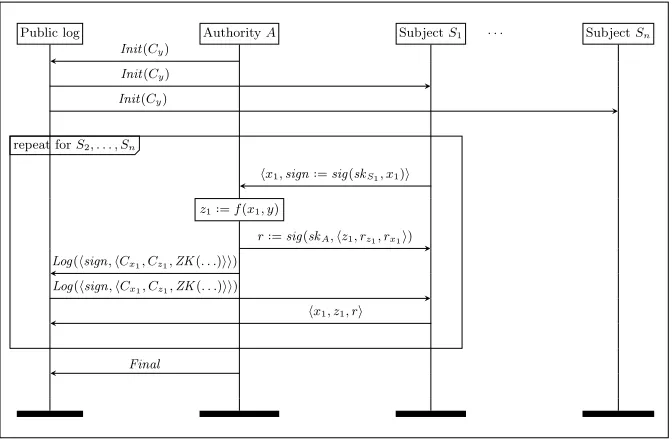
5.2 Accountable algorithms
Public log AuthorityA SubjectS1 SubjectSn
Init(Cy)
Init(Cy)
Init(Cy)
hx1,sign··=sig(skS1, x1)i
z1··=f(x1, y)
r··=sig(skA,hz1, rz1, rx1i)
Log(hsign,hCx1, Cz1,ZK(. . .)ii)
Log(hsign,hCx1, Cz1,ZK(. . .)ii)
hx1, z1, ri repeat forS2, . . . , Sn
Final
· · ·
Fig. 3.Honest protocol run for Example 11
computations for any number of subjects S1 to Sn. It is useful for many tasks
in which a central authority computes a function for a large number of subjects that provide inputs, e.g., validation of tax returns. A secret input y may be used to hold elements of some policy secret, but fixed from the start, e.g., a threshold on the gross income to decide when someone will undergo a tax audit. The most interesting aspect is that, in contrast to Example 2 and many other protocols providing accountability, there is no central trusted party, all parties that provide evidence might deviate and thus lie.