CAMFAS: A Compiler Approach to Mitigate
Fault Attacks via Enhanced SIMDization
Zhi Chen1, Junjie Shen1, Alex Nicolau1, Alex Veidenbaum1, Nahid Farhady Ghalaty2, and Rosario Cammarota3
1
University of California Irvine, Irvine, USA
2
Accenture Cyber Security Technology Labs, Virginia, USA
3
Qualcomm Research, San Diego, USA
{zhic2, junjies1, nicolau, alexv}@ics.uci.edu, [email protected], [email protected]
Abstract. The trend of supporting wide vector units in general pur-pose microprocessors suggests opportunities for developing a new and elegant compilation approach to mitigate the impact of faults to crypto-graphic implementations, which we present in this work. We propose a compilation flow, CAMFAS, to automatically and selectively introduce vectorization in a cryptographic library - to translate a vanilla library into a library with vectorized code that is resistant to glitches. Unlike in traditional vectorization, the proposed compilation flow uses the extent of the vectors to introduce spatial redundancy in the intermediate com-putations. By doing so, without significantly increasing code size and execution time, the compilation flow provides sufficient redundancy in the data to detect errors in the intermediate values of the computation. Experimental results show that the proposed approach only generates an average of 26% more dynamic instructions over a series of asymmetric cryptographic algorithms in the Libgcrypt library.
Keywords: Fault attack, SIMD, Vectorization, Countermeasure
1
Introduction
Instruction duplication and triplication countermeasures (herein after “instruc-tion redundancy”) [1] are well established Instruc“instruc-tion Set Architecture (ISA) mitigations against fault attacks. Instruction duplication executes each instruc-tion of a cryptographic algorithm twice and compares the results from both runs to detect the occurrence of a fault. This countermeasure takes advantage of time-based redundancy. It assumes that the original instruction and its duplicate will not be affected by the same faults. Hence, the presence of a fault can be detected.
high performance and (also) code size overheads. In addition, the extra instruc-tions may also induce register pressure. Combined with these effects, as reported in [1], instruction duplication can cause up to3.4xtimes performance slowdown. Yuce et al. [3] have shown that instruction duplication, triplication etc, can be thwarted by leveraging artifacts of pipelined execution. Specifically, due to the asymmetry in the critical path of instructions, Yuce et. al. have shown the possibility of injecting a single or multiple glitches at certain pipeline stages, and that the fault propagates through the critical path of the affected instructions in a way to bypass instruction duplication (and triplication) countermeasure. To fully utilize the benefits provided by some form of instruction duplication, a more sophisticated mechanism is therefore necessitated.
This paper proposes to enable operation duplication by leveraging at its essence the single instruction multiple data (herein after ”SIMD”) extensions of modern microprocessors. SIMD extensions are ubiquitous in most commercial general purpose microprocessors, and the major manufacturers, such as Intel, IBM, and ARM suppliers, are apt to build increasingly larger vector units in new processor generations.SIMDextensions use a distinct set of instructions and operate on wider registers to complete multiple operations in parallel. When it comes to cryptographic implementations, the customary use ofSIMD resources is to increase performance by leveraging the maximum amount of data par-allelism available in a cipher through mapping the algorithm statements into vector statements manually, e.g., in the OpenSSL library.4
This work presents a compilation approach,CAMFAS, which harnesses these available SIMD extensions to mitigate fault attacks. The proposed approach at-tempts to gain instruction redundancy for free, achieving both operation and data duplication. In this regard, CAMFAS is new, because it differs from both the traditional approach to code vectorization (here in after “SIMDization”), as well as the traditional approach to introduce instruction level countermeasures against fault attacks. The process essentially migrates the execution of most instructions from the scalar unit to the vector unit, and effectively transforms instruction redundancy into data redundancy. For example, in the case of in-struction duplication, instead of running the original inin-struction and its copy sequentially as it was adopted in the prior art,CAMFAS vectorizes these two in-structions and packs them into aSIMD register for execution. Error checking is then performed on the vectorized instruction for fault detection. To the best of our knowledge, this is the first work that exploits SIMD extensions to protect cryptographic algorithms against fault attacks, and trade-off resistance against fault-attacks with throughput in the cryptographic operations.
CAMFAS is fully implemented and automated in the LLVM compiler infras-tructure [4]. Similarly to the state-of-the-art time-based instruction duplication techniques, e.g., [1], our SIMDization based countermeasure doesn’t need to be aware of any detail about the algorithm implementation. In addition, it delivers the following improvements.
4
First, previous instruction duplication directly inserts countermeasures into the code obtained via disassembling the executable object code for redundancy purposes. In the circumstance that the cryptographic code is inaccessible, this ad hoc solution is perhaps the only way to duplicate instructions. However, most assembly cannot be duplicated trivially, e.g., when a register is present as both the source and the destination. An expert has to judiciously save the temporary result into an unused register so that the content in the reused register will not be overwritten by the redundant computation. Thus duplication at the assembly level needs a considerable amount of expert effort. Therefore, the work of Barenghi et al. [1] only covers a small fraction of assembly instructions in the AESblock cipher.
OurSIMDization based instruction redundancy strategy resorts to compila-tion techniques to trade-off throughput (achievable by taking full advantage of the available vector length) with resistance to fault attacks. It focuses on the in-termediate representation (IR) level, which is after the front-end optimizations, but before register allocation and code generation. Replicated instructions and error checking code are inserted automatically without any manual intervention during the traversal of an IR form. Then the fault tolerant code generation is left to the back-end of the compiler. Our work avoids the tedious and error prone assembly programming, yet still preserving all compiler optimizations. Portabil-ity is another important benefit of introducing mitigations at the IR level, since the IR is normally target independent.
Second,CAMFASconverts instruction duplication to operation/data duplica-tion so repeating execuduplica-tions are avoided for individual instrucduplica-tions. This conver-sion effectively exploits spatial redundancy at the granularity of an instruction rather than exploiting the temporal redundancy as in [1], which is vulnerable to the single fault injected at certain pipeline stages [3].
Third, even though additional instructions may be needed to pack/unpack data into/from vector registers,CAMFASparallelizes the execution of the original instruction and its duplicate thus leading to the significantly reduced code size and better performance.
Fourth, CAMFAS has lower register pressure because no extra registers are needed by the replicate.
In our experiments, we have applied CAMFAS to cryptographic algorithms in the Libgcrypt library.5 The fault injection experiments demonstrate that our
approach is able to deliver nearly full fault coverage with much reduced overhead. Furthermore, on average the mitigated cryptographic algorithms execute 2.2x slower and impose an average of 26% more dynamic instructions compared to unmitigated code.
2
Fault Model
This work considers an attacker capable of injecting glitches, as in [5,6], which could corrupt data and/or instruction (mainly instruction skipping). For data
5
LLVM compliable source code
LLVM IR front-end optimization
SIMD-based Instruction redundancy
Instruction identification
Redundancy/ Err. checking
Remove scalar Instruction
Fault tolerant executable
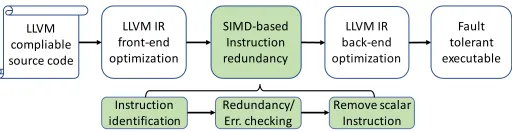
Fig. 1:CAMFAScompilation flow for introducing SIMDization based approach for fault detection in cryptography.
corruption, the main focus of this work, fault types that apply to our approach include:
– Single Random Bit-Flip: The fault injection induces bit-flip in a random po-sition in a register.
– Multiple Random Bit-Flips at different elements in a SIMDRegister: Multiple faults are injected into the same SIMD register but at different elements of it - it is easy to prove that this type of fault can occur with a negligible probability which further decreases with the vector length. Multiple faults that are injected to identical positions different vector lanes are not considered in this paper because it is much more difficult to inject these type of faults [1].
An attacker can skip an instruction or replace it with an effectivenop. The error checking code, or particularly the error checking branch instruction, might be targeted by adversaries to thwart the inserted countermeasures. We refer to literature to mitigate this case. For example, in [7], instructions are rearranged so that the vulnerable branch instruction is followed by adefault-failerror handling module.
3
Compilation flow for fault detection in cryptography
Figure 1 depicts the compilation flow implementing CAMFAS for fault tolerant code generation in cryptography. The instruction redundancy pass in Figure1 handles the Intermediate Representation IRfiles in three steps: (a) instruction identification and redundancy; (b) error checking code insertion; and (c) scalar code deletion. The transformedIRfiles are then passed to the LLVM back-end for further optimizations and register allocation before generating the fault tolerant executable.
Note that, although the countermeasures in the rest of the paper will only focus on fault detection,CAMFAScan be extended to support fault correction by triplicating the data in a SIMD register and performing majority voting among the resultant values. The correction can be implemented as a standalone module invoked on fault detection.
etc.), as it focuses on the IR form of the source files which is normally plat-form independent. For illustrative purpose, this work illustrates an application of CAMFAS to Intel SSE and AVX/2 SIMD instruction set extensions, and to the case of instruction duplication.
3.1 Application of the framework to Instruction Duplication
In this section we present how CAMFAS handles vector based instruction dupli-cation. The first step of our implementedLLVMpass is to traverse each individual IRinstruction. This step determines if it is necessary to duplicate a discovered instruction during the traversal. If so, a vector instruction that contains two ex-act copies of the data used by the original instruction will be inserted to replace the original one. The framework copes with different instruction categories as follows:
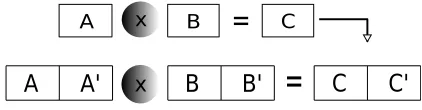
– Arithmetic, logic, and shift/rotate instructions:These IRinstructions are directly duplicated via an equivalent vector instruction and the result is saved in a vector intermediate register. Figure2 shows the transformation of a scalar arithmetic operation (on the top) to its alternativeSIMDform (at the bottom).A’is the replica of dataAthat can be either loaded from the memory or computed by preceding instructions.
A
A'
x
B
B'
=
C
C'
A x B
=
CFig. 2: Duplicate and vectorize scalar arithmetic isnstructions.
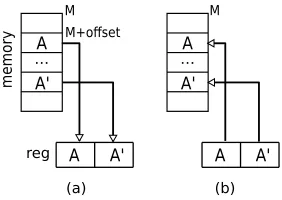
– Memory instructions: CAMFASprotects all load and store addresses by us-ing gather and scatter instructions to duplicate memory access computation. A gather instruction effectively eliminates the extra load used in the previ-ous scalar instruction duplication. Researchers in [3] have observed that the original load and its duplicate can be present at two adjacent pipeline stages at the same cycle, i.e., one is at the register access stage and the other is at the execute stage, where only a single fault injected might corrupt these two loads simultaneously. However, our duplication avoids executing identical loads sequentially. It thus makes the countermeasure resistant to the above single fault injection.
addressM+offsetandA’from addressM+offset+S and then pack them into a SIMD register as shown in Figure 3(a). A comparison is then performed to validate the equivalence of these two values to check if the loaded memory content is corrupted.
Similar operations can be performed to protect stores as well using scatter instructions as represented by the right side of Figure 3. However, we would have to read back the two values stored by a scatter instruction to testify if there was a fault injected to the content at one of the particular memory addresses, which requires another gather instruction and one more comparison. These procedures enable countermeasure on loads and stores at the cost of high performance overhead because gathers and scatters normally require much more µops than amovinstruction. To avoid the prohibitively expensive cost, we only protect memory addresses and gather the value from (e.g., A) the same memory location into a SIMD register in this paper. Duplication and verification of memory contents are left as future work.
...
A A' A
A'
memory
(a) (b)
...
A A' A
A'
reg M M+offset
M
Fig. 3: Memory instruction duplication using (a) gather, (b) scatter. – Branch instructions:All comparison instructions are duplicated since their
SIMD alternatives are supported bySIMDinstruction extensions, thus branch conditions are also protected. Attacks on branch instructions that change the branch target are not counteracted directly in our approach due to three rea-sons. First, existing signature-based techniques, e.g. [8,9], can be employed to guard the integrity of control flows. Second, data integrity faults are more im-portant in cryptographic applications since crypto algorithms usually consist of xor and shift instructions. Third, fault attacks mostly exploit the cor-rupted data result (DFA) rather than the control flow. Our goal is to defeat fault attacks, hence it is more important to consider data integrity instead of control flow integrity.
– Other instructions:Other instructions such as stack manipulation instruc-tions (e.g., push and pop) are not duplicated because of two major reasons. First, these instructions are not present in theIRform. Second, no equivalent SIMD instruction exists to achieve the same purpose. Conversion instructions are secured becauseLLVM IRprovides us the vector version of truncation, type conversion, and sign extension instructions.
3.2 Error Checking Code Insertion
Once an instruction is duplicated and vectorized, we need to decide if a check is required to be inserted for fault detection. Checks can be added to various code places to trade off the performance/code size and the fault coverage. For example, a check can be inserted immediately after a vectorized instruction to compare equality of the upper and bottom 64 bits of a resultant SIMDregister. While it attains full coverage of the attacks since all duplicated instructions are validated, checking all duplicated instructions may overreact to fault detection as many checks are actually superfluous. This is because the value change in a register will generally propagate to influence all the registers that are directly or indirectly dependent on this register. In some cases, this change is masked by some operations on the execution path, i.e., a shift operation could mask all the changed bits in a register that will be shifted out.
A' A
A A'
A=A' A'=A reg1
reg2
Fig. 4: Error checking operation
Therefore, to leverage the fault coverage rate at the expense of a reason-able performance and extra instruction overhead, fault checking will be only performed at certain program points, such as before stores, function calls, con-ditional branches, etc.
4
Evaluation
This section provides an experimental evaluation of CAMFAS. We will first in-spect its capability in detecting injected faults and then study the overhead in terms of performance and the dynamic instruction count. LLVM4.0 was used to compile the Libgcrypt library and to add mitigations against fault-attacks. The following cryptographic algorithms are investigated: RSA; DSA; ELG; and ECC, this last includes ECDSA, ED25519; and GOST. We duplicated the kernels that are heavily used by the cryptographic algorithms, i.e., the ones under thempi directory in the Libgcrypt library. These kernels perform all the required arith-metic operations for each of these four cryptographic algorithms, e.g., addition, subtraction, multiplication, division, modulo, etc. All the results are normalized to the originally unmodified program which is also referred to as thebaseline in this section.
4.1 Experimental Setup
All versions of the compiled benchmarks were executed on the Intelx86 64 ISA with AVX-512 SIMD extension. Specifically, the processor model is Intel Xeon Phi(TM) 7210 Knights Landing processor and 16GB memory, running Linux 4.4.0 kernel. While we experimented on Xeon Phi processor, the proposed tech-nique is generic and can be applied on any target processor with vector exten-sions. Nowadays fault attacks are also viable on high performance processors, as the technology has improved for glitch or laser injection, e.g., via VC glitcher.6
RSA DSA ELG
ECDSA Ed25519 GOST Mean
0 20 40 60 80 100
N N N N N N N
Cryptographic algorithms
P
ercen
tage
(%)
Other Comparison Load Arithmetic
OW OW OW OW OW OW OW
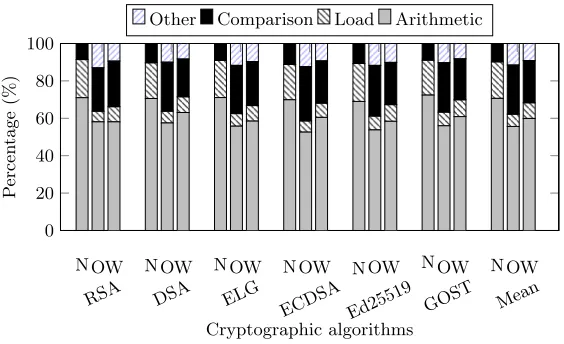
Fig. 5: The breakdown of faults injected on each type of instruction for differ-ent mechanisms: no fault detection (N), duplication without gather and scatter instructions (O), duplication with gather and scatter instructions (W).
6
4.2 Fault Coverage
Now we evaluate the effectiveness of our SIMD-based fault detection technique. The fault coverage of the original and the vectorized binaries (both with and without gather/scatter instructions) are analyzed by injecting faults to the cor-responding binaries. PIN [10] is used to achieve this in two steps. First, we collect the full program trace via a customized Pin tool. This step records all the exe-cuted instructions associated with their instruction pointers (IP) and read/write registers for every iteration of the specified functions (kernels) in the hardened part of the program. Second, an instruction at a random iteration is picked from the trace file before the program starts execution again. An operand register is then arbitrarily selected for fault injection, and finally a single bit in a random byte of the register is flipped during the execution of the program. Although only single-fault model is simulated in experiments, our work is able to detect multiple flipped bits because they will produce the same effect as a single ran-dom fault. Recall, it is very difficult to inject identical faults to both the original and its redundant copy.
We modified register files, including general purpose registers and floating point registers, while leaving the memory contents untouched. We also repro-duced the scenario when one bit of a memory read address is flipped, to emulate errors in the memory address for load instructions.
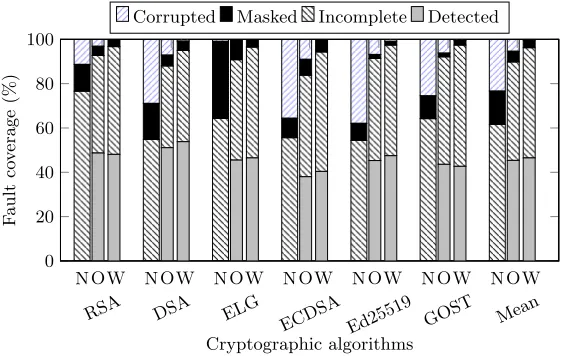
The faulty program continues until completion and the outcome of each run is recorded. 1000 faults were injected in each cryptographic algorithm execution to collect the statistics. The results are classified into one of the following four categories by comparing to the known good outputs (e.g., the result produced by the unmodified original binary).
– Detected: The program terminates due to the fault being detected by our vector based error detection technique.
– Incomplete: The injected fault causes abnormal behavior of the target bi-nary, i.e., it may result in the infinite execution as the error makes the loop termination condition not hold ever, or a program with inserted countermea-sures fails because of segfaults (e.g., the injected error causes invalid memory access) or other faults, such as double free or corruption (i.e., the injected error propagates to cause double free of a portion of the memory), floating point exception (e.g., divide by zero), and bus error (i.e., the injected error leads to misaligned address access).
– Masked: The faulty program completes normally and produces correct en-crypted/decrypted results. In this case, the injected error didn’t corrupt the program due to application level or architectural level masking. As we will present later, some injected errors are masked in Libgcrypt mainly due to the wide use of bitwise operations in the algorithms.
RSA DSA ELG
ECDSA Ed25519 GOST Mean
0 20 40 60 80 100
N N N N N N N
Cryptographic algorithms
F
ault
co
v
erage
(%)
Corrupted Masked Incomplete Detected
OW OW OW OW OW OW OW
Fig. 6: Fault coverage by each cryptographic algorithm among different mecha-nisms: no fault detection (N), duplication without gather and scatter instructions (O), duplication with gather and scatter instructions (W).
Libgcrypt library provides a series of self tests to make sure that the value computed at each stage is valid for the cryptographic algorithms. It signals a failure when a mismatch is found between the modified data and the original data. This case is also classified into the corrupted category because neither our mechanism nor the system detects it. To guarantee that each run could be finished in a reasonable amount of time, We only used 1024-bit keys for RSA, DSA and ELG, 192-bit and 256-bit inputs for ECDSA, and 256-bit input for GOST. A run is treated astimeoutand thus goes to theIncomplete category when it executes at least 5 times longer than producing the masked results.
Figure 5 shows the breakdown of faults injected in each type of the in-structions for three configurations, baseline with no fault detection (N), vector based duplication with gathers/scatters (W), and vector based duplication with-out gathers/scatters (O). Four major instruction categories are investigated, 1) arithmetic instructions including logic and rotation operations, 2) memory loads (stores are excluded since checks are inserted before them to guard the validity of address computation), 3) comparison operations including those inserted for fault detection, and 4) the ”Other” category including instructions that perform shuffle operations before each comparison for error detection as described in Sec-tion3. Note that the last category doesn’t apply to the baseline, since no such operation exists in the original program.
and scatters, about 60% and 8.4% faults are injected to arithmetic instructions and load instructions on average, respectively. Compared to the baseline, these two numbers are decreasing because other instructions are introduced as coun-termeasures. The percentage of faults injected to comparisons increases by 12% forCAMFAS with protection of memory computation. This number is very close to the percentage of errors injected to “Other” instructions (e.g. 9.2%) because every error checking code requires one shuffle instruction. We can also observe that the percentage of errors injected to each instruction category for our dupli-cation without using gather and scatter instructions is close to the case of using gather and scatters. This is because the number of instructions for these two mechanisms are close to each other despite that they employ different sets of instructions to fetch data from memory, i.e., the former usesbroadcastand the later usesgathercombined with a few other instructions to prepare the mask.
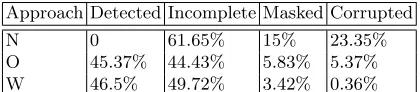
Figure6associated with Table1 shows the effectiveness of our vector based error detection approach in detecting injected faults. As it is tabulated in Ta-ble 1, CAMFAS with memory address protection yields negligible corrupted re-sults. These incorrect results are mostly caused by the errors injected to the error checking code since this portion of code is not protected. The percent of corrupted runs goes up to 5.37% when we don’t check memory addresses. It is significantly reduced compared to the baseline where an average of 23.35% runs are corrupted. In the worst cases, the corrupted results could be up to 38% (ED25519).
Approach Detected Incomplete Masked Corrupted
N 0 61.65% 15% 23.35%
O 45.37% 44.43% 5.83% 5.37%
W 46.5% 49.72% 3.42% 0.36%
Table 1: Comparison of fault coverage rates of each category among no fault detection (N), duplication without gather and scatter (O), and duplication with gather and scatter (W).
RSA 1024
RSA 2048
RSA 3072
DSA 1024
DSA 2048
DSA 3072
ELG 1024
ELG 2048
ELG 3072
ECDSA 192
ECDSA 256
ECDSA 384
ED25519GOST256GOST512Mean 1
1.5 2 2.5 3
Cryptographic algorithms
Slo
wdo
wn
private with g/s private without g/s public with g/s public without g/s
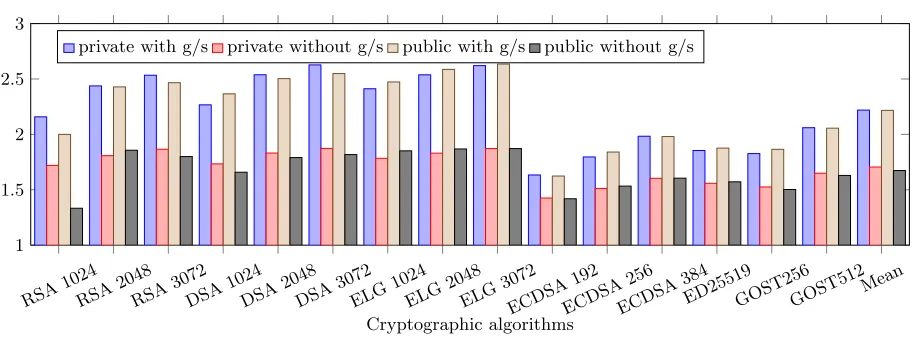
Fig. 7: The slowdowns of error detection enabled cryptographic algorithms to compute private and public keys compared to the original ones without error detection for different input sizes.
Sometimes a binary could still finish execution despite the injection of an error at a certain run. This can happen in cryptographic algorithms since some of the developed kernels contain operations such as and, or, etc. The result of these operations might not depend on the value of the operand where a fault is injected. However, the number of masked runs falls from 15% in the baseline to 3.42% and 5.83% in our duplicated versions with and without gathers/scatter, respectively.
Most of the decreased numbers from the above three categories come into thedetectedcategory, i.e., more than 45 percent of the faults are detected by CAMFAS. The difference between the error detection rate of using and not using gather/scatter instructions is minimal, e.g., less than 1.2%. This is because a majority of errors injected in memory addresses are turned into segfaults as discussed above.
4.3 Fault Attack Prevention Discussion
There are different categories of fault attacks on cryptosystems that are divided based on the assumption on the fault model.CAMFASdetects and prevents cryt-posystems from the following categories of fault attacks:
– Differential Fault Intensity Analysis (DFIA) [6]: Unlike other fault attacks, DFIA does not rely on a fault model hypothesis. It relies on the bias of fault behavior and the differential of faulty outputs. Since CAMFAS prevents the faulty output from being propagated, it is able to effectively prevent DFIA. – Single-Glitch Attacks: [3] has proposed some hardware based microprocessor
fault attacks that rely on different scenarios of fault injection. Yuce et.al, have proposed a framework, by inspecting fault sensitivity characterization, in which the adversary is able to find scenarios to thwart redundancy techniques. In case of these attacks, as provided in Section2, the possibility of corrupting the original and its duplicate is low which eliminates the case of scenario 1. We still believe that Scenario 2 and 3 might be possible based on the underlying microprocessor platform. However, since the comparison of the original and the duplicate copy is at the IR level, an accurate fault injecting into the vulnerable points in the pipeline to modify comparison instruction to nopwill be more difficult.
4.4 Fault Detection Overhead
The performance and code size overhead caused by the virtually full coverage of our inserted countermeasures will be examined in this section.
RSA
1024
RSA
2
048
RSA
3072
DSA
1024
DSA
204
8
DSA
3072
ELG
1024
ELG
2048
ELG
3
072
ECDSA
192
ECDSA
25
6
ECDSA
384
ED25519 GOST256 GOST512 Mean 1
1.1 1.2 1.3 1.4
Cryptographic algorithms
Instruction
size
duplication with g/s duplication without g/s
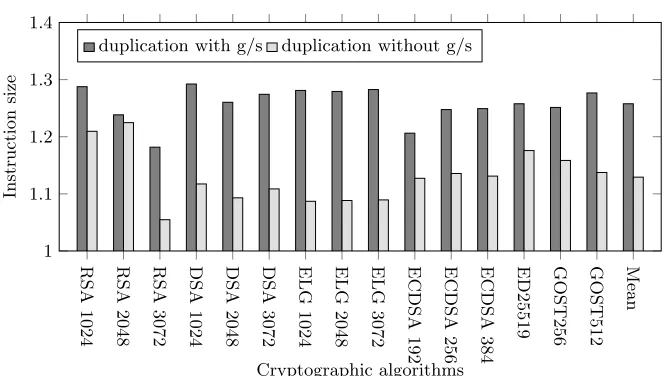
Fig. 8: The dynamic instruction count overhead for duplication with and without gather/scatter instructions.
of experiments were conducted. One duplicates load and store addresses using gather and scatter alternatives. The other, instead of using gathers and scatters, loads the content in an address and broadcasts it to fill a SIMD register. In Figure7, a “private/public with g/s” bar represents the slowdown of a vectorized benchmark with gather/scatter instructions over the baseline counterpart when computing the private/public key. A “private/public without g/s” bar indicates the slowdown without using gather/scatter instructions.
The average slowdowns of the instruction duplicated cryptographic algo-rithms are 2.2x for computing both the private and the public key when gather/s-catter instructions are used to duplicate the memory addresses. The slowdowns are mainly attributed to the following facts.
First, there is no vector form of integer division and quadword multiplica-tion instrucmultiplica-tions. Therefore, all these division and multiplicamultiplica-tion operamultiplica-tions are performed as scalars that require unpacking the upper and bottom quadwords from a SIMD register. After unpacking, two scalardivq/mulxqinstructions are executed sequentially to obtain the upper and bottom quadword values. These two values are packed into a SIMD register using vpunpcklqdq instruction in the end. The whole process needs at least 7 instructions, therefore causing high performance overhead.
Second, extra instructions are needed for error detection beside comparison and test instructions. For example, we have to swap the upper and bottom quadwords before a comparison for error checking since there is no direct way to check the equivalence of them.
Third, most vector instructions are more expensive than their scalar counter-parts on Knights Landing processors in terms of latency, although the number of micro operations from the decoder might be the same. For instance, all vector instructions have a latency of at least 2 clock cycles on the Knights Landing pro-cessor, while their scalar alternatives on general purpose registers usually have a latency of 1 clock cycle [11].
The overhead reduces to an average of 1.7x for both private and public key computation if load/store addresses are not duplicated (except the ones com-puted by previous arithmetic operations) using gather/scatter instructions. This is because gather and scatter instructions are very costly on most of Intel pro-cessors, i.e.,vpgatherqqinstruction needs 18 and 15 clock cycles on Skylake and Broadwell [12], respectively. At least the same latency would be expected on the Knights Landing processor because it needs 6 micro operations (µops) vs 5 on Skylake [11].
to efficiently detect attacks only at an insignificant instruction count overhead across the public key cryptographic algorithms. Furthermore, these numbers pro-vide more justification for some facts that are given in the previous performance overhead experiment.
First, using gathers and scatters to duplicate memory address computations only requires 13% percent more extra instructions (e.g.,kmovwto set write mask registers) compared to the one that doesn’t protect memory address computa-tions. Recall that, compared to the baseline, the average performance slowdown values of the versions where memory address calculations are hardened and not hardened are around 2.2x and 1.7x, respectively. The results altogether corrobo-rate that gathers and scatters are expensive operations that primarily contribute to the additional performance degradation.
Second, the dynamic instruction count grows disproportionally to the in-crease in performance overhead shown in Figure7. This is consistent to the fact that integer vector instructions are generally much more expensive than their scalar counterparts on the Knights Landing processor.
Another interesting observation is that the variations of the dynamic instruc-tion count for each bar in Figure 8 are small for both cases. For instance, the instruction count overhead ranges from 21% to 29% percent from duplication with gathers and scatters, and it is from 6% to 22% when gathers/scatters are not used.
5
Related Work
Recent prior art focused on specific hardware approaches to implement fault detection and mitigation [13,5]. Hardware based techniques usually have to du-plicate the hardware circuits, repeatedly execute a computation, and verify the results from both computations using a specific hardware unit. This type of countermeasures is quite costly in both application performance and hardware areas, plus end users are generally not able to modify off-the-shelf hardware.
In contrast, software countermeasures provide more flexibility and portabil-ity than hardware techniques as they don’t require any underlying hardware modification. Prior art on software based countermeasures propose mitigations either at the algorithm level [14,15] or at the instruction level [1,2] to hinder consistent fault injection.
Algorithm level countermeasures run a cryptographic algorithm twice and then compare the outcomes of both runs to check their equivalence. A fault is detected once a mismatch is signaled. These fault detection mechanisms focus on a coarse granularity, e.g., high level algorithms. The mitigations are not aware of the low-level architectural and hardware details. While easy to implement, countermeasures at this level are prone to break by injecting identical faults to the same data across repeated executions [3].
mechanisms attempt to counteract faults through duplicating instructions, re-peating execution, and comparing the results from the original instruction and the redundant one. Instruction duplication is believed to be able to reach full error coverage, plus it is generally quite portable. However, the downside of it is the relatively high performance overhead, e.g., more than 3.4x in [1], and instruction size overhead since they need to execute at least as twice as many in-structions. Another side-effect of instruction duplication is the increased number of registers which may bring high register pressure.
Considering the pros and cons of instruction duplication, we take a step for-ward to make these techniques less costly but still preserve their benefits by taking advantage of SIMD features from modern processors. Rather than dupli-cating and executing two identical instructions sequentially, our approach vector-izes the original instruction and its replicate using a SIMD register. It effectively converts operation duplication into data duplication, therefore obtaining fault tolerance with minimal overhead.
Pabbuleti et al. has looked into SIMD units to accelerate modular multipli-cations in prime fields [16], but they didn’t address the fault tolerance problem. Chen et at. proposed a compilation framework to utilizeSIMDresources for fault tolerance [17]. They attempted to protect processors against soft errors by du-plicating instructions into SIMD registers, but no memory address computation was protected. To our best knowledge, this is the first work that trades off per-formance and fault countermeasures usingSIMDunits.
6
Conclusion
This work proposesCAMFAS, a new compiler flow for fault tolerance in cryptogra-phy using vectorization. The proposed technique exploits the underutilized vec-tor resources on processors for redundancy purposes.CAMFASwas implemented in theLLVMcompiler infrastructure. It automates the insertion of instruction redun-dancy in cryptographic code. In addition, the compiler oriented countermeasure converted the traditional temporal redundancy based instruction duplication into spatial redundancy with relatively low performance and code size overhead. The experimental result showed that our proposed approach only required up to an average of 26% more dynamic instructions compared to the originally un-protected cryptographic algorithms, but it achieved almost full fault coverage.
7
Acknowledgement
This work was supported, in part, by the NSF award XPS 1533926.
References
2. C. Patrick, B. Yuce, N. F. Ghalaty, and P. Schaumont, “Lightweight fault at-tack resistance in software using intra-instruction redundancy,” Cryptology ePrint Archive, Report 2016/850, 2016.
3. B. Yuce, N. F. Ghalaty, H. Santapuri, C. Deshpande, C. Patrick, and P. Schaumont, “Software fault resistance is futile: Effective single-glitch attacks,” inFDTC, 2016, pp. 47–58.
4. C. Lattner and V. Adve, “LLVM: A Compilation Framework for Lifelong Program Analysis & Transformation,” inCGO, 2004, pp. 75–86.
5. B. Yuce, N. F. Ghalaty, C. Deshpande, C. Patrick, L. Nazhandali, and P. Schau-mont, “FAME: Fault-attack Aware Microprocessor Extensions for Hardware Fault Detection and Software Fault Response,” inHASP, 2016, pp. 8:1–8:8.
6. N. F. Ghalaty, B. Yuce, and P. Schaumont, “Analyzing the efficiency of biased-fault based attacks,”IEEE Embedded Systems Letters, vol. 8, no. 2, pp. 33–36, 2016. 7. S. Endo, N. Homma, Y.-i. Hayashi, J. Takahashi, H. Fuji, and T. Aoki, “A
multiple-fault injection attack by adaptive timing control under black-box conditions and a countermeasure,” inCOSADE, 2014, pp. 214–228.
8. M. Abadi, M. Budiu, U. Erlingsson, and J. Ligatti, “Control-flow integrity,” inccs, 2005, pp. 340–353.
9. G. A. Reis, J. Chang, N. Vachharajani, R. Rangan, and D. I. August, “SWIFT: Software Implemented Fault Tolerance,” inCGO, pp. 243–254.
10. V. J. Reddi, A. Settle, D. A. Connors, and R. S. Cohn, “PIN: A Binary Instru-mentation Tool for Computer Architecture Research and Education,” in WCAE, 2004.
11. A. Fog, “Lists of instruction latencies, throughputs and micro-operation
break-downs for Intel, AMD and VIA CPUs,” http://www.agner.org/optimize/
instruction tables.pdf, 2017.
12. “Intel Intrinsics Guide,” https://software.intel.com/sites/landingpage/
IntrinsicsGuide/.
13. H. Bar-El, H. Choukri, D. Naccache, M. Tunstall, and C. Whelan, “The sorcerer’s apprentice guide to fault attacks,” Proceedings of the IEEE, vol. 94, no. 2, pp. 370–382, 2006.
14. M. Medwed and J.-M. Schmidt, “A generic fault countermeasure providing data and program flow integrity,” inFDTC, 2008, pp. 68–73.
15. R. Karri, G. Kuznetsov, and M. Goessel, “Parity-based concurrent error detection of substitution-permutation network block ciphers,” inCHES, 2003, pp. 113–124. 16. K. C. Pabbuleti, D. H. Mane, A. Desai, C. Albert, and P. Schaumont, “SIMD accel-eration of modular arithmetic on contemporary embedded platforms,” inHPEC, 2013, pp. 1–6.