Currency Recognition Using Image Processing
Chinmay Bhurke
1, Meghana Sirdeshmukh
2, Prof. Mrs. M.S.Kanitkar
3Student, Dept. of E&TC., PES’ Modern College of Engineering, Pune, India1 Student, Dept. of E&TC., PES’ Modern College of Engineering, Pune, India2 Asst. Professor, Dept. of E&TC., PES’ Modern College of Engineering, Pune, India3
ABSTRACT: There are around 200+ different currencies used in different countries around the world. The technology
of currency recognition aims to search and extract the visible as well as hidden marks on paper currency for efficient classification. Currency Recognition and conversion system is implemented to reduce human power to automatically recognize the amount monetary value of currency and convert it into the other currencies without human supervision. The software interface that we are proposing here could be used for various currencies (we are using four in our project). Many a times, currency notes are blurry or damaged; many of them have complex designs to enhance security. This makes the task of currency recognition very difficult. So it becomes very important to select the right features and proper algorithm for this purpose. The basic requirements for an algorithm to be considered as practically implementable are simplicity, less complexity, high speed and efficiency. Our main aim is to design an easy but efficient algorithm that would be useful for maximum number of currencies, because all currencies have different security features, making it a tough job to design one algorithm that could be used for recognition of all available currencies. Writing different programs for all is also a tedious job. The aim of the project is to recognize the currencies and not authentication.
KEYWORDS: Currency Recognition; Digital Image Processing.
I. INTRODUCTION
All currencies around the world look totally different from each other. For instance the size of the paper is different, the same as the colour and pattern. The staffs who work at places like money exchange offices have to distinguish between different types of currencies and that is not an easy job. They have to remember the symbol of each currency. This may result into wrong recognition, so they need an efficient and foolproof system to aid in their work. The aim of our system is to help people who need to recognize different currencies, and work with convenience and efficiency. With development of modern banking services, automatic methods for paper currency recognition become important in many applications such as vending machines. It is very difficult to count different denomination notes in a bunch. This project proposes an image processing technique for paper currency recognition and conversion. The extracted region of interest (ROI) can be used with Pattern Recognition and Neural Networks matching technique.
The image processing approach is discussed with MATLAB to detect the features of paper currency. Image Processing involves changing the nature of an image in order to improve its pictorial information for human interpretation. There are various techniques for currency recognition that involve texture, pattern or colour based. We use digital image processing techniques to find region of interest, after that Neural Network and Pattern Recognition Technique is used for matching the pattern. The proposed system will work on two images, one is original image of the paper currency and other is the test image on which verification is to be performed. A number of methods for banknote classification have been proposed. Template matching is often used as a simple method to classify banknotes. However, new template or matching rules are required for new bill types. An effective way to overcome the problem is to extract features from bill images representing unique characteristics of bill data.
II. RELATED WORK
A lot of work has been done in order to recognize currencies automatically,
A distinctive point extraction method used a coordinate data extraction method from specific parts of a Euro banknote representing the same colour. In order to recognize banknotes, they used two key properties of banknotes: direction (front, rotated front, back, and rotated back) and face value, neural network based bill recognition and verification method, the learning vector quantization (LVQ) method to recognize Italian Liras, 4 Robust and Effective Component-based method for Banknote Recognition by SURF Features. [3]
In another research work, a simple statistical test is used as the verification step, where univariate Gaussian distribution is employed, in another technique for paper currency recognition, three characteristics of paper currencies including size, colour and texture are used in the recognition. [4]
After studying the previously used methods for currency recognition, we can see that most of these methods/algorithms use Artificial Neural Networks.
III.PROPOSED ALGORITHM
A. Algorithm:
Obtain the image of the target currency using one of the possible methods (e.g. : Camera, Scanner, etc)
Use Image Pre processing algorithms to change the nature of the image in order to extract required information.
Detect the boundaries and extract the ROI (Region of Interest) using cropping.
Extract the desired features.
Compare the extracted feature values with ideal feature values that are calculated.
Display the outputs.
B. Description of the Proposed Algorithm:
Aim of the proposed algorithm is to develop an algorithm which can be easily applied to number of different currencies and has good efficiency and high speed.
Step 1: Obtaining the Image:
An Image can be obtained using number of different equipments, such as cameras or Scanner. The only precaution we need to take is, try to maintain a controlled environment so that the external factors won’t affect the feature values.
Step 2: Pre processing Operations:
Pre processing operations are required to alter the nature of the image, which makes extraction of features easier. In this particular case, pre processing operations involve, blurring, grayscale conversion, thresholding, noise removal using filters, color blurring RGB to HSV conversion. These operations help us in detecting boundaries, cropping the ROI and Calculating color features.
Step 3: Boundary Detection and cropping:
For boundary detection, we require a binary image, which has only 2 colors, black and white. All we do in this process is simply, separate the background and the foreground, and separate the ROI.
Step 4: Feature extraction:
Euclidian distance equation for finding out the average values of the differences between the target and Ideal HSV features
𝑑 𝑝, 𝑞 = (ℎ2 − ℎ1)2+ (𝑆2 − 𝑆1)2+ (𝑉2 − 𝑉1)2
Where,
(H1, S1, V1) = Target image feature set (H2, S2, V2) = Ideal feature set.
Step 5: Displaying results:
To display the results, we have built a graphical User Interface (GUI); where we are also providing a feature to calculate currency conversions for which we are trying to obtain the conversion rates from the Internet.
IV.RESULTS
Here are some of the screen shots of the GUI that we have designed. In the GUIs, you can see different currencies are successfully recognized and also we have added outputs of the difference Image processing stages.
Fig. 1 INR Recognition
Fig. 1 shows snap shot of our projects GUI for recognizing INR Banknotes. Each column in the image provides the outputs of different pre processing techniques. Here, a Rs. 20 has been recognized successfully. We have worked on 2 banknotes of each currency. For INR, we have chosen Rs. 5 and Rd. 20 denominations.
Fig. 2 . EUR Recognition
For Euros, we have chosen 20 Euro, 50 Euro Banknotes. In Fig. 2, the same pre processing techniques are visible. Here we have changed the aspect ratio of the image, the aspect ratio test fail, so we have also printed that the detection was done using colour features.
Fig. 3 AUD Recognition
Fig. 3 shows results for 20 AUD note. Here the detection was done using aspect ratio. Again we have chosen 2 denominations, 20 and 50 AUD.
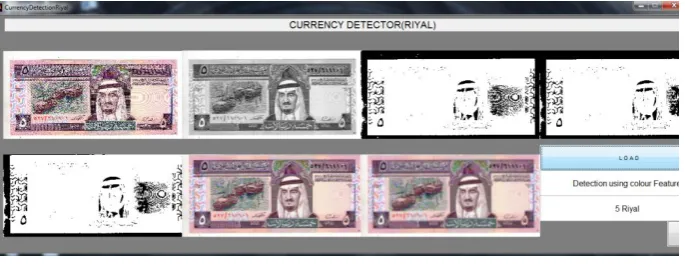
Fig. 4 SAR Recognition
In fig. 4, a successful detection of 5 SAR is shown. We worked on 1 and 5 SAR banknotes. We are still working on final GUI design, so the above GUI is not final. They are just designed to demonstrate the results of successful recognition.
V. CONCLUSION AND FUTURE WORK
In this project, we actually worked on 5 currencies and it was found that the proposed algorithm based on color and feature analysis works well for four currencies.
The USD Banknotes has very minute differences, when it comes to size and color, making it difficult to recognize using proposed algorithm. But for INR, AUD, SAR, the algorithm works very well.
So we can conclude that with above proposed algorithm, we can recognize currencies, which have good differentiation in color and size related to features. Also NN based approach give quicker results.
We have also successfully retrieved currency conversion rates from the internet, using web service.
In order to make this project widely useful and accurate, we can work on involving first line inspection methods in the algorithm and with these improvements, this system could be a very useful tool in order to prevent high order counterfeiting by taking advantage of cheaper and high quality equipment.
2. Rafael C. Gonzalez, Richard E. Woods, Steven L.Eddins. Digital Image Processing Using MATLAB. Pearson Education, 2004
3. Rubeena Mirza, Vinti Nanda, “Paper Currency Verification System Based on Characteristic Extraction Using Image Processing”, International Journal of Engineering and Advanced Technology (IJEAT) ISSN: 2249 –8958, Volume-1, Issue-3, February 2012
4. Vipin Kumar Jain, Dr. Ritu Vijay, “Indian Currency Denomination Identification Using Image Processing Technique” ,Vipin Kumar Jain et al, / (IJCSIT) International Journal of Computer Science and Information Technologies, Vol. 4 (1) , 2013, 126 – 128
5. Shashank Araokar, “Visual Character Recognition using Artificial Neural Networks” 6. http://in.mathworks.com/help/