This is the Full Version of the Extended Abstract that appears
in the Proceedings of the 20th International Conference on Practice and Theory in Public-Key Cryptography (PKC ’17) (28 – 31 March 2017, Amsterdam, The Netherlands)
Serge Fehr Ed., Springer-Verlag, LNCS ????, pages ???–???.
Cut Down the Tree to Achieve Constant Complexity in Divisible
E-Cash
David Pointcheval1, Olivier Sanders2 and Jacques Traor´e3 1
CNRS, ENS, INRIA, and PSL Research University, Paris, France
2 Orange Labs, Applied Crypto Group, Cesson-S´evign´e, France 3
Orange Labs, Applied Crypto Group, Caen, France
Abstract. Divisible e-cash, proposed in 1991 by Okamoto and Ohta, addresses a practical concern of electronic money, the problem of paying the exact amount. Users of such systems can indeed withdraw coins of a large valueNand then divide it into many pieces of any desired valuesV ≤N. Such a primitive therefore allows to avoid the use of several denominations or change issues. Since its introduction, many constructions have been proposed but all of them make use of the same framework: they associate each coin with a binary tree, which implies, at least, a logarithmic complexity for the spendings.
In this paper, we propose the first divisible e-cash system without such a tree structure, and so without its inherent downsides. Our construction is the first one to achieve constant-time spendings while offering a quite easy management of the coins. It compares favorably with the state-of-the-art, while being provably secure in the standard model.
1 Introduction
Electronic payment systems have a strong impact on individual’s privacy, and this is often under-estimated by the users. Transaction informations, such as payee’s identity, date and location, allow a third party (usually, the financial institution) to learn a lot of things about the users: individuals’ whereabouts, religious beliefs, health status, etc, which can eventually be quite sensitive.
However, secure e-payment and strong privacy are not incompatible, as shown by Chaum in 1982 [Cha82]: he introduced the concept of electronic cash (e-cash), the digital analogue of regular cash, and in particular with its anonymity property. Typically, e-cash systems consider three kinds of parties, the bank, users and merchants. The bank issues coins, which can be withdrawn by users, and then be spent to merchants. Eventually, the merchants deposit the money on their account at the bank. It is better when the spending process does not involve the bank, in which case the e-cash system is said offline. Ideally, users and merchants should form a single set, which means that anyone receiving a coin should be able to spend it again without depositing it to the bank. Unfortunately, such a solution, calledtransferable e-cash implies [CP93] coins of growing size which quickly becomes cumbersome.
Although most of the features of regular cash, such as anonymity, can be reproduced by e-cash, there is one fundamental difference between these two systems: the latter can easily by duplicated, as any digital information. This property is a major issue for money, since dishonest users could spend several times the same coin to different merchants. To deter this bad behavior, e-cash systems must enable (1) detection of double-spending (i.e.the reuse of a spent coin), or alternatively over-spending (i.e.spending more money than withdrawn) and (2) identification of defrauders.
Unfortunately, achieving such properties becomes tricky when anonymity of transactions is re-quired. Indeed, the bank can no longer trace the users’ payments and check that, for each of them, the global amount spent remains lower than the amount he withdrew. To enable detection of double-spending/over-spending, most of the e-cash systems then make use of serial numbers: every coin is associated with a unique number, only known to its owner until he spends the coin. The serial number is indeed revealed during the transaction and stored by the bank in a database. The bank can thus detect any reuse of serial numbers and so any double-spending.
1.1 Divisible E-Cash
s
s0
s00
SN1 SN2
s01
SN3 SN4
s1
s10
SN5 SN6
s11
... ...
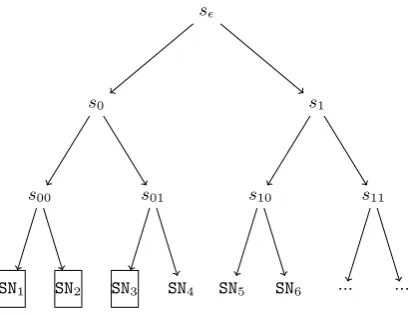
Fig. 1.Tree-based divisible coin
have the ability of dividing it into many pieces of any desired valuesVi ≤N such thatPiVi=N.
Such a property enables the user to pay the exact amount whatever the amount of the initially withdrawn coin was, which was a problem for traditional e-cash (and regular cash) systems. The authors proposed a framework representing each coin of valueN = 2n by a binary tree where each leaf is associated with a serial number, and so with a value 1. When a user wants to spend a value 2`≤N, he reveals an information related to a nodesof depthn−`, allowing the bank to recover the
2` serial numbers associated with the leaves descending froms. The benefit of this tree structure is to provide a partial control on the amount of serial numbers the user reveals. The latter can indeed send them by batches of 2`, for any 0≤`≤n, which is much more efficient than sending them one
by one, while ensuring that no information on serial numbers which do not descend from the spent nodes will leak.
Following this seminal work, a large number of constructions (including for example the following papers [CG07,ASM08,CG10,CPST15a,M¨ar15,CPST15b]) have been proposed, all of them making use of this framework, with a binary tree. In 2007, Canard and Gouget [CG07] proposed the first anonymous construction in the random oracle model, and recently, Canardet al [CPST15a] showed that both anonymity and efficiency can be achieved in the standard model.
However, this binary tree structure has a major downside: it is tailored to spend powers of 2. Unfortunately, such an event is unlikely in real life. In practice, to pay a value V, the users must write V = P
ibi·2i, for bi ∈ {0,1} and then repeat the Spend protocol v times, where v = P
ibi.
Therefore, the constant-time property claimed by several constructions is somewhat misleading: spendings can be performed in constant-time as long as V is a power of 2 but not in the general case, and in the worst case the complexity is logarithmic.
Moreover, this structure makes the coin management slightly more difficult. Indeed, let us con-sider the case illustrated by the Figure 1, where a user has already spent a value V1 = 3 and so revealed the first three serial numbersSN1,SN2 and SN3. Now assume that the user wants to spend a value V2 = 2. He cannot use the node s01, since SN3 has already been revealed and so must use
s10 or s11. This means that the serial number SN4 will remain isolated, and the user will have to spend it later as a unit. It is then necessary to maintain a list of unspent serial numbers and try to avoid the presence of several “holes” in the tree, which thereafter restricts a lot the value that can be spent at once.
1.2 Our Contribution
In this work, we aim at a greater simplicity and a better efficiency, and propose the first divisible e-cash system which truly achieves constant-time spendings. The main novelty of our construction it that we get rid of the tree structure and so of its inherent downsides that we have described above. Our scheme enables users to reveal, by sending a constant number of elements, the sequence ofV
We start from [CPST15a], which introduced the idea of a unique coin’s structure, but make several changes to achieve constant-time spendings. The most important one is that we generate the public parameters in such a way that a same element can be used for spendings of any pos-sible amount. This stands in sharp contrast with previous constructions where each element was associated with a node of the tree and so with a unique amount. More specifically, we use bilinear groups (i.e.a set of three cyclic groupsG1,G2 and GT of prime orderp, along with a bilinear map e:G1×G2 → GT) and set the N serial numbers of a coin as SNj = e(s,eg)
x·yj
, for j = 1, . . . , N, wherex is the coin’s secret and (y, s,ge)∈ Zp×G1×G2 are global parameters of the system (not all public). These parameters additionally contain the elementssj =sy
j
∈G1, forj= 1, . . . , N and
e gj =eg
yj
∈G2, for j= 1, . . . , N−1. The relations between all these elements (namely the fact that they all depend ony) are at the heart of the efficiency of our construction but have a strong impact on anonymity. Indeed, (1) they could be used by an adversary to link transactions together and (2) they make the anonymity property much more difficult to prove.
Regarding (2), the problem comes from the fact that the reduction in the anonymity proof must take all these relations into account while being able to reveal the non-critical serial numbers {e(s,eg)x·yj}jj=1∗−1∪{e(s,eg)x·yj}N
j=j∗+V∗and to insert the challenge serial numbers in{e(s,eg)x·y
j
}jj∗=+jV∗∗−1,
for anyj∗, V∗ ∈[1, N]. Nonetheless, we manage to prove the anonymity of our construction under an assumption which, albeit new and rather complex, does not depend on either j∗ and V∗. We stress that the latter point was far from obvious. We also investigate in Appendix C another way of generating the public parameters which allows to rely on a more classical assumption but at the cost of significant increase of the complexity (which nevertheless remains constant).
Regarding (1), we must pay attention to the way the serial numbersSNi, fori=j, . . . , j+V −1,
are revealed during a spending of valueV. For example, we show in Section 4.1 that the solution from [CPST15a] (namely sendingsxj) would trivially be insecure in our setting. The user will then rather sendsxj encrypted in a way that prevents anyone from testing relations between spendings while ensuring that only a specific amount of serial numbers can be recovered from it.
Our Spend protocol is then quite efficient: it mostly consists in sending an encryption of sxj
along with a proof of well-formedness. As illustrated on Figure 3 of Section 5.2, it outperforms the state-of-the-art [M¨ar15,CPST15b], whose complexity logarithmically depends on the spent valueV. Since spending is the operation subject to the strongest time constraints (for example, it should be performed in less than 300ms in a public transport system [GSM12]) we argue that our construction makes all the features of e-cash systems much more accessible.
1.3 Organization
In Section 2, we recall some definitions and present the computational assumptions underlying the security of our scheme. Section 3 reviews the syntax of a divisible E-cash system along with security properties definitions. We provide in Section 4 a high level description of our construction and a more detailed presentation in Section 5. The latter additionally contains a comparison with state-of-the-art. Eventually, the security analysis is performed in Section 6.
We describe in the appendix an instantiation of our divisible e-cash system (Appendix A) and propose (Appendix C) an alternative scheme which is less efficient, but whose anonymity relies on a more classical assumption. The hardness of our new assumption is proven in the generic bilinear group model in Appendix B.
2 Preliminaries
2.1 Bilinear Groups
Bilinear groups are a set of three cyclic groups G1, G2, and GT of prime order p, along with a
bilinear mape:G1×G2→GT with the following properties:
3. the mapeis efficiently computable.
Galbraith, Paterson, and Smart [GPS08] defined three types of pairings: in Type-1, G1 = G2; in Type-2, G1 6=G2 but there exists an efficient homomorphism φ:G2 → G1, while no efficient one
exists in the other direction; in Type-3, G1 6= G2 and no efficiently computable homomorphism exists betweenG1 and G2, in either direction.
Although Type-1 pairings were mostly used in the early-age of pairing-based cryptography, they have been gradually discarded in favour of Type-3 pairings. Indeed, the latter offer a better efficiency and are compatible with several computational assumptions, such as theSXDHand theN−MXDH0
ones we present below, which do not hold in the former.
2.2 Computational Assumptions
Our security analysis makes use of theSXDH,q−SDH [BB08] and N−BDHI [BB04] assumptions which have been considered reasonable for Type-3 pairings.
Definition 1 (SXDH assumption). For k ∈ {1,2}, the DDH assumption is hard in Gk if, given
(g, gx, gy, gz)∈G4
k, it is hard to distinguish whetherz=x·y orz is random. TheSXDHassumption
holds ifDDH is hard in both G1 and G2
Definition 2 (q−SDH assumption). Given (g, gx, gx2, ..., gxq)∈ G1, it is hard to output a pair
(m, gx+1m)∈Zp×G1.
Definition 3 (N −BDHI assumption). Given ({gyi}N i=0,{eg
yi
}N
i=0)∈G
N+1
1 ×G
N+1
2 , it is hard to computeG=e(g,eg)1/y ∈GT.
However, the anonymity of our construction relies on a new assumption, that we callN −MXDH0. To provide more confidence in the latter, we first introduced a weaker variant, called N −MXDH, that holds (as we prove it in Appendix B) in the generic bilinear group model for Type-3 pairings and next prove that both variants are actually related as stated in Theorem 6.
Definition 4. ∀N ∈ N∗, we define C = N3 −N2, S = C+ 1, E = N2−N, D = S +E and
P =D+C, along with the following assumptions.
– (N−MXDHassumption).Given{(gγk)Pk=0,(gα·δ·γ−k)Ek=0,(gχ·γk)Pk=D+1,(gα·γ−k, gχ·γk/α)Ck=0} ∈
GP1+E+3S+1, as well as (eg γk
,egα·γ−k)Ck=0 ∈ G2S
2 and an element gz ∈ G1, it is hard to decide whether z=δ+χγD/α or z is random.
– (N − MXDH0 assumption). Given {(gγk, hγk)Pk=0,(gα·δ·γ−k, hα·δ·γ−k)Ek=0,(gχ·γk, hχ·γk)Pk=D+1,
(gα·γ−k, gχ·γk/α, hχ·γk/α
)C
k=0} ∈ G21P+5S+2E+2, as well as (eg γk,
e gα·γ−k)C
k=0 ∈ G22S and a pair (gz1, hz2)∈G2
1, it is hard to decide whetherz1 =z2=δ+χγD/αor (z1, z2) is random.
In Appendix C, we present another divisible e-cash protocol whose proof relies on a more classical assumption, but at the cost of larger public parameters and more complex (but still constant-size) protocols.
Regarding theN−MXDHassumption, the core idea is that the elements provided in an instance allow to compute the sets S1 = {e(g,ge)χ·γk}S−k=01 and S2 = {e(g,eg)χ·γk}Pk=+DC+1 but no element of S3 = {e(g,eg)
χ·γk
}D
k=S. In the security proof, we will manage to force the V
∗ “challenge” serial
numbers SNj∗, . . . ,SNj∗+V∗−1 (where V∗ is the amount of the challenge transaction, i.e the one
Theorem 5. TheN−MXDHassumption holds in the generic bilinear group model: after qG group
and pairing oracle queries, no adversary can solve theN −MXDH problem with probability greater than 2N3·(7N3+qG)2/p.
The proof, that is quite classical, can be found in Appendix B. It is worthy to note that the integer
N will represent the amount of a divisible coin and so will remain negligible compared to p. For example, a typical value forN is 1000 which allows users to withdraw coins of value 10$, if the basic unit is the cent.
Theorem 6. The N −MXDH0 assumption holds if both the DDH assumption in G1 and the N −
MXDHassumption hold.
Proof. LetAbe an adversary against the N−MXDH0 assumption with a non-negligible advantage
Adv(A) =|Pr[A(S, gz, hz)|z=δ+χ·γD/α]−Pr[A(S, gz1, hz2)|z
1, z2←$ Zp]|,
whereS refers to the set of all elements, exceptgz1 andhz2, provided in anN −MXDH0 challenge. We define hybrid distributions:
Adv1(A) =|Pr[A(S, gz, hz)|z=δ+χ·γD/α]−Pr[A(S, gz, hz)|z←$ Zp]| Adv2(A) =|Pr[A(S, gz, hz)|z←$ Zp]−Pr[A(S, gz1, hz2)|z1, z2
$ ←Zp]|,
we then have:Adv(A)≤Adv1(A) +Adv2(A).
Since Adv(A) is non-negligible, at least Adv1(A) or Adv2(A) is non-negligible.
In the former case, A can be used to break the N −MXDH assumption: from an N −MXDH
instance, one can generate anN −MXDH0 instance with a random scalarcand setting h=gc. By runningAon this instance, it gives a valid guess for it if and only if this would be a valid guess for theN−MXDHinstance. The advantage is thus the same.
In the latter case,Acan be used to break theDDH assumption inG1. Indeed, let (g, gz1, h, hz2) be aDDHchallenge. One can compute a valid setS fromg andh by using random (known) scalars
α, γ and δ, and then runA on (S, gz1, hz2). ut
One can note that the N −MXDH and N −MXDH0 assumptions would actually be equivalent if the former implied theDDH assumption inG1 (which does not seem to be true). Nevertheless, this theorem shows that the N −MXDH0 assumption is not much stronger than the N −MXDH one, since theDDHassumption can be considered reasonable.
2.3 Digital Signature Scheme
A digital signature schemeΣ is defined by three algorithms:
– the key generation algorithm Σ.Keygen which outputs a pair of signing and verification keys (sk,pk) – we assume thatsk always contains pk;
– the signing algorithm Σ.Sign which, on input the signing key sk and a message m, outputs a signatureσ;
– and the verification algorithm Σ.Verifywhich, on inputm,σ and pk, outputs 1 ifσ is a valid signature on m underpk, and 0 otherwise.
2.4 Groth-Sahai Proof Systems
In [GS08], Groth and Sahai proposed a non-interactive proof system, in the common reference string (CRS) model, which captures most of the relations for bilinear groups. There are two types of setup for the CRS that yield either perfect soundness or perfect witness indistinguishability, while being computationally indistinguishable (under theSXDH assumption, in our setting).
To prove that some variables satisfy a set of relations, the prover first commits to them (by using the elements from the CRS) and then computes one proof element per relation. Efficient non-interactive witness undistinguishable proofs are available for
– pairing-product equations, for variables {Xi}ni=1 ∈ G1, {Xei}ni=1 ∈ G2 and constant tT ∈ GT,
{Ai}ni=1 ∈G1,{Bei}ni=1 ∈G2,{ai,j}ni,j=1 ∈Zp: n
Y
i=1
e(Ai,Xei) n Y
i=1
e(Xi,Bei) n Y
i=1
n Y
j=1
e(Xi,Xej)ai,j =tT;
– or multi-exponentiation equations, for variables {Xi}ni=1 ∈ Gk, {yi}ni=1 ∈ Zp and constant
T ∈Gk,{Ai}in=1∈Gk,{bi}in=1∈Zp,{ai,j}ni,j=1 ∈Zp fork∈ {1,2}: n
Y
i=1
Ayi
i n Y
j=1
Xbj
j n Y
i=1
n Y
j=1
Xyi·ai,j
j =T.
Multi-exponentiation equations and pairing-product equations such thattT = 1GT also admit
non-interactive zero-knowledge (NIZK) proofs at no additional cost.
3 Divisible E-cash System
We recall in this section the syntax and the security model of a divisible e-cash system, as described in [CPST15a].
3.1 Syntax
A divisible e-cash system is defined by the following algorithms, that involve three types of entities, the bankB, a user U and a merchantM.
– Setup(1k, N): On input a security parameter kand an integer N, this probabilistic algorithm outputs the public parameters pp for divisible coins of global value N. We assume thatpp are implicit to the other algorithms, and that they includekandN. They are also an implicit input to the adversary, we will then omit them.
– BKeygen(): This probabilistic algorithm executed by the bank Boutputs a key pair (bsk,bpk). It also setsL as an empty list, that will store all deposited coins. We assume that bskcontains
bpk.
– Keygen(): This probabilistic algorithm executed by a user U (resp. a merchant M) outputs a key pair (usk,upk) (resp. (msk,mpk)). We assume thatusk(resp.msk) containsupk(resp.mpk).
– Withdraw(B(bsk,upk),U(usk,bpk)): This is an interactive protocol between the bank B and a user U. At the end of this protocol, the user gets a divisible coinCof valueN or outputs ⊥(in case of failure) while the bank stores the transcript Tr of the protocol execution or outputs⊥.
– Spend(U(usk, C,bpk,mpk, V),M(msk,bpk, V)): This is an interactive protocol between a user U and a merchant M. At the end of the protocol the merchant gets a master serial number
Z of valueV (the amount of the transaction they previously agreed on) along with a proof of validity Π or outputs ⊥.U either updates C or outputs⊥.
– Deposit(M(msk,bpk,(V, Z, Π)),B(bsk, L,mpk)): This is an interactive protocol between a mer-chant Mand the bankB.Bfirst checks the validity of the transcript (V, Z, Π) and that it has not already been deposited. If one of these conditions is not fulfilled, thenBaborts and outputs ⊥. At the end of the protocol B stores the V serial numbersSN1, . . . ,SNV derived fromZ inL
or returns a transcript (V0, Z0, Π0) such that SNi is also a serial number derived from Z0, for
ExptraA(1
k
, N) – Traceability Security Game
1. pp←Setup(1k, N)
2. (bsk,bpk)←BKeygen()
3. [(V1, Z1, Π1), . . . ,(Vu, Zu, Πu)]← A$ OAdd,OCorrupt,OAddCorrupt,OWithdrawB,OSpend(bpk)
4. IfPu
i=1Vi> m·N and∀i6=j,Identify((Vi, Zi, Πi),(Vj, Zj, Πj)) =⊥,
then return 1 5. Return 0
ExpexcuA (1k, N) – Exculpability Security Game
1. pp←Setup(1k, N) 2. bpk← A()
3. [(V1, Z1, Π1),(V2, Z2, Π2)]← AOAdd,OCorrupt,OAddCorrupt,OWithdrawU,OSpend()
4. IfIdentify((V1, Z1, Π1),(V2, Z2, Π2),bpk) =upkandupknot corrupted,
then return 1 5. Return 0
ExpanonA −b(1k, N) – Anonymity Security Game
1. pp←Setup(1k, N) 2. bpk← A()
3. (V,upk0,upk1,mpk)← A
OAdd,OCorrupt,OAddCorrupt,OWithdrawU,OSpend
() 4. Ifupkiis not registered fori∈ {0,1}, then return 0
5. Ifcupki> mupki·N−V fori∈ {0,1}, then return 0
6. (V, Z, Π)←Spend(C(uskb, C,mpk, V),A())
7. cupk1−b←cupk1−b+V
8. b∗← AOAdd,OCorrupt,OAddCorrupt,OWithdrawU,OSpend
() 9. Ifupkihas been corrupted fori∈ {0,1}, then return 0
10. Return (b=b∗)
Fig. 2.Security Games for Anonymous Divisible E-Cash
– Identify((v1, Z1, Π1),(v2, Z2, Π2),bpk): On inputs two different valid transcripts (v1, Z1, Π1) and (v2, Z2, Π2), this deterministic algorithm outputs a user’s public keyupkif there is a collision between the serial numbers derived from Z1 and from Z2, and ⊥otherwise.
3.2 Security Model
Informally, to reconcile the interests of all parties, a divisible e-cash system should (1) ensure detection of double-spending/over-spending and identification of the defrauders, (2) preserve privacy of its users, (3) ensure that none of them can be falsely accused of fraud. Regarding the first point, we recall that reuse of money cannot be prevented (since digital coin can always be duplicated) but the guarantee of being identified should constitute a strong incentive not to cheat. The third point implicitly ensures that a coin can only be spent by its owner.
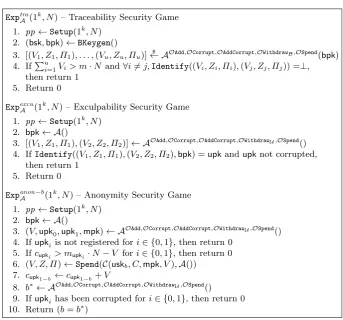
These security properties were formally defined astraceability, anonymity and exculpability by the authors of [CPST15a]. For consistency, we recall the associated security games, in Figure 2, which make use of the following oracles:
– OAdd() is an oracle used by the adversary A to register a new honest user (resp. merchant). The oracle runs theKeygenalgorithm, storesusk(resp.msk) and returnsupk(resp. mpk) toA. In this case, upk(resp. mpk) is saidhonest.
– OCorrupt(upk/mpk) is an oracle used byA to corrupt an honest user (resp. merchant) whose public key is upk (resp. mpk). The oracle then returns the corresponding secret key usk(resp.
msk) toAalong with the secret values of every coin withdrawn by this user. From now on,upk
(resp. mpk) is saidcorrupted.
– OAddCorrupt(upk/mpk) is an oracle used byAto register a new corrupted user (resp. merchant) whose public key isupk(resp.mpk). In this case,upk(resp.mpk) is saidcorrupted. The adversary could use this oracle on a public key already registered (during a previousOAddquery) but for simplicity, we do not consider such case as it will gain nothing more than using the OCorrupt oracle on the same public key.
– OWithdrawU(upk) is an oracle that executes the user’s side of the Withdraw protocol. This
– OWithdrawB(upk) is an oracle that executes the bank’s side of the Withdraw protocol. This
oracle will be used by A playing the role of a user whose public key isupk against the bank.
– OSpend(upk, V) is an oracle that executes the user’s side of theSpend protocol for a value V. This oracle will be used byA playing the role of the merchantM.
In the experiments, users are denoted by their public keys upk, cupk denotes the amount already
spent by user upk during OSpend queries and mupk the number of divisible coins that he has
withdrawn. This means that the total amount available by a userupk is mupk·N. The number of
coins withdrawn by all users during an experiment is denoted bym.
In the anonymity security game, we differ a little bit from [CPST15a]: whilecupkb is increased by
V at step 6 during the Spendprotocol, cupk1−b is also increased byV at step 7 to avoidA trivially
wins by trying to make one of the two players to overspend money.
LetA be a probabilistic polynomial adversary. A divisible E-cash system is:
– traceable ifSucctra(A) = Pr[ExptraA (1k, V) = 1] is negligible for any A;
– exculpable ifSuccexcu(A) = Pr[ExpexcuA (1k, V) = 1] is negligible for any A;
– anonymous ifAdvanon(A) =|Pr[ExpanonA −1(1k, V)] - Pr[ExpanonA −0(1k, V)]| is negligible for any A.
4 Our Construction
4.1 High Level Description
Our Approach. We start from [CPST15a,CPST15b], in order to keep the quite easy and efficient withdrawal procedure (which mostly consists in certifying secret scalars). But we would like to improve on the spending procedure, and namely to get everything really constant (both in time and in size). Indeed, the user should be able to send only one information revealing the serial numbers, corresponding to the amount to be spent. But he should also be able to choose the sequence he discloses. For example, if he wants to pay a valueV with a coin whose (j−1) first serial numbers have already been used, then he should be able to send an element φV,j revealing the V serial
numbersSNj, . . . ,SNj+V−1.
Description. All the serial numbers have the same structure, and are just customized by a random secret scalarxwhich constitutes the secret of the coin (our withdrawals are thus similar to the ones of [CPST15a,CPST15b]). More specifically, the public parameters contain the N values sj = sy
j
(for j = 1, . . . , N), with a public group element s ∈ G1, and some secret scalar y ←$ Zp: for any coin’s secretx, this defines the serial numbers SNj =e(s,eg)
x·yj
.
The critical point is to find a way to construct the unique φV,j and to decide which elements
should be provided in the public parameterspp to enable the bank to compute the serial numbers (all the expected ones, but not more).
First Attempt. One could define φV,j as sxj, in which case pp should contain the set S = {egk =
e
gyk}Nk=0−1. Indeed, a user with a fresh coin (i.e.never involved in a spending) must be able to spend a value N by revealing sx1 and so the bank needs to know S to recover SNi ← e(sx1,egi−1), for i= 1, . . . , N. One can note that S is actually enough for any spending, since, for any j ∈ [1, N], recoveringSNj, . . . ,SNj+V−1 from φV,j still requires elements from{egk}
V−1
k=0.
However, there is an obvious problem with this solution. OnceS is published, nothing prevents the bank from computing more serial numbers than the amountV of the transaction. For example, if a user with a fresh coin spends a value 1, then the bank is still able to recover all the serial numbers fromφ1,1 =sx1.
Our Solution. It is therefore necessary to provide a way, for the user, to control the amount of serial numbers which can be recovered from the elementsxj. To this end, we defineN (one for each possible value V ∈ [1, N]) ElGamal [ElG84] public keys hV = gaV and add the sets SV = {eg
−aV
k } V−1
V = 1, . . . , N, topp. To revealV serial numbers from sxj, the user now encrypts it underhV, which
definesφV,j as (c0 =gr, c1=sxj ·hrV), for somer ∈Zp. By using the elements fromSV, the bank is
still able to compute theV serial numbers since:
e(c1,egk)·e(c0,eg −aV
k ) =e(s x
j ·hrV,egk)·e(g r,
e g−aV
k )
=e(sxj,egk)·e(h r
V,egk)·e(g r,
e g−aV
k )
=e(syj·x,geyk)·e(gaV·r,
e
gk)·e(g−aV·r,egk)
=e(s,ge) x·yj+k
=SNj+k,
fork = 0, . . . , V −1. But now, it can no longer derive additional serial numbers because SV only contains V elements. Moreover, the elements of the other sets SV0, for V0 6= V, are useless since
they correspond to other public keys.
One can note that ElGamal encryption was also used in [CPST15b] but to prevent an adversary from testing relations across the different levels of the tree. We here use it to enable a total control on the amount of revealed serial numbers. A same elementsxj can thus be involved in spendings of different values, which is the basis of the efficiency and the flexibility of our scheme.
Security Analysis. An interesting feature of our solution is that the bank does not need to know the indexj to compute the serial numbers. This is due to the fact that SNj+1 =SNyj, for all
j∈[1, N −1] and so that the computation of a serial number is independent fromj. Therefore, a spending does not reveal any additional information about the coin (such as the spent part) and so achieves the strongest notion of anonymity.
However, this has implications on the security analysis, since one must take into account the relations between the different serial numbers. Anonymity will then rely on a new assumption, called
N−MXDH0, which seems reasonable for Type-3 pairings, as we explain in Section 2.2.
Validity of a Transaction. Serial numbers are central to the detection of double-spending and so to ensure the traceability of the scheme. It is therefore necessary, during a spending of valueV, to force the user to send a valid elementφV,j, by requesting a proof that the latter is well-formed.
The user must then prove that (1) φV,j is an ElGamal encryption of some sxj under hV (which is
known since it corresponds to the spent amount), where (2)xhas been certified, and (3)sj is a valid
parameter for a transaction of value V. The first two statements can easily be handled using the Groth-Sahai [GS08] methodology, but this is not the case for the third one. Indeed, as we explained,
sj (and so the indexj) cannot be revealed unless breaking the anonymity of the scheme which would
only achieve a weaker unlinkability property (as defined in [CPST15a]).
We could use the solution from [CPST15a] which consists in certifying eachsj under the public
keys pk1, . . . ,pkN−j+1 and to prove that the sj to be used is certified under the public key pkV.
However, such a solution is quite efficient for tree-based schemes where eachsj is associated with a
unique node and so with a single amount, but not for our scheme wheresj can be involved in any
transaction of valueV such that V ∈[1, N −j+ 1]. This would dramatically increase the bank’s public key since it would contain aboutN2/2 certificates.
While our public parameters will be of quadratic size, because of the setsSV, we hope the part
necessary to the user to be at most linear inN. We will then use another solution which exploits the relatione(sj,geV−1) =e(sj+V−1,ge). To prove thatj ≤N−V+ 1, the user will thus simply prove
that there is some sk, for k ∈ [1, N], such that e(sj,egV−1) =e(sk,eg). This can be done efficiently
if a certificate on eachsk is provided by the bank. One may note that this proof only ensures that j≤N −V + 1 and not that j ≥1. However, we will show, in the security analysis, that a user is unlikely to produce a proof for an elementsj ∈ {/ s1, . . . , sN}.
the power of tracing any user of the system. We will then use the standard technique of security tags which allows to recover the spender’s identity from any pair of transactions detected as a double-spending. Similarly to the constructions of [CPST15a,CPST15b], we will add to the public parameters the elements tj such that, ∀j ∈ [1, N], tj = scj for some c ∈ Zp and define, for a
transaction involving φV,j, the security tag as ψV,j = (gr 0
,upkR·txj ·hrV0) where upk is the user’s public key andR is some public information related to the transaction. As we prove below, such a tag hides the identity of a spender as long as he does not double-spend its coin.
Remark 7. Divisible e-cash systems do not usually specify the way the coin should be spent. As explained above, our construction is the first one to allow sequential spendings, contrarily to tree-based construction where the coins may contain several holes (see Section 1.1). Therefore, for sake of simplicity, we assume in the following that the user sequentially reveals the serial numbers and so we associate each coin to an index j. The latter means that SN1, . . . ,SNj−1 have already been revealed and that the next spending of valueV will revealSNj, . . . ,SNj+V−1.
However, we stress that the user is free to spend the coin as he wants. The only constraint is that two spendings must not reveal the same serial numbers, otherwise the user will be accused of double-spending.
4.2 Setup
Public Parameters. Let (p,G1,G2,GT, e) be the description of bilinear groups of prime order p, elementsg, h, u1, u2, w be generators of G1,eg be a generator of G2, and H be collision-resistant
hash function ontoZp. A trusted authority generates (z, y)←$ Z2p and, fori= 1, . . . , N (whereN is
the value of the coin),ai ←$ Zp. It then computes the public parameters as follows:
– (s, t)←(gz, hz);
– (sj, tj)←(sy
j
, tyj), for j= 1, . . . , N;
– gek←eg yk
, fork= 0, . . . , N−1
– hi←gai, fori= 1, . . . , N;
– ehi,k ←eg−ai·y
k
, fori= 1, . . . , N and k= 0, . . . , i−1.
These parameters can also be cooperatively generated by a set of users and the bank, in a way similar to the one described in [CPST15a]. The point is that none of these entities should know the scalars (ai)i,y orz.
We divide the public parametersppinto two parts,ppU ← {g, h, u1, u2, w, H,{hi}Ni=1,{(sj, tj)}Nj=1} andppB ← {{egk}
N−1
k=0,{(ehi,k)ki−=01}Ni=1}. The former contains the elements necessary to all the entities
of the system whereas the latter contains the elements only useful to the bank during theDeposit protocol. We therefore assume that the users and the merchants only store ppU and discard ppB.
Note that the former is linear inN, while the latter is quadratic.
Our protocols make use ofNIZKand NIWI proofs for multi-exponentiations and pairing-product equations which are covered by the Groth-Sahai proof system [GS08]. We then add to ppU the
description of a CRS for the perfect soundness setting and of a one-time signature schemeΣots(e.g.
the one from [BB08]).
5 Our Divisible E-Cash System
In this section, we provide an extended description of our new protocol and then discuss its efficiency. We describe a concrete instantiation in Appendix A.
5.1 The protocol
– Keygen(): Each user (resp. merchant) selects a randomusk←Zp(resp.msk) and getsupk←gusk
– BKeygen(): The bank has two important roles to play. It must (1) deliver new coins to users during withdrawals and (2) control the transactions to detect double-spendings and identify the defrauders.
The first point will require a signature scheme Σ1 whose message space is G21 to certify the secret values associated with the withdrawn coins. We can therefore use the construction from [AGHO11] which is optimal in type-3 bilinear groups.
The second point relies on the proof of validity of the elements φV,j sent during a transaction.
As explained above, such a proof requires that the elements sk are certified, for k= 1, . . . , N.
For the same reasons, their dual elements tk must be certified too. It is therefore necessary
to select a structure-preserving signature scheme Σ0 whose message space isG21. We can then still choose the one from [AGHO11] but our security analysis shows that a scheme achieving a weaker security notion would be enough.
Once the schemes Σ0 and Σ1 are selected, the bank generates (sk0,pk0)←Σ0.Keygen(pp) and (sk1,pk1) ← Σ1.Keygen(pp). It then computes τj ← Σ0.Sign(sk0,(sj, tj)) for all j ∈ 1, . . . , N
and sets bsk←sk1 and bpk← {pk0,pk1, τ1, . . . , τN}.
– Withdraw(B(bsk,upk),U(usk,bpk)): As explained in the previous section, each coin is associated with a random scalarx, which implicitly defines its serial numbers asSNk=e(sjx,eg) =e(s,eg)
x·yk
, for k = 1, . . . , N. Delivering a new coin thus essentially consists in certifying this scalar x. However, for security reasons, it is necessary to bind the latter with the identity of its owner. Indeed, if this coin is double-spent, it must be possible to identify the user who has withdrawn it. This could be done by certifying the pair (x,usk) ∈Z2
p (without revealing them), using for
example the scheme from [CL04], but, in the standard model, the bank will rather certify the pair (uusk1 , ux2) ∈ G2
1. This is due to the fact that scalars cannot be efficiently extracted from Groth-Sahai proofs, contrarily to group elements in G1.
In practice, the user computes uusk1 and ux1
2 for some random x1 $
← Zp and sends them to
the bank along with upk. He then proves knowledge of x1 and usk in a zero-knowledge way (using, for example, the Schnorr’s interactive protocol [Sch90]). If the bank accepts the proof, it generates a randomx2
$
←Zp, computesu←$ ux21·u
x2
2 and σ←Σ1.Sign(sk1,(uusk1 , u)) (unless
u was used in a previous withdrawal) and returns σ and x2 to the user. The latter then sets the coin’s secret x ← x1+x2 and coin state C ← (x, σ,1): the last element of C is the index of the next serial number to be used. Hence the remaining amount on the coin isN + 1 minus this index.
Informally, the cooperative generation of the scalar x allows us to exclude (with overwhelming probability) false positives,i.e.a collision in the listLof serial numbers maintained by the bank which would not be due to an actual double-spending. We refer to Remark 8 for more details.
– Spend(U(usk, C,bpk,mpk, V),M(msk,bpk, V)): Let C = (x, σ, j) be the coin the user wishes to spend. The latter selects two random scalars (r1, r2)
$ ← Z2
p and computes R ← H(info), φV,j ←(gr1, sxj ·h
r1
V ) andψV,j←(gr2,upkR·txj ·h r2
V ), where info is some information related to
the transaction (such as the date, the amount, the merchant’s public key,...).
Now, he must prove that (1) his coin C is valid and (2) that the elements φV,j and ψV,j are
well-formed. The first point consists in proving knowledge of a valid signature σ on (uusk1 , ux2), whereas the second point requires to prove knowledge of τj+V−1 on (sj+V−1, tj+V−1). This can be efficiently done in the standard model by using the Groth-Sahai methodology [GS08]. Unfortunately, the resulting proofs can be re-randomized which enables a dishonest merchant to deposit several versions of the same transcript. To prevent such a randomization, the user generates a one-time signature key pair (skots,pkots) which will be used to sign the whole
transcript. To ensure that only the spender can produce this signature, the public keypkotswill
be certified into µ←w
1
usk+H(pkots). One may note that these problems do not arise in the ROM since the proofs would be simply converted into a (non-randomizable) signature of knowledge by using the Fiat-Shamir heuristic [FS87].
More formally, once the user has computed φV,j, ψV,j and µ, he computes Groth-Sahai
1. a NIZK proof π that the committed values satisfy:
φV,j= (gr1, sxj ·h r1
V ) ∧ ψV,j = (g
r2,(gR)usk·tx
j ·h r2
V )
∧ U2=ux2 ∧ U1 =u1usk ∧ µ(usk+H(pkots))=w ∧ e(sj,egV−1) =e(sj+V−1,eg) ∧ e(tj,geV−1) =e(tj+V−1,eg)
2. a NIWI proof π0 that the committed values satisfy:
1 =Σ0.Verify(pk0,(sj+V−1, tj+V−1), τj+V−1) ∧ 1 =Σ1.Verify(pk1,(U1, U2), σ).
Finally, he computes η←Σots.Sign(skots, H(R||φV,j||ψV,j||π||π0)) and sends it toMalong with
pkots, φV,j, ψV,j, πand π0.
The merchant accepts if the proofs and the signatures are correct in which case he stores (V, Z, Π)←(V,(φV,j, ψV,j),(π, π0,pkots, η)) while the user updates its coinC ←(x, σ, j+V).
– Deposit(M(msk,bpk,(V, Z, Π)),B(bsk, L,mpk)): When a transcript is deposited by a merchant, the bank parses it as (V,(φV,j, ψV,j),(π, π0,pkots, η)) and checks its validity (in the same way as
the merchant did during the Spend protocol).B also verifies that it does not already exist in its database.
If everything is correct,Bderives the serial numbers fromφV,j = (φV,j[1], φV,j[2]) by computing
SNk ← e(φV,j[2],egk)·e(φV,j[1],ehV,k), for k = 0, . . . , V −1. If none of these serial numbers is
in L, the bank adds them to this list and stores the associated transcript. Else, there is at least one SN0 ∈L (associated with a transcript (V0, Z0, Π0)) and onek∗ ∈[0, V −1] such that SN0 =SNk∗. The bank then outputs the two transcripts (V, Z, Π) and (V0, Z0, Π0) as a proof of
a double-spending.
– Identify((V1, Z1, Π1),(V2, Z2, Π2),bpk): The first step before identifying a double-spender is to check the validity of both transcripts and that there is a collision between their serial numbers, i.e.there are k1 ∈[0, V1−1] andk2 ∈[0, V2−1] such that:
SNk1 =e(φV1,j1[2],egk1)·e(φV1,j1[1],ehV1,k1)
=e(φV2,j2[2],egk2)·e(φV2,j2[1],heV2,k2) =SNk2
Let Tb be e(ψVb,jb[2],egkb)·e(ψVb,jb[1],heVb,kb), for b ∈ {1,2}. The algorithm checks, for each
registered public key upki, whether T1·T2−1=e(upki,eg R1
k1 ·eg −R2
k2 ) until it gets a match. It then returns the corresponding key upk∗ (or⊥ if the previous equality does not hold for anyupki), allowing anyone to verify, without the linear cost in the number of users, that the identification is correct.
Remark 8. A collision in the list L means that two transcripts (V1, Z1, Π1) 6= (V2, Z2, Π2) lead to a same serial number SN. Let Zb = (φVb,jb, ψVb,jb), for b∈ {1,2}, the soundness of the NIZK proofs
produced by the users during the spendings implies that:
e(φV1,j1[2],gek1)·e(φV1,j1[1],ehV1,k1) =e(s1,egk1)
x1 =SN =e(s2,egk2)
x2 =e(φ
V2,j2[2],egk2)·e(φV2,j2[1],ehV2,k2)
for somek1 ∈[0, V1−1],k2∈[0, V2−1] and certified scalars x1 and x2, where the elementss1 and s2 verify, with `1, `2 ∈[1, N]:
e(s1,egV1−1) =e(s`1,eg) and e(s2,geV2−1) =e(s`2,eg).
Therefore, we have, forb∈ {1,2},e(sb,eg) =e(s,eg)
y`b−Vb+1, and so
SN=e(s,eg)x1·y`1−V1+1+k1 =e(s,
e
g)x2·y`2−V2+1+k2
Remark 9. The soundness of the proofs implies that theIdentifyalgorithm will output, with over-whelming probability, an identityupkeach time a collision is found inL. Indeed, let (V1, Z1, Π1),(V2, Z2, Π2) be the two involved transcripts, andk1, k2 such that:
SNk1 =e(φV1,j1[2],gek1)·e(φV1,j1[1],ehV1,k1)
=e(φV2,j2[2],gek2)·e(φV2,j2[1],ehV2,k2) =SNk2 Forb∈ {1,2}, ifΠb is sound, then (φVb,jb[1], φVb,jb[2]) = (g
rb, sxb
jb ·h
rb
Vb) for some rb∈Zp and so:
SNk1 =e(s
x1
j1,egk1) =e(s
x2
j2,gek2) =SNk2 (1) For the same reasons,Tb=e(ψVb,jb[2],egkb)·e(ψVb,jb[1],heVb,kb) =e(upk
Rb
b ·t xb
jb,egkb), forb∈ {1,2}.
As explained in the previous remark, the equality (1) is unlikely to hold for different scalarsx1 and x2. We may then assume that x1 = x2 = x and so that upk1 = upk2 = upk since the bank verifies, during a withdrawal, that the same scalarx(or equivalently the same public value u=ux2) is not used by two different users.
The relation (1) also implies that e(tx
j1,egk1) =e(t
x
j2,egk2) and so that:
T1·T2−1 =e(upkR1,egk1)·e(upk
R2,
e gk2)
−1=e(upk,
e gR1
k1 ·eg −R2
k2 ).
The defrauder’s identityupkwill then be returned by the algorithmIdentify, unlesseg R1
k1 ·eg −R2
k2 = 1G2. However, such an equality is very unlikely for distinct k1 and k2 (for the same reasons as the ones given in Remark 8) but also fork1 =k2 since it would imply that R1 =R2 and so a collision on the hash functionH.
The security of our divisible E-Cash system is stated by the following theorems, whose proofs can be found in the next section.
Theorem 10. In the standard model, our divisible E-Cash system istraceableunder theN−BDHI
assumption if Σ0 is an EUF-SCMA signature scheme,Σ1 is an EUF-CMA signature scheme, and
H is a collision-resistant hash function.
Theorem 11. Let q be a bound on the number of OSpend queries made by the adversary. In the standard model, our divisible E-Cash system achieves theexculpability propertyunder theq−SDH
assumption if Σots is a SUF-OTS signature scheme, and H is a collision-resistant hash function.
Theorem 12. In the standard model, our divisible E-Cash system isanonymousunder theSXDH
and the N−MXDH0 assumptions.
Remark 13. A downside of our construction is that its anonymity relies on a quite complex assump-tion. This is due to the fact that most elements of the public parameters are related, which must be taken into account by the assumption. As we explain in Appendix C, we can rely on a more conventional assumption (while keeping the constant size property) by generating these parameters independently. Unfortunately, this has a strong impact on the efficiency of the protocol. Such a solution must then be considered as a tradeoff between efficiency and security assumption.
5.2 Efficiency
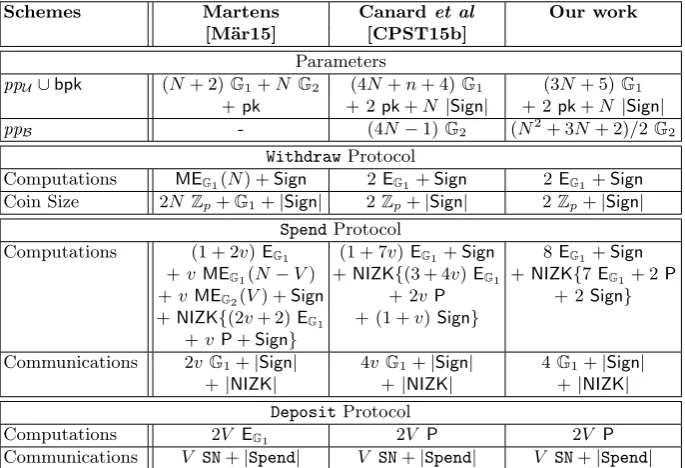
We compare in Figure 3, the efficiency of our construction with the state-of-the-art, and namely Martens [M¨ar15] (which improves the construction of [CG10]) and Canard et al [CPST15b]. One can note that our table differs from those provided in these papers. This is mostly due to the fact that they only describe the most favorable case, where the spent valueV is a power of 2. However, in real life, such an event is quite unlikely. Most of the time, the users of such systems will then have to write V = P
bi ·2i, for bi ∈ {0,1} and repeat the Spend protocol for each bi = 1. Our
description therefore considers the Hamming weightv of V (i.e.the number ofbi such thatbi = 1)
Schemes Martens Canardet al Our work [M¨ar15] [CPST15b]
Parameters
ppU∪bpk (N+ 2)G1+N G2
+pk
(4N+n+ 4)G1
+ 2pk+N |Sign|
(3N+ 5)G1
+ 2pk+N |Sign|
ppB - (4N−1)G2 (N2+ 3N+ 2)/2G2
WithdrawProtocol
Computations MEG1(N) +Sign 2EG1+Sign 2EG1+Sign
Coin Size 2N Zp+G1+|Sign| 2Zp+|Sign| 2Zp+|Sign| SpendProtocol
Computations (1 + 2v)EG1
+vMEG1(N−V) +vMEG2(V) +Sign
+NIZK{(2v+ 2)EG1
+vP+Sign}
(1 + 7v)EG1+Sign
+NIZK{(3 + 4v)EG1 + 2vP + (1 +v)Sign}
8EG1+Sign
+NIZK{7EG1+ 2P + 2Sign}
Communications 2vG1+|Sign|
+|NIZK|
4vG1+|Sign|
+|NIZK|
4G1+|Sign|
+|NIZK|
DepositProtocol
Computations 2V EG1 2V P 2V P
Communications V SN+|Spend| V SN+|Spend| V SN+|Spend|
Fig. 3.Efficiency comparison between related works and our construction for coins of valueN andSpendandDeposit
of valueV (V ≤N). The computation and communication complexities2are given from the user’s point of view. Another difference with [M¨ar15] comes from the fact that the author considered that “a multi-base exponentiation takes a similar time as a single-multi-base exponentiation”. Although some works (e.g. [BGR98]) have shown that an N-base exponentiation can be done more efficiently that N
single-base exponentiations, considering that the cost of the former is equivalent to the one of a single exponentiation is a strong assumption, in particular whenN can be greater than 1000 (if the coin’s value is greater than 10$). Our table therefore distinguishes multi-base exponentiations from single ones.
An important feature for an electronic payment system is the efficiency of itsSpendprotocol. This is indeed the one subject to the strongest time constraints. For example, public transport services require that payments should be performed in less than 300ms [GSM12], to avoid congestion in front of turnstiles. From this perspective, our scheme is the most effective one and, above all, is the first one to achieve constant time (and size) spendings, no matter which value is spent. Moreover, our divisible E-Cash system offers the same efficiency as the withdrawals of [CPST15b], while keeping a reasonable size for the parametersppU. Indeed, in our protocol, ppU just requires 230 KBytes of
storage space forN = 1024 (defining the coin’s value as 10.24$) if Barreto-Naehrig curves [BN06] are used to instantiate the bilinear groups. For the same settings, ppU amounts to 263 KBytes for [CPST15b] and 98 KBytes for [M¨ar15].
From the bank’s point of view, the downside of our scheme is the additional parameters ppB that the bank must store, and they amount to 33 MBytes, but it should not be a problem for this entity. As for the other schemes, each deposit of a valueV requires to storeV serial numbers whose size can be adjusted by using an appropriate hash function (see Remark 14 below).
Remark 14. As explained in [CPST15a], the bank does not need to store the serial numbers but only their smaller hash values, as fingerprints. Therefore, the size of the V elements SN computed during a deposit of valueV is the same for all the schemes. The Deposit size then mostly depends on the size of theSpendtranscripts. By achieving smaller, constant-size spendings, we thus alleviate the storage burden of the bank and so improve the scalability of our divisible E-Cash system.
2 ndenotes the smallest integer such thatN≤2nandvthe Hamming weight ofV.
EG refers to an exponentiation inG,MEG(m) to a multi-exponentiation withmdifferent bases inG,Pto a pairing computation, andSignto the cost of the signing protocol whose public key ispk.
NIZK{EG}denotes the cost of aNIZKproof of a multi-exponentiation equation inG,NIZK{P}the one of a pairing-product equation, andNIZK{Sign}the one of a valid signature.
Remark 15. Public identification of defrauders has an impact on the complexity of the system. This roughly doubles the size of the parameters and requires several additional computations during a spending. Such a property also has consequences on the security analysis which must rely on a stronger assumption (namely the N −MXDH0 one instead of its weaker variant) involving more challenge elements.
However, in some situations, it can be possible to consider an authority which would be trusted to revoke user’s anonymity only in case of fraud. The resulting e-cash system, calledfair, obviously weakens anonymity but may be a reasonable tradeoff between user’s privacy and legal constraints. Our scheme can be modified to add such an entity. One way would be to entrust it with the extraction key of the Groth-Sahai proof system. It could then extract the elementU1 =uusk1 from any transaction and so identify the spender. The elementstj would then become unnecessary and could
be discarded from the public parameters. Moreover, the elements ψV,j, along with the associated
proofs, would also become useless during theSpendprotocol. The complexity of the scheme would then be significantly improved. The consequences of these changes on the security analysis are discussed in Remark 21 of the next section.
6 Security Analysis
6.1 Proof of Theorem 10: Traceability
Let us consider a successful adversary A which manages to spend more than he has withdrawn without being traced. This formally means that it is able to produce, after qw withdrawals, u
valid transcripts {(Vi, Zi, Πi)}ui=1 representing an amount of
Pu
i=1Vi > N ·qw, but such that Identify((Vi, Zi, Πi),(Vj, Zj, Πj)) =⊥, for all i6=j. We can have the three following cases:
– Type-1 Forgeries:∃isuch thatΠi contains commitments to a pair (s`i, t`i) which was not signed
in a τ` by the bank, during the key generation phase;
– Type-2 Forgeries: ∃i such thatΠi contains commitments to a pair (uusk1 , ux2) which was never signed by the bank, during a OWithdrawU query;
– Type-3 Forgeries: ∀1 ≤ i ≤ u, ∃τ`i in bpk which is a valid signature on the pair (s`i, t`i)
committed in Πi and the pairs (uusk1 , ux2) involved in this transcript were signed by the bank during a OWithdrawU query, but identification fails.
Intuitively, the first two cases imply an attack against the signatures schemesΣ0 orΣ1, respectively. This is formally stated by the two following lemmas:
Lemma 16. Any Type-1 forger A with success probability ε can be converted into an adversary against the EUF-SCMA security of Σ0 with the same success probability.
Proof. The reductionRgenerates the public parameters (the group elements), and sends{(sj, tj)}Nj=1 to the signing oracle of the EUF-SCMA security experiment which returns the signatures{τj}Nj=1 along with the challenge public keypk. It can runΣ1.Keygento get the key pair (sk1,pk1) and set
bpkas (pk0 =pk,pk1, τ1, . . . , τN). One may note that Ris able to answer any query from A since
it knowsbsk=sk1.
At the end of the game,Rextracts (it has generated theCRS of the Groth-Sahai proofs system and so knows the related extraction keys) fromΠi, fori∈[1, u], a valid signature τ`i on some pair
(s`i, t`i) under the public key pk. SinceAis a Type-1 forger with success probability ε, at least one
of these pairs does not belong to the set {(sj, tj)}Nj=1 and so is valid forgery which can be used to
break the EUF-SCMA security ofΣ0, with probabilityε. ut
Lemma 17. Any Type-2 forger A with success probability ε can be converted into an adversary against the EUF-CMA security ofΣ1 with the same success probability.
Proof. The reductionRgenerates the public parameters (the group elements) and its public key as usual except that it setspk1 aspk, the challenge public key in the EUF-CMA security experiment. R can then directly answer all the queries except the OWithdrawB ones for which it will forward
the pairs (uusk
The game ends when A outputs u transcripts such that one of them, (2`, Z, Π), contains a commitment to a pair (uusk
1 , ux2) which was never signed by the bank during aOWithdrawB query. The soundness of the proof implies that it also contains a commitment to an elementσ such that
Σ1.Verify((uusk1 , ux2), σ,pk) = 1. Such a forgery can then be used to break the EUF-CMA security
ofΣ1. ut
Now, it remains to evaluate the success probability of a Type-3 forger. The following lemma shows that it is negligible underN −BDHIassumption.
Lemma 18. Any Type-3 forger A with success probability ε can be converted into an adversary against theN −BDHI assumption with the same success probability.
Proof. Let ({gyi}N i=0,{eg
yi}N
i=0)∈GN1+1×G2N+1be aN−BDHIchallenge. The reductionRgenerates random scalarsc, z0 ←Zp andai ←Zp, fori= 1, . . . , N, and sets the public parameters as follows:
– (sj, tj)←((gy
j−1
)z0,(gyj−1)c·z0), forj= 1, . . . , N;
– gek←eg yk
, fork= 0, . . . , N−1
– hi←gai, fori= 1, . . . , N;
– ehi,k ←(egy
k
)−ai, fori= 1, . . . , N and k= 0, . . . , i−1.
By setting (s, t) = (gz0·y−1, gc·z0·y−1) —recall that this pair is not published inpp—, one can easily check that the simulation is correct:sj =sy
j
andtj =ty
j
.Rthen generates theCRS for the perfect soundness setting and stores the extraction keys. Finally, it computes the bank’s key pair (bsk,bpk) as usual and so is able to answer every oracle queries.
At the end of the game, R extracts the elements s(i) committed in Πi, for i = 1, . . . , u.
Each of these proofs also contains a commitment to signature τ`i on the pair (s`i, t`i) such that:
e(s(i),geVi−1) = e(s`i,eg). Since we here consider Type-3 forgeries, `i ∈ [1, N] (otherwise τ`i ∈/ bpk)
and so s`i = s
y`i
. Therefore, we have s(i) = sy`i−Vi+1, where `i −Vi + 1 ≤ N −Vi+ 1. We then
distinguish the two following cases.
– Case 1: ∀i∈[1, u],`i−Vi+ 1≥1;
– Case 2: ∃i∈[1, u] such that`i−Vi+ 1<1.
The first case means thatAonly used valid elementss(i)(i.e.s(i)=sjisuch thatji ∈[1, N−Vi+1]) to
construct the proofsΠi. So all the (Pui=1Vi) serial numbers derived from theutranscripts returned
byAbelong to the setS ={∪qw
k=1{e(s,eg) xk·y`}N
`=1}, where{xk}qkw=1 is the list of the scalars certified
by the bank during theOWithdrawU queries. An over-spending means that Pui=1Vi> N·qw=|S|,
so there is at least one collision in the list of the serial numbers. However, a collision without identification of a defrauder is unlikely, as we explained in Remark 9. Hence, case 1 can only occur with negligible probability.
Now, let us consider the second case: when such a case occurs, Ris able to extract the element
sy`i−Vi+1such that`i−Vi+1≤0, and computeg←(sy`i −Vi+1
)1/z0 =gy`i−Viwith 1−N ≤`i−Vi ≤ −1.
Letkibe the integer such that`i−Vi+ki =−1. The previous inequalities imply thatki∈[0, N−2]
and soR can break theN −BDHIassumption by returninge(g,eg)y−1 =e(g,egki). ut
6.2 Proof of Theorem 11: Exculpability
The goal of the adversary A is to make the identify procedure to claim an honest user upk guilty of double-spending: it publishes two valid transcripts (V1, Z1, Π1) and (V2, Z2, Π2) such that upk= Identify((V1, Z1, Π1),(V2, Z2, Π2)), while this user did not perform the two transactions (maybe one). We can obviously assume that one of these transcripts has been forged byA.
Let us consider a successful adversary. We distinguish the two following cases:
– Type-1 forgeries: the public key pkots of the one-time signature scheme used in this forged transcript is one of those used by the honest user to answer OSpendqueries.
Lemma 19. Let qs be a bound on the number ofOSpendqueries. Any Type-1 forgerAwith success
probability ε can be converted into an adversary against the SUF-OTS security of the one-time signature scheme Σots with success probability greater thanε/qs.
Proof. The reductionRgenerates the public parameters along with the bank’s key pair and selects an integeri∗ ∈[1, qs]. Upon receiving theith OSpendquery, it acts normally if i6=i∗, but uses the
public keypk∗otsand the signing oracle of the SUF-OTS security experiment if i=i∗.
Let pkots be the public key involved in the forged transcript. R aborts if pkots 6=pk∗ots, which occurs with probability 1−1/qs. Else, the forged transcript contains a new one-time signature η
underpk∗ots which can be used against the security of Σots. ut
Lemma 20. Let qs (resp. qa) be a bound on the number of OSpend queries (resp. OAdd queries).
Any Type-2 forger A with success probability ε can be converted into an adversary against the
qs−SDH assumption with success probability ε/qa.
Proof. Let (g, gα, . . . , gαqs) be a q
s−SDH challenge, the reduction R will make a guess on the
user upk∗ framed by A and will act as if its secret key was α. Therefore, it selects 1 ≤ i∗ ≤ qa
and generates the public parameters as in the Setup algorithm except that it sets u1 as gz for some random z ∈ Zp. Next, it computes qs key pairs (sk(otsi),pk
(i)
ots) ← Σots.Keygen(1k) and sets w
asgQqsi=1(α+H(pk (i)
ots)) (which is possible using theqs−SDH challenge [BB08], since the exponent is a
polynomial inα of degree qs). The reduction will answer the oracle queries as follows.
– OAdd() queries: When the adversary makes theith OAdd query to register a user, R runs the Keygenalgorithm if i6=i∗ and setsupk∗ ←gα otherwise.
– OCorrupt(upk/mpk) queries:R returns the secret key if upk6=upk∗ and aborts otherwise.
– OAddCorrupt(upk/mpk) queries:Rstores the public key which is now considered as registered.
– OWithdrawU(bsk,upk) queries: R acts normally if upk 6= upk∗ and simulates the interactive
proof of knowledge of α otherwise.
– OSpend(upk, V) queries:Racts normally ifupk6=upk∗. Else, to answer thejth query onupk∗,
it computes µ ← g Qqs
i=1,i6=j(α+H(pk
(i)
ots)) which satisfies µ = w1/(α+H(pk(otsj))), and uses sk(j)
ots as in
the Spendprotocol.
The adversary then outputs two valid transcripts (V1, Z1, Π1) and (V2, Z2, Π2) which accuseupkof double-spending. Ifupk6=upk∗ thenRaborts which will occur with probability 1−1/qa. Else, the
soundness of the proof implies that the forged transcript was signed under pkots and so that the
proof involves an elementµ=w
1
α+H(pkots). Since here we consider Type-2 attacks, pk
ots ∈ {/ pk
(i)
ots}i.
Therefore,H(pkots)∈ {/ H(pk(otsi))}i with overwhelming probability, due to the collision-resistance of the hash functionH. The elementµcan then be used to break the qs−SDH assumption inG1 (as
in [BB08]). ut
6.3 Proof of Theorem 12: Anonymity
In this proof, we assume that the coins are spent in a sequential way: the index j in C = (x, σ, j) is increased byV after each spending of an amountV, and the newj is used in the next spending. A next coin is used when the previous coin is finished. But the proof would also apply if the user could adaptively choose the coin (x, σ), as well as (j, V) for every spending.
We can make the proof with a sequence of games, starting from the initial game for anonymity, with a random bit b (see Figure 2), where the simulator emulates the challenger but correctly generating all the secret values. The advantage isε, and we want to show it is negligible.
In a next game, the simulator makes a guess on the amountV∗ ∈[1, N] chosen by the adversary during the step 3 of the anonymity experiment (see Figure 2) and also makes a guess j∗ ∈[1, N −
V∗+ 1] for the actual index of the coin of the user upkb at the challenge time (but this challenge value could be chosen by the adversary, as said above). In addition, we denote qw the bound on
the number ofOWithdrawU queries, and the simulator selects a random integer`∗ ∈[1, qw], for the
If during the simulation it appears they are not correct, one stops the simulation. This guess does not affect the success probability of the adversary, when the guess is correct, but just reduces the advantage fromε to 2ε/(qwN2).
Next, the simulator generates theCRS for the Groth-Sahai proofs in the perfect witness indis-tinguishability setting, so that it can later simulate the proofs. This is indistinguishable from the previous game under theSXDH assumption.
Now, the simulator will simulate the public parameters from an N−MXDH0 challenge:
– (gγk, hγk)Pk=0∈G2P+2
1 ,
– (gα·δ·γ−k, hα·δ·γ−k)Ek=0∈G21E+2,
– (gχ·γk, hχ·γk)Pk=D+1 ∈G2C
1 ,
– and ((gα·γ−k)Ck=0,(gχ·γk/α, hχ·γk/α)Ck=0,)∈G3S
1 ,
– as well as (egγk,egα·γ−k)Ck=0∈G2S
2 ,
– and a pair (gz1, hz2)∈
G21 be anN −MXDH
0 challenge.
We recall that C = N3 −N2, S = C + 1, E = N2 − N, D = S + E = N3 −N + 1 and
P = D +C = 2N3 −N2 −N + 1. Let d be the quotient of the division of N2 by V∗ (i.e.
N2 =d·V∗+rdwith 0≤rd< V∗), then the simulator constructs the public parameters as follows.
– g and h are defined fromgγk and hγk respectively, withk= 0;
– u1 $
←G1 andu2←gw·γ
P
, for a random w∈Zp;
– geis defined from egγk, withk= 0;
– (sj, tj)←(gγ
D+d(1−V∗+j−j∗)
, hγD+d(1−V ∗+j−j∗)
), forj = 1, . . . , N;
– gek←eg γd·k
, fork= 0, . . . , N−1;
– hi←gwi·α·γ
d(−i+1)
, for i∈[1, . . . , N], with wi a random scalar;
– ehi,k ←eg−wi·α·γ
d(k−i+1)
, fori∈[1, . . . , N] andk= 0, . . . , i−1.
We must check that
(1) the simulation of the parameters is correct: let us define y = γd, (s, t) = (gγD+d(1−V∗−j ∗)
, hγD+d(1−V∗−j
∗
)
), andai =α·wi·γd(−i+1) fori∈[1, . . . , N]. We then have:
– (sj, tj) = ((gγ
D+d(1−V∗−j∗)
)γd·j,(hγD+d(1−V∗−j ∗)
)γd·j) = (syj, tyj);
– egk=eg yk
, fork= 0, . . . , N−1;
– hi=gai, fori= 1, . . . , N;
– ehi,k =eg−ai·y
k
, fori= 1, . . . , N and k= 0, . . . , i−1. The simulation is therefore correct;
(2) all of these elements can be provided from the N −MXDH0 challenge: First, recall thatN2 =
d·V∗+rd with 0≤rd< V∗ ≤N. Then 2≤V∗+j∗≤N+ 1 and N ≤d≤N2.
Let us consider the pairs (sj, tj) = (gγ
D+d(1−V∗+j−j∗)
, hγD+d(1−V ∗+j−j∗)
), for j= 1, . . . , N: 1 +j− (V∗+j∗)≥2−(N+1)≥ −N+1, therefore,d(1−V∗+j−j∗)≥ −d(N−1)≥ −N2(N−1)≥ −C. Moreover,d(1−V∗+j−j∗)≤d(N−1)≤N2(N−1)≤C. HenceD−C≤D+d(1−V∗+j−j∗)≤
D+C=P. SinceD=S+E =C+ 1 +E,D−C =E+ 1 =N2−N+ 1≥0. Hence, the pairs (sj, tj) can be defined from the tuple (gγ
k
, hγk)Pk=0 of the N−MXDH0 instance. About the elements egk=eg
γd·k, since we have 0≤d·k≤N2(N−1) =C, for k= 0, . . . , N−1, they all are in the tuple (egγk)C
k=0.
Eventually, let us consider the elements hi = gwi·α·γ
d(−i+1)
and ehi,k = e
g−wi·α·γd(k−i+1), for i ∈
[1, N] and k∈[0, i−1]. Since −C ≤ −d(N−1)≤d(−i+ 1)≤0 and −C ≤d(k−i+ 1) ≤0, they all can be computed from the tuples (gα·γ−k)Ck=0and (egα·γ−k)Ck=0, just using the additional random scalar wi.
The reductionRis thus able to generate the public parameters from theN−MXDH0 instance.
The simulator now has to answer all the oracle queries, with all the secret keys.