Physics Procedia 00 (2009) 000–000
www.elsevier.com/locate/procedia
Frontier Research in Nanoscale Science and Technology
White light generation and amplification using a soliton pulse within
a nano-waveguide
Khuntong Sarapat
a, Jalil Ali
a,*, Preecha P. Yupapin
b, Artit Worrarutkul
b,
and Wanchai Khunnam
caInstitute of Advanced Photonics Sciences, Science Faculty Universiti Teknologi Malaysia, 81310 Skudai, Johor Bahru, Malaysia
bAdvanced Research Center for Photonics, Faculty of Science King Mongkut’s Institute of Technology Ladkrabang, Bangkok 10520, Thailand cDepartment of Physics, Faculty of Science, Naresuan University, Pitsanulok, Thailand
Elsevier use only: Received date here; revised date here; accepted date here
Abstract
We propose a novel system of a nano-waveguide that can be used to generate the continuous optical spectrum, i.e. white light. A system consists of two micro and a nano ring resonators that can be integrated into a single system. The large bandwidth signa is generated by using a soliton pulse propagating within a Kerr type nonlinear medium, whereas the continuous bandwidth or wavelength of light signal can be performed. Results obtained have shown the potential of using such system for white light source generation and amplification, which is discussed. The amplified pulse can be stored within a nano-waveguide, which is allowed to form the continuous spectrum after amplification. Alternatively, the low level solar radiation can be amplified, and the bandwidth signals can also be enlarge. © 2009 Elsevier B.V. All rights reserved.
PACS:42.50.Ex; 42.70.-a
Keywords: Solar radiation; Solar amplification; Continuous spectra; White light, Nano-waveguide
1. Introduction
Linear electronic devices and system have been used in human life for years, whereas the various applications have been seen in the world. To date, the progress in new technology and application is quite slow, which may be limited in the near future. Therefore, the trend of new device and technology is become the interesting subject of research today. Nonlinear device is one of the target device and technology that should be encouraged to research for the new era of technology of the world. The interesting results of the nonlinear device that have been reported [1, 2], they have shown the interesting and promising result of using the nonlinear device known as a “nano-ring resonator”
* Corresponding author: Tel: 07-5591500, fax: 07-5565899 E-mail address: [email protected].(Jalil Ali).
Physics Procedia 2 (2009) 53–57
www.elsevier.com/locate/procedia
in various applications. Further, the evidence of such a device using in the laboratory has also been report [3]. The device is fabricated by using the nonlinear material called “InGaAsP/InP”, where the nonlinear refractive index is one of the properties of the key phenomenon and good results. To begin this concept, we introduce the device known as a “ring resonator”, which is in the circular form or planar waveguide. Yupapin et al [4, 5] have shown the promising applications when the ring radius is down to micrometer or nanometer. For instance, the ultra fast switching can be easily generated by using a remarkably simple arrangement, where the achievement of the switching time of attosecond and beyond is confirmed [1]. The most interesting results is seen when light pulse can be slow down, stopped and stored within the nonlinear nano-waveguide [2], where the signal amplification within the tiny device has shown the great successful.
Recently, Yupapin and Suwancharoen have reported [6] the interesting results of light pulse propagating within a nonlinear micro ring device, where the transfer function of the output at resonant condition is derived and used. They found that the broad spectrum of light pulse can be transformed to the discrete pulses.An optical soliton is recognized as a powerful laser pulse, which can be used to enlarge the optical bandwidth when propagating within the nonlinear micro ring resonator [7]. Initially, the optimum energy is coupled into the waveguide by a larger effective core area device, i.e. ring resonator. Then the smaller one is connected to form the stopping behavior. The filtering characteristic of the optical signal is presented within a ring resonator, where the suitable parameters can be controlled to obtain the required output energy. To maintain the soliton pulse propagating within the ring resonator, the suitable coupling power into the device is required, whereas the interference signal is a minor effect compared to the loss associated to the direct passing through. In this letter, we propose two different optical schemes that can be used to generate the continuous spectrum, and store within the tiny device. Firstly, the white light spectrum can be formed by using the soliton pulse within the novel system. Secondly, the selected pulse can be amplified and stored within the nano-waveguide. The operation of the system can be used to describe the concept of white light generation and regeneration, which is allowed to perform the solar energy collection and conversion.
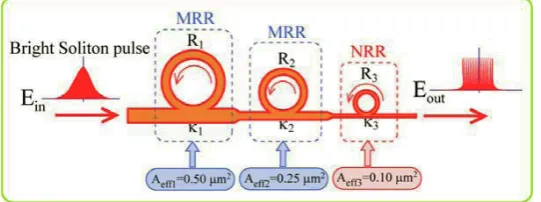
Fig. 1. A schematic of a continuous spectrum generation system, where a bright soliton, where Rs: ring radii, Ns: coupling coefficients, MRR: micro ring, NRR: nano ring.
An optical soliton is recognized as a powerful laser pulse, which can be used to enlarge the optical bandwidth when propagating within the nonlinear micro ring resonator. Moreover, the superposition of self-phase modulation soliton pulses can keep the large output power. Initially, the optimum energy is coupled into the waveguide by a lager effective core area device, i.e. ring resonator. Then the smaller one is connected to form the stopping behavior. The filtering characteristic of the optical signal is presented within a ring resonator, where the suitable parameters can be controlled to obtain the required output energy. To maintain the soliton pulse propagating within the ring resonator, the suitable coupling power into the device is required, whereas the interference signal is a minor effect compared to the loss associated to the direct passing through. soliton pulse, which is introduced into themulti-stage nano ring resonators as shown in Figs. 1 or 2, the input optical field (Ein) of the bright and dark soliton pulses input are given by an Eq. (1) and (2), respectively.
0 0
sec exp
2 in
D
T z
E t A h i t
T L Z
ª º
ª º § ·
«¨ ¸ »
« »
© ¹
¬ ¼ ¬ ¼
Where A and z are the optical field amplitude and propagation distance, respectively. T is a soliton pulse propagation time in a frame moving at the group velocity, T = t-E1*z, where E1 and E2 are the coefficients of the linear andsecond order terms of Taylor expansion of the propagation constant. 2 2
0
E
TLD is the dispersion length of the soliton pulse. To in equation is a soliton pulse propagation time at initial input. Where t is the soliton phase shift time, and he frequency shift of the soliton is Ȧ0. This solution describes a pulse that keeps its temporal width invariance as it propagates, and thus is called a temporal soliton. When a soliton peak intensity
20 2/*T
E is given, then
T
o is known. For the soliton pulse in the micro ring device, a balance should be achieved between the dispersion length (LD) and the nonlinear length (LNL= (1/*INL), where * = n2*k0, is the length scale over which dispersive or nonlinear effects makes the beam becomes wider or narrower. For a soliton pulse, there is a balance between dispersion and nonlinear lengths, henceL
DL
NL.When light propagates within the nonlinear material (medium), the refractive index (n) of light within the medium is given by
, ) ( P A n n I n n n eff (2)
where n and n are the linear and nonlinear refractive indexes, respectively. I and P are the optical intensity and optical power, respectively. The effective mode core area of the device is given byAeff . For the micro ring and nano ring resonators, the effective mode core areas range from 0.50 to 0.1 Pm2 [3], where they found that fast light pulse can be slow down experimentally after input into the nano ring.
When a soliton pulse is input and propagated within a micro ring resonator as shown in Fig. 1 or 2, which consists of a series micro ring resonators. The resonant output is formed, thus, the normalized output of the light field is the ratio between the output and input fields (Eout(t)andEin(t)) in each roundtrip, which can be expressed as
» » » » ¼ º « « « « ¬ ª ) 2 ( sin 1 1 4 ) 1 1 1 ( ) ) 1 ( 1 ( 1 ) 1 ( ) ( ) ( 2 2 2 2 I N J N J N J J x x x t E t E in out (3)
The close form of equation (3) indicates that a ring resonator in the particular case is very similar to a Fabry-Perot cavity, which has an input and output mirror with a field reflectivity, (1-N), and a fully reflecting mirror. Nis the coupling coefficient, andx exp
DL/2 represents a roundtrip loss coefficient, I kLn andI
NLkLn
2E
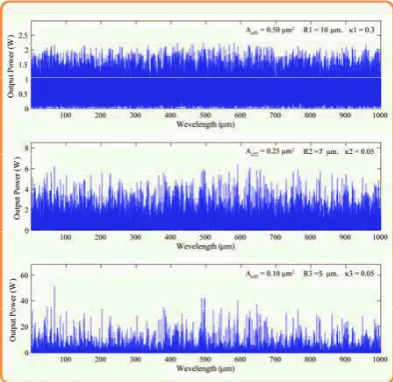
in 2 are the linear and nonlinear phase shifts, k S/O is the wave propagation number in a vacuum. Where L and D are a waveguide length and linear absorption coefficient, respectively. In this work, the iterative method is introduced to obtain the results as shown in equation (3), similarly, when the output field is connected and input into the other ring resonators.Fig. 2. Results obtained when a soliton pulse is input into a micro ring resonator system for within NRR.
In operation, the large bandwidth signal within the micro ring device can be generated by using a soliton pulse input into the nonlinear micro ring resonator. This means that the white light spectra can be generated after the soliton pulse is input into the ring resonator. The schematic diagram of the proposed system is as shown in Fig. 1. A soliton pulse with 50 ns pulse width, peak power at 0.65 W is input into the system. The suitable ring parameters are used, for instance, ring radii R1= 10.0 ȝm, R2= 7.0 ȝm, and R3= 5.0 ȝm. In order to make the system associate with the practical device [8, 9], the selected parameters of the system are fixed to O0 = 1.55 Pm, n0 = 3.34 (InGaAsP/InP), Aeff = 0.50, 0.25 Pm2 and 0.10 Pm2 for a micro ring and nano ring resonator [3], respectively, D = 0.5 dBmm-1, J = 0.1. The coupling coefficient (kappa, N) of the micro ring resonator ranged from 0.03 to 0.1. The nonlinear refractive index is n2=2.2 x 10⁻¹³ m2/W. In this case, the wave guided loss used is 0.5dBmm-1. The input soliton pulse is chopped (sliced) into a smaller signal spreading over the spectrum (i.e. white light) as shown in Fig. 2, which is shown that the large bandwidth signal is generated within the first ring device. The biggest output amplification is obtained within the nano-waveguide (last ring, R3). In Fig. 3, results obtained when a soliton pulse is input into the ring resonator system in Fig. 1, where the parameters used are R1= 10 ȝm, Aeff1 = 0.50 Pm2, R2= 7
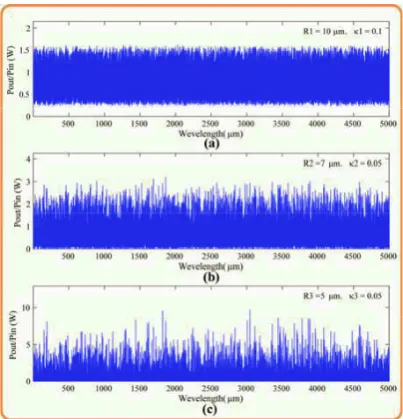
ȝm, Aeff2 = 0.25 Pm2, R3= 5 ȝm, Aeff3 = 0.10 Pm2 and N1 = 0.10 and N2 = N3 = 0.05. The continuous spectra output with 10 times larger than the input is obtained. The coupling coefficients are given as shown in the figures. We also found that the light pulse energy recovery (amplification) can be obtained by connecting the nano ring device into the system. The coupling loss is included due to the different core effective areas between micro and nano ring devices, which is given by 0.1dB. The key point of this proposal is that the solar radiation can be amplified, which is available for solar energy collection and amplification. This is the target for the improvement of solar energy collection efficiency.
The continuous spectrum of light pulse is chopped (sliced) to be a discrete spectrum by the nonlinear behavior of light known as chaotic property. The main parameter involved is the nonlinear refractive index of the device, i.e. a waveguide material and structure. The effective core area used is 0.10 Pm2, which is formed by a nano-waveguide. In principle, the power amplification within a nano ring device is obtained by the soliton behavior known as self-phase and cross self-phase modulations, which can be performed when the balance between the dispersion and nonlinear length phase shift presented. This is introduced the soliton pulse energy recovery, i.e. amplification, which is generated the large white light output power.
we are looking for the possible implementation system, where the generation of white light source and solar radiation collection within the tiny device can make the benefit to human life within the near future.
Fig. 3. Results obtained when a bright soliton pulse is input into the ring resonator system in Fig. 1, where (a) ring R1, (b) ring R2 and (c) ring R3.
References
[1] P.P. Yupapin, N. Pornsuwanchroen and S. Chaiyasoonthorn, Microw. and Opt. Technol. Lett., 50(2008) 3108. [2] P.P. Yupapin and N. Pornsuwancharoen, IEEE Photon. Technol. Lett., 21(4)(2009)404.
[3] Y. Su, F. Liu and Q. Li, Proc. SPIE, 6783(2007)68732P.
[4] P.P. Yupapin and N. Pornsuwancharoen, Guided Wave Optics and Photonics: Micro Ring Resonator Design for Telephone Network Security, Nova Science Publishers, New York, 2008.
[5] P.P. Yupapin, N. Pornsuwancharoen and J. Ali, Optical Soliton in Micro Ring Resonator: Unexpected Results and Applications, Nova Science Publishers, New York, 2009.
[6] P.P. Yupapin and W. Suwancharoen, Opt. Commun., 280(2007)343.
[7] N. Pornsuwancharoen, S. Chaiyasoonthorn and P.P. Yupapin, Opt. Eng., 48(1)(2008)899. [8] C. Fietz and G. Shvets, Opt. Lett., 32(2007)1683-1685.