R E S E A R C H
Open Access
An enhancement of binary particle swarm
optimization for gene selection in classifying
cancer classes
Mohd Saberi Mohamad
1*, Sigeru Omatu
2, Safaai Deris
1, Michifumi Yoshioka
3, Afnizanfaizal Abdullah
1and Zuwairie Ibrahim
4Abstract
Background:Gene expression data could likely be a momentous help in the progress of proficient cancer diagnoses and classification platforms. Lately, many researchers analyze gene expression data using diverse computational intelligence methods, for selecting a small subset of informative genes from the data for cancer classification. Many computational methods face difficulties in selecting small subsets due to the small number of samples compared to the huge number of genes (high-dimension), irrelevant genes, and noisy genes.
Methods:We propose an enhanced binary particle swarm optimization to perform the selection of small subsets of informative genes which is significant for cancer classification. Particle speed, rule, and modified sigmoid function are introduced in this proposed method to increase the probability of the bits in a particle’s position to be zero. The method was empirically applied to a suite of ten well-known benchmark gene expression data sets.
Results:The performance of the proposed method proved to be superior to other previous related works, including the conventional version of binary particle swarm optimization (BPSO) in terms of classification accuracy and the number of selected genes. The proposed method also requires lower computational time compared to BPSO.
Background
Scientists are allowed to measure the expression levels of thousands of genes simultaneously in the field of biological organisms by utilizing recent advancement in microarrays technology. This technology allows and produces databases of cancerous tissues based on gene expression data [1]. The output of the microarrays technology are gene expression data which consist of valuable information of genomic, diagnostic, and prognostic for researchers. Thus, it is neces-sary to select informative genes that are really related to cancerous state [2]. However, the gene selection process normally faces problems due to the subsequent features of gene expression data: the large number of genes compared to the small number of samples (high-dimensional data), irrelevant genes, and noisy data. Gene selection is called
feature selection in artificial intelligence domain. The gene selection has several advantages [3]:
1) keeps or enhances classification accuracy. 2) minimizes dimensionality of the data. 3) reduces computational time.
4) eliminates irrelevant and noisy genes. 5) minimizes the cost in a clinical setting.
Gene expression analysis has been intensively researched for more than a decade [4]. Selecting a smaller subset of informative genes from thousands of genes is a crucial step for accurate cancer classification based on gene expression data. Gene selection methods can be classified into two categories in the context of machine learning [3]. A gene selection method is categorized as a filter method if it is carried out independently from a classification procedure. Otherwise, it is called as a hybrid (wrapper) method. Most previous works in the early era of microarrays analysis have used the filter method to select genes due to its lower computation compared to the hybrid method. T-test,
* Correspondence:[email protected]
1Artificial Intelligence and Bioinformatics Research Group, Faculty of
Computer Science and Information Systems, Universiti Teknologi Malaysia, Skudai, Johor 81310, Malaysia
Full list of author information is available at the end of the article
signal-to-noise-ratio, information gain, etc. are the exam-ples of the filter method that are usually considered as individual gene-ranking methods. Researchers evaluate a gene based on its discriminative power for the target classes without considering its correlations with other genes, which may result in the inclusion of irrelevant and noisy genes in a gene subset for cancer classification. These genes increase the dimensionality of the gene subset and, in turn affect the classification performance. The filter methods also select a number of genes manually, which is known having difficulties in usage, especially for beginner biologists. It has been demonstrated that genes in a cell do not act independently. They interact with one another to complete certain biological processes or to implement certain molecular functions [5].
Therefore, several hybrid methods, especially combina-tions between particle swarm optimization (PSO) and a classifier, have been implemented to select informative genes in since few years ago up to recent time [3,6-9]. The hybrid methods usually produce better result in term of accuracy than the filter methods, since the genes are selected by considering and optimizing the correla-tions among genes. PSO is a new population based stochastic optimization technique. It was proposed by Kennedy and Eberhart [10] based on the observation of social behavior of organisms such as bird flocking and fish schooling. PSO has been successfully implemented in many researches and application areas. It also has only few parameters to adjust and is easier to apply in many applications.
Shen et al. [3] introduced a hybrid of PSO and tabu search approaches for gene selection. Unfortunately, the results obtained by using the hybrid method were less meaningful because the tabu approaches in PSO were unable to search for a near-optimal solution in search spaces. Next, Chuang et al. proposed an improved binary PSO [6]. Using the proposed method yields 100% classification accuracy in many data sets, but it utilizes a large number of selected genes (large gene subset) to obtain the high accuracy. This method uses a large number of genes because the global best particle is reset to the zero position when its fitness values do not change after three consecutive iterations. Liet al. brought out an idea of hybrid of PSO and genetic algorithms (GA) for the same purpose thereafter [7]. Unfortunately, the result still did not pose high accuracy and many genes had to be selected for cancer classification because there were no direct probability relations between GA and PSO. Chuang et al. [8,9] also introduced a combination of tabu search and PSO for gene selection, and currently they proposed a hybrid of BPSO and a combat GA for the same purpose. However, the both proposed approaches [8,9] still need a high number of selected genes to result high classification accuracy. A significant weakness is also found because of
a combination of PSO and a tabu search technique, and a hybrid of BPSO and a combat GA which do not share probability significance in their processes. Generally, the PSO-based methods [3,6-9] are incapable to yield a small (near-optimal) subset of informative genes for high classi-fication accuracy. This drawback is known caused mainly by the large number of gene (high-dimension data).
Accurate classification of microarray data is critical for successful clinical diagnosis and treatment [11]. Thus, one diagnostic goal aims to develop a medical procedure based on the least number of genes that are needed to detect diseases accurately. We propose an enhanced binary PSO (EPSO) to select a small (near-optimal) subset of informative genes that is most relevant for cancer classification. To test the effectiveness of our pro-posed method, we applied the EPSO to ten gene expression data sets, including binary-classes and multi-classes data sets.
This paper is organized as follow. In Section 2, we briefly describe the conventional version of binary PSO and EPSO. Section 3 presents the data sets used and the experimental results. Section 4 summarizes this paper by providing its main conclusions and addresses future directions.
Methods
A conventional version of binary PSO (BPSO)
Binary PSO (BPSO) is initialized with a population of particles. All particles move in a problem space to find the optimal solution for each of the iteration. A potential solution in ann-dimensional space is presented by a par-ticle. Each particle has its own position and velocity vectors for guiding its movement. The position and velocity vectors of theith particle in then-dimension can be represented as Xi = (xi1, xi2,…, xin) and Vi= (vi1,vi2,…,vin), respectively, where xid ∈ {0, 1};i=1,2,..m (m is the total number of particles) andd=1,2,..n(nis the dimension of data) [12].
vid is a real number for the d-th dimension of the particle i, where the maximum vid is Vmax= (1/3) ×n.
This maximum value is important, as it controls the granularity of the search by clamping the escalating veloci-ties. A large value of Vmax assists the global exploration,
while a small value encourages the local exploitation. If Vmaxis too small, the swarm may not be able to explore
sufficiently beyond locally good regions. In addition, the small value of Vmaxincreases the number of time steps to
reach an optimum and may become trapped in a local optimum. On the other hand, the possibility of missing a good region becomes higher if values ofVmaxis too large.
the range [1, (1/3) × n] which prevented an overly large velocity. A particle can be close to an optimal solution, but a high velocity may make it move far away. By limiting the maximum velocity, particles cannot fly too far away from the optimal solution. Therefore, the BPSO method has a greater chance to find the optimal solution under the limit. For gene selection, a binary bit string of length n represents the vector of particle where n is the total number of genes. Each position vector (Xi) represents a gene subset. The corresponding gene is selected if the value of the bit is 1. On the other hand, the gene is not selected if the value is 0. The following equations show how each particle in the t-th iteration updates its own position and velocity:
vdiðtþ1Þ ¼w tð Þ vdið Þ þt c1rd1ð Þt pbestdið Þt −xdið Þt þc2rd2ð Þt
gbestdð Þt −xdið Þt ð1Þ Sig vd
iðtþ1Þ
¼ 1
1þe−vd
iðtþ1Þ ð
2Þ
ifSig(vid(t+ 1)) >r3d(t), thenxid(t+ 1) = 1; or otherwise
xdiðtþ1Þ ¼0 ð3Þ
wherec1andc2are the acceleration constants in the
inter-val [0,2] and rd
1ð Þt ;rd2ð Þt ;rd3ð Þt eUð0;1Þ are random values
in the range [0,1], which are sampled from a uniform distri-bution. Pbesti(t) = (pbesti1(t),pbesti2(t),…,pbestin(t)) and Gbest(t) = (gbest1(t),gbest2(t),…,gbestn(t)) signify the best previous position of theith particle and the global best pos-ition of the swarm (all particles), respectively. They are evaluated by a fitness function. Sig(vid(t+ 1)) is a sigmoid function where Sig(vid(t+ 1))∈[0, 1]. w(t) is an inertia weight, which was introduced by Shi and Eberhart [13] as a mechanism to control the exploration and exploitation abil-ities of the swarm and remove the need for velocity clamping. The momentum of the particle is controlled by the inertia weight through weighting the contribution of the previous velocity, namely controlling how much mem-ory of the previous particle direction will influence the new velocity. A nonlinear decreasing approach was applied in BPSO to update w(t) in each of the iteration. An initially large value decreased nonlinearly to a small value in this approach. It also permitted a shorter exploration time than a linear decreasing approach where more time would be spent on refining solution (exploiting). Thew(t) was initial-ized with a value of 1.4 and was updated as follows [14,15]:
w tð þ1Þ ¼ðw tð Þ−0:4Þ ðMAXITER−Iter tð ÞÞ MAXITERþ0:4
ð Þ ð4Þ
where MAXITER is the maximum iteration (generation) and Iter(t) is the current iteration. The pseudo code of BPSO described in the following section.
The Pseudo code of BPSO
The pseudo code of BPSO as follows:
Initialize m particles with n- dimension; // m is the total number of particles REPEAT
FOR each particle i = 1, . . . , m DO Calculate fit ness value
IF (the fitness value is better than the best fitness value (Pbest) in history) THEN
Set the current particle position as the new Pbest; ENDFOR
Select the particle with the best fitness value of all the particles as the Gbest; FOR each particle i = 1, . . . , m DO
Update particle velocity according to Equation (1) Update particle position according to Equation (3) ENDFOR
UNTIL stopping condition is TRUE
Investigating the drawbacks of BPSO and previous PSO-based methods
It would be practical to find the limitations of BPSO and previous PSO-based methods before attempting to propose EPSO [3,6-9]. This subsection investigates the limitations of these methods by analyzing Eq. 2 and Eq. 3, which are the most crucial equations for gene selection in binary spaces. Both these equations are also implemented in BPSO and the PSO-based methods.
The sigmoid function (Eq. 2) represents a probability for xid(t) to be 0 or 1 (P(xid(t) = 0) or P(xid(t) = 1)). For example,
ifvid(t) = 0, thenSig(vid(t) = 0) = 0.5 andP(xid(t) = 0) = 0.5. ifvid(t) < 0, thenSig(vid(t) < 0) < 0.5 andP(xid(t) = 0) > 0.5. ifvid(t) > 0, thenSig(vid(t) > 0) > 0.5 andP(xid(t) = 0) < 0.5.
In addition,P(xid(t) = 0) = 1−P(xid(t) = 1). Thus, we con-cluded that P(xid(t) = 0) =P(xid(t) = 1) = 0.5 for the initial iteration, because Eq. 2 is a standard sigmoid function without any constraint and no modification. Although the next iterations potentially influence the P(xid(t) = 0) or P(xid(t) = 1), the P(xid(t) = 0) =P(xid(t) = 1) = 0.5 mostly maintained its application on the gene expression data because the gene expression data was highly dimensional and had a large search space. It only minimized the num-ber of genes to about half of the total numnum-ber of genes by using the standard sigmoid function in high-dimensional data. This is shown and proven in the section of experi-mental results. Therefore, Eq. 2 and Eq. 3 could potentially be the shortcomings of BPSO and the previous PSO-based methods in selecting a small number of genes for producing a near-optimal (small) subset of genes from the gene expression data.
An enhanced binary PSO (EPSO)
cancer classifications. Thus, we propose EPSO for the selection of a near-optimal (small) subset of genes in order to overcome the shortcomings of BPSO and previous PSO-based methods [3,6-9]. EPSO differs from the BPSO and PSO-based methods in three ways: 1) we introduced a scalar quantity called particle speed (s); 2) we modified the existing sigmoid function; 3) we proposed a rule for updat-ing xid(t+ 1). In contrast, the BPSO and PSO-based methods do not apply particle speed, use the standard sigmoid function (Eq. 2), and implement the original rule (Eq. 3). The particles’ speed, modified sigmoid function, and new rule were introduced in order to:
maximize the probability ofxid(t+ 1) = 0 (P(xid(t+ 1) = 0)) and meanwhile
minimize the probability ofxid(t+ 1) = 1 (P(xid(t+ 1) = 1)).
A small number of genes were selected and grouped into a gene subset caused by the increased and decreased probability values.xid(t+ 1) = 1 represents that the corre-sponding gene is selected. Otherwise,xid(t+ 1) = 0 indicates that the corresponding gene is not selected.
Definition 1.siis the speed, length or magnitude of Vi for the particle i. Therefore, the following properties of si are crucial:
non-negativity: si≥0;
definiteness: si= 0if and only if Vi= 0;
homogeneity:‖αVi‖=α‖Vi‖=αsiwhereα≥0;
the triangle inequality:‖Vi+ Vi+1‖≤‖Vi‖+‖Vi+1‖where
‖Vi‖= siand‖Vi+1‖= si+1.
The particles’ speed (Equation 5), sigmoid function (Equation 6), and the rule (Equation 7) are proposed as follow:
siðtþ1Þ ¼w tð Þ sið Þ þt c1r1ð Þt
dist Pbestð ið Þt −Xið Þt Þ þc2r2ð Þt
dist Gbest tð ð Þ−Xið Þt Þ ð5Þ
Sig sðiðtþ1ÞÞ ¼
1
1þe−siðtþ1Þ ð6Þ
subjected to si(t+ 1)≥0 if Sig(si(t+ 1)) >r3d(t), then xid
(t+ 1) = 0; or else
xdiðtþ1Þ ¼1 ð7Þ
where si(t+ 1) represents the speed of the particle i for the t+1 iteration. By contrast, in BPSO and other PSO-based methods (Eq. 1, Eq. 2, and Eq. 3),vid(t+ 1) is related to a single element of a particle velocity vector for the particlei. In EPSO, Eq. 5, Eq. 6, and Eq. 7 were used to replace Eq. 1, Eq. 2, and Eq. 3, respectively. si(t+ 1) is the rate at which the particleichanges its position.si(t+ 1)≥0
is the most significant property of si(t+ 1) based on Definition 1. Hence, si(t+ 1) was used instead ofvid(t+ 1) so that its positive value could increaseP(xid(t+ 1) = 0).
si(t+ 1) for each of the particle was initialized with positive real numbers in Eq. 5. The distance between Pbesti(t) andXi(t) (dist(Pbesti(t)−Xi(t))), and the distance betweenGbest(t) andXi(t) (dist(Gbest(t)−Xi(t))), are the basic features that needed to be taken into consideration for calculating and updatingsi(t+ 1) in Eq. 5, whereasvid (t+ 1) was calculated by using the original formula (Eq. 1) and it was fundamentally based on the difference between Pbestid(t) and xid(t), and the difference between Gbestd(t) and xid(t). The distances were used in the calculation for updating si(t+ 1) in order to make sure that Eq. 6 always satisfied the property of si(t+ 1), namely (si(t+ 1)≥0) and to increaseP(xid(t+ 1) = 0). The next subsection shows how to calculate the distance between two positions of two particles, e.g.,dist(Gbest(t)−Xi(t)).
Equations (5–7) andsi(t)≥0 increase P(xid(t) = 0) due to the minimum value for P(xid(t) = 0) which was 0.5 when si(t) = 0 ( minP(xid(t) = 0)≥0.5). In addition, they reduced the maximum value forP(xid(t) = 1) to 0.5 ( max P(xid(t) = 1)≤0.5). Therefore, if si(t) > 0, then P(xid(t) = 0) > > 0.5 andP(xid(t) = 1) < < 0.5.
Figure 1 shows that a) Equations (5–7) and si(t)≥0 in EPSO increase P(xid(t) = 0); b) Equations (1–3) in BPSO yield P(xid(t) = 0) =P(xid(t) = 1) = 0.5. As an example, the calculations forP(xid(t) = 0) andP(xid(t) = 1) in Figure 1(a) are shown as follow:
ifsi(t) = 1, thenP(xid(t) = 0) = 0.993307 andP(xid(t) = 1) = 1−P(xid(t) = 0) = 0.006693.
ifsi(t) = 2, thenP(xid(t) = 0) = 0.999955 andP(xid(t) = 1) = 1−P(xid(t) = 0) = 0.000045.
From the calculation above (based on Eq. 6), the modi-fied sigmoid function (Eq. 6) generates higherP(xid(t) = 0) compared to the standard sigmoid function (Eq. 2). For example, the calculations forP(xid(t) = 0) andP(xid(t) = 1) based on Eq. 2 in Figure 1(b) are shown as follow:
ifvid(t) = 1, thenP(xid(t) = 0) = 0.731059 andP(xid(t) = 1) = 1−P(xid(t) = 0) = 0.268941.
ifvid(t) = 2, thenP(xid(t) = 0) = 0.880797 andP(xid(t) = 1) = 1−P(xid(t) = 0) = 0.119203.
Calculating the distance of two particles’positions
The number of different bits between two particles is related to the difference between their positions. For example, let us consider Gbest(t) = [0, 0, 1, 1, 1, 0, 1, 0, 0, 0] and Xi(t) = [1, 1, 1, 0, 1, 1, 0, 1, 0, 0]. The difference between Gbest(t) and Xi(t) is indicated as diff(Gbest(t)−Xi(t)) = [−1,−1, 0, 1, 0,−1, 1,−1, 0, 0]. A value of 1 indicates that this bit (gene) should be selected in comparison with the best position. However, if it is not selected, the classification quality may decrease and direct to a lower fitness value. In contrast, a value of −1 shows that this bit should not be selected in comparison with the best position, but it is nonetheless selected. The selection of irrelevant genes makes the length of the subset longer and leads to a lower fitness value. The number of 1 is assumed to bea, whereas the number of−1 isb. We used the absolute value ofa−b(|a−b|) to express the distance between the two positions. In this example, the
distance betweenGbest(t) and Xi(t) is dist(Gbest(t)−Xi (t)) = |a−b| = |2−4| = 2.
Fitness functions
The fitness value of a particle (a gene subset) is calcu-lated as follows:
fitness Xð Þ ¼i w1A Xð Þ þi ðw2ðn−R Xð Þi Þ=nÞ ð8Þ
in which A(Xi)∈[0, 1] is the leave-one-out-cross-valid-ation (LOOCV) classificleave-one-out-cross-valid-ation accuracy that uses the only gene in a gene subset (Xi). Support vector machine clas-sifiers (SVM) provide this accuracy.R(Xi) is the number of selected genes in Xi. n is the total number of genes for each sample. The importance of accuracy and the number of selected genes correspond to two priority weights w1and w2, respectively. For this article, the
ac-curacy is more important than the number of selected genes. Thus, we selected the value of w1 in the range
[0.6, 0.9] and we setw2= 1−w1. In order to produce the
remaining percentage of weights after the value of w1
had been chosen, the value ofw2was set to 1−w1. ( )
1 ( ( ))
1 di
d i
v t
Sig v t e
= +
0 1
0.5
0
(di( ) 1) P x t =
(id( ) 0) P x t=
( )
d i
v t ( ( ))d
i
Sig v t
2 -2
0 1
0.5
0
2 -2
5 ( )
1 ( ( ))
1 i
i s t
Sig s t e
= +
(d( ) 0) i P x t=
(d( ) 1) i P x t =
( )
i
s t The area of
unsatisfied s ti( ) 0
( ( ))i
Sig s t
Legends:
The area of unsatisfied s ti( ) 0. The area of P x(id( )t =0). The area of P x(id( ) 1).t=
(a)
The Probability area for EPSO(b)
The Probability area for BPSOFigure 1The areas of unsatisfiedsi(t)≥0,P(xid(t) = 0) andP(xid(t) = 1) in EPSO and BPSO.
Table 1 The Description of gene expression data sets
Data sets Number of
samples
Number of genes
Number of classes
11_Tumors 174 12,533 11
9_Tumors 60 5,726 9
Brain_Tumor1 90 5,920 5
Brain_Tumor2 50 10,367 4
Leukemia1 72 5,327 3
Leukemia2 72 11,225 3
Lung_Cancer 203 12,600 5
SRBCT 83 2,308 4
Prostate_Tumor 102 10,509 2
DLBCL 77 5,469 2
Note:SRBCT = small round blue cell tumor.
DLBCL = diffuse large B-cell lymphomas.
Table 2 Parameter settings for EPSO and BPSO
Parameters Values
The number of particles 100
The number of iteration (generation) 500
w1 0.8
w2 0.2
c1 2
c2 2
Cost,C 1
Gamma,g 1/k
Note:k= the number of genes (features) in a subset during a training phase
Results and discussion Data sets and experimental setup
Table 1 summarizes the gene expression data sets used in this study. The data sets incorporated binary-classes and multi-classes data sets that have thousands of genes (high-dimensional data). They were downloaded from http://www.gems-system.org. All of the experimental re-sults reported in this article were acquired using Rocks Linux version 4.2.1 (Cydonia) on the IBM xSeries 335 (a cluster machine that contains 13 compute nodes). Each compute node has four high performances 3.0 GHz Intel Xeon CPUs with 512 MB of memory. Thus, a total of 52
CPUs for the 13 compute nodes were used. The IBM xSeries 335 with 52 CPUs was needed to experiment EPSO and BPSO because both these methods have huge computational times and run on high-dimensional data. The computational power of IBM xSeries 335 can reduce the computational time of high-dimensional data for both methods. Each run had been independently experimented using only one CPU in order to make sure the computational time of every run utilize the same capacity of CPUs usage. This situation was crucial for the performance comparison of computational times between EPSO and BPSO.
Table 3 Experimental result for each using run epso on 11_tumors, 9_tumors, brain_tumor1, brain_tumor2 and leukemia1 data sets
Run# 11_Tumors 9_Tumors Brain_Tumor1 Brain_Tumor2 Leukemia1
#Acc (%) #Selected
genes
#Acc (%) #Selected
genes
#Acc (%) #Selected
genes
#Acc (%) #Selected
genes
#Acc (%) #Selected
genes
1 96.55 243 76.67 251 93.33 8 94 4 100 3
2 95.98 245 76.67 255 93.33 11 94 5 100 4
3 95.98 250 75 231 92.22 6 94 8 100 3
4 95.40 232 75 237 92.22 7 92 4 100 3
5 95.40 241 75 242 92.22 8 92 7 100 3
6 95.40 244 75 253 92.22 9 92 7 100 4
7 94.83 218 75 255 92.22 11 92 7 100 4
8 94.83 229 75 261 91.11 3 92 7 100 3
9 94.83 232 73.33 238 91.11 5 92 8 100 3
10 94.83 243 73.33 248 91.11 7 90 3 100 2
Average ± S.D. 95.40 ±0.61 237.70 ±9.66 75 ±1.11 247.10 ±9.65 92.11 ±0.82 7.5 ±2.51 92.40 ±1.26 6.00 ±1.83 100.00 ±0 3.20 ±0.63
Note: Results of the best subsets are written in aboldstyle. A near-optimal subset that produces the highest classification accuracy with the smallest number of
genes is selected as the best subset. #Acc and S.D. denote the classification accuracy and the standard deviation, respectively, whereas #Selected Genes and Run# represent the number of selected genes and a run number, respectively.
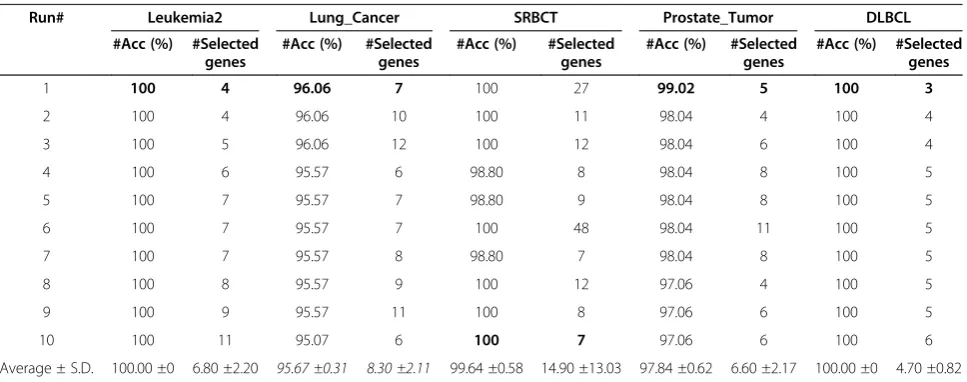
Table 4 Experimental results for each run using epso on leukemia2, lung_cancer, SRBCT prostate_tumor, and DLBCL data stes
Run# Leukemia2 Lung_Cancer SRBCT Prostate_Tumor DLBCL
#Acc (%) #Selected
genes
#Acc (%) #Selected
genes
#Acc (%) #Selected
genes
#Acc (%) #Selected
genes
#Acc (%) #Selected
genes
1 100 4 96.06 7 100 27 99.02 5 100 3
2 100 4 96.06 10 100 11 98.04 4 100 4
3 100 5 96.06 12 100 12 98.04 6 100 4
4 100 6 95.57 6 98.80 8 98.04 8 100 5
5 100 7 95.57 7 98.80 9 98.04 8 100 5
6 100 7 95.57 7 100 48 98.04 11 100 5
7 100 7 95.57 8 98.80 7 98.04 8 100 5
8 100 8 95.57 9 100 12 97.06 4 100 5
9 100 9 95.57 11 100 8 97.06 6 100 5
10 100 11 95.07 6 100 7 97.06 6 100 6
Average ± S.D. 100.00 ±0 6.80 ±2.20 95.67 ±0.31 8.30 ±2.11 99.64 ±0.58 14.90 ±13.03 97.84 ±0.62 6.60 ±2.17 100.00 ±0 4.70 ±0.82
Note: Results of the best subsets shown are written in aboldstyle. A near-optimal subset that produces the highest classification accuracy with the smallest
Experimental results that were generated by EPSO were evaluated with an experimental method (BPSO) and other previous PSO-based methods for objective comparisons [3,6-9]. Firstly, a gain ratio technique was applied for pre-processing in order to pre-select 500-top-ranked genes. This technique is a filter-based feature ranking approach and based on the concept of entropy. The original work of the gain ratio technique can be found in Quinlann [17]. The genes were then applied in EPSO and BPSO. Next, the LOOCV classification accur-acy on gene subsets that were produced by EPSO and BPSO, was measured by using SVM. Generally, in LOOCV classification accuracy, N-1 samples is trained and tested on the remaining sample which has not been used during the training.Nrepresents the total number of samples. By cycling through all the samples, we can get realistic and honest estimates of the both approaches. The implementation of LOOCV was in exactly the same way as done by Chuanget al. in order to avoid selection bias
[6,8,9] where the only one cross-validation cycle (outer loop); namely LOOCV, was utilized, instead of two nested ones. Several experiments were independently carried out 10 times on each data set using EPSO and BPSO. Next, an average result of the 10 independent runs was achieved. To evaluate the performances of EPSO and BPSO, three criteria, following their importance, were considered: LOOCV classification accuracy, the number of selected genes, and computational times. Each criterion should have the best, average, and standard deviation results. High accuracy, the small number of selected genes, and low computational time were needed to obtain an effective performance.
The parameter values for EPSO and BPSO are shown in Table 2. The results of preliminary runs decided the parameter values. The numbers of particles and itera-tions to reach a good solution are problem dependent [16]. If the numbers were large, both methods would need more time to complete their processes. If the
numbers were small, they would take short period of time, but they would not be able to find a good solution. Therefore, we chose intermediate values for the number of particles and iterations between 100 and 500. The value ofw1was larger than w2because the classification
accuracy was more important than the number of se-lected genes. We tried to get the best value based on trial and error approaches. EPSO and BPSO were analyzed using different parameter values. So far, the best values for both w1 and w2 using these methods were 0.8 and 0.2,
respectively. When w2was more thanw1, the number of
selected genes also increased.c1andc2had the same value
(2) so that particles would be attracted towards the averages of Pbesti(t) and Gbest(t) [15].
In the fitness functions of EPSO and BPSO, SVM classifiers have been used to evaluate the subsets of selected genes. A radial basis function (RBF) kernel was implemented on the SVM classifiers. The rationale to use this kernel was that early results from previous works were readily found with excellent generalization performance in non-linear separable and low computa-tional cost [18]. This RBF kernel nonlinearly maps samples into a higher dimensional space so it, unlike the linear kernel, can handle the case when the relation
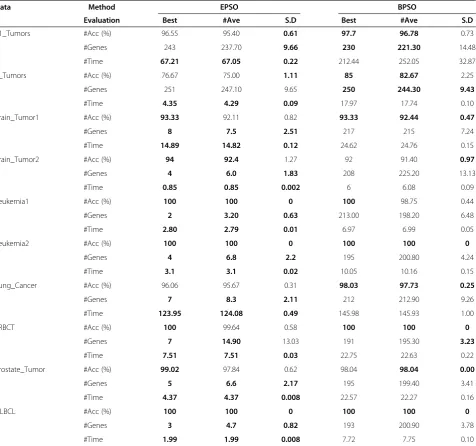
Table 5 Comparative Experimental Results of the best subsets produced by EPSO and BPSO
Data Method EPSO BPSO
Evaluation Best #Ave S.D Best #Ave S.D
11_Tumors #Acc (%) 96.55 95.40 0.61 97.7 96.78 0.73
#Genes 243 237.70 9.66 230 221.30 14.48
#Time 67.21 67.05 0.22 212.44 252.05 32.87
9_Tumors #Acc (%) 76.67 75.00 1.11 85 82.67 2.25
#Genes 251 247.10 9.65 250 244.30 9.43
#Time 4.35 4.29 0.09 17.97 17.74 0.10
Brain_Tumor1 #Acc (%) 93.33 92.11 0.82 93.33 92.44 0.47
#Genes 8 7.5 2.51 217 215 7.24
#Time 14.89 14.82 0.12 24.62 24.76 0.15
Brain_Tumor2 #Acc (%) 94 92.4 1.27 92 91.40 0.97
#Genes 4 6.0 1.83 208 225.20 13.13
#Time 0.85 0.85 0.002 6 6.08 0.09
Leukemia1 #Acc (%) 100 100 0 100 98.75 0.44
#Genes 2 3.20 0.63 213.00 198.20 6.48
#Time 2.80 2.79 0.01 6.97 6.99 0.05
Leukemia2 #Acc (%) 100 100 0 100 100 0
#Genes 4 6.8 2.2 195 200.80 4.24
#Time 3.1 3.1 0.02 10.05 10.16 0.15
Lung_Cancer #Acc (%) 96.06 95.67 0.31 98.03 97.73 0.25
#Genes 7 8.3 2.11 212 212.90 9.26
#Time 123.95 124.08 0.49 145.98 145.93 1.00
SRBCT #Acc (%) 100 99.64 0.58 100 100 0
#Genes 7 14.90 13.03 191 195.30 3.23
#Time 7.51 7.51 0.03 22.75 22.63 0.22
Prostate_Tumor #Acc (%) 99.02 97.84 0.62 98.04 98.04 0.00
#Genes 5 6.6 2.17 195 199.40 3.41
#Time 4.37 4.37 0.008 22.57 22.27 0.16
DLBCL #Acc (%) 100 100 0 100 100 0
#Genes 3 4.7 0.82 193 200.90 3.78
#Time 1.99 1.99 0.008 7.72 7.75 0.10
Note: The best result of each evaluation is written in aboldstyle. The best method of each data set is shown in the shaded cells. The best method is selected
Table 6 A comparison between our method (EPSO) and previous PSO-based methods
Data Method EPSO
[This work]
IBPSO [6]
PSOTS [3]
PSOGA [7]
TS-BPSO [8]
BPSO-CGA [9] Evaluation
11_Tumors Average #Acc (%) 95.40 - - - -
-Best #Acc (%) 96.55 93.10 - - 97.35
-Average #Genes 237.70 - - - -
-Best #Genes 243 2948 - - 3206
-9_Tumors Average #Acc (%) 75 - - - -
-Best #Acc (%) 76.67 78.33 - - 81.63
-Average #Genes 247.10 - - - -
-Best #Genes 251 1280 - - 2941
-Brain_Tumor1 Average #Acc (%) 92.11 - - -
-Best #Acc (%) 93.33 94.44 - - 95.89 91.4
Average #Genes 7.5 - - - -
-Best #Genes 8 754 - - 2913 456
Brain_Tumor2 Average #Acc (%) 92.4 - - - -
-Best #Acc (%) 94 94.00 - - 92.65
-Average #Genes 6.0 - - - -
-Best #Genes 4 1197 - - 5086
-Leukemia1 Average #Acc (%) 100 - 98.61 95.10 -
-Best #Acc (%) 100 100 - - 100 100
Average #Genes 3.2 - 7 21 -
-Best #Genes 2 1034 - - 2577 300
Leukemia2 Average #Acc (%) 100 - - - -
-Best #Acc (%) 100 100 - - 100
-Average #Genes 6.8 - - - -
-Best #Genes 4 1292 - - 5609
-Lung_Cancer Average #Acc (%) 95.67 - - - -
-Best #Acc (%) 96.06 96.55 - - 99.52
-Average #Genes 8.3 - - - -
-Best #Genes 7 1897 - - 6958
-SRBCT Average #Acc (%) 99.64 - - - -
-Best #Acc (%) 100 100 - - 100.00 100
Average #Genes 14.90 - - - -
-Best #Genes 7 431 - - 1084 880
Prostate_Tumor Average #Acc (%) 97.84 - - - -
-Best #Acc (%) 99.02 92.16 - - 95.45 93.7
Average #Genes 6.6 - - - -
-Best #Genes 5 1294 - - 5320 795
DLBCL Average #Acc (%) 100 - - - -
-Best #Acc (%) 100 100 - - 100.00
-Average #Genes 4.7 - - - -
-Best #Genes 3 1042 - - 2671
-Note: The best result of each evaluation is written in aboldstyle. The best result of evaluations could not be compared and stated if the results of evaluations
have not been reported in the previous works. The best method of each data set is shown in the shaded cells. The best method is selected based on the highest number of the best results for all evaluations. #Acc and S.D. denote the classification accuracy and the standard deviation, respectively, whereas #Genes and #Ave
represent the number of selected genes and an average, respectively. #Time stands for running time in the hour unit.‘-‘means that a result is not reported in the
previous related work.
between class labels and attributes is nonlinear. For a multi-class SVM, we have applied the“one-against-one” approach. Hsu and Lin [19] have provided a detailed comparison and conclude that “one-against-one” is a competitive approach.
Experimental results
The results yielded by EPSO were almost consistent in all data sets based on the standard deviations in Tables 3 and 4. Attractively, 100% LOOCV accuracy with less than 12 selected genes on the Leukemia1, Leukemia2, and DLBCL data sets had been achieved from all runs. Furthermore, EPSO had efficiently selected and yielded a near-optimal gene subset from high-dimensional data (gene expression data), with a proof that over 92% aver-age classification accuracies had been obtained on other data sets, except for the 9_Tumors data set. Moreover, the standard deviations of the number of selected genes were less than 10 for all of the data sets except for the SRBCT data set (13.03 standard deviations). All the best results achieved 100% LOOCV accuracy with not more than 7 selected genes, indicating that EPSO efficiently selected and produced a near-optimal gene subset from high-dimensional data (gene expression data).
Practically, the best subset of a data set is first chosen and the genes in it are then listed for biological usage. These informative genes, among thousands of genes, may be excellent candidates for clinical and medical investigations. Biologists can save time because they can directly refer to the genes that have higher possibilities of being useful for cancer diagnoses and as drug targets in the future. The best subset is chosen based on the highest classification accuracy with the smallest number of selected genes. The highest accuracy provides confidence for the most accurate classification of cancer types. Moreover, the smallest number of selected genes for cancer classification can reduce the cost in clinical settings.
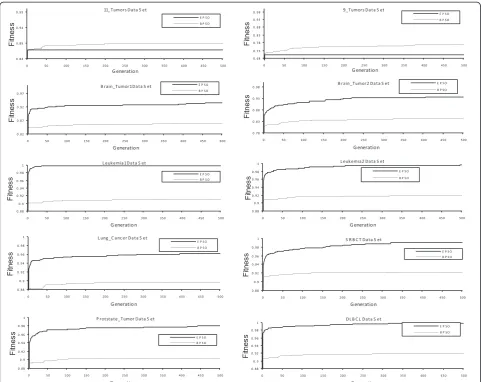
The averages of fitness values of EPSO increased dra-matically after a few generations on all the data sets as shown in Figure 2. This trend proved that EPSO is suit-able for selecting a small number of genes from high-dimensional data (gene expression data) to maximize classification accuracy. It also proved that a combination between a high classification rate and a small number (subset) of selected genes can produce a high fitness value. The condition of the proposed particles’ speed that should always be positive real numbers started in the initialization method, the modified sigmoid function, and the new rule for updating particle’s positions, which provoked the early convergence of EPSO. The fitness value of EPSO still increased for further generations on all the data sets except for 9_Tumors and 11_Tumors data sets. However, there was only a small rise in values. EPSO did the exploration in order to find a good
solution and it had been proven by this growth. In con-trast, P(xid(t) = 0) =P(xid(t) = 1) = 0.5. caused the aver-ages of fitness values of BPSO to become lower than the fitness value of EPSO until the last generation, except for the 9_Tumors and 11_Tumors data sets.
In general, it is worthwhile to mention that the classi-fication accuracy, the number of selected genes, and computational times of EPSO were superior to BPSO in terms of the best, average, and standard deviation results on all the data sets except for the 9_Tumors data set according to the result in Table 5. The computational times of BPSO were also higher than EPSO in all the data sets. EPSO was able to minimize its computational times because of the following reasons:
1) EPSO chose smaller number of genes compared to BPSO;
2) SVM utilized a small number of features (genes) that were selected by EPSO for the classification process which caused the computation of SVM to be fast;
3) Only the speed of a particle for comparing withr3d(t) was used by EPSO, whereas all elements of a particle’s velocity vector for the comparison had been practiced by BPSO.
We compared our work with previous related works that used PSO-based methods in their proposed methods for an objective comparison [3,6-9]. Table 6 shows the result of the comparison. Two criteria were used to evalu-ate the performance of EPSO and the other methods: clas-sification accuracy and the number of selected genes. Higher accuracy with a smaller number of selected genes is needed to obtain superior performance. For all of the data sets, the averages of the number of the selected genes for our work were smaller than the previous works [3,6-9]. Our work also produced higher classification accur-acies on the six data sets (Brain_Tumor2, Leukemia1, Leukemia2, SRBCT, Prostate_Tumor, and DLBCL) com-pared to the previous PSO-based methods [3,6-9]. More-over, our method resulted in higher averages of the classification accuracies on all data sets compared to the other methods [3,7]. The number of selected genes of our work in terms of average and the best results were also smaller than the previous works for all the data sets. How-ever, Chuang et al. showed better classification accuracies than our work on four data sets (11_Tumors, 9_Tumors, Brain_Tumor1, and Lung_Cancer) [8].
results, causing that they could not have statistically mean-ingful conclusions. Since the proposed method is a stochas-tic approach, therefore the average results are important. Overall, our work outperformed the other methods in terms of the LOOCV accuracy and the number of selected genes on six data sets (Brain_Tumor2, Leukemia1, Leukemia2, SRBCT, Prostate_Tumor, and DLBCL). The running times between EPSO and these works could not be compared because they were not reported.
According to Figure 2 and Tables 3–6, EPSO is reliable for gene selection where it had yielded the near-optimal solution from gene expression data. This was due to the proposed particles’speed, the modified sigmoid function, and the introduced rule which maximized the probability xid(t+ 1) = 0 (P(xid(t+ 1) = 0)). This high probability caused the selection of a small number of informative genes and fi-nally produced a near-optimal subset (a small subset of in-formative genes with high classification accuracy) for cancer classification. The particles’speed was introduced to provide the rate at which a particle changed its position, whereas the rule was proposed to update the particle’s positions. The sigmoid function was modified for increas-ing the probability of bits in particle’s positions to be zero.
Conclusions
In this paper, EPSO is proposed for gene selection on ten gene expression data sets. In general, the performance of EPSO is better than BPSO and PSO-based methods that have been proposed in previous related works, in terms of classification accuracy and the number of selected genes. EPSO is efficient because the probability xid(t+ 1) = 0 is increased by the particle speed, the modified sigmoid function, and the introduced rule in order to yield a near-optimal subset of genes for better cancer classification. EPSO also features lower running times because it selects only a smaller number of genes compared to BPSO. A modified representation of particle’s positions in PSO will be proposed to minimize the number of genes subsets in solution spaces for future works
Competing interests
The authors declared that they have no competing interests.
Authors’contributions
MSM is a principal researcher and proposed the main idea for this study. SO, SD, MY supported and checked the manuscript. Moreover, they gave well advises. AA and ZI aided in interpretation of the results. All authors read and approved the final manuscript.
Acknowledgements
The authors would like to express gratitude to the referees for helpful suggestions and Universiti Teknologi Malaysia for sponsoring this research with a GUP Research Grant (Vot Number: Q.J130000.7107.01H29).
Author details
1
Artificial Intelligence and Bioinformatics Research Group, Faculty of Computer Science and Information Systems, Universiti Teknologi Malaysia, Skudai, Johor 81310, Malaysia.2Department of Electronics, Information and Communication Engineering, Osaka Institute of Technology, Osaka 535-8585,
Japan.3Department of Computer Science and Intelligent Systems, Graduate School of Engineering, Osaka Prefecture University, Sakai, Osaka 599-8531, Japan.4Faculty of Electrical and Electronic Engineering, Universiti Malaysia Pahang, Pekan, Pahang 26600, Malaysia.
Received: 22 June 2012 Accepted: 16 April 2013 Published: 24 April 2013
References
1. Knudsen S:A biologist’s guide to analysis of DNA microarray data.New York, USA: John Wiley & Sons; 2002.
2. Mohammad MS, Omatu S, Yoshioka M, Deris S:A cyclic hybrid method to select a smaller subset of informative genes for cancer classification,
International Journal of Innovative Computing.Inf Control2009,
5(8):2189–2202.
3. Shen Q, Shi WM, Kong W:Hybrid particle swarm optimization and tabu search approach for selecting genes for tumor classification using gene expression data.Comput Biol Chem2009,32:53–60.
4. Pavlidis SP, Payne AM, Swift SM:Multi-membership gene regulation in pathway based microarray analysis.Algorithms for Molecular Biology2011,6:22. 5. Liu Z, Magder LS, Hyslop T, Mao L:Survival associated pathway
identification with group LPpenalized global AUC maximization.
Algorithms for Molecular Biology2010,5:30.
6. Chuang LY, Chang HW, Tu CJ, Yang CH:Improved binary PSO for feature selection using gene expression data.Comput Biol Chem2009,32:29–38. 7. Li S, Wu X, Tan M:Gene selection using hybrid particle swarm
optimization and genetic algorithm.Soft Computing2008,12:1039–1048. 8. Chuang LY, Yang CH, Yang CH:Tabu search and binary particle swarm
optimization for feature selection using microarray data.J Comput Biol 2009,16(12):1689–1703.
9. Chuang LY, Yang CH, Li JC, Yang CH:A hybrid BPSO-CGA approach for gene selection and classification of microarray data.J Comput Biol2011,18:1–14. 10. Kennedy J, Eberhart R:Particle swarm optimization.Perth, Australia: Proc.
1995 IEEE Int. Conf. Neural Networks 4, IEEE Press; 1995:1942–1948. 11. Yao B, Li S, ANMM4CBR:A case-based reasoning method for gene
expression data classification.Algorithms For Molecular Biology2010,5:14. 12. Kennedy J, Eberhart R:A discrete binary version of the particle swarm
algorithm.Proc. 1997 IEEE Int. Conf. Systems, Man, and Cybernetics, IEEE Press, Florida, USA1997,5:4104–4108.
13. Shi Y, Eberhart RC:A modified particles swarm optimizer.Piscataway, NJ: Proc. 1998 IEEE Congress on Evolutionary Computation, IEEE Pres; 1998:69–73. 14. Naka S, Genji T, Yura T, Fukuyama Y:Practical distribution state estimation using hybrid particle swarm optimization.Ohio, USA: Proc. 2001 IEEE Power Engineering Society Winter Meeting, IEEE Press; 2001:815–820.
15. Peram T, Veeramacheneni K, Mohan CK:Fitness-distance-ratio based particle swarm optimization.Indiana, USA: Proc. 2003 IEEE Swarm Intelligence Symposium, IEEE Press; 2003:174–181.
16. Engelbrecht AP:Fundamentalsof computational swarm intelligence. West Succex, England: John Wiley and Sons; 2005.
17. Quinlan JR:Induction of decision tress.Mach Learn1986,1(1):81–106. 18. Suykens JAK, Vandewalle J:Least squares support vector machine
classifiers.Neural Processing Letters1999,9(3):293–300.
19. Hsu CW, Lin CJ:A comparison of methods for multi-class support vector machines.IEEE Transaction on Neural Networks 20022002,13(2):415–425.
doi:10.1186/1748-7188-8-15
Cite this article as:Mohamadet al.:An enhancement of binary particle
swarm optimization for gene selection in classifying cancer classes.