Vol.7 (2017) No. 4-2
ISSN: 2088-5334
Intelligent Learning Model based on Significant Weight
of Domain Knowledge Concept for Adaptive E-Learning
Norsham Idris
#, Siti Zaiton Mohd Hashim
#, Ruhaidah Samsudin
#, Nor Bahiah Hj Ahmad
##
Department of Software Engineering, Faculty of Computing, Universiti Teknologi Malaysia, Skudai Johor, Malaysia E-mail:[email protected]
Abstract
— In order to support personalized learning, an adaptive learning system should have a capability to provide each student
with a suitable learning material regarding his profile. However, the issue of student varieties in acquiring every Domain Knowledge Concept (DKC), and a range of DKC important variations in a particular learning material produced a complex dependency that causes a difficulty in the learning material selection process. Existing rule-based learning material selection approach requires the definition of a huge set adaptation rules. However, this approach usually results in inaccurate and incorrect selection due to the inconsistent, insufficient and confluence of the defined rules. Consequently, the process of learning material selection is hard to be algorithmized, therefore, intelligent methods are applied to handle the complexity challenges. This research proposes a significance weight approach that represents the complex dependency of learning material selection problem to substitute the rules definition in the selection process. In addition, this research proposes an intelligent learning model that combines unsupervised and supervised machine learning techniques to accurately select the learning material for a particular student adaptively. The unsupervised machine learning technique is vital in obtaining a learning material classification and labelling based on the proposed significance weight. Meanwhile, the supervised machine learning technique, the Multilayer Perceptron Artificial Neural Networks conducts the adaptation process that will assign the student to suitable learning materials regarding his performance upon specific DKC. With 98% achievement of classification accuracies, this model can be considered as highly accurate in selecting a correct and suitable learning material based on student’s domain knowledge level.
Keywords— adaptive e-learning; domain knowledge concept; learning material selection; supervised machine learning
I. INTRODUCTION
The advancement of the information and communication technology has changed the process of teaching and learning towards a portable, student-centered and multi-platform environment. The history started with a stand-alone Computer Aided Learning (CAL) and CD-ROM which only provided a set of programmed instructions used for educational purposes. However, such technologies were not able to replace the traditional classroom in which teachers typically consider factors that affect the learning of each student [1]. Therefore, researchers have been studying the adaptation element to be included in CAL system so that the material and the learning session can be personalized to entertain students’ heterogeneity [2]. Particularly, Intelligent Tutoring System (ITS) and Adaptive Educational Hypermedia System (AEHS) are then designed under the paradigm of Adaptive Learning System (ALS) in order to cater the issue of personalization [3]. The past decade has seen the rapid development of ALS with a broad range of adaptation and implementation strategies that offered
promising solutions through the use of various techniques and approaches.
Machine learning is one approach that has been utilized to support adaptation in ALS. The capability of machine learning techniques in addressing pattern recognition and prediction problem has caught the interest of researchers in the field of adaptive learning to apply it for adaptation and personalization. Machine learning algorithms can be divided into two types of supervised and unsupervised learning. Usually, supervised learning is used for classification task while unsupervised learning in the clustering task. In most of ALS, supervised learning has been employed for classification of students [5], [6] and prediction of student performance [7], [8], [9]. Whilst clustering in ALS can be divided into clustering of students [10] or clustering of learning materials [11]. To date, there have very few works reported in combining both classification and clustering techniques especially in learning material selection of ALS.
II. MATERIAL AND METHOD
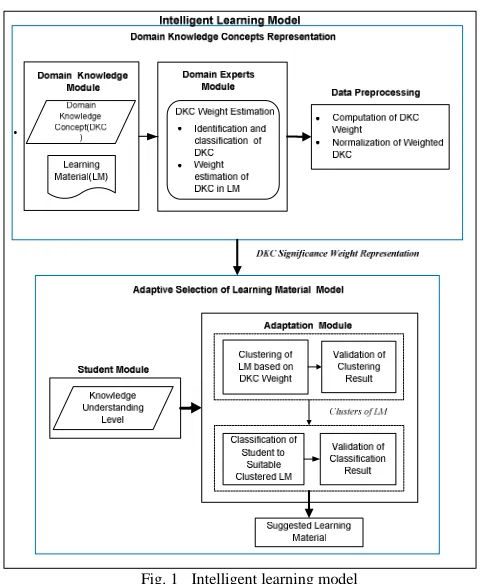
The proposed intelligent learning model which is to solve the problem of adaptive selection of learning material, comprehends three major modules, namely Domain Knowledge Module, Domain Experts Module and lastly, Adaptation Module as illustrated in Fig. 1. In addition, the intelligent learning model consists of two major parts, Domain Knowledge Concept Representation (DKCR) and Adaptive Selection of Learning Material.
A. Domain Knowledge Module
Domain Knowledge Module is one of the components of DKCR in the intelligent learning model. This module is to establish the domain knowledge elements that would be structured in order to feed the adaptation and personalization process. In this proposed model, the element of domain knowledge chosen is its DKC. Every learning material provided to students should associate to particular DKC in order to achieve the learning outcome as specified.
B. Domain Experts Module
In the intelligent learning model, Domain Experts Module is a part of DKCR. This module is to constitute the role of the domain experts in this research. In this proposed approach the domain expert roles are to identify the related DKC and to estimate the significance of every DKC in a particular learning material.
C. Data Preprocessing
Data Preprocessing is a task of Representation of DKC in the DKCR in this proposed intelligent learning model. This is to compute the estimated DKC significance weight and to normalize the resulted DKC significance weight.
D. Adaptation Module
The function of this module is as the engine for the adaptation and the selection tasks. For the adaptation and personalization, unsupervised learning technique is used to cluster the learning materials based on the DKC significance weight similarity before being assigned to students. The assignment of learning material to the student is treated as a classification problem. Thus a supervised learning technique is applied.
Fig. 1 Intelligent learning model
E. Student Module
The proposed intelligent learning model considers student’s knowledge understanding level as adaptation factor to be suited to the learning material. Thus, in this module, the result of student pre-test data is represented in DKC-based format, the same as the representation of the learning material data.
Analysis of DKC is the first task of the DKCR framework. It involves the Domain Knowledge Module and the Domain Expert Module. It is the responsibility of the Domain Knowledge Module to ensure that each knowledge unit called domain knowledge concept of a course are represented correctly and completely. This includes the terms of coverage, sequence, and dependencies between each of the DKC.
Identification of related DKC is the step in the analysis part of the Domain Expert Module in the process of DKCR. This step implemented according to the procedure used by [12]. Domain experts have been asked to identify related concepts from the domain knowledge. The domain experts involved are three (3) lecturers from the Department of Software Engineering, Faculty of Computing, Universiti Teknologi Malaysia who had more than 3 semesters experience in teaching the course. A study on the current course syllabus used in the faculty that contemporized with the Association for Computing Machinery (ACM) Curriculum (Computer Science Curriculum 2008) also has been conducted along with investigation on some popular textbooks which is used by the faculty.
level is a concept which is considered as the main concept that should be learned by all students for the Array topic. Advance is the concept that is considered tough and complex. Determination of the complexity levels is suggested by the domain experts. For the purpose of data preparation, the DKC order in the list is ranked or sorted according to the complexity level classification. Table 1 shows the list of 25 DKC that have been identified with the associated level of complexity [13].
Meanwhile, this task involves the preparation of learning materials that cover all of the identified DKC. In the area of education, learning materials for teaching and learning activities can be in the type of forum, textual notes, animation, simulation, game, on-line question, Powerpoint slides, hypertext and etc. [14]. In this research, the type of learning material that we focused is a test or quiz question which is normally used for student assessment. For the purpose of this study, the selection of 120 test questions is varied and cover from Prerequisite, Basic to Advance DKC complexities.
In order to evaluate the significance of DKC in our test question collection, we have conducted a survey among the domain experts. Each of them is given a set of test questions which covers the topic of Array and the prerequisites of it. For every test question, they were required to rate how significant or important the listed 25 DKC to one particular question. This Likert scale type of concept relevance evaluation is rated from 0 to 5 (Not relevant to Strongly Relevant) [13].
TABLEI
LIST OF DOMAIN KNOWLEDGE CONCEPTS
ID CONCEPTS COMPLEXITY
LEVEL C1 Primitive data type Prerequisite C2 Declaration of primitive data type Prerequisite
C3 For loop Prerequisite
C4 Assignment statement Prerequisite
C5 Identifier Prerequisite
C6 Element indexing Prerequisite C7 Passing parameter by value Prerequisite C8 Passing parameter by reference Prerequisite C9 Nested for loop Prerequisite C10 Passing one element Prerequisite C11 Returning value Prerequisite
C12 Class and object Basic
C13 Object declaration Basic C14 Array declaration Basic C15 Method definition Basic C16 Assign value using nested for loop Basic
C17
Declare, create and initialize value using array initializer
Basic
C18
Access array element using indexed variable
Basic
C19
Create object in each/particular index of the array
Basic
C20 Assign value using nested for loop Basic C21 Passing entire array Advance
C22 Returning array Advance
C23 Create array of type class Advance C24 Declare array reference variable Advance
C25
Copy contents from one array to another
Advance
To date, various methods have been developed and introduced to measure the difficulty and complexity of test question and learning materials. Among the methods that have been reported are based on Item Response Theory [15], Learner Feedback [12], Expert Rating [11] and Latent Semantic Analysis [16]. However, far too little attention has been paid to the significance of DKC in learning the material for the purpose of personalization. There is no research so far in the field of adaptive learning that takes this significance factor into account despite its reliability in supporting adaptation.
Consequently, in this study, the expert rating approach was chosen in estimating the significance of DKC in a particular learning material in order to encapsulate the human domain expert point of view or decision. After the domain expert rating of the learning materials is collected, next is to compute and transform the rating into a DKC significance weight. For that purpose, the formula as depicted in (1) which is adopted from [11] was employed.
= (1)
Dexp refers to the experts’ decision of the concept
relevancy level for each question. Cn denotes the number of
an expert who chose a significance level of Reln. The
significance level of the concept is classified into 6 points (from Not relevant to Strongly relevant), depicted as Rel0,
Rel1, Rel2, Rel3, Rel4, Rel5. Cexperts denotes the number of
domain expert [13].
The computed DKC significance weight (Dexp) data are
within the range of [0...5]. Therefore a scaling method has to be implemented for the data set to normalized them into [0...1] range of data. This is to ensure that the data is compatible with machine learning process in the next stage.
III.RESULTS AND DISCUSSION
This research aims to study the ability to utilize both supervised and unsupervised machine learning techniques in order to select suitable categories of learning materials (Prerequisite, Basic and Advanced) for a particular group of students (Beginner, Intermediate, and Advanced). The learning material data which is originated from domain experts’ estimation of DKC significance weight produce a set of data which describes the characteristics of each learning material through the significance weight of 25 DKC that have been computed. These unlabelled and unclassified data need to be clustered using the unsupervised algorithm in order to obtain a grouping of similar learning material based on DKC weight.
A. Clustering of Learning Material
The data set has a total of 3000 DKC significance weight data and a dimension of 120 rows and 25 columns. The rows represent 120 learning materials whilst the columns represent 25 DKC. The experiment is implemented using MATLAB tool for Self-Organizing Map (SOM) clustering. SOM has been widely used in many areas as its ability in clustering of high dimensional data [17].
number of student categories. In this study, students are categorized based on their understanding level upon each DKC as being collected during the pre-test earlier. In this study, three (3) categories of student performance are being considered for the classification namely Beginner, Intermediate and Advanced. Therefore, the learning material data will be grouped into 3 clusters to satisfy the requirement of each category of students.
For experiment using SOM, a network has been created with 25 input neurons and has been trained with different dimension sizes of the map (2 x 2, 3 X 3 and 5 X 5) in order to get the best clustering result. From the experiments, using our data, the best result was obtained when the size of the map dimension is 5 x 5. The Euclidean similarity measure is used in this experiment. Table 2 presents the confusion matrix for SOM test result.
TABLEII
CONFUSION MATRIX FOR OVERALL SOMCLUSTERING Predicted by SOM
Accuracy
Actual
(Domain Expert Decision)
Prerequisite Basic Advanced
Prerequisite 78 (TP) 7 (FN) 0 (FN) 0.9176
Basic 4 (FP) 12 (TP) 0 (FN) 0.750
Advanced 0 (FP) 2 (FP) 15 (TP) 0.8823
Table 2 explains that TP (true positives): is the number of correct predictions that an instance is positive; TN (true negatives): is the number of correct predictions that an instance is negative; FP (false positives): is the number of incorrect predictions that an instance is positive; FN (false negatives): is the number of incorrect of predictions that an instance negative. The accuracy of the classification can be defined by the following formula:
= + ++ + (2)
B. Learning Material Selection for Student Using Classification Technique
The proposed approach is based on the intelligent mechanism to model the decision from domain experts in the selection of learning materials. The neural network is chosen considering its ability to learn from data and predict the class for new input. A classifier from neural network paradigm is built to select learning materials according to the characteristics of its class. Compared to rule-based approach, this approach has the advantage that it can facilitate the work should be done by domain experts, especially in the definition of adaptation rules.
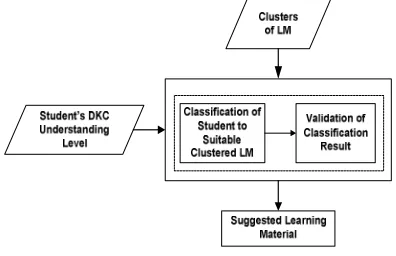
In this approach, the selection of learning materials do not require the definition of rules, but machine learning will determine the connection between the characteristics of the learning material with the characteristics of the students. Thereby, the selection of learning materials is expected to be the same as the selection made by the domain experts. Therefore, the testing data for validating the classifier are labeled by the domain expert prior to the experiment. Based on the pre-test result which is presented in each DKC, the domain expert will identify whether the student is Beginner, Intermediate or Excellent. The manual classification performed by domain experts will produce a set of data for benchmarking the classifier model. The input data of the model is clusters of learning materials and the knowledge understanding level of students. Outputs of the model are groups of learning materials that are assigned to students.
Fig. 2 illustrates the framework of the classification task.
Fig. 2 Classification framework
A common multi-layer perceptron neural network architecture (MLP ANN) consists of three (3) layers or groups of units as follows; input, hidden and output. In this study, the input layer represents the 25 DKCs, where the input vector is a set of values {0…1}. After the network is constructed, next is to train the network using learning material data set as discussed previously. In order to choose the best classifier model, experiments using three different training algorithms are performed.
TABLEIII
ACCURACY RATE OF DIFFERENT TRAINING ALGORITHM
Training Algorithm
Hidden Layer Size
13 25 50
Acc
(%) MSE Acc
(%) MSE Acc
(%) MSE SCG 96.8 0.013 94.6 0.024 96.4 0.015 LM 95.6 0.014 97.2 0.008 97.5 0.012 RP 97.0 0.015 97.1 0.011 93.8 0.062
Data used in this experiment is the average score of 60 student’s pre-test results. The pre-test consists of questions that cover all 25 DKCs. Since one DKC may be represented by more than one pre-test question, an average of marks that student gained from each DKC is taken as data for this experiment. For classifier validating purpose, each student data is classified by the domain expert and labelled as Beginner, Intermediate or Advanced based on his pre-test marks. Table 4 depicts the distribution of student data used in this experiment.
TABLEIV
DISTRIBUTION OF STUDENT DATA FOR TESTING
Class No. of instances Percentage (%)
Beginner 21 35
Intermediate 20 33
Excellent 19 32
TOTAL 60 100
Table 5 presents the performance of the classifier model that classify student into three classes based on their level of domain knowledge understanding. From the table, we can see that the proposed classifier model performed excellently with 98% accuracy in terms of correctly classified instances for the classes. The Kappa statistic value is high, 0.9712 reveals the similarity of classifier decision and the domain expert’s decision. Error rate produced by the classifier model is considered low.
TABLEV CLASSIFICATION RESULT
Performance Measures Result
Correctly Classified Instances (%) 98
Kappa statistic 0.9712
Mean absolute error 0.0245
Root mean squared error 0.115 Relative absolute error (%) 5.5476 Root relative squared error (%) 24.445
Outputs from the Adaptation Module of the proposed intelligent learning model are three categories of students namely Beginner, Intermediate and Advanced. The learning material selection scheme for different categories of the student is shown in Table 6. Based on the table, a Beginner type of student is assigned a learning material from Prerequisite class, the Intermediate student is assigned with learning material of Basic type, whilst the Advanced student is given learning material which contains more Advanced DKC. This learning material selection scheme is adopted from previous works.
TABLEVI
LEARNING MATERIAL SELECTION SCHEME
Students Appropriate Type of
Learning Material
Beginner Prerequisite
Intermediate Basic
Advanced Advanced
Therefore, students that have been classified into three classes by the proposed model are assigned to the type of learning material automatically based on the allocation in Table 6.
In order to validate the accuracy of the learning material selection by the proposed approach, an experiment is conducted to compare the selection result with the rule-based selection approach. The learning material selection rules employed for this experiment are depicted in Fig. 3. These rules are extracted from the decision of domain experts on the learning material assignment to students.
Fig. 3 Rules for learning material classification
The rule-based selection experiment is performed using the learning material and student knowledge understanding level data that have been used by the proposed model. Table 7 shows the comparison of learning material selection result obtained by the proposed approach and rule-based approach. As presented in the previous section, the proposed approach has correctly selected learning materials for 59 students which represent 98% of accuracy. While rule-based approach achieved 95% accuracy where 57 students are assigned a correct type of learning materials.
TABLEVII
COMPARISON WITH RULE-BASED SELECTION Learning Material
Selection Approach
Accuracy (Correct Selection)
Number of students with correct selection (out of 60 students) Proposed
approach 98 % 59
Rule-based 95% 57
Based on the experimental results, the proposed adaptive selection of learning material model has successfully
For every learning material
Calculate means and for each complexity level Compare means value for each complexity level
IF (0.938≤ means_Advance≥ 0.982) AND IF (0.578≤ means_Basic≥ 0.933) AND IF (0.009≤ means_Prerequisite≥ 0.867) THEN
Assign LM to ADVANCED-STUDENT
IF (0.00≤ means_Advance≥ 0.067) AND IF (0.524≤ means_Basic≥ 0.908) AND IF (0.349≤ means_Prerequisite≥ 0.486) THEN
Assign LM to INTERMEDIATE-STUDENT
IF (0.017≤ means_Advance≥ 0.121) AND IF (0.020≤ means_Basic≥ 0.153) AND IF (0.133≤ means_Prerequisite≥ 0.489) THEN
selected 98% correct learning materials for a particular group of students. From 60 students, only 1 are being misclassified or given a different type of learning material other than suggested by a domain expert. The performance of the proposed model slightly better than the rule-based selection approach as presented in Table 7.
IV.CONCLUSION
In this research, learning materials is personalized for every student through an adaptive selection that suited to his knowledge understanding level of each specified DKC. Towards the end, the student will be assigned a group of learning material that appropriate to his knowledge understanding. Most of previous researches solved this problem by defining adaptation rules which were tedious, highly cost and complicated. This study however, treated the student to learning material assignment task as supervised classifications that can be done without prior define of adaptation rules.
The first problem to encounter is to find good quality groups of learning materials with similar characteristics. In this case, the characteristics are the significance weight of domain knowledge concept. One learning material may consist of many DKC and each of the concepts has different levels of significance. For the domain knowledge ‘Array in Java’, 25 domain knowledge concepts are identified by the domain experts, i.e the lecturers. They are also required to rate the significance weight of the concepts for each learning material. Clustering techniques are then applied towards the learning material data to simplify the assignment (classification) process by providing labeled instances. Next, for the purpose of personalization of learning material selection, a supervised classification is performed by constructing and training of ANN model that could select suitable learning material for each student.
It was hypothesized that the representation of DKC significance weight and employment of machine learning techniques in a learning material selection model could provide a better accuracy of selection. The finding of this study is consistent and supports the hypothesis of this research. The proposed approach has achieved 98% accuracy in selecting a correct type of learning material for a particular student. This achievement overcomes the result of rule- based selection using the same dataset (95% of accuracy) as well as improving of previous work on non-rule based selection with ANN MLP technique (97% of accuracy).
ACKNOWLEDGMENT
This research was funded by UTM Research University Project grant, Q.J130000.2628.12J35.
REFERENCES
[1] S. Bhattacharya and S. Nath (2016). International Journal of Interactive Multimedia and Artificial Intelligence, Vol. 4, No2 DOI: 10.9781/ijimai.2016.4212
[2] Fatiha Elghibari,Rachid Elouahbi and Fatima El Khoukhi,(2017)."An Automatic Updating Process to Control The E-learning Courseware," International Journal on Advanced Science, Engineering and Information Technology, vol. 7, no. 2, pp. 546-551. [Online]. Available: http://dx.doi.org/10.18517/ijaseit.7.2.1871.
[3] Dziuban, Charles; Moskal, Patsy; Johnson, Constance; and Evans, Duncan (2017) "Adaptive Learning: A Tale of Two Contexts,"Current Issues in Emerging eLearning” Vol. 4: Iss. 1, Article 3.
[4] Karampiperis, P., Lin, T. and Sampson, D. G. (2006). Adaptive cognitive‐based selection of learning objects. Innovations in
Education and Teaching International, 43(2), 121–135.
doi:10.1080/14703290600650392
[5] Oancea, B., Dragoescu, R. and Ciucu, S. (2013). Predicting students ’ results in higher education using neural networks. In International Conference on Applied Information and Communication Technology (pp. 190–193).
[6] López, M. I., Luna, J. M., Romero, C. and Ventura, S. (2012). Classification Via Clustering For Predicting Final Marks Based On Student Participation In Forums. In In Proceedings Of The 5th International Conference On Educational Data mining (pp. 148– 151). (pp. 148–151).
[7] P. A. Khodke, M. G. Tingane, A. P. Bhagat, S. P. Chaudhari and M. S. Ali, "Neuro Fuzzy intelligent e-Learning systems," 2016 Online International Conference on Green Engineering and Technologies (IC-GET), Coimbatore, 2016, pp. 1-7.doi: 10.1109/GET.2016.7916766
[8] Mashiloane, L. and Mchunu, M. (2013). Mining for Marks : A Comparison of Classification Algorithms when Predicting Academic Performance to Identify “ Students at Risk ,” 541–552.
[9] Mishra, T., Kumar, D. and Gupta, S. (2014). Mining Students’ Data for Prediction Performance. 2014 Fourth International Conference on Advanced Computing & Communication Technologies, 255–262. doi:10.1109/ACCT.2014.105
[10] Moucary, C. El. and Khair, M. (2011). Improving Student ’ s Performance Using Data Clustering and Neural Networks in Foreign-Language Based Higher Education, II(Iii).
[11] Lu, F., Li, X., Liu, Q., Yang, Z., Tan, G. and He, T. (2007). Research on Personalized E-Learning System Using Fuzzy Set Based Clustering Algorithm. In ICCS 2007, Part III, LNCS, Springer-Verlag Berlin Heidelberg (pp. 587–590)
[12] Kim, S. B., Yang, K. M. and Kim, C. M. (2006). A Diagnostic Model Using a Clustering Scheme, 278–287.
[13] N. Idris N. Yusof S. Z. M. Hashim (2013). A Model For Adaptive Selection Of Learning Material In An IntelLigent Learning System Using Combination Of Supervised And Unsupervised Machine Learning Techniques. Proceeding Int. Conf. Artif. Intell. Comput. Sci. ICT AICS2013 ISBN 978-967-11768-3-2.
[14] Nor Bahiah Hj Ahmad. (2012). Granular Mining Approach For Identifying Student’s Learning Style In E-Learning Environment. PhD Tesis, Universiti Teknologi Malaysia.
[15] Baylari, A. and Montazer, G. A. (2009). Design a Personalized E-Learning System Based On Item Response Theory And Artificial Neural Network Approach. Expert Systems with Applications, 36(4), 8013–8021. doi:10.1016/j.eswa.2008.10.080
[16] Chang, T.-H., Sung, Y.-T. and Lee, Y.-T. (2013). Evaluating the Difficulty of Concepts on Domain Knowledge Using Latent Semantic Analysis. 2013 International Conference on Asian Language Processing, 193–196. doi:10.1109/IALP.2013.58 [17] Lee, L. C., Liong, C. Y., & Jemain, A. A. (2016). Applying
Fourier-Transform Infrared Spectroscopy and Self-Organizing Maps for Forensic Classification of White-Copy Papers. International Journal
on Advanced Science, Engineering and Information