Time for Spreading of Compensatory Mutations Under Gene Duplication
Tomoko
Ohta
National Institute ofGenetics, Mishima 41 1, Japan
Manuscript received February 2 0 , 1989 Accepted for publication July 14, 1989
ABSTRACT
Evolution by compensatory mutations is accelerated by gene duplication because selective constraint
is relaxed by gene redundancy. A mutation is called compensatory if it corrects the effect of an earlier deleterious mutation. Without duplication, Kimura has shown that the time for spreading of compen-
satory mutations is much reduced by tight linkage between the two chromosomal sites of mutations.
In this report, the time for spreading with gene duplication was studied by using the diffusion equation method of Kimura, together with computer simulations. It was shown that, when 2Nu- is much less
than unity, the time for spreading is greatly shortened by gene duplication as compared with the case
of complete linkage between the two sites of mutations, where 2N is the effective population size (haploid) and u- is the rate of compensatory mutations. However, if 2Nu- > 1, gene duplication is not effective for accelerating the evolution by such mutations.
G
ENE duplication is now considered to occur fairly frequently in eukaryote chromosomes. Previous studies suggest that the rate of gene duplication is-
per ordinary gene locus (GELBART and CHOVNICK 1979; SHAPIRA and FINNERTY 1986; MA- RONI et al. 1987), which is not negligibly low as com- pared with the nucleotide substitution rate, and gene duplication provides important material for evolution. Indeed, numerous examples of utilizing gene dupli- cation and subsequent differentiation for organismal evolution have been reported (for a recent review, see OHTA 1988~). I have been studying the role of gene duplication in evolution from the standpoint of pop- ulation genetics (OHTA 1987a,b; 1988a,b). One role is to provide relaxation of selective constraint by means of gene redundancy (OHNO 1970; KIMURA 1983). In my previous report (OHTA 1988d), it has been shown, by extensive Monte Carlo simulations, that compensatory mutant substitution is accelerated through relaxation when gene duplication is incor- porated. In the present paper, a more quantitative analysis is presented by using KIMURA'S diffusion equa- tion method (KIMURA 1985a,b), together with com- puter simulations. It will be shown that, when the rate of compensatory mutations is low, such that the prod- uct of the mutation rate and the population size is much less than unity, the time for spreading of the mutants is greatly shortened by gene duplication.BASIC THEORY
Compensatory mutations are individually deleteri- ous, but become neutral or advantageous when two
of page charges. This article must therefore be hereby marked "advertisement"
The publication costs of this article were partly defrayed by the payment in accordance with 18 U.S.C. $1734 solely to indicate this fact.
Genetics 123: 579-584 (November, 1989)
mutations accumulate in the same individual. In this paper, compensation is assumed to occur in the same gene. Such a mutant is assumed to occur with the constant rate, u-, per gene per generation. In the present study, no completely neutral mutations are assumed. Initially, there is a single gene in a haploid individual, and with the constant rate, y, per gene copy per generation, a gene is either duplicated or deleted by intrachromosomal unequal crossing over. If unequal crossing over results in the total loss of the gene, the individual becomes lethal. A finite haploid population with effective size 2N is assumed, and no interchromosomal crossing over is considered. The above model of compensatory mutations is the same as my previous one (OHTA 1988d), but in this study, neither additional neutral mutation nor sexual recom- bination is introduced. Thus the model is simpler than the previous one, but is similar to the two-locus model of compensation by KIMURA (1985a,b) and may be treated analytically under certain conditions.
A gene carrying a single mutation lowers the fitness of the individual by s-. If an individual has the gene, the fitness of this individual becomes as follows.
w - , ~ = exp(-s-), (1)
of mutations in one of them may be covered by the activity of the remaining one or more functional genes. On the other hand, for gene families that produce large amounts, the effect of deleterious mu- tations would be more difficult to be covered. This is especially so for gene families with uniform members such as genes of ribosomal RNA or histone. For them, another approach that is different from the present one, is required for understanding evolution of com- pensatory mutations, that seem to be fairly common
(BRIMACOMBE 1984).
When a gene has two mutations, they compensate their deleterious effect and become neutral or advan- tageous, so that genes contain two mutations. An additional (third) mutation is deleterious but may be again compensated by the fourth mutation. Thus com- pensatory mutations accumulate two at a time. T h e model of positive selection is similar to the previous one (OHTA 1987a,b; 1988a,b,d), i.e., if the number of alleles affected by compensatory mutations in an in- dividual is more than the population average, such an individual enjoys a selective advantage according to the fitness function,
W+,l = 1 for hi 3
X
(2) w + , ~ = exp(-s+(X-
hi)] for hi<
jiwhere hi is the number of alleles with an even number of mutations in the ith individual,
1
is the population average, and s+ is the coefficient of positive selection. Note that the term "allele" is used here for genes belonging to any locus in the family of duplicated loci as in my previous reports. Also, a slight modification on counting the number of alleles in an individual is incorporated, i.e., the original allele without mutations is not counted as an allele here whereas it was counted in my previous study. T h e purpose of this modifica- tion is to enable examination of the case when there is no gene duplication, to which KIMURA'S (1985a,b) theory may be directly applied.When genes are redundant, relaxation of selective constraint is introduced, i.e., a deleterious mutation becomes neutral so long as one or more normal genes exist on the same chromosome. Under such an as- sumption, it is convenient to partition the process of compensatory mutations into the following three phases: 1) spreading of a duplication-bearing chro- mosome into the population; 2) spreading of a dele- terious mutation, that occurs in one of the duplicated genes and is therefore neutral, into the population; and 3) spreading of a compensatory mutation, that occurs in one of the genes with the previous mutant, into the population. These phases may be treated separately when 2Ny and 2Nv- are much less than unity. Here it is assumed that the products of popu- lation size and unequal crossing-over rate (PNy), or
mutation rate (2Nv-) are much less than unity. Later, this assumption is weakened.
T h e first phase is the same as in the previous model (OHTA 198813) and is analogous to the spreading of a neutral mutant under mutation pressure. KIMURA'S formula gives such time in number of generations, and becomes for this phase
where VI = 2N-y and $( - ) stands for the digamma function. (For details, see derivation of Equation 13 of KIMURA, 1985a.)
T h e second phase is again the spreading of a neutral mutant, but V1 should now be replaced by VZ = ~ N v - , since there are two genes in which mutation may occur.
4N
v,
-
1t 2
= -
[0.577+
$(VZ)].If the mutants are compensatory neutral (s+ = 0 ) , the third phase is also neutral spreading, but Vz should be replaced by V3 = ~ N v - , because the second muta- tion must occur in the gene with the first mutant. When mutants are compensatory advantageous, the third phase becomes the spreading of an advantageous mutation under mutation pressure. In the present model of positive selection, the increase of mutant frequency becomes the same as that for a recessively advantageous mutant (OHTA 1987a), and Equations
7-9
of KIMURA (1 985a) may be used. Thus, the third phase becomes,4N
t 3
=
-
v3
-
1 [0.577+
$(V,)], for s+ = 0 (5)for s+
>
0where S = 2Ns+ and V3 = 4Nv-.
T h e total time for spreading of a compensatory mutation under gene duplication is the sum of the above values.
T d = t l
+
t Z+
t 3 . (7)Spreading of Compensatory Mutations
TABLE I
Observed and expected time for spreading of compensatory mutations
Time in units of 4 N generations
2Ns+ 2N7 ~ N v - Observed” Expected
0 0.0
0.2
20 0.0
0.2 0.1 0.2 0.3 0.4 0.5 1
.o
0.1 0.2 0.3 0.4 0.5 1
.o
0.1 0.2 0.3 0.4 0.5 1
.o
0.1 0.2 0.3 0.4
0.5
1
.o
61 1.9 f 574.8 143.0 f 146.1 57.0 k 52.7 34.9 f 31.8 23.7 f 20.6 4.9 f 3.2 20.2 f 15.5 11.6 f 5.9 10.1 f 7.6 8.8 f 5.5 6.4 f 4.0 4.9 f 2.7 101.7 f 77.4
25.7 k 28.9 9.3 f 8.5 6.3 f 6.0 3.9 & 3.2 1.6 f 1.2 11.3 f 7.9 5.7 f 3.6 4.6 k 3.3 3.2 f 3.1 2.6 f 1.7 1.2 f 0.8
912.9 212.1 88.4 47.0 28.7 6.5 15.1 1 1 . 1 9.7 9.0 8.5 7.7 129.9 32.6 14.3 8.3 5.4 1.5 11.0 8.5 8.1 7.8 7.6 7.5
Mean f SD of 40 replications. Other parameter: 2Ns- = 10 and 2N = 100.
where V = 2A2/(D
+
3A) and B ( [ ) = 2Ns+t2+
2AD[/ (D+
3A), with A = 2Nv- and D = ~ N s - . Results of numerical studies by using Equations7
and 8 will be given in the next section.NUMERICAL ANALYSES A N D MONTE CARLO SIMULATIONS
In order to check the validity of the above results, Monte Carlo simulations were performed. T h e simu- lated population is made of 2N haploid individuals. At the start, each individual has a single locus free of mutation. T h e method of simulation was the same as described in OHTA (1987a,b; 1988a,b,d). Each gen- eration consisted of unequal crossing over, mutation, random sampling and selection. Deleterious mutations were stored by negative integers, and compensation was done by changing two negative integers into pos- itive ones. If a third mutation occurs in a gene with two compensatory mutations, the gene becomes del- eterious again. Selection was carried out by combining the two fitness functions (1) and (2).
All experiments were carried out until all individ- uals in the population contained at least one gene with compensatory mutations. T h e number of generations needed until the above condition was attained was
0 1
0.025 0.1 0.2 0.3 0.4 0.5
2Nv-
FIGURE 1.-Time (in units of 4N generations, T = Td/4N or T0/4N) as functions of NU-. Parameters not shown in the figure are, 2Ns- = 10 and 2Ns+ = 0.
recorded. Forty replicate runs were performed in each set of parameters.
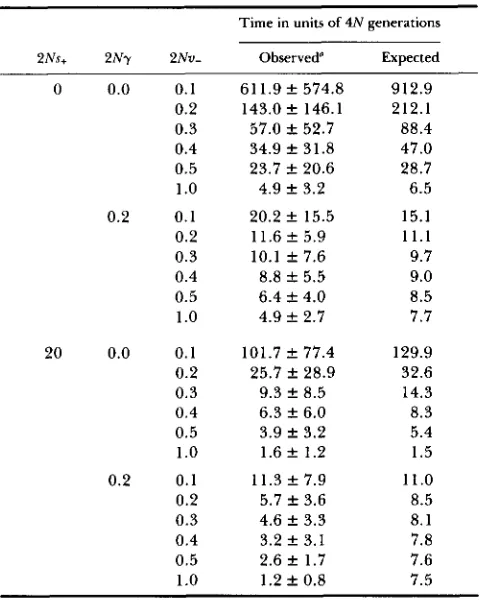
Table 1 gives the comparison of the observed (Monte Carlo simulation) and the expected (Equations
7
and 8) time for spreading of compensatory muta- tions. T h e figures are in units of 4N generations. Four classes examined are combinations of with and with- out gene duplication, and of with and without positive selection. As can be seen from the table, the agree- ment between the observed and the expected values are generally satisfactory. Note that the standard de- viation is almost as large as the mean, but that the standard errors of the observed values become1/& 116.3 of the listed values of the standard deviation. Since the distribution of the time for spreading is expected to be highly skewed like that of a neutral mutant infinite populations (KIMURA 1970), it is difficult to carry out statistical tests of significance here.
A few points need caution. One is on the assumption of 2Ny
<<
1 and 2Nv-<<
1. This condition is not satisfied in some sets of parameters examined. Then the three phases are not separate as described above, but overlap. Thus Equation7
overestimates the time for spreading as may be seen from the disagreement between the observed and the theoretical time wheny
> 0
and 2Nv- = 0.4 or more. This is especially evident when s+>
0, since the time estimated by Equation7
is longer than that by Equation 8, which can not be true.I
2Ns,s, = 0
:-,;---
“““”””0
0 0.05 0.1 0.15 0.2 0.25
rn
FIGURE 2.-Time (in units of 4 N generations, T ) as functions of 2N-y. Parameters not shown in the figure are, 2Ns- = 10 and 2Nv- = 0.1.
stance, presumably because the derivation is based on the assumption that the frequency of individuals with a single (deleterious) mutation is kept low by mutation- selection balance, while the second (compensatory) mutant increases its frequency. When 2Nv-
<<
1 , this balance is not stable, and may cause deviation from the theoretical prediction.Next, let us examine how the time for spreading of compensatory mutations is influenced by various pa- rameter values through numerical analyses of Equa- tions
7
and 8. Figure l shows the time ( T , in units of 4N generations) as functions of 2Nv-, with and with- out gene duplication. It is very clear from the figure that the time gets longer as 2Nv- becomes smaller, especially when y = 0. Indeed, KIMURA’S formula tells that the time is inversely proportional to v?. When y>
0, however, it is simply proportional to l/v-. Also note that, as mentioned earlier, when 2Ny is 0.4 or more, the time for 2Ny = 0.2 overestimates the true value.Figure 2 shows the time as functions of 2N7, with and without positive selection. As can be seen from the figure, unequal crossing-over greatly shortens the time especially for compensatory neutral mutations (s+ = 0). When s+
>
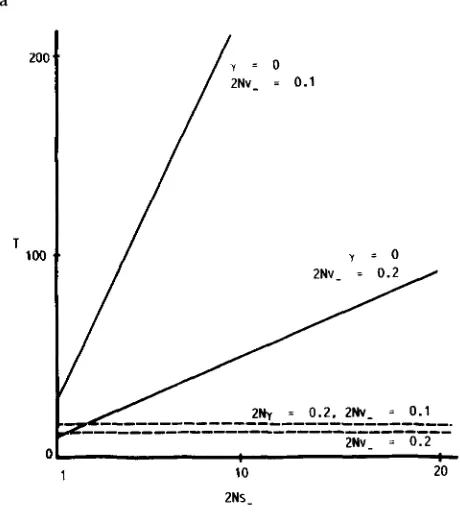
0, the effect of gene duplication is not so pronounced, as the large difference of the two curves is seen for 2Ny << 1 .Figure 3 shows the time for spreading as functions of ~ N s - . When y = 0, the time linearly increases with ~ N s - . However when y
>
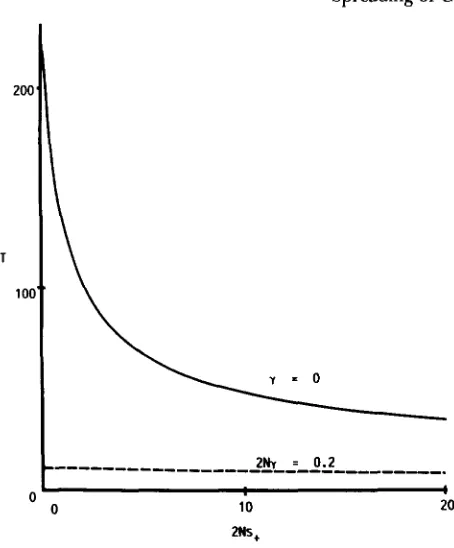
0, the time is independent of ~ N s - , since the process of spreading is composed of three selectively neutral phases. Figure 4 represents the time as functions of 2Ns+, with and without gene duplication. When y = 0, the time is inversely pro-I /
-
1 10
-
20
.-
2NS-
FIGURE 3.-Time (in units of 4N generations, T ) as functions of ~ N s - . Parameter not shown in the figure is, 2Ns+ = 0.
portional to 2Ns+, but when 2Ny = 0.2, the effect of positive selection is very small. This is because the third phase is accelerated by positive selection.
DISCUSSION
T h e present analyses show clearly that gene dupli- cation greatly shortens the time for spreading com- pensatory mutations when the mutation rate is low such that 2Nv-
<<
1 . This condition would be usually satisfied as discussed below. Several examples of mo- lecular compensatory mutations, as discussed by OHTA (1974), KIMURA (1985a,b), and OHTA (1988d), in- clude amino acid changes of pancreatic ribonuclease (WYCKOFF 1968), tryptophan synthetase (YANOFSKY, HORN and THORPE 1964), and ferredoxin (TSUKI-HARA et al. 1982), and base changes of tRNA (MUTO,
YAMAO and OSAWA 1987; JUKES 1985). These exam-
ples are likely to be the results of compensatory mu- tant substitutions, however, some clustered amino acid substitutions in a short region may be due to gene conversion of short segments (POWERS and SMITHIES
1986; MELLOR et al. 1983). Thus one should be care- ful in evaluating the role of compensatory mu- tant substitutions.
Spreading of Compensatory Mutations 583
21
T
1
""-""""""~~-~-~~""""-.
0 10 20
I
ZNs,
FIGURE 4.-Time (in units of 4N generations, T ) as functions
of 2Ns+. Parameters not shown in the figure are, 2Nv- = 0.2 and
2Ns- = 10.
compensatory changes act globally at the molecular level, ie., they do not correct the original defect specifically. Thus there appear to be two types of compensatory mutations at the molecular level; spe- cific and global compensations.
On the other hand, it is now known that the muta- tion rate of nucleotide substitution is generally lo-'
-
1 O-' per site per year (KIMURA 1983). T h e effective population size of higher organisms is usually lo4-
lo6 (KIMURA 1983). If the generation time of many higher organisms on an evolutionary scale is roughly one year, the important parameter, the product of mutation rate and population size, would be
IO-*
-
per nucleotide site. T h e number of nucleotide sites related to molecular compensation would be rather small and at most of the order of ten at any locus. Then the value of 2Nv- of our model would be much less than unity, and gene duplication may greatly accelerate the evolution by compensatory mu- tations.
In the present model, relaxation of selective con- straint is assumed, ie., when at least one gene copy free of mutation exists on the chromosome, deleteri- ous mutations that occur in redundant gene copies become neutral. T h e acceleration of the mutant spreading is caused by this assumption, and gene duplication may not be so effective as estimated here. However, if the value of 2Nv- is extremely small, compensatory mutations will almost never spread without duplication. Once redundant genes have been attained, selective penalties may be lessened even if it
may take some time after duplication, and compen- satory mutations may increase their frequencies.
One may conclude, from the present results, that gene duplication provides favorable opportunities for evolution by compensatory mutations when 2Nv-
<<
1. KIMURA (1 985a,b) has shown that compensatory mutations can be fixed under complete linkage much more rapidly than under free recombination between the two sites of mutations. T h e time for spreading becomes much shorter under gene duplication even compared with the case of complete linkage, if 2Nv- is much less than unity.I thank B. S. WEIR, J. B. WAISH and two anonymous referees
for their many valuable suggestions and comments on the manu- script. This work is supported by a grant-in-aid from the Ministry of Education, Science and Culture ofJapan. Contribution no. 1807 from the National Institute of Genetics, Mishima, 41 1 Japan.
LITERATURE CITED
BRIMACOMBE, R., 1984 Conservation of structure in ribosomal
RNA. Trends Biochem. Sci. 9: 273-277.
GELBART, W. M., and A. CHOVNICK, 1979 Spontaneous unequal
exchange in the rosy region of Drosophila melanogaster. Ge-
netics 9 2 849-859.
JUKES, T . H., 1985 A change in the genetic code in Mycoplasma
capricolum. J. Mol. Evol. 22: 361-362.
KIMURA, M., 1970 The length of time required for a selectively
neutral mutant to reach fixation through random frequency
drift in a finite population. Genet. Res. 15: 131-133.
KIMURA, M., 1983 The Neutral Theory of Molecular Evolution.
Cambridge University Press, London.
KIMURA, M., 1985a Diffusion models in population genetics with
special reference to fixation time of molecular mutants under
mutational pressure, pp. 19-39. in Population Genetics and
Molecular Evolution, edited by T. OHTA and K. AOKI. Japan Science Society Press, Tokyo.
KIMURA, M., 1985b The role of compensatory neutral mutations
in molecular evolution. J. Genet. 64: 7-19.
KLIG, L. S., D. L. OXENDER and C. YANOFSKY, 1988 Second-site
revertants of Escherichia colt trp repressor mutants. Genetics
1 2 0 651-655.
MARONI, G., J. WISE, J. E. YOUNG and E. OTTO,
1987 Metallothionein gene duplications and metal tolerance
in natural populations of Drosophila melanogaster. Genetics 117:
739-744.
MELLOR, A. L., E. H. WEISS, K. RAMACHANDRAN and R. A . FLAV-
ELL, 1983 A potential donor gene for the bml gene conver-
sion event in the C57BL mouse. Nature 306 792-795.
MUTO, A., F. YAMAO and S. OSAWA, 1987 The genome of Myco-
plasma capricolum. Prog. Nucleic Acid Res. Mol. Biol. 3 4 29- 58.
OHNO, S., 1970 Evolution by Gene Duplication. Springer-Verlag,
Berlin.
OHTA, T., 1974 Mutational pressure as the main cause of molec-
ular evolution and polymorphisms. Nature 252: 351-354.
OHTA, T., 1987a Simulating evolution by gene duplication. Ge-
netics 115: 207-213.
OHTA, T., 1987b A model of evolution for accumulating genetic
information. J. Theor. Biol. 124: 199-2 1 1.
OHTA, T., 1988a Further simulation studies on evolution by gene
duplication. Evolution 42: 375-386.
OHTA, T., 1988b Time for acquiring a new gene by duplication.
OHTA, T., 1988c Multigene and supergene families. Oxf. Surv.
Evol. Biol. 5: 41-65.
OHTA, T . , 1988d Evolution by gene duplication and compensa- tory advantageous mutations. Genetics 120: 841-847.
POWERS, P. A., and 0. SMITHIES, 1986 Short gene conversion in the human fetal globin gene region: a by-product of chromo- some pairing during meiosis? Genetics 112: 343-358.
SHAPIRA, S. K., and V. G . FINNERTY, 1986 The use of genetic complementation in the study of eukaryotic macromolecular
evolution: rate of spontaneous gene duplication at two loci of
Drosophila melanogaster. J. Mol. Evol. 23: 159-167.
TSUKIHARA, T., M . KOBAYASHI, M. NAKAMURA, Y . KATSUBE, K.
FUKUYAMA, T. HASE, K. WADA and H . MATSUBARA,
1982 Structure-function relationship of [2Fe-2S] ferredoxins
and design of a model molecule. Biosystems 15: 243-257.
YANOFSKY, C . , V. HORN and D. THORPE, 1964 Protein structure
relationships revealed by mutational analysis. Science 1 4 6
1593-1594.
WYCKOFF, H. W., 1968 Discussion. Brookhaven Symp. Biol. 21: 252-257.