KUDENOV, PETER ALEXANDER. Software Engineering as a Problem-Oriented Sociotechnical Regime. (Under the direction of Drs. David Rieder and Helen Burgess).
This project describes software engineering as a problem-oriented sociotechnical regime, developing a Deleuze and Guattarian theoretical framework to explain how software is the culmination of a progressive series of problematic encounters between axiomatics—which are the formalized practices which design, implement, test, and maintain software—and the states of affairs for which, and in which, the software is produced. The purpose of this project, and its use of Deleuze and Guattarian theory, is to connect software as a type of media to the practices which produce it, thereby concretizing the reasoning behind its concepts and implementation in the world at large, essentially the transition from the virtual to the actual. This was done in response to media studies’ scholarship’s lack of engagement with the patterns and practices of software’s implementations—the work and the ways software engineers solve problems—to
connect a crucially important media technology to the practices and perspectives that design and implement it. This dissertation has three major parts. The first part defines the problem-oriented sociotechnical regime, laying the theoretical framework for the rest of the dissertation. It
describes how social and technical factors and resources relate to an orienting problematic, which is the combination of a problem and its conditions in a Deleuzian sense. Regimes represents a type of stable identity that has cohered around a problematic and the axiomatics designed to implement solutions to the problem related to its conditions. The second part of this dissertation examines the impetus for ‘software engineering’ to exist, namely as a response to the ‘software crisis’ of the 1950s and 60s, by looking at the history of early software development,
and practices, thereby making it more predictable and reliable. It is related to but distinct from Computer Science and managerial practices. The third part of this dissertation examines the consequences of communicating with a sociotechnical regime when such communication crosses signifying and asignifying boundaries, a process referred to here as transduction. Software is a diagrammatic, asignifying computational product that must interact with a signifying, human world. Its design requires that signifying values are translated into asignifying diagrammatical processes. Using Guattarian mixed semiotics, transduction describes part of the issue of making reliable software—in essence, the problem of communicating problems—when those
understandings shed meanings as they are transduced from signifying domains into asignifying domains, and vice versa. Taken together, this project describes software engineering as a sociotechnical regime, which has acquired its own identity and axiomatics, while providing a basis for interpreting ‘software’ and the practices that instantiate it for future media studies’
by
Peter Alexander Kudenov
A dissertation submitted to the Graduate Faculty of North Carolina State University
in partial fulfillment of the requirements for the degree of
Doctor of Philosophy
Communications, Rhetoric and Digital Media
Raleigh, North Carolina 2019
APPROVED BY:
_______________________________ _______________________________ Dr. David Rieder Dr. Helen Burgess
Committee Co-Chair Committee Co-Chair
DEDICATION
BIOGRAPHY
Peter Kudenov holds a Bachelor's (2009) and a Master's degree (2013) in English. Professionally, he has been designing and implementing a variety of technology solutions for clients as a software developer and engineer since 2001. His longstanding interests in
ACKNOWLEDGMENTS
This project would not have been possible without the support of David Rieder, whose patience and enthusiasm for my topic provided the encouragement needed to move forward with the work. Stephen Wiley provided detailed feedback and always challenged me to think through broader issues (“whose problems?”), providing a basis for moving forward with my work into
TABLE OF CONTENTS
LIST OF TABLES ... vi
LIST OF FIGURES ... vii
Chapter 1: Software Engineering as a Problem-Oriented Sociotechnical Regime ... 1
There is No Software? No: There Are No Typical Software Projects ... 3
On Sociotechnical Regimes ... 8
On Software and Software Engineering, Programming, and Source Code ... 12
The Visibility of Software Requires Software Engineering ... 30
Chapter 2: Problem-Oriented Sociotechnical Regimes ... 33
Problematics ... 38
Problem-Orientation ... 46
Sociotechnical Regimes ... 53
What is a Sociotechnical Regime? ... 54
How does a Sociotechnical Regime Work? ... 63
Events. ... 64
Plateaus and Rhizomes. ... 67
Smooth and Striated Spaces. ... 70
Describing Software Engineering as a Sociotechnical Regime. ... 73
Chapter 3: Tracing the Emergence of Software Engineering as a Sociotechnical Regime ... 78
Software Engineering... 82
Early Software ... 83
1968, Formalization of Computer Science ... 89
Software in Crisis: Intersections of Computation and Management Practices ... 104
Emergence of Software Engineering ... 117
Software Engineering as a Plateau ... 134
Chapter 4: Transduction and Mixed Semiotics of Software Engineering ... 137
Asignification ... 140
Asignification Defined ... 141
Collection Assemblage of Enunciation ... 144
Diagrammatism in McLuhan and Kittler: Consistency, Automation, and the Digital .. 149
Diagrammatic Processes, Digital Technology ... 154
Transduction ... 160
Necessary limitations. ... 167
Potentials from limits. ... 170
Problematics and Transduction ... 184
Chapter 5: On Sociotechnical Regimes, Software Engineering, and Transducive Practices ... 188
Contributions... 192
Summaries... 195
Applications ... 198
Future Directions ... 200
LIST OF TABLES
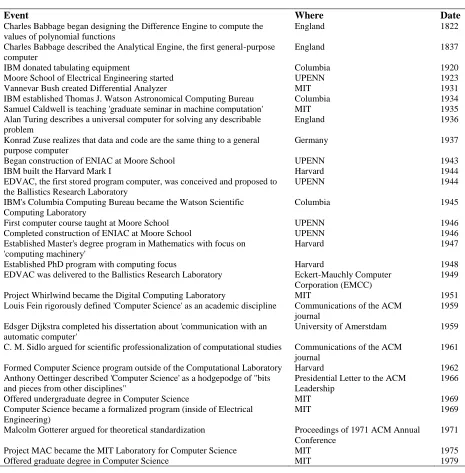
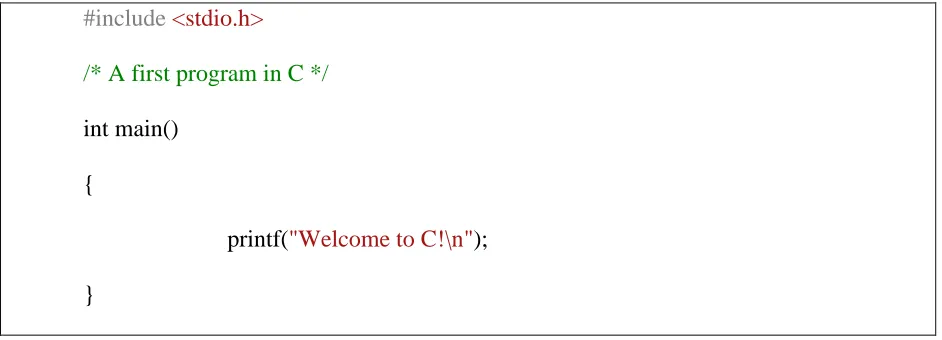
Table 3.1 Significant Events in the Inception of Computer Science ... 92 Table 3.2 A slightly modified first C program from Deitel & Deitel’s (1994) textbook,
adjusted to include the stdio.h header so that standard input and output subroutines, like “printf,” are available to the program, making it
LIST OF FIGURES
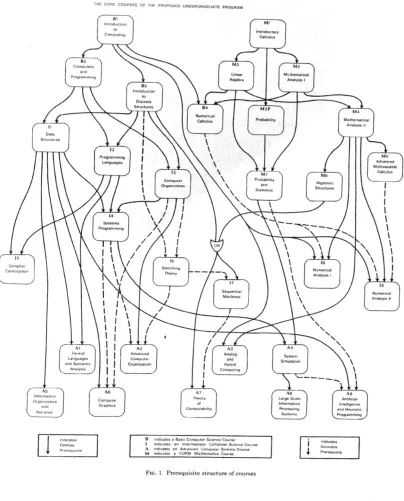
Figure 3.1 The Curriculum Map of Math (“M”), Basic (“B”), Intermediate (“I”), and
Advanced (“A”) courses established by Atchison et al. in 1968. ... 99
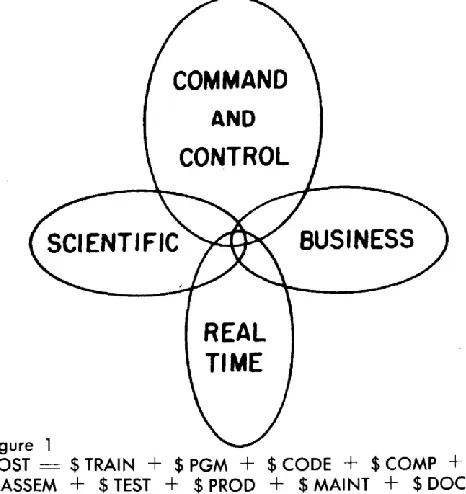
Figure 3.2 The formula for cost analysis forwarded at the 1962 RAND Symposium, “On Programming Languages” (Patrick et al., 1962, p. 25). ... 113
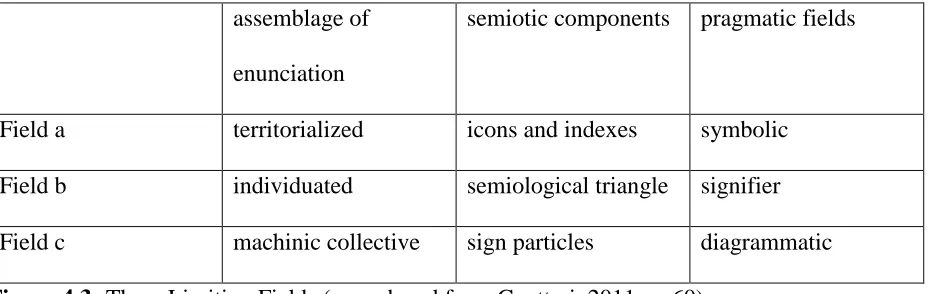
Figure 4.1 Guattarian Assemblages of Enunciation (reproduced from Guattari,
Chapter 1: Software Engineering as a Problem-Oriented Sociotechnical Regime This dissertation project is a direct response to an issue brought forth by Wendy Chun (2011), who argued that media studies’ engagements with software made it more ephemeral and
therefore less knowable, causing software to become a fetishistic medium. In response, this project seeks to de-fetishize source code, programming, and software by looking broadly at software engineering through a Deleuze and Guattarian framework. De-fetishizing software has significant implications for media theorists but has seemingly not been picked up as an area of study by humanist scholars. Chun argues that attempts to study source code that try “to map and know the workings of [a] machine” as a basis for understanding it and theorizing it as a media
technology tend toward a type of reductionism that equates source code to action, i.e., as a “magical entity” and “source of causality” (p. 51). To combat this, Chun asserts that to “make our computers more productively spectral” scholars must embrace “the unexpected possibilities of source code” by treating it as a fetish (p. 20), which “allows one to visualize what is
unknown” by “[substituting] images for causes” (pp. 50-51). Chun argues against the belief that
source code is what it is, against the position Ellen Ullman took, i.e., that source code’s “entire meaning is its function” (Ellen qtd in Chun), because it can be read by many human and
nonhuman agents and understood in multiple ways. Consequently, due to its readability and ability to convey multiple types of information, source code is a medium in the “full sense of the word,” because “it channels the ghost that we imagine runs the machine” (pp. 49-50): “the power” of (or behind) source code, she asserts, “lies elsewhere … in social and machinic
relations” (emphasis added, p. 51). This is true, in the sense that software does not emerge into
made, and consequently, what software engineering does; doing so will de-fetishize software, allowing it to become knowable and seeable in ways media studies has typically not integrated into its theoretical milieus. As evidenced later in this chapter, media theorists studying software have generally not moved past the primacy of code and the concept of the programmer, even in automated and machine learning systems, and have not given an account of the ontological and epistemological values that broadly deploy and execute software. My argument is that source code and programming are but one process in a set of processes that produces software, and that looking past the programmer and source code to the practices of software engineering integrates the world of social and machinic relations to which Chun alluded into future definitions of software: programming is but one process of many that brings source code into existence. Software is not a ghostly medium if its exigencies and ontologies of design, management, and funding are incorporated into its definition. So, while Chun (2011) does look at certain types of social and machinic relations in Programmed Visions, the reasoning for the processes leading to the ‘software’ she and others use, like Alexander Galloway (2012) in Interface Effect, are largely
taken for granted in the larger and ongoing discussion about power and its consequences. Software engineering is the field of praxis that produces most modern software, and
The way to account for the reasoning of software, the ‘why’ of the ‘how’ software is made, is to set aside the concept of power and instead examine the problematics—which to
Deleuze (1994) are the combination of a problem with its conditions—leading to the production of the disciplines themselves which are dedicated to solving problems computationally, e.g., those of Computer Science and Software Engineering. What produces the identity of a software engineer, what does it mean to ‘engineer’ software, and why is the conjunction of ‘software’ with ‘engineer’ both polemical and desirable? An analysis of problematics is where Deleuze and Guattari’s independent and conjunctive works bloom, with its emphasis on ontologies of
becoming and of rhizomatic associations stemming from events, which I mobilize to produce an analytical framework capable of accounting for why software engineers produce software in ways that they do. To this end, this dissertation develops the concept of the problem-oriented sociotechnical regime to frame a historical analysis of the factors leading to the inception and evolution of software engineering, which then examines the difficulties inherent to the mixed semiotic interactions of transducing problems into software.
There Is No Software? No: There Are No Typical Software Projects
expensive software development efforts at the time and would come to realize that software development is confounding in many ways. While one might assume that if a product were running behind, adding more developers would speed up the development process, Brooks found it held the project up in several crucial ways. At the time, more developers meant, blithely, more sick days, more scheduling headaches, less effective communication among the team members, and slower overall progress; counter-intuitively, fewer developers produced software faster. From a ‘programming’ perspective—the extent to which a developer just writes code in their
day-to-day job—Brooks' ratio arguably changes depending on the kind of Software Development Life Cycle (SDLC) their organization adopts, and the level of seniority and experience they have. Junior developers tend to do less planning and design work, while senior developers and
architects might regularly meet with stakeholders, write requirements documents, map out designs, and assign tasks and prioritize work for junior team members. Brooks’ ratio shows that
software is more than its programming and source code and is rather an aggregation of efforts. Software development is far more than programming and compiling source code cloned from git repositories. While Brooks found that planning, documentation, testing, and
maintenance took more time than implementation work, the most valuable insight is the realization that software development is fundamentally communicative across human and technical domains. Planning ideally takes place prior to implementation, and includes tasks like needs assessments, requirements gathering, and design work, which are all processes that are performed to such an extent that the problem someone is having is understood well enough that a tenable solution can be found. During planning, project managers, architects, and senior
developers talk to clients and stakeholders, turning the information they gather into
anticipated outcome. Those requirements are then divided up and communicated with team members—like artists and programmers—who take them and start turning them into something that performs work. User interfaces are created and connected programmatically to the business logic they are designed to use, and the work is managed over time by senior developers and project managers. Ongoing work is checked against the design documents to ensure conformity, and meetings are held when issues arise that slows the work down to determine if the tasks can be divided and completed by other team members. Testing can mean several things in a software development effort, but generally it is a means to determine if the solution meets the
requirements stated at the outset: does the software do what the customer wants it to do? Anytime software fails to meet its requirements, implementations are fixed, possibly leading to new programming work, which then elicits more testing. A major caveat with bug fixing is the additional testing (and sometimes, documentation) it requires: a bug fix might introduce a regression, which occurs when the fix for one issue causes a new issue; a fix can break other parts of an application. Software enters a ‘maintenance mode’ after it has been delivered to a
customer, and many bugs are often fixed after a product has entered the market. Maintenance modes can often last years, if not longer, depending on the needs of the customer, the nature of the software, and the budget allocated for its lifecycle.
While programming is how software is ‘written,’ software cannot be planned, tested, or maintained without multiple layers of communication: many words are spoken and written to facilitate a software project. As Brooks noted, the implementation phase of an application, while important, is one part of a larger set of processes that are largely driven by people talking to each other. This communicative impetus is part of the reason why software, popularly, is never
before it becomes ‘not-bicycle frame’ (or perhaps, ‘was-bicycle frame’), software can be
modified and scoured in myriad ways while still maintaining cohesion because improvements can always be integrated and bugs can always be fixed as long as they are brought to the attention of those charged with maintaining it. For example, Microsoft recently increased the number of Fiber Local Storage slots in the Windows 10 Kernel which is notable because the feature lives in the code the kernel uses to manage threading, which allows many processes to run simultaneously on a computer. As the change touches virtually every application Windows runs, it will require long-term testing to verify that it works properly without unduly affecting other parts of the Windows Operating System (OS). Throughout it all, Microsoft has
communicated with stakeholders, like its developers, its testers and Windows Insiders’ members,
and customers potentially affected by (and benefiting from) the changes. It was implemented when a program manager in Microsoft made the case for the change to the Kernel team,
attracting enough supporters to the argument for a risky change. He made the case because of the feedback he received from professional audio producers and musicians on a pro-audio forum because the need existed, and it was an issue that would enable Windows to be used far into the future. In a real sense, the communication around software and about it enables it to be
produced.
The areas Brooks’ identified—planning, implementation, testing, and maintenance—have been codified as SDLCs, which have emerged over the years since IBM’s OS/360 debacle to
widely adopted by industry after it was standardized by the Department of Defense in 1985 (DOD, “Defense Systems Software Development,” DOD-STD-2167A). Waterfall development
efforts flow from top-to-bottom (like a waterfall), such that a development effort begins with a ‘requirements’ phase and proceeds, in turn through design, implementation, verification, and
maintenance phases. Waterfall works well for smaller projects but leads to problems when changes to specifications are introduced mid-course, because the model assumes that all the requirements have been gathered and accounted during a project’s inception. Brooks’ experience
shows—and as Chapter 3 will detail—that large projects have many unforeseen requirements. Contemporary SDLCs still include Brooks’ phases but change the way they operate. Agile or
Incremental SDLCs tend to integrate documentation and testing into their implementation phase with ideas like self-documenting code and iterative development to, ideally, make them highly responsive to requirements changes. In Agile, requirements are revisited repeatedly. Scott W. Ambler (2018) explains that “Agilists [sic] take an evolutionary, iterative and incremental, approach to development,” because “requirements are identified throughout most of [a] project.”
The work to implement software relies on concurrent or successive efforts to plan, test, and maintain the product.
increasing the predictability and reliability of the results (topics discussed in chapters 3 and 4), the reality is that models are abstractions and the reality of the day-to-day effort to engineer software is full of sick days, hurt feelings, broken tools, bad routers, power struggles, and
miscommunications. Software is a representation of a set of processes which, through aggregated efforts, culminate in a process that works on a problem computationally, and each ‘becoming’ is
a unique negotiation of human and technical communication.
On Sociotechnical Regimes
To define software engineering as a problem-oriented sociotechnical regime and in turn expand the scholarly focus from source code or software toward the social and machinic relations in the processes used to it, this dissertation makes three supporting arguments. In Chapter 2, “Problem-Oriented Sociotechnical Regimes,” I develop the idea of a sociotechnical
regime to describe how problems organize and coalesce human and non-human agents into sets of technical and social relations and practices that form relatively stable recursive values, identities, and products. From a Deleuze and Guattarian perspective, the concept of the
sociotechnical regime addresses the aspect of Chun’s (2011) argument about ‘sourcery’ and its focus on ‘source code’ by allowing scholarly focus to pivot toward the broad collection of social
and machinic processes leading to the production of software. For their recognition of the role problems play in materialist ‘becomings’ as open-ended processes, I elaborate on concepts from
Deleuze and Guattari’s individual and collaborative work to create the framework of a
sociotechnical regime, which allows me to describe ‘software engineering’ as a distinct, but
allows one to build context around and demystify the solutions they produce, the practices and the products of those practices derived from estimable and reproduceable axiomatics by a
regime. Sociotechnical regimes are part of my response to Chun’s concern about the fetishization of code by placing ‘source code’ in context with the practices and actors involved in its creation.
Software is less about its ghostly visage and more about the processes that created it.
Technological development is iterative and additive in nature, and sociotechnical regimes do not spontaneously emerge into the world. Problems become visible as soon as the right techniques and processes exist to expose them within their conditions. Therefore, sociotechnical regimes are organized material responses to a problematic (a problem and its conditions, according to
Deleuze) that seek to solve that problem while negotiating on-going changes to its conditions. Sociotechnical regimes, like Computer Science or managerial praxis generally, persist through time as they iterate over their solutions to the problems embedded in their relative conditions. The concept allows a definition of software engineering to have its own identity as a discipline while also encapsulating practices and techniques evident in other regimes.
After the concept of the sociotechnical regime is adequately described in Chapter 2, it becomes possible in Chapter 3, ‘Software Engineering as Sociotechnical Regime,’ to look at the
historical factors and problematics leading to the development of software engineering as a distinct regime from the neighboring communities of practice of Computer Science and managerial praxis. The historical factors point to how software engineering became a
sociotechnical regime comprising a distinct expression of a social and machinic epistemology that is principally unstable in that it resides in a constant state of tension between Computer Science and corporatized managerial praxis. Mapping ‘software engineering’ as a sociotechnical
revalued. The historical evidence in the organization of software engineering will show that code and coding are one of many practices and products in the work surrounding computation, and while important, programming and source code are always an expression of a problematic, which is a problem and its conditions. The history of software engineering reveals more about the nature of software when the practices used to create and deploy it are shown to connect to practices inherent in Computer Science and managerial praxis. Software is theory and practice and is an immanent material expression of social and machinic relations; it maintains its ‘ghostly’ qualities only when the broad array of social and machinic relations leading to its
creation are uninterrogated.
Chapter 4, ‘Unstable Intersections,’ completes the circuit of the problem-oriented
sociotechnical framework by exploring and defining transduction, which I define as the
interfacing operation a sociotechnical regime uses to relate to the world and itself. The chapter argues for an interpretation of Guattari’s concept of mixed semiotics to show how software
engineering, a sociotechnical regime premised on a principally asignifying plane of reference comprised of functions and propositions, relates to the signifying content of human expressions. The chapter performs three tasks: it defines Guattari’s concept of asignification by locating its
role in enunciative acts, e.g., the mixed semiotics of assemblages of enunciation, and explores its relationships to the works of McLuhan and Kittler to show how his orientation toward
how transduction—the loss or addition of signification to a process—shapes a problem-oriented regime’s material outcomes and encounters. Transduction and mixed semiotics are a way to
account for the unreliability of software and the unpredictability of its implementation and delivery by elucidating what happens when, reciprocally and bidirectionally, diagrammatic processes are imposed on signifying interpretations and interactions. This, in turn, allows one to understanding why a sociotechnical regime’s problem-orientation explains more about its
relation to the world and itself, and why, specifically sourcery must be dispelled and why future media studies scholarship should incorporate thorough understandings of software engineering.
The significance of a Deleuze and Guattarian framework for media studies, of
sociotechnical regimes to analyze and describe software engineering, allows a simplification of terms such that intersections between philosophical concepts—as proposed in media studies scholarship—and scientific functions can be analyzed in the contexts in which they operate. Just as the sciences should not attempt to redefine philosophical concepts, philosophical projects should not attempt to overcode scientific functions. Sociotechnical regimes offer a Deleuze and Guattarian framework for analyzing the intersections between a discipline, like software
engineering, and the world in which it operates, produces, and mediates. The significant
contribution this framework makes is to narrow the distance between media studies scholarship and the engineering practices and outcomes they purport to study. The gap is evident when evaluating current definitions of ‘software,’ ‘programming,’ and ‘source code.’
This dissertation is an attempt to reboot parts of the media studies’ scholarship associated
with software. Using Deleuze and Guattarian methods to incorporate and elucidate the
ways. They believed that “philosophical concepts act no more in the constitution of scientific functions than do functions in the constitution of concepts,” which means that the work of
philosophy in evaluating scientific functions resides outside of a definitive, denotative domain (Deleuze & Guattari, 1994, p. 161). The issue with media studies scholarship about software is that it has unnecessarily attempted to redefine terms: Deleuze and Guattari viewed philosophical concepts as an event or virtuality that exists and affects beings whether they like it or not, but crucially recognized the actualization of things within a state of affairs as being governed by scientific propositions and functions. This distinction of philosophy from science, that the
“actualization and counter-effectuation are not two segments of the same line but rather different lines” (p. 160), provides a basis for looking for intersections between a virtual concept and an
actual function. So, rather than treating software as invisible, or fetishizing it, which leads to narratives of its existence and functions in our lives as mysterious, or of media studies’
investigations into its nature which offer to ‘pull back the veil’ to only further redefine it, it may
be more productive to consider it as always visible by working with its existing and science-oriented definitions. Tracing the connections between things—their intersections—describes their becomings without the need the redefine their terms.
On Software and Software Engineering, Programming, and Source Code
inseparable it is in their respective sufficiency, and philosophical concepts act no more in the constitution of scientific functions than do functions in the constitution of concepts. It is in their full maturity, and not in the process of their constitution, that concepts and functions necessarily intersect, each being created only by their specific means. (Deleuze & Guattari, 1994, p. 161)
Before diving into Deleuze and Guattari’s (1994) epigraph to this section, we need to
touch upon a connection in media studies scholarship that speaks to a theme of intersection between philosophy and science. Bernhard Siegert described media studies’ scholarship as operating in a Kittlerian mode for the last twenty-years during the closing remarks of the 2018 Princeton Weimar Summer School for Media Studies. He stated that while it had worked well, the future of media studies required a broadening of the approaches used to study cultural techniques (incidentally, the research question for the Princeton Weimar 2019 session is, “What Happens When Practices Become Algorithmic Technologies?”). Siegert lamented that the study
of cultural techniques must be connected to their practices. While Kittler may have learned to program, it is not clear that he understood the reasoning behind software engineering’s
axiomatics. Deleuze and Guattari offer a way past the Kittlerian mode for media studies scholarship. The divide between industry and STEM-based definitions of software,
programming, and source code with media studies scholarship is stark, notwithstanding some exceptions. While there are several factors influencing this divide, including issues of education, training, and professional experience, Kittler’s attitude about technology and software has
While media studies’ definitions for ‘software,’ ‘programming,’ and ‘source code’
incorporate aspects of industrial and STEM perspectives, more often the work attempts to redefine those terms, rather than intersect with them. Deleuze and Guattari’s epigraph above is an argument for respecting the self-sufficiency of philosophical concepts and scientific
functions: inquiry that relies on intersections between philosophical concepts and scientific functions are often not fruitful because they do not give each other the respect they deserve. Preceding Deleuze and Guattari’s epigraph, philosophical concepts and scientific functions and
propositions move in co-equal spheres: just as a concept requires one to return to “the event that gives its virtual consistency,” it is also “necessary to come down to the actual state of affairs that provides the function with its reference” (Deleuze & Guattari, 1994, p. 159). Concepts cannot
dominate functions, and conversely, functions cannot dominate concepts: events are “actualized or effectuated whenever [they are] inserted … into a state of affairs,” but are “
counter-effectuated whenever [they are] abstracted from states of affairs so as to isolate the concept.” A
concept, in fact, is treated as amor fati, e.g., “I was born to embody [the concept] as event
because I was able to disembody it as state of affairs or lived situation.” Concepts are there—and
lived—whether one likes them or not, and should be accepted as such; but concepts, which are virtual, rely on the functions and propositions of science to become actualized in a state of affairs. While related, they are not equivalent, and attempting to equate them is a type of domination, or over-coding, that leads to confusion: “actualization and counter-effectuation are not two segments of the same line but rather different lines” (p. 160). It follows from Deleuze and Guattari’s reasoning that, if concepts and functions are not the same, that they have
lived contexts. Such understanding ultimately frees inquiry looking at their intersections by eliminating the desire to dominate one or the other by redefining terms. Scientific thought-forms, Deleuze and Guattari argued, are self-sufficient within their own wholeness; the task of philosophical inquiry into the sciences is not to tell the sciences how their functions work, but to discover the intersections between virtual and actual, between the event of a concept as its consequences ripple throughout the lives of those enmeshed in a state of affairs.
The intersections Deleuze and Guattari argued for occur not in the formation of a concept or function, or even in its actualization, but in how they move and shape life in accordance with the concept of an event. Computer science and software engineering, like any scientific or engineering disciplines, are governed by ontological commitments and epistemologies that are distinct in their definitions, practices, and actualizations from the philosophical concepts’ media
studies investigates. An example of science respecting the self-sufficiency of concepts is found in Julio M. Ottino (2013) opinion piece written for the Robert R. McCormick School of
Engineering and Applied Science at Northwestern University. In View from the Intersection: Why We Need the Humanities and the Arts, Ottino argued that the focus of the arts was not necessarily to solve problems, but to create questions, and that such a mindset allowed one to “[see] things in a completely new fashion,” which is “ultimately what innovation is about.”
Humanistic inquiry and its methods, with their emphasis on concepts and the virtual,
complement the work of engineers and scientists by allowing them to discover incongruities and question abstractions. The concepts of the virtual and the methods used for finding new
questions were strengths to be leveraged, rather than over-coded.
argued that software be treated as a fetish—or treated it as a fetish purposely or unwittingly—is evidence of Deleuze and Guattari’s concerns: the definitions of software from those who create
it—e.g., computer scientists, software engineers, software developers, programmer analysts, programmers, and web designers—are considered only insofar as to dismiss and refute them, a practice contrary to the independence and self-sufficiency of concepts, functions, and
propositions that Deleuze and Guattari argued for. For example, the industry and scientific definitions of ‘software’ has been over-coded and redefined by media studies’ to such an extent that its wholeness and self-sufficiency as a distinct product from an independent thought-form has been ablated from its state of affairs. This means that the definition of ‘software’ in media studies is not the definition of ‘software’ from a scientific or industry perspective. If Deleuze and Guattari’s argument for self-sufficiency is taken seriously, both fields would operate with
co-equal definitions, spend time examining intersections of concepts and their manifestations in the actual without the need to redefine already sufficient terms. It simply is not the role of the philosopher, according to Deleuze and Guattari, to define how science works. Rather, it is far more productive to look for intersections between power or media effects and software and its constitution from the common definitions that respect philosophical and scientific denotations. If respected, the self-sufficiency of science and philosophy and art provide a baseline for
cooperation by eliminating the impetus to over-code one another’s methods and operations. Over-coding is especially egregious in software’s case, where the conceptual and axiomatic frameworks in which it is designed, implemented, tested, and maintained are often ignored or glossed over in favor of attempts to redefine what it is. For example, despite software being ubiquitous, it is only “allegedly” something that “[all] new media … rely on” (Chun, 2008,
which is true (p. xxxix); he stated that “[inside] the computers themselves everything becomes a number,” which is true (p. 1); but he also claims that “[our] media systems merely distribute the words, noises, and images people can transmit and receive. … the only thing being computed is the transmission quality of the storage media,” which is hyperbole to the extent that it is false and
easily disproved by investigating how Netflix maintains streaming quality under adverse internet transmission rates (p. 2). Interactions with ‘software’ are always ‘computing’; an idling modern
computer is always servicing its many processes, checking for user input events and network events. The software that humans interact with is always running, and therefore always visible to an important extent.
Chun (2011) states that definitions of software are often reduced to a kind of “[visible invisibility],” because “[software] seems to allow one to grasp the entire elephant because it is the invisible whole that generates the sensuous parts” (p. 300). Visibility does not always equate to ‘scrutibility,’ to play with the word: software presents only as much of itself as it needs to
through well-defined interfaces, a topic which Alexander Galloway (2012) wrote about at length. So as a matter of perspective, software is visibly invisible, because aspects of its implementation are hidden, stored in memory cells, executed by processors, converted to electron flows; but as a matter of perspective, it is important to note that such a description describes the consequence of an effect: users press a button or swipe next on their smartphone’s touch-screen. From the
inappropriate—from a Deleuze and Guattarian perspective, at least—for philosophical epistemes to attempt to redefine it (Deleuze & Guattari, 1994, p. 161). Media studies’ scholarship will only
benefit from integrating the definitions of established scientific and engineering functions and propositions, because often the consequences of their effects are more important than the details of their implementation.
While much effort has been spent on attempting to define the materiality of code and the software it becomes, many important works in media studies’ have ignored the how and why of
code, the practices leading to its creation, and the communicative and human practices which are arguably more important than the code itself. Evidenced by Zara Dinnen’s (2013) explanation
that notable scholars like Katherine Hayles, Johanna Drucker, Matthey G. Kirschenbaum, Wendy Chun, Alexander R. Galloway, Adrian Mackenzie, and Eugene Thacker have “a shared concerned with code as language and code as text” (pp. 175-176), media studies scholars have
spent most of their time examining the nature of source code and the activity of programming. Yet, while one or more derivations of terms like “program,” “programming,” “programmer,” “code,” “coding,” and “source code” are indexed topics in the appendices of the major works of
N. Katherine Hayles (1999, 2005), Alexander R. Galloway (2012), Lev Manovich (2013), Wendy Hui Kyong Chun (2008, 2011, 2016), Rob Kitchen and Martin Dodge (2011), and Friedrich Kittler (2008; 2010; with Gumrecht, 2013), terms like “software” in conjunction with “engineering,” “development,” or “developer” are absent. “Programming” and “programmer” are
Respecting the self-sufficiency of a term like ‘programmer’ or ‘source code’ would reduce the error of conflating those terms with software engineering. By redefining the terms, media studies scholarship has limited itself to a simplified definition of software that fetishizes ‘programming’
at the expense of a nuanced and sophisticated understanding of the communicative processes through which problems become solutions, and solutions become software, while allowing for their self-sufficiency and wholeness is the way forward to introduce such nuance into media studies’ scholarship.
Current media studies and scholarly definitions of software range in degrees from assertions that it does not exist (Kittler, 2013, p. 223), to omitting its definition in theoretical discussions (Hayles, 2005; 1999). As pointed out earlier, Chun (2011) argued to “make our computers more productively spectral” by allowing scholars to accept the “the unexpected possibilities of source code” by fetishizing it (p. 20); while fetishization effectively “allows one to visualize what is unknown” by “[substituting] images for causes,” those images are flawed by
being, at best, oversimplifications, and at worst, technically and socially inaccurate. Examining code for what it is—by respecting the self-sufficiency of its definition in Computer Science, and software engineering—allows it to be accurately described, explained, and understood within the actualized contexts in which it is produced. Fetishism is and has been the wrong move for media studies’ investigations of software, programming, and source code because it has led to a
disassociation from the technical and social contexts in which they exist, are practiced, and are enacted. Contrasting definitions of ‘software’ in the contexts in which it is created and by those creating it to media studies’ perspectives provides a sense of how Chun’s argument for
undermines scholarly investigations of software mediation by attempting to define it as
something it is not. The issue at stake here is not with media studies scholarship that describes it, from the perspective of the intersections it makes with the concepts of our lives, but with
scholarship that attempts to re-define it, which is contrary to Deleuze and Guattari’s (1994)
argument for the self-sufficiency of functions and concepts. This literature review, although brief, provides evidence for the extent to which ‘software’ as a technology is fetishized in media
studies. Additionally, as this review contrasts the industry and media studies definitions of software, programmer, and source code, it will illustrate how productive a study of software engineering can be for future media studies’ scholarship if the Deleuze and Guattarian
perspective about the self-sufficient domains of functions and concepts in science and philosophy are observed.
From the perspective of Computer Science and software engineering, software comprises the communities of practice that produce the instructions which compel a computer to perform work. The word ‘software’ began to be used during the late 1950s by the engineers and scientists of the time to describe the nature of the operating contexts of a “stored-program computer”
(Cambell-Kelly et. al, 2014, p. 168). Paul Niquette (1995) claims to have “coined the word ‘software’” in 1953. From the perspective of a scientific and practice-driven thought-form, software was defined as the “set of instructions that cause [a] computer to operate; a program or set of programs” (Kohanski, 2000, p. 226). It’s common definition, according to Oxford
Dictionaries, includes “the programs and other operating information used by a
computer” to perform work with the hardware upon which it executes. Dictionary.com defines software in relation to computers as “the programs used to direct the operation of a computer, as
Deitel’s (1994) classic book on C programming, C: how to program, software is defined as “the
instructions you write to command the computer to perform actions and make decisions” that
allows hardware to operate (p. 3). The instructional perspective—that of guiding the work computers perform—is echoed in Paul Cerruzi’s (2012) MIT Press effort, Computing, where he describes the tasks and guiding principles of software and hardware design as managing “the
complexity from the lower levels of logical circuits to ever-higher levels that nest above one another” so that a computer system can perform meaningful work (p. 83). While a duality may
have existed between hardware and software at the inception of mechanical computation, the reality now is that software is often the reason for new hardware developments, because “[every] machine requires a set of procedures to get it to do what it was built to do,” and “[only]
computers elevate those procedures to a status equal to that of the hardware” (p. 56). Software
enables hardware which enables software, and so on in a process of recursion. Computer scientists typically view computers, historian Nathan Ensmenger (2010) explains, as “simply a device that can run a certain kind of software program”; it does not matter what kind of device it is if “it is programmable” (p. 5). His most succinct definition of software states that it “is what makes a computer useful,” and without it a “computer is … irrelevant, like an automobile without gasoline or a television set without a signal.” Computer hardware requires software,
which is a set of instructions that cause the hardware to work on a specific task. Extending Ensmenger’s gasoline metaphor a step further allows software to be placed in the contexts in
which it is drilled for, refined, stored, and shipped: Michael Mahoney (2008) argued that producing a history of software is hard, because all “current” software is in fact “’legacy’” software, because of the way “the models and tools that constitute” it “reflect the histories of the
which extend beyond computers and computing to encompass the full range of human activities”
(p. 8). Software encompasses the knowledges and processes that lead to the production and distribution of instructions that impel any kind of mechanical or electronic device to perform work of some kind, so knowing what software is requires knowledge of how software is made.
In media studies, software is defined as largely unknowable and un-seeable, as instructions derived from source code, and that computers—and therefore software—created themselves. While some definitions of software tend to half-align with those found in Computer Science and software engineering, like Rob Kitchen and Martin Dodge’s (2011) which states that “software consists of lines of code—instructions and algorithms that, when combined and
supplied with appropriate input, produces routines and programs capable of complex digital functions” (p. 3), they tend to exclude the communities of practice that design and produce it.
Software tends to be defined as instructions, and depending on the scholar, may not exist at all if it did not need to intersect with humanity: Kittler (2010) has described computer instructions in terms of electrical voltages (p. 226), which he elaborated on in his essay, “There Is No Software” (2013), by reasoning that “elementary code operations, notwithstanding their metaphorical promises (e.g., ‘call’ or ‘return’), amount to strictly local manipulations of signs and therefore (more’s the pity, Lacan) to signifiers of varying electric potentials” (p. 223). He ultimately argued that software would not exist at all if computers “did not need … to coexist with an environment of everyday languages.” Or software exists, but “is extremely difficult to
comprehend,” which Wendy Chun (2008) attempted to simplify by treating it as a metaphor that “illuminates an unknown” which “does so through an unknowable (software)” (p. 2). Software,
Manovich (2013) explains that the languages of modern society are the languages of software, and that software “is the invisible glue that ties” all aspects of modern societies “together” (p. 8). In his essay, “Hardware / Software / Wetware,” Geoffrey Winthrop-Young (2010) dismisses the Oxford English Dictionary’s definition of ‘software’ as “pithy” because the “computer / software binary restages the old boundary disputes between body and spirit,” which makes an easy
definition of the term complicated (p. 189). He echoes the ‘unknowable’ and ‘un-seeable’
definition by explaining that it may be only “the most visible part of a bewildering edifice … that for the vast majority of users remain out of sight,” which in turn “interposes itself between the user and the basic operation of the servile tool” (pp. 190-191). Winthrop Young cites Kittler’s assertion in “There Is No Software” that while all software operations “can be reduced to
hardware operations” (p. 193), computers are “both very social and irredeemably autistic,” to an extent such that “it is not enough to say that human communication is modeled on the computer”
(p. 197), implying that computers are endowed with a kind of self-generating agency,
independent of the humans who engineered and produced them. N. Katherine Hayles (1999), for example, used an assertion by Alan Turing to empower hardware with a sort of disembodied intelligence and post-human agency that is proved through the ‘Turing test,’ which Alan Turing explained as one where, if by ‘talking’ to a computer, a human could not determine if they were
talking to a person or a program, the computer was thinking (pp. xi-xii). As used by Hayles, Turing’s test ignores the software techniques and mathematical advances necessary to
tricks us into believing that we are in charge of the computer. We continue to think of computers as mere tools, and this, in turn, serves to perpetuate our narcissistic self-image as homo faber, man the toolmaker” (p. 75). Software is untrustworthy, inscrutable, and aligned against humanity. So, despite Manovich (2013) recognizing that “software as a theoretical category is
still invisible to most academics, artists, and cultural professionals interested in IT and its cultural and social effects” (p. 9), there has been an explicit rejection of the definition of
‘software’ as it has been employed by the thought-forms responsible for its maintenance in favor
of a broad cynicism.
From an industry perspective, programmers (synonymously referred to as a developer, software developer, or software engineer) are the people who design and develop software, and ‘programmer’ is a title encapsulating practices beyond those of writing computer code.
According to PC Magazine’s encyclopedia of terms, the “software business is a service industry that involves human thinking almost exclusively,” which “contrasts with computer hardware or
any other industry that makes equipment, whereby manufacturing is a major part of the
business.” The Oxford Dictionaries definition states that a programmer is “a person who writes computer programs,” which is refined in Kohanski’s (2000) definition, which explains that a programmer is a person “trained in one or more computer languages” who uses those languages
to create computer programs (p. 224). The Bureau of Labor Statistics (BLS) of the United States Department of Labor (2019) has entries for computer programmers and software developers: programmers “write and test code that allows computer applications and software programs to function properly,” while software developers “are the creative minds behind computer
as programmers” (Ensmenger, 2010, p. 14). The term “programmer” arose from “coder,” which “implied manual labor, and mechanical translation or rote transcription,” a mistake John von
Neumman and Herman Goldstine—authors of the first textbook on programming—quickly realized as erroneous: “[what] had been expected to be a straightforward process of coding an algorithm turned out to involve many layers of analysis, planning, testing, and debugging” (p.
15).
Programming and source code are covariant terms. The job of programming computers, or the task of ‘programming problems’ as Cambell-Kelly et al. (2014) called it, grew to
encompass “more than simply writing efficient and bug-free code”: as the complexity of
software increased, the individuals designing and writing the software became increasingly involved “in a broad range of activities that included analysis, design, evaluation, and
communication—none of which were activities that could be easily automated” (p. 183). Today, job titles and responsibilities tend to refer to a type of expertise relative to the contexts in which a problem resides, such as those outlined by a corporation’s needs, or a societal issue. For
example, for one company, a web developer’s job responsibilities might encompass expertise in
a range of skills that overlap with ‘software engineers’ in another company: titles can be highly interchangeable. While seniority and autonomy tend to determine the extent to which developers are required to cultivate many skills, “full stack” developer positions are increasingly common.
Trista Liu (2017) describes full-stack developers as having wide “horizontal [skill trees]” who have knowledge at width, rather than at depth. A “full-stack” developer is expected to meet with
emphasis on width rather than depth of a skill set—most of the tasks previously described are common to any Software Development Life Cycle (i.e., Waterfall, Agile, etc.), and rely as much on communication skills as purely technical ones. Clear communication of and about a problem mitigates errors by increasing the likelihood that the developed software reflects customer requirements; programming is but one area of expertise software developers must gain competency in.
Definitions of programmers and programming, in media studies, vary in degrees from industry positions. Manovich (2013) hews closest to established definitions, describing programmers as those who have “programming skills,” with “access to a computer, a programming language, and a compiler” (p. 93). Programming skills produce software. He explains that “software development is an industry” which is “constantly balancing between stability and innovation, standardization and exploration of new possibilities.” Kitchin and
Dodge (2011) also work from industry positions, describing programming as a skill, the purpose of which is to “construct a set of coded instructions that a microprocessor can unambiguously interpret and perform in ongoing flows of operations” (p. 25). Programmers produce code which are ‘unambiguous’ instructions for a computer to follow. The code that programmers produce
should be clear enough for a computer to follow, and for a human to understand, maintain, and reproduce in other contexts, for other problems.
One of the most influential definitions of ‘programming,’ programmer, and code—the issues entangled with the skills and acts of producing software originates with Kittler, which has introduced a stark divide in terms of the ambiguities (or lack thereof) of source code and what it is which programmers produce. His definition of ‘programming’ is commonly reflected in media
led to attempts to redefine it in terms of signification (rather than asignification), e.g., ambiguity in favor of unambiguity. For example, in a recent collection of essays about Kittler studies published in 2015, Kittler Now: Current Perspectives in Kittler Studies, Stephen Sale
summarized Kittler’s perspective on programming languages as those which have “toppled the
monopoly of ordinary language” and are “multiplying in order to obfuscate the technical
decisions made at a hardware level” (p. 64). Kittler (2013) set the mold for this interpretation of
computation and programming when he conflated writing with a “peculiar kind of software … at the incurable confusion between use and reference” (p. 220). But if what Winthrop-Young (2011) pointed out about Kittler’s attitude about software is true, that “he came to deny its very existence” because “it can be reduced to basic hardware operations,” programming cannot exist either (p. 75), then what kind of writing is programming? Kittler believed that “[we] must study
basic programming and operating languages in order to overcome their dependence on the software opium handed out by the industry” (p. 77), so software—in its non-existence—must be
a form of power or coercion, which is a theme Chun (2016) argued in later work: computers are a medium that are “essential to organizing and managing, assessing and predicting—that is,
programming—populations and individuals” (p. 19). Programming then becomes a kind of writing that inscribes command and control logics onto the canvas souls of human beings. So, programming, as a kind of writing, produces text that may not exist at all, but at the very least produces something that is a form of power, which is itself a form of fetishism for the
mechanisms, processes, and social and machinic relations that categorize and coerce humans. ‘Power’ and this kind of ‘command and control’ narrative is evident when Chun (2011)
programming by describing commands issued to a computer using a programming language as a “certain logic of cause of effect, a causal pleasure that erases execution and reduces
programming to an act of writing” (p. 101). Here writing implies a hermeneutic framing, which
are the domain of concepts, in terms of Deleuze and Guattari; source code, defined from an industry and scientific perspective, is less ambiguous. Chun had, earlier in her work, defined programming as a sort of logos which “turns program into a noun—it turns process in time into process in (text) space” (p. 19), the emphasis on ‘text’ is important, because it indicates the
presence of a bias in the interpretation of another thought-form’s definitions, attempting to coerce in this case something functional and propositional into that which is signifying and open to hermeneutical interpretations. From an industry perspective, programming is writing insofar as it is ‘writing’ instructions a computer will follow that humans can understand for further development purposes. Kohanski (2000) defined source code as “a program in the form of
statements written in some language that a human being can understand. A compiler or assembler will convert source code to object form, and the linker will combine one or more objects into an executable program” (p. 226). What could media studies gain if it moved away from Kittler’s distrust of software toward thorough understandings and appreciations of software development’s axiomatics and problem-orientations? At this stage, regardless of whether a machine learning, artificial intelligence, or human intellect is generating ‘programming,’ each
making sense of software requires that the practices leading to its production are enumerated and understood so that narratives of sourcery can be dispelled productively.
There is an impasse in the ways philosophy and science speak of each other. In the epigraph to this section, Deleuze and Guattari (1994) stated that “No doubt states of affairs that
are too dense are absorbed, counter-effectuated by the event, but we find only allusions to them on the plane of immanence and in the event” (p. 161). This means that, for however a state of
affairs, in its concrete, actualized form is configured, it alludes to philosophical concepts through indirect means, and vice versa: philosophical concepts will “counter-effect[uate]” an event in response to a change in a state of affairs, but do not directly affect the composition of the functions and propositions that configured it. Philosophical concepts and scientific functions relate, rather than correspond, with each other: they are self-sufficient. This is important, because as Deleuze and Guattari argued, “[it] is in their full maturity, and not in the process of their constitution, that concepts and functions necessarily intersect”; the task of philosophy is not to
redefine the functions of the sciences, nor is it the job of the sciences to redefine concepts emerging from philosophy.
Software, programming, and source code represent an impasse where the key terms provided by science are modified in such a way that their fundamental meanings are undermined by philosophical overcodings. This represents a shift away from an actual state of affairs into explorations of ‘intersections’ that reside primarily in a philosophical domain. As evidenced by the comparison of industry and media studies’ definitions of ‘programmer,’ ‘source code,’ and ‘software,’ their self-sufficiency has not been respected. Deleuze and Guattari’s thought-forms
forth in such a way as to give rise to new concepts and reflective functions, “each being created
only by their specific means” (1994, p. 161). Self-sufficiency is a way to provide a basis for collaboration, hence the purpose of this dissertation project is to model Deleuze and Guattari’s
argument at a point of intersection within the scholarship and history of software engineering.
The Visibility of Software Requires Software Engineering
Treating software as always visible requires that software engineering be defined in terms of what it is not, which is Computer Science. It further requires that the practices and reasoning of software engineering be both enumerated and respected for the purposes they originated, to solve problems computationally. Software is the visible expression of a solution to a problem. Its visibility not only outlines its functions but provides insights into the ways it was designed and implemented. Understanding software from the perspective of software engineering practices breaks the ‘invisible’ narrative apart by revealing the common scenarios and axioms that lead to
its development and deployment under most circumstances. Software became ubiquitous as soon as it was deployed broadly in society at large within the cheap read only memory (ROM) chips, embedded processors, and integrated circuit boards of toys and consumer products in the late 1970s and early 1980s; it is not mysterious if subjected to scrutiny that takes the processes used to problematize its solutions into account. Treating software as invisible, or as a fetish, is simply a failure to engage with and understand the broader communities of practice that produce it. Software is the visible artefact of a problematic; software is the visible solution to a problem.
problem be solved computationally? If so, what should the solution look like? What is the solution supposed to do? Can the problem be broken down into smaller parts, or must it be solved in its entirety? Software and its effects are always visible from the perspective of an engineer because matters of implementation allude to issues of design, which is always rooted in a problematic, which Deleuze (1994) defines as “the ensemble of the problem and its conditions” (p. 177). Problems, for Deleuze, are immanent to their conditions: “the complete determination
of a problem is inseparable from the existence, the number and the distribution of the
determinant points which precisely provide its conditions.” Solutions, on the other hand, tend to
“conceal the problem,” because they become representational and experiential, factors which
tend to outweigh and overshadow the broader implications a problem may have (p. 178). If software is treated as a solution, its implementation and manifestation is less important than the problem it seeks to produce a “solution-instance” for (p. 178); rather, an instance of ‘software’ or
the manifold of processes in a ‘software environment,’ from a user’s desktop operating system (OS) to those run in server farms by Microsoft or Google provides clues to an orientation that lead to its implementation and purposing.
The sociotechnical regime, developed here over three chapters, incorporates Deleuze and Guattari’s respect for the distinct nature of scientific functions and philosophical concepts. By defining what a sociotechnical regime is, relating software engineering’s history in terms of a
regime, and describing how that regime intersects with society at large through processes of transduction based on signifying and asignifying transmissions, this project offers an alternative to the Kittlerian perspective on software which lead to Chun’s later argument for its fetishization.
incorporated to solve problems within and for those conditions. Understanding software
Chapter 2: Problem-Oriented Sociotechnical Regimes
Problems work through their conditions. Truth, for a software developer, flows from the contexts in which they find themselves into the tasks they must complete. And for software, the problems and conditions of its encounters with us, in our situations, to borrow the spirit of Kittler’s (1999) language, are mediated by ‘software engineering’ processes and identities long
before the software itself is produced and deployed to act upon us. Software engineering
processes encompass the machine and the software; while it is obvious that ‘engineering’ implies a way of solving problems, the fetishization evident in media studies indicates that problems are being separated from their conditions. Kittler’s (2013) attitude toward software and hardware has
greatly influenced media studies, and while the assertion he made about the Central Processing Units (CPUs) in machines is true, in that they “can do both less and more than [their] data sheets” reveal (p. 216), processors and their data sheets have not been placed in the broader
software engineering contexts that recursively generate them. In fact, what is most striking in media studies is that, while the spirit of Kittler’s suspicion is borne out in the works of Alexander
Galloway (2012), Mark Sample (2013), or Felicitas Kraemer and Kees Overveld (2010), seemingly lost in scholarship examining the technics of computation is one of the most striking points he made in his famous essay, “Protected Mode,” where he stated that “[the] lovely phrase ‘source code’ names the literal truth” (p. 218). De-fetishizing source code requires that the
to move away from the nebulous opacity Kittler thought the codes in CPUs represented, from a principally fetishistic perspective of source code and programmers, to one that factors in the all-to-human considerations shaping the truth of a software developer, which is that they are always enmeshed in the problematics of their situations. Kittler’s statement about ‘source code’ as literal
truth should be taken literally, because it represents a perspective Deleuze and Guattari (1994) argued for by stating a self-sufficient definition of code that does not attempt to overcode or deterritorialize: “philosophical concepts act no more in the constitution of scientific functions
than do functions in the constitution of concepts” (p. 161). Source code, for a computer, is literal truth, having been “created only by [its] specific means.” This chapter develops the concepts of
problem-orientation and the sociotechnical regime and describes a Deleuze and Guattarian framework for understanding how problems organize and coalesce into practices and identities. Those practices and identities are captured by sociotechnical regimes, which are sets of technical and social practices forming relatively stable recursive values (operating principles, statements of purpose, mores), identities (the project manager, the computer scientist, the programmer analyst), and product outcomes (software, user stories, unit tests, memos, code) as means to solve
problematics.
This chapter establishes a basis for thinking about software engineering as a problem-oriented sociotechnical regime by looking at three areas. First, it starts by examining
problematics, considered by Deleuze to be a combination of a problem with its conditions, which looks at its Bergsonian origins, the significance of problematization to Deleuze and Guattari’s
(1977) Anti-Oedipus, its role in the conceptual and analytical approaches to What Is Philosophy?
material and experiential encounters with the world, which provides a basis for understanding how problems can lead to the organization of a discipline focused on solving them, leading to disciplines encapsulating identities and practices, like Computer Science. Finally, it defines sociotechnical regimes as a problem’s manifestation in a human world, developing an analytical
framework using Deleuze and Guattarian concepts to account for and describe why a regime’s development of social and technical practices coalescences around continuing encounters with its governing problematics. It concludes by describing why problem-orientation and sociotechnical regimes matter for understanding software by mapping software engineering as a sociotechnical regime and briefly describing three of the fundamental problems guiding and complicating its organization and focus as a regime, a history of which is developed further in Chapter 3. The work outlined here provides a framework for understanding the relationships between
problematics and sociotechnical regimes and is the first of three steps this project makes in responding to its exigence. For media studies, the concepts of problem-orientation and sociotechnical regimes and their relationships are the basis for a means to de-fetishize (Chun, 2011; 2008) and disentangle the identity of the ‘programmer’ with the primacy of ‘source code.’
The problem-oriented sociotechnical regime encapsulates a nuanced understanding of how the broad array of social and machinic processes used to design and implement software mediate problems themselves, which, by altering the problems they seek to solve in subtle and explicit ways, have greater consequences in a software-dominated world than source code’s materiality or treating the programmer as its soul author.
to Deleuze and Guattari’s theoretical considerations. Framed as such, these cursory definitions
will provide a conceptual basis for relating the dense and nuanced works of Deleuze and Guattari to the overall shape of a regime like software engineering. To begin with, a problem-oriented sociotechnical regime like software engineering enacts many types of processes to complete the work necessary to solve problems. I define problem-orientation as a type of task-based, process-driven form of effort that parses problematics according to some orienting principles that dictate, by and large, how the problem in a problematic is to be understood and solved relative to its conditions. I employ Deleuze’s (1994) definition of problematics, which is the combination of a
problem with its conditions, which has several implications: first, problems are inseparable from their conditions; second, problems reside in a set of conditions; and third, problems arise from their conditions (p. 177). According to the Oxford English Dictionary, a process is, in its noun-form, “a series of actions or steps taken in order to achieve a particular end,” which for
computing is “a series of interdependent operations carried out by computer”; as a verb, process becomes the performance of “a series of … operations on (something) in order to change or preserve it,” and for a computer, ‘to process’ becomes how a computer “operate[s] on (computer data)” using a program. Problem-orientation is a way of describing the types of tasks software