Nucleon structure studies with the COMPASS experiment at
CERN
Stephane Platchkov1,a
1IRFU/SPhN, CEA Saclay
Abstract. The COMPASS experiment at CERN uses hadron and lepton beams for nu-cleon structure studies. Most of the data collected so far with a muon beam and either pro-ton or deuteron polarised target were analysed in terms of longitudinally or transversely polarised parton distribution functions and transverse momentum-dependent distributions in the nucleon. A negative hadron beam is used to perform Drell-Yan measurements. The COMPASS large polarised target gives access to several momentum-dependent single-spin asymmetries and provides a stringent test of the fundamental QCD factorisation assumptions. With positive and negative muon beams COMPASS also studies Gener-alised Parton Distributions using exclusive deeply virtual Compton scattering and meson production experiments. An overview of the most recent COMPASS results is given. The expected physics outcome of the forthcoming measurements is discussed.
1 Introduction
The COMPASS fixed-target experiment at CERN [1] uses the SPS secondary and tertiary beams for nucleon structure and spectroscopy studies. The COMPASS hadron spectroscopy programme is covered elsewhere in this conference [2]. In the last few years COMPASS has made detailed studies of the nucleon structure using Deep-Inelastic Scattering (DIS) and Semi-Inclusive DIS (SIDIS). The data were collected with a positive, naturally-polarised muon beam, and either proton or deuteron longitudinally polarised target. An important share of the beam time was dedicated to measurements with a transversely polarised target. The DIS and SIDIS data are mainly used to evaluate the polarised parton distribution functions (PDF) and transverse-momentum dependent (TMD) distributions.
Since 2012 COMPASS has initiated a new physics programme, making full use of its high-acceptance experimental setup. The nucleon structure share of this programme comprises two parts. In the first part, a negative hadron beam is used to perform Drell-Yan measurements on polarised nucleon and unpolarised nuclear targets. The Sivers momentum-dependent asymmetry measured in Drell-Yan will be compared with the single-spin asymmetries already measured in SIDIS. The com-parison should provide a stringent test of the fundamental QCD factorisation assumptions.
The second part of the new programme is devoted to the study of the Generalised Parton Dis-tributions (GPD). Positive and negative muons beams scattered offan unpolarised proton target will allow measurements of both beam charge and spin sum and difference. The results will provide a determination of the transverse nucleon size as a function of the parton longitudinal momentum.
2 Quark contribution to the nucleon spin
Most of the information [3] about the quark helicity contribution to the spin,ΔΣ, comes from deep-inelastic scattering (DIS) measurements of polarised leptons on polarised targets. In the recent years COMPASS has measured double-polarisation asymmetries on both proton (NH3) and deuteron (6LiD)
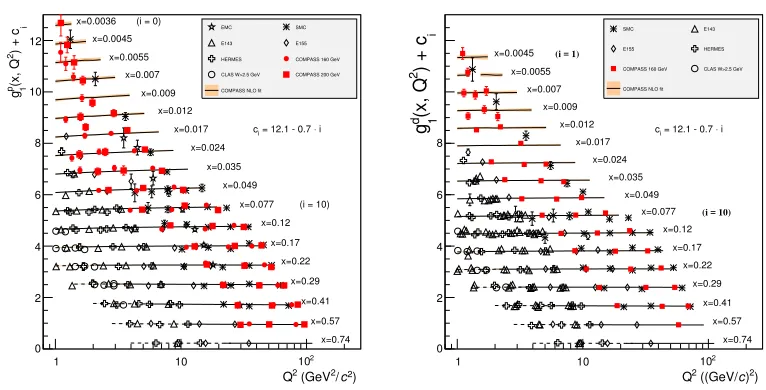
targets [4, 5]. The corresponding proton,g1p, and deuteron,gd1, spin-dependent structure functions are shown in Fig. 1, together with available data from other experiments. The data are displayed as a function of the four-momentum transfer squared,Q2, in differentx=x
B jintervals. The COMPASS
data are particularly important as they cover the low-xdomain.
) 2 c / 2 (GeV 2 Q
1 10 2
10
i
) + c
2
(x, Q
pg 1
0 2 4 6 8 10 12
x=0.0036 (i = 0)
x=0.0045 x=0.0055 x=0.007 x=0.009 x=0.012 x=0.017 x=0.024 x=0.035 x=0.049
x=0.077 (i = 10)
x=0.12 x=0.17 x=0.22 x=0.29 x=0.41 x=0.57 x=0.74 i ⋅
= 12.1 - 0.7
i
c
EMC SMC E143 E155 HERMES COMPASS 160 GeV CLAS W>2.5 GeV COMPASS 200 GeV COMPASS NLO fit
) 2 ) c ((GeV/ 2 Q
1 10 2
10
i
) + c
2 (x, Q d 1 g 0 2 4 6 8
x=0.0045 (i = 1)
x=0.0055 x=0.007 x=0.009 x=0.012 x=0.017 x=0.024 x=0.035 x=0.049
x=0.077 (i = 10)
x=0.12 x=0.17 x=0.22 x=0.29 x=0.41 x=0.57 x=0.74 i ⋅
= 12.1 - 0.7
i
c
SMC E143 E155 HERMES COMPASS 160 GeV CLAS W>2.5 GeV COMPASS NLO fit
Figure 1.World data on theg1(x) structure function for the proton (left) and for the deuteron (right) a a function ofQ2, for various x values. The COMPASS data are indicated in red. The lines represent any of the solutions of the COMPASS global NLO QCD fit (see text).
The world data for the spin structure functions for proton, deuteron and neutron targets are in-cluded in a global QCD fit [5], performed at NLO. A functional form is assumed at an initial Q2 0
scale for all singlet, triplet, and octet flavour combinations of the quark distributions, as well as for the gluon distribution. The first moments of the non-singlet distributions are fixed to the values of the axial-vector weak coupling constants measured in neutron and hyperonβ-decay and assuming SU(3) flavour symmetry. Thex−Q2evolution ìs done in theMSfactorisation scheme. In order to investigate
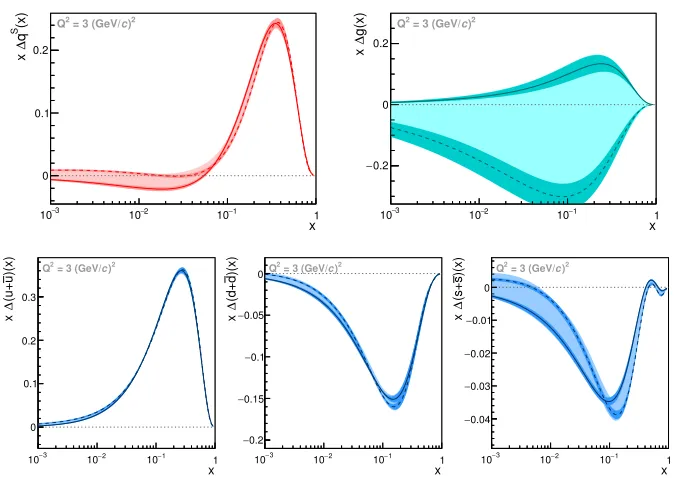
the sensitivity of the results to the functional form, the fit was performed for several sets of functional shapes. It was found that two sets of functional shapes are needed to span almost entirely the range of the possible fit results, and particularly for the less-well known gluon contributions,Δg(x).
x
3 −
10 10−2 10−1
1 (x) S q Δ x 0 0.1 0.2 2 ) c
= 3 (GeV/
2
Q
x
3 −
10 10−2 10−1
1 g(x) Δ x 0.2 − 0 0.2 2 ) c
= 3 (GeV/
2
Q
x
3 −
10 10−2 10−1 1
(u+u)(x) Δ x 0 0.1 0.2 0.3 2 ) c = 3 (GeV/ 2 Q
x
3 −
10 10−2 10−1 1
(d+d)(x) Δ x 0.2 − 0.15 − 0.1 − 0.05 − 0 2 ) c = 3 (GeV/ 2 Q
x
3 −
10 10−2 10−1 1
(s+s)(x) Δ x 0.04 − 0.03 − 0.02 − 0.01 − 0 2 ) c = 3 (GeV/ 2 Q
Figure 2. Top: Helicity distributions for quarks (left) and for gluons (right) atQ2 =3 (GeV/c)2. Bottom left to right: helicity distributions for up, down, and strange quark flavour, respectively. The solid and dashed lines correspond to the two extreme solutions for theΔgdistributions. The dark bands correspond to the statistical uncertainties and the light bands to the systematic uncertainties.
to the propagation of the statistical errors and the systematic uncertainties. A significant part of the systematic uncertainties is attributed to the choice of the functional form.
2.1 Gluon contribution to the nucleon spin
The range of solutions resulting from the different assumptions for the shape of theΔg(x) distribution clearly show that the inclusive data are unable to determine neither the shape, nor even the sign of
Δg. Further information onΔgis inferred by considering the photon-gluon fusion (PGF) process, in which the virtual photon is absorbed by a gluon in the nucleon, giving rise to a quark-antiquark pair. There are two options for the identification of the PGF process. The first, "open charm" option, is free from physical background at LO. This fact is justified by a negligible quantity of intrinsic-charm in the nucleon [6] in the COMPASS kinematic domain. The open charm is tagged by the invariant mass reconstruction of D0mesons, via detection of their hadronic decay products [7]. The open charm result forΔg/g, obtained from 160 GeV/cpolarised muon scattering offpolarised proton and deuteron targets is shown in Fig. 3.
In the second method, called "high-pT" method, hadron pairs with high transverse momentapT
andQ2 > 1 (GeV/c)2 in the final state are selected [8]. Despite the large statistics available, this
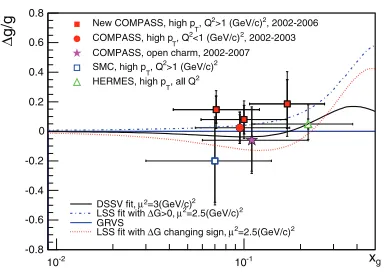
Figure 3.COMPASS results for directΔg/g extraction at LO using the hadron pairs method (squares) and the open charm method (star). The data points from SMC and HERMES are also displayed.
The curves are NLO global fit evaluations ofΔg/g
from Refs [12–14].
to the PGF process only, the contributions from the LP and QCDC processes must be evaluated and subtracted. The corresponding parton asymmetries, as well as the fractions corresponding to each physical process, are determined from a full Monte Carlo simulation of the COMPASS experiment [8]. The resulting data points are shown in Fig. 3. They agree with the open charm point from
COMPASS and with the high-pT points from SMC [9] and HERMES [10] experiments, as well as
with a previous [11] evaluation by COMPASS using a quasi-real photoproduction process instead of DIS. Figure 3 also shows some of the available world data fits at NLO [12–14].
All COMPASS data on a deuteron target (2002 to 2006) were recently re-analysed, using an
extension of the high-pTmethod, called "all-pT" method [15]. In this new method, the lowpT events
are kept in the analysis and at least one hadron is required in the final state. The gluon polarization
and leading process asymmetry (which is dominant at lowpT) are extracted simultaneously from the
same data set using a Neural Network approach. The all-pT method results in a reduction of both
systematic and statistical uncertainties by more than 50%, compared to the result of Ref. [8]. The
preliminary value of the gluon polarization isΔg/g = 0.113±0.038±0.035 at an average gluon
momentum fractionxg =0.10 and at a scale ofμ2 =3 (GeV/c)2. All studies indicate that the gluon
polarisation is small and either slightly positive or compatible with zero in thexgrange of the data.
2.2 Polarised quark distributions
The polarised quark distributions for the light flavours are extracted from semi-inclusive DIS (SIDIS)
asymmetry measurements. A total of 8 asymmetries are measured [16] at COMPASS, namelyAπ+,
Aπ−,AK+, andAK−for both proton and deuteron targets. By also taking into account the two inclusive
spin asymmetries, which were used for the extraction ofgd
1 andg
p
1, theΔu(x),Δu¯(x),Δd(x),Δd¯(x),
andΔs(x) quark helicities are evaluated using a LO fit. All helicities are extracted assuming the DSS
parametrisation [17] for the quark to pion and quark to kaon fragmentation functions. The results from the extractions are shown in Fig. 4.
The SIDIS results forΔu(x) andΔd(x) PDFs are compatible with the QCD fit results of the DIS
data. However, the strange quark polarised distribution is quite different. The corresponding first
moment is: Δs = −0.01±0.01(stat.)±0.01(syst.). The difference between this result and the one
obtained from the inclusive asymmetries, (Δs+ Δs¯)=−0.08±0.01(stat.)±0.02(syst.), is puzzling.
2.3 Quark fragmentation functions
A possible explanation of theΔspuzzle could come from the kaon fragmentation functions (FF) used
Figure 4.SIDIS results for the light quark helicities, under the assumption that atQ2=3 (GeV/c)2. The curves
correspond to a global NLO fit taken from Ref. [13].
to the kaon FFs. The FFs are universal and describe the process of hadronisation. They can be ex-tracted via a QCD fit to the pion and kaon multiplicities, which represents the number of produced pions and kaons per deep inelastic events. COMPASS has measured both pion and kaons
multiplic-ities on a deuteron target. Using theπ+andπ−multiplicities data and some additional assumptions
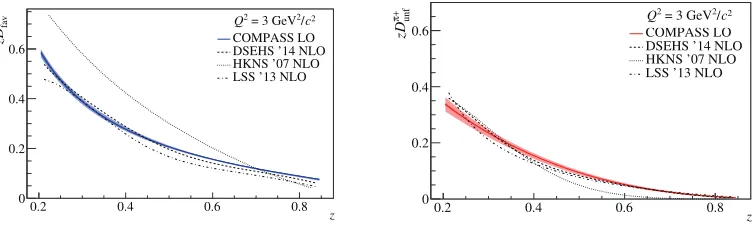
(charged conjugation and isospin symmetry), a LO QCD fit is performed. Two pion FFs are fitted: the “favoured” FF (when the quark of the target nucleon is a valence quark of the produced hadron) and the “unfavoured” FF (when the quark of the target nucleon is a sea quark of the produced hadron). Preliminary results for the pion FFs extracted at LO [18] are shown in Fig. 5. The results are compared to the FFs used for analysing the SIDIS results. The new COMPASS FFs are at variance with one
z
0.2 0.4 0.6 0.8
+π fav
zD
0 0.2 0.4 0.6
2 /c 2 = 3 GeV 2 Q
COMPASS LO DSEHS ’14 NLO HKNS ’07 NLO LSS ’13 NLO
z 2 c / 2 = 3 GeV 2 Q
fav
+π
Dz
z
0.2 0.4 0.6 0.8
unf
+π
zD
0 0.2 0.4 0.6
2 /c 2 = 3 GeV 2 Q
COMPASS LO DSEHS ’14 NLO HKNS ’07 NLO LSS ’13 NLO
z 2 c / 2 = 3 GeV 2 Q
unf
+π
Dz
of the older parametrisation [19]. Recent NLO re-analyses [20, 21], which include the preliminary COMPASS pion multiplicities data, are in close agreement with the COMPASS LO fit. The observed
differences between the older and new parametrisations of the pion FFs have a minor effect on the
extraction of theΔu(x) andΔd(x) distributions. In connection with theΔspuzzle presented above,
it is worth noting that the kaon FFs are much less well known than the pion FFs. COMPASS has also measured the kaon multiplicities; preliminary FF fits show large deviations from the available parametrisations.
3 The three-dimensional spin-dependent structure of the nucleon
A complete description of the partonic structure of the nucleon in QCD includes the spin and trans-verse momentum dependent parton distribution functions (TMD PDF). At leading twist there are eight TMD PDFs that take into account the correlations between the quark spin, the quark transverse mo-mentum and the nucleon spin. The TMD PDFs can be accessed in SIDIS by detecting at least one
of the produced hadrons. The resulting SIDIS cross section exhibits different azimuthal modulations,
with different combinations of two relevant angles:φsandφh. The two angles are the azimuthal
an-gles of the initial nucleon transverse spin vector and the produced hadron momentum, respectively, in
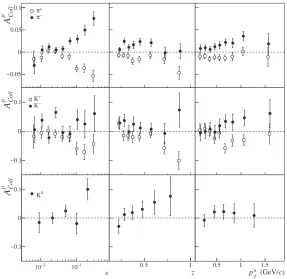
Figure 6.The Collins asymmetries for charged pions (top), charged kaons (middle) and neutral kaons (bottom)
a reference system in which thezaxis is the virtual photon direction and thex−zplane is the lepton plane according to Ref. [22].
Over the years COMPASS has performed extensive studies of these TMD PDFs using data for
sin-gle and two hadron SIDIS offunpolarised [23], longitudinally [24] and transversely polarised protons
(deuterons) [25] in a NH3(6LiD) target. The two most thoroughly studied transverse spin asymmetries
are the Collins and Sivers asymmetries.
The Collins asymmetries allow access to the transversity PDF, which is coupled to the Collins fragmentation functions. The results for the Collins asymmetries using a transversely polarised
pro-ton target [26] are shown in Fig. 6 as a function of the Bjorken variable,x, the fraction of the hadron
energy relative to the virtual photon energy,z, and the transverse hadron momentum, pT. At small
xthe pion asymmetries are compatible with zero, while in the valence region they show an
increas-ing signal, which has opposite sign for positive and negative pions. The results for charged kaons, although with larger statistical uncertainties, show a similar trend. The Collins asymmetry for neutral
kaons shows a positive trend with increasingz. The average asymmetry is positive but compatible
with zero within the statistical uncertainty.
p Siv
A
−0.05 0 0.05
+
π − π
p Siv
A
−0.05 0 0.05
0.1 KK+−
x −2
10 10−1
p Siv
A
−0.05 0 0.05
0.1 0
K
z
0.5 1
) c (GeV/ h T p
0.5 1 1.5
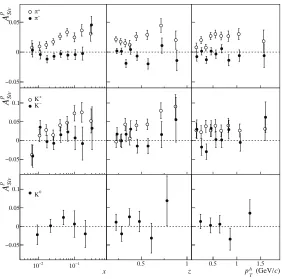
Figure 7.The Sivers asymmetries for charged pions (top), charged kaons (middle) and neutral kaons (bottom) as
a function ofx,zandpT.
Figure 7 shows the COMPASS measurement of the Sivers asymmetries [26] for a transversely
to the Sivers PDFs, which describe the correlations between quark transverse momentum and nucleon spin. The asymmetries for negative pions and kaons, as well as for neutral kaons are compatible with zero, while for positive pions and kaons there is a clear evidence for a positive signal extending over
the full measuredxregion and increasing withz.
The new COMPASS data for the TMD PDFs provide a valuable input for multidimensional global analyses and constitute an important contribution for the understanding of the transverse momentum structure of the nucleon.
4 Generalised parton distributions
The Generalised Parton Distributions (GPD) contain additional information on the nucleon structure [27, 28]. They are accessible at COMPASS via deeply virtual Compton scattering (DVCS) and deeply
virtual meson production (DVMP). At leading twist and for a spin 1/2 target, there exist four
chiral-even GPDs (H, ˜H,E, ˜E) for each quark flavour. The first two of them describe processes that conserve
nucleon helicity and the last two those that involve nucleon helicity flip. The GPDsHandEare of
special interest as they are related to the total angular momentum carried by the partons in the nucleon [29]. When Fourier-transformed to impact parameter space and for the case of vanishing longitudinal momentum transfer, GPDs provide a three-dimensional description of the nucleon in a momentum-coordinate space, which is also known as "nucleon tomography" [30].
For DVCS on a proton unpolarised target in the COMPASS kinematical domain, the GPD H
distribution yields the dominant contribution, while the GPDE is accessible with transverse target
polarisation or with a neutron (deuteron) target. All GPDs depend on the photon virtualityQ2, the
to-tal four-momentum transfer squared,t, between the initial and final nucleon states, and two additional
(deg)
γ
*
γ
φ
-100 0 100
A.U. 0.0 0.2 0.4 0.6 0.8 1.0 < 0.01 Bj 0.005 < x
(deg)
γ
*
γ
φ
-100 0 100
0.0 0.1 0.2 0.3 0.4 0.5 < 0.03 Bj 0.01 < x
(deg)
γ
*
γ
φ
-100 0 100
0.0 0.1
< 0.27 Bj 0.03 < x
Data MC (BH) bgd. MC 0 π max. min. bgd. 0 π BH + max
re
re
Pre
re
P
P
P
P
P
P
P
eli
elim
a
a
mina
a
0.2
mi
mi
m
m
eli
e
e
e
el
eli
eli
li
lii
ary
ry
ry
ry
rr
y
d. COMPASS 2012
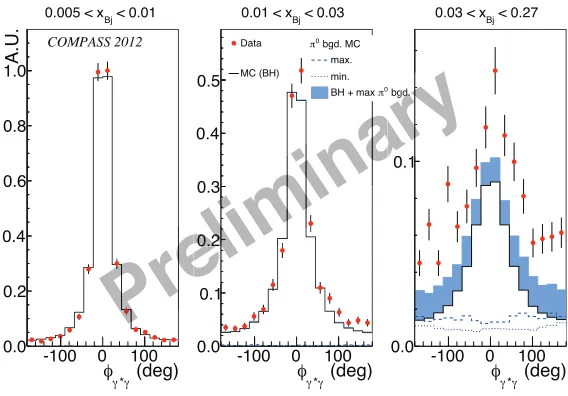
Figure 8.Exclusive single photon events obtained in the 2012 test run as a function ofφγ∗γ(red dots) compared
to the Bethe-Heitler contribution (black line histogram) and theπ0 contamination estimated by a Monte-Carlo
variables,xandξ, representing the average and half the difference between the initial and final longitu-dinal momentum fraction of the nucleon carried by the struck parton. In DVCS and DVMP processes
xis an internal variable, while the skewnessξis related to the Bjorken variablexB j=Q2/2Mν.
The extraction of GPDs from such measurements needs experimental data on hard exclusive
pro-cesses in a broad kinematic range. Up to now information in the high-energy regime at lowxB jwas
provided by H1 and ZEUS at DESY. On the other hand, HERMES and JLAB experiments cover the
low-energy domain at highxB j. The COMPASS measurements will provide a connection between
these measurements by covering the region ofxB jbetween 0.01 and 0.1, where both sea and valence
quarks are important.
A competing process is the Bethe-Heitler (BH) process of elastic lepton-nucleon scattering with a hard Bremsstrahlung photon emitted by the incoming or by the outgoing lepton. It produces the same final state as DVCS so that both processes interfere at the level of amplitudes.
In the COMPASS kinematical domain the dominant process is function of thexB jvariable. At low
xB jalmost pure BH events are recorded; these events provide a reference yield, which is used for
nor-malisation purposes. At higherxB j, the DVCS contribution is dominant. After subtraction of the BH
contribution, the data can be used for a measurement of thet-dependence of the cross section, which
provides a tomographic image of the nucleon. In the intermediatexB jdomain the DVCS contribution
is enhanced by the BH process through their interference. The size of the interference term increases
with risingxB j and provides via its characteristicφγ∗γ modulation additional possibilities to access
real and imaginary part of the complex DVCS amplitude. Hereφγ∗γis the azimuthal angle between
the leptonic plane (defined by the incident and scattered lepton) and the hadronic plane (defined by
the virtual and real photon). The DVCS process itself is dominant forxB j>0.03.
The first proof of the feasibility for DVCS was made in 2009 with a reduced experimental setup. In 2012, a four-week long pilot run has been recorded, with a mostly complete DVCS setup, which included a full-scale recoil detector and a large-size hydrogen target. The preliminary results from the
pilot run are shown in Fig. 8. The data are displayed in threexB jbins as a function ofφγ∗γ. The data
confirm the expected behaviour: in the lowestxB jbin, where the DVCS contribution is negligible, the
calculated BH contribution perfectly agrees with the measurements. Theπ0contamination, when one
of the decay photon mimics the high energy DVCS photon and the other photon is not detected, is estimated using a Monte-Carlo simulation.
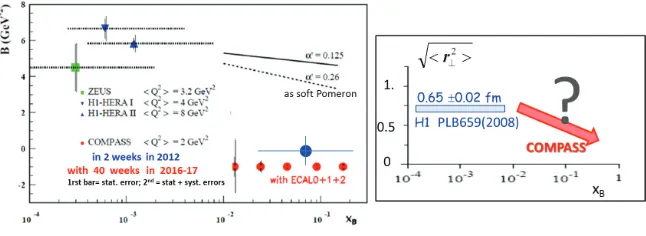
Figure 9.Projections for the measurement of thexB jdependence of thet-slope parameterB(xB j) of the DVCS cross section for a two years data taking, together with the expected measurement from the 2012 pilot run. The
data from HERA (see text) are shown as triangles (left). Sketch of the correspondingxB jdependence of the mean
The full DVCS run is planned for 2016 and 2017. The data taking will include cross sections measurements with both muon charge and polarisation states of the incoming lepton beam,dσ(μ+,→) anddσ(μ−,←). The real and the imaginary part of the Compton form factors (CFF) can be extracted from the sumSand the differenceDof these two two cross-sections. A CFF is a sum over flavours
f of convolutions of the respective GPDs with a perturbatively calculable kernel describing the hard photon-quark interaction. In the differenceDthe pure BH contribution cancels out. The analysis of theφγ∗γdependence provides a measurements of the real part of the corresponding CFF. On the other
hand, inSthe BH contribution does not cancel and has to be subtracted. Integrating overφγ∗γ yields
thet dependence of the cross section, and therefore the transverse size of the nucleon at different values ofxB j.
Figure 9 left shows thet-slope parameter Bas a function ofxB j. In the region of low xB j this
parameter has been measured in HERA by H1 [31] and ZEUS [32] to be constant. A decrease is expected at the higher xB jregion covered by COMPASS. The projected COMPASS results should
clearly measure this decrease. The point with a large horizontal bar represents the statistical uncer-tainty of the 2012 pilot run measurement. Here, the shrinkage parameterα is related, through a simple relation, to the decrease of the nucleon size with increasingxB j. Figure 9 right summarises this
information for the proton strong radius, instead ofB.
5 Drell-Yan measurements
In the Drell-Yan process (DY), the annihilation of a quark from the beam with an antiquark from the target (or vice versa) produces, via a virtual time-like photon, a pair of leptons with a large invariant mass [33]. The properties of this lepton pair reflect the distributions of the partons inside the interact-ing hadrons. The Drell-Yan process thus provides a powerful tool for probinteract-ing the parton substructure of the hadrons by allowing an extraction of the shape and the flavour dependence of the familiar PDFs in both beam and target hadrons. In specific cases and for polarised beam or target, the Drell-Yan process is also sensitive to the transverse momentum dependent (TMD) parton density distributions.
COMPASS has several unique advantages for performing Drell-Yan studies. First of all, CERN is presently the only place where beams of (positive or negatve) pions, kaons and protons beams are available. The valence antiquarks in the beam interact preferentially with the valence quarks of the target nucleons. Meson-induced Drell-Yan process is the unique way to access the quark structure of pions and kaons, as these short-lived mesons cannot be used as stable targets.
A second advantage lies in the COMPASS experimental setup. The setup, operational since 2002, was especially designed for semi-inclusive and exclusive experiments, requiring detection of several particles in the final state and therefore a large geometrical acceptance. The latter has been achieved by building two consecutive spectrometers around two large-aperture dipole magnets. As a result, the COMPASS acceptance is between 4 and 10 times larger than the acceptances of the previous Drell-Yan experiments. These factors are directly related to the final statistical accuracy achieved. Finally, COMPASS will be able to access the correlation between the nucleon’s transverse spin and the transverse momentum distributions of valence quarks by making use of its large-size transversely polarised NH3target.
The main goal of the COMPASS studies is a measurement of the TMD Sivers asymmetry. QCD factorisation predicts that the Sivers quark distribution function, which depends on the quark trans-verse momentum, is not universal, i.e. when extracted from the DY process, it should have a sign oppositie to that extracted from a SIDIS reaction. The test of this fundamental prediction is consid-ered as a crucial test of the QCD TMD factorisation.
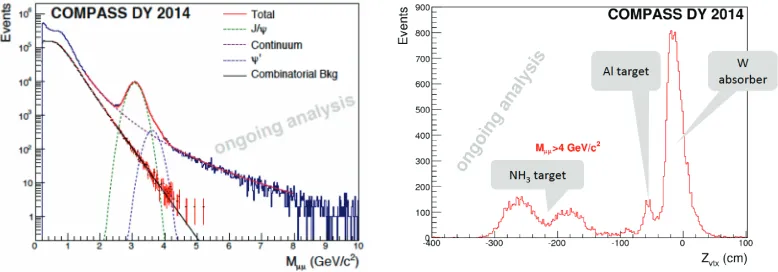
COMPASS, close to 108 particles per second, is used. A thick hadron absorber is placed immedi-ately downstream the polarised target. In its inner part, the absorber contains a core of tungsten (W) designed to stop the beam which did not interact in the polarised target. This beam plug is in itself a heavy nuclear target. A thin aluminium (Al) target is also placed half-way between the polarised target and the beam plug. The data from the Al and W targets will be used for additional unpolarised Drell-Yan studies.
Figure 10. Dimuon mass distribution for two weeks of data taking with an unpolarized target in 2014 (left). Vertex distribution of the events from the three targets in use (right).
A full-scale DY pilot run with the nearly final COMPASS setup, but with an unpolarised target was taken in the fall of 2014. The results from the pilot run are shown in Fig. 10. The resulting mass distribution (left panel) is in good agreement with the expectations, both in terms of mass resolution
(estimated by the width of the J/ψpeak) and counting rates. The reconstructed muon tracks give
access to the interaction vertex, as shown in the right panel. The two NH3 cells are well separated
and the peaks from the Al and W targets are clearly visible. The COMPASS Drell-Yan measurement
started in 2015. In the mass range of 4<Mμμ <9 GeV/c2, about 800 events per day are expected.
The expected statistical uncertainty for the Sivers asymmetry from the 2015 data should be of about 2%.
References
[1] COMPASS Collaboration, P. Abbon et al., Nucl. Inst. Meth. A 577, 455 (2007); COMPASS
Collaboration, P. Abbon et al., Nucl. Inst. Meth.A 779, 69 (2015).
[2] F. Nerling, talk at this conference.
[3] C.A. Aidala, S.D. Bass, D. Hasch and G.K. Mallot, Rev. Mod. Phys.85, 655 (2013).
[4] COMPASS Collaboration, M. G. Alekseev et al., Phys. Lett.B 690, 466 (2010).
[5] COMPASS Collaboration, C. Adolph et al., arXiv:1503.08935. [6] J. Alwall, PoS, DIS 2005, Madison, USA, arXiv:0508126v1.
[7] COMPASS Collaboration, C. Adolph et al., Phys. Rev.D 87, 052018 (2013).
[8] COMPASS Collaboration, M. G. Alekseev et al., Phys. Lett.B 718, 922 (2013).
[9] SMC Collaboration, B. Adeva et al., Phys. Rev.D 70, 012002 (2004).
[10] HERMES Collaboration, A. Airapetian et al., Journal of High Energy Physics1008, 130 (2010).
[12] E. Leader, A.V. Sidorov and D.B. Stamenov, Phys. Rev.D 82, 114018 (2010);
[13] D. de Florian, R. Sassot, M. Stratmann and W. Vogelsang, Phys. Rev.D 80, 034030 (2009). [14] M. Gluck, E. Reya, M. Stratmann and W. Vogelsang, Phys. Rev.D 63, 094005 (2001). [15] M. Stolarski, PoS, DIS 2014, Warsaw, Poland, 211.
[16] COMPASS Collaboration, M. G. Alekseev et al., Phys. Lett.B 693, 227 (2010). [17] D. de Florian, R. Sassot and M. Stratmann Phys. Rev.D 75, 114010 (2007). [18] COMPASS Collaboration, C. Adolph et al., to be published.
[19] M. Hirai, S. Kumano, T.-H. Nagai and K. Sudoh, Phys. Rev.D 75, 094009 (2007). [20] E. Leader, A. Sidorov and D. Stamenov, arXiv:1312.5200.
[21] D. de Florian, et al, Phys. Rev.D 91, 014035 (2015). [22] A. Bacchetta et al., Phys. Rev.D 70, 117504 (2004).
[23] COMPASS Collaboration, C. Adolph et al., Nucl. Phys.B 886, 1046 (2014). [24] COMPASS Collaboration, M. G. Alekseev et al., Eur. Phys. J.C 70, 39 (2010). [25] COMPASS Collaboration, M. G. Alekseev et al., Phys. Lett.B 673, 127 (2009) [26] COMPASS Collaboration, C. Adolph et al., Phys. Lett.B 744, 250 (2015). [27] D. Mueller et al., Fortsch. Phys.42, 101 (1994).
[28] A. V. Radyushkin, Phys. Lett.B380, 417 (1996). [29] X. D. Ji, Phys. Rev. Lett.78, 610 (1997). [30] M.Burkardt, Int. J. Mod. Phys.A 18, 173 (2003).
[31] A. Aktas et al., Eur. Phys. J.C 44, (2005) 1; D. Aaron et al., Phys. Lett.B 659, 796 (2008). [32] ZEUS Collaboration, S. Chekanov et al., JHEP0905, 108 (2009).
[33] J.C. Peng and J.-W. Qiu, Prog. Part. Nucl. Phys.76, 43 (2014).