Rotational excitation of SO
2by collision with H
2: a
collaborative work
N. Feautrier1,a, C. Balanc¸a1, F. Dayou1, A. Spielfiedel1, L. Cressiot-Vincent1, A. Faure2, L. Wiesenfeld2, and M.-L. Senent3
1 LERMA and UMR 8112 of CNRS, Observatoire de Paris-Meudon, 92195 Meudon Cedex, France 2 UJF-Grenoble 1 / CNRS-INSU, Institut de Plan´etologie et d’Astrophysique de Grenoble (IPAG)
UMR 5274, Grenoble, F-38041, France
3 DAMIR, Instituto de Estructura de la Materia, CSIC Madrid, Spain
Abstract. The SO2molecule is detected in a large variety of objects, notably cold dark
clouds and star-forming regions. An accurate modeling of the observations requires a very good knowledge of the collisional excitation rates with H2 due to competition between
collisional and radiative processes that excite and quench the different rotational levels of the molecule. The results of our recent collisional calculations are summarized.Pierre was associated to all steps of this collaborative work that was a key project in the Molecular Universe European FP6 network.
1 Introduction
Sulfur dioxyde is a very abundant species in warm molecular clouds and is also present in dark clouds. SO2 as well as SO and SiO is considered as a molecular tracer of shocks and as a consequence was identified as one of the milestones of the RTN-FP6 ”Molecular Universe” network. Being a heavy species, SO2has many transitions in mm, submm, cm and far IR domains and may be observed with different ground-based telescopes as well as with the Herschel Space Observatory. The new generation of receivers for ground based telescopes will permit to carry out sensitive line surveys in dark clouds in the centimeter and millimeter domains. The collisional rate coefficients with the most abundant interstellar molecule, H2, are needed since the collisional processes contribute, in competition with the radiative processes, to populate the rotational levels of the molecules. The knowledge of the collision rate coefficients allows one to define for each level ja critical densityncritj such that:
ncritj = ∑
iAji ∑
ikji
(1)
whereAji is the Enstein coefficient for spontaneous emission for transitioni j, theki j are, colli-sion rate coefficients. The sum runs over all reachable states. We may consider that the so-called Local Thermodynamical Equilibrium is fulfilled if the density of the collider is much larger thanncritj as colli-sions tend to equilibrate the populations of the considered species. Conversely, the radiative processes are dominant for densities much lower thanncrit
j . Between these two extreme cases, accurate collision rates are needed for the precise determination of the physical conditions of the molecular clouds. It is clear that studying different transitions with different Einstein and collisional rate coefficients allows one to explore different regions of the studied cloud with different densities.
Until now, the only available rate coefficients of SO2were those computed by Green [1] for collisions with He multiplied by 1.39 to correct for the velocity difference between H2and He. Moreover, these
a e-mail:[email protected]
DOI: 10.1051/
C
Owned by the authors, published by EDP Sciences, 2012
epjconf 20123/ 403003
excitation rates were calculated within the IOS scattering approach based on a rather approximate potential energy surface. Considering the importance of SO2to investigate the physical and chemical conditions of astrophysical objects, we decided to provide new accurate rate coefficients for SO2 in collision with H2. The adopted strategy was similar to that developed by Pierre and his colleagues in Grenoble for H2O-H2collisions [2] and a large collaboration between Madrid, Meudon and Grenoble was set up. The different steps and the results of this project are described in the following sections, the contribution of Pierre was decisive for several aspects.
2 The 5D SO
2-H
2Potential Energy Surface
All calculations presented below were performed with rigid molecules using the expansion of the 5D potential energy surface (PES) developed by Spielfiedel et al. [3] where full details can be found. The PES was calculated at the CCSD(T) level [4, 5] using a three step procedure with basis sets of increasing accuracy. Extensive calculations of a reference PES were performed with the MOLPRO package [6] for 49 intermolecular distances and 8074 sets of angles for each distance using the aVDZ basis of Woon and Dunning [7] and bond functions of Williams et al. [8]. Corrections, including CBS extrapolation, were performed to obtain the final intermolecular potential. The angular expansion of the PES suitable for dynamics calculations was obtained from the final very accurate set as a least square fit of the ab initio values for each of 49 intermolecular distances, leading to 129 angular functions which are specifically adapted to quantum calculations. The selection was found to reproduce the ab initio values within 1 cm−1for distances R larger than 6.5 bohr. The global minimum was found to be Vmin =−192.723758 cm−1, seven secondary minima were also found. Contour plots of the PES are displayed in Fig. 1.
Fig. 1.Contour plots of the SO2-H2potential energy surface with H2in thexz(left) andxy(right) planes (see [3]
for details). The SO2molecule is shown to scale. Equipotentials (in cm−1): in dashed red: -3, -10, -30, -100; in
solid black: 0; in blue: 3, 10, 30, 100, 300, 1000, 3000, 10000.
3 Inelastic cross sections and rate coefficients at low temperatures
OpenMP extension of the code, available to all users via the web1. 72 levels were included in the basis set to obtain convergence better than 5% on the collisional cross sections. The convergence of the cross sections with the total angular momentumJtotwas carefully studied.Jtotincreases gradually from 27 (at low energies) up to 60 at the highest energies. We checked at a total energyE=100 cm−1that the inclusion of the j2=2 channel (closed at the considered energies) has small effects on the calculated cross sections. We carefully spanned the energy range to take into acount the presence of resonances.
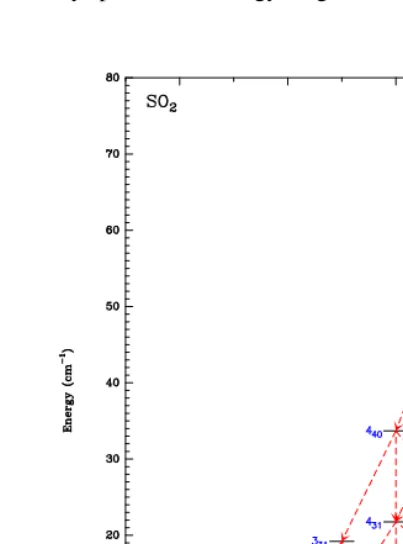
Fig. 2.The 31 lowest rotational levels of the SO2molecule.
The state-to-state rotational inelastic rates are the Boltzmann thermal average at temperatureT of state-to-state inelastic cross sections:
R(β→β′)=
(
8kT
πµ
)1 2( 1
kT )2∫ ∞
0
σβ→β′(Ec)Ece−Ec/kTdEc (2)
wherekis the Boltzmann constant, Ec is the kinetic energy,β = jKa,Kc. Rate coefficients obey the detailed balance relation:
R(β′→β)= (2j+1) (2j′+1)exp
[
Eβ′−Eβ kT
]
R(β→β′) (3)
Fig. 3 displays the temperature variation of the para and ortho-H2rate coefficients for a selection of|∆J| = 0 and|∆Ka| = 0 transitions. The following trends are found: the temperature dependence is weak within a factor 2-3 for both para and ortho-H2collisions. There is no exact selection rule but the rates decrease for increasing|∆J|and the most important rates are those that connect levels with |∆Ka|=0. This trend may be assigned to the difficulty to reorient the angular momentum vector with
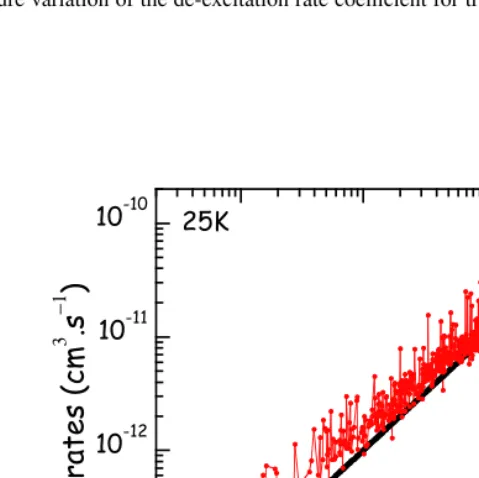
respect to thea-axis. Comparison of rate coefficients with ortho and para-H2(see Fig. 4) shows large variation with transitions, with a factor of about 2 in average, the largest rate coefficients being mainly the rates for collisions with ortho-H2. This latter effect reflects the importance of the H2quadrupole and in particular the dipole-quadrupole interaction which does not contribute, at first order, to collisions with para-H2(j2=0,2).
2 10-11
4 10-11
6 10-11
8 10-11
1 10-10
0 5 10 15 20 25 30
rates (cm
3.s −1)
T (Kelvin)
5(3,3)−> 4(3,1)
6(3,3)−> 4(3,1)
o1 o1 p2 p2 o1 p2
7(3,5)−> 4(3,1)
4(3,1) −> 3(3,1) o1
p2
∆K a=0
2 10-11 4 10-11 6 10-11 8 10-11 1 10-10
0 5 10 15 20 25 30
rates (cm
3.s −1)
T (Kelvin)
4(3,1)−> 4(1,3) 4(3,1)−> 4(2,2)
o1 o1 p2 p2 o1 p2
4(4,0)−> 4(3,1)
4(3,1) −> 4(0,4)
o1 p2
∆J=0
Fig. 3.Temperature variation of the de-excitation rate coefficient for transitions with∆Ka=0 (left) and∆J=0
(right). 10-14 10-13 10-12 10-11 10-10
10-13 10-12 10-11 10-10
ortho rates (cm
3
.s
−1)
para rates (cm
3.s
−1)
25K
Fig. 4.De-excitation rate coefficients of SO2in collision with ortho-H2as function of rate coefficients with
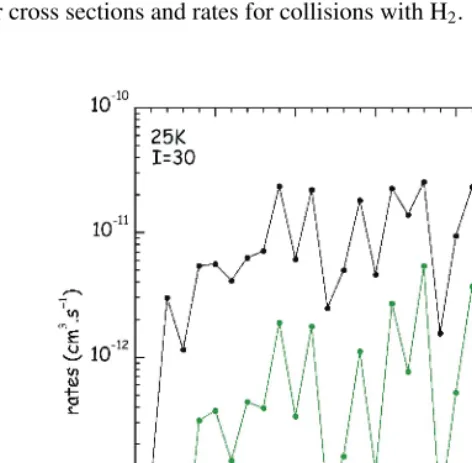
We compare in Fig. 5 the present collisional rates at 25 K with those of Green [1]. It should be noted that the He rates of Green have been scaled by the reduced mass ratio (µSO2−H
2/µSO2−He)
1/2=1.39. We first note significant discrepancies between the present rates and the scaled He-rates, even for collisions with para-H2(j2 =0,2). Differences do not vary uniformly with transitions and are found to exceed a factor of ten in some cases. Such discrepancies were actually expected as the rates were computed by Green within the IOS scattering approach based on a coarse electron-gas approximation used for the PES. However, we point out that similar trends for He/H2 have been found for other systems like SO [10], SiS [11], HC3N [12, 13], H2O-H2[14], H2CO [15], NH3-H2 [16] even though the PES as well as the cross sections have been computed with the same accuracy. For all these systems, the well depth for interaction with H2is larger by a factor of∼2-3 than the one for interaction with He, leading to larger cross sections and rates for collisions with H2.
Fig. 5.Comparison of the present result for para-H2(j2 =0,2) (black curve) with He results of Green (1995)
(green curve) for different final levels (initial level:431,T=25 K). Th
4 Towards higher temperatures
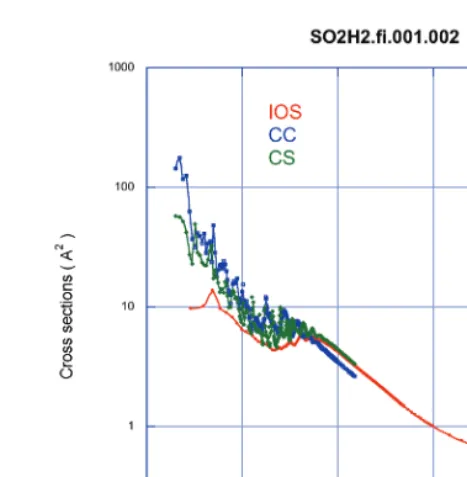
We stress that, due to the increasingly large computer time and memory resources needed for these calculations, extension of full close-coupling calculations to high-J levels and temperatures is not realistic presently. Use of approximate quantal approaches like Coupled States (CS) and Infinite Order Sudden Approximation (IOS) is a possible way to overcome this difficulty. Preliminary results (see Fig. 6 for the 000 −200 transition) show that cross sections calculated through CC and then CS and IOS approaches for increasing energies agree within a factor better than two. A statistical study of the difference between rate coefficients calculated at 25K within the CC and IOS approaches has shown a better agreement than expected between the two methods, the IOS rate coefficients being systematically lower than the CC ones.
Fig. 6.Cross sections for the transition 000−200in SO2excited by para-H2(j2=0,2) as a function of total energy.
The CC results are compared to the approximate CS and IOS cross sections.
0 2 4 6 8 10 12 14 16 18
Final level 1e-13
1e-12 1e-11 1e-10
Rate constant (cm
3s -1)
CC J2=0 QCT J2=0 QCT J2=1 Green (1995)*1.39
SO
2-H2 @30K
Initial level 18 (431)
Fig. 7.Rate coefficients at 30 K for SO2in the initial level 431excited by H2. QCT calculations for para-H2(j2=0)
and ortho-H2(j2=1) are compared to present quantum calculations for para-H2(j2=0) and to the (scaled) result
of Green (1995) for He.
5 What about the astrophysical consequences?
On 11 June 2008, we received this enthusiastic message from Pierre:
“J’ai par ailleurs discut´e ces r´esultats pr´eliminaires avec Pepe en nous basant pour l’instant sur les sections `a 10 cm−1. Nous confirmons la pr´ediction d´ej`a faite par Pepe sur la base des taux de Green pour SO2-He: 1) d’un effet d’absorption anormale pour la transition 2(0,2)←1(1,1) 2) d’un effet maser pour la transition 3(1,3)←4(0,4) [...] Une interpr´etation des deux effets semble possible par un m´ecanisme `a dominante radiative [...] L’id´ee serait de faire rapidement un proposal pour des observations `a basse fr´equence `a Effelsberg, histoire de confirmer ces deux pr´edictions”
The next episode of this story is presented in the paper by J. Cernicharo in this volume.
6 Conclusion
Beyond science, we would like to emphasize the nice atmosphere between the participants of this collaborative work. Pierre contributed particularly to this atmosphere of work sharing, confidence and friendship.
Acknowledgements
The authors wish to acknowledge their friend and colleague Pierre Valiron who actively participated to the work that led to this paper. We would like to thank J. Cernicharo for his continuing interest in this work and for fruitful discussions.
References
1. Green, S. J. Chem. Phys. , 103, 1035 (1995) 2. Valiron, P. et al. J. Chem. Phys., 129, 134306( 2008) 3. Spielfiedel, A. et al. J. Chem. Phys. , 131, 014305 (2009) 4. Knowles, P. J. et al. J. Chem. Phys. 99, 5219 (1993) 5. Knowles, P. J. et al. J. Chem. Phys. 112, 3106 (2000)
6. MOLPRO is a package of ab initio programs written by : H.-J. Werner and P. J. Knowles, with contributions from J. Alml¨of, R. D. Amos, M. J. Deegan, S. T. Elbert,C. Hampel, W. Meyer, K. Peterson, R. Pitzer, A. J. Stone, P. R. Taylor, R. Lindh M. E. Mura, and T. Thorsteisson
7. Woon, D.E. and Dunning Jr T.H.. J. Chem. Phys., 100, 2975 (1994)
8. William, H.L., Mas, E.M., Szalewicz, K., and Jeziorski, B. J. Chem. Phys. 103, 7374 (1995) 9. Hutson J. M. and Green S., MOLSCAT computer code, version 14 (Collaborative Computational
Project No. 6 of the Science and Engineering Research Council, United Kingdom, 1994) 10. Lique, F. et al.. J. Chem. Phys. 126, 164312 (2007)
![Fig. 1. Contour plots of the SO2-H2 potential energy surface with H2 in the xz(left) and xy (right) planes (see [3]for details)](https://thumb-us.123doks.com/thumbv2/123dok_us/8073341.1346710/2.595.57.423.337.517/contour-plots-potential-energy-surface-right-planes-details.webp)