A Novel Approach for Energy Efficient
Reliable Routing Using TABU in Wireless
Ad Hoc Networks
M.Ranjitha, K.Gowsic
PG Scholar, Department of CSE, Sri Shanmugha College of Engineering and Technology, Pullipalayam, Salem,
TamilNadu, India
Assistant Professor, Department of CSE, Sri Shanmugha College of Engineering and Technology, Pullipalayam, Salem,
TamilNadu, India
ABSTRACT: Wireless sensor network often used in a challenging application where data transmission is daunting. In order to improve the reliability of the data transmission two novel energy-aware routing algorithms for wireless ad hoc networks called Signal Interference Noise Ratio (SINR) and TABU energy routing has been proposed in this work. SINR addresses some parameters like energy-efficiency, reliability and operation of network. It deliberates the energy consumption and the remaining battery energy of nodes as well as quality of links to find energy-efficient and reliable routes that increase the operational lifetime of the network. TABU on the other hand, is an energy-efficient routing algorithm which finds routes minimizing the total energy required for end-to-end packet traversal. RMER and RMECR are proposed of networks in which either hop-by-hop or end-to-end retransmissions ensure reliability. This makes SINR an elegant solution to increase energy-efficiency, reliability and lifespan of wireless ad hoc networks.
KEYWORDS: WANET: Energy Efficiency, Operational Lifetime Network And Reliability, Hop Path.
I. INTRODUCTION
Wireless Ad Hoc Networks (WANET) are ideal candidates for applications to report detected events of interest such as military surveillance and forest fire monitoring. A Wireless Sensor Network comprises battery-powered senor nodes with extremely limited processing capabilities. A sensor node wirelessly sends messages to a base station via a multi-hop path. Energy-Efficient routing is an effective mechanism for reducing energy cost of data communication in wireless ad hoc networks. Routes are discovered considering the energy consumed for end-to-end (E2E) packet traversal. It should not result in finding less reliable routes or overusing a specific set of nodes in the network. Energy-efficient routing networks is neither complete nor Energy-efficient without the consideration of reliability of links and residual energy of nodes. Find reliable routes can be enhance quality of the service for networks.
Issues
The issues of protocol design in Wireless Ad Hoc Networks are must run in distributed environment, must provide loop-free routes, must be able to find multiple routes, must establish routes quickly, must minimize overhead in its communication / reaction to topology change. Some Implementation Choices are Flat vs. hierarchical architecture, proactive vs. reactive to topology changes, table-based, demand-driven, associativity-driven, topology change dissemination methods, when/how often to exchange topology info, assumptions about rate of change of topology and/or quality of connections.
Benefits
Decentralized and robust
Easy to build and spontaneous infrastructureII. RELATED WORK
There are two well-known ways to achieve end-to-end reliability on multi-hop paths. The main approach hires hop-by-hop retransmissions. The second approach adopts that link layersare unreliable and retransmissions are completed end-to-end [1]. It can be motivate the definition of a link cost that is a function of both the energy required for a single transmission attempt across the link and the link error rate.To present a new power-based route selection algorithm called the Maximum Residual Packet Capacity (MRPC).MRPC identifies the capacity (9) of a node not just by its residual battery energy and also by the expected energy spent in reliably forwarding a packet over a specific link.MRPC selects a route that has the maximumreliable packet carrying capacity among all possible paths to assuming no other cross traffic passes through the nodeson that path.
Wireless Quality-of-Service (QoS) algorithms approach route selection from the top down. Some techniques explicitly scheduletransmission slots in time or frequency (5)division MAC layers to provide bandwidth guarantees while others treat theMAC as opaque, and rely upon it for bandwidth and delay information and constraints. To avoid the termination of asimulation due to battery power exhaustion at source or destination nodes for all source and sink nodes were configuredto have infinite power resources.
The cost function captures the cumulative energy expended in reliable data transfer for both reliable and unreliable link layers. The techniques are accurately measure traffic load at nodes should be devised. Even though the number of packets buffered in the node‟s queue can be used to measure the traffic load.To calculate the total packet throughput by counting the total number of packets successfully received at the destination nodes, and the energy costs per packet by dividing the total energy expenditure by the total packet throughput.
III. EXISTING SYSTEM
The existing system are describe the progress of network and deliberate the reliability of links to find more reliable routes. The minimum hop-countmetric chooses arbitrarily among the different paths of the same minimumlength. The metric predicts the number of retransmissions required using per-link measurements of packet loss ratios in both directions of each wireless link.
Notion of expected transmission count (ETX) to find reliable routes
Comprise of links requiring less number of retransmissions for lost packet recovery.
They does not minimize the energy consumption for E2E packet traversal.
A higher priority for reliability of routes may result in overusing some nodes.
They does not determine the actual energy consumption of nodes to discover energy-efficient routes.
Declare the transmission power of nodes neglecting the energy consumed by processing elements
oftransmitters and receivers. Analysis of Energy Cost of a Path
The energy cost of a path is analyzed in four steps:
Analyzing the expected transmission count of dataand ACK packets,
Analyzing the expected energy cost of a link takinginto account the energy cost of retransmissions,
Analyzing the E2E reliability of a path,
Formulating the energy cost of a path taking intoaccount the energy cost of links and E2E reliability ofthe path.
To Performance of schemes, theyare implemented and observed three separate routing algorithms:
The minimum-hop routing algorithm are the cost of all links is identical and independent of both the transmission
energy and the error rate.
The Energy-A ware (EA) routing algorithm, where the cost associated with each link is the energy required to
Our Retransmission-Energy A ware (RA) algorithm, where the link cost includes the packet error rates, and thus considers the impact of retransmissions necessary for reliable packet transfer. For the HHR scenario and use the link cost for the EER model.
IV. PROPOSED SYSTEM
They are not specify the energy efficiency and overuse of nodes during transmission. This paper is used to determine the energy efficiency of reliable routes with operational lifetime of network. Energy-efficient routing in ad hoc networks is neither complete nor efficient without the consideration of reliability of links and residual energy of nodes. Finding reliable routes can be enhance quality of the service.
Consider the residual energy of nodes in routing can be avoid nodes from being overused and eventually lead to an increase in the operational lifetime of the network [3]. Signal Interference Noise Ratio (SINR) and TABU energy routing can increase the energy-efficiency, reliability, and the lifespan of wireless ad hoc networks.
A.ARCHITECTURE DIAGRAM
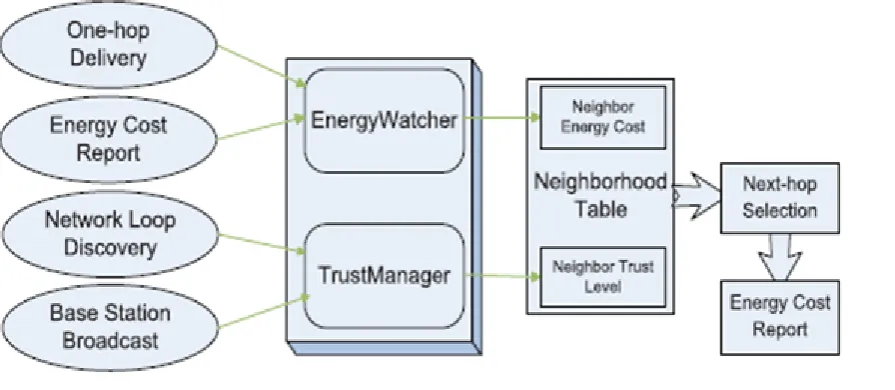
The Energy Watcher are check energy level with cost of neighbor path for delivery of packets The Trust Manager are manage the traffic flow of transmission and enhance the lifetime of network. After, checking the node path with trust level for destination. They are report the level of node during end to end transmission.
Fig 1. Architecture Diagram
Research in this paper as follows:
Parameter are improve with algorithm during transmission.
Reduce traffic amount of battery energy during end to end transmission.
Minimizing energy consumption in Wireless Ad Hoc Networks.
Estimate trust level of probability for packets.
Delivery packet with unit size and cost of energy.
Assign routing values for nodes by using simulation.
B.MODULES a. Node Initialization
b. Route Selection
For a TARF-enabled node N to route a data packet to the base station, N only needs to decide to which neigh boring node it should forward the data packet considering both the trustworthiness and the energy efficiency. Once the data packet is forwarded to that next-hop node, the remaining task to deliver the data to the base station is fully delegated to it, and N is totally unaware of what routing decision its next-hop node makes. N maintains a neighborhood table with trust level values and energy cost values for certain known neighbors.
c. Energy watcher
For a node N, the energy cost of a neighbor is the average energy cost to successfully deliver a unit sized data packet with this neighbor as its next-hop node, from N to the base station. That energy cost is denoted as E.
d. Trust Manager
For a node N, the trust level of a neighbor is a decimal number in [0, 1], representing N‟s opinion of that neighbor‟s level of trustworthiness. Specifically, the trust level of the neighbor is N‟s estimation of the probability that this neighbor correctly delivers data received to the base station. That trust level is denoted as T.
V. ALGORITHM USED
A.SIGNAL INTERFERENCE NOISE RATIO ALGORITHM
The algorithm are describe about the traffic detection and data losses during transmission. They are overcome this problem by using algorithm and enhancing the energy efficiently. In modules, it can be use Trust Aware Routing Framework (TARF) to enable node for data transmission. Then, node are initialized based on weight value and select the node through End to End to Transmission. While, the node are transmit data by using this algorithm and easily reliably gather information without detection.
Multi-hop wireless networks typically possess two important characteristics:
1. The battery power available on the constituent lightweight mobilenodes (such as sensor nodes or smart-phones) is relatively limited.
2. Communication costs (in terms of transmission energy required) are often much higher than computing costs (on individual devices). Energy-aware routing protocols for such networks typically select routes that minimize the total transmission power over all the nodes in the selected path.
As part of this analysis, consider two different operating models:
a) End-to-End Retransmissions (EER): where the individual links do not provide link-layer retransmissions and error recovery– reliable packet transfer is achieved only via retransmissions initiated by the source node.
b) Hop-by-Hop Retransmissions (HHR): where each individual link provides reliable forwarding to the next hop using localized packet retransmissions.
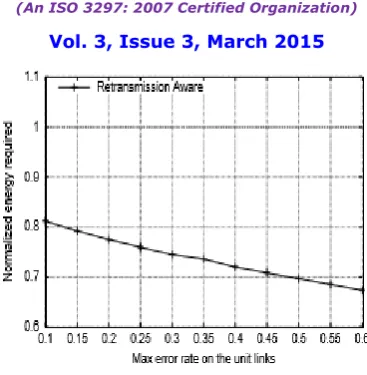
Fig 2. Flow fixed transmission power scenario of HHR
B. TABU ALGORITHM
TABU means that name of person and introduce this algorithm for sin easy manner. Therefore, The RMER are check only path information without verify about node for destination and RMECR are check path information with energy level with verification of nodes. Both of them are execute path as separately in a existing system.
This algorithm is implement the operation of transmission and it can single execution of transmission to check path information of node energy level with calculation of trust node .The following figure 3 are describe about processing node in a mutlihop path for End to End transmission. It can be compare the value between nodes during transmission. Determine the highest level of path based on the route path among routing algorithm for process of transmission.
Fig 3. Best value for multihop paths
Power saving mechanisms based only on metrics related to the remaining power cannot be used to establish the best route between source and destination nodes. In this sense, the actual drain rate power consumption of the node will be
tend to be high, resultant in a sharp reduction of battery power
.
VI. PSEUDO CODE
Step 1: Deploy „N‟ number of nodes in the wireless sensor network. Step 2: Arrange the nodes as a cluster.
Step 3: Choose source node „S‟ and destination node as base station “BS” Step 4: Create TCP/UDP connection among the nodes.
Step 5: Declare Energy value „E‟ for All nodes in the network. Step 6: Declare trust value „T‟ for All nodes in the network.
Step 7: Create Routing Table, one- hop neighbor for all nodes deployed in WSN.
If {
trust value = 0,assign the node to routing table Rt if {
energy value <1
assign the node to routing table Rt }}
Get Rt
Step 9: Start the packet delivery by using the router derived above.
Step 10: Destination, Base station receives packet from source using TARF enable mode.
VII. SIMULATION RESULTS
The Wireless Ad Hoc Network are able to reduce energy consumption by using both algorithms. The Signal Interference Algorithms are finding reliable node for transmission. They are based on hop path with construction of table nearest neighbor path destination. The TABU Algorithm are assign values for routing table of simulation. It can be reduce energy consumption per packet transmission with the framework of path selection.
Finally, they are improve efficiency of energy with percentage of 80-90% consumption, reliable route path and enhancing the lifespan of network. It can be able to find reliable route from source to destination nodes by using algorithms. Based on the path selection, node are select route with energy level to forward packets during end to end transmission.
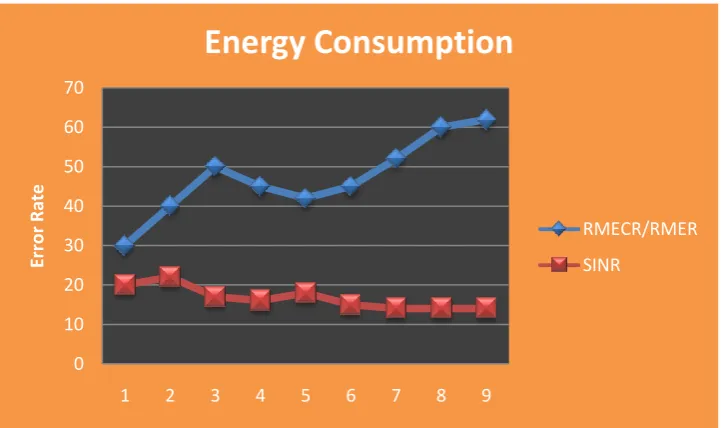
Fig 4. Performance Evaluation
In this figure 4, the report of the graph is improve energy efficiency with reliable route path to reduce error rate during end to end transmission or hop by hop transmission. By using algorithm, they are enhance the lifetime of network during transmission for forward packets.
VII.CONCLUSION
Design and implement a new routing algorithm for wireless ad hoc networks such as a Reliable Minimum Energy Routing (RMER) and Reliable Minimum Energy Cost Routing (RMECR). RMECR can be increase the operational lifetime of the network using energy-efficient and reliable routes. In the design of RMECR, They are used a
0 10 20 30 40 50 60 70
1 2 3 4 5 6 7 8 9
Er
ro
r
R
ate
Energy Consumption
RMECR/RMER
detailed energy consumption model for packet transfer in wireless ad hoc networks. The Proposed system are SINR and TABU energy routing Technique. They are SINR based energy routing successfully and construct the routing table.
In future improvement, TABU Algorithm are able to enhance the energy efficiency of node with operational lifetime of network. To produce the reliable node of transmit packets during transmission and reduce traffic overflow of load for delivery.
REFERENCES
1. Sebastin Christhu Raj A, Helensupriya M, Shanmuga Priya S ,”Reliable Energy Efficient Routing Algorithms In Wireless Ad Hoc Networks”,
Volume 3, Issue 4, April 2014.
2. J. Vazifehdan, R. Prasad, and I. Niemegeers, “Minimum Battery Cost Reliable Routing in Ad Hoc Wireless Networks,” Proc. Eighth IEEE
Consumer Comm. and Networking Conf., Jan. 2011.
3. X.-Y. Li, Y. Wang, H. Chen, X. Chu, Y. Wu, and Y. Qi, “Reliable and Energy-Efficient Routing for Static Wireless Ad Hoc Net- works with
Unreliable Links,” IEEE Trans. Parallel and Distributed Systems, vol. 20, no. 10, pp. 1408-1421, Oct. 2009.
4. D.J. Vergados, N.A. Pantazis, and D.D. Vergados, “Energy- Efficient Route Selection Strategies for Wireless Sensor Net- works,” Mobile
Networks and Applications, vol. 13, nos. 3-4, pp. 285-296, Aug. 2008.
5. J. Zhu, C. Qiao, and X. Wang, “On Accurate Energy Consumption Models for Wireless Ad Hoc Networks,”IEEE Trans. Wireless
Comm.,vol. 5, no. 11, pp. 3077-3086, Nov. 2006.
6. Suresh Singh, C.S.Raghavendra,”PAMAS-Power Aware Multi Access Protocol with Signalling for Ad Hoc Networks”,pp-43-55,2006.
7. J.-H. Chang and L. Tassiulas, “Maximum Lifetime Routing in Wireless Sensor Networks,” IEEE/ACM Trans. Networking, vol. 12, no. 4, pp.
609-619, Aug. 2004.
8. D. Kim, J.J.G. Luna Aleve's, K. Obraczka, J. Carlos Cano, and P. Manzoni, “Routing Mechanisms for Mobile Ad Hoc Networks Based on the
Energy Drain Rate,” IEEE Trans. Mobile Computing, vol. 2, no. 2, pp. 161-173, Apr.-June 2003.
BIOGRAPHY