Image Robber Using Wavelet Transformation
and Hue Histogram
Dr.R.Senthilkumar
1, D.Anureka
2Head and Associate Professor, Dept. of MCA, Narasu’s Sarathy Institute of Technology, Salem, Tamilnadu, India1
II-year MCA Student, Dept. of MCA, Narasu’s Sarathy Institute of Technology, Salem, Tamilnadu, India2
ABSTRACT: An image retrieval system is used for browsing, searching and retrieving images from a large database of digital image. Image retrieval is the basic principle task in the present scenario.Content Based Image Retrieval is the popular image retrieval system by which the target image to be retrieved based on the useful features of the given image. CBIR (Content Based Image Retrieval) scheme searches the most similar images of a query image using Color Histogram. It compare the feature vector of all the images in the database with that the query image using some preselected similarity measures, and then sorting of the results. In this paper, we present CBIR system based on color, shapes and texture using DWT (Discrete Wavelet Transformation) Technique for image retrieval. DWT represent the some of wavelet functions. In this paper DWT consist dubacheise transformation method. It improves the accuracy of image and fast retrieval into image retrieval techniques. Experimental result show confirms that the proposed method is most effective.
KEYWORDS:CBIR, DWT Techniques, Dubacheise transformation, RGB Color, HSV Color.
I. INTRODUCTION
Research on content-based image retrieval has gained maximum momentum during the last decade. CBIR is the process of retrieving images from a database digital images according to the visual content of the images. It means that it is the retrieval of images that have similar content of colors, textures or shapes. Images have always been an inevitable part of human communication and its roots millennia ago. Images make the communication process more interesting, illustrative, elaborate, understandable and transparent.
The rest of the paper is organized as follows: In section 2, a brief review of the related work is presented. The section 3 describes the color feature extraction. The section 4, presents the texture feature extraction and the section 5, presents the similarity matching. The proposed method is given in section 6 and section 7 describes the performance evaluation of the proposed method. Finally the experimental work and the conclusions are presented in section 8 and section 9 respectively.
II. RELATED WORK
CBIR has become an active and fast-advancing research area in image retrieval in the last decade. The difference between the user’s information need and the image representation is called the semantic gap in CBIR systems. The limited retrieval accuracy of image centric retrieval systems is essentially due to the inherent semantic gap between users.
A.W.M. Smeulders, M. Worring, and R. Jain [1] describe “Content-based" means that the search will analyze the actual contents of the image rather than the metadata such as keywords, tags, and/or descriptions associated with the image. The term 'content' in this context might refer to colors, shapes, textures, or any other information that can be derived from the image itself.
Gulfishan Firdose Ahmed, Raju Barskar [2] in this paper, the basic components of content-based image retrieval system is introduced. The semantic-based image retrieval is a better way to solve the “semantic gap” problem, so the semantic-based image retrieval method is stressed in this paper. Other related techniques such as relevance feedback and performance evaluation also discussed. In many areas of commerce, government, academia, and hospitals, large collections of digital images are being created. Many of these collections are the product of digitizing existing collections of analogue photographs, diagrams, drawings, paintings, and prints. Usually, they are searched by using keyword indexing, or simply by browsing. Digital images databases however, open the way to content-based searching. In this paper the survey is done on some technical aspects of current content-based image retrieval systems.
X. Zhou and T. Huang [3] in this paper analyze the nature of the relevance feedback problem in a continuous representation space in the context of multimedia information retrieval. Emphasis is put on exploring the uniqueness of the problem and comparing the assumptions, implementations, and merits of various solutions in the literature. An attempt is made to compile a list of critical issues to consider when designing a relevance feedback algorithm. With a comprehensive review as the main portion, this paper also offers some novel solutions and perspectives. Relevance feedback is a feature of some information retrieval systems. The idea behind relevance feedback is to take the results that are initially returned from a given query and to use information about whether or not those results are relevant to perform a new query.
Chun et al. [12] proposed a CBIR method based on an efficient combination of multi resolution color and texture features based CBIR. Their colors, auto correlograms features of the hue and saturation component images in HSV color space are used. As its texture features, block difference of inverse probabilities and block variation of local correlation coefficient moments of the value component image are adopted. The color and texture features are extracted in multi resolution wavelet domain and then combined.
S. Tong and E. Chang [13] this paper describes that Support vector machines (SVMs, also support vector networks) are supervised learning models with associated learning algorithms that analyze data and recognize patterns, used for classification and regression analysis. The basic SVM takes a set of input data and predicts, for each given input, which of two possible classes forms the output, making it a non-probabilistic binary linear classifier. Given a set of training examples, each marked as belonging to one of two categories, an SVM training algorithm builds a model that assigns new examples into one category or the other. An SVM model is a representation of the examples as points in space, mapped so that the examples of the separate categories are divided by a clear gap that is as wide as possible. New examples are then mapped into that same space and predicted to belong to a category based on which side of the gap they fall on.
negative feedbacks equivalently although this assumption is not appropriate since the two groups of training feedbacks have very different properties. It means that all positive feedbacks share a homogeneous concept while negative feedbacks do not. Authors explore solutions to this important problem by proposing an orthogonal complement component analysis. Experimental results are reported on a real-world image collection to demonstrate that the proposed complement components method consistently outperforms.It thconventional principal components method in
both linear and kernel spaces when users want to retrieve images with a homogeneous concept.
III. COLOR AND TEXTURE FEATURES
A. COLOR SPACES
Color spaces are important component in representing images in digital form. Color representations:-color histogram, color coherence vector which are together called as color space. The color histogram feature is the most important in image retrieval. Here colorhistogram is a vector which is collection of elementwhere each element stands for the no of pixels in a bin ofimage.
(i)Color feature extraction
A color image can be represented using three primaries of a color space. Since the RGB color space does not correspond to the human way of perceiving the colors, so the HSV color space in this approach is used. HSV is an intuitive color space in the sense that each component contributes directly to visual perception, and it is common for image retrieval systems. Hue is used to distinguish colors or represents a pure color, where as saturation gives a measure of the percentage or amount of white light added to a pure color. Value refers to the perceived light intensity or measures brightness. Advantages of HSV color space are:-good compatibility with human intuition and there is a separability of chromatic and achromatic components. The color distribution of pixels in an image contains sufficient information. There are Global color properties and Local color properties for an image. The following two features to represent the global properties of an image can be used. The mean of pixel colors states the principal color of the image, and the standard deviation of pixel colors represents the variation of pixel colors in an image. The variation degree of pixel colors in an image is called the color complexity of the image. Global Color Properties:
The mean (𝜇) and the standard deviation (𝜎) of a color image are defined as follows:
µ = 1̸N ∑ i=1pi………(1)
𝜎 = √(1∕𝑁−1∑i=1(𝑃𝑖𝑁𝑖=1−𝜇)2)……(2)
Where 𝜇 = [𝜇 H, 𝜇 S, 𝜇 V] T and σ = [𝜎 H, 𝜎 S, 𝜎 V] T, each component of 𝜇 and 𝜎 indicates the HSV information, and Pi indicates the ith pixel of an image. Local Color Properties: The local color properties in an image play also an important role to improve the retrieval performance. Hence, a feature called binary bitmap can be used to capture the local color information of an image.
B. TEXTURE
This feature is generally used in similarity matching of images. Texture means smoothness, coarseness and regularity. The texture features are analyzed using statistical approach.The content based image retrieval system is implemented with determining support. Here we are using K-means clustering technique of data mining to create index of images in database once index is created we implement retrieval and search process using index. Commonly in traditional image search and retrieval process every time when a query image is done against database then the query image is verified with every image in database. During this process feature extraction is performed for query images and database images in every search process. Also similarity matching is performed in every search process. As the search process is costly and time consuming every time. In case of proposed system, first K-means clustering creates index and images are organized in clusters in memory. Every cluster is collection of similar images based on content. Now every time search process is implemented the feature extraction and similarity matching are performed on clusters rather than individual images. This shows that the process is improved and is of less cost than the traditional one.
(i)Texture properties
Texture is an important attribute that refers to innate surface properties of an object and their relationship to the surrounding environment. The gray level co-occurrence matrix (GLCM) is a simple and effective method for representing texture. GLCM creates a matrix with the directions and distances between pixels, and then extracts meaningful statistics from the matrix as texture features. The GLCM represents the probability p (i, j; d, 𝜃) that two pixels in an image, which are located with distance d and angle 𝜃, have gray levels i and j.
IV. PROPOSED METHOD
DISCRETE WAVELET TRANSFORMATION (i)Dubacheise transformation method
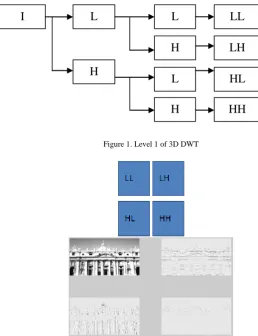
The wavelet representation gives information about the variations in the image at different scales. Discrete Wavelet Transform (DWT) represents an image as a sum of wavelet functions with different locations (shift) and scales [5]. Wavelet is the multi-resolution analysis of an image and it is proved that having the signal of both space and frequency domain [6]. Any decomposition of an 2D image into wavelet involves a pair of waveforms: the high frequency components are corresponding to the detailed parts of an image while the low frequency components are corresponding to the smooth parts of an image. DWT for an image as a 3D signal can be derived from a 2D DWT, implement 2D DWT to every rows then implement 2D DWT to every column. Any decomposition of a 3D image into wavelet involves four sub-band elements representing LL (Approximation), HL (Vertical Detail), LH (Horizontal Detail), and HH (Detail), respectively. The wavelet transform may be seen as a filter bank and illustrated as follow, on a one dimensional signal x[n]. x[n] is input signal
Figure 1. Level 1 of 3D DWT
Figure 2.Example of DWT
LL
LH
HL
HH
I
L
H
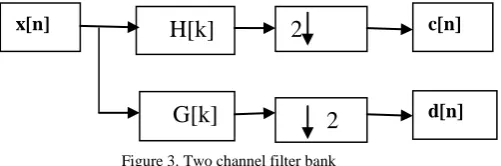
that contains high frequencies and low frequencies. h[k] and g[k] is channel filter bank involving sub sampling. c[n] is called averages contains low frequencies signal. d[n] is called wavelet coefficients contain high frequencies signal. c[n] and d[n] be sub sampled (decimated by 2: ) the next process for further decomposition is iterated on the low signal c[n].
Figure 3. Two channel filter bank
For example, 2D Haar wavelet decomposition is expressed as follows, let x[n] be an input, x[n]= X0,X1,X2,…XN-1 which contains N elements. Then output will consist of N/2 elements of averages over the input and is stored in c[n]. Also the other output contains N/2 elements wavelet
coefficients values and is stored in d[n]. The Haar equation to calculate an average AVi (See Eq.1) and a wavelet coefficient WCi (See Eq.2) from pair data odd and even element in the input data are:
AVi = Xi+Xi+1 (1)
2
WCi = Xi-Xi+1 (2)
2 Where:
AV = Average
WC =Wavelet coefficient
C. Image Retrieval Algorithm
The proposed image retrieval algorithm is as follows,
Step1: First Read Query image and Convert from RGB image to gray image and HSV image then Decomposition using wavelet transformation.
Step2: Make every Wavelet coefficients, WCnew = | WCold |.
Step3: Combination of horizondal details and vertical details, CVdHd(i,j) = Max(Vd(i,j),Hd(i,j)).
Step4: Choose significant points on CVdHd(i,j) by threshold the high value.
Step5: Choose points on HSV image and it neighbor (3x3 pixel) base on coordinate significant points on CVdHd(i,j) then Forming color feature vector by using The first order statistical moment and the second order statistical moment.
Step6: Forming texture feature vector by using Gabor transform on 7x7 pixel neighbor of significant points and Implement min/max normalization on all feature vector with range [0 1].
Step7: Measure the distance between feature vector image query and feature vector image in the dataset by using Euclidean distance then display image results with X top ranking from the dataset.
x[n]
d[n] c[n]
G[k]
H[k]
D.SYSTEM DESIGN
V. PERFORMANCE EVALUATION
The performance of retrieval of the system can be measured in terms of its recall and precision. Recall measures the ability of the system to retrieve all the models that are relevant, while precision measures the ability of the system to retrieve only the models that are relevant. It has been reported that the histogram gives the best performance through recall and precision value [35, 44]. They are defined as:
Precision= Number of relevant image retrieved
(5) Total number of images retrieved
Recall = Number of relevant image retrieved
(6) Total number of relevant image
Where A represent the number of relevant images that are retrieved, B, the number of irrelevant items and the C, number of relevant items those were not retrieved. The number of relevant items retrieved is the number of the returned images that are similar to the query image in this case. The total number of items retrieved is the number of images that are returned by the search engine.
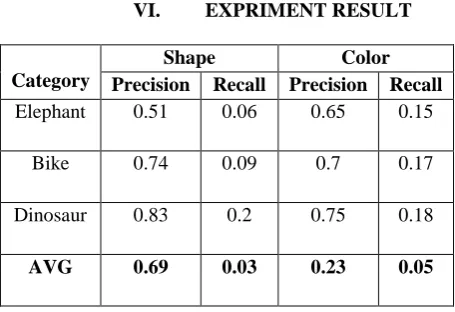
VI. EXPRIMENT RESULT
Category
Shape Color
Precision Recall Precision Recall
Elephant 0.51 0.06 0.65 0.15
Bike 0.74 0.09 0.7 0.17
Dinosaur 0.83 0.2 0.75 0.18
AVG 0.69 0.03 0.23 0.05
Category
Color & Shape (CCV)
Color & Shape (Histogram) Precision Recall Precision Recall
Elephant 0.76 0.04 0.45 0.1
Bike 0.59 0.08 0.38 0.08
Dinosaur 0.69 0.15 0.44 0.1
AVG 0.22 0.03 0.14 0.03
VII. CONCLUSION
In this paper, we presented a novel approach for Content Based Image Retrieval by combining the color and texture features called Discrete Wavelet Transformation (DWT). The experimental result shows that the proposed method outperforms the other retrieval methods in terms of Average Precision. Moreover, the computational steps are effectively reduced with the use of Wavelet transformation. As a result, there is a substational increase in the retrieval speed and accuracy.
REFERENCES
[1] R. Data, D. Joshi, J. Li and J. Z. Wang, “Image retrieval: Ideas, influences, and trends of the new age”, ACM computing Survey, vol.40, no.2, pp.1-60, 2008.
[2] J. Eakins and M. Graham, “Content-Based Image Retrieval”, Technical report, JISC Technology Applications Programmed, 1999.
[3] Y. Rui, T. S. Huang and S.F. Chang, “Image Retrieval: Current Techniques, Promising Directions and Open Issues. Journal of Visual Communication and Image Representation. 10(4): pp. 39-62. 1999.
[4] A. M. Smeulders, M. Worring and S. Santini, A. Gupta and R. Jain, “Content Based Image Retrieval at the End of the Early Years”, IEEE Transactions on Pattern Analysis and Machine Intelligence, 22(12): pp. 1349-1380, 2000.
[5] Y. Liu, D. Zang, G. Lu and W. Y. Ma, “A survey of content-based image retrieval with high-level semantics”, Pattern Recognition, Vol-40, pp- 262-282, 2007.
[6] Y. A. Aslandogan and C. T. Yu, "Techniques and Systems for Image and Video Retrieval," IEEE Transactions on Knowledge and Data Engineering, Vol. 11, Issue 1, pp. 56-63, Jan/Feb 1999.
[7] A. W. M. Smeulders, M. Worring, S. Santini, A. Gupta, and R. Jain, "Content-Based Image Retrieval at the End of the Early Years," IEEE Transactions on Pattern Analysis and Machine Intelligence, Vol. 22, Issue 12, pp. 1349-1380, December 2000.
[8] M. J. Swain and D. H. Ballard, „„Color indexing‟‟, International Journal of Computer Vision, vol. 7, Issue 1, pp. 11-32, 1991.
[9] Irena Valova, Boris Rachev and Michael Vassilakopoulos, “Optimization of the Algorithm for Image Retrieval by Color Features”, International Conference on Computer Systems and Technologies- CompSysTech‟, pp 1-4, 2006.
[10] Sarfraz and M. Ridha “Content-Based Image Retrieval Using Multiple Shape Descriptors”, IEEE/ACS International Conference On Computer Systems and Applications, pp. 730-737, 2007.
[12] N. Sebe, Q. Tian, E. Loupias, M. Lew and T. Huang. "Evaluation of salient point techniques". International Conference, 2004.
[13] C.H. Lin, R.T. Chen and Y.K. Chan, “A smart content-based image retrieval system based on color and texture feature”, Image and Vision [14] J. Huang and S. K. Ravi, “Image Indexing Using Color Correlograms” , Proceedings of the IEEE Conference, Computer Vision and Pattern Recognition, Puerto Rico, Jun. 1997.
[15] G. Pass and R. Zabih, “Refinement Histogram for Content-Based Image Retrieval”, IEEE Workshop on Application of Computer Vision, pp. 96-102. 1996.