An Efficient approach to maintain and protect
Human Health Based on Fall Detection
Algorithm
Deepika.P1, Saranya.A.R2, Shruthi.G3, Udayakumar.S.M4
Assistant Professor, Dept of CSE, K.S. Rangasamy College of Technology, Tiruchengode, Tamilnadu, India 1
Final year students, Dept of CSE, K.S. Rangasamy College of Technology, Tiruchengode, Tamilnadu, India 2, 3, 4
Abstract - The rapidly aging population not only causes long hospital waiting times and expensive hospital waits, but also it increases the time to fix an appointment, workload of doctors and medical practitioners. Managing the cost and quality of treatment and caring of seniors are becoming key pressing issues both in developed and developing countries. Diagnosing and continuous record of real-time data by the use of portable patient monitoring system during normal activity would be beneficial for medical practitioners to do proper and better treatment also it would be useful for health care providers to improve diseases management. This work we provide a facility to fix an appointment through mobile and main purpose of this work is to reduce the waiting time of the patient. This system provides a facility to view emergency first aid (audio and text) in mobile, until doctor arrives first aid treatment was given to the patient according to those first aid details. If doctor cannot reach the patient on time this system provides a video conversation facility between the patient and doctor which can be recorded. And finally this system provides an immediate recovery of patient by tracking his/her location using Global Positioning System (GPS).
Keywords - Accelerometer, ADL, fall detection, falls in the elderly, GPS, Gyroscope, health monitoring device, wearable sensors.
I. INTRODUCTION
As technology starts growing system need to update ourselves to current trends and our upcoming generations looking forward for necessary services in one touch. As a carrier of emergency alarm and healthcare management system, there are some advantages for cell phone. First, the cell phone is convenient to carry. Second, open
operating systems on cell phones, such as iOS, Android and Symbian have many applications and easy to extend by developing application. Third, by the cell phone, user can make a phone call to their friends and family, and with the help of Global Positioning System chip, their location can be acquired. Healthcare management system provides health related medical services through smart phone which helps all generation people. This system provides emergency first aid details; by using those details system can give first aid for the patients until doctor arrives to the place. This helps in giving a supporting treatment after the doctor’s arrival. And also providing a patient tracking facility which helps to tracks the patient’s location in case of danger. An alert is send through this service to emergency numbers stored in this system. By using A-GPS algorithm system can track the patient’s current location for immediate recovery.
Falling of elders or any patients may cause moderate to severe injuries owing to the impact to floor or ground at any age. They are more commonly experienced by old people. 35% and 50% of people aged above 70 and 80 years, respectively, all those people especially elders do not have the strength to control their body . As a result, many complications are faced by older people such as fracture, physical harm, and functional disorder. In this busy life not all people can constantly monitor them but constant care is needed. Measures can be taken to reduce the number of falls by adopting certain safety procedures within the living environment. However, risk of fall can neither be predictable nor removable. If the fall occurs, the most important process is taking emergency measures. Therefore, there is a need for constant monitoring of fall and taking the emergency action as soon as it is detected.
network approach, many solutions attach sensor nodes consisting of accelerometer and gyroscope to human body for continuous monitoring of the patients. Increasing the accuracy to detect fall by attaching sensor nodes to chest and thigh was used before in many regions. But, it is uncomfortable to live with sensor nodes attached into chest and thigh irrespective of fall detection performance. They do not allow the patients or the elders to walk freely.
And even with slight movement they might produce wrong signals wearing these uncomfortable nodes can be a serious problem, if people tend to avoid wearing those sensor nodes, even though the nodes might offer high accuracy. A wrist watch style sensor or a necklace shaped sensor has been proposed which is more comfortable to wear and practical to use. However, both arm and wrist shows frequent movement nature preventing accurate fall detection. Hence necklace shaped model provide a better way of using the system for performance and other features.
A. Introduction to Android
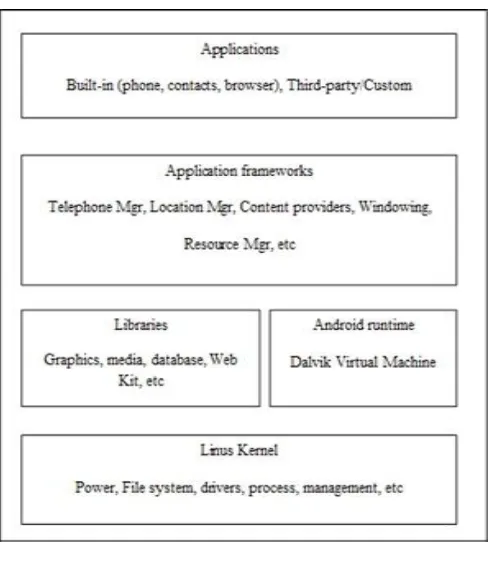
Android is a software stack for mobile devices that includes an operating system, middleware and key applications. The Android SDK provides the tools and APIs necessary to begin developing applications on the Android platform using the Java programming language. Android is a layered environment built upon a foundation of the Linux kernel, and it includes rich functions. The UI subsystem includes:
Windows
Views
Widgets for displaying common elements such
as edit boxes, lists, and drop-downlists
Android includes an embeddable browser built upon Web Kit, the same open source browser engine powering the iPhone's Mobile Safari browser. Android boasts a healthy array of connectivity options, including Wi-Fi, Bluetooth, and wireless data over a cellular connection (for example, GPRS, EDGE, and 3G). A popular technique in Android applications is to link to Google Maps to display an address directly within an application. Support for location-based services (such as GPS) and accelerometers is also available in the Android software stack, though not all Android devices are equipped with the required hardware. There is also camera support. Historically, two areas where mobile applications have struggled to keep pace with their desktop counterparts are graphics/media, and data storage methods.
Fig. 1 Android Software layers
Android runs a top a Linux kernel. Android applications are written in the Java programming language, and they run within a virtual machine (VM). It's important to note that the VM is not a JVM as you might expect, but is the Dalvik Virtual Machine, an open source technology. Each Android application runs within an instance of the Dalvik VM, which in turn resides within a Linux-kernel managed process.
An Android application consists of one or more of the following classifications:
Activities:
An application that has a visible UI is implemented with an activity. When a user selects an application from the home screen or application launcher, an activity is started.
Services:
A service should be used for any application that needs to persist for a long time, such as a network monitor or update-checking application.
Content providers:
available to multiple activities or applications, a content provider is the means of accessing the data.
Broadcast receivers:
An Android application may be launched to process an element of data or respond to an event, such as the receipt of a text message. An Android application, along with a file called Android Manifest.xml, is deployed to a device. AndroidManifest.xml contains the necessary configuration information to properly install it to the device. It includes the required class names and types of events the application is able to process, and the required permissions the application needs to run. For example, if an application requires access to the network — to download a file, for example — this permission must be explicitly stated in the manifest file. Many applications may have this specific permission enabled. Such declarative security helps reduce the likelihood that a rogue application can cause damage in the device.
II. EXISTING SYSTEM
Presently most of the office functionalities are done manually. Patients’ needs long wait to meet the doctor till his/her chance is called. Emergency services are not efficient. In case of a fall, early detection and prompt notification to emergency services is essential for quick recovery. However, the existing fall detection devices are bulky and uncomfortable to wear. Also, detection system using the devices requires the higher computation overhead to detect falls from activities of daily living (ADL).There are certain issues in existing system which include:
Time consuming-This aspect is a main constrain and this paper shows an efficient way of managing time. In this way all the patients have to wait for a long time having health problems. Consumes large volume of paper work –When done manually all patient record needs to be maintained and retrieval of them is also very difficult. Lack of security of data-All the patient details cannot be kept confidential and hence lack of security prevails. Manual work-Since all work are done manually there is a threat in which manual errors may occur in them. Inefficient emergency services-First aid needs to be provided for patients in case of emergency. Due to lack of knowledge in health care this becomes difficult. Simple sensors, such as single- or dual-element PIR (passive infrared) sensors, provide fair crude data that’s difficult to interpret. Wearable devices such as wrist communicators and motion detectors have potential but rely on a person’s ability and willingness to wear them. Cameras might
appear intrusive and require considerable human resources to monitor activity. Machine interpretation of camera images is complex and might be difficult.
III. PROPOSED SYSTEM
The Health Care Management System is user friendly service which reduces the waiting time of patients. It provides immediate emergency first aid details and maintains the patient’s record (video, text) in smart phone. It also tracks the patient’s location for immediate recovery. The mobile healthcare applications that system develops are helping medical practitioners in maintaining competency and patients in living a healthy life. With a mobile healthcare application, patients can get 24x7 medical help as well as access to health related information, anytime & anywhere. For doctors, patient communication application is better & cost-effective way of monitoring a patient’s health because of the easy accessibility it provides. We propose a new fall detection system using one sensor node which can be worn as a necklace to provide both the comfortable wearing and low computation overhead. It offers high accuracy and more comfortable and practical to use. Tri-axial accelerometer and gyroscope sensors which are fabricated in the form of a necklace and wrist watch. This provides a more sophisticated and practical way of usage of all the system with modern approach in technology and new trends with the developing new platform which is open source that helps all the users to modify and continuously upgrade the system.
Fig. 2 Health care management system
A. ADVANTAGES
control and access the data information. They provide great flexibility and ensure a robust feature. Greater efficiency-All mobile device are easy to carry and provide high data access via internet thus they provide an efficient way of using the system device. Ensures data accuracy-No manual work is needed hence human errors are not found in many cases. Accurate values and readings provide more sophisticated and secure environment.
Minimum time is required-As they are system oriented they provide more efficient and faster way of executing a given task. Minimize manual job-All work are system based they provide a workspace environment which is system oriented and execution of all the application will be in the mobile device. Security of data-Data security and confidentiality is ensured in them with help of passwords and other pattern features. This ensures the security of all data and information.
IV. MODULES
A. EMERGENCY FIRST AID
EF provides first aid details in case of any emergency. The patients can view the first aid details in emergency situation such as details for Flu, Stomach Pain, fire accidents, etc. Generally people don’t know what kind of first aid should be given during doctor’s absence. In such case this system is very much helpful. The user can view the details in one touch and also using Google translator we can view the same details in other language. Using the READ OUT mode the people can hear those emergency details through voice process. The details are given in both audio and text format so that this system can be used by physically challenged people too. By using Statistical machine translation algorithm a natural language is converted to other natural language.
Fig. 3 Emergency First Aid Data flow diagram
B. LOCATION TRACKING
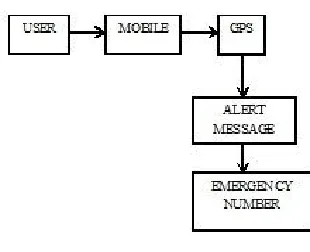
This location tracking facility is very much helpful to track the location of the patient in case of any emergency or danger. If the patient suddenly gets any health problem just by pressing a button an alert message will be sent to one of his contact number and to the doctor’s number who is dealing the patient. The alert message consists of current location of the patient. GPS gets activated and that will track the patient’s location. Until GPS gets deactivate the alert message will be sent for the particular interval of time. This was calculated using A-GPS algorithm. This system is very much useful to track the user when he/she is in any danger. When pressing the button, latitude and longitude was calculated and within seconds the location address was sent to the particular contacts.
Fig. 4 Location Tracking Data flow diagram
C. APPOINTMENT FIXING
The main purpose of this service is to reduce the waiting time of the patients which one of the issues faced in hospitals. The user can fix an appointment through mobile where the time is allotted according to the purpose of the meeting. A token number is generated in user’s mobile which is also stored in hospital server. At particular interval of time next appointment is fixed for next user. This may avoid the waiting time and gives the doctor to analyze the patient for the better treatment. It is user friendly and helpful to patients.
USER MOBILE EMERGENCY
FIRST AID DETAILS
TEXT VOICE
V. TECHNIQUES
A. STATSTICAL MACHINE TRANSLATION
ALGORITHM
Statistical machine translation (SMT) provides translation of any natural language into a machine learning one. By examining many samples of human-produced translation, SMT algorithms automatically learn how to translate. It translates the written form of the language but can be used in combination with speech recognition and text-to-speech synthesis to translate spoken language. The fundamental aim of statistical machine translation is to take a fragment in one written language and translate it into another written language.
eˆ = arg e max P(e|f)
The kind of sentences that is likely in the language E. This is known as the language model — P (e).
The way sentences in E get converted to sentences in F. This is called the translation model –P (f|e).
1. Benefits
The most frequently cited benefits of statistical machine translation over rule-based approach are:
i. Better use of resources
a. There is a great deal of natural language in machine-readable format.
b. Generally, SMT systems are not
tailored to any specific pair of languages.
c. Rule-based translation systems require the manual development of linguistic rules, which can be costly, and which often do not generalize to other languages.
ii. More natural translations
a. Rule-based translation systems are
likely to result in Literal translation. While it appears that SMT should avoid this problem and result in natural translations, this is negated by the fact that using statistical matching to
translate rather than a
dictionary/grammar rules approach can often result in text that include
apparently nonsensical and obvious errors.
B. ASSISTED – GLOBAL POSITIONING SYSTEM
ALGORITHM
It’s important to note that AGPS will only work if the device has a GPRS (data) connection, normally using a 3G connection. The first time GPS signal attempts to track it has to download three sets of data (GPS satellite signals, almanac data, and ephemeris data) to calculate its position. Assisted GPS can help avoid this, solving the data connection issue by linking to a web-based internet server (known as an assistance server) that already holds the current satellite information. It can take anywhere from 30 seconds to a couple of minutes to acquire a signal. In the A-GPS architecture, in addition to a digitized GPS signal, several pieces of assistance data are made available to the GPS algorithm, including:
1. Time stamp. This can be supplied through a cellular network and represents an estimate of the time at which the GPS signal capture was initiated. In a CDMA network, time stamps are typically accurate to within 100 ls or better. In a GSM network, time stamps can be off by several seconds.
2. Approximate location. Typically taken to be the location of the base station from which the mobile device receives assistance data, the approximate location serves as a coarse estimate of the receiver’s location. In urban areas, the closest base station is typically within a few kilometers of the receiver. In rural areas, the closest base station can be tens of kilometers from the receiver.
3. Ephemeris information. This is easily obtained through a network, and can be used to compute satellite locations, velocity, and acceleration. 4. Satellite clock corrections. Satellite clocks drift
over time. At any given time, clock error estimates can be obtained through the network. 5. Differential corrections. As with conventional
differential GPS systems, this data is obtained from a reference receiver network and enhances system accuracy.
d = || currPosition, p index, ||
nextPointIndex = nextPointIndex + direction. Where || . || denotes GPS distance.
C. FALL DETECTION ALGORITHM
A simple fall detection algorithm along with the sensor node capability of comfortable wearing and high detection probability in order to produce the fast detection result on the sink node which could be also developed as battery powered device.
1.Accelerometer & Gyroscope
Acceleration suddenly increases during fall which is detected using accelerometer. This device is used in most of fall detection systems. Accelerometer sensor node can be attached with chest, thigh, stomach, and wrist. The angle of body or angular velocity is measured by using gyroscope. It is generally used along with
accelerometer to complement accelerometer's fall
detection rate.
Commonly used locations for the sensors in existing works are chest and thigh. These locations are good to measure constant acceleration because of limited movement of these body parts. That is, each posture shows different angles between chest and thigh, thus these algorithms provide good performance for fall detection by analyzing the angles obtained from more than 2 sensor nodes. However, if the elderly people or patients are moving with these sensors attached to the chest and thigh, their daily life will be interfered with the nodes due to the number, size, and weight of nodes. Also, chest and thigh are not suitable position for charging or battery replacement because sensors are placed inside the cloths. Also, the wrists watch style sensor in which is more comfortable to wear but provides low performance result.
In order to figure out this uncomfortable wearing problem and inefficient detection performance, we developed a new sensor node in the form of wearable necklace. For accurate measurement, sensor node tied to tight necklace is placed close to neck, thus the movement of sensor node is expected to be minimized much. Additionally, we can place the sensor node inside the cloth which would limit the movement of the sensor node and replace the battery easily at the same time.
Accelerometer in this system is attached with chest. Acceleration in this algorithm is compared with upper falls threshold (UFT) and lower falls threshold (LFT). If acceleration is greater than UFP or less than LFP then it is classified as falls. Algorithm shows erroneous behavior during large movements.
The sensors are attached to trunk and thigh of human body. Fall is detected using the angle of inclination of trunk, thigh, and Signal Vector Magnitude. Although the algorithm has a high fall detection rate but it has low practicability because sensors are attached with trunk and thigh which is uncomfortable. The algorithm attempts to detect translation and the rotary motion during falling. Difference in the values of acceleration which are observed from chest and stomach are used to detect fall.
VI. CONCLUSION
This system presents an android-based Emergency Alarm and Healthcare Management System, which is practically deployed on android-based Phones. The system can give emergency help at anywhere and anytime, can remind users for medicine and can provide the function of seeing a doctor to the user. This does not only undoubtedly provide the senior people and the chronic patients the more convenience and safety, but also provide most of people. In case of a fall, early detection and prompt notification to emergency services is essential for quick recovery. However, the existing fall detection devices are bulky and uncomfortable to wear. Also, detection system using the devices requires the higher computation overhead to detect falls from activities of daily living (ADL).
Our proposed fall detection system can be regarded as alternative device to the existing detection approaches, since the device provides the comfortable wearing and fast fall response. These advantage features are obtained by sacrificing the sensitivity of the falls a little bit and using one sensor node. Service-oriented paradigm can be successfully applied to medical systems, increasing their flexibility and dynamism, allowing the creating of applications of added value, such as the usage of smartphones. The proper selection of data sampling rate and transmission interval is very important in terms of reliability and energy consumption. This is a very useful in the field of medical where it applies to all categories of people. It is projected that the percentage of elderly people making up the total population will more than double over the next 50 years, resulting in many more individuals requiring special hospital treatment and long-term medical care. So our system will be more useful and it is user friendly.
REFERENCES
[1] D. N. Kanten, C. D. Mulrow, M. B. Gerety, M. J. Lichtenstein, C.
reporting methods in nursing homes," Journal of Am Geriatr Soc., vol. 41, pp. 662-666, 1993.
[2] Y. G. Lee, D. 1. Cheon and G. W. Yoon, "Telemonitoring System of Fall Detection for the Elderly," Journal of Sensor Science and Technology., vol. 20, no. 6, pp. 420-427, 2011.
[3] C. W. Lin, Z. H. Ling, Y. C. Chang and C. J. Kuo, "Compressed domain Fall Incident Detection for Intelligent Homecare," Journal of VLSI Signal Processing., vol. 49, pp. 393-408, 2007.
[4] A. Sixsmith and N. Johnson, "A Smart Sensor to Detect the Falls of the Elderly," Journals & Magazines., vol. 3, no. 2, pp. 42-47, 2004.
[5] Q. Li, J. A. Stankovic, M. Hanson, A. Barth and J. Lach,
"Accurate, Fast Fall Detection Using Gyroscopes and
Accelerometer-Derived Posture Information," in 2009 Sixth International Workshop on Wearable and Implantable BSN., pp. 138-143, Jun. 2009.
[6] A. K. Bourke, J. V. O'Brien and G. M. Lyons, "Evaluation of a threshold-based tri-axial accelerometer fall detection algorithm," in Gait & Posture., vol. 26, pp. 194-199,2007.
[7] N. S. Kim, "Development of an Emergency Monitoring Device in a Wrist Watch," The Journal of Korea Institute of Information Technology., vol. 8, no 4, pp. 9-18, Apr. 2010.
[8] M. Quwaider and S. Biswas, "Physical Context Detection using Wearable Wireless Sensor Networks," Journal of Communications Software and Systems., vol. 4, no. 3, pp. 191-201, Sep. 2008.
[9] H. L. Lee, "The falls detection algorithm using the differences of accelerations according to the parts of body," M. Eng. thesis, Graduate School Pusan National University, Pusan, Korea, Feb. 2011.