Effect of Nanoparticle Concentration on
Thermophysical Properties of Nanofluids
Onkar Lathkar1, Dr. P J Bansod2
M Tech Student, Department of Mechanical Engineering, G H Raisoni college of Engineering and Management, Pune,
Maharashtra, India1
Associate Professor, Department of Mechanical Engineering, G H Raisoni College of Engineering and Management,
Pune, Maharashtra, India2
ABSTRACT: Present study aims at comprehensive review of Thermo-physical properties of a nanofluid. Heat transfer in Nanofluids depends upon various factors like Particle Size, Brownian Motion, Molecular layering of liquid etc. In this work different thermos-physical properties like Thermal Conductivity, Viscosity, Specific Heat, Density are studied and the effect of particle concentration at different levels on these thermos-physical properties was reviewed. As Thermal Conductivity, Specific Heat and Density majorly effect on heat transfer capacity of Nanofluid, this work is concentrated on Study of these thermos-physical properties. Nanofluids’ thermal conductivity and viscosity greatlydepend on their size, volume concentration, shape and material. Nanofluid viscosity mayincrease or decrease depending upon the material of nanoparticle on lowering the size.Viscosity of nanofluid increases with increase in volume fraction of nanoparticle.
KEYWORDS: Nanoparticles, Nanofluid, Thermal Conductivity, Viscosity, VolumeConcentration, Heat Transfer.
I. INTRODUCTION
II. MEASUREMENT OF THERMO-PHYSICAL PROPERTIES AT DIFFERENT CONCENTRATION
The main thermo-physical properties of nanofluids are discussed in this section.
A) Measurement of Thermal Conductivity:Thermal conductivity is defined as amount of heat transferred through unit thickness of material in a direction normal to unit surface area. It is a measure of amount of heat transferred through material.
Thermal conductivity of nanofluid is determined by following equation,
Where, kp = Thermal conductivity of nanoparticle Kwater= Thermal conductivity of water.
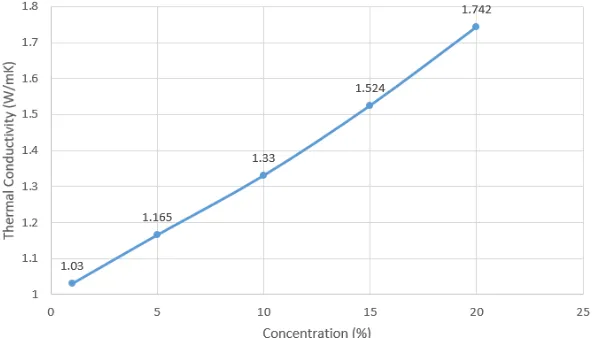
Thermal Conductivity measured using above equation at different concentration is given in following table,
Concentration (%)
Thermal conductivity (W/mK)
1 1.03
5 1.165
10 1.33
15 1.524
20 1.742
B) Measurement of Specific Heat:The specific heat capacity is ratio of quantity of heat added or removed from an object to temperature change. The specific heat of nanofluids can be calculated by using mass balance equation as:
Where, Ø = Nanoparticle Percentage,
ρ = Density of Base Fluid.
ρ = Density of Nanoparticle
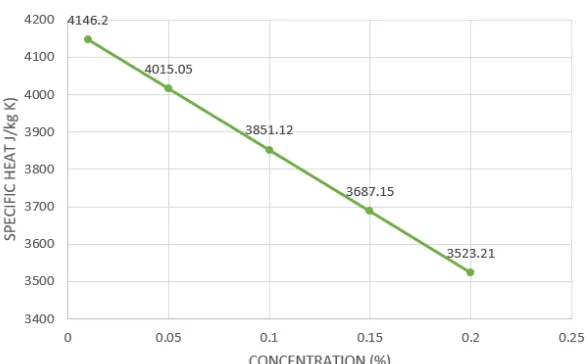
Specific heat measured using above equation at different concentration is given in following table,
Concentration (%)
Specific Heat ( J/kg K)
1 4146.2
5 4015.05
10 3851.12
15 3687.15
20 3523.21
Table 2 Values of Specific Heat at Different Concentration
C) Measurement of Density:The density of a substance is mass per unit volume. It can be numerically calculated by mass balance as follows,
Where, ρf = Density of Base Fluid, Øs = Concentration of Nanoparticles,
ρp = Density of Nanoparticles.
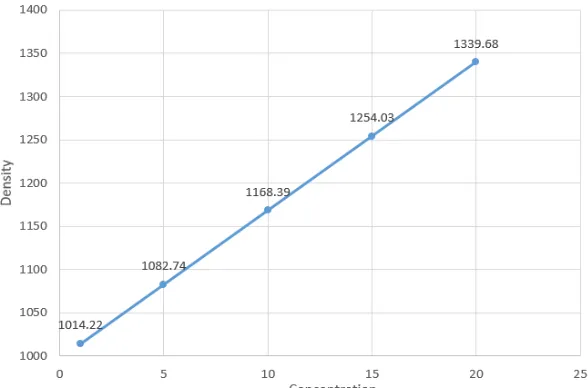
Density measured by above equation at different concentration levels is given in following table.
Concentration
(%)
Density
(kg/m
3)
1
1014.22
5
1082.74
10
1168.39
15
1254.03
20
1339.68
Table 3 Values of Density at different concentration
III. CONCLUSION
From this study it can be concluded that,
Nanofluids can show better heat transfer capacity which depends upon particle sizeThermal Conductivity & Viscosity of the nanofluid.
The increased concentration nanoparticles is will to raise the convective heat transferefficiency.
The convective heat transfer coefficient depends on Axial Profile, Length andconcentration of nanoparticles.
The nanofluids can be used efficiently in convective heat transfer applications..
REFERENCES
[1] S. Kumar and S. Chkarabarthi “Experimental investigation of laminar forced convective heattransfer of Graphene–water nanofluid inside a circular tube”. International Journal of ThermalSciences, 100, 316-323.
[2] Prakash M, Giannelis EP (2007) Mechanism of heat transport in nanofluids. J Comput AidedMater Des 14:109–117
[3] Prasher R (2005) Thermal conductivity of nanoscale colloidal solutions (nanofluids). PhysRev Lett 94:025901. doi: 10.1103/PhysRevLett.94.025901
[4] Prince Kumar and K.M. Pandey Effect on Heat Transfer Characteristics of NanofluidsFlowing under Laminar and Turbulent Flow Regime – A Review IOP Conf. Ser.: Mater. Sci.Eng. 225 012168
[5] Lazarus Godson Asirvatham NANOFLUID HEAT TRANSFER AND APPLICATIONSJournal of Thermal Engineering Yildiz Technical University Press, Istanbul, Turkey Vol.1, No. 2, pp. 113-115, April, 2015
[6] Andrew D. Sommers Æ Kirk L. Yerkes, Experimental investigation into the convective heattransfer and system-level effects of Al2O3-propanol nanofluid. J Nanopart Res SpringerScience+Business Media B.V. 2009 DOI 10.1007/s11051-009-9657-3
[7] Sayantan Mukherjee1, Somjit Paria Preparationand Stabilityof Nanofluids-A Review OSRJournal of Mechanical and Civil Engineering (IOSR-JMCE)e-ISSN: 2278-1684,p-ISSN: 2320-334X, Volume 9, Issue 2 (Sep. -Oct. 2013), PP 63-69
[8] Das S., Putra N., Thiesen P. and Roetzel W., “Temperature dependence of thermalconductivity enhancement for nanofluids”, Journal of Heat Transfer, Vol.125, pp.567-574, 2003.
[9]. Ahuja A.S., “Augmentation of heat transport in Laminar flow of polystyrene suspensions I.Experiments and Results”, Journal of Applied Physics, Vol.46, No. 83, pp.408-3416, 1975.
[10]. Masuda H., Ebata A., Teramae K. and Hishinuma N., “Alteration of Thermal Conductivityand Viscosity of Liquid by Dispersing Ultra-Fine Particles (Dispersion of Al2O3, SiO2 and TiO2Ultra-Fine Particles)”, Netsu Bus-sei (Japan), Vol.7, No. 4, pp.227- 233, 1993.
[11]. L. SyamSundar, M. T. Naik, K. V. Sharma, M. K. Singh, and T. C. Siva Reddy,“Experimental investigation of forced convection heat transfer and friction factor in a tube withFe3O4 magnetic nanofluid,” ExperimentalThermal and Fluid Science, vol. 37, pp.65–71, 2012.