INVESTIGATION
Gene Capture by
Helitron
Transposons Reshuf
fl
es
the Transcriptome of Maize
Allison M. Barbaglia,*,1Katarina M. Klusman,* John Higgins,*,2Janine R. Shaw,† L. Curtis Hannah,†and Shailesh K. Lal*,3
*Department of Biological Sciences, Oakland University, Rochester, Michigan 48309, and†Department of Horticulture and Plant Molecular and Cellular Biology Program, University of Florida, Gainesville, Florida 32610–0245
ABSTRACTHelitronsare a family of mobile elements that were discovered in 2001 and are now known to exist in the entire eukaryotic kingdom.Helitrons, particularly those of maize, exhibit an intriguing property of capturing gene fragments and placing them into the mobile element.Helitron-captured genes are sometimes transcribed, giving birth to chimeric transcripts that intertwine coding regions of different captured genes. Here, we perused the B73 maize genome for high-quality, putative Helitrons that exhibit plus/minus polymorphisms and contain pieces of more than one captured gene. SelectedHelitronswere monitored for expression viain silicoEST analysis. Intriguingly, expression validation of selected elements by RT–PCR analysis revealed multiple transcripts not seen in the EST databases. The differing transcripts were generated by alternative selection of splice sites during pre-mRNA processing. Selection of splice sites was not random since different patterns of splicing were observed in the root and shoot tissues. In one case, an exon residing in close proximity but outside of theHelitronwas found conjoined withHelitron-derived exons in the mature transcript. Hence, Helitrons have the ability to synthesize new genes not only by placing unrelated exons into common transcripts, but also by tran-scription readthrough and capture of nearby exons. Thus,Helitronshave a phenomenal ability to“display”new coding regions for possible selection in nature. A highly conservative, minimum estimate of the number of new transcripts expressed by Helitrons is
11,000 or25% of the total number of genes in the maize genome.
T
HE Helitron family of transposable elements resides in the genome of species representing the entire eukaryotic kingdom (reviewed in Lal et al. 2009). While present in many genomes, the extent of their presence varies dramat-ically. In maize, the subject of these investigations,Helitrons compose 2% of the total genome (Yang and Bennetzen 2009a; Du et al. 2009). Despite their massive abundance in several eukaryotic genomes, autonomousHelitronactivityhas not yet been reported in any species. The discovery of two maize mutants caused by recent insertions ofHelitrons and the presence of nearly identical Helitrons at different locations in the maize genome point to their recent move-ment in maize (Kapitonov and Jurka 2001; Lalet al.2003; Gupta et al.2005a; Lai et al.2005). The detection of very recent somatic excisions ofHelitronsin maize also indicates these elements are active in the present day maize genome (Li and Dooner 2009).
Helitrons are highly polymorphic in both length and se-quence primarily due to different gene pieces captured by these elements (Duet al.2009; Yang and Bennetzen 2009a; review by Feschotte and Pritham 2009). While several mo-lecular mechanisms for gene capture have been proposed (Feschotte and Wessler 2001; Bennetzen 2005; Brunner et al.2005; Lalet al.2009), definitive experimental evidence supporting a particular mechanism is still lacking. The cap-ture of genes appears to be indiscriminate, and the biolog-ical relevance of capture to the element or the genome is not apparent. Captured genes exhibit varying degrees of se-quence similarity to their wild-type progenitors.
Copyright © 2012 by the Genetics Society of America doi: 10.1534/genetics.111.136176
Manuscript received October 28, 2011; accepted for publication December 4, 2011 Available freely online through the author-supported open access option. Sequence data from this article have been deposited with the EMBL/GenBank Data Libraries under accession no. AC220956, AC213839, AC205986, AC211765, JN417509, JN638823, JN638824, JN638825, JN638826, JN638827, JN638828, JN638829, JN638830, JN638831, JN638832, JN638833, JN638834, JN638835, JN638836, JN638837, JN638842, AC209160, JN638843, JN638844, JN638845, JN638846, JN638847, JN638848, JN638849, JN638838, AC211765, JN638839, JN638840, JN638841, and AC220956.
1Present address: Cell and Molecular Biology Program, Michigan State University,
East Lansing, MI 48824-4320.
2Present address: Department of Engineering, Franklin W. Olin College of Engineering, Needham, MA 02492.
3Corresponding author: 3200 N. Squirrel Rd., Dodge Hall of Engineering, Oakland
The massive diversity ofHelitronsand their lack of termi-nal repeats as well as nonduplication of the insertion site sequences as associated with class I and II transposable ele-ments have made their detection computationally challeng-ing. In maize, however, analysis ofHelitronsassociated with plus/minus genetic polymorphisms identified a family of Helitrons containing conserved, short terminal ends. These conserved termini have been used to detect other family members (Gupta et al. 2005a; Jameson et al. 2008). Re-cently, two computer-based programs, HelitronFinder and HelSearch, containing algorithms to recognize these termi-nal ends, have been implemented to identify otherHelitrons in the B73 genome (Duet al.2008, 2009; Yang and Bennet-zen 2009a,b). Both programs identified an overlapping set of2000 putative, high-qualityHelitrons. When these puta-tive, high-quality elements, identified using conserved ter-minal ends of theHelitron, were used as a query in a BLAST search, an additional 20,000 Helitrons or associated ele-ments comprising 2% of the total maize genome were identified (Du et al. 2009; Yang and Bennetzen 2009a). The vast majority of maize Helitrons have acquired gene fragments derived from up to 10 different genes embedded within a single element (Duet al.2009; Yang and Bennetzen 2009a). These observations indicate thatHelitronshave cap-tured, multiplied, and moved thousands of gene fragments of the maize genome. How these events impact the evolu-tion and expression of the maize genome is poorly under-stood. In comparison to Helitrons of other species, maize elements appear unique in their highly efficient ability to acquire gene fragments. This has significantly contributed to the diversity and lack of gene colinearity observed be-tween different maize lines. This so-called “1/2 polymor-phism”is primarily caused by presence and absence of gene-ferryingHelitronsbetween different maize inbred lines (Lai et al.2005; Morganteet al.2005).
The genes captured by Helitrons are sometimes tran-scribed, giving birth to eclectic transcripts intertwining cod-ing regions of different genes. These potentially may evolve into new genes with novel domains and functions (Lalet al. 2003; Brunner et al. 2005; Lal and Hannah, 2005a,b; Jamesonet al.2008; reviewed in Lalet al.2009). Whether Helitronshave been a major driving force for gene evolution remains to be determined.
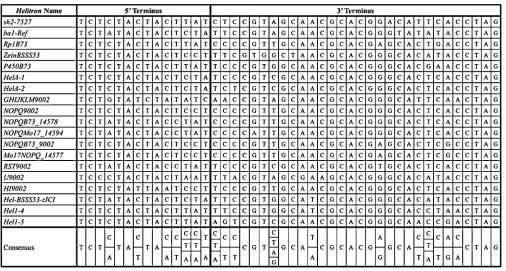
To analyze the transcriptional activity of Helitron-captured genes, we first identified highly reliable maize Helitrons in the sequenced B73 genome. These selected Helitronshad the following features: (1) They contained terminal 59(59-TCTMTAYTAMYHNW-39) and 39(59-YCGTN RYAAHGCACGKRYAHNNNNCTAG-39) sequences. These were derived from the multiple sequence alignment of the terminal ends of theHel1family of maizeHelitrons(Dooneret al.2007). (2) Termini were in the correct orientation. (3) They exhibited
1/2 polymorphisms in paralogs in B73 or in orthologs in other maize lines. (4) They contained fragments of more than one captured gene. (5) They exhibited EST evidence of tran-scription. TheseHelitronswere further validated for their
au-thenticity and the structure of their captured genes and transcripts by manual annotation. Resulting data indicate that Helitrons not only intertwine the coding regions of different captured genes but also generate multiple transcripts by alter-native splicing and by readthrough transcription that captures exons in genes near the Helitron. Hence, Helitrons are quite remarkable in generating diversity of coding regions which, upon selection, may lead to the evolution of new genes with novel domains and functions.
Materials and Methods
Plant material
The maize inbred lines described in this report were obtained from the Maize Genetics Cooperative Stock Center, University of Illinois. The plants were grown in the greenhouse or in thefield at the University of Florida/ Institute of Food and Agricultural Sciences facility, Citra, FL.
Identification of Helitrons and expression analysis of the captured genes
The conserved 59and 39terminal ends of the experimentally determinedHel1family ofHelitronswere isolated (Lalet al. 2008) and subjected to multiple sequence alignments. The strict consensus pattern of nucleotides displayed in Figure 1 was used as a template to search the entire database of Zea mays BAC sequences (B73 inbred) downloaded from the Plant Genome Database (www.plantgdb.org/). A script was written in Python programming language using mod-ules from the BioPython project to identify putative Heli-trons. This program called HelRaizer, (secs.oakland.edu/ helraizer) batch processes the input maize genome sequence and searches for sequences matching the terminal ends of theHelitrons. Correctly oriented 59and 39termini separated by 100–25,000 bp were identified and the intervening ge-nomic sequence was labeled a putativeHelitron. The iden-tification of the Helitron-captured gene fragments was performed using BLASTX search against the nr/protein Na-tional Center for Biotechnology Information (NCBI) data-base. Batch alignment was performed and alignments matching gene fragments of.50 bp with at least 85% sim-ilarity were recorded as an instance of gene capture.
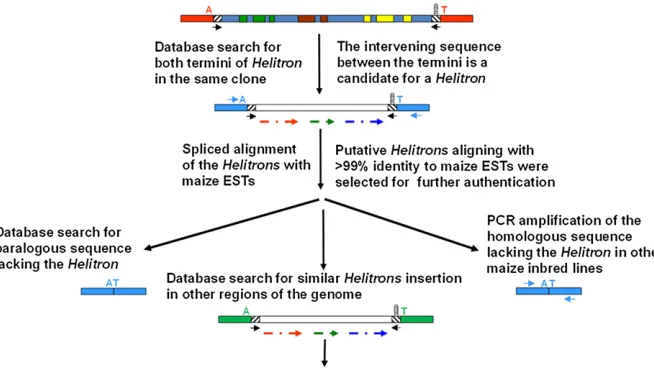
Expressed candidate Helitrons were identified by batch processing the putative Helitron sequences through the National Center of Biotechnology Information, NCBI (www.ncbi.nlm.nih.gov) BLAST (Basic Local Alignment Search Tool) analysis against the Expressed Sequence Tag (EST) database of Z. mays. Helitrons that had sequences aligning with the entire length of the EST sequences with at least 99% identity were assigned as candidates for expres-sion of captured genes and were manually annotated and further pursued for experimental analysis. Figure 2 outlines the strategy used to discoverHelitronsthat display EST ex-pression of captured host genes.
Annotation and structure analysis of captured gene pieces was done by manual examination of the splice alignment of theHelitronswith their cognate ESTs and their putative protein products using the computer software GeneSeqer (deepc2.psi.iastate.edu/cgi-bin/gs.cgi) and Spli-cePredictor (deepc2.psi.iastate.edu/cgi-bin/sp.cgi), respec-tively (Usuka and Brendel 2000; Usukaet al.2000).
Genomic and RT–PCR analysis
Genomic DNA extracted from kernel tissue of different maize inbred lines was performed using DNeasy Plant Mini kit (Qiagen) according to the protocol provided by the manufacturer. Optimization of the PCR parameters for
TAAT-39), which are complementary to positions 145,787– 145,805 bp and 149,498–149,518 bp of the HTGS clone and span exons 1 and 6 of the predicted gene structure by EST analysis. Similarly, primer pairs H33E1F (59-GAGGCCACC GACACATATTC-39) and H33E14R (59-GCTTTCCTGCTCA CACCTTC-39), complementary to exon 1 and exon 14 of EST predicted gene structure, were used for RT–PCR analy-sis ofHel1-333(gi:187358562;B73) on RNA isolated from B73 root and shoot tissue. These span positions 51,865– 51,855 bp and 60,107–60,127 bp of the HTGS clone. The RT–PCR of Hel1-334 (gi: 193211579; B73) used primers, H34E1F (59-ATAGCGCTGGACACTTCCAC-39) and H34E6R (59-AGCGCCTGTTATGGAGATGA-39). These are comple-mentary to exons 1 and 6 of the EST predicted gene struc-ture and span positions 116,802–116,822 bp and 120,472– 120,492 bp of the HTGS clone, respectively.
The amplified PCR products were resolved on 1% agarose gels, excised, and purified using DNA agarose gel purifica-tion kit, QIAquick Gel Extracpurifica-tion kit (Qiagen). The purified DNA was cloned and sequenced in both directions by either ABI Prism Dye Terminator sequencing protocol provided by Applied Biosystem (Foster City, CA) or done by the University of Florida Interdisciplinary Center for Biotech-nology Research DNA Sequencing Core Laboratory.
Results
Identification of maize Helitrons expressing captured genes
We searched the B73 genome using the computer program, HelRaizer. This program predicts highly reliableHelitronson the basis of a strict consensus to the short, conserved termi-nal ends of the experimentally determined Hel1 family (Dooner and He 2008). This program identified 2,376 pu-tative Helitrons ranging from 168 to 25,024 bp in length with an average and median length of 7,336 and 6,129 bp, respectively. These putativeHelitronscompose 17.4 Mb or 0.73% of the total B73 genome. Sequences of 4310
different gene fragments were detected within the predicted Helitron sequence, representing an average of 1.81 gene fragments per element. The preliminary analysis of the Heli-trons discovered byHelRaizerdisplayed substantial overlap with the elements previously reported using other programs (Du et al. 2008, 2009; Yang and Bennetzen 2009a) (data not presented).
EST evidence indicates expression of two genes captured by Helitron, Hel1-331
The alignment of Hel1-331 (gi: 192757708; B73) with maize ESTs, (gis: 71331232, 71324104, 71331231, and 78110425) predicted a gene structure of eight exons and seven introns embedded within the element (data not pre-sented). The validation of Hel1-331was done by detecting
proteins in the database (Figure 3C). This observation indi-cates the transcript conjoins coding regions of two separate genes captured by this element.
Hel1-331 generates multiple transcripts that are differentially spliced in root and shoot tissue
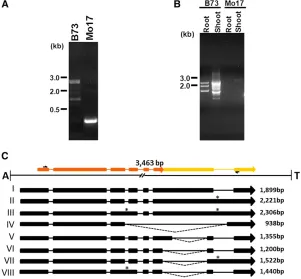
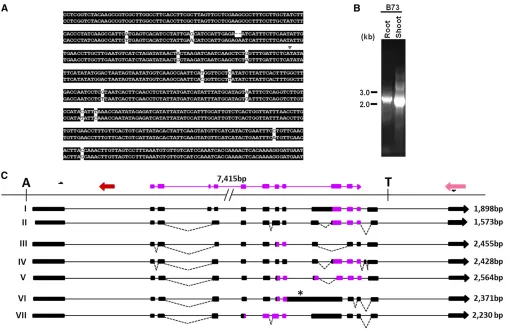
The RT–PCR analysis using primers complementary to exons 1 and 7 of the predicted gene amplified eight PCR products ranging from 700 to 2300 bp from root and shoot RNA from inbred B73 but not from Mo17 (Figure 3B). Fragments were cloned and sequenced. Figure 3C displays the sche-matic representation of the splice alignment of the resulting transcript sequences with Helitron Hel1-331. These tran-scripts are generated by differential selection of splice sites during pre-mRNA processing. For example, transcript I con-forms to the gene structure predicted by EST evidence and contains seven exons ranging from 59 to 888 bp and six introns of 85–322 bp, respectively. Transcript II retains in-tron 6, whereas transcript III retains both inin-trons 3 and 6. Transcript IV is generated by utilization of a donor site of intron 3 and a cryptic acceptor site 95 bp upstream to the acceptor site of intron 6, resulting in omission of exons 4–6. Transcripts V and VI are generated by utilizing a cryptic donor and an acceptor site within exon 6, creating an addi-tional intron of 544 and 699 bp, respectively, within exon 6. Transcript VII is identical to transcript VI except it retains intron 6. Similarly, transcript VIII is identical to transcript VI but retains intron 3. Intriguingly, these alternatively spliced transcripts are differentially expressed in root and shoot tissues (Figure 3B). Inbred B73 roots exhibits three products of 1440, 1899, and 2221 bp, corresponding to transcripts
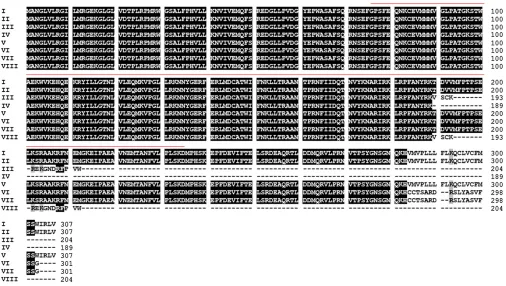
VIII, I, and II, respectively. In contrast, B73 shoots produced six products of 938, 1200, 1355, 1522, 1899, and 2306 bp. These correspond to transcripts IV, VI, V, VII, I, and III, re-spectively. The predicted translation products encode pro-teins ranging from 189 aa to 307 aa residues. The multiple sequence alignment of these putative proteins as shown in Figure 4 indicates that entire conserved domain of the nucleotide/nucleoside kinase superfamily remains intact in transcripts I, II, V, and VI, whereas transcripts III, IV, and VIII lack a minor portion of the amino terminal of the domain.
Hel1-332, a member of a Helitron gene family, is expressed
Comparison of a 1.4-kb consensus sequence derived from the multiple sequence alignments of maize ESTs, gis: 78105127, 71450147, 18174728, 78105126, 8930323, 76909069, and 6021609 with the Hel1-332a element revealed a gene structure containing six exons and five introns (data not presented). This 4174-bp element, Hel1-332a (gi: 209956049; B73), spanning positions 145,554– 149,742 bp, contains portions of three different genes. The positions 170–645 bp contained an ORF of 224 amino acid residues, which is annotated as an uncharacterized maize protein in GenBank (gi: 212275660). Similarly, a spliced alignment of a sorghum hypothetical protein (gi: 242041151) bears sequence similarity to a five-exon– bear-ing gene structure spannbear-ing positions 1071–2751 bp, whereas positions 3779–3960 bp displayed significant similarity to maize hypothetical protein (gi: 195657737) (Figure 5B). Four other members of the Hel1-332 family Figure 3 Genomic and RT–PCR analysis ofHelitron Hel1-331. (A) PCR product amplified from genomic DNA extracted from different maize inbred lines using primers, H31-1F and H31-1R,flanking the 59and 39sequence of the Helitroninsertion, respectively. (B) RT–PCR products amplified from root and shoot tissues of maize inbred lines B73 and Mo17 using primers, H31E1F and H31E7R. (C) Splice alignment of the sequences of the RT–PCR products shown in B with the Helitron Hel1-331 sequence. The exons of a captured hypothetical gene, gi: 212721678, and an uncharacterized gene, are color coded in orange and yellow, respectively. In the alignment, boxes and lines denote exons and introns, respectively. Alternative donor and acceptor splice sites are joined by dashed lines and*
are: Hel1-332b (gi: 166006896; B73) spanning position 132,003–136,174 bp, Hel1-332c (gi: 219689165; B73) spanning position 52,049–56,228 bp, Hel1-332d (gi: 221567066; B73) spanning position 27,404–31,607 bp, and Hel1-332e (gi: 166852593; B73) spanning position 148,980–153,171 bp. EST evidence for expression of other family members was not found.
Alternative splicing produces at least six populations of Hel1-332 captured gene transcripts
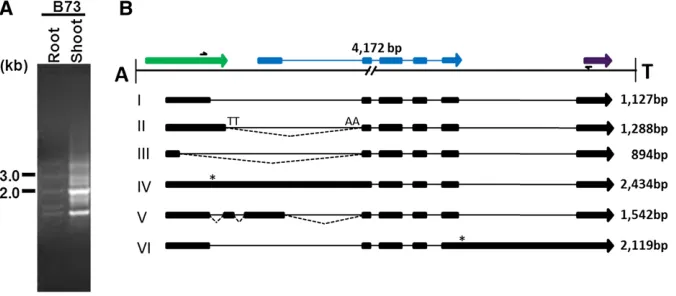
To validate the EST evidence of Hel1-332aexpression, we performed RT–PCR on total RNA from maize inbred B73 root and shoot tissues using primers complementary to exons 1 and 6 of the gene structure predicted by the spliced alignment of the maize ESTs with the Hel1-332a element. The resulting RT–PCR products ranging from 1000 to 3000 bp from both root and shoot tissues were cloned and sequenced (Figure 5A). Of the eight cloned fragments, two lacked similarity to theHel1-332aand were discarded. The alignment of the resultant six sequences withHel1-332a (Figure 5B) indicates their origin by alternative splicing. For example, alignment of transcript I displayed six exons and five introns, which is identical to the gene structure pre-dicted by the EST evidence. Transcript II utilizes an alterna-tive donor and acceptor site inside intron 1 located 171 bp downstream and 10 bp upstream to the donor and acceptor site of intron 1, respectively. This creates a cryptic intron bearing noncanonical donor (TT) in combination with a
non-canonical (AA) acceptor site within intron 1. Transcript III utilizes a cryptic donor site in exon 1, situated 233 bp up-stream to the donor site of intron 1 in combination with the acceptor site of intron 1. The entire sequence of intron 1 is retained in transcript IV. The use of two alternative donor and acceptor sites creates two exons of 71 and 344 bp in length within intron 1 in transcript V. Transcript VI is similar to transcript I except intron 5 is retained.
Molecular and expression analysis of Hel1-333
The alignment of EST clones (gis: 224034606, 149102396, 76284017, 71768008, and 76284017) all derived from a maize full-length cDNA library (Soderlundet al.2009) withHel1-333 and theflanking sequence, revealed a putative gene structure (PGS) consisting of 14 exons and 13 introns (Figure 6C, tran-script I). Furthermore, the perfect alignment of these full-length ESTs within the 59boundary of theHelitronindicated they represent transcription initiation within theHelitron.
Intriguingly, the last exon of this EST is not contained within the Helitron, rather, this portion of the mRNA se-quence was derived from a sese-quence just 39to theHelitron. This mRNA sequence shows perfect alignment with the flanking sequence of the 39boundary of theHelitron inser-tion, creating an intron of 1500 bp in length and exhibiting 93% similarity to a hypothetical protein (gi: 293335527) from maize. To validate the EST evidence, we performed RT–PCR on root and shoot RNA using primers complemen-tary to exons 1 and 14 sequences, respectively. The ampli-fied products (Figure 6B) were excised from the gel, cloned, and sequenced in both directions. The alignment of the resulting sequences with Hel1-333 is shown in Figure 6C. These data indicate seven different transcript isoforms gen-erated by alternative splicing. For example, transcript I aligns identically to the EST predicted gene structure. Tran-script II revealed four regions of alternative splice site usage compared to the EST predicted gene structure. Use of an alternative acceptor splice site in intron 4 and donor site of exon 3, results in the complete skipping of exon 4. Sim-ilarly, usage of an alternative acceptor site inside intron 7 and donor site of exon 6 increases the length of exon 8 by 62 bp. Also, alternative usage of both donor and acceptor sites creates an intron of 316 bp internal to exon 10, and alter-native acceptor site within exon 13 in conjugation with do-nor site of exon 12 decreases the length of exon 13 by 61 bp. Transcript III utilizes a cryptic site downstream to the accep-tor site of intron 2, thus decreasing the length of exon 3 by 5 bp. Also, the usage of a donor site of exon 3 and the acceptor site of exon 5 results in skipping of exon 4, and a cryptic donor site internal to exon 10, in combination with the exon 11 acceptor site decreases the length of exon 10 by 502 bp. Transcript IV is generated by the combination of the splice sites described for transcripts I–III. For example, splicing
from exons 1–7 follows the same pattern as transcript II, except for splicing of intron 2, which is similar to transcript III. Splicing of exons 7–10 follows the same pattern as tran-script III, and splicing of exons 10–15 is similar to transcript I, except usage of alternative donor and acceptor site creates an exon of 50 bp inside intron 12 and an alternative donor and acceptor site creates an intron of 315 bp within exon 10. Splicing of exons 1–7 of transcript V is similar to transcript II except usage of an alternative acceptor site within exon 7 increases the length of intron 6 by 62 bp, and exons 7–14 is similar to transcript I, except for an alternative donor and acceptor site creating an intron of 439 bp internal to exon 10. Similarly, splicing of exons 1–10 of transcript VI follows the same pattern as transcript V, except introns 8 and 9 remain unspliced, and splicing of exons 10–12 is similar to transcript II, except usage of an alternative donor site inside intron 11 increases the length of exon 11 by 8 bp. Splicing of transcript VII follows a similar pattern to transcript II, except a usage of alternative acceptor site inside exon 7 and donor site of exon 6 decreases the length of exon 6 by 18 bp, and the splicing of exon 9 is similar to exon 10 in transcript I. Intriguingly, all these alternatively spliced transcripts con-tained ORFs ranging from 84 to 105 aa residues in length that span the conserved peptidase domain (Figure 6C).
Molecular and expression analysis of Hel 1-334
derived from a full-length cDNA clone and Hel1-334 se-quence is displayed in Figure 7C (transcript I). The RT– PCR analysis using primers complementary to exons 1 and 6 resulted in amplification products of400, 500, 1000, and 1600 bp in length using RNA template from both roots and shoots (Figure 7B). These fragments were excised, cloned, and sequenced. The alignment of the resulting sequences revealed three distinct alternatively spliced transcripts, each generated via alternative usage of the acceptor site of intron 1. For example, transcript I conforms to the gene structure pre-dicted by EST evidence. In contrast, transcripts II and III uti-lized an alternative acceptor site 29 bp downstream and 30 bp upstream to the acceptor site of intron 1, respectively.
Discussion
The abundance ofHelitronsand their phenomenal ability to capture pieces of different genes and express them in chime-ric transcripts strongly suggests that Helitrons are a major driving force in gene evolution. Analysis of the complete
root differed from those in the shoot. Also, it is interesting to note that the vast majority of the alternatively spliced tran-scripts reported here are not represented in the extant maize EST database. In this regard, we note that two maize genes, zmRSp31A and zmRSP31B, encode isoforms of arginine/ serine (SR)-rich proteins via alternative splicing (Gupta et al. 2005b). Similar to maize Helitrons, the majority of these transcript isoforms are not represented in the available maize EST collection (data not presented). Clearly the depth of maize ESTs is not sufficient to account for all the alter-natively spliced events of the maize transcriptome.
While the retention of an unspliced intron in the mature transcripts ofHelitron-captured genes has been reported (Lal et al.2003; Brunneret al.2005), our data indicate that gen-eration of multiple transcript isoforms via alternative splicing are quite widespread in expression ofHelitron-captured genes. The impact of this process on maize genome evolution is de-pendent on the abundance and diversity of transcribed Heli-tron-captured genes. In this regard, we note that at least 9% of maize Helitrons exhibit extant EST evidence of expression (Yang and Bennetzen 2009a). These studies suggest that of the20,000 high-qualityHelitrons,1800 elements are tran-scribed in at least one tissue (Yang and Bennetzen 2009a). Here, we showed that only a small minority of the transcripts arising from Helitron-captured genes is currently present in maize EST databases; hence, it is quite plausible that the vast majority of Helitron-transcribed sequences are alternatively spliced and the EST evidence of their expression may just
represent the tip of the iceberg of their transcript diversity and abundance. Our data suggestHelitronsnot only intertwine coding regions of different genes and transcribe them, but also augment the transcript repertoire by high levels of alternative splicing as well as capture of exon sequences from genes sit-uated outside of theHelitron. Using the likely underestimate of expression from 1800 Helitronsand our estimate of six tran-scripts arising from each Heliton-created gene, we estimate, at minimum, 11,000 transcripts arise from Helitrons. It is highly implausible that these newly created sequences have not played a role in the evolution of maize genes and of maize. We reported earlier thefirst case of incomplete splicing of exons from Helitron-captured genes. The splicing pattern appears to be determined contextually, and intragenic muta-tions acting from a distance to alter splice site selection occur in both plants and vertebrates (McNelliset al.1994; Marillonnet and Wessler 1997; Lalet al.1999). It appears that reshuffling of exons originally residing in different genes changes the rec-ognition of splice sites by spliceosomal machinery. How the new splice sites are recognized also appears to be tissue spe-cific. For example, splice sites created by the insertion of the maize transposable elementDissociation(Ds) are recognized in the developing maize endosperm but not utilized in maize suspension cells (Lal and Hannah 1999).
Simon and Starlinger 1987; Ortiz and Strommer 1990; Wessler 1991; Varagonaet al.1992; Chuet al.1993; Giroux et al. 1994; Ruiz-Vazquez and Silva 1999). For example, insertion of Tgm-Express1, a member of CACTA family of transposable elements, in intron 2 of the glycine max flava-none 3-hydroxylase (F3H) gene triggers alternative splicing of the mutant transcript. The resultant isoforms of the tran-script display a unique combination of exons offive different gene fragments ferried by Tgm-Express1 spliced into F3H transcript (Zabala and Vodkin 2007). Intriguingly, the anal-ysis of the flanking sequence of all the Helitrons reported here indicates their insertion is not inside the transcribed regions of the host gene. In addition, the transcript appears to be initiated inside the element sequence.
The location of promoters driving transcription of cap-tured genes inside the element has been proposed (Brunner et al.2005; Morgante et al.2005). For example, transcrip-tion of a maize cytochrome P450 monooxygenase captured by aHelitronseems to occur inside of the element (Jameson et al. 2008). In this regard, Helitrons are similar to pack-MULEs, where the initiation of transcription within the ele-ment is well docuele-mented (Jianget al.2004). In contrast, the promoter of theSh2gene drives the expression of the maize mutantsh2-7527transcript containing the exons of different genes (Lalet al.2003).
The perfect alignment of multiple ESTs derived from the full-length cDNA project within the element indicates that transcription is initiated inside theHelitronin all four cases reported here. The capture and splicing of a flanking exon located outside of the element with the transcript of cap-tured genes initiated within theHelitronis intriguing, and to the best of our knowledge, has not been demonstrated with any other transposable element. This observation suggests that maize Helitrons, in addition to intertwining coding regions of different genes, dramatically increase their tran-script diversity by alternative splicing as well as capture and splicing offlanking exon sequences. The abundance of Heli-trons in genic-rich regions of the genome suggests they are frequently flanked by exonic sequences that could poten-tially be spliced into the Helitron-transcribed sequences, thus, adding another dimension to further augment the di-versity of transcripts created by these elements.
Acknowledgments
This work was supported in part by National Science Foundation grant awards, 0514759, 0815104, and 1126267, US Department of Agriculture/National Institute of Food and Agriculture grant, 2011-67003-30215 and by a research excellence award, Oakland University.
Literature Cited
Bennetzen, J. L., 2005 Transposable elements, gene creation and genome rearrangement inflowering plants. Curr. Opin. Genet. Dev. 15: 621–627.
Brunner, S., G. Pea, and A. Rafalski, 2005 Origins, genetic orga-nization and transcription of a family of non-autonomous heli-tronelements in maize. Plant J. 43: 799–810.
Chu, J. L., J. Drappa, A. Parnassa, and K. B. Elkon, 1993 The defect in Fas mRNA expression in MRL/lpr mice is associated with insertion of the retrotransposon, ETn. J. Exp. Med. 178: 723–730.
Dooner, H. K., and L. He, 2008 Maize genome structure variation: interplay between retrotransposon polymorphisms and genic recombination. Plant Cell 20: 249–258.
Dooner, H. K., L. C. Hannah, and S. K. Lal, 2007 Suggested guide-lines for naming Helitronsin maize. Maize Genet. Coop. News Lett. 81: 24–25.
Du, C., J. Caronna, L. He, and H. K. Dooner, 2008 Computational prediction and molecular confirmation ofHelitrontransposons in the maize genome. BMC Genomics 9: 51.
Du, C., N. Fefelova, J. Caronna, L. He, and H. K. Dooner, 2009 The polychromatic Helitronlandscape of the maize genome. Proc. Natl. Acad. Sci. USA 106: 19916–19921.
Feschotte, C., and E. J. Pritham, 2009 A cornucopia ofHelitrons shapes the maize genome. Proc. Natl. Acad. Sci. USA 106: 19747–19748.
Feschotte, C., and S. R. Wessler, 2001 Treasures in the attic: roll-ing circle transposons discovered in eukaryotic genomes. Proc. Natl. Acad. Sci. USA 98: 8923–8924.
Gallavotti, A., Q. Zhao, J. Kyozuka, R. B. Meeley, M. K. Ritteret al., 2004 The role of barren stalk1 in the architecture of maize. Nature 432: 630–635.
Giroux, M. J., M. Clancy, J. Baier, L. Ingham, D. McCarty et al., 1994 De novo synthesis of an intron by the maize transposable element Dissociation. Proc. Natl. Acad. Sci. USA 91: 12150– 12154.
Gupta, S., A. Gallavotti, G. A. Stryker, R. J. Schmidt, and S. K. Lal, 2005a A novel class ofHelitron-related transposable elements in maize contain portions of multiple pseudogenes. Plant Mol. Biol. 57: 115–127.
Gupta, S., B. B. Wang, G. A. Stryker, M. E. Zanetti, and S. K. Lal, 2005b Two novel arginine/serine (SR) proteins in maize are differentially spliced and utilize non-canonical splice sites. Bio-chim. Biophys. Acta 1728: 105–114.
Jameson, N., S. Georgelis, E. Fouladbash, S. Martens, L. C. Hannah et al., 2008 Helitron mediated amplification of cytochrome P450 monooxygenase gene in maize. Plant Mol. Biol. 67: 295–304.
Jiang, N., Z. Bao, X. Zhang, S. R. Eddy, and S. R. Wessler, 2004 Pack-MULE transposable elements mediate gene evolu-tion in plants. Nature 431: 569–573.
Kapitonov, V. V., and J. Jurka, 2001 Rolling-circle transposons in eukaryotes. Proc. Natl. Acad. Sci. USA 98: 8714–8719. Lai, J., Y. Li, J. Messing, and H. K. Dooner, 2005 Gene movement
byHelitrontransposons contributes to the haplotype variability of maize. Proc. Natl. Acad. Sci. USA 102: 9068–9073.
Lal, S., J. H. Choi, and L. C. Hannah, 1999 The AG dinucleotide terminating introns is important but not always required for pre-mRNA splicing in the maize endosperm. Plant Physiol. 120: 65–72. Lal, S. K., M. J. Giroux, V. Brendel, C. E. Vallejos, and L. C. Hannah, 2003 The maize genome contains a helitroninsertion. Plant Cell 15: 381–391.Lal, S. K., and L. C. Hannah, 1999 Maize transposable elementDs is differentially spliced from primary transcripts in endosperm and suspension cells. Biochem. Bio-phys. Res. Commun. 261: 798–801.
Lal, S. K., and L. C. Hannah, 2005a Helitrons contribute to the lack of gene colinearity observed in modern maize inbreds. Proc. Natl. Acad. Sci. USA 102: 9993–9994.
Lal, S. K., N. Georgelis, and L. C. Hannah, 2008 Helitrons: their impact on maize genome evolution and diversity. The Maize Handbook: Domestication, Genetics, and Genome, edited by J. Bennetzen and S. Hake. Springer-Verlag, New York
Lal, S. K., M. Oetjens, and L. C. Hannah, 2009 Helitrons: Enig-matic abductors and mobilizers of host genome sequences. Plant Sci. 176: 181–186.
Li, Y., and H. K. Dooner, 2009 Excision ofHelitrontransposons in maize. Genetics 182: 399–402.
Marillonnet, S., and S. R. Wessler, 1997 Retrotransposon inser-tion into the maize waxy gene results in tissue-specific RNA processing. Plant Cell 9: 967–978.
McNellis, T. W., A. G. von Arnim, T. Araki, Y. Komeda, S. Misera et al., 1994 Genetic and molecular analysis of an allelic series of cop1 mutants suggests functional roles for the multiple pro-tein domains. Plant Cell 6: 487–500.
Morgante, M., S. Brunner, G. Pea, K. Fengler, A. Zuccolo et al., 2005 Gene duplication and exon shuffling by helitron-like transposons generate intraspecies diversity in maize. Nat. Genet. 37: 997–1002.
Ortiz, D. F., and J. N. Strommer, 1990 The Mu1 maize transpos-able element induces tissue-specific aberrant splicing and poly-adenylation in two Adh1 mutants. Mol. Cell. Biol. 10: 2090– 2095.
Ruiz-Vazquez, P., and F. J. Silva, 1999 Aberrant splicing of the Drosophila melanogaster phenylalanine hydroxylase pre-mRNA caused by the insertion of a B104/roo transposable element in the Henna locus. Insect Biochem. Mol. Biol. 29: 311–318.
Schnable, P. S., D. Ware, R. S. Fulton, J. C. Stein, F. Weiet al., 2009 The B73 maize genome: complexity, diversity, and dy-namics. Science 326: 1112–1115.
Simon, R., and P. Starlinger, 1987 Transposable elementDs2of Zea mays influences polyadenylation and splice site selection. Mol. Gen. Genet. 209: 198–199.
Soderlund, C., A. Descour, D. Kudrna, M. Bomhoff, L. Boydet al., 2009 Sequencing, mapping, and analysis of 27,455 maize full-length cDNAs. PLoS Genet. 5: e1000740.
Song, R., and J. Messing, 2003 Gene expression of a family in maize based on noncollinear haplotypes. Proc. Natl. Acad. Sci. USA 100: 9055–9060.
Usuka, J., and V. Brendel, 2000 Gene structure prediction by spliced alignment of genomic DNA with protein sequences: increased accuracy by differential splice site scoring. J. Mol. Biol. 297: 1075–1085.
Usuka, J., W. Zhu, and V. Brendel, 2000 Optimal spliced align-ment of homologous cDNA to a genomic DNA template. Bioin-formatics 16: 203–211.
Varagona, M. J., M. Purugganan, and S. R. Wessler, 1992 Alternative splicing induced by insertion of retrotransposons into the maize waxy gene. Plant Cell 4: 811–820.
Wang, Q., and H. K. Dooner, 2006 Remarkable variation in maize genome structure inferred from haplotype diversity at the bz locus. Proc. Natl. Acad. Sci. USA 103: 17644–17649.
Wessler, S. R., 1991 The maize transposableDs1element is al-ternatively spliced from exon sequences. Mol. Cell. Biol. 11: 6192–6196.
Wessler, S. R., G. Baran, and M. Varagona, 1987 The maize trans-posable elementDsis spliced from RNA. Science 237: 916–918. Xu, J. H., and J. Messing, 2006 Maize haplotype with ahelitron
-amplified cytidine deaminase gene copy. BMC Genet. 7: 52. Yang, L., and J. L. Bennetzen, 2009a Distribution, diversity,
evo-lution, and survival ofHelitronsin the maize genome. Proc. Natl. Acad. Sci. USA 106: 19922–19927.
Yang, L., and J. L. Bennetzen, 2009b Structure-based discovery and description of plant and animalHelitrons. Proc. Natl. Acad. Sci.USA 106: 12832–12837.
Zabala, G., and L. Vodkin, 2007 Novel exon combinations gener-ated by alternative splicing of gene fragments mobilized by a CACTA transposon in Glycine max. BMC Plant Biol. 7: 38.