ISSN(Online): 2320-9801
ISSN (Print): 2320-9798
I
nternational
J
ournal of
I
nnovative
R
esearch in
C
omputer
and
C
ommunication
E
ngineering
(An ISO 3297: 2007 Certified Organization)
Vol. 3, Issue 7, July 2015
Effect of Truncation Matrix on Compression
Ratio in Block Truncation Coding Technique
Rimjim and Mauli Joshi
Dept of Computer Science, Maharishi Ved Vyas Engineering College, Jagadhri, Haryana, India
ABSTRACT: Biomedical images are important factor in health care for diagnosis of disease. As medical imaging facilities are moving towards film less imaging technology, digital image processing techniques plays an important role. Image compression technique is an important multimedia application to effectively store and transmit data at lower bandwidth. BTC based algorithm is designed to compress the biomedical x-ray image. A new application of block truncation coding (BTC) is presented to compress gray scale X-ray images with square and rectangular non-overlapping truncation matrix. The compressed image characteristics parameters such as signal to noise ratio (SNR), peak signal to noise ratio (PSNR), root mean square error (RMSE), and mean absolute error (MAE) with respect to original images are computed. Experimental results are presented which demonstrate that at lower value of truncation matrix, the compression rate is low with image characteristic parameters close to the original image values. As the size of truncation matrix is increased, higher compression of the x-ray image is obtained. Comparative analysis between square truncation matrix and rectangular matrix is also carried out.
KEYWORDS: BTC; Compression; Truncation; Image characteristics.
I. INTRODUCTION
Bio medical imaging is the technique and process of creating visual representations of the interior of a body for clinical analysis and medical intervention. Bio medical imaging seeks to reveal internal structures hidden by the skin and bones, as well as to diagnose and treat disease. Bio medical imaging also establishes a database of normal anatomy and physiology to make it possible to identify abnormalities. Although imaging of removed organs and tissues can be performed for medical reasons, such procedures are usually considered part of pathology instead of bio medical imaging. It includes the analysis, enhancement and display of images captured via x-ray, ultrasound, MRI, nuclear medicine and optical imaging technologies [1].
With the continuing growth of modern communication technology, demand for image transmission and storage is increasing rapidly. Advanced in computer technology for mass storage and digital processing have paved the way for implementing advanced data compression techniques to improve the efficiency of transmission and storage of images. Applications of data compression are primarily in transmission and storage of information [2]. Typically, a compressed image when decoded to reconstruct its original form will be accompanied by some distortion. The efficiency of a compression algorithm is measured by its data compression ability, the resulting distortion and as well by its implementation complexity. The complexity of data compression algorithms is a particularly important consideration in their hardware implementation image transmission application are in broadcast television, remote sensing via satellite, aircraft, radar, sonar, teleconferencing, computer communication, facsimile Transmission...etc. image storage is required most commonly for education, and business document, medical image used in-patient monitoring system....etc. because of their wide application, data compression and coding schemes have been of great importance in digital image processing application of data compression is also possible in the development of fast algorithms where the number of operation required to implement an algorithm is reduced by working with the compressed data [3-5].
ISSN(Online): 2320-9801
ISSN (Print): 2320-9798
I
nternational
J
ournal of
I
nnovative
R
esearch in
C
omputer
and
C
ommunication
E
ngineering
(An ISO 3297: 2007 Certified Organization)
Vol. 3, Issue 7, July 2015
Block Truncation Coding is a lossy image compression techniques .It is a simple technique which involves less computational complexity. BTC is a recent technique used for compression of monochrome image data. It is one-bit adaptive moment-preserving quantizer that preserves certain statistical moments of small blocks of the input image in the quantized output. The original algorithm of BTC preserves the standard mean and the standard deviation [6-9]. The statistical overheads Mean and the Standard deviation are to be coded as part of the block. The truncated block of the BTC is the one-bit output of the quantizer for every pixel in the block .Block Truncation Coding is a well-known compression scheme proposed in 1979 for the grayscale images. It was also called the moment-preserving block truncation because it preserves the first and second moments of each image block. Various parameters that can be used for measure the quality of images are: SNR, PSNR, RMSE and MAE [10-11].
II. METHODOLOGY
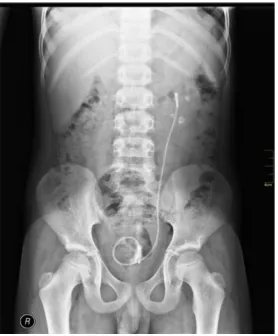
In order to proceed with the research work image processing toolbox is used. The work is divided into two major parts. The main goal of image compression is to reduce redundancy in the image as much as possible. Block Truncation Coding (BTC) is one of the simple and easy to implement image compression algorithms. The basic steps of BTC algorithm is shown in Fig. 2. The first section of the research work is divided into two sub divisions with square and rectangular truncation matrix. The size of truncation matrices ranging from 8 bit to 256 bit with step size of 8 bits. Similarly, in case of rectangular truncation matrices of size n 8 n. Figure 3 shows the image used in research work.
ISSN(Online): 2320-9801
ISSN (Print): 2320-9798
I
nternational
J
ournal of
I
nnovative
R
esearch in
C
omputer
and
C
ommunication
E
ngineering
(An ISO 3297: 2007 Certified Organization)
Vol. 3, Issue 7, July 2015
III.RESULTS
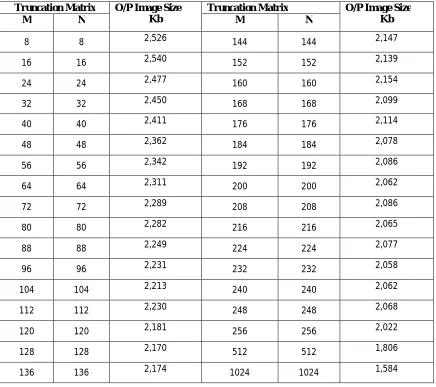
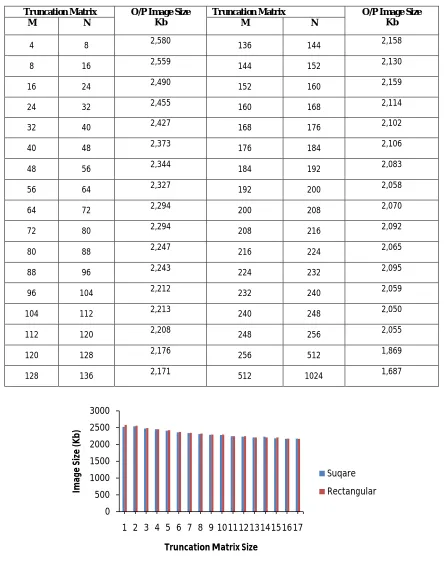
BTC based x-ray image compression is carried out to estimate the compression ratio and image quality parameters. The research work is divided into two parts. In the first part square truncation matrix are used ranging from 8bit to 1024 bits. In the second part, rectangular truncation matrices having size n 8 n and range of 4bit to 512 bit are taken. The capability of BTC based compression depends upon the complete coverage of image by truncation matrix. Various iteration of truncation matrix such as 8x8, 16x16, 24x24…..., and 1024x1024 are taken and compressed output images are obtained. Table 1 and Table 2 shows the size of compressed image size with respect to truncation matrix size. Compression of x-ray image using square and rectangular truncation matrix in BTC algorithm provides low size image with good quality information. The graphical representation of size of compressed image with increasing order of truncation matrices are shown in Fig. 4. It can be observed that as the size of matrix is increased size of the compressed image decreases. The compression of image provided by rectangular truncation matrix is lower than square matrix.
Table 1 Size of compressed image w.r.t square truncation matrix in BTC.
Truncation Matrix O/P Image Size Kb
Truncation Matrix O/P Image Size Kb
M N M N
8 8 2,526 144 144 2,147
16 16 2,540 152 152 2,139
24 24 2,477 160 160 2,154
32 32 2,450 168 168 2,099
40 40 2,411 176 176 2,114
48 48 2,362 184 184 2,078
56 56 2,342 192 192 2,086
64 64 2,311 200 200 2,062
72 72 2,289 208 208 2,086
80 80 2,282 216 216 2,065
88 88 2,249 224 224 2,077
96 96 2,231 232 232 2,058
104 104 2,213 240 240 2,062
112 112 2,230 248 248 2,068
120 120 2,181 256 256 2,022
128 128 2,170 512 512 1,806
ISSN(Online): 2320-9801
ISSN (Print): 2320-9798
I
nternational
J
ournal of
I
nnovative
R
esearch in
C
omputer
and
C
ommunication
E
ngineering
(An ISO 3297: 2007 Certified Organization)
Vol. 3, Issue 7, July 2015
Table 1 Size of compressed image w.r.t rectangular truncation matrix in BTC.
Truncation Matrix O/P Image Size
Kb
Truncation Matrix O/P Image Size
Kb
M N M N
4 8 2,580 136 144 2,158
8 16 2,559 144 152 2,130
16 24 2,490 152 160 2,159
24 32 2,455 160 168 2,114
32 40 2,427 168 176 2,102
40 48 2,373 176 184 2,106
48 56 2,344 184 192 2,083
56 64 2,327 192 200 2,058
64 72 2,294 200 208 2,070
72 80 2,294 208 216 2,092
80 88 2,247 216 224 2,065
88 96 2,243 224 232 2,095
96 104 2,212 232 240 2,059
104 112 2,213 240 248 2,050
112 120 2,208 248 256 2,055
120 128 2,176 256 512 1,869
128 136 2,171 512 1024 1,687
0 500 1000 1500 2000 2500 3000
1 2 3 4 5 6 7 8 9 1011121314151617
Im
ag
e
Si
ze
(
Kb
)
Suqare
ISSN(Online): 2320-9801
ISSN (Print): 2320-9798
I
nternational
J
ournal of
I
nnovative
R
esearch in
C
omputer
and
C
ommunication
E
ngineering
(An ISO 3297: 2007 Certified Organization)
Vol. 3, Issue 7, July 2015
IV.CONCLUSION AND FUTURE WORK
Block Truncation Coding (BTC) is an apparently elegant and efficient time-domain compression technique. BTC is attractive in many applications that require low complexity and moderate data rates. It was observed from the results that the compression of image using rectangular truncation matrix is lower as compared to square truncation matrix. With lower truncation matrix i.e. 8x8 and 4x8 the size of compressed images are 2,526 Kb and 2,580 Kb respectively. Similarly for higher value of truncation matrix 1024 x 1024 and 512 x 1024 the size of compressed images are 1,584 Kb and 1,687 Kb respectively.
REFERENCES
1. C.A. Roobottom, G. Mitchell, and G. Morgan-Hughes, “Radiation-reduction strategies in cardiac computed tomographic angiography,” Clinical radiology, Vol. 65, pp. 859-867, 2010.
2. D. Sachin, “A Review of Image Compression and Comparison of its Algorithms,” International Journal on Electronics & Communication Technology (IJECT), Vol. 2, pp. 22-26, 2011.
3. S. G. Amruta and L. N. Sanjay, “A Review on Lossy to Lossless Image Coding,” International Journal of Computer Applications (IJCA), Vol. 67, pp. 9-16, 2013.
4. S. Sridevi, V. R. Vijayakuymar, and R. Anuja, “A Survey on Various Compression Methods for Medical Images,” International Journal of Intelligent Systems and Applications, Vol. 3, pp. 13-19, 2012.
5. M. Das and S. Burgett, “Lossless Compression of Medical Images Using Two Dimensional Multiplicative Autoregressive Models,” IEEE Transactions on Medical Imaging, Vol. 12, pp. 721-726, 1993.
6. M. Das and C. Lin, “Lossless Compression of Medical Images Using Hierarchical Autoregressive Models,” 9th IEEE Symposium on Computer-Based Medical Systems, pp. 6-11, 1996.
7. E. J. Delp and O. R. Mitchell, “Image coding using block truncation coding,” IEEE Transaction Communication, Vol. 27, pp. 1335–1342, 1979.
8. M. D. Lema and O. R. Mitchell, “Absolute Moment Block Truncation Coding and its Application to Color Image”, IEEE Transaction Communication, Vol. COM-32, pp. 1148-1157, 1984.
9. M. Eskicioglu and P.S. Fisher, “Image quality measures and their performance,” IEEE Transaction Communication, Vol. 34, pp. 2959-2965, 1995.
10. N. Yamsang and S. Udomhunsakul, “Image Quality Scale (IQS) for compressed images quality measurement”, in Proc. International Multiconference of Engineers and Computer Scientists, Vol. 1, pp. 789- 794, 2009.