Island 2 Mutant as a Candidate Live Attenuated Oral Vaccine
Junlei Yin, Zhao Cheng, Xiaochun Wang, Lijuan Xu, Qiuchun Li, Shizhong Geng, Xinan Jiao
Jiangsu Key Laboratory of Zoonosis, Jiangsu Co-innovation Center for Prevention and Control of Important Animal Infectious Diseases and Zoonoses, Yangzhou University, Yangzhou, Jiangsu, People’s Republic of China
Salmonella enterica
serovar Pullorum (S. Pullorum) is a highly adapted pathogen that causes pullorum disease (PD), an
impor-tant systemic disease of poultry that causes severe economic losses in developing countries. In the interests of developing a safe
and immunogenic oral vaccine, the efficacy of a
Salmonella
pathogenicity island 2 (SPI2)-deleted mutant of
S. Pullorum
(S06004
⌬
SPI2) was evaluated in chickens. S06004
⌬
SPI2 was severely less virulent than the parental wild-type strain S06004 as
determined by the 50% lethal dose (LD
50) for 3-day-old chickens when injected intramuscularly. Two-day-old chickens
immu-nized with a single oral dose of S06004
⌬
SPI2 showed no differences in body weight or clinical symptoms compared with those in
the negative-control group. S06004
⌬
SPI2 bacteria were not isolated from livers or spleens of immunized chickens after a short
period of time, and specific humoral and cellular immune responses were significantly induced. Immunized chickens were
chal-lenged with
S. Pullorum strain S06004 and
Salmonella
enterica serovar Gallinarum (S. Gallinarum) strain SG9 at 10 days
postim-munization (dpi), and efficient protection against the challenges was observed. None of the immunized chickens died, the
clini-cal symptoms were slight and temporary following challenge in immunized chickens compared with those in the control group,
and these chickens recovered by 3 to 5 dpi. Overall, these results demonstrate that S06004
⌬
SPI2 can be used as a live attenuated
oral vaccine.
S
almonella enterica
serovar Pullorum (
S
. Pullorum) is a highly
adapted pathogen that causes pullorum disease (PD) in
poul-try. PD is an acute systemic disease with high morbidity and
mor-tality in young chicks, and causes weight loss, decreased fertility
and hatchability, lesions (peritonitis, perihepatitis, and so on),
diarrhea, and reproductive tract abnormalities in infected adults.
In addition,
S
. Pullorum can be transmitted to chicks through eggs
(
1
,
2
). PD is rare in most developed countries because of modern
poultry-rearing facilities and well-established disease control
pro-grams, but in recent years, its incidence has been frequently
re-ported in developing countries (
3
).
Salmonella enterica
serovar
Gallinarum (
S
. Gallinarum) causes the severe systemic disease
fowl typhoid (FT) in young and adult chickens, and multilocus
enzyme electrophoresis and comparative sequence analyses show
it is closely related to
S
. Pullorum (
4–6
). Although largely
eradi-cated in several countries, FT still causes significant morbidity and
mortality worldwide, which results in substantial economic losses
(
7
).
Several strategies have been used to prevent and control these
diseases, such as antimicrobial therapy, biosecurity practices, and
effective vaccination programs. Antimicrobial therapy can result
in multidrug-resistant bacteria in poultry. In addition, these
mul-tidrug-resistant pathogens can be transmitted to humans via the
food chain (
8
,
9
). Vaccination is one of the most effective methods
of preventing
Salmonella
infections (
10
). Killed vaccines are the
most commonly used commercially available vaccines, as only a
few
Salmonella
live vaccines are registered. These live vaccines
offer more effective protection than killed vaccines because they
can induce more comprehensive cellular immune responses (
10
).
Salmonella
pathogenicity island 2 (SPI2) can encode type III
secretion system 2 (T3SS2) and is a major virulence determinant
of
Salmonella
species. T3SS2 is very important for the ability of
Salmonella
to survive and replicate inside host cells and plays an
important role in systemic disease development (
11
). There are
many papers describing the function of SPI2 and the vaccine
po-tential of live SPI2 mutant strains for preventing
Salmonella
infec-tions (
12
,
13
), but there is no report on the vaccine potential of an
SPI2 mutant strain of
S
. Pullorum.
In this study, we preliminarily evaluated the feasibility of an
SPI2-deleted
S
. Pullorum mutant strain (S06004
⌬
SPI2) for use as
a live attenuated oral vaccine based on the virulence, changes in
body weight and clinical symptoms, bacterial persistence,
im-mune responses, and protective effects in susceptible HY-Line
white chickens.
MATERIALS AND METHODS
Bacterial strains and growth conditions.S. Pullorum S06004 (GenBank accession no.CP006575.1) is a virulent nalidixic acid-resistant (Nalr) clin-ical isolate obtained in 2006 from chickens with pullorum disease in the Jiangsu Province of China and stored in our laboratory (8). The virulentS. Gallinarum SG9 (Nalr) strain was supplied by P. A. Barrow (14). S06004⌬SPI2 (Nalr), the whole SPI2-deleted (⬃40 kb) mutant ofS. Pul-lorum S06004, was constructed using the one-step inactivation method described by Datsenko and Wanner and stored in our laboratory (15,16). Luria-Bertani (LB) broth, LB agar medium (containing 1.5% [wt/vol]
Received10 March 2015Returned for modification31 March 2015
Accepted21 April 2015
Accepted manuscript posted online29 April 2015
CitationYin J, Cheng Z, Wang X, Xu L, Li Q, Geng S, Jiao X. 2015. Evaluation of the Salmonella entericaserovar Pullorum pathogenicity island 2 mutant as a candidate live attenuated oral vaccine. Clin Vaccine Immunol 22:706 –710.
doi:10.1128/CVI.00130-15.
Editor:D. W. Pascual
Address correspondence to Xinan Jiao, [email protected].
Copyright © 2015, American Society for Microbiology. All Rights Reserved.
doi:10.1128/CVI.00130-15
on August 17, 2020 by guest
http://cvi.asm.org/
agar), and XLT4 agar (Difco) were used for culturing bacteria at 37°C. When needed, nalidixic acid was added to the medium at a final concen-tration of 40g/ml.
Chickens.HY-Line white chicken eggs were hatched, and neither clin-ical symptoms of enteric disease norSalmonellawas detected in the chick-ens. All chickens were maintained in wire cages and reared with commer-cial feed and drinking water. Experiments were undertaken with the permission of the Animal Care and Ethics Committee of Yangzhou Uni-versity.
Virulence assessment. To investigate the virulence of mutant S06004⌬SPI2 in 3-day-old chickens, 60 chickens were randomly assigned into six groups (n⫽10). Each group was inoculated intramuscularly with 10-fold dilutions of the mutant strain, from 1⫻1010to 1⫻105CFU, in 100l of phosphate-buffered saline (PBS). Another 60 chickens were injected with the same doses of the parental strain S06004. Ten control chickens received 200l of PBS via the same route. Chickens that died or were killed humanely were recorded over the 3-week experimental period. The 50% lethal dose (LD50) was calculated using the Karber and Behrens method (17).
Changes in body weight and clinical symptoms.Sixty 2-day-old chickens were randomly divided into 3 groups of 20. The infected group received 2⫻108CFU of S06004 in 100l of PBS orally, the vaccinated group received an equal dose of S06004⌬SPI2 (2⫻108CFU), and the PBS group received 100l of PBS as a negative control. The body weights of these chickens were recorded at 5, 12, and 19 days postinoculation (dpi), and clinical symptoms were observed daily from 1 to 19 dpi.
Colonization and persistence assay.To evaluate bacterial persistence in the internal organs of chickens following oral immunization, four chickens from each group (infected group, vaccinated group, and PBS group) were euthanized at 5, 7, 10, 14, and 21 dpi, and liver and spleen samples were aseptically collected. Samples were weighed, suspended in 1 ml of PBS, and homogenized individually. One hundred microliters of serial 10-fold dilutions of the homogenates was plated onto XLT4 agar containing 40g/ml nalidixic acid and then incubated at 37°C for 20 h. Bacteria were counted and expressed as log10CFU/g. Negative samples were indicated as 0 CFU/g.
Enzyme-linked immunosorbent assay (ELISA) for serum IgG. Se-rum samples were collected from four chickens of each group at 3, 7, 14, and 21 dpi. Specific antibody levels were assessed by ELISA, using heat-killed wholeS. Pullorum bacteria as the coating antigen, as previously described (18). Briefly, 96-well plates were coated with 50l of antigen (1⫻108CFU/ml) in PBS overnight at 4°C. Plates were washed three times with PBS containing 0.02% Tween 20 and blocked for 2 h with 100l of 10% fetal calf serum in PBS at 37°C. To determine specific serum IgG, serum samples (diluted 1:50) were used as the primary antibody. Horse-radish peroxidase (HRP)-conjugated rabbit anti-chicken IgG (diluted 1:10,000) was used as the secondary antibody. The bound HRP activity was determined usingo-phenylenediamine dihydrochloride (Sigma), and the absorbance was measured at 492 nm using an ELISA reader after the reactions were stopped by the addition of 2 M H2SO4.
Lymphocyte proliferation assay.Peripheral lymphocytes were sepa-rated from the blood of four chickens per group using Histopaque-1077 (Sigma) at 7, 14, and 21 dpi. Cell viability was determined using trypan blue dye exclusion. The lymphocyte proliferation assay was performed with specific antigens prepared from the wild-typeS. Pullorum S06004 strain as described previously (19,20). Briefly, a viable mononuclear cell
suspension (100l) at 1⫻105cells/ml in RPMI 1640 medium (contain-ing 10% fetal calf serum, 2 mML-glutamine, 50 U/ml of penicillin, and 50 g/ml of streptomycin) was incubated in triplicate in 96-well tissue cul-ture plates with 50l of medium alone or with medium containing 4 g/ml of soluble antigen at 41°C in a humidified 5% CO2atmosphere for 72 h. Lymphocyte proliferation activity was measured using ATP biolu-minescence with a ViaLight Plus kit (Lonza, Rockland, ME, USA). The blastogenic response for the assay was expressed as the mean stimulation index (SI), as previously described (19).
Protection assessment.To examine the protective efficacy of mutant S06004⌬SPI2, 50 two-day-old chickens were randomly divided into 5 groups of 10 chickens (groups A to E). Groups A and C were immunized orally with 2⫻108CFU of S06004⌬SPI2 in 100l of PBS, while groups B, D, and E received 100l of PBS. After 10 days, groups A and B were challenged intramuscularly with 1⫻109CFU of strain S06004 in 100l of PBS. Groups C and D received equal amounts of SG9. Group E received 100l PBS as a negative control. The surviving chickens were counted at 21 days postchallenge, and clinical symptoms (including anorexia, diar-rhea, depression, high morbidity, and mortality) were recorded daily from 1 to 35 dpi.
Statistical analysis.All data are expressed as mean⫾standard error of the mean (SEM) unless otherwise specified. All statistical analyses were performed using GraphPad Prism.Pvalues of⬍0.05 were considered significant when using one-way analysis of variance.
RESULTS
Virulence of
S. Pullorum mutant S06004
⌬
SPI2.
The virulence of
parental and mutant strains was evaluated in 3-day-old HY-Line
white chickens. The LD
50of the
S
. Pullorum mutant S06004
⌬
SPI2
(2.08
⫻
10
9CFU) was 208-fold higher than that of the wild-type
parental strain S06004 (1.00
⫻
10
7CFU), indicating that the
vir-ulence of the
S
. Pullorum mutant S06004
⌬
SPI2 was attenuated.
Changes in body weight and clinical symptoms following
im-munization.
The mean body weights of chickens in the three
treatment groups (infected group, vaccinated group, and PBS
group) at 5, 12, and 19 dpi are shown in
Table 1
. No statistically
significant differences were observed between the three groups,
although the body weights in the vaccinated group and PBS group
were slightly higher than those in the infected group. Clinical signs
of disease, including slight and temporary lethargy, anorexia, and
diarrhea, were observed in chickens from the infected group, but
these clinical symptoms were absent in chickens of the vaccinated
and PBS groups.
Bacterial colonization and persistence in internal organs.
All
liver and spleen samples from the negative-control group (PBS
group) were negative for bacterial recovery. As shown in
Fig. 1
, the
viable counts in organs from chickens inoculated with the
wild-type parent strain S06004 (infected group) were higher than those
from chickens inoculated with the
S
. Pullorum mutant
S06004
⌬
SPI2 (vaccinated group). Of the four examined livers of
the vaccinated group, one and two samples were negative at 7 and
10 dpi, respectively, and no colonies were recovered at 14 dpi. In
contrast, three and two liver samples were positive in the infected
TABLE 1Mean body weights of chickens following immunization
Group
Immunization Mean body wt (g) per chicken at:
Strain or control Route Dose (CFU) 5 dpi 12 dpi 19 dpi
Infected S06004 Oral 2⫻108 62.79⫾0.36 110.22⫾0.51 181.35⫾0.55
Vaccinated S06004⌬SPI2 Oral 2⫻108 66.43⫾0.29 114.55⫾0.49 186.05⫾0.12
PBS PBS 66.80⫾0.11 115.12⫾0.23 185.17⫾0.26
on August 17, 2020 by guest
http://cvi.asm.org/
group at 14 and 21 dpi, respectively. From the four examined
spleens of the vaccinated group, one and two samples were
nega-tive at 10 and 14 dpi, respecnega-tively, and no colonies were recovered
from any animal at 21 dpi. However, all four spleen samples from
the infected group were positive at 21 dpi.
Determination of serum IgG by ELISA.
To evaluate the
hu-moral immune response following immunization, serum IgG
lev-els were examined using indirect ELISA. Chickens inoculated with
the wild-type parent strain S06004 (infected group) and the
S
.
Pullorum mutant S06004
⌬
SPI2 (vaccinated group) showed
sig-nificantly elevated levels of serum IgG at 3, 7, 14, and 21 dpi (
Fig.
2
). The considerably elevated serum IgG levels of the infected and
vaccinated groups were continuously observed through 21 dpi.
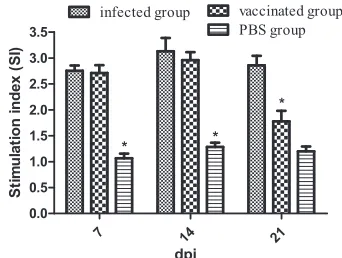
Lymphocyte proliferation assay.
To evaluate cellular immune
responses following immunization, a peripheral lymphocyte
pro-liferation assay was performed using soluble antigen. As shown in
Fig. 3
, the SI values of chickens inoculated with mutant
S06004
⌬
SPI2 (vaccinated group) were 2.711
⫾
0.152, 2.959
⫾
0.156, and 1.778
⫾
0.203 at 7, 14, and 21 dpi, respectively, and the
values of chickens inoculated with strain S06004 (infected group)
were 2.755
⫾
0.102, 3.131
⫾
0.257, and 2.861
⫾
0.184 at the same
respective dpi. The SI values of the infected and vaccinated groups
were significantly increased at 7, 14, and 21 dpi, and the SI value of
the infected group was also significantly higher than that of the
vaccinated group at 21 dpi. Sequential monitoring of lymphocyte
responses revealed considerably elevated SI values in the infected
and vaccinated groups; significantly elevated SI values in the
in-fected and vaccinated groups were observed at 14 dpi but were
reduced at 21 dpi.
Evaluation of immune protection.
The percentage of survival
in chickens orally vaccinated with the
S
. Pullorum mutant
S06004
⌬
SPI2, followed by intramuscular challenge with the
par-ent
S
. Pullorum strain S06004 or
S
. Gallinarum strain SG9, at 10
dpi is shown in
Table 2
. None of the immunized chickens died,
whereas four chickens died in control group B following challenge
with S06004, and seven chickens died in control group D
follow-ing challenge with SG9. The clinical symptoms in the immunized
chickens were slight and temporary following challenge,
com-pared with those of the blank control group (group E), and the
chickens had recovered by 3 to 5 days postchallenge, indicating the
protection was effective. The classical clinical symptoms, such as
anorexia, diarrhea, depression, high morbidity, and mortality,
were observed in groups B and D.
DISCUSSION
PD and FT are two important systemic diseases in poultry that are
caused by
S
. Pullorum and
S
. Gallinarum, respectively. They
re-main common and can result in substantial economic losses in
many countries (
2
). Thus, effective measures are needed to
pre-vent and control the diseases, and vaccination may be a viable
choice. Many live attenuated
Salmonella
vaccines have been
de-scribed and are generally more efficacious than killed vaccines (
21
,
22
).
SPI1 and SPI2 mutants were identified as having vaccine
po-tential in
Salmonella enterica
serovar Enteritidis (
S
. Enteritidis),
Salmonella enterica
serovar Typhimurium (
S
. Typhimurium), and
Salmonella enterica
serovar Typhi (
S
. Typhi) (
23
,
24
). In this
study, we evaluated the efficacy of a candidate live-attenuated oral
vaccine, S06004
⌬
SPI2, for PD and FT based on the virulence,
changes in body weight and clinical symptoms, colonization,
se-rum IgG response, peripheral lymphocyte proliferation response,
and protective efficiency in susceptible HY-Line white chickens.
The ideal vaccine should be avirulent, and this is especially
important for live vaccines. SG9R has been used for nearly 50 years
as an
S
. Gallinarum vaccine for FT, but it is not an optimal vaccine
strain because of its residual virulence and controversial
protec-tion (
25
).
S
. Enteritidis and
S
. Typhimurium mutants with
dele-tion of SPI2 or other key genes located within the pathogenicity
3 7 14 21
0.0 0.2 0.4 0.6 0.8 1.0 1.2 1.4
infected group vaccinated group PBS group
* * *
dpi
OD
4
9
2
FIG 2Determination of serum IgG levels. The infected group received 2⫻108
CFU of strain S06004 orally, the vaccinated group received 2⫻108CFU of
mutant S06004⌬SPI2, and the PBS group received 100l of PBS. Values rep-resent the mean⫾SEM. OD492, optical density at 492 nm. *,P⬍0.05.
5 7 10 14 21
0 1 2 3 4 5 6
7 infected group
Liver
* *
*
dpi
lo
g10
CF
U/
g
5 7 10 14 21
0 1 2 3 4 5 6
7 infected group
vaccinated group vaccinated group
Spleen
* *
* *
dpi
lo
g10
CF
U/
g
FIG 1Bacterial colonization and persistence in liver and spleen of chickens following immunization. The infected group received 2⫻108CFU of strain
S06004 orally; the vaccinated group received 2 ⫻ 108 CFU of mutant
S06004⌬SPI2. Values represent the mean⫾SEM log10CFU/g. *,P⬍0.05.
7 14 21
0.0 0.5 1.0 1.5 2.0 2.5 3.0 3.5
infected group vaccinated group PBS group
* *
*
dpi
S
tim
u
la
tio
n
in
d
e
x
(
S
I)
FIG 3Stimulation index of chicken lymphocyte samples determined by pe-ripheral lymphocyte proliferation assay using soluble antigen. The infected group received 2⫻108CFU of strain S06004 orally, the vaccinated group
received 2⫻108CFU of mutant S06004⌬SPI2, and the PBS group received 100 l of PBS. Values represent the mean⫾SEM. *,P⬍0.05.
on August 17, 2020 by guest
http://cvi.asm.org/
island display decreased virulence in poultry, pigs, cattle, mice,
and humans (
13
,
24
,
26–29
). Compared with that of the parental
wild-type strain S06004, the virulence of
S
. Pullorum mutant
S06004
⌬
SPI2 was attenuated, as demonstrated by the LD
50of
3-day-old chickens inoculated by intramuscular injection. We
next evaluated the effects of S06004
⌬
SPI2 on chicken growth by
recording body weight and observing clinical symptoms following
oral immunization, which showed that S06004
⌬
SPI2 has almost
no side effects in terms of growth performance in chickens.
T3SS2 is necessary for maintenance of infection and, hence,
persistence.
Salmonella
lacking a functional T3SS2 is cleared from
the host more rapidly than the parental wild-type strain, and some
studies have failed to detect SPI2 mutant strains in the liver and
spleen following oral inoculation (
7
,
14
,
30
). Our results showed
that mutant S06004
⌬
SPI2 can persist for a short time in chicken
liver and spleen, but it was more rapidly cleared from these organs
than parent strain S06004 after oral inoculation. This may be
re-lated to the inoculation dose and the breed of chicken.
It is crucial that live attenuated
Salmonella
vaccines stimulate
the humoral and the cellular immune responses in the host (
10
).
Determination of the specific serum IgG antibody level by indirect
ELISA showed that a strong humoral antibody response was
in-duced, and antibodies were detectable at 7 dpi. Chickens
inocu-lated with S06004
⌬
SPI2 showed significantly higher levels of
se-rum IgG and levels similar to those of chickens inoculated with
S06004. A previous report showed that an
S
. Enteritidis SPI2
mu-tant also leads to a significant antibody increase in chickens (
13
).
Salmonella
is a facultative intracellular pathogen, meaning that
cellular immune responses are required for adequate host defense,
which can only be induced by live
Salmonella
(
31
). As avian
lym-phocytes are mostly composed of T cells, we can evaluate cellular
immune responses using a peripheral lymphocyte proliferation
assay. In the present study, cellular immune responses were clearly
observed in the vaccinated chickens. The SI value of the vaccinated
group was significantly lower than that of the infected group at 21
dpi; this may be related to bacterial colonization and persistence in
internal organs (
32
,
33
).
Live
Salmonella enterica
vaccines can confer cross-protection
immunity to different pathogenic
Salmonella
serotypes (
34
). To
evaluate the protective efficacy of the candidate vaccine, we
determined protection rates and observed clinical symptoms
following intramuscular challenge with strains S06004 and
SG9. None of the immunized chickens died, which
demon-strated that the candidate vaccine S06004
⌬
SPI2 provides high
levels of protection in HY-Line white chickens. Clinical
symp-toms in immunized chickens following challenge were slight,
temporary, and resolved quickly, but classical clinical
symp-toms were observed in control groups (groups B and D). These
results showed that S06004
⌬
SPI2 can offer efficient protection
against acute systemic PD and FT infection.
In conclusion, the present study demonstrated that the live
vaccine candidate S06004
⌬
SPI2 can induce acquired immunity,
including humoral and cellular immune responses, and can
pro-vide efficient protection against systemic PD and FT infection.
Furthermore, vaccinated chickens did not display adverse side
ef-fects. Taken together, these data showed that S06004
⌬
SPI2 can be
used as a novel live attenuated oral vaccine, although further trials
are needed.
ACKNOWLEDGMENTS
This work was supported by the Key Program of the National Natural Science Foundation of China (grant 31230070), the Colleges and Univer-sities of Jiangsu Province Plans to Graduate Research and Innovation (grant CXZZ13_0917), the National Science & Technology Pillar Pro-gram (grant 2014BAD13B02), the National Natural Science Foundation of China (grant 31201905), the 333 Project in Jiangsu Province (grant BRA2011141), and the Priority Academic Program Development (PAPD) of Jiangsu Higher Education Institutions.
REFERENCES
1.Rettger LF.1909. Further studies on fatal septicemia in young chickens, or “white diarrhea.” J Med Res21:115–123.
2.Li Q, Hu Y, Chen J, Liu Z, Han J, Sun L, Jiao X.2013. Identification of Salmonella entericaserovar Pullorum antigenic determinants expressedin vivo. Infect Immun81:3119–3127.http://dx.doi.org/10.1128/IAI.00145-13. 3.Barrow PA, Freitas Neto OC.2011. Pullorum disease and fowl typhoid–
new thoughts on old diseases: a review. Avian Pathol40:1–13.http://dx .doi.org/10.1080/03079457.2010.542575.
4.Barrow PA, Simpson JM, Lovell MA, Binns MM.1987. Contribution of SalmonellaGallinarum large plasmid toward virulence in fowl typhoid. Infect Immun55:388 –392.
5.Baumler AJ, Tsolis RM, Ficht TA, Adams LG.1998. Evolution of host adaptation inSalmonella enterica. Infect Immun66:4579 – 4487. 6.Li J, Smith NH, Nelson K, Crichton PB, Old DC, Whittam TS, Selander
RK.1993. Evolutionary origin and radiation of the avian-adapted non-motile salmonellae. J Med Microbiol38:129 –139.http://dx.doi.org/10 .1099/00222615-38-2-129.
7.Wigley P, Berchieri A, Jr, Page KL, Smith AL, Barrow PA. 2001. Salmonella entericaserovar Pullorum persists in splenic macrophages and in the reproductive tract during persistent, disease-free carriage in chick-ens. Infect Immun 69:7873–7879. http://dx.doi.org/10.1128/IAI.69.12 .7873-7879.2001.
8.Geng S, Jiao X, Barrow PA, Pan Z, Chen X.2014. Virulence determi-nants ofSalmonellaGallinarum biovar Pullorum identified by PCR signa-ture-tagged mutagenesis and thespiCmutant as a candidate live attenu-ated vaccine. Vet Microbiol 168:388 –394. http://dx.doi.org/10.1016/j .vetmic.2013.11.024.
9.Tollefson L, Miller MA.2000. Antibiotic use in food animals: controlling the human health impact. J AOAC Int83:245–254.
10. Mastroeni P, Chabalgoity JA, Dunstan SJ, Maskell DJ, Dougan G.2001. Salmonella: immune responses and vaccines. Vet J161:132–164.http://dx .doi.org/10.1053/tvjl.2000.0502.
TABLE 2Protective efficacy of mutant S06004⌬SPI2 in chickens
Group
Vaccination Challenge
No. of survivors/total no. of chickens
Strain or control Route Dose (CFU) Strain Route Dose (CFU)
A S06004⌬SPI2 Oral 2⫻108 S06004 Intramuscular 1⫻109 10a/10
B PBS S06004 Intramuscular 1⫻109 6/10
C S06004⌬SPI2 Oral 2⫻108 SG9 Intramuscular 1⫻109 10a/10
D PBS SG9 Intramuscular 1⫻109 3/10
E PBS 10/10
aP⬍0.05 for comparison of group A with group B and group C with group D.
on August 17, 2020 by guest
http://cvi.asm.org/
11. Galan JE.2001.Salmonellainteractions with host cells: type III secretion at work. Annu Rev Cell Dev Biol17:53– 86.http://dx.doi.org/10.1146 /annurev.cellbio.17.1.53.
12. Hindle Z, Chatfield SN, Phillimore J, Bentley M, Johnson J, Cosgrove CA, Ghaem-Maghami M, Sexton A, Khan M, Brennan FR, Everest P, Wu T, Pickard D, Holden DW, Dougan G, Griffin GE, House D, Santangelo JD, Khan SA, Shea JE, Feldman RG, Lewis DJ.2002. Char-acterization ofSalmonella entericaderivatives harboring definedaroCand Salmonellapathogenicity island 2 type III secretion system (ssaV) muta-tions by immunization of healthy volunteers. Infect Immun70:3457– 3467.http://dx.doi.org/10.1128/IAI.70.7.3457-3467.2002.
13. Matulova M, Havlickova H, Sisak F, Rychlik I.2012. Vaccination of chickens withSalmonellapathogenicity island (SPI) 1 and SPI2 defective mutants ofSalmonella entericaserovar Enteritidis. Vaccine30:2090 –2097. http://dx.doi.org/10.1016/j.vaccine.2012.01.050.
14. Jones MA, Wigley P, Page KL, Hulme SD, Barrow PA.2001.Salmonella entericaserovar Gallinarum requires theSalmonellapathogenicity island 2 type III secretion system but not theSalmonellapathogenicity island 1 type III secretion system for virulence in chickens. Infect Immun69:5471– 5476.http://dx.doi.org/10.1128/IAI.69.9.5471-5476.2001.
15. Datsenko KA, Wanner BL.2000. One-step inactivation of chromosomal genes inEscherichia coliK-12 using PCR products. Proc Natl Acad Sci U S A97:6640 – 6645.http://dx.doi.org/10.1073/pnas.120163297. 16. Yin J, Wu Y, Lin Z, Wang X, Hu Y, Li Q, Geng S, Jiao X.13 February
2015. Construction and characterization of SPI-2 deletion mutant of Sal-monellaPullorum S06004. Wei Sheng Wu Xue Bao (In Chinese.)http://dx .doi.org/10.13343/j.cnki.wsxb.20140621.
17. Gilles HJ.1974. Calculation of the index of acute toxicity by the method of linear regression. Comparison with the method of “Karber and Behrens.” Eur J Toxicol Environ Hyg7:77– 84. (In French.)
18. Haneda T, Okada N, Kikuchi Y, Takagi M, Kurotaki T, Miki T, Arai S, Danbara H.2011. Evaluation ofSalmonella entericaserovar Typhimu-rium and CholeraesuisslyAmutant strains for use in live attenuated oral vaccines. Comp Immunol Microbiol34:399 – 409.http://dx.doi.org/10 .1016/j.cimid.2011.07.001.
19. Rana N, Kulshreshtha RC.2006. Cell-mediated and humoral immune responses to a virulent plasmid-cured mutant strain ofSalmonella enterica serotype Gallinarum in broiler chickens. Vet Microbiol 115:156 –162. http://dx.doi.org/10.1016/j.vetmic.2006.01.011.
20. Song H, Yan R, Xu L, Song X, Shah MA, Zhu H, Li X.2010. Efficacy of DNA vaccines carryingEimeria acervulinalactate dehydrogenase antigen gene against coccidiosis. Exp Parasitol126:224 –231.http://dx.doi.org/10 .1016/j.exppara.2010.05.015.
21. Smith HW.1956. The use of live vaccines in experimentalSalmonella Gallina-rum infection in chickens with observations on their interference effect. J Hyg (Lond)54:419 – 432.http://dx.doi.org/10.1017/S0022172400044685. 22. Van Immerseel F, Methner U, Rychlik I, Nagy B, Velge P, Martin G, Foster N, Ducatelle R, Barrow PA.2005. Vaccination and early protec-tion against non-host-specificSalmonellaserotypes in poultry: exploita-tion of innate immunity and microbial activity. Epidemiol Infect133:
959 –978.http://dx.doi.org/10.1017/S0950268805004711.
23. Bohez L, Ducatelle R, Pasmans F, Haesebrouck F, Van Immerseel F.
2007. Long-term colonisation-inhibition studies to protect broilers against colonisation withSalmonellaEnteritidis, usingSalmonella patho-genicity island 1 and 2 mutants. Vaccine25:4235– 4243.http://dx.doi.org /10.1016/j.vaccine.2007.02.082.
24. Khan SA, Stratford R, Wu T, McKelvie N, Bellaby T, Hindle Z, Sinha KA, Eltze S, Mastroeni P, Pickard D, Dougan G, Chatfield SN, Brennan FR.2003.SalmonellaTyphi andS. Typhimurium derivatives harbouring deletions in aromatic biosynthesis andSalmonellapathogenicity island-2 (SPI-2) genes as vaccines and vectors. Vaccine21:538 –548.http://dx.doi .org/10.1016/S0264-410X(02)00410-3.
25. Bouzoubaa K, Nagaraja KV, Kabbaj FZ, Newman JA, Pomeroy BS.
1989. Feasibility of using proteins fromSalmonellaGallinarum vs. 9R live vaccine for the prevention of fowl typhoid in chickens. Avian Dis33:385– 391.http://dx.doi.org/10.2307/1591094.
26. Boyen F, Pasmans F, Van Immerseel F, Morgan E, Botteldoorn N, Heyndrickx M, Volf J, Favoreel H, Hernalsteens JP, Ducatelle R, Hae-sebrouck F.2008. A limited role for SsrA/B in persistentSalmonella Ty-phimurium infections in pigs. Vet Microbiol128:364 –373.http://dx.doi .org/10.1016/j.vetmic.2007.10.031.
27. Coombes BK, Coburn BA, Potter AA, Gomis S, Mirakhur K, Li Y, Finlay BB.2005. Analysis of the contribution ofSalmonellapathogenicity islands 1 and 2 to enteric disease progression using a novel bovine ileal loop model and a murine model of infectious enterocolitis. Infect Immun
73:7161–7169.http://dx.doi.org/10.1128/IAI.73.11.7161-7169.2005. 28. Dieye Y, Ameiss K, Mellata M, Curtiss R, III.2009. TheSalmonella
pathogenicity island (SPI) 1 contributes more than SPI2 to the coloniza-tion of the chicken bySalmonella entericaserovar Typhimurium. BMC Microbiol9:3.http://dx.doi.org/10.1186/1471-2180-9-3.
29. Karasova D, Sebkova A, Havlickova H, Sisak F, Volf J, Faldyna M, Ondrackova P, Kummer V, Rychlik I.2010. Influence of 5 major Sal-monellapathogenicity islands on NK cell depletion in mice infected with Salmonella entericaserovar Enteritidis. BMC Microbiol10:75.http://dx .doi.org/10.1186/1471-2180-10-75.
30. Cirillo DM, Valdivia RH, Monack DM, Falkow S.1998. Macrophage-dependent induction of theSalmonellapathogenicity island 2 type III secretion system and its role in intracellular survival. Mol Microbiol30:
175–188.http://dx.doi.org/10.1046/j.1365-2958.1998.01048.x.
31. Collins FM, Scott MT.1974. Effect ofCorynebacteriumparvum treatment on the growth ofSalmonella enteritidisin mice. Infect Immun9:863– 869. 32. Matsuda K, Chaudhari AA, Lee JH. 2011. Evaluation of safety and protection efficacy oncpxRand lon deleted mutant ofSalmonella Gallina-rum as a live vaccine candidate for fowl typhoid. Vaccine29:668 – 674. http://dx.doi.org/10.1016/j.vaccine.2010.11.039.
33. Wigley P, Jones MA, Barrow PA. 2002. Salmonella enterica serovar Pullorum requires theSalmonellapathogenicity island 2 type III secretion system for virulence and carriage in the chicken. Avian Pathol31:501–506. http://dx.doi.org/10.1080/0307945021000005879.
34. Heithoff DM, House JK, Thomson PC, Mahan MJ.2015. Development of aSalmonellacross-protective vaccine for food animal production systems. Vaccine33:100 –107.http://dx.doi.org/10.1016/j.vaccine.2014.11.012.