© 2015, IJCSMC All Rights Reserved 229
Available Online at www.ijcsmc.com
International Journal of Computer Science and Mobile Computing
A Monthly Journal of Computer Science and Information Technology
ISSN 2320–088X
IJCSMC, Vol. 4, Issue. 1, January 2015, pg.229 – 235
RESEARCH ARTICLE
Android Based Children Tracking System
Using Voice Recognition
M.Navya
1, S. Mohammed Rafi
2, K. Niranjan Reddy
3¹M.Tech (ES), Mallareddy Engineering College for Women, JNTU, Hyderabad, India ²Assistant Professor (ECE), Mallareddy Engineering College for Women, JNTU, Hyderabad, India ³Head of the Department (ECE), Mallareddy Engineering College for women, JNTU, Hyderabad, India
Abstract— Recently, all over the world, crime against children is increasing at higher rates and it is high time to offer safety support system for the children going to schools. This paper focuses on implementing children tracking system for every child attending school. However the existing systems are not powerful enough to prevent the crime against children since these systems give information about the children group and not about each child resulting in low assurance about their child safety to parents and also does not concentrate on sensing the cry of the child and intimating the same to its parents. The proposed system includes a child module and two receiver modules for getting the information about the missed child on periodical basis. The child module includes ARM7 microcontroller (lpc 2378), Global positioning system (GPS), Global system for mobile communication (GSM), Voice playback circuit and the receiver module includes Android mobile device in parent’s hand and the other as monitoring database in control room of the school. Finally, implementation results for the proposed system are provided in this paper.
Keywords—Android, ARM7, GPS, GSM, lpc2378
I. INTRODUCTION
Recently, all over the world crime against children is increasing at higher rates and it is high time to offer safety support system for the children going to schools. This paper focuses on implementing children tracking system for every child attending school. However the existing systems are not powerful enough to prevent the crime against children since these systems give information about the children group and not about each child resulting in low assurance about their child safety to school authorities and also does not concentrate on sensing the cry of the child and intimating the same.
Children Tracking system is widely used all over the world to assure parents that their wards are safe from suspicious actions and their kid is happy in school atmosphere without crying. The proposed system includes tracking the child’s movement to and from school. The information pertaining to missed child is sent to the control room of the school as well as to their respective parents, if they move beyond the coverage area. Not only the information about the child’s whereabouts but also whether the child is crying is sent to parents through text message to their Android mobile device.
© 2015, IJCSMC All Rights Reserved 230
The proposed system includes a child module and receiver module for getting the information about the missed child. The child module includes Cortex M3 (Lpc1768),Global positioning system (GPS), Global system for mobile communication (GSM) ,Voice recognition module, RFID tag and the receiver modules includes android phone and school module contains Global system for mobile communication (GSM) ,RFID reader and the other as monitoring database in control room of the school. This proposed system transmitting section describes the conceptual design of a Children Tracking System (Figure1.1). The children information is transmitted and received using GSM technology. The Child module acts as a transmitter which includes Arm cortex M3 microcontroller LPC1768, GSM module, GPS module and Voice recognition module. RFID tag will be inserted in the child ID card. Child module is fixed to each and every child. The position of the moving child is tracked by GPS and is sent to ARM cortex LPC1768 microcontroller. This Controller forwards the GPS data (latitude & longitude) to GSM board. GSM will in turn send the position of the moving child to two receivers. When the child cries, voice recognition module is triggered by ARM LPC1768 microcontroller and intimation about corresponding child is given through text message to their parents and to the school module. Whenever switch is pressed GPS data will be sent to the parents and school database by using GSM. An app is also included in the parent mobile to locate the GPS location values on the GMAP.
Fig.1.1Block Diagram of Child module.
Fig.1.2 Block Diagram of School module.
© 2015, IJCSMC All Rights Reserved 231
child is crying is sent to parents through text message to their Android mobile device. System developed by Yuichiro MORI, et.al, uses “Autonomous Clustering technique” for managing groups of Android terminals attached to children in school. Android terminals have wireless LAN and Bluetooth device. It adopts Bluetooth communication among Android mobile terminals in every cluster to collect information and cluster head delivers the same through tags to server at school using wireless LAN. It results in lack of individual attention towards the children since the cluster head sends the information about the children group and not about each individual & also does not concentrate on child crying inside the school. It offers less security [1].
Children tracking system is also developed based on mobile adhoc networks. System developed in [2] says that in GPS system and tag based system, each parent cannot obtain group information on the vicinity of the child. Through field experiments, it is confirmed that, as long as children walked at normal speed on the predetermined way to and back rom school, the system could provide location and group information of children to their parents. From experimental analysis, it is found that system independent factors such as power shortage in phone and performing wrong registrations in Bluetooth tags dominate in lowering average tag recognition rates for school routes. Tracking system in hospital environment is performed using integrated Ultra wideband and GPS technologies for performing efficient indoor/outdoor tracking. Experiments show that system may provide extra protection for patients but system rely on WiFi network to transmit data and updation rate is quite low due to network jam. It includes complicated calibration procedure as well as high set up cost for the UWB sensor network [3]. Multihop Clustering scheme can be incorporated for adhoc network and it includes dynamic change in topology of adhoc networks, overhead for the management of the network is small and uniformly distributed. It does not include design of generic function to evaluate adaptability of clustering schemes [5]. The above mentioned system [4] inspired me to make an attempt to reconfigure it by adding few features and thus making it more secure compared to the existing one.
II. DESIGNTECHNOLOGY
2.1GPS Technology
The Global Positioning System, usually called GPS, and originally named NAVSTAR, is a satellite navigation system used for determining one's precise location almost anywhere on Earth. A GPS unit receives time signal transmissions from multiple satellites, and calculates its position by triangulating this data. The GPS was designed by and is controlled by the United States Department of Defence and can be used by anybody for free. The cost of maintaining the system is approximately $400 million per year.
GPS Principle
The GPS satellites act as reference points from which receivers on the ground detect their position. The fundamental navigation principle is based on the measurement of pseudo ranges between the user and four satellites. Ground stations precisely monitor the orbit of every satellite and by measuring the travel time of the signals transmitted from the satellite four distances between receiver and satellites will yield accurate position, direction and speed. Though three – range measurements are sufficient, the fourth observation is essential for solving clock synchronization error between receiver and satellite. Thus, the term ―pseudo ranges‖ is derived. The secret of GPS measurement is due to the ability of measuring carrier phases to about 1/100 of a cycle equalling to 2 to 3 mm in linear distance. Moreover the high frequency L1 and L2 carrier signal can easily penetrate the ionosphere to reduce its effect. Dual frequency observations are important for large station separation and for eliminating most of the error parameters.
2.2 GSM Technology
© 2015, IJCSMC All Rights Reserved 232
Fig.2.1 GSM Architecture 2.3 RFID (Radio Frequency Identification)
Radio-frequency identification (RFID) is the wireless non-contact use of radio-frequency electromagneticfields to transfer data, for the purposes of automatically identifying and tracking tags attached to objects. The tags contain electronically stored information.
Fig.2.2 RFID Reader Board
Basic RFID consists of an antenna, transceiver and transponder. Antenna emits the radio signals to activate tag and to read as well as write information to it. Reader emits the radio waves, ranging from one to 100 inches, on the basis of used radio frequency and power output. While passing through electronic magnetic zone, RFID tag detects activation signals of reader Powered by its internal battery or by the reader signals, the tag sends radio waves back to the reader. Reader receives these waves and identifies the frequency to generate a unique ID. Reader then decodes data encoded in integrated circuit of tags and transmits it to the computers for use.
III.HARDWARESYSTEMDESIGN
A. ARM7 (LPC 2378)
LPC 2378 belongs to ARM7 (Advance Risc Machine) family. It has high clocking speed and provides enhanced interfacing features with external devices. It needs low power for its functioning thus suiting for this paper. The embedded microcontroller has the knowledge to give AT commands to initiate and send the child information message to Mobile phone through GSM module.
B. GPS
© 2015, IJCSMC All Rights Reserved 233
C. GSM
The advantage of GSM is, its international roaming capability in over 100 countries, improved battery life, efficient network design for less expensive system expansion, efficient use of spectrum, advanced features such as short messaging and caller ID, a wide variety of handsets and accessories, high stability mobile fax and data up to 9600 baud, Easy to use over air activation, and all account information is held in a smart card, which can be moved from handset to handset. The GSM module used in this paper is SIM300 which offers all features mentioned above and serves as a medium between transmitter and receiver.
D. Voice Playback Circuit
The voice playback circuit has the following features:
1) Single chip, high quality voice recording and playback solution. 2) User friendly, easy to use operation.
3) Non - Volatile - flash memory technology, no battery backup is required. 4) 4-8 KHz adjustable sampling rate can be done.
5) Audio output to drive a speaker or audio out for public address system. 6) Can record voice with the help of on-board microphone or via any audio input.
IV.RESULTANDEXPERIMENTALTOOLS
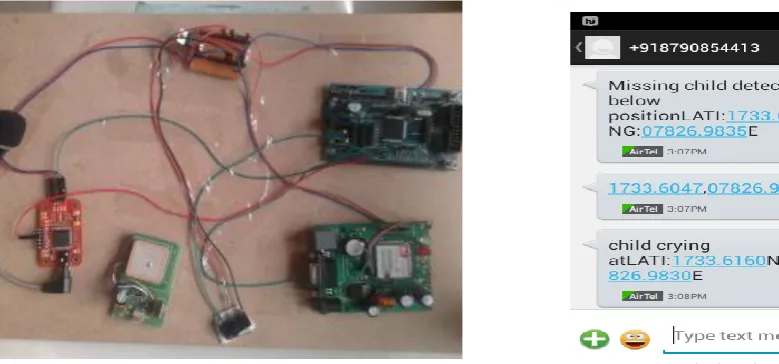
Fig 4.1 Kit Arrangement of Child Module. Fig 4.2 Message Displayed In Parent’s Mobile.
© 2015, IJCSMC All Rights Reserved 234
Fig.4.3Arrangement at School module Fig.4.4 Msg Displayed when RFID Tag is read
i
Above figure shows the output displayed when ever RFID Tag is kept near the Reader.If it is a valid card then a msg will be sent to the coresponding parent that your child is entered the school. The same card when swiped twice means whenever the child has left the school,again a msg will be sent to the parent that your child has left the school.
Fig.4.5 Output when Valid RFID card is used Fig.4.6 Excel Sheet at School database
V. CONCLUSION
© 2015, IJCSMC All Rights Reserved 235
R
EFERENCES[1] Yuichiro MORI, Hideharu KOJIMA, Eitaro KOHNO,Shinji INOUE, Tomoyuki OHTA, and Yoshiaki KAKUDA, “A Self-Configurable New Generation Children Tracking System based on Mobile Ad Hoc Networks Consisting of Android Mobile Terminals” proposed in 2011 tenth International symposium on Autonomous decentralized systems. W.-K. Chen, Linear Networks and Systems (Book style). Belmont, CA: Wadsworth, 1993, pp. 123–135.
[2] Eitaro Kohno, Tomoyuki Ohta ,Yoshiaki KAKUDA ,Shinji Inoue and yusuke Akiyama, “Performance Improvement of hiroshima city children tracking system by correction of wrong registrations on school routes” Proc. 9th IEEE International Symposium on Autonomous Decentralized Systems (ISADS 2009), Athens, Greece, pp.261-265, 2009.
[3] Lijun Jiang, Lim Nam Hoe, Lay Leong Loon, “Integrated UWB and GPS Location Sensing System in Hospital Environment”, proposed in 2010 5th IEEE conference on Industrial Electronics and Applicationsis
[4] Peng Wang, Zhiwen Zhao, Chongbin Xu, Zushun Wu, Yi Luo,” Design and Implementation of the Low-Power tracking System Based on GPSGPRS Module” proposed in 2010 5th IEEE conference on Industrial Electronics and Applicationsis. [5] Tomoyuki Ohta, Shinji Inoue, Yoshiaki Kakuda, and Kenji Ishida, “An adaptive multihop clustering scheme for ad hoc networks with high mobility,” IEICE Transactions on Fundamentals of Electronics, Communications and Computer Sciences (Special Issue on Multidimensional Mobile Information Networks), vol.E86-A, no.7, pp.1689-1697, 2003.
M.NAVYA
Graduated(B.Tech) in Electronics and Communication Engineering from Jawaharlal Nehru Technological university and currently pursing M.Tech in Embedded Systems from Jawaharlal Nehru Technological University, Hyderabad, India. Interested in working on cloud server and power communication domains.