R E S E A R C H
Open Access
Cross-pose face recognition by integrating
regression iteration and interactive
subspace
Kefeng Li
*and Quanzhen Huang
Abstract
At present, the pose change of the face test sample is the main reason that affects the accuracy of face
recognition, and the design of cross-pose recognition algorithm is a technical problem to be solved. In this paper, a cross-pose face recognition algorithm which integrates the regression iterative method and the interactive
subspace method was proposed, and through the regression iteration, the target function converges rapidly and important characteristics of the sample were extracted. Then, the posture of cross-pose face image was estimated, and finally, the interactive subspace method was applied to judge the similarity of the human face. The
experimental results of FERET face database (± 45°and ± 90° posture) and MIT-CBCL face database (N-fold cross-validation) showed that the proposed RIM-ISM algorithm had a higher recognition rate and robustness, and it could effectively solve the difficulty of cross-pose face recognition.
Keywords:Regression iterative method (RIM), Cross-pose face recognition, Pose estimation, Interactive subspace method (ISM) , N-fold cross-validation
1 Introduction
The cross-pose face recognition problem is caused by texture changes brought by the rotation transformation of the face. When face pose change is bigger, and within-cluster variation is greater than inter-cluster vari-ation, the recognition rate will fell sharply. Therefore, cross-pose face recognition is an important research topic in recent years.
In order to solve the problem of cross-pose recogni-tion, there are two main research methods: the algo-rithms based on pose correction and feature-based algorithms. Pose correction method rotates the face image and fits it into a new image, and this synthesis method includes two types of face models based on 3D and 2D.Y. Taigman et al. proposed DeepFace [1]. First of all, 3D face alignment was used for face pose correction, and then face frontal was processed. Later, it was then fed into the convolutional neural network for feature ex-traction, using the classifier for face authentication. Masi et al. proposed pose-aware CNN models (PAMs) method
to deal with pose changes for large pose changes [2]. The method uses a convolutional neural network to learn a specific multi-pose model and converts the multi-pose image to the learned model. Zhu et al. de-signed a new multi-view sensor, which can separate pose and sample information by using different neurons in the network and reconstruct various pose images of a single 2D image [3]. M. Kan et al. designed a stacked progressive auto-encoders (SPAE) neural network model to achieve nonlinear modeling of posture changes in a small-scale data [4]. J. Yim et al. designed a deep neural network based on multi-task learning, the network can achieve any pose and any illumination face rotated to the designated face pose and normal illumination. Feature-based methods are to extract face features which are robust to pose for face recognition [5]. Y. Sun pro-posed DeepID network structure, which considered local and global characteristics simultaneously, and intro-duced a larger data set for model training [6]. Florian Schroff et al. proposed FaceNet framework to directly learn the coding method from image to Euclidean space, and then conduct face recognition, face verification and face clustering on basis of this coding [7]. Omkar M.
© The Author(s). 2019Open AccessThis article is distributed under the terms of the Creative Commons Attribution 4.0 International License (http://creativecommons.org/licenses/by/4.0/), which permits unrestricted use, distribution, and reproduction in any medium, provided you give appropriate credit to the original author(s) and the source, provide a link to the Creative Commons license, and indicate if changes were made.
* Correspondence:[email protected]
Parkhi applied the deep network VGG to face recognition task. This network structure is implemented by a 16-layer convolutional neural network and a three-layer fully con-nected layer, and it has been tested in LFW and YouTube Faces database and achieved a better recognition effect [8]. Recently, cross-pose recognition methods based on features such as scale-invariant feature transform (SIFT) [9], LBP [10], and Gabor [11] have achieved good recogni-tion effects under controlled condirecogni-tions and partially un-constrained conditions.
Based on the study of these two kinds of methods, and through combining regression iterative method with interactive subspace method, this study designed a RIM-ISM cross-pose recognition algorithm: first of all, the regression iteration method was adopted to regress cross-pose face shape to the location close to the real shape and detect important characteristics of the sample. Secondly, the deflection angle of the 2D face image cor-responding to the 3D rectangular coordinate system was calculated in the 2D plane and the pose correction was carried out. Finally, the similarity of cross-pose facial image was measured by using the interactive subspace method. In order to verify the effectiveness of RIM-ISM algorithm, large-scale experiments were conducted in the FERET database and the MIT-CBCL database. Com-pared with other algorithms, the experimental results show that the proposed RIM-ISM cross-pose face recog-nition algorithm had great advantages.
2 Methodology
2.1 Extraction of important characteristics
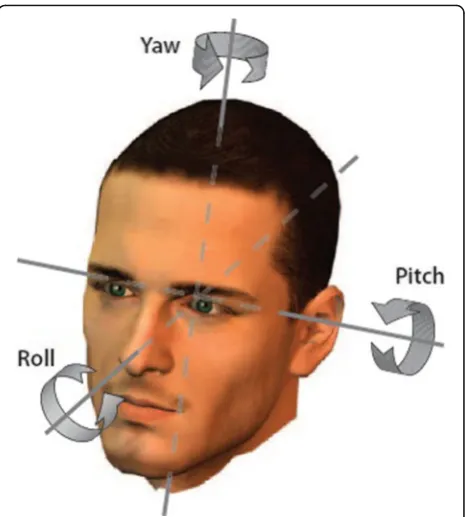
Cross-pose face recognition is to recognize or identify faces of any pose in an image. The human face is a 3D structure, and the face pose can change in the three di-mensions (X,Y, and Z), as shown in Fig.1. Pitch =θx ro-tates around X-axis, yaw =θy rotates around Y-axis horizontally, and roll =θzrotates aroundZ-axis plane.
The position of key feature points changes due to the change of pose, and the regression iterative method was adopted in this paper to deal with the change. The basic principle of regression iterative method is to provide an initial shape for a given face image, and through constant iterations, the initial shape is regressed to the position which is close to or equal to that of the real shape, and then obtains a series of downward directions and the di-rections on the scale, so as to make the target function converge to the minimum value quickly through studying, which improves the running speed of the program.
Given a face image containing m pixels, x∈Rm× 1, d(x)∈Rp× 1 represent p important characteristics of the sample, andh(·) represents a nonlinear characteristic ex-traction function. Then, on the basis of a given initial shapex0, regression iterative method was used to regress
x0to the correct shape x*of the face, that is, to solveΔx which minimizedf(x0+Δx) in Formula (1):
f xð 0þΔxÞ ¼kh d xð ð 0þΔxÞÞ−ϕk22 ð1Þ
Where ϕ∗=h(d(x∗)) is SIFT characteristics obtained from the real feature points of the face. The objective function was expanded by Taylor expansion as follows:
f xð 0þΔxÞ≈ f xð Þ þ0 Jfð Þx0 TΔxþ
1
2ΔxH xð Þ0 Δx
ð2Þ
Where, Jf(x0) is Jacobian matrix, H(x0) is Hessian matrix, and Formula (2) solved the derivative ofΔx:
Δx¼−H−1ð Þx0 Jfð Þ ¼x0 −2H−1JThðϕk−1−ϕÞ ð3Þ
Where Δx=xk−xk−1, Jh is Jacobian matrix, and
ϕk−1=h(d(xk−1)) the feature vector extracted from face feature point xk−1. The regression iterative method was applied to solve the optimization problem of Formula (1). The optimal solution could be obtained by solving Formula (3), and Formula (3) could be rewritten as the re-gression iterative formula:
Δx¼Rk−1ϕk−1þbk−1 ð4Þ
WhereRk−1is the gradient optimization direction,bk−1 is the average deviation parameter, and Rk−1 and bk−1 could be obtained directly through training and learning. The regression iterative method could be used to detect
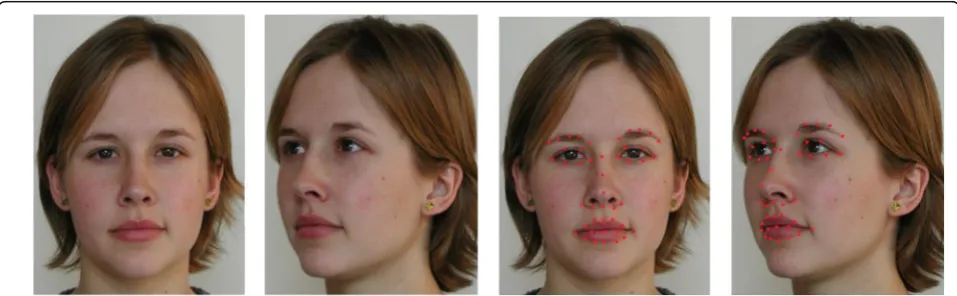
the important characteristics of the sample in real time and extract the eyes, mouth, nose, and other important characteristic positions of the sample. At last, a total of 45 pairs of important characteristics were detected, as shown in Fig.2.
2.2 Estimation of pose deflection
Face pose deflection estimation is to calculate the deflec-tion angle (θx,θy,θz) of the 2D face image corresponding to the 3D rectangular coordinate system in the 2D plane, extract the important characteristics (eyes, nose, mouth, etc.) of the face image, and then determine the feature cor-respondence between the 3D model and the 2D model.
The multi-pose sample image was defined as IQ, and pi(xi,yi)i= 1, 2,…, 45 is an important characteristic of the sample detected by the regression iterative method, as shown in Fig.2c–d. According to the perspective pro-jection principle of the camera, the corresponding rela-tionship between the key feature point P of the 3D model and the key feature point p of the current face imageIQcould be obtained as follows:
pTi;PTi
¼ðxi;yi;Xi;Yi;ZiÞT ð5Þ
The mapping relation between important characteris-tics from the 2D model to the 3D model was defined as CQ, thus:
CQ¼AQ RQtQ
p¼CQP ð6Þ
Where AQis the camera’s internal parameter mapping matrix,tQ is the translation mapping matrix, and RQis the rotation mapping matrix. RQ contains the attitude information of the image to be recognized, and its map-ping relation is
Formula (5), (6), and (7) can determine the pose of the face image IQ to be recognized, that is, the deflection angle (θx,θy,θz) of the 2D face image in the 3D coordin-ate system. The rotation matrix can be expressed as
Rxð Þ ¼θx
The rotation mapping matrixRQcan be expressed as
RQ¼Rzð Þθz Ry θy Rxð Þθx ð11Þ
Formula (8) to (11) can be used to calculate the deflec-tion angle (θx,θy,θz), respectively. The calculation
for-2.3 Determination of face similarity
After the face deflection angle was estimated, the cross-pose face image was rotated to correct the pose, so
(a)
Frontal face to be identified(b)
-45°face to be identified(c)
Frontal face key feature points(d)
- 45 °key feature pointsas to fit the approximate positive attitude image and es-tablish the subspaceG after pose correction, and vector g∈G. The reference subspace of frontal face was defined asD, vector d∈D; through calculating the similarity be-tween two subspaces, it determined whether the two subspaces were the same category. Subspace method was usually used as the similarity criterion through com-puting two subspace cosine of the angleθ, namely,
cosθ¼S gð Þ ¼ 1 g
k k2
XN
n¼1
g;φn
ð Þ2 ð
15Þ
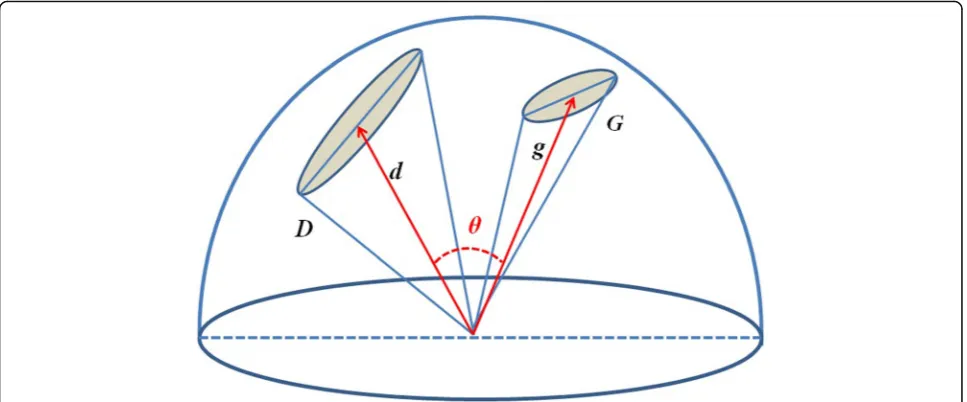
Whereφnis the eigenvector ofD, andNis the dimen-sion ofD. In order to avoid the interference brought by artificial selection of reference subspace, and improve the stability of the similarity between samples, this paper adopted the interactive subspace method (ISM) to meas-ure the similarity between cross-pose face images: one subspace was used as the input subspace, and the other subspace was used as a reference subspace. Then the subspace method calculation was conducted for two times, and the two new spatial vectors were obtained. Later, the included angle between the two new vectorsθ was calculated, and the principle was shown in Fig.3.
The calculation formula is as follows:
cos2θ¼ sup
d∈D;g∈G;k kd≠0;k kg ≠0
d;g
ð Þ
j j2
d
k k2
g
k k2 ð16Þ
Formula (16) has a local maximum value, so matrix P and Qwere defined as the orthogonal projection matrix of subspaceDandG, and the value of cosθcould be ob-tained by calculating the maximum value λmax of the eigenvalue of matrixPQP, namely:
cosθ¼λmax ð17Þ
Through using the interactive subspace method, the eigenvalue problem of calculating high-dimensional matrix PQPwas transformed into calculating the eigen-value of a low-dimensional matrix, and let the matrixXbe
X¼ xij ¼
XN
n¼1 ρi;φn
φn;ρj
ð18Þ
Whereρjis the eigenvector ofG,Lis the dimensions of G(L≤N), and the matrixXcould be decomposed into
WTXW ¼Λ ð19Þ
Where the diagonal value of the matrix Λ is the eigen-value ofX, and the maximum eigenvalueλmaxwas selected to evaluate the similarity betweenDandG:
SISMðD;GÞ ¼λmax ð20Þ
According to Formula (17), 0≤SISM≤1, if SISM is closer to 1, the greater the similarity between the two samples will be, and the greater the possibility that the face image it represents is the same person. On the con-trary, ifSISMis closer to 0, the greater the difference be-tween the two samples will be, and the face image it represents cannot be the same person.
3 Experiments
3.1 FERET database cross-pose recognition experiment
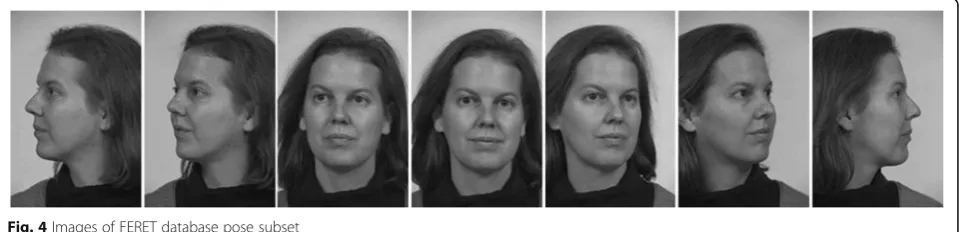
In order to verify the cross-pose face recognition perform-ance of the proposed method, an experiment was con-ducted on FERET database, which was created by the FERET project of the U.S. military. It contains 14,051 cross-pose, multi-illumination grayscale face images. The
database contains subsets for different orientations. Fig-ure4shows an example of the images of FERET database posture subset.
Using the“leave-one-out”cross-validation method, the RIM-ISM method was compared with the three methods of DeepFace, SIFT, and Gabor, and a face image in the database was removed and used as test data, and the remaining images were used for training.
The experiment was repeated until all the images were tested again. Although the calculation was tedious, the sample utilization rate was the highest, so it was suitable for small samples.
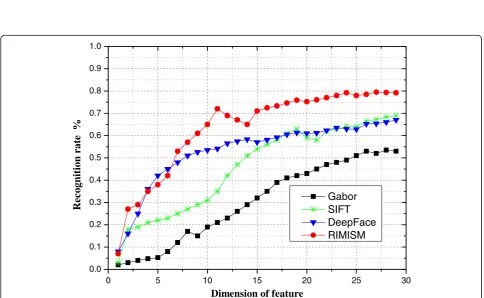
We chose face image of ± 45°and ± 90°with a larger difficulty to test, and the experimental data were shown in Figs.5and6.
3.2 N-fold cross-validation
In order to test the robustness and recognition efficiency of the RIM-ISM algorithm, N-fold cross-validation was performed in MIT-CBCL face database. The N-fold cross-validation randomly divided the sample data into N parts and selected one of them as the test sample set and N-1 parts as the training sample set. The cross-validation was repeated for N times, and each sub-sample was verified once, and the average result of N times was the estimation of the final single sample. The advantage of this test method is that it can ran-domly select generated sub-samples repeatedly for train-ing and verification, so as to verify the robustness of face recognition algorithm in the face of random samples. At this time, the obtained average recognition rate and average recognition time had a more scientific statistical significance [12].
MIT-CBCL face database consisted of 10 people, and 200 images were collected from each of them, so there are a total of 2000 images. The sample image contained a large range of continuous pose changes, lighting and expression changes, in which the pose changes included horizontal pose changes and pitch angle changes. Fig-ure 7 shows an example of MIT-CBCL face database pose change image.
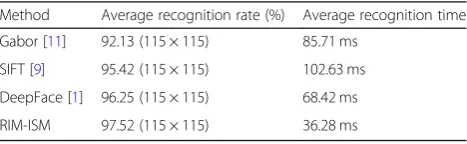
The MIT-CBCL database was randomly divided into 10 parts, and each part contained 1 pose change image of each person. Therefore, each group was composed of 10 images, and each image corresponded to a different person. A 10-fold cross-validation test was conducted. In each experimental operation, 9 groups (90 images in total) were used as the training samples, and 1 group (10 images in total) was reserved as the test samples. The experimental data was shown in Table1, showing the ef-ficiency comparison of the RIM-ISM method with the DeepFace, SIFT, and Gabor methods.
4 Results and discussion
The data in Figs.5and 6showed that when the samples’ characteristic dimensions were relatively low, the RIM-ISM algorithm is close to the recognition rate of DeepFace algorithm. With the increase of the samples’ characteristic dimensions, the RIM-ISM algorithm had a higher accuracy than DeepFace, SIFT, and Gabor method. In the experiment of ± 45° pose change, the recognition rate was up to 97.1%, and in the experiment of ± 90° pose change, the recognition rate was up to 79.3%, which were higher than the performance of the other three methods in the same condition. The recognition rate in Fig.5was significantly higher than that in Fig.6, indicating that the difficulty of face recognition increased with the increase of pose deflection angle. Since the pose of the test samples was changed from ± 45 to ± 90°, the extraction of key fea-ture points were insufficient, and the 45 pairs of feafea-ture points were reduced to 19 pairs, resulting in the calcula-tion deviacalcula-tion of the three defleccalcula-tion angles in face pose deflection estimation. When using ISM to determine the similarity between cross-pose face images, the accuracy was greatly reduced.
As can be seen from the data in Table 1, for random multi-pose face samples, the RIM-ISM method proposed in this paper could achieve an average recognition rate of 97.52% in the 10-fold cross-validation test, which was higher than DeepFace, SIFT, and Gabor method. In this experiment, the average recognition time of a single test sample was 36.28 ms, which was far lower than that of
0 5 10 15 20 25 30 0.0
0.1 0.2 0.3 0.4 0.5 0.6 0.7 0.8 0.9 1.0
et
ar
n
oi
ti
n
g
oc
e
R
Dimension of feature
Gabor SIFT DeepFace RIMISM
Fig. 5Average recognition rate of ± 45° pose of FERET database
0 5 10 15 20 25 30
0.0 0.1 0.2 0.3 0.4 0.5 0.6 0.7 0.8 0.9 1.0
et
ar
n
oi
ti
n
g
oc
e
R
Dimension of feature
Gabor SIFT DeepFace RIMISM
the other three methods. There were two main reasons for the high efficiency of the RIM-ISM method:
(1) Through constant iterations, learning a series of decreasing directions and scales in that direction, the initial shape was regressed to the position which was close to or equal to that of the real shape, so as to make the objective function converge to the minimum value at a very fast speed. Therefore, it avoided the problem of solving the Jacobian matrix and Hessian matrix, improved the running speed of the algorithm, and simplified the complexity of the algorithm.
(2) Through using the interactive subspace method, the eigenvalue problem of high-dimensional matrix was transformed into the eigenvalue of a low-dimensional matrix, which greatly reduced the computation and improved the recognition efficiency.
To sum up, the RIM-ISM algorithm had strong ro-bustness and higher recognition efficiency when dealing with random cross-pose samples.
5 Conclusion
Aiming at the problem of pose change recognition in face recognition technology, this paper proposed a cross-pose face recognition method based on regression iterative method and interactive subspace method.
Through the regression iteration, the target function converges rapidly, and 45 pairs of important characteris-tic positions such as eyes, mouth, and nose of the target face sample were extracted. Later, the pose correction was carried out by solving the pose deflection angle of the cross-pose face image. Finally, the similarity of cross-pose face image was measured by using the inter-active subspace method. The cross-pose recognition ex-periments in FERET database and MIT-CBCL database indicated that the RIM-ISM method proposed in this paper had a higher recognition accuracy, and it simpli-fied the computation complexity. Meanwhile, it had a strong robustness in dealing with face samples with large angle pose changes.
Abbreviations
ISM:Interactive subspace method; MVP: Multi-view perceptron; PAMs: Pose-aware CNN models; RIM: Regression iterative method; SIFT: Scale-invariant feature transform; SPAE: Stacked progressive auto-encoders
Acknowledgements
This research had received support from the Science and Technology Department of Henan Province.
Funding
The authors acknowledge the National Natural Science Foundation of China-Henan Joint Fund (Grant: U1804162), the Henan Province Science and Technology Project (Grant: 192102310180).
Availability of data and materials
Not applicable.
Authors’contributions
LKF is the main writer of this paper. He completed the derivation process of RIM-ISM cross-pose face recognition algorithm, completed the simulation in FERET database and MIT-CBCL database, and analyzed the experimental re-sult. HQZ provided some important suggestions for face pose estimation and experimental methods. Both authors read and approved the final manuscript.
Competing interests
The authors declare that they have no competing interests.
Fig. 7Pose change face image of MIT-CBCL database
Table 110-fold cross-validation comparison of MIT-CBCL database
Method Average recognition rate (%) Average recognition time
Gabor [11] 92.13 (115 × 115) 85.71 ms
SIFT [9] 95.42 (115 × 115) 102.63 ms
DeepFace [1] 96.25 (115 × 115) 68.42 ms
RIM-ISM 97.52 (115 × 115) 36.28 ms
Publisher’s Note
Springer Nature remains neutral with regard to jurisdictional claims in published maps and institutional affiliations.
Received: 19 February 2019 Accepted: 10 April 2019
References
1. Y. Taigman, M. Yang, M. Ranzato, inComputer Vision and Pattern Recognition (CVPR), 2014 IEEE Conference.. DeepFace: Closing the gap to human-level performance in face verification (Columbus, 2014), pp. 1701–1708 2. I. Masi, S. Rawls, G. Medioni, inComputer Vision and Pattern Recognition
(CVPR), 2016 IEEE Conference. Pose-aware face recognition in the wild (Las Vegas, 2016), pp. 4838–4846
3. Z. Zhu, P. Luo, X. Wang, inthe 27th International Conference on Neural Information Processing Systems. Multi-view perceptron: a deep model for learning face identity and view representations (Cambridge, 2014), pp. 217–225
4. M. Kan, S. Shan, H. Chang, inComputer Vision and Pattern Recognition(CVPR), 2014 IEEE Conference. Stacked Progressive -Encoders (SPAE) for face recognition across poses (Columbus, 2014), pp. 1883–1890
5. J. Yim, H. Jung, B.I. Yoo, inComputer Vision and Pattern Recognition (CVPR), 2015 IEEE Conference. Rotating your face using multi-task deep neural network (Boston, 2015), pp. 676–684
6. Y. Sun, X. Wang, X. Tang, inComputer vision and pattern recognition (CVPR), 2014 IEEE Conference. Deep learning face representation from predicting 10,000 classes (2014), pp. 1891–1898
7. F. Schroff, D. Kalenichenko, J. Philbin, inComputer Vision and Pattern Recognition (CVPR), 2015 IEEE Conference. FaceNet: A unified embedding for face recognition and clustering (Boston, 2015), pp. 815–823
8. O.M. Parkhi, A. Vedaldi, A. Zisserman, inBritish Machine Vision Conference. Deep face recognition, vol 171 (2015), pp. 1–171 12
9. L. Wu, Z. Peng, Y. Hou, et al., Complete pose binary SIFT for face recognition with pose variation. Chin. J. Sci. Instrum.36(4), 736–742 (2015)
10. C. Li, W. Wei, J. Li, et al., A cloud-based monitoring system via face recognition using Gabor and CS-LBP features. J. Supercomput.73(4), 1532–1546 (2017) 11. B.S. Oh, K.A. Toh, A. Teoh, et al., An analytic Gabor feedforward network for
single-sample and pose-invariant face recognition. IEEE Trans. Image Process.27(6), 2791–2805 (2018)